Educational Psychology Childhood and Adolescent Development
Preschool Development Physical Development Gross & Fine motor development 2 yrs- walk, climb 3 yrs-run, stack blocks 4 yrs-run with rhythm, skip, jump, draw shapes 5 yrs-balance, stand on one foot, buttons, eating utensils, may be able to tie shoes
Preschool Development Cognitive Development   Language Acquisition- Oral Vocabulary & rules Language Acquisition-Reading Emergent literacy Phonemic awareness Concept of print Language Acquisition- Writing Print discrimination Invented spelling
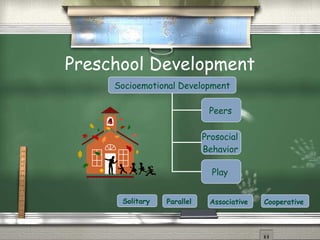
Preschool Development Socioemotional Development Peers   Prosocial  Behavior   Play  Parallel   Cooperative   Associative  Solitary
Kinds of Early Childhood Programs Day Care Programs   2.   Preschools   3.   Compensatory Programs:  Head Start   4.   Early Intervention Programs 5.   Kindergarten Programs   6.   Developmentally Appropriate Practice
Development During the Elementary Years Physical Slows in the Primary Years Bone and Skeletal Development “Growing Pains” Near the end of 4 th  grade, girls begin growth spurt that continues until puberty Boys are 1 to 1 ½ years behind girls
Development During the Elementary Years Cognitive Transition from Pre-Operational to Concrete Operational Form concepts, see relationships & solve problems as long as they involve familiar objects and situations Draw inferences Seriation Transivity Class inclusion Metacognition
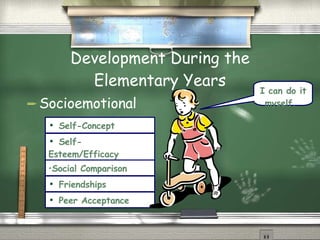
Development During the Elementary Years Socioemotional Self-Concept Self-Esteem/Efficacy   Social Comparison   Peer Acceptance   Friendships   I can do it myself.
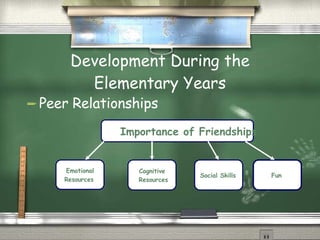
Development During the Elementary Years Peer Relationships Importance of Friendships   Emotional Resources   Cognitive Resources Social Skills   Fun
Middle and High School Development “ If all the world’s the stage that Shakespeare claimed, children and adolescents are playing primarily to an audience of peers.  Their peers sit in the front rows and the box seats; parents and teachers are now relegated to the back rows and the balcony.”  (J. Gordon, 2005, p. 166)
Middle School & High School Development Physical Development Puberty- 2-6 years Girls 1-2 years earlier than boys “raging hormones” Comparisons Early maturation can lead to behavioral problems Late maturation can lead to issues of self-esteem
Middle School & High School Development Cognitive Development Intellectual Growth spurt?  Plateau effect? Transition from Concrete to Formal Operations
Formal Operational Thinking Adolescents gain the ability to think about things without the necessity to see a physical representation of the concept they are addressing  Abstract thought becomes a reality.
Formal Operational Thinking Hypothetico-deductive reasoning is the capacity to think of all possible factors that might affect the outcome of a problem and test them in an orderly fashion Start with a theory of the factors affecting the outcome on a problem Deduce predictions about what might happen Test the hypotheses Contrast to Concrete Operational thinkers who can only operate on reality before them.
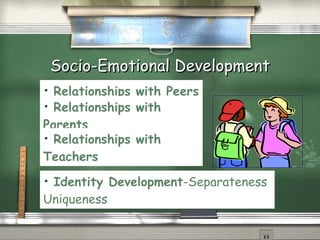
Socio-Emotional Development Relationships with Peers Relationships with Parents Relationships with Teachers Identity Development -Separateness Uniqueness
Middle and High School Development Marcia’s Four Identity Statues   Foreclosure Identity  Diffusion   Moratorium   Identity Achievement
Middle and High School Development Social Relationships   Importance of Peers Increases Independent Identities from Parents   Peer Acceptance   Social Status
Middle and High School Development Self-Concept and   Self-Esteem   More Abstract Portrayals   Differentiated   Self-Concept   Fluctuations
Middle and High School Development Emotional Problems are related to:  Physical, Cognitive,  and Social Development Copyright © Allyn & Bacon 2006
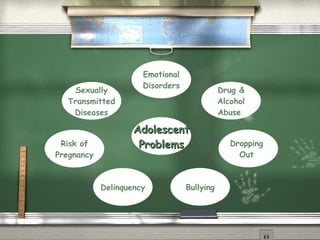
Sexually Transmitted Diseases Risk of Pregnancy Delinquency Bullying Dropping  Out  Drug & Alcohol Abuse  Emotional Disorders Adolescent Problems

Childhood And Adolescent Development2007

  • 1.
    Educational Psychology Childhoodand Adolescent Development
  • 2.
    Preschool Development PhysicalDevelopment Gross & Fine motor development 2 yrs- walk, climb 3 yrs-run, stack blocks 4 yrs-run with rhythm, skip, jump, draw shapes 5 yrs-balance, stand on one foot, buttons, eating utensils, may be able to tie shoes
  • 3.
    Preschool Development CognitiveDevelopment Language Acquisition- Oral Vocabulary & rules Language Acquisition-Reading Emergent literacy Phonemic awareness Concept of print Language Acquisition- Writing Print discrimination Invented spelling
  • 4.
    Preschool Development SocioemotionalDevelopment Peers Prosocial Behavior Play Parallel Cooperative Associative Solitary
  • 5.
    Kinds of EarlyChildhood Programs Day Care Programs 2. Preschools 3. Compensatory Programs: Head Start 4. Early Intervention Programs 5. Kindergarten Programs 6. Developmentally Appropriate Practice
  • 6.
    Development During theElementary Years Physical Slows in the Primary Years Bone and Skeletal Development “Growing Pains” Near the end of 4 th grade, girls begin growth spurt that continues until puberty Boys are 1 to 1 ½ years behind girls
  • 7.
    Development During theElementary Years Cognitive Transition from Pre-Operational to Concrete Operational Form concepts, see relationships & solve problems as long as they involve familiar objects and situations Draw inferences Seriation Transivity Class inclusion Metacognition
  • 8.
    Development During theElementary Years Socioemotional Self-Concept Self-Esteem/Efficacy Social Comparison Peer Acceptance Friendships I can do it myself.
  • 9.
    Development During theElementary Years Peer Relationships Importance of Friendships Emotional Resources Cognitive Resources Social Skills Fun
  • 10.
    Middle and HighSchool Development “ If all the world’s the stage that Shakespeare claimed, children and adolescents are playing primarily to an audience of peers. Their peers sit in the front rows and the box seats; parents and teachers are now relegated to the back rows and the balcony.” (J. Gordon, 2005, p. 166)
  • 11.
    Middle School &High School Development Physical Development Puberty- 2-6 years Girls 1-2 years earlier than boys “raging hormones” Comparisons Early maturation can lead to behavioral problems Late maturation can lead to issues of self-esteem
  • 12.
    Middle School &High School Development Cognitive Development Intellectual Growth spurt? Plateau effect? Transition from Concrete to Formal Operations
  • 13.
    Formal Operational ThinkingAdolescents gain the ability to think about things without the necessity to see a physical representation of the concept they are addressing Abstract thought becomes a reality.
  • 14.
    Formal Operational ThinkingHypothetico-deductive reasoning is the capacity to think of all possible factors that might affect the outcome of a problem and test them in an orderly fashion Start with a theory of the factors affecting the outcome on a problem Deduce predictions about what might happen Test the hypotheses Contrast to Concrete Operational thinkers who can only operate on reality before them.
  • 15.
    Socio-Emotional Development Relationshipswith Peers Relationships with Parents Relationships with Teachers Identity Development -Separateness Uniqueness
  • 16.
    Middle and HighSchool Development Marcia’s Four Identity Statues Foreclosure Identity Diffusion Moratorium Identity Achievement
  • 17.
    Middle and HighSchool Development Social Relationships Importance of Peers Increases Independent Identities from Parents Peer Acceptance Social Status
  • 18.
    Middle and HighSchool Development Self-Concept and Self-Esteem More Abstract Portrayals Differentiated Self-Concept Fluctuations
  • 19.
    Middle and HighSchool Development Emotional Problems are related to: Physical, Cognitive, and Social Development Copyright © Allyn & Bacon 2006
  • 20.
    Sexually Transmitted DiseasesRisk of Pregnancy Delinquency Bullying Dropping Out Drug & Alcohol Abuse Emotional Disorders Adolescent Problems