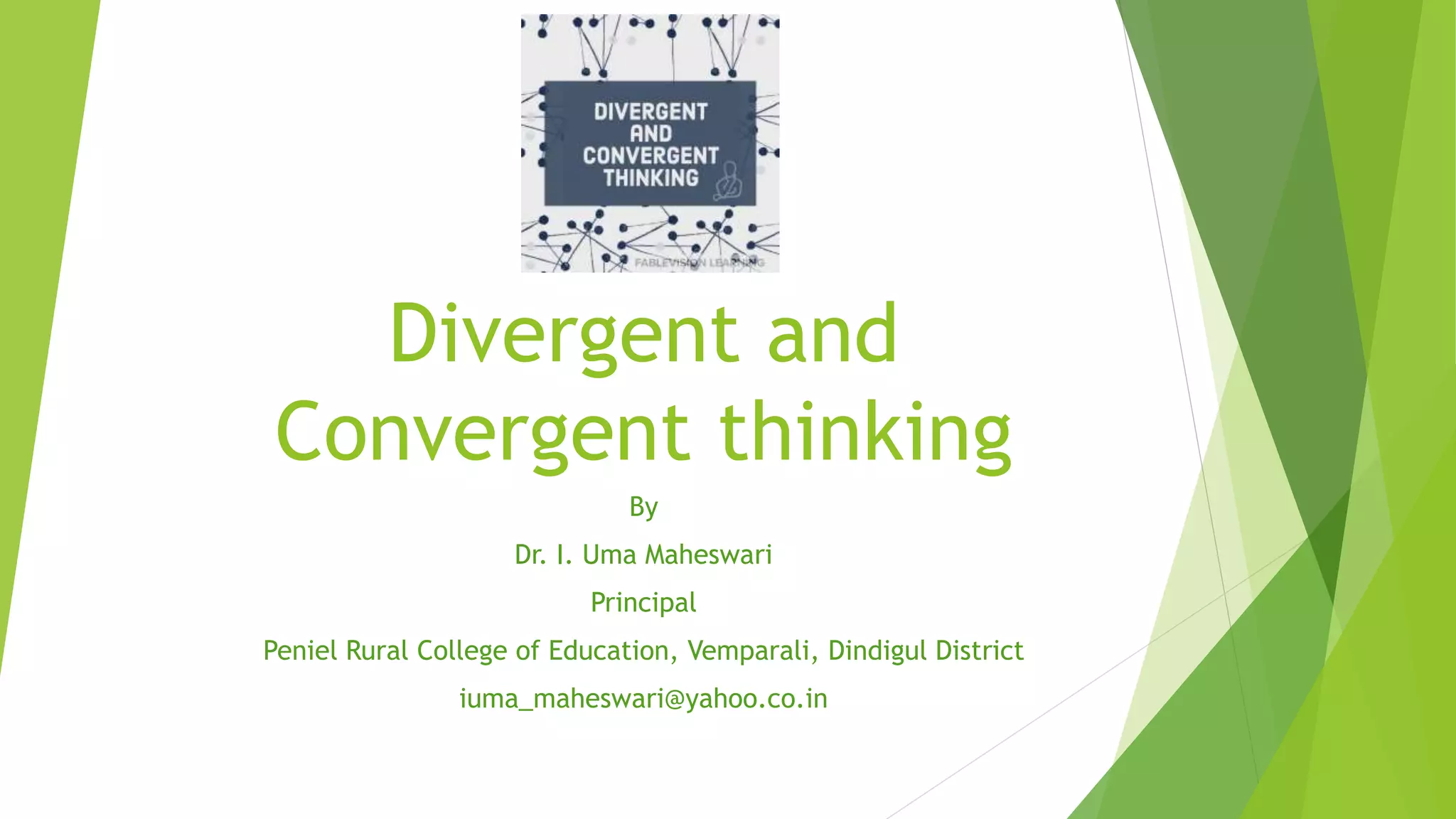
Divergent and
Convergent thinking
By
Dr. I. Uma Maheswari
Principal
Peniel Rural College of Education, Vemparali, Dindigul District
iuma_maheswari@yahoo.co.in
Introduction
 The American psychologist Joy Paul Guilford (1897-1987)
introduced the terms divergent and convergent thinking in 1946
 The divergent and convergent thinking are two natural forms of
thinking
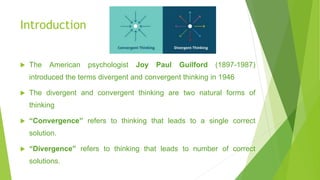
 “Convergence” refers to thinking that leads to a single correct
solution.
 “Divergence” refers to thinking that leads to number of correct
solutions.
Definitions
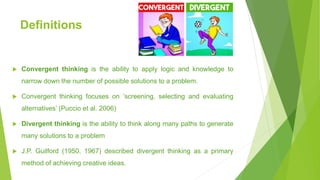
 Convergent thinking is the ability to apply logic and knowledge to
narrow down the number of possible solutions to a problem.
 Convergent thinking focuses on ‘screening, selecting and evaluating
alternatives’ (Puccio et al. 2006)
 Divergent thinking is the ability to think along many paths to generate
many solutions to a problem
 J.P. Guilford (1950, 1967) described divergent thinking as a primary
method of achieving creative ideas.
Convergence and divergence
 Convergence means bringing together and moving toward
one point. Divergence means developing in different
directions.
 A “converger” would tend to prefer convergent problem
solving techniques while a “diverger” would tend to favour
divergent problem solving techniques.
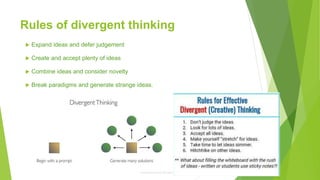
Rules of divergent thinking
 Expand ideas and defer judgement
 Create and accept plenty of ideas
 Combine ideas and consider novelty
 Break paradigms and generate strange ideas.
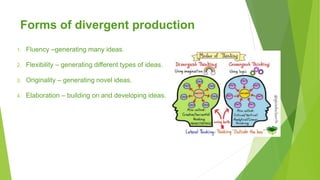
Forms of divergent production
1. Fluency –generating many ideas.
2. Flexibility – generating different types of ideas.
3. Originality – generating novel ideas.
4. Elaboration – building on and developing ideas.
Purpose of convergent thinking
 Convergent thinking emphasizes speed, accuracy, and logic and
focuses on recognizing the familiar, reapplying techniques, and
accumulating stored information.
 It is most effective in situations where an answer readily exists and
simply needs to be either recalled or worked out through decision
making strategies.
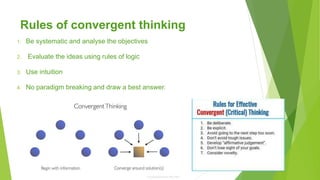
Rules of convergent thinking
1. Be systematic and analyse the objectives
2. Evaluate the ideas using rules of logic
3. Use intuition
4. No paradigm breaking and draw a best answer.
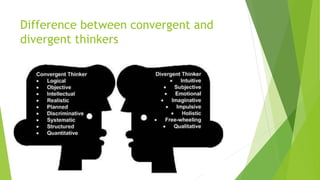
Difference between convergent and
divergent thinkers
Advantages
 Convergent and divergent thinking skills are both important to critical
thinking.
 Convergent and divergent thinking tools are extremely helpful when
making decisions.
 Creative achievement requires a complex combination of both divergent
and convergent thinking.
 Divergent thinking is the wellspring of invention.

Life skill - Divergent and convergent thinking

  • 1.
    Divergent and Convergent thinking By Dr.I. Uma Maheswari Principal Peniel Rural College of Education, Vemparali, Dindigul District iuma_maheswari@yahoo.co.in
  • 2.
    Introduction  The Americanpsychologist Joy Paul Guilford (1897-1987) introduced the terms divergent and convergent thinking in 1946  The divergent and convergent thinking are two natural forms of thinking  “Convergence” refers to thinking that leads to a single correct solution.  “Divergence” refers to thinking that leads to number of correct solutions.
  • 3.
    Definitions  Convergent thinkingis the ability to apply logic and knowledge to narrow down the number of possible solutions to a problem.  Convergent thinking focuses on ‘screening, selecting and evaluating alternatives’ (Puccio et al. 2006)  Divergent thinking is the ability to think along many paths to generate many solutions to a problem  J.P. Guilford (1950, 1967) described divergent thinking as a primary method of achieving creative ideas.
  • 4.
    Convergence and divergence Convergence means bringing together and moving toward one point. Divergence means developing in different directions.  A “converger” would tend to prefer convergent problem solving techniques while a “diverger” would tend to favour divergent problem solving techniques.
  • 5.
    Rules of divergentthinking  Expand ideas and defer judgement  Create and accept plenty of ideas  Combine ideas and consider novelty  Break paradigms and generate strange ideas.
  • 6.
    Forms of divergentproduction 1. Fluency –generating many ideas. 2. Flexibility – generating different types of ideas. 3. Originality – generating novel ideas. 4. Elaboration – building on and developing ideas.
  • 7.
    Purpose of convergentthinking  Convergent thinking emphasizes speed, accuracy, and logic and focuses on recognizing the familiar, reapplying techniques, and accumulating stored information.  It is most effective in situations where an answer readily exists and simply needs to be either recalled or worked out through decision making strategies.
  • 8.
    Rules of convergentthinking 1. Be systematic and analyse the objectives 2. Evaluate the ideas using rules of logic 3. Use intuition 4. No paradigm breaking and draw a best answer.
  • 9.
    Difference between convergentand divergent thinkers
  • 10.
    Advantages  Convergent anddivergent thinking skills are both important to critical thinking.  Convergent and divergent thinking tools are extremely helpful when making decisions.  Creative achievement requires a complex combination of both divergent and convergent thinking.  Divergent thinking is the wellspring of invention.