Convergent and DivergentThinking
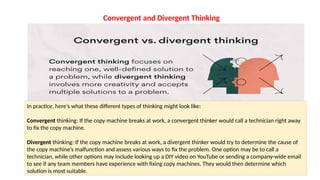
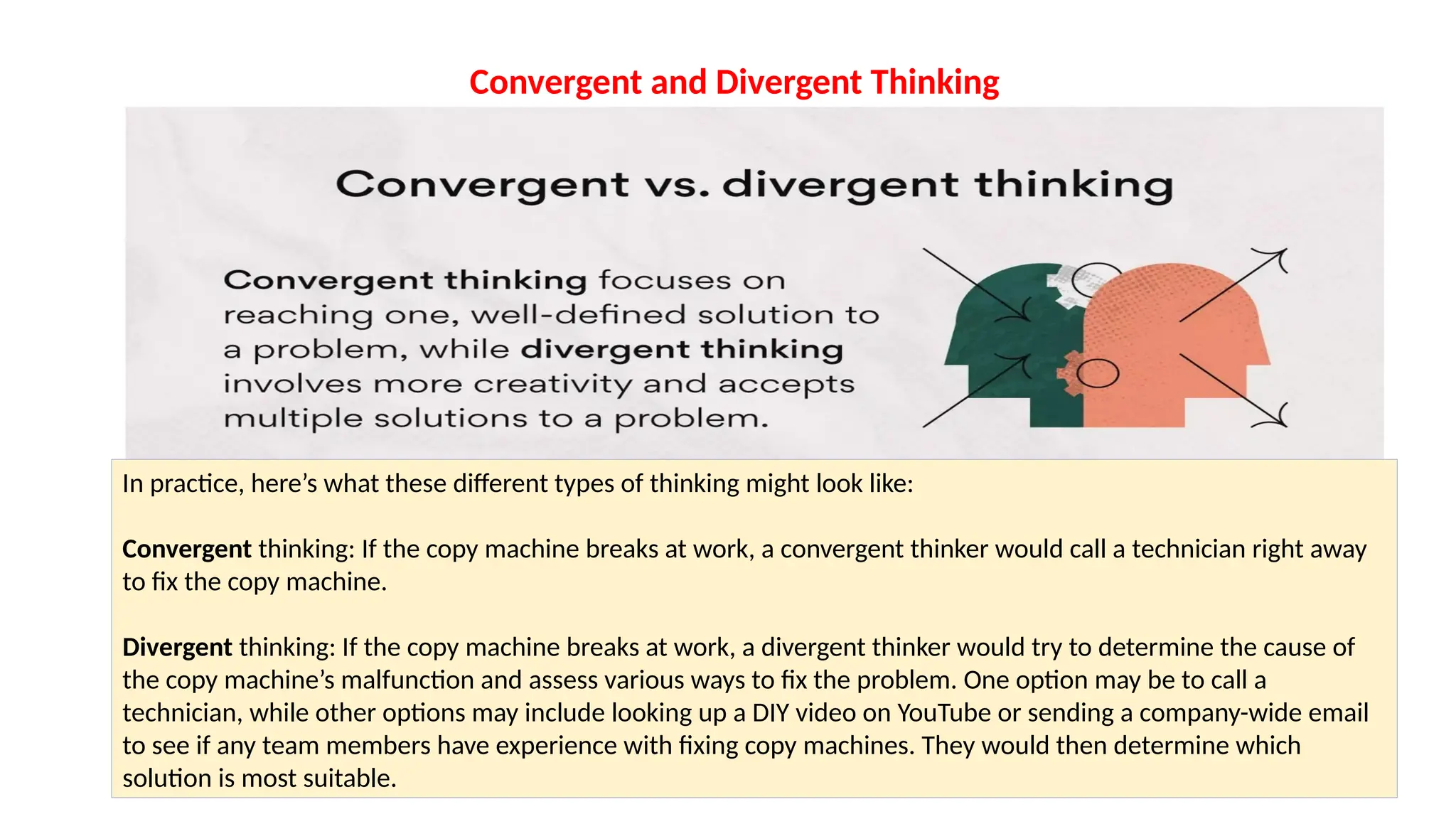
In practice, here’s what these different types of thinking might look like:
Convergent thinking: If the copy machine breaks at work, a convergent thinker would call a technician right away
to fix the copy machine.
Divergent thinking: If the copy machine breaks at work, a divergent thinker would try to determine the cause of
the copy machine’s malfunction and assess various ways to fix the problem. One option may be to call a
technician, while other options may include looking up a DIY video on YouTube or sending a company-wide email
to see if any team members have experience with fixing copy machines. They would then determine which
solution is most suitable.
Convergent and DivergentThinking
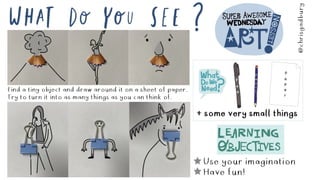
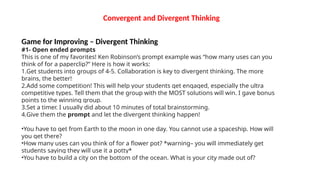
Game for Improving – Divergent Thinking
#1- Open ended prompts
This is one of my favorites! Ken Robinson’s prompt example was “how many uses can you
think of for a paperclip?” Here is how it works:
1.Get students into groups of 4-5. Collaboration is key to divergent thinking. The more
brains, the better!
2.Add some competition! This will help your students get engaged, especially the ultra
competitive types. Tell them that the group with the MOST solutions will win. I gave bonus
points to the winning group.
3.Set a timer. I usually did about 10 minutes of total brainstorming.
4.Give them the prompt and let the divergent thinking happen!
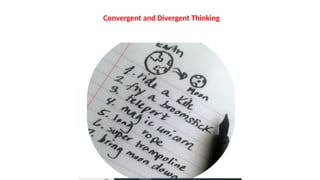
•You have to get from Earth to the moon in one day. You cannot use a spaceship. How will
you get there?
•How many uses can you think of for a flower pot? *warning– you will immediately get
students saying they will use it a potty*
•You have to build a city on the bottom of the ocean. What is your city made out of?
3. Lateral Thinking
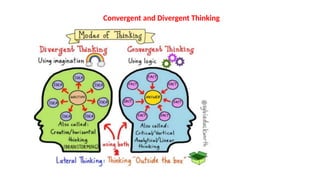
Summary:Using both Convergent and Divergent Thinking
Also called: ‘Thinking Outside the Box’
Wikipedia Excerpt & Overview
‘Lateral thinking is solving problems through an indirect
and creative approach, using reasoning that is not immediately obvious and
involving ideas that may not be obtainable by using only traditional step-by-
step logic.[1]
To understand lateral thinking, it is necessary to compare lateral thinking and
critical thinking. Critical thinking is primarily concerned with judging the truth
value of statements and seeking errors. Lateral thinking is more concerned
with the “movement value” of statements and ideas. A person uses lateral
thinking to move from one known idea to creating new ideas.’
Lateral Thinking


![3. Lateral Thinking
Summary: Using both Convergent and Divergent Thinking
Also called: ‘Thinking Outside the Box’
Wikipedia Excerpt & Overview
‘Lateral thinking is solving problems through an indirect
and creative approach, using reasoning that is not immediately obvious and
involving ideas that may not be obtainable by using only traditional step-by-
step logic.[1]
To understand lateral thinking, it is necessary to compare lateral thinking and
critical thinking. Critical thinking is primarily concerned with judging the truth
value of statements and seeking errors. Lateral thinking is more concerned
with the “movement value” of statements and ideas. A person uses lateral
thinking to move from one known idea to creating new ideas.’
Lateral Thinking](https://image.slidesharecdn.com/2convergentanddivergentthinking-250920163106-d459cd1d/85/2_Convergent-and-Divergent-Thinking-pptx-13-320.jpg)