THINKING
• Thinking is base of all cognitive activities
or processes
• Thinking is unique to human beings
• Involves manipulation and analysis of
information received from environment
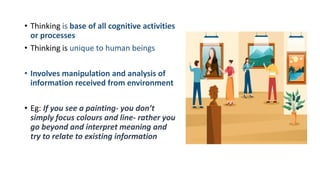
• Eg: If you see a painting- you don’t
simply focus colours and line- rather you
go beyond and interpret meaning and
try to relate to existing information
Thinking is a higher metal process through
which we manipulate and analyse the
acquired or existing information
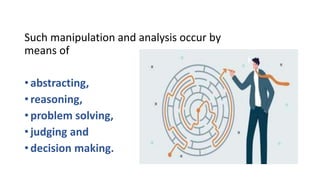
Such manipulation and analysis occur by
means of
• abstracting,
• reasoning,
• problem solving,
• judging and
• decision making.
• Thinking is organised and goal directed
• Thinking is an internal mental process
which can be inferred from overt
behaviour
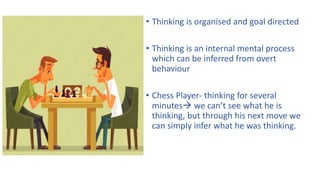
• Chess Player- thinking for several
minutes we can’t see what he is
thinking, but through his next move we
can simply infer what he was thinking.
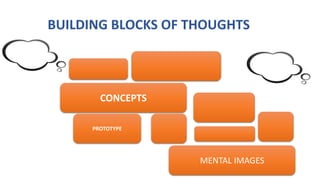
BUILDING BLOCKS OF THOUGHTS
MENTAL IMAGES
CONCEPTS
PROTOTYPE
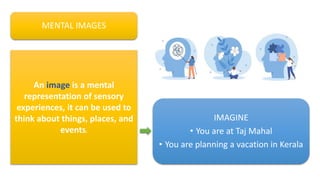
MENTAL IMAGES
An image is a mental
representation of sensory
experiences, it can be used to
think about things, places, and
events.
IMAGINE
• You are at Taj Mahal
• You are planning a vacation in Kerala
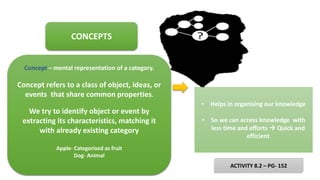
CONCEPTS
Concept – mental representation of a category.
Concept refers to a class of object, ideas, or
events that share common properties.
We try to identify object or event by
extracting its characteristics, matching it
with already existing category
Apple- Categorised as fruit
Dog- Animal
• Helps in organising our knowledge
• So we can access knowledge with
less time and efforts  Quick and
efficient
ACTIVITY 8.2 – PG- 152
PROTOTYPE
• Best representative member of category
• People decide whether an item is
member of a category by comparing it
with most typical item of the category
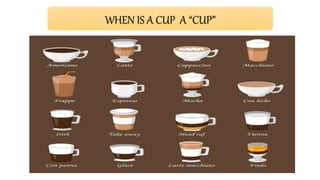
WHEN IS A CUP A “CUP”
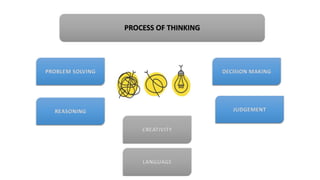
PROCESS OF THINKING
DECISION MAKING
REASONING
PROBLEM SOLVING
JUDGEMENT
CREATIVITY
LANGUAGE
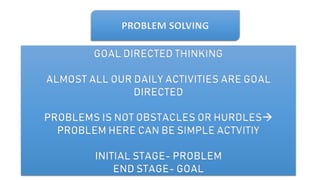
PROBLEM SOLVING
GOAL DIRECTED THINKING
ALMOST ALL OUR DAILY ACTIVITIES ARE GOAL
DIRECTED
PROBLEMS IS NOT OBSTACLES OR HURDLES
PROBLEM HERE CAN BE SIMPLE ACTVITIY
INITIAL STAGE- PROBLEM
END STAGE- GOAL
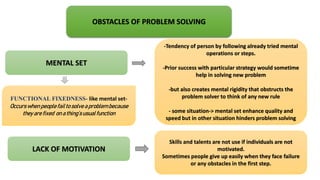
OBSTACLES OF PROBLEM SOLVING
MENTAL SET
LACK OF MOTIVATION
-Tendency of person by following already tried mental
operations or steps.
-Prior success with particular strategy would sometime
help in solving new problem
-but also creates mental rigidity that obstructs the
problem solver to think of any new rule
- some situation-> mental set enhance quality and
speed but in other situation hinders problem solving
FUNCTIONAL FIXEDNESS- like mental set-
Occurswhen peoplefailto solve aproblem because
they are fixed on a thing’susualfunction
Skills and talents are not use if individuals are not
motivated.
Sometimes people give up easily when they face failure
or any obstacles in the first step.
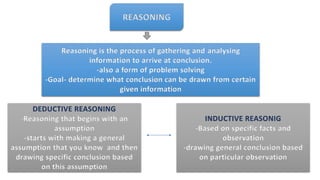
REASONING
Reasoning is the process of gathering and analysing
information to arrive at conclusion.
-also a form of problem solving
-Goal- determine what conclusion can be drawn from certain
given information
DEDUCTIVE REASONING
-Reasoning that begins with an
assumption
-starts with making a general
assumption that you know and then
drawing specific conclusion based
on this assumption
INDUCTIVE REASONIG
-Based on specific facts and
observation
-drawing general conclusion based
on particular observation
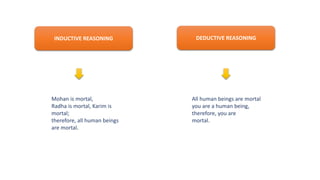
Mohan is mortal,
Radha is mortal, Karim is
mortal;
therefore, all human beings
are mortal.
All human beings are mortal
you are a human being,
therefore, you are
mortal.
INDUCTIVE REASONING DEDUCTIVE REASONING
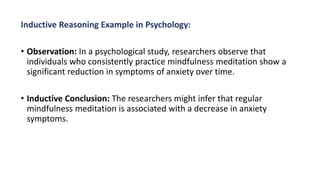
Inductive Reasoning Example in Psychology:
• Observation: In a psychological study, researchers observe that
individuals who consistently practice mindfulness meditation show a
significant reduction in symptoms of anxiety over time.
• Inductive Conclusion: The researchers might infer that regular
mindfulness meditation is associated with a decrease in anxiety
symptoms.
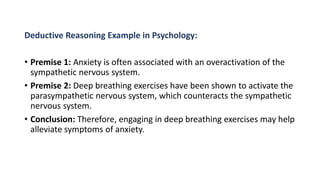
Deductive Reasoning Example in Psychology:
• Premise 1: Anxiety is often associated with an overactivation of the
sympathetic nervous system.
• Premise 2: Deep breathing exercises have been shown to activate the
parasympathetic nervous system, which counteracts the sympathetic
nervous system.
• Conclusion: Therefore, engaging in deep breathing exercises may help
alleviate symptoms of anxiety.
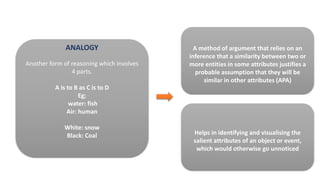
ANALOGY
Another form of reasoning which involves
4 parts.
A is to B as C is to D
Eg;
water: fish
Air: human
White: snow
Black: Coal Helps in identifying and visualising the
salient attributes of an object or event,
which would otherwise go unnoticed
A method of argument that relies on an
inference that a similarity between two or
more entities in some attributes justifies a
probable assumption that they will be
similar in other attributes (APA)
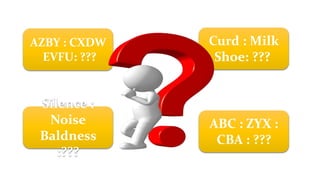
AZBY : CXDW
EVFU: ???
Silence :
Noise
Baldness
:???
Curd : Milk
Shoe: ???
ABC : ZYX :
CBA : ???
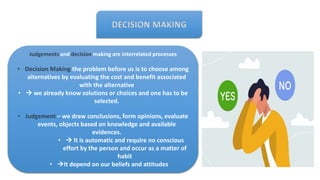
DECISION MAKING
Judgements and decision making are interrelated processes
• Decision Making the problem before us is to choose among
alternatives by evaluating the cost and benefit associated
with the alternative
•  we already know solutions or choices and one has to be
selected.
• Judgement – we draw conclusions, form opinions, evaluate
events, objects based on knowledge and available
evidences.
•  It is automatic and require no conscious
effort by the person and occur as a matter of
habit
• It depend on our beliefs and attitudes
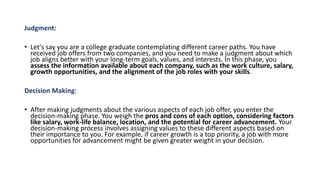
Judgment:
• Let's say you are a college graduate contemplating different career paths. You have
received job offers from two companies, and you need to make a judgment about which
job aligns better with your long-term goals, values, and interests. In this phase, you
assess the information available about each company, such as the work culture, salary,
growth opportunities, and the alignment of the job roles with your skills.
Decision Making:
• After making judgments about the various aspects of each job offer, you enter the
decision-making phase. You weigh the pros and cons of each option, considering factors
like salary, work-life balance, location, and the potential for career advancement. Your
decision-making process involves assigning values to these different aspects based on
their importance to you. For example, if career growth is a top priority, a job with more
opportunities for advancement might be given greater weight in your decision.
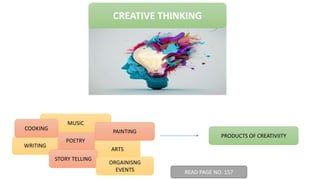
CREATIVE THINKING
READ PAGE NO. 157
POETRY
MUSIC
PRODUCTS OF CREATIVIITY
ARTS
PAINTING
WRITING
COOKING
STORY TELLING
ORGAINISNG
EVENTS
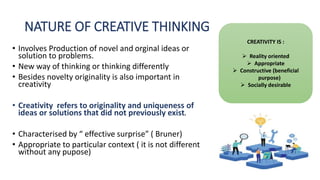
NATURE OF CREATIVE THINKING
• Involves Production of novel and orginal ideas or
solution to problems.
• New way of thinking or thinking differently
• Besides novelty originality is also important in
creativity
• Creativity refers to originality and uniqueness of
ideas or solutions that did not previously exist.
• Characterised by “ effective surprise” ( Bruner)
• Appropriate to particular context ( it is not different
without any pupose)
CREATIVITY IS :
 Reality oriented
 Appropriate
 Constructive (beneficial
purpose)
 Socially desirable
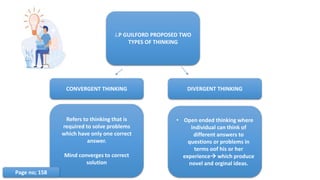
J.P GUILFORD PROPOSED TWO
TYPES OF THINKING
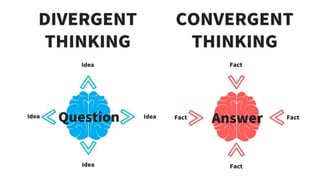
CONVERGENT THINKING DIVERGENT THINKING
Refers to thinking that is
required to solve problems
which have only one correct
answer.
Mind converges to correct
solution
• Open ended thinking where
individual can think of
different answers to
questions or problems in
terms oof his or her
experience which produce
novel and orginal ideas.
Page no; 158
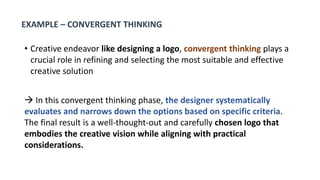
• Creative endeavor like designing a logo, convergent thinking plays a
crucial role in refining and selecting the most suitable and effective
creative solution
 In this convergent thinking phase, the designer systematically
evaluates and narrows down the options based on specific criteria.
The final result is a well-thought-out and carefully chosen logo that
embodies the creative vision while aligning with practical
considerations.
EXAMPLE – CONVERGENT THINKING
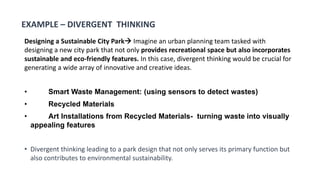
Designing a Sustainable City Park Imagine an urban planning team tasked with
designing a new city park that not only provides recreational space but also incorporates
sustainable and eco-friendly features. In this case, divergent thinking would be crucial for
generating a wide array of innovative and creative ideas.
• Smart Waste Management: (using sensors to detect wastes)
• Recycled Materials
• Art Installations from Recycled Materials- turning waste into visually
appealing features
• Divergent thinking leading to a park design that not only serves its primary function but
also contributes to environmental sustainability.
EXAMPLE – DIVERGENT THINKING
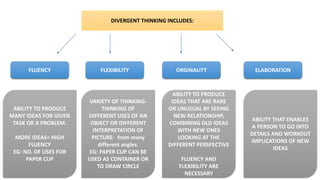
FLUENCY FLEXIBILITY ORGINALITY ELABORATION
ABILITY TO PRODUCE
MANY IDEAS FOR GIVEN
TASK OR A PROBLEM.
MORE IDEAS= HIGH
FLUENCY
EG: NO. OF USES FOR
PAPER CUP
VARIETY OF THINKING-
THINKING OF
DIFFERENT USES OF AN
OBJECT OR DIFFERENT
INTERPRETATION OF
PICTURE- from many
different angles.
EG: PAPER CUP CAN BE
USED AS CONTAINER OR
TO DRAW CIRCLE
ABILITY TO PRODUCE
IDEAS THAT ARE RARE
OR UNUSUAL BY SEEING
NEW RELATIONSHIP,
COMBINING OLD IDEAS
WITH NEW ONES
LOOKING AT THE
DIFFERENT PERSPECTIVE
FLUENCY AND
FLEXIBILITY ARE
NECESSARY
ABILITY THAT ENABLES
A PERSON TO GO INTO
DETAILS AND WORKOUT
IMPLICATIONS OF NEW
IDEAS
DIVERGENT THINKING INCLUDES:
Divergent thinking  essential in generating a wide
range of ideas
Convergent thinking  important to identify the most
useful or appropriate idea
In summary, convergent thinking is about
finding a single correct solution, while
divergent thinking is about generating
multiple ideas and exploring various
possibilities. Both types of thinking play
essential roles in problem-solving and
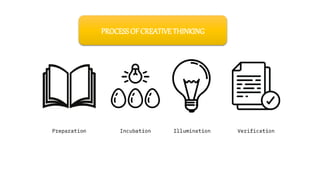
PROCESS OF CREATIVE THINKING
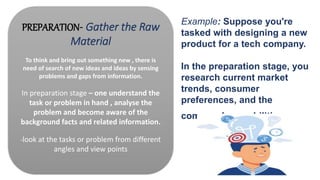
PREPARATION- Gather the Raw
Material
To think and bring out something new , there is
need of search of new ideas and ideas by sensing
problems and gaps from information.
In preparation stage – one understand the
task or problem in hand , analyse the
problem and become aware of the
background facts and related information.
-look at the tasks or problem from different
angles and view points
Example: Suppose you're
tasked with designing a new
product for a tech company.
In the preparation stage, you
research current market
trends, consumer
preferences, and the
company's capabilities.
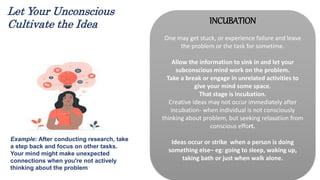
INCUBATION
One may get stuck, or experience failure and leave
the problem or the task for sometime.
Allow the information to sink in and let your
subconscious mind work on the problem.
Take a break or engage in unrelated activities to
give your mind some space.
That stage is incubation.
Creative ideas may not occur immediately after
incubation- when individual is not consciously
thinking about problem, but seeking relaxation from
conscious effort.
Ideas occur or strike when a person is doing
something else– eg: going to sleep, waking up,
taking bath or just when walk alone.
Example: After conducting research, take
a step back and focus on other tasks.
Your mind might make unexpected
connections when you're not actively
thinking about the problem.
Let Your Unconscious
Cultivate the Idea
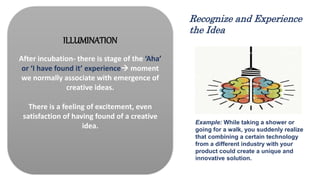
ILLUMINATION
After incubation- there is stage of the ‘Aha’
or ‘I have found it’ experience moment
we normally associate with emergence of
creative ideas.
There is a feeling of excitement, even
satisfaction of having found of a creative
idea. Example: While taking a shower or
going for a walk, you suddenly realize
that combining a certain technology
from a different industry with your
product could create a unique and
innovative solution.
Recognize and Experience
the Idea
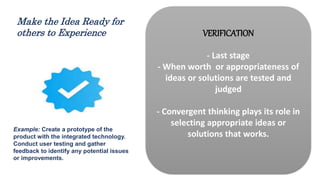
VERIFICATION
- Last stage
- When worth or appropriateness of
ideas or solutions are tested and
judged
- Convergent thinking plays its role in
selecting appropriate ideas or
solutions that works.
Example: Create a prototype of the
product with the integrated technology.
Conduct user testing and gather
feedback to identify any potential issues
or improvements.
Make the Idea Ready for
others to Experience
THOUGHT AND LANGUAGE
DID YOU FEEL THAT WORDS OR LANGUAGE ARE ESSENTIAL TO
EXPRESS WHAT WE THINK?
IS IT LANGUAGE DETERMINING YOUR THOUGHTS OR THOUGHTS
DETERMINING YOUR LANGUAGE?
Language as a determinant of thought
• Benjamin Lee Whorf
• His view is known as Linguistic relativity hypothesis
• How and What a human possibly can think is determined by the
language and linguistic categories they use.
LINGUISTIC DETERMINISM
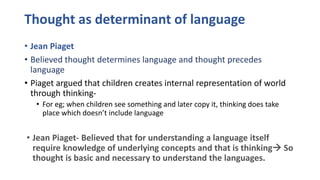
Thought as determinant of language
• Jean Piaget
• Believed thought determines language and thought precedes
language
• Piaget argued that children creates internal representation of world
through thinking-
• For eg; when children see something and later copy it, thinking does take
place which doesn’t include language
• Jean Piaget- Believed that for understanding a language itself
require knowledge of underlying concepts and that is thinking So
thought is basic and necessary to understand the languages.
ORGINS OF LANGUAGE AND THOUGHT
• Russian psychologist Lev Vygotsky argued that
thoughts and language develop in a child
separately until two years of age when they
merge.
• Before 2 years thought is preverbal and is
experienced more in action( Piaget’s sensory
motor stage)
• Child’s utterances are more automatic reflexes
than thought based-( crying when
uncomfortable)
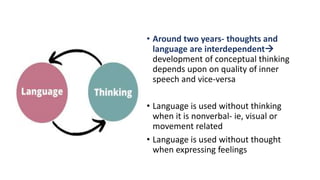
• Around two years- thoughts and
language are interdependent
development of conceptual thinking
depends upon on quality of inner
speech and vice-versa
• Language is used without thinking
when it is nonverbal- ie, visual or
movement related
• Language is used without thought
when expressing feelings
MEANING AND NATURE OF LANGUAGE
• Language consist of a system of symbols
organised by means of certain rules that we
use to communicate with each other.
• Language has 3 basic characteristics
1. Presence of symbols
2. Set of rules to organize these symbols
3. communication
1 SYMBOLS
Language involves symbols
Symbols represent something or someone–
For eg; the word home’ represents place where you live
The thing that you eat is called food.
These words alone don’t carry any meaning until it is
associated with some objects or events and we begin to
recognise those objects or events
2 RULES
Language have certain rules
Follow a definite and accepted order of presenting these
words
For eg; I am going to school
school am going I
3 COMMUNICATION
Through language one communicate one’s thought, ideas,
intentions and feelings to others
Some occasions we communicate using our body parts-
called gestures and postures( non verbal communication)
Some people who cannot use oral speech ( severe hearing
and speech problem) communicate through sign language
DEVELOPMENT OF LANGUAGE
• Human language is more spontaneous, creative and complex than
the system of language of other animals.
• There is also a great deal of regularity with which children all over
the world seem to be learning the language or languages to which
they are exposed.
• There is some predictable pattern in which children’s acquisition of
language from ‘no use’ of language to becoming competent language
user
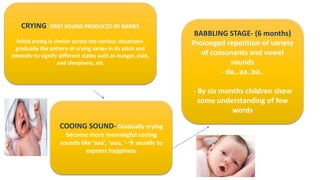
CRYING- FIRST SOUND PRODUCED BY BABIES
Initial crying is similar across the various situations-
gradually the pattern of crying varies in its pitch and
intensity to signify different states such as hunger, pain,
and sleepiness, etc
COOING SOUND- Gradually crying
become more meaningful cooing
sounds like ‘aaa’, ‘uuu, ’- usually to
express happiness
BABBLING STAGE- (6 months)
Prolonged repetition of variety
of consonants and vowel
sounds
- da…aa..ba..
- By six months children show
some understanding of few
words
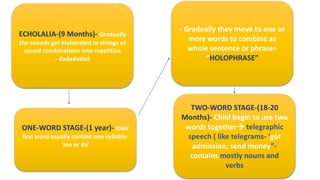
ECHOLALIA-(9 Months)- Gradually
the sounds get elaborated to strings of
sound combinations into repetitive
- dadadadad
ONE-WORD STAGE-(1 year)- their
first word usually contain one syllable-
‘ma or da’
- Gradually they move to one or
more words to combine as
whole sentence or phrase=
“HOLOPHRASE”
TWO-WORD STAGE-(18-20
Months)- Child begin to use two
words together telegraphic
speech ( like telegrams- ‘got
admission; send money”-
contains mostly nouns and
verbs
THINKING-XI E SIS [Autosaved].pptx......

THINKING-XI E SIS [Autosaved].pptx......

  • 1.
  • 2.
    • Thinking isbase of all cognitive activities or processes • Thinking is unique to human beings • Involves manipulation and analysis of information received from environment • Eg: If you see a painting- you don’t simply focus colours and line- rather you go beyond and interpret meaning and try to relate to existing information
  • 4.
    Thinking is ahigher metal process through which we manipulate and analyse the acquired or existing information
  • 5.
    Such manipulation andanalysis occur by means of • abstracting, • reasoning, • problem solving, • judging and • decision making.
  • 6.
    • Thinking isorganised and goal directed • Thinking is an internal mental process which can be inferred from overt behaviour • Chess Player- thinking for several minutes we can’t see what he is thinking, but through his next move we can simply infer what he was thinking.
  • 7.
    BUILDING BLOCKS OFTHOUGHTS MENTAL IMAGES CONCEPTS PROTOTYPE
  • 8.
    MENTAL IMAGES An imageis a mental representation of sensory experiences, it can be used to think about things, places, and events. IMAGINE • You are at Taj Mahal • You are planning a vacation in Kerala
  • 9.
    CONCEPTS Concept – mentalrepresentation of a category. Concept refers to a class of object, ideas, or events that share common properties. We try to identify object or event by extracting its characteristics, matching it with already existing category Apple- Categorised as fruit Dog- Animal • Helps in organising our knowledge • So we can access knowledge with less time and efforts  Quick and efficient ACTIVITY 8.2 – PG- 152
  • 10.
    PROTOTYPE • Best representativemember of category • People decide whether an item is member of a category by comparing it with most typical item of the category
  • 11.
    WHEN IS ACUP A “CUP”
  • 12.
    PROCESS OF THINKING DECISIONMAKING REASONING PROBLEM SOLVING JUDGEMENT CREATIVITY LANGUAGE
  • 13.
    PROBLEM SOLVING GOAL DIRECTEDTHINKING ALMOST ALL OUR DAILY ACTIVITIES ARE GOAL DIRECTED PROBLEMS IS NOT OBSTACLES OR HURDLES PROBLEM HERE CAN BE SIMPLE ACTVITIY INITIAL STAGE- PROBLEM END STAGE- GOAL
  • 14.
    OBSTACLES OF PROBLEMSOLVING MENTAL SET LACK OF MOTIVATION -Tendency of person by following already tried mental operations or steps. -Prior success with particular strategy would sometime help in solving new problem -but also creates mental rigidity that obstructs the problem solver to think of any new rule - some situation-> mental set enhance quality and speed but in other situation hinders problem solving FUNCTIONAL FIXEDNESS- like mental set- Occurswhen peoplefailto solve aproblem because they are fixed on a thing’susualfunction Skills and talents are not use if individuals are not motivated. Sometimes people give up easily when they face failure or any obstacles in the first step.
  • 15.
    REASONING Reasoning is theprocess of gathering and analysing information to arrive at conclusion. -also a form of problem solving -Goal- determine what conclusion can be drawn from certain given information DEDUCTIVE REASONING -Reasoning that begins with an assumption -starts with making a general assumption that you know and then drawing specific conclusion based on this assumption INDUCTIVE REASONIG -Based on specific facts and observation -drawing general conclusion based on particular observation
  • 16.
    Mohan is mortal, Radhais mortal, Karim is mortal; therefore, all human beings are mortal. All human beings are mortal you are a human being, therefore, you are mortal. INDUCTIVE REASONING DEDUCTIVE REASONING
  • 17.
    Inductive Reasoning Examplein Psychology: • Observation: In a psychological study, researchers observe that individuals who consistently practice mindfulness meditation show a significant reduction in symptoms of anxiety over time. • Inductive Conclusion: The researchers might infer that regular mindfulness meditation is associated with a decrease in anxiety symptoms.
  • 18.
    Deductive Reasoning Examplein Psychology: • Premise 1: Anxiety is often associated with an overactivation of the sympathetic nervous system. • Premise 2: Deep breathing exercises have been shown to activate the parasympathetic nervous system, which counteracts the sympathetic nervous system. • Conclusion: Therefore, engaging in deep breathing exercises may help alleviate symptoms of anxiety.
  • 19.
    ANALOGY Another form ofreasoning which involves 4 parts. A is to B as C is to D Eg; water: fish Air: human White: snow Black: Coal Helps in identifying and visualising the salient attributes of an object or event, which would otherwise go unnoticed A method of argument that relies on an inference that a similarity between two or more entities in some attributes justifies a probable assumption that they will be similar in other attributes (APA)
  • 20.
    AZBY : CXDW EVFU:??? Silence : Noise Baldness :??? Curd : Milk Shoe: ??? ABC : ZYX : CBA : ???
  • 21.
    DECISION MAKING Judgements anddecision making are interrelated processes • Decision Making the problem before us is to choose among alternatives by evaluating the cost and benefit associated with the alternative •  we already know solutions or choices and one has to be selected. • Judgement – we draw conclusions, form opinions, evaluate events, objects based on knowledge and available evidences. •  It is automatic and require no conscious effort by the person and occur as a matter of habit • It depend on our beliefs and attitudes
  • 22.
    Judgment: • Let's sayyou are a college graduate contemplating different career paths. You have received job offers from two companies, and you need to make a judgment about which job aligns better with your long-term goals, values, and interests. In this phase, you assess the information available about each company, such as the work culture, salary, growth opportunities, and the alignment of the job roles with your skills. Decision Making: • After making judgments about the various aspects of each job offer, you enter the decision-making phase. You weigh the pros and cons of each option, considering factors like salary, work-life balance, location, and the potential for career advancement. Your decision-making process involves assigning values to these different aspects based on their importance to you. For example, if career growth is a top priority, a job with more opportunities for advancement might be given greater weight in your decision.
  • 23.
    CREATIVE THINKING READ PAGENO. 157 POETRY MUSIC PRODUCTS OF CREATIVIITY ARTS PAINTING WRITING COOKING STORY TELLING ORGAINISNG EVENTS
  • 24.
    NATURE OF CREATIVETHINKING • Involves Production of novel and orginal ideas or solution to problems. • New way of thinking or thinking differently • Besides novelty originality is also important in creativity • Creativity refers to originality and uniqueness of ideas or solutions that did not previously exist. • Characterised by “ effective surprise” ( Bruner) • Appropriate to particular context ( it is not different without any pupose) CREATIVITY IS :  Reality oriented  Appropriate  Constructive (beneficial purpose)  Socially desirable
  • 25.
    J.P GUILFORD PROPOSEDTWO TYPES OF THINKING CONVERGENT THINKING DIVERGENT THINKING Refers to thinking that is required to solve problems which have only one correct answer. Mind converges to correct solution • Open ended thinking where individual can think of different answers to questions or problems in terms oof his or her experience which produce novel and orginal ideas. Page no; 158
  • 26.
    • Creative endeavorlike designing a logo, convergent thinking plays a crucial role in refining and selecting the most suitable and effective creative solution  In this convergent thinking phase, the designer systematically evaluates and narrows down the options based on specific criteria. The final result is a well-thought-out and carefully chosen logo that embodies the creative vision while aligning with practical considerations. EXAMPLE – CONVERGENT THINKING
  • 27.
    Designing a SustainableCity Park Imagine an urban planning team tasked with designing a new city park that not only provides recreational space but also incorporates sustainable and eco-friendly features. In this case, divergent thinking would be crucial for generating a wide array of innovative and creative ideas. • Smart Waste Management: (using sensors to detect wastes) • Recycled Materials • Art Installations from Recycled Materials- turning waste into visually appealing features • Divergent thinking leading to a park design that not only serves its primary function but also contributes to environmental sustainability. EXAMPLE – DIVERGENT THINKING
  • 28.
    FLUENCY FLEXIBILITY ORGINALITYELABORATION ABILITY TO PRODUCE MANY IDEAS FOR GIVEN TASK OR A PROBLEM. MORE IDEAS= HIGH FLUENCY EG: NO. OF USES FOR PAPER CUP VARIETY OF THINKING- THINKING OF DIFFERENT USES OF AN OBJECT OR DIFFERENT INTERPRETATION OF PICTURE- from many different angles. EG: PAPER CUP CAN BE USED AS CONTAINER OR TO DRAW CIRCLE ABILITY TO PRODUCE IDEAS THAT ARE RARE OR UNUSUAL BY SEEING NEW RELATIONSHIP, COMBINING OLD IDEAS WITH NEW ONES LOOKING AT THE DIFFERENT PERSPECTIVE FLUENCY AND FLEXIBILITY ARE NECESSARY ABILITY THAT ENABLES A PERSON TO GO INTO DETAILS AND WORKOUT IMPLICATIONS OF NEW IDEAS DIVERGENT THINKING INCLUDES:
  • 29.
    Divergent thinking essential in generating a wide range of ideas Convergent thinking  important to identify the most useful or appropriate idea In summary, convergent thinking is about finding a single correct solution, while divergent thinking is about generating multiple ideas and exploring various possibilities. Both types of thinking play essential roles in problem-solving and
  • 31.
  • 32.
    PREPARATION- Gather theRaw Material To think and bring out something new , there is need of search of new ideas and ideas by sensing problems and gaps from information. In preparation stage – one understand the task or problem in hand , analyse the problem and become aware of the background facts and related information. -look at the tasks or problem from different angles and view points Example: Suppose you're tasked with designing a new product for a tech company. In the preparation stage, you research current market trends, consumer preferences, and the company's capabilities.
  • 33.
    INCUBATION One may getstuck, or experience failure and leave the problem or the task for sometime. Allow the information to sink in and let your subconscious mind work on the problem. Take a break or engage in unrelated activities to give your mind some space. That stage is incubation. Creative ideas may not occur immediately after incubation- when individual is not consciously thinking about problem, but seeking relaxation from conscious effort. Ideas occur or strike when a person is doing something else– eg: going to sleep, waking up, taking bath or just when walk alone. Example: After conducting research, take a step back and focus on other tasks. Your mind might make unexpected connections when you're not actively thinking about the problem. Let Your Unconscious Cultivate the Idea
  • 34.
    ILLUMINATION After incubation- thereis stage of the ‘Aha’ or ‘I have found it’ experience moment we normally associate with emergence of creative ideas. There is a feeling of excitement, even satisfaction of having found of a creative idea. Example: While taking a shower or going for a walk, you suddenly realize that combining a certain technology from a different industry with your product could create a unique and innovative solution. Recognize and Experience the Idea
  • 35.
    VERIFICATION - Last stage -When worth or appropriateness of ideas or solutions are tested and judged - Convergent thinking plays its role in selecting appropriate ideas or solutions that works. Example: Create a prototype of the product with the integrated technology. Conduct user testing and gather feedback to identify any potential issues or improvements. Make the Idea Ready for others to Experience
  • 36.
    THOUGHT AND LANGUAGE DIDYOU FEEL THAT WORDS OR LANGUAGE ARE ESSENTIAL TO EXPRESS WHAT WE THINK? IS IT LANGUAGE DETERMINING YOUR THOUGHTS OR THOUGHTS DETERMINING YOUR LANGUAGE?
  • 37.
    Language as adeterminant of thought • Benjamin Lee Whorf • His view is known as Linguistic relativity hypothesis • How and What a human possibly can think is determined by the language and linguistic categories they use. LINGUISTIC DETERMINISM
  • 38.
    Thought as determinantof language • Jean Piaget • Believed thought determines language and thought precedes language • Piaget argued that children creates internal representation of world through thinking- • For eg; when children see something and later copy it, thinking does take place which doesn’t include language • Jean Piaget- Believed that for understanding a language itself require knowledge of underlying concepts and that is thinking So thought is basic and necessary to understand the languages.
  • 39.
    ORGINS OF LANGUAGEAND THOUGHT • Russian psychologist Lev Vygotsky argued that thoughts and language develop in a child separately until two years of age when they merge. • Before 2 years thought is preverbal and is experienced more in action( Piaget’s sensory motor stage) • Child’s utterances are more automatic reflexes than thought based-( crying when uncomfortable)
  • 40.
    • Around twoyears- thoughts and language are interdependent development of conceptual thinking depends upon on quality of inner speech and vice-versa • Language is used without thinking when it is nonverbal- ie, visual or movement related • Language is used without thought when expressing feelings
  • 41.
    MEANING AND NATUREOF LANGUAGE • Language consist of a system of symbols organised by means of certain rules that we use to communicate with each other. • Language has 3 basic characteristics 1. Presence of symbols 2. Set of rules to organize these symbols 3. communication
  • 42.
    1 SYMBOLS Language involvessymbols Symbols represent something or someone– For eg; the word home’ represents place where you live The thing that you eat is called food. These words alone don’t carry any meaning until it is associated with some objects or events and we begin to recognise those objects or events
  • 43.
    2 RULES Language havecertain rules Follow a definite and accepted order of presenting these words For eg; I am going to school school am going I
  • 44.
    3 COMMUNICATION Through languageone communicate one’s thought, ideas, intentions and feelings to others Some occasions we communicate using our body parts- called gestures and postures( non verbal communication) Some people who cannot use oral speech ( severe hearing and speech problem) communicate through sign language
  • 45.
    DEVELOPMENT OF LANGUAGE •Human language is more spontaneous, creative and complex than the system of language of other animals. • There is also a great deal of regularity with which children all over the world seem to be learning the language or languages to which they are exposed. • There is some predictable pattern in which children’s acquisition of language from ‘no use’ of language to becoming competent language user
  • 46.
    CRYING- FIRST SOUNDPRODUCED BY BABIES Initial crying is similar across the various situations- gradually the pattern of crying varies in its pitch and intensity to signify different states such as hunger, pain, and sleepiness, etc COOING SOUND- Gradually crying become more meaningful cooing sounds like ‘aaa’, ‘uuu, ’- usually to express happiness BABBLING STAGE- (6 months) Prolonged repetition of variety of consonants and vowel sounds - da…aa..ba.. - By six months children show some understanding of few words
  • 47.
    ECHOLALIA-(9 Months)- Gradually thesounds get elaborated to strings of sound combinations into repetitive - dadadadad ONE-WORD STAGE-(1 year)- their first word usually contain one syllable- ‘ma or da’ - Gradually they move to one or more words to combine as whole sentence or phrase= “HOLOPHRASE” TWO-WORD STAGE-(18-20 Months)- Child begin to use two words together telegraphic speech ( like telegrams- ‘got admission; send money”- contains mostly nouns and verbs