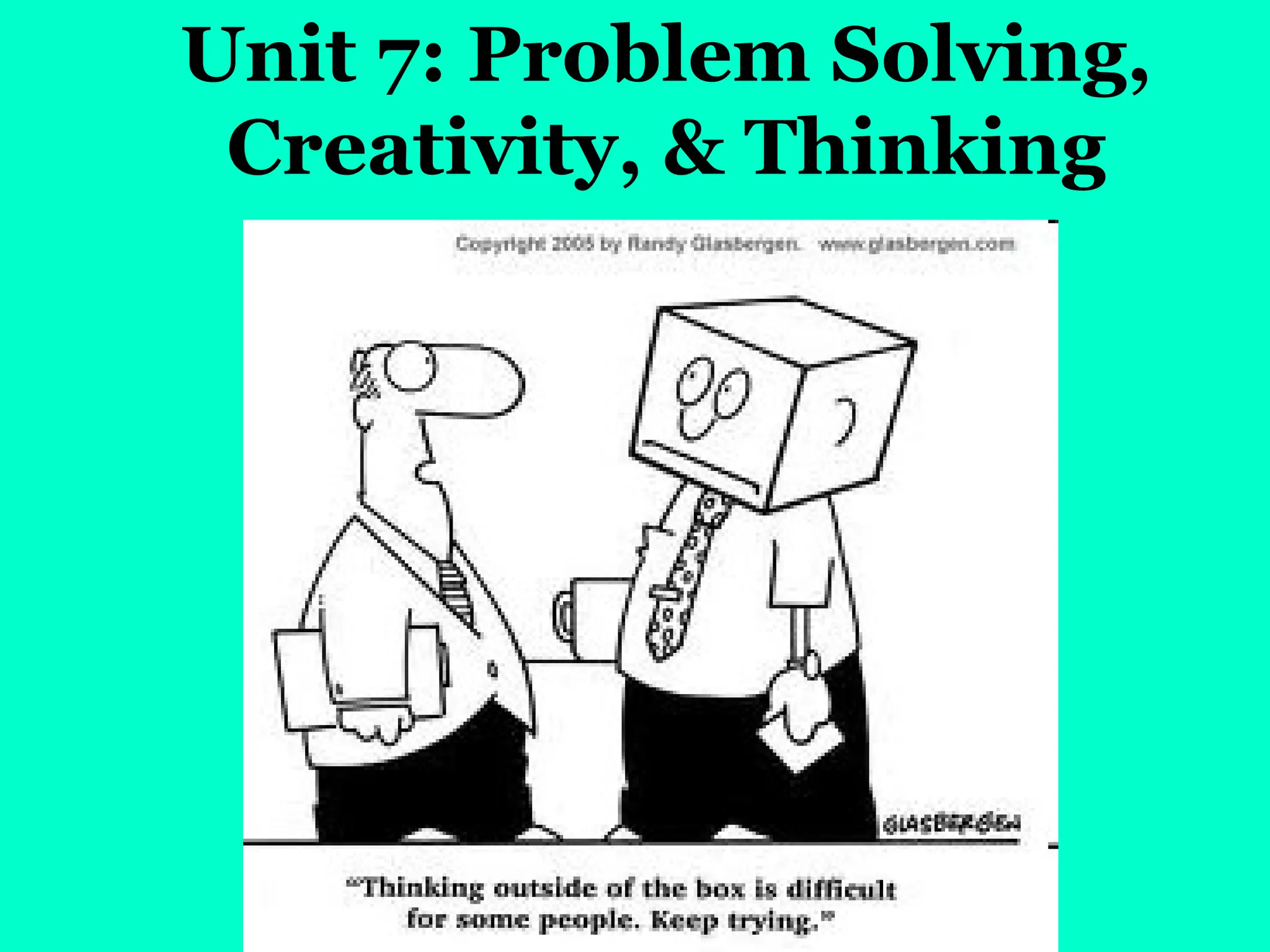
Unit 7: Problem Solving,
Creativity, & Thinking
Thinking
• Remember, cognition
refers to all the mental
activities associated with
thinking, knowing,
remembering, and
communicating
• Very often in our
cognition, or thinking,
we create concepts
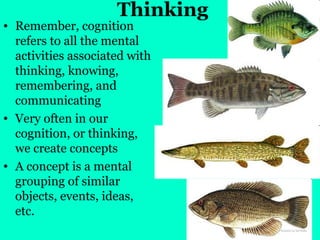
• A concept is a mental
grouping of similar
objects, events, ideas,
etc.
• Concepts keep things
simple, without them,
chaos would ensue
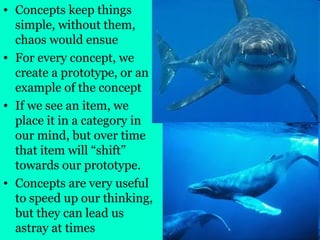
• For every concept, we
create a prototype, or an
example of the concept
• If we see an item, we
place it in a category in
our mind, but over time
that item will “shift”
towards our prototype.
• Concepts are very useful
to speed up our thinking,
but they can lead us
astray at times
Problem Solving
• There are different
ways to solve problems
o Trial and error:
‘guessing’ different
possibilities until we
stumble on the correct
answer
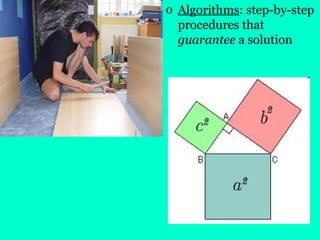
o Algorithms: step-by-step
procedures that
guarantee a solution
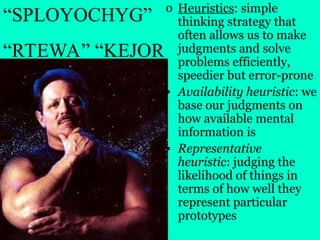
o Heuristics: simple
thinking strategy that
often allows us to make
judgments and solve
problems efficiently,
speedier but error-prone
• Availability heuristic: we
base our judgments on
how available mental
information is
• Representative
heuristic: judging the
likelihood of things in
terms of how well they
represent particular
prototypes
“SPLOYOCHYG”
“RTEWA” “KEJOR
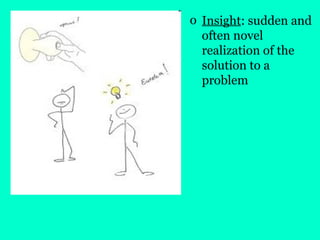
o Insight: sudden and
often novel
realization of the
solution to a
problem
Obstacles to Problem
Solving
• There is often one of a
few things that affect our
cognition process when
we are trying to solve
problems: confirmation
bias and fixation
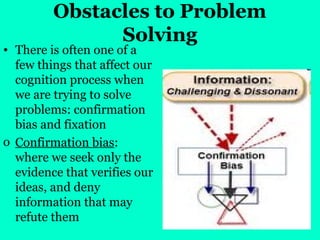
o Confirmation bias:
where we seek only the
evidence that verifies our
ideas, and deny
information that may
refute them
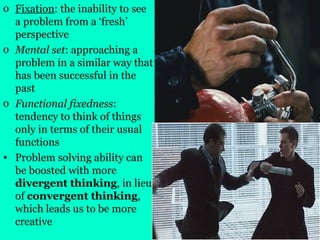
o Fixation: the inability to see
a problem from a ‘fresh’
perspective
o Mental set: approaching a
problem in a similar way that
has been successful in the
past
o Functional fixedness:
tendency to think of things
only in terms of their usual
functions
• Problem solving ability can
be boosted with more
divergent thinking, in lieu
of convergent thinking,
which leads us to be more
creative
Creativity
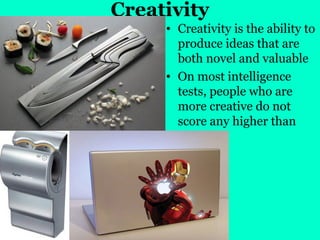
• Creativity is the ability to
produce ideas that are
both novel and valuable
• On most intelligence
tests, people who are
more creative do not
score any higher than
others
• According to Robert
Sternberg there are 5
components of
creativity:
o 1. Expertise: the more we
know about a
subject/area, the more
likely we are to create
something novel
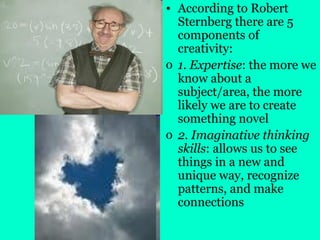
o 2. Imaginative thinking
skills: allows us to see
things in a new and
unique way, recognize
patterns, and make
connections
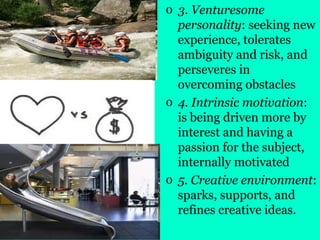
o 3. Venturesome
personality: seeking new
experience, tolerates
ambiguity and risk, and
perseveres in
overcoming obstacles
o 4. Intrinsic motivation:
is being driven more by
interest and having a
passion for the subject,
internally motivated
o 5. Creative environment:
sparks, supports, and
refines creative ideas.

problemsolve_creativity_art_how to solve problems.ppt

  • 1.
    Unit 7: ProblemSolving, Creativity, & Thinking
  • 2.
    Thinking • Remember, cognition refersto all the mental activities associated with thinking, knowing, remembering, and communicating • Very often in our cognition, or thinking, we create concepts • A concept is a mental grouping of similar objects, events, ideas, etc.
  • 3.
    • Concepts keepthings simple, without them, chaos would ensue • For every concept, we create a prototype, or an example of the concept • If we see an item, we place it in a category in our mind, but over time that item will “shift” towards our prototype. • Concepts are very useful to speed up our thinking, but they can lead us astray at times
  • 4.
    Problem Solving • Thereare different ways to solve problems o Trial and error: ‘guessing’ different possibilities until we stumble on the correct answer
  • 5.
    o Algorithms: step-by-step proceduresthat guarantee a solution
  • 6.
    o Heuristics: simple thinkingstrategy that often allows us to make judgments and solve problems efficiently, speedier but error-prone • Availability heuristic: we base our judgments on how available mental information is • Representative heuristic: judging the likelihood of things in terms of how well they represent particular prototypes “SPLOYOCHYG” “RTEWA” “KEJOR
  • 7.
    o Insight: suddenand often novel realization of the solution to a problem
  • 8.
    Obstacles to Problem Solving •There is often one of a few things that affect our cognition process when we are trying to solve problems: confirmation bias and fixation o Confirmation bias: where we seek only the evidence that verifies our ideas, and deny information that may refute them
  • 9.
    o Fixation: theinability to see a problem from a ‘fresh’ perspective o Mental set: approaching a problem in a similar way that has been successful in the past o Functional fixedness: tendency to think of things only in terms of their usual functions • Problem solving ability can be boosted with more divergent thinking, in lieu of convergent thinking, which leads us to be more creative
  • 10.
    Creativity • Creativity isthe ability to produce ideas that are both novel and valuable • On most intelligence tests, people who are more creative do not score any higher than others
  • 11.
    • According toRobert Sternberg there are 5 components of creativity: o 1. Expertise: the more we know about a subject/area, the more likely we are to create something novel o 2. Imaginative thinking skills: allows us to see things in a new and unique way, recognize patterns, and make connections
  • 12.
    o 3. Venturesome personality:seeking new experience, tolerates ambiguity and risk, and perseveres in overcoming obstacles o 4. Intrinsic motivation: is being driven more by interest and having a passion for the subject, internally motivated o 5. Creative environment: sparks, supports, and refines creative ideas.