NATURE OF CREATIVE
THINKING
BY: SYEDA HAMDA ASHRAF AND SHIVANI
OF CLASS 11TH B
Introduction
Have you ever wondered how many times
we think in a day? We ‘think’ about when
our train will likely arrive, how are we going
to tackle a given problem, etc. But creative
thinking is a bit different in the effect that it
is capable of producing original ideas and
unprecedented solutions to a certain
problem. Eureka!
20XX presentation title 2
• We witness creativity around us
every day, from beautiful pieces of
art to innovative solutions to trivial
issues, creativity surrounds us in all
aspects of life.
• Creative thinking requires an idea to
be novel and original.
• American psychologist Jerome
Bruner referred to creative thinking
as ‘effective surprise’, saying that
if an idea is unique and different, it
often comes as a surprise.
2022 presentation title 3
UNDERSTANDING CREATIVE THINKING
TYPES OF CREATIVE THINKING
• Another important feature of creative thinking is appropriateness
in a particular context. Researchers state that thinking is creative
when it is reality-oriented, constructive, and socially desirable.
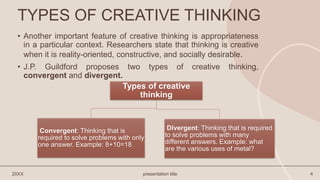
• J.P. Guildford proposes two types of creative thinking,
convergent and divergent.
20XX presentation title 4
Types of creative
thinking
Convergent: Thinking that is
required to solve problems with only
one answer. Example: 8+10=18
Divergent: Thinking that is required
to solve problems with many
different answers. Example: what
are the various uses of metal?
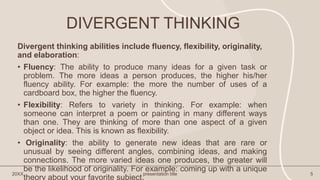
DIVERGENT THINKING
Divergent thinking abilities include fluency, flexibility, originality,
and elaboration:
• Fluency: The ability to produce many ideas for a given task or
problem. The more ideas a person produces, the higher his/her
fluency ability. For example: the more the number of uses of a
cardboard box, the higher the fluency.
• Flexibility: Refers to variety in thinking. For example: when
someone can interpret a poem or painting in many different ways
than one. They are thinking of more than one aspect of a given
object or idea. This is known as flexibility.
• Originality: the ability to generate new ideas that are rare or
unusual by seeing different angles, combining ideas, and making
connections. The more varied ideas one produces, the greater will
be the likelihood of originality. For example: coming up with a unique
theory about your favorite subject.
20XX presentation title 5
20XX presentation title 6
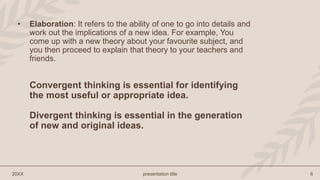
• Elaboration: It refers to the ability of one to go into details and
work out the implications of a new idea. For example, You
come up with a new theory about your favourite subject, and
you then proceed to explain that theory to your teachers and
friends.
Convergent thinking is essential for identifying
the most useful or appropriate idea.
Divergent thinking is essential in the generation
of new and original ideas.
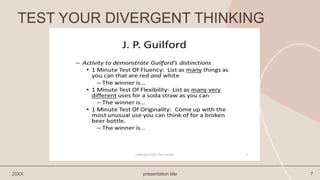
TEST YOUR DIVERGENT THINKING
20XX presentation title 7
Thank you!
Made by: Syeda Hamda Ashraf and Shivani
Of class 11th B

NATURE OF CREATIVE THINKING: a presentation that explains Creative Thinking

  • 1.
    NATURE OF CREATIVE THINKING BY:SYEDA HAMDA ASHRAF AND SHIVANI OF CLASS 11TH B
  • 2.
    Introduction Have you everwondered how many times we think in a day? We ‘think’ about when our train will likely arrive, how are we going to tackle a given problem, etc. But creative thinking is a bit different in the effect that it is capable of producing original ideas and unprecedented solutions to a certain problem. Eureka! 20XX presentation title 2
  • 3.
    • We witnesscreativity around us every day, from beautiful pieces of art to innovative solutions to trivial issues, creativity surrounds us in all aspects of life. • Creative thinking requires an idea to be novel and original. • American psychologist Jerome Bruner referred to creative thinking as ‘effective surprise’, saying that if an idea is unique and different, it often comes as a surprise. 2022 presentation title 3 UNDERSTANDING CREATIVE THINKING
  • 4.
    TYPES OF CREATIVETHINKING • Another important feature of creative thinking is appropriateness in a particular context. Researchers state that thinking is creative when it is reality-oriented, constructive, and socially desirable. • J.P. Guildford proposes two types of creative thinking, convergent and divergent. 20XX presentation title 4 Types of creative thinking Convergent: Thinking that is required to solve problems with only one answer. Example: 8+10=18 Divergent: Thinking that is required to solve problems with many different answers. Example: what are the various uses of metal?
  • 5.
    DIVERGENT THINKING Divergent thinkingabilities include fluency, flexibility, originality, and elaboration: • Fluency: The ability to produce many ideas for a given task or problem. The more ideas a person produces, the higher his/her fluency ability. For example: the more the number of uses of a cardboard box, the higher the fluency. • Flexibility: Refers to variety in thinking. For example: when someone can interpret a poem or painting in many different ways than one. They are thinking of more than one aspect of a given object or idea. This is known as flexibility. • Originality: the ability to generate new ideas that are rare or unusual by seeing different angles, combining ideas, and making connections. The more varied ideas one produces, the greater will be the likelihood of originality. For example: coming up with a unique theory about your favorite subject. 20XX presentation title 5
  • 6.
    20XX presentation title6 • Elaboration: It refers to the ability of one to go into details and work out the implications of a new idea. For example, You come up with a new theory about your favourite subject, and you then proceed to explain that theory to your teachers and friends. Convergent thinking is essential for identifying the most useful or appropriate idea. Divergent thinking is essential in the generation of new and original ideas.
  • 7.
    TEST YOUR DIVERGENTTHINKING 20XX presentation title 7
  • 8.
    Thank you! Made by:Syeda Hamda Ashraf and Shivani Of class 11th B