Erbil Polytechnic University
Technical Engineering College
Civil Engineering Department
LEVELLING PROCEDURES
Prepared by:
Asst. Prof. Salar K.Hussein
Mr. Kamal Y.Abdullah
Asst.Lecturer. Dilveen H. Omar
1
Review of levelling
In this lecture we will cover :
Rules for levelling
Collimation error
Purposes of levelling
Adjustment of collimation line
Method of Booking Level Reading:
 Rise and fall method
Height of collimation (height of instrument) (H.I)
Types of errors in levelling
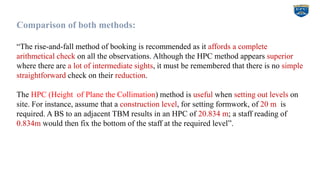
Comparison of both methods:
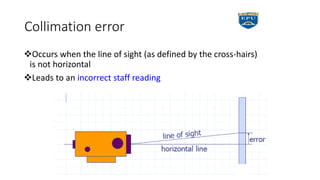
Collimation error
Occurs when the line of sight (as defined by the cross-hairs)
is not horizontal
Leads to an incorrect staff reading
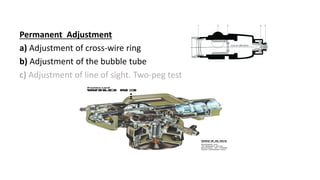
Permanent Adjustment
a) Adjustment of cross-wire ring
b) Adjustment of the bubble tube
c) Adjustment of line of sight. Two-peg test
:
Permanent Adjustment:
Adjustment of line of sight
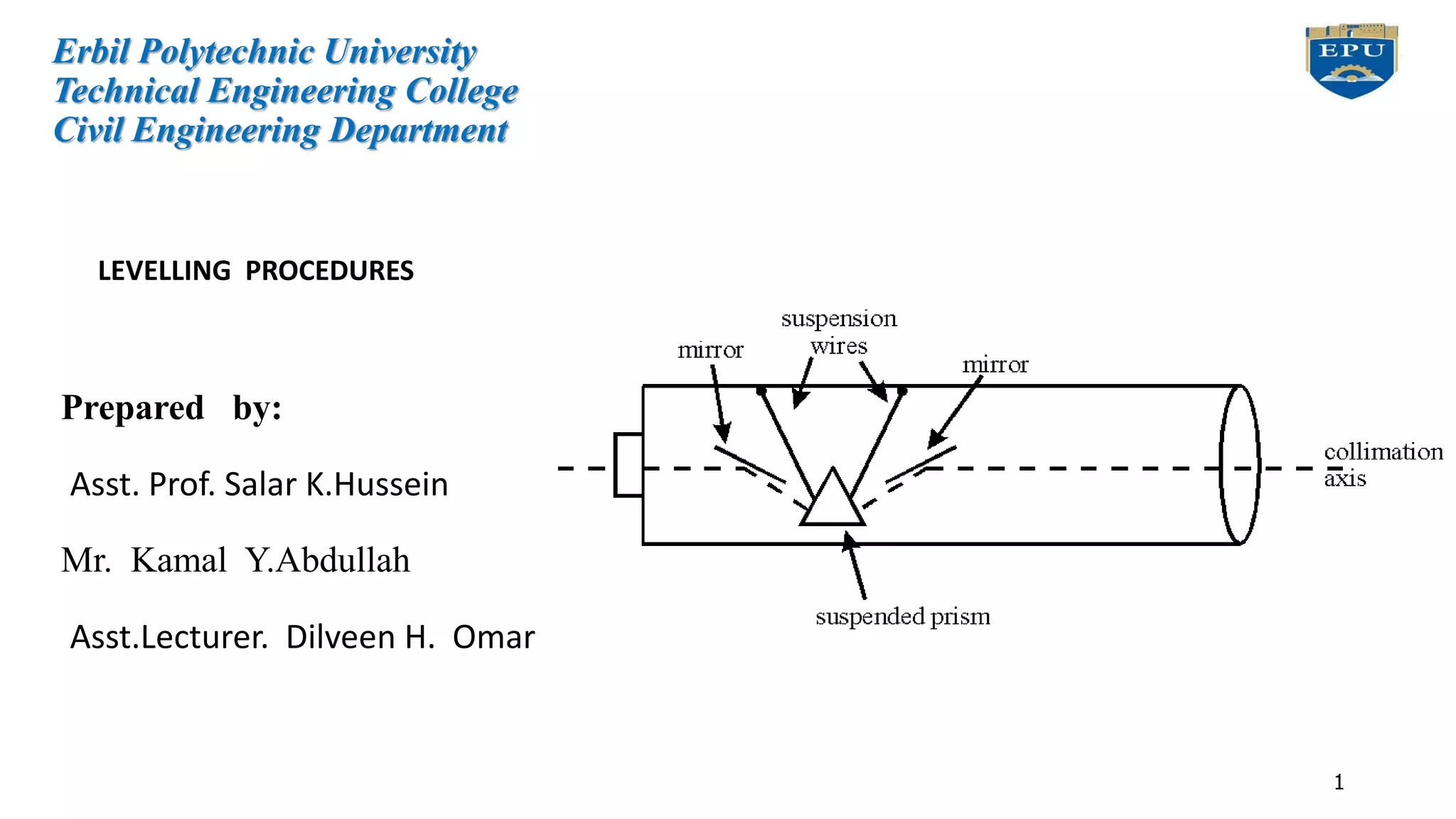
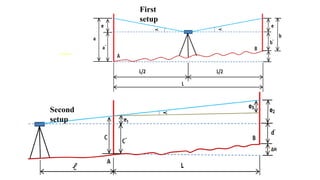
To make the bubble –tube axis of the telescope parallel to the line of
collimation , to test this adjustment , the two-peg is adopted as done in the
case of a dumpy level, select two stations (S1) and (S2) on level ground
about (60)m apart ,set the instrument exactly at mid point. Find the true
difference in level between the two points by clamping the vertical circle
to zero and bring the telescope bubble to the center by means of the clip
screw before taking staff readings, shift the instrument near one of the
points and level the bubble accurately, take a staff reading on the near
First
setup
Second
setup
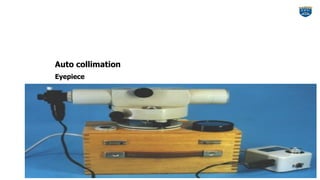
Auto collimation
Eyepiece
Terms used in leveling
1.Reduced Level;(RL) The reduced level of a point is its height or elevation above
the surface adopted as a datum.
2.Elevation; E vertical distance above or below a given reference surface or datum.
3.Back sight;(BS) This is the first reading taken with a leveling instrument in a
leveling operation.
4.Foresight;(FS) This is the last reading taken in a leveling operation.
5.Intermediate Sight;(IS) This is the reading taken between the back sight and
foresight in a leveling operation
6.Turning Point -T P - or Change Point - CP
A change point or turning point:
is a staff station on which two staff readings are taken without changing
the position of the staff.
7.Error or Mis-closure:
The difference between true value and measured value.
Levelling procedures
• Observation procedures
• Booking procedures
• Reduction procedures
• Method of Booking Level Reading
1)-Rise-and-fall method
2)-Height of collimation (height of instrument (H.I.)
1)Rise-and-fall
Rise (+) and fall (-)
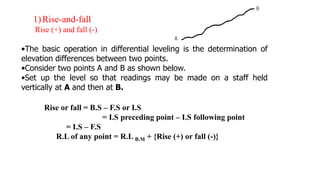
•The basic operation in differential leveling is the determination of
elevation differences between two points.
•Consider two points A and B as shown below.
•Set up the level so that readings may be made on a staff held
vertically at A and then at B.
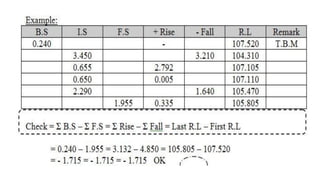
Rise or fall = B.S – F.S or I.S
= I.S preceding point – I.S following point
= I.S – F.S
R.L of any point = R.L B.M + {Rise (+) or fall (-)}
The rise and fall method
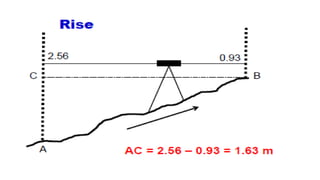
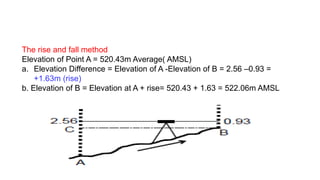
Elevation of Point A = 520.43m Average( AMSL)
a. Elevation Difference = Elevation of A -Elevation of B = 2.56 –0.93 =
+1.63m (rise)
b. Elevation of B = Elevation at A + rise= 520.43 + 1.63 = 522.06m AMSL
The rise and fall method
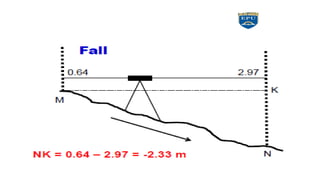
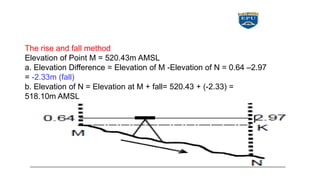
Elevation of Point M = 520.43m AMSL
a. Elevation Difference = Elevation of M -Elevation of N = 0.64 –2.97
= -2.33m (fall)
b. Elevation of N = Elevation at M + fall= 520.43 + (-2.33) =
518.10m AMSL
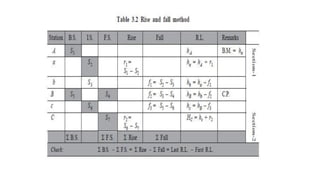
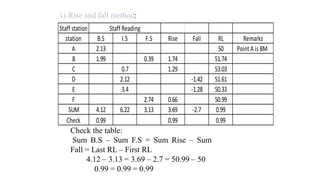
1) Rise and fall method:
Staff station Staff Reading
station B.S I.S F.S Rise Fall RL Remarks
A 2.13 50 PointA is BM
B 1.99 0.39 1.74 51.74
C 0.7 1.29 53.03
D 2.12 -1.42 51.61
E 3.4 -1.28 50.33
F 2.74 0.66 50.99
SUM 4.12 6.22 3.13 3.69 -2.7 0.99
Check 0.99 0.99 0.99
Check the table:
Sum B.S – Sum F.S = Sum Rise – Sum
Fall = Last RL – First RL
4.12 – 3.13 = 3.69 – 2.7 = 50.99 – 50
0.99 = 0.99 = 0.99
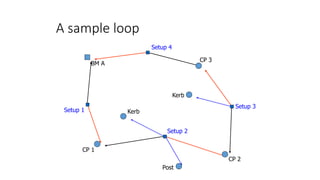
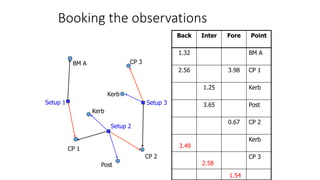
A sample loop
BM A
CP 1
CP 2
CP 3
Kerb
Post
Kerb
Setup 1
Setup 2
Setup 3
Setup 4
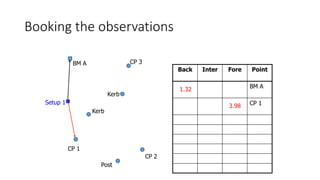
Booking the observations
BM A
CP 1
CP 2
CP 3
Kerb
Post
Kerb
Setup 1
Back Inter Fore Point
BM A
CP 1
1.32
3.98
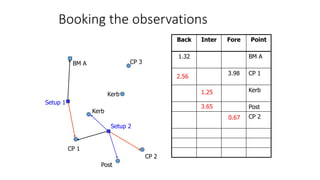
Booking the observations
BM A
CP 1
CP 2
CP 3
Kerb
Post
Kerb
Setup 1
Setup 2
Back Inter Fore Point
1.32 BM A
3.98 CP 1
Kerb
Post
CP 2
2.56
1.25
3.65
0.67
Booking the observations
BM A
CP 1
CP 2
CP 3
Kerb
Post
Kerb
Setup 1
Setup 2
Setup 3
Back Inter Fore Point
1.32 BM A
2.56 3.98 CP 1
1.25 Kerb
3.65 Post
0.67 CP 2
Kerb
CP 3
3.49
2.58
1.54
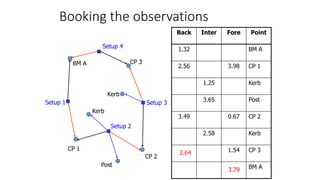
Booking the observations
BM A
CP 1
CP 2
CP 3
Kerb
Post
Kerb
Setup 1
Setup 4
Setup 2
Setup 3
Back Inter Fore Point
1.32 BM A
2.56 3.98 CP 1
1.25 Kerb
3.65 Post
3.49 0.67 CP 2
2.58 Kerb
1.54 CP 3
BM A
2.64
3.79
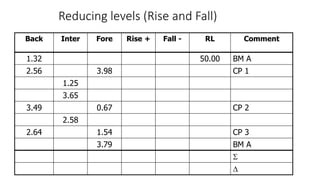
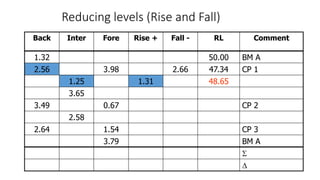
Reducing levels (Rise and Fall)
Back Inter Fore Rise + Fall - RL Comment
1.32 50.00 BM A
2.56 3.98 CP 1
1.25
3.65
3.49 0.67 CP 2
2.58
2.64 1.54 CP 3
3.79 BM A


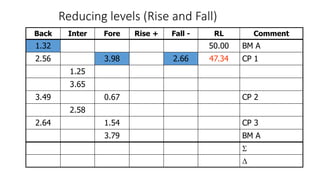
Reducing levels (Rise and Fall)
Back Inter Fore Rise + Fall - RL Comment
1.32 50.00 BM A
2.56 3.98 2.66 47.34 CP 1
1.25
3.65
3.49 0.67 CP 2
2.58
2.64 1.54 CP 3
3.79 BM A


Reducing levels (Rise and Fall)
Back Inter Fore Rise + Fall - RL Comment
1.32 50.00 BM A
2.56 3.98 2.66 47.34 CP 1
1.25 1.31 48.65
3.65
3.49 0.67 CP 2
2.58
2.64 1.54 CP 3
3.79 BM A


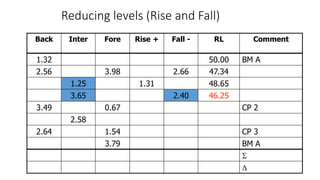
Reducing levels (Rise and Fall)
Back Inter Fore Rise + Fall - RL Comment
1.32 50.00 BM A
2.56 3.98 2.66 47.34
1.25 1.31 48.65
3.65 2.40 46.25
3.49 0.67 CP 2
2.58
2.64 1.54 CP 3
3.79 BM A


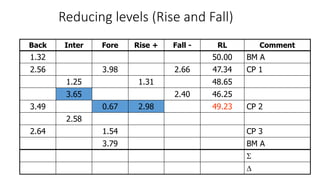
Reducing levels (Rise and Fall)
Back Inter Fore Rise + Fall - RL Comment
1.32 50.00 BM A
2.56 3.98 2.66 47.34 CP 1
1.25 1.31 48.65
3.65 2.40 46.25
3.49 0.67 2.98 49.23 CP 2
2.58
2.64 1.54 CP 3
3.79 BM A


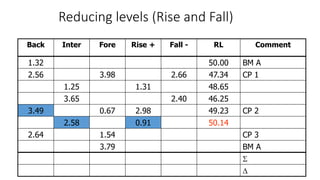
Reducing levels (Rise and Fall)
Back Inter Fore Rise + Fall - RL Comment
1.32 50.00 BM A
2.56 3.98 2.66 47.34 CP 1
1.25 1.31 48.65
3.65 2.40 46.25
3.49 0.67 2.98 49.23 CP 2
2.58 0.91 50.14
2.64 1.54 CP 3
3.79 BM A


Reducing levels (Rise and Fall)
Back Inter Fore Rise Fall RL Comment
1.32 50.00 BM A
2.56 3.98 2.66 47.34 CP 1
1.25 1.31 48.65
3.65 2.40 46.25
3.49 0.67 2.98 49.23 CP 2
2.58 0.91 50.14
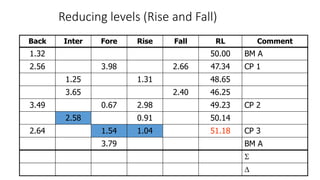
2.64 1.54 1.04 51.18 CP 3
3.79 BM A


Reducing levels (Rise and Fall)
Back Inter Fore Rise Fall RL Comment
1.32 50.00 BM A
2.56 3.98 2.66 47.34 CP 1
1.25 1.31 48.65
3.65 2.40 46.25
3.49 0.67 2.98 49.23 CP 2
2.58 0.91 50.14
2.64 1.54 1.04 51.18 CP 3
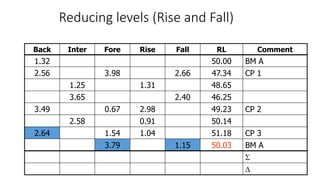
3.79 1.15 50.03 BM A


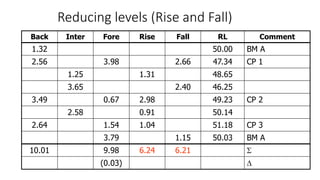
Reducing levels (Rise and Fall)
Back Inter Fore Rise Fall RL Comment
1.32 50.00 BM A
2.56 3.98 2.66 47.34 CP 1
1.25 1.31 48.65
3.65 2.40 46.25
3.49 0.67 2.98 49.23 CP 2
2.58 0.91 50.14
2.64 1.54 1.04 51.18 CP 3
3.79 1.15 50.03 BM A
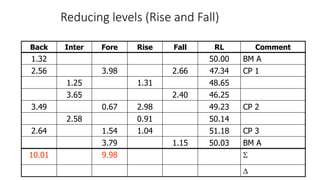
10.01 9.98 

Reducing levels (Rise and Fall)
Back Inter Fore Rise Fall RL Comment
1.32 50.00 BM A
2.56 3.98 2.66 47.34 CP 1
1.25 1.31 48.65
3.65 2.40 46.25
3.49 0.67 2.98 49.23 CP 2
2.58 0.91 50.14
2.64 1.54 1.04 51.18 CP 3
3.79 1.15 50.03 BM A
10.01 9.98 
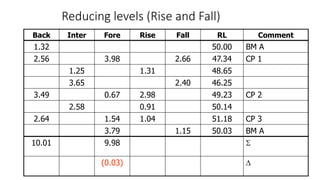
(0.03) 
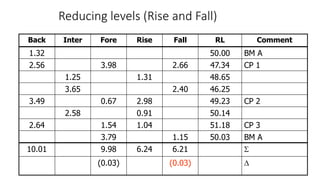
Reducing levels (Rise and Fall)
Back Inter Fore Rise Fall RL Comment
1.32 50.00 BM A
2.56 3.98 2.66 47.34 CP 1
1.25 1.31 48.65
3.65 2.40 46.25
3.49 0.67 2.98 49.23 CP 2
2.58 0.91 50.14
2.64 1.54 1.04 51.18 CP 3
3.79 1.15 50.03 BM A
10.01 9.98 6.24 6.21 
(0.03) 
Reducing levels (Rise and Fall)
Back Inter Fore Rise Fall RL Comment
1.32 50.00 BM A
2.56 3.98 2.66 47.34 CP 1
1.25 1.31 48.65
3.65 2.40 46.25
3.49 0.67 2.98 49.23 CP 2
2.58 0.91 50.14
2.64 1.54 1.04 51.18 CP 3
3.79 1.15 50.03 BM A
10.01 9.98 6.24 6.21 
(0.03) (0.03) 
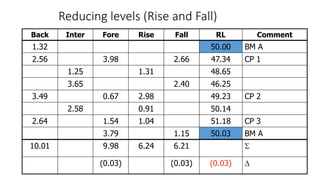
Reducing levels (Rise and Fall)
Back Inter Fore Rise Fall RL Comment
1.32 50.00 BM A
2.56 3.98 2.66 47.34 CP 1
1.25 1.31 48.65
3.65 2.40 46.25
3.49 0.67 2.98 49.23 CP 2
2.58 0.91 50.14
2.64 1.54 1.04 51.18 CP 3
3.79 1.15 50.03 BM A
10.01 9.98 6.24 6.21 
(0.03) (0.03) (0.03) 
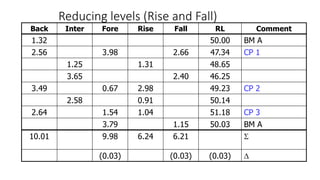
Reducing levels (Rise and Fall)
Back Inter Fore Rise Fall RL Comment
1.32 50.00 BM A
2.56 3.98 2.66 47.34 CP 1
1.25 1.31 48.65
3.65 2.40 46.25
3.49 0.67 2.98 49.23 CP 2
2.58 0.91 50.14
2.64 1.54 1.04 51.18 CP 3
3.79 1.15 50.03 BM A
10.01 9.98 6.24 6.21 
(0.03) (0.03) (0.03) 
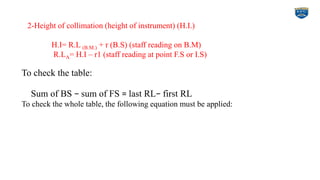
To check the table:
Sum of BS − sum of FS = last RL− first RL
To check the whole table, the following equation must be applied:
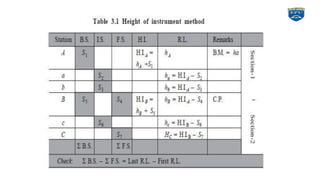
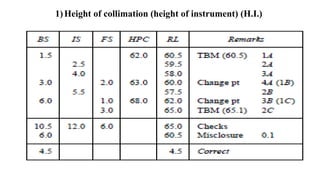
2-Height of collimation (height of instrument) (H.I.)
H.I= R.L (B.M.) + r (B.S) (staff reading on B.M)
R.LA= H.I – r1 (staff reading at point F.S or I.S)
1)Height of collimation (height of instrument) (H.I.)
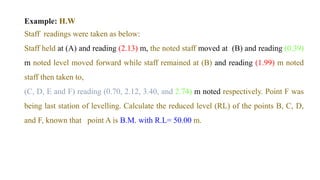
Example: H.W
Staff readings were taken as below:
Staff held at (A) and reading (2.13) m, the noted staff moved at (B) and reading (0.39)
m noted level moved forward while staff remained at (B) and reading (1.99) m noted
staff then taken to,
(C, D, E and F) reading (0.70, 2.12, 3.40, and 2.74) m noted respectively. Point F was
being last station of levelling. Calculate the reduced level (RL) of the points B, C, D,
and F, known that point A is B.M. with R.L= 50.00 m.
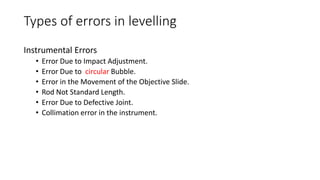
Types of errors in levelling
Instrumental Errors
• Error Due to Impact Adjustment.
• Error Due to circular Bubble.
• Error in the Movement of the Objective Slide.
• Rod Not Standard Length.
• Error Due to Defective Joint.
• Collimation error in the instrument.
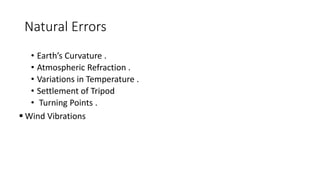
Natural Errors
• Earth’s Curvature .
• Atmospheric Refraction .
• Variations in Temperature .
• Settlement of Tripod
• Turning Points .
 Wind Vibrations
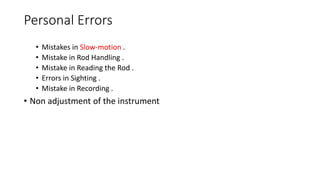
Personal Errors
• Mistakes in Slow-motion .
• Mistake in Rod Handling .
• Mistake in Reading the Rod .
• Errors in Sighting .
• Mistake in Recording .
• Non adjustment of the instrument
Comparison of both methods:
“The rise-and-fall method of booking is recommended as it affords a complete
arithmetical check on all the observations. Although the HPC method appears superior
where there are a lot of intermediate sights, it must be remembered that there is no simple
straightforward check on their reduction.
The HPC (Height of Plane the Collimation) method is useful when setting out levels on
site. For instance, assume that a construction level, for setting formwork, of 20 m is
required. A BS to an adjacent TBM results in an HPC of 20.834 m; a staff reading of
0.834m would then fix the bottom of the staff at the required level”.
Thank you
45

LEVELLING PROCEDURES

  • 1.
    Erbil Polytechnic University TechnicalEngineering College Civil Engineering Department LEVELLING PROCEDURES Prepared by: Asst. Prof. Salar K.Hussein Mr. Kamal Y.Abdullah Asst.Lecturer. Dilveen H. Omar 1
  • 2.
    Review of levelling Inthis lecture we will cover : Rules for levelling Collimation error Purposes of levelling Adjustment of collimation line Method of Booking Level Reading:  Rise and fall method Height of collimation (height of instrument) (H.I) Types of errors in levelling Comparison of both methods:
  • 3.
    Collimation error Occurs whenthe line of sight (as defined by the cross-hairs) is not horizontal Leads to an incorrect staff reading
  • 4.
    Permanent Adjustment a) Adjustmentof cross-wire ring b) Adjustment of the bubble tube c) Adjustment of line of sight. Two-peg test :
  • 5.
    Permanent Adjustment: Adjustment ofline of sight To make the bubble –tube axis of the telescope parallel to the line of collimation , to test this adjustment , the two-peg is adopted as done in the case of a dumpy level, select two stations (S1) and (S2) on level ground about (60)m apart ,set the instrument exactly at mid point. Find the true difference in level between the two points by clamping the vertical circle to zero and bring the telescope bubble to the center by means of the clip screw before taking staff readings, shift the instrument near one of the points and level the bubble accurately, take a staff reading on the near
  • 6.
  • 7.
  • 8.
    Terms used inleveling 1.Reduced Level;(RL) The reduced level of a point is its height or elevation above the surface adopted as a datum. 2.Elevation; E vertical distance above or below a given reference surface or datum. 3.Back sight;(BS) This is the first reading taken with a leveling instrument in a leveling operation. 4.Foresight;(FS) This is the last reading taken in a leveling operation. 5.Intermediate Sight;(IS) This is the reading taken between the back sight and foresight in a leveling operation
  • 9.
    6.Turning Point -TP - or Change Point - CP A change point or turning point: is a staff station on which two staff readings are taken without changing the position of the staff. 7.Error or Mis-closure: The difference between true value and measured value. Levelling procedures • Observation procedures • Booking procedures • Reduction procedures • Method of Booking Level Reading 1)-Rise-and-fall method 2)-Height of collimation (height of instrument (H.I.)
  • 10.
    1)Rise-and-fall Rise (+) andfall (-) •The basic operation in differential leveling is the determination of elevation differences between two points. •Consider two points A and B as shown below. •Set up the level so that readings may be made on a staff held vertically at A and then at B. Rise or fall = B.S – F.S or I.S = I.S preceding point – I.S following point = I.S – F.S R.L of any point = R.L B.M + {Rise (+) or fall (-)}
  • 13.
    The rise andfall method Elevation of Point A = 520.43m Average( AMSL) a. Elevation Difference = Elevation of A -Elevation of B = 2.56 –0.93 = +1.63m (rise) b. Elevation of B = Elevation at A + rise= 520.43 + 1.63 = 522.06m AMSL
  • 14.
    The rise andfall method Elevation of Point M = 520.43m AMSL a. Elevation Difference = Elevation of M -Elevation of N = 0.64 –2.97 = -2.33m (fall) b. Elevation of N = Elevation at M + fall= 520.43 + (-2.33) = 518.10m AMSL
  • 16.
    1) Rise andfall method: Staff station Staff Reading station B.S I.S F.S Rise Fall RL Remarks A 2.13 50 PointA is BM B 1.99 0.39 1.74 51.74 C 0.7 1.29 53.03 D 2.12 -1.42 51.61 E 3.4 -1.28 50.33 F 2.74 0.66 50.99 SUM 4.12 6.22 3.13 3.69 -2.7 0.99 Check 0.99 0.99 0.99 Check the table: Sum B.S – Sum F.S = Sum Rise – Sum Fall = Last RL – First RL 4.12 – 3.13 = 3.69 – 2.7 = 50.99 – 50 0.99 = 0.99 = 0.99
  • 17.
    A sample loop BMA CP 1 CP 2 CP 3 Kerb Post Kerb Setup 1 Setup 2 Setup 3 Setup 4
  • 18.
    Booking the observations BMA CP 1 CP 2 CP 3 Kerb Post Kerb Setup 1 Back Inter Fore Point BM A CP 1 1.32 3.98
  • 19.
    Booking the observations BMA CP 1 CP 2 CP 3 Kerb Post Kerb Setup 1 Setup 2 Back Inter Fore Point 1.32 BM A 3.98 CP 1 Kerb Post CP 2 2.56 1.25 3.65 0.67
  • 20.
    Booking the observations BMA CP 1 CP 2 CP 3 Kerb Post Kerb Setup 1 Setup 2 Setup 3 Back Inter Fore Point 1.32 BM A 2.56 3.98 CP 1 1.25 Kerb 3.65 Post 0.67 CP 2 Kerb CP 3 3.49 2.58 1.54
  • 21.
    Booking the observations BMA CP 1 CP 2 CP 3 Kerb Post Kerb Setup 1 Setup 4 Setup 2 Setup 3 Back Inter Fore Point 1.32 BM A 2.56 3.98 CP 1 1.25 Kerb 3.65 Post 3.49 0.67 CP 2 2.58 Kerb 1.54 CP 3 BM A 2.64 3.79
  • 22.
    Reducing levels (Riseand Fall) Back Inter Fore Rise + Fall - RL Comment 1.32 50.00 BM A 2.56 3.98 CP 1 1.25 3.65 3.49 0.67 CP 2 2.58 2.64 1.54 CP 3 3.79 BM A  
  • 23.
    Reducing levels (Riseand Fall) Back Inter Fore Rise + Fall - RL Comment 1.32 50.00 BM A 2.56 3.98 2.66 47.34 CP 1 1.25 3.65 3.49 0.67 CP 2 2.58 2.64 1.54 CP 3 3.79 BM A  
  • 24.
    Reducing levels (Riseand Fall) Back Inter Fore Rise + Fall - RL Comment 1.32 50.00 BM A 2.56 3.98 2.66 47.34 CP 1 1.25 1.31 48.65 3.65 3.49 0.67 CP 2 2.58 2.64 1.54 CP 3 3.79 BM A  
  • 25.
    Reducing levels (Riseand Fall) Back Inter Fore Rise + Fall - RL Comment 1.32 50.00 BM A 2.56 3.98 2.66 47.34 1.25 1.31 48.65 3.65 2.40 46.25 3.49 0.67 CP 2 2.58 2.64 1.54 CP 3 3.79 BM A  
  • 26.
    Reducing levels (Riseand Fall) Back Inter Fore Rise + Fall - RL Comment 1.32 50.00 BM A 2.56 3.98 2.66 47.34 CP 1 1.25 1.31 48.65 3.65 2.40 46.25 3.49 0.67 2.98 49.23 CP 2 2.58 2.64 1.54 CP 3 3.79 BM A  
  • 27.
    Reducing levels (Riseand Fall) Back Inter Fore Rise + Fall - RL Comment 1.32 50.00 BM A 2.56 3.98 2.66 47.34 CP 1 1.25 1.31 48.65 3.65 2.40 46.25 3.49 0.67 2.98 49.23 CP 2 2.58 0.91 50.14 2.64 1.54 CP 3 3.79 BM A  
  • 28.
    Reducing levels (Riseand Fall) Back Inter Fore Rise Fall RL Comment 1.32 50.00 BM A 2.56 3.98 2.66 47.34 CP 1 1.25 1.31 48.65 3.65 2.40 46.25 3.49 0.67 2.98 49.23 CP 2 2.58 0.91 50.14 2.64 1.54 1.04 51.18 CP 3 3.79 BM A  
  • 29.
    Reducing levels (Riseand Fall) Back Inter Fore Rise Fall RL Comment 1.32 50.00 BM A 2.56 3.98 2.66 47.34 CP 1 1.25 1.31 48.65 3.65 2.40 46.25 3.49 0.67 2.98 49.23 CP 2 2.58 0.91 50.14 2.64 1.54 1.04 51.18 CP 3 3.79 1.15 50.03 BM A  
  • 30.
    Reducing levels (Riseand Fall) Back Inter Fore Rise Fall RL Comment 1.32 50.00 BM A 2.56 3.98 2.66 47.34 CP 1 1.25 1.31 48.65 3.65 2.40 46.25 3.49 0.67 2.98 49.23 CP 2 2.58 0.91 50.14 2.64 1.54 1.04 51.18 CP 3 3.79 1.15 50.03 BM A 10.01 9.98  
  • 31.
    Reducing levels (Riseand Fall) Back Inter Fore Rise Fall RL Comment 1.32 50.00 BM A 2.56 3.98 2.66 47.34 CP 1 1.25 1.31 48.65 3.65 2.40 46.25 3.49 0.67 2.98 49.23 CP 2 2.58 0.91 50.14 2.64 1.54 1.04 51.18 CP 3 3.79 1.15 50.03 BM A 10.01 9.98  (0.03) 
  • 32.
    Reducing levels (Riseand Fall) Back Inter Fore Rise Fall RL Comment 1.32 50.00 BM A 2.56 3.98 2.66 47.34 CP 1 1.25 1.31 48.65 3.65 2.40 46.25 3.49 0.67 2.98 49.23 CP 2 2.58 0.91 50.14 2.64 1.54 1.04 51.18 CP 3 3.79 1.15 50.03 BM A 10.01 9.98 6.24 6.21  (0.03) 
  • 33.
    Reducing levels (Riseand Fall) Back Inter Fore Rise Fall RL Comment 1.32 50.00 BM A 2.56 3.98 2.66 47.34 CP 1 1.25 1.31 48.65 3.65 2.40 46.25 3.49 0.67 2.98 49.23 CP 2 2.58 0.91 50.14 2.64 1.54 1.04 51.18 CP 3 3.79 1.15 50.03 BM A 10.01 9.98 6.24 6.21  (0.03) (0.03) 
  • 34.
    Reducing levels (Riseand Fall) Back Inter Fore Rise Fall RL Comment 1.32 50.00 BM A 2.56 3.98 2.66 47.34 CP 1 1.25 1.31 48.65 3.65 2.40 46.25 3.49 0.67 2.98 49.23 CP 2 2.58 0.91 50.14 2.64 1.54 1.04 51.18 CP 3 3.79 1.15 50.03 BM A 10.01 9.98 6.24 6.21  (0.03) (0.03) (0.03) 
  • 35.
    Reducing levels (Riseand Fall) Back Inter Fore Rise Fall RL Comment 1.32 50.00 BM A 2.56 3.98 2.66 47.34 CP 1 1.25 1.31 48.65 3.65 2.40 46.25 3.49 0.67 2.98 49.23 CP 2 2.58 0.91 50.14 2.64 1.54 1.04 51.18 CP 3 3.79 1.15 50.03 BM A 10.01 9.98 6.24 6.21  (0.03) (0.03) (0.03) 
  • 37.
    To check thetable: Sum of BS − sum of FS = last RL− first RL To check the whole table, the following equation must be applied: 2-Height of collimation (height of instrument) (H.I.) H.I= R.L (B.M.) + r (B.S) (staff reading on B.M) R.LA= H.I – r1 (staff reading at point F.S or I.S)
  • 39.
    1)Height of collimation(height of instrument) (H.I.)
  • 40.
    Example: H.W Staff readingswere taken as below: Staff held at (A) and reading (2.13) m, the noted staff moved at (B) and reading (0.39) m noted level moved forward while staff remained at (B) and reading (1.99) m noted staff then taken to, (C, D, E and F) reading (0.70, 2.12, 3.40, and 2.74) m noted respectively. Point F was being last station of levelling. Calculate the reduced level (RL) of the points B, C, D, and F, known that point A is B.M. with R.L= 50.00 m.
  • 41.
    Types of errorsin levelling Instrumental Errors • Error Due to Impact Adjustment. • Error Due to circular Bubble. • Error in the Movement of the Objective Slide. • Rod Not Standard Length. • Error Due to Defective Joint. • Collimation error in the instrument.
  • 42.
    Natural Errors • Earth’sCurvature . • Atmospheric Refraction . • Variations in Temperature . • Settlement of Tripod • Turning Points .  Wind Vibrations
  • 43.
    Personal Errors • Mistakesin Slow-motion . • Mistake in Rod Handling . • Mistake in Reading the Rod . • Errors in Sighting . • Mistake in Recording . • Non adjustment of the instrument
  • 44.
    Comparison of bothmethods: “The rise-and-fall method of booking is recommended as it affords a complete arithmetical check on all the observations. Although the HPC method appears superior where there are a lot of intermediate sights, it must be remembered that there is no simple straightforward check on their reduction. The HPC (Height of Plane the Collimation) method is useful when setting out levels on site. For instance, assume that a construction level, for setting formwork, of 20 m is required. A BS to an adjacent TBM results in an HPC of 20.834 m; a staff reading of 0.834m would then fix the bottom of the staff at the required level”.
  • 45.