Becoming A 
Reflective 
Teacher 
Create a 
Learning 
environment & 
not merely a 
Teaching one
LESSON PLAN
TODAY’S OBJ 
Terminal Obj 
• Get the students to know the importance of 
lesson planning & its mechanics – at the end 
of the session the trainers should be able to 
evolve macro & micro lesson plans to be an eff 
teacher
TODAY’S OBJS 
Learning Objs: 
By the end of the session the participants will be 
able to: 
– Understand what is a plan 
– Importance of lesson planning 
– Contents of Macro & Micro lesson plans 
– Explain the process of lesson planning 
– Construct both micro and macro lesson plans 
– Prepare a lesson plan as per the text book 
– Demonstrate their understanding of the skills 
enhanced through the use of the lesson plans
What is a Lesson? 
• A lesson is a learning experience for an indl 
or a gp and is acquired either through a 
structured interaction or by accident
MAHAJAN 
Churu 
RAJGARH 
JHUNJHUNUN 
Sikar 
CHIRAWA 
N K THANA 
WHAT IS A PLAN? 
Sandwa 
Ladnun 
Ankholiyan 
Tanvara 
Didwana 
Fatehpur 
CHHAPAR 
S SHAHR 
R GARH 
JASRASAR
A detailed proposal for doing or achieving 
something - Oxford 
A series of actions that you think about carefully 
to help you to achieve something - Macmillan 
A written account of intended future course of 
action (scheme) aimed at achieving specific goals or 
objs within a specific timeframe, with resources avl 
It explains what needs to be done, when, how 
and by whom
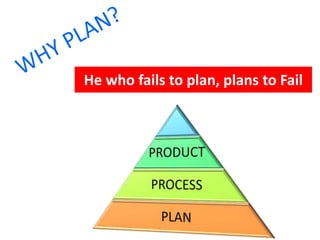
He who fails to plan, plans to Fail
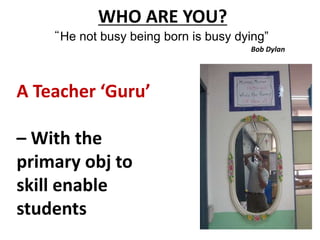
WHO ARE YOU? 
“He not busy being born is busy dying” 
Bob Dylan 
A Teacher ‘Guru’ 
– With the 
primary obj to 
skill enable 
students
10 
Instructor 
• directs the learning situation
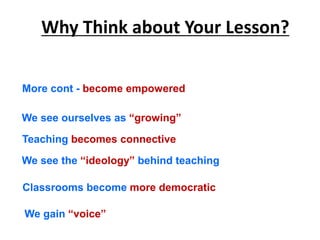
Why Think about Your Lesson? 
More cont - become empowered 
We see ourselves as “growing” 
Teaching becomes connective 
We see the “ideology” behind teaching 
Classrooms become more democratic 
We gain “voice”
Why is lesson planning important? 
Lesson plg means making decisions in adv 
about what to teach, how to teach and the time 
assignment of every teaching procedure 
• Teaching plan is necessary for both novice 
and experienced teachers 
• Prep does not guarantee successful lessons, 
walking into a classroom unprepared is 
often the beginning of a disastrous lesson 
• Although the main teaching contents may be 
the same, the students, the time and the 
mood are all different.
There’s A LOT to a lesson 
A Great 
Lesson
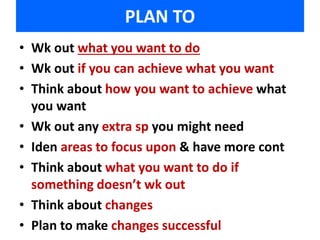
PLAN TO 
• Wk out what you want to do 
• Wk out if you can achieve what you want 
• Think about how you want to achieve what 
you want 
• Wk out any extra sp you might need 
• Iden areas to focus upon & have more cont 
• Think about what you want to do if 
something doesn’t wk out 
• Think about changes 
• Plan to make changes successful
A GOOD PLAN SHOULD 
• Be about what you want 
• Incl all resources / sp needed 
• Have only things that you agree with 
• Help you to do what you want 
• Incl big picture (goals/Objs) 
• Incl things that will make your plan happen 
• List resp 
• Incl time frames 
• Be flexible to adopt to changes 
• Be easy for you and every one to understand 
• Should be a written docu
17 
Planning 
• Designs the learning experience
Principles for Good Lesson Planning 
• Aim: Should be simple & clear. The teacher has 
to set & achieve the realistic goals of the 
lesson 
• Variety: Incl various activities and materials to 
ensure high motivation and interest 
• Flexibility: Adopt more teaching methods & 
techniques - do not restrict to just reading / 
disseminating the lesson / its contents
Principles for Good Lesson Planning 
• Learnability: the planned contents & tasks 
should be within learning capability of students. 
– doing things that are beyond or below the 
students’ coping ability will diminish their 
motivation (Schumann, 1999) 
– Contents should be slightly higher than the 
present proficiency of the students 
• Linkage: the teaching steps should be linked 
with each other. That is, there should be 
coherence.
Macro Planning vs. Micro Planning 
• Macro planning - planning over a 
longer period of time. Planning for the 
entire subject / course 
• Macro planning is not writing lesson 
plans for specific lessons but rather 
helping teachers get an overall felling 
or idea about the course and also get 
familiarized with the context in which 
teaching will takes place
Macro planning involves 
• Knowing about the profession: 
Get to know what should be taught / practised 
in the course, what materials and teaching 
aids are available, and what methods and 
techniques can be used. 
• Knowing about the institution: 
The teacher should get to know the institution’s 
arrangements regarding time, length, 
frequency of lessons, physical conditions of 
classrooms, and exam requirements.
• Knowing about the learners: 
Acquire information about the students’ age, 
service bracket, motivation, attitudes, 
interests, learning needs & other factors 
• Knowing about the curriculum/syllabus: 
The teacher should be clear about the 
purposes, requirements and targets 
specified in the syllabus.
• Knowing about the textbook: 
Know the textbook well in terms of methods of 
teaching, organization of learning contents, 
major topics, recommend teaching methodology, 
unit components and ways of assessment. 
• Knowing about the objectives: 
Know what learners are expected to achieve and 
able to do after the course 
• Macro planning provides a general guidance for 
teachers, but it is not enough for good teaching. 
Teachers need to plan each lesson in detail in order 
to teach effectively and confidently in the classroom.
Micro planning 
• Micro planning - planning for a specific unit / 
lesson, which may last for a or two weeks / 
forty to fifty minutes respectively 
• Micro planning should be based on macro 
planning, and macro planning is apt to be 
modified as lessons go on.
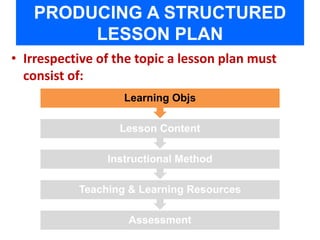
PRODUCING A STRUCTURED 
LESSON PLAN 
• Irrespective of the topic a lesson plan must 
consist of: 
Terminal Obj of the lesson 
Learning Objs 
Lesson Content 
Instructional Method 
Teaching & Learning Resources 
Assessment
CONSIDER 
• What format or template to use? 
• How detailed should be the plan?
SAMPLE TEMPLATE 
• The samples are for guidance – we may mod it 
to suit the lesson
SAMPLE TEMPLATE 
Instructor Date Time 
Module Topic Location 
Learning Objs 
Subject / 
Content 
Time Teaching / 
Learning 
methods 
Teaching / 
Learning 
resources 
Introduction 
Body 
Summary
PRODUCING A STRUCTURED 
LESSON PLAN 
• Irrespective of the topic a lesson plan must 
consist of: 
Learning Objs 
Lesson Content 
Instructional Method 
Teaching & Learning Resources 
Assessment
LEARNING OBJS 
• These are specific action statements like - 
what the learner should be able to do, think, 
say, etc – objs must be measurable 
• These are not what the instructor would do to 
make this happen 
• Eg – At the end of the module / lesson the student 
should be able to describe the functioning of 
hydraulic sys of T-90 / Power sup module of BFSR 
(SR), etc, (a performance obj)
PERFORMANCE OBJS 
• These contain three elements 
– Observable action / behaviour / performance 
– The conditions 
– The criteria / standard 
• Observable Action – specify clearly an 
observable parameter, like to write, to calculate, 
to implement, to do, etc
PERFORMANCE OBJS 
• Specified Conditions 
– like able to drive on a mtn rd / replacement of assy 
during ni 
– whether the trainee will be assisted by a co-dvr, 
have a check list, etc 
– Whether a check list will be provided / the trainee 
has to make one, etc 
• Criterion / Standard – drive at ni without 
crossing the centre line of rd more than twice 
in 5 km
PERFORMANCE OBJS 
• Vital that these are measurable, else assessment 
of trg eff is very difficult to be est. Avoid vague 
objs like: 
– Trainee should be able to think correctly (soft obj) 
– He should be happy at the end of the lesson (soft obj) 
– He should be able to replace a module (conditions & 
standard not addsd) 
• Remember what you cannot measure you cannot 
test / verify / validate
PERFORMANCE OBJS 
• Performance objs to be appropriately structured & 
sequenced – what comes first list first & so on 
• Objs listed should be indicative of progressive build up 
– Should be able to start the veh 
– Should have knowledge of gears & their changing 
– Should be able to drive in day in plains with co-dvr 
– Should be able to drive in day in plains without co-dvr 
– Should be able to drive at ni in plains with co-dvr 
– And so on
PERFORMANCE OBJS 
• Set objs based on the reqmt for one or more of: 
Skill 
Attitude 
Knowledge 
Knowledge + Practice = Skill
SKILL DEVP 
• Psycho motor skills – drive, open, fit, ect 
• Intellectual skills 
– Classifying – understand the concept, basic definitions, etc 
– how does a transistor / valve function 
– Rule-using – how will the transistor / valve behave in a 
circuit 
– Forecasting – needs higher skill than Rule-using, eg. Use 
of past failure data to assess likely defects that can occur 
– Problem solving – diagnostics to link symptom to a defect
PRODUCING A STRUCTURED 
LESSON PLAN 
• Irrespective of the topic a lesson plan must 
consist of: 
Learning Objs 
Lesson Content 
Instructional Method 
Teaching & Learning Resources 
Assessment
LESSON CONTENT 
• Content of the lesson is the knowledge to be 
imparted 
• Simply knowing the subject, or how to do the 
task does not enable to teach eff 
• Need to devp a structure / framework over which 
the knowledge is to be fitted 
• Ensure content is logically org 
• Iden key principles, concepts & models to be 
taught
LESSON CONTENT 
• Sequence them from : Simple – Concrete – 
Complex – Abstract; ensures eff learning 
• Ensure a Beginning – Middle – End 
– Beginning : outlines Obj of Session 
– End : provides opportunity to Recap & Clarifications
PRODUCING A STRUCTURED 
LESSON PLAN 
• Irrespective of the topic a lesson plan must 
consist of: 
Learning Objs 
Lesson Content 
Instructional Method 
Teaching & Learning Resources 
Assessment
METHOD OF INSTRUCTION 
Has three stages 
Presentation 
Practice 
Production
The 3P’s model 
• Presentation stage - the teacher introduces the 
topic 
• Practice stage - the lesson moves from controlled 
practice to guided practice and further to practical 
exploitation of the content 
• Production stage - students are encouraged to 
use what they have learned and practised to 
perform tasks. The focus is on meaning rather 
than accurate reproduction of content
Instructional Method 
• Planned strategies to help learner to understand the 
concept & devp competencies 
• Most used methods – Explanation & Demo 
• To be eff these methods need to be sp by other 
methods that promote Interaction & Participation 
• Ensure : 
– Content facilitated by the adopted – task is best 
understood by demo & practice, whereas concepts need 
explanation & relation to physical world 
– Method fits the maturity of the gp – Gde I & III need 
separate methods
PRODUCING A STRUCTURED 
LESSON PLAN 
• Irrespective of the topic a lesson plan must 
consist of: 
Learning Objs 
Lesson Content 
Instructional Method 
Teaching & Learning Resources 
Assessment
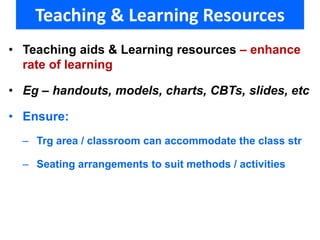
Teaching & Learning Resources 
• Teaching aids & Learning resources – enhance 
rate of learning 
• Eg – handouts, models, charts, CBTs, slides, etc 
• Ensure: 
– Trg area / classroom can accommodate the class str 
– Seating arrangements to suit methods / activities
Seating Optoins
Learning Gp 
• In case of a new batch find out: 
– Age 
– Experience 
– Qualifications 
– Gender (M / F or mix) 
– Previous courses 
– Str 
– Any other relevant info
PRODUCING A STRUCTURED 
LESSON PLAN 
• Irrespective of the topic a lesson plan must 
consist of: 
Learning Objs 
Lesson Content 
Instructional Method 
Teaching & Learning Resources 
Assessment
ASSESSMENT 
• Often understood as Grading / Allocating marks 
at the end of the session 
• Rarely understood that it is vital for every class 
• Assessment has to be a continuous to iden: 
– What & how the students are learning 
– Weak students & focus on them 
– Feedback on pace of instr 
• Use appropriate method of assessment
Common mistakes in Lesson Plans 
• Lesson Plans not made 
• Learning Objs either not enunciated / poorly 
written 
• Timelines not allotted based on content 
• No time planned for interaction 
• Trg aids not planned 
• Lesson assessment not connected with 
behavior indicated in the obj 
• No activities planned to promote interaction
YOUR TIME

Lesson plan

  • 1.
    Becoming A Reflective Teacher Create a Learning environment & not merely a Teaching one
  • 2.
  • 3.
    TODAY’S OBJ TerminalObj • Get the students to know the importance of lesson planning & its mechanics – at the end of the session the trainers should be able to evolve macro & micro lesson plans to be an eff teacher
  • 4.
    TODAY’S OBJS LearningObjs: By the end of the session the participants will be able to: – Understand what is a plan – Importance of lesson planning – Contents of Macro & Micro lesson plans – Explain the process of lesson planning – Construct both micro and macro lesson plans – Prepare a lesson plan as per the text book – Demonstrate their understanding of the skills enhanced through the use of the lesson plans
  • 5.
    What is aLesson? • A lesson is a learning experience for an indl or a gp and is acquired either through a structured interaction or by accident
  • 6.
    MAHAJAN Churu RAJGARH JHUNJHUNUN Sikar CHIRAWA N K THANA WHAT IS A PLAN? Sandwa Ladnun Ankholiyan Tanvara Didwana Fatehpur CHHAPAR S SHAHR R GARH JASRASAR
  • 7.
    A detailed proposalfor doing or achieving something - Oxford A series of actions that you think about carefully to help you to achieve something - Macmillan A written account of intended future course of action (scheme) aimed at achieving specific goals or objs within a specific timeframe, with resources avl It explains what needs to be done, when, how and by whom
  • 8.
    He who failsto plan, plans to Fail
  • 9.
    WHO ARE YOU? “He not busy being born is busy dying” Bob Dylan A Teacher ‘Guru’ – With the primary obj to skill enable students
  • 10.
    10 Instructor •directs the learning situation
  • 11.
    Why Think aboutYour Lesson? More cont - become empowered We see ourselves as “growing” Teaching becomes connective We see the “ideology” behind teaching Classrooms become more democratic We gain “voice”
  • 12.
    Why is lessonplanning important? Lesson plg means making decisions in adv about what to teach, how to teach and the time assignment of every teaching procedure • Teaching plan is necessary for both novice and experienced teachers • Prep does not guarantee successful lessons, walking into a classroom unprepared is often the beginning of a disastrous lesson • Although the main teaching contents may be the same, the students, the time and the mood are all different.
  • 13.
    There’s A LOTto a lesson A Great Lesson
  • 15.
    PLAN TO •Wk out what you want to do • Wk out if you can achieve what you want • Think about how you want to achieve what you want • Wk out any extra sp you might need • Iden areas to focus upon & have more cont • Think about what you want to do if something doesn’t wk out • Think about changes • Plan to make changes successful
  • 16.
    A GOOD PLANSHOULD • Be about what you want • Incl all resources / sp needed • Have only things that you agree with • Help you to do what you want • Incl big picture (goals/Objs) • Incl things that will make your plan happen • List resp • Incl time frames • Be flexible to adopt to changes • Be easy for you and every one to understand • Should be a written docu
  • 17.
    17 Planning •Designs the learning experience
  • 18.
    Principles for GoodLesson Planning • Aim: Should be simple & clear. The teacher has to set & achieve the realistic goals of the lesson • Variety: Incl various activities and materials to ensure high motivation and interest • Flexibility: Adopt more teaching methods & techniques - do not restrict to just reading / disseminating the lesson / its contents
  • 19.
    Principles for GoodLesson Planning • Learnability: the planned contents & tasks should be within learning capability of students. – doing things that are beyond or below the students’ coping ability will diminish their motivation (Schumann, 1999) – Contents should be slightly higher than the present proficiency of the students • Linkage: the teaching steps should be linked with each other. That is, there should be coherence.
  • 20.
    Macro Planning vs.Micro Planning • Macro planning - planning over a longer period of time. Planning for the entire subject / course • Macro planning is not writing lesson plans for specific lessons but rather helping teachers get an overall felling or idea about the course and also get familiarized with the context in which teaching will takes place
  • 21.
    Macro planning involves • Knowing about the profession: Get to know what should be taught / practised in the course, what materials and teaching aids are available, and what methods and techniques can be used. • Knowing about the institution: The teacher should get to know the institution’s arrangements regarding time, length, frequency of lessons, physical conditions of classrooms, and exam requirements.
  • 22.
    • Knowing aboutthe learners: Acquire information about the students’ age, service bracket, motivation, attitudes, interests, learning needs & other factors • Knowing about the curriculum/syllabus: The teacher should be clear about the purposes, requirements and targets specified in the syllabus.
  • 23.
    • Knowing aboutthe textbook: Know the textbook well in terms of methods of teaching, organization of learning contents, major topics, recommend teaching methodology, unit components and ways of assessment. • Knowing about the objectives: Know what learners are expected to achieve and able to do after the course • Macro planning provides a general guidance for teachers, but it is not enough for good teaching. Teachers need to plan each lesson in detail in order to teach effectively and confidently in the classroom.
  • 24.
    Micro planning •Micro planning - planning for a specific unit / lesson, which may last for a or two weeks / forty to fifty minutes respectively • Micro planning should be based on macro planning, and macro planning is apt to be modified as lessons go on.
  • 25.
    PRODUCING A STRUCTURED LESSON PLAN • Irrespective of the topic a lesson plan must consist of: Terminal Obj of the lesson Learning Objs Lesson Content Instructional Method Teaching & Learning Resources Assessment
  • 26.
    CONSIDER • Whatformat or template to use? • How detailed should be the plan?
  • 27.
    SAMPLE TEMPLATE •The samples are for guidance – we may mod it to suit the lesson
  • 28.
    SAMPLE TEMPLATE InstructorDate Time Module Topic Location Learning Objs Subject / Content Time Teaching / Learning methods Teaching / Learning resources Introduction Body Summary
  • 29.
    PRODUCING A STRUCTURED LESSON PLAN • Irrespective of the topic a lesson plan must consist of: Learning Objs Lesson Content Instructional Method Teaching & Learning Resources Assessment
  • 30.
    LEARNING OBJS •These are specific action statements like - what the learner should be able to do, think, say, etc – objs must be measurable • These are not what the instructor would do to make this happen • Eg – At the end of the module / lesson the student should be able to describe the functioning of hydraulic sys of T-90 / Power sup module of BFSR (SR), etc, (a performance obj)
  • 31.
    PERFORMANCE OBJS •These contain three elements – Observable action / behaviour / performance – The conditions – The criteria / standard • Observable Action – specify clearly an observable parameter, like to write, to calculate, to implement, to do, etc
  • 32.
    PERFORMANCE OBJS •Specified Conditions – like able to drive on a mtn rd / replacement of assy during ni – whether the trainee will be assisted by a co-dvr, have a check list, etc – Whether a check list will be provided / the trainee has to make one, etc • Criterion / Standard – drive at ni without crossing the centre line of rd more than twice in 5 km
  • 33.
    PERFORMANCE OBJS •Vital that these are measurable, else assessment of trg eff is very difficult to be est. Avoid vague objs like: – Trainee should be able to think correctly (soft obj) – He should be happy at the end of the lesson (soft obj) – He should be able to replace a module (conditions & standard not addsd) • Remember what you cannot measure you cannot test / verify / validate
  • 34.
    PERFORMANCE OBJS •Performance objs to be appropriately structured & sequenced – what comes first list first & so on • Objs listed should be indicative of progressive build up – Should be able to start the veh – Should have knowledge of gears & their changing – Should be able to drive in day in plains with co-dvr – Should be able to drive in day in plains without co-dvr – Should be able to drive at ni in plains with co-dvr – And so on
  • 35.
    PERFORMANCE OBJS •Set objs based on the reqmt for one or more of: Skill Attitude Knowledge Knowledge + Practice = Skill
  • 36.
    SKILL DEVP •Psycho motor skills – drive, open, fit, ect • Intellectual skills – Classifying – understand the concept, basic definitions, etc – how does a transistor / valve function – Rule-using – how will the transistor / valve behave in a circuit – Forecasting – needs higher skill than Rule-using, eg. Use of past failure data to assess likely defects that can occur – Problem solving – diagnostics to link symptom to a defect
  • 37.
    PRODUCING A STRUCTURED LESSON PLAN • Irrespective of the topic a lesson plan must consist of: Learning Objs Lesson Content Instructional Method Teaching & Learning Resources Assessment
  • 38.
    LESSON CONTENT •Content of the lesson is the knowledge to be imparted • Simply knowing the subject, or how to do the task does not enable to teach eff • Need to devp a structure / framework over which the knowledge is to be fitted • Ensure content is logically org • Iden key principles, concepts & models to be taught
  • 39.
    LESSON CONTENT •Sequence them from : Simple – Concrete – Complex – Abstract; ensures eff learning • Ensure a Beginning – Middle – End – Beginning : outlines Obj of Session – End : provides opportunity to Recap & Clarifications
  • 40.
    PRODUCING A STRUCTURED LESSON PLAN • Irrespective of the topic a lesson plan must consist of: Learning Objs Lesson Content Instructional Method Teaching & Learning Resources Assessment
  • 41.
    METHOD OF INSTRUCTION Has three stages Presentation Practice Production
  • 42.
    The 3P’s model • Presentation stage - the teacher introduces the topic • Practice stage - the lesson moves from controlled practice to guided practice and further to practical exploitation of the content • Production stage - students are encouraged to use what they have learned and practised to perform tasks. The focus is on meaning rather than accurate reproduction of content
  • 43.
    Instructional Method •Planned strategies to help learner to understand the concept & devp competencies • Most used methods – Explanation & Demo • To be eff these methods need to be sp by other methods that promote Interaction & Participation • Ensure : – Content facilitated by the adopted – task is best understood by demo & practice, whereas concepts need explanation & relation to physical world – Method fits the maturity of the gp – Gde I & III need separate methods
  • 44.
    PRODUCING A STRUCTURED LESSON PLAN • Irrespective of the topic a lesson plan must consist of: Learning Objs Lesson Content Instructional Method Teaching & Learning Resources Assessment
  • 45.
    Teaching & LearningResources • Teaching aids & Learning resources – enhance rate of learning • Eg – handouts, models, charts, CBTs, slides, etc • Ensure: – Trg area / classroom can accommodate the class str – Seating arrangements to suit methods / activities
  • 46.
  • 47.
    Learning Gp •In case of a new batch find out: – Age – Experience – Qualifications – Gender (M / F or mix) – Previous courses – Str – Any other relevant info
  • 48.
    PRODUCING A STRUCTURED LESSON PLAN • Irrespective of the topic a lesson plan must consist of: Learning Objs Lesson Content Instructional Method Teaching & Learning Resources Assessment
  • 49.
    ASSESSMENT • Oftenunderstood as Grading / Allocating marks at the end of the session • Rarely understood that it is vital for every class • Assessment has to be a continuous to iden: – What & how the students are learning – Weak students & focus on them – Feedback on pace of instr • Use appropriate method of assessment
  • 50.
    Common mistakes inLesson Plans • Lesson Plans not made • Learning Objs either not enunciated / poorly written • Timelines not allotted based on content • No time planned for interaction • Trg aids not planned • Lesson assessment not connected with behavior indicated in the obj • No activities planned to promote interaction
  • 51.