Module 1: Training program
organization
PreparingTutorsfor
WorkBasedLearning
Developed in the framework of the Erasmus+ Project 2018-1-RO01-KA202-049191
TOTVET - Training of Tutors and VET professionals for high quality in Work
Based Learning and Dual Learning
This publication reflects the views only of the author, and the Commission cannot be held
responsible for any use which may be made of the information contained therein.
Summary
In this Leaning Tool you will:
learn
 How the curriculum is taught, structured and how the students
learn;
 How to create a succesfull course plan;
 Instructional planning happens when a teacher is able to visualise
and forecast the future of what, why, and how of the teaching-
learning process.
understand
 Planning is important. No matter if it’s for your classroom, going to a
supermarket, or buying a car. In education, a well-worked out
course/lesson plan will act as a core of teaching-learning process.
be able to
 Planning a course plan using attractive methods.
Summary
 Main issues:
Planning and strategy in teaching-learning process
1. Why is planning so important
2. How to plan for classrooms
3. The 3 Stages of lesson planning
4. A few steps to walk you through the process
5. How to assess your plan
Why is planning so important
Planning is a roadmap to the instructor’s success.
Whenever you make a plan, you know what you want to achieve. At
the same time, it becomes clear what the future might hold and what your
goals are. Your goals, which has been decided by planning, makes your
decision making more efficient and more ‘to the point’.
This is because you know that how a decision will affect your plan in
the long term and whether or not, this decision will help you in achieving your
goals. Thus it helps you make decisions faster.
Planning takes a lot of time and effort. It’s easy to procrastinate or to
tag it unnecessary. But once you realise the time and energy you save with
proper planning, there’s no way you can unsee it. Something so simple as
creating a lesson plan can be this transformational event which instantly takes
your teaching to the next level.
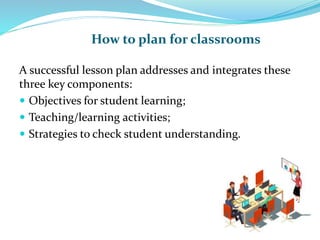
A successful lesson plan addresses and integrates these
three key components:
 Objectives for student learning;
 Teaching/learning activities;
 Strategies to check student understanding.
How to plan for classrooms
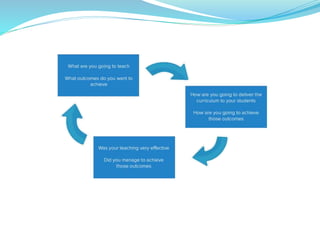
1. Outlining stage
Creating an overview of the curriculum, desirable
outcomes, learning objectives etc. Structuring the
timeline for the plan. Gathering data and
teaching/course materials.
2. Decision stage
Decision stage is where you create your plan, and decide
on what and how you are going to execute your plan.
Workflow of step by step implementation, delivery
methods, assessment techniques, backup options, etc.
comes under this section.
3. Mapping stage
Map the things which you have decided on with the
things you want to achieve. See if they align. If not, try to
rethink your decision.
The 3 Stages of lesson planning
Step 1. Create an outline of the curriculum you
want to cover
This is basically how you begin. Learn about what
you are going to teach and how deep your subjects are.
This will give you an overall idea about how big your
task is.
A few steps to walk you through the process
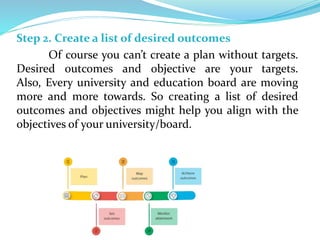
Step 2. Create a list of desired outcomes
Of course you can’t create a plan without targets.
Desired outcomes and objective are your targets.
Also, Every university and education board are moving
more and more towards. So creating a list of desired
outcomes and objectives might help you align with the
objectives of your university/board.
Step 3. Make another outline of the time —
year/semester.
Having an idea about the time frame can help you
plan better. The effectiveness of your plan depends on
intelligently distributing the curriculum across the
year/semester.
Step 4. Break curriculum down into small
manageable pieces
This could improve your productivity. Small tasks
would seem easy job and will get you through doing a
lot more than within short time. This could keep you
from procrastinating and help you maintain a better
control over the curriculum.
Step 5. Take time to decide which takes what time
Analyse the importance of each modules and
decide how much hours you want to spend on each
topics. Also decide which parts can be skipped or
omitted if you are pressed by time. And conversely,
which topics you can expand on if things moved faster
than expected. You can have a better authority over the
time if you know how much time you need beforehand.
Step 6. Spread them across the timeline
Spread the curriculum across the timeline
accordingly. This one is totally your call and you shall
decide how much you are going to cover within a given
period of time. You could also collaborate with other
faculties to have better inputs and fresh perspectives.
Step 7. Gather teaching materials and supporting
data
Besides the usual teaching materials, planning
gives you time to gather enough data and resources to
support your teaching. You could make use of books
and documents from outside the curriculum and new
technologies to assist your instruction. Techniques
like flipped learning and making use of technologies
like
Step 8. Decide on how you are going to share course
materials with students
The interactions you have with your students are
really important. You could save a lot of time and
optimise the efficiency by implementing ICT enabled
education to share course materials and other important
documents.
Step 9. Decide how you are going to assess students,
exams, assignments, projects, tasks etc.
Deciding the assessment mechanisms and
evaluations beforehand can be of great help. The way
you assess will have an overall impact on the teaching,
and it gives you valuable insights on the course progress.
But to be prepared and to be able to effectively map your
outcomes to the curriculum, you might need to focus on
the evaluation techniques even before you begin the
semester.
General Principles in Selecting Learning Experiences
A variety of methods breaks the monotony and holds the
learners' interest.
Determine opportunities to use different methods and
resources, combined appropriately, depending on the topic to
be taught.
Select methods and learning experiences that give
opportunities to practise the behaviour implied in the
learning objective.
Use a variety of experiences and methods that are less
tutor/facilitator centred and more learner centred.
Ensure that the instructional media you choose will help to
achieve the objectives and facilitate the learning of new
content.
General Principles in Selecting Learning Experiences
 Experiential
 Learning
 Visualization in Participatory Programmes (VIPP)
 Lecturette
 Discussions
 Role-plays
 Case studies/Scenarios
 Brainstorming
 Guest Speakers
Evaluating the Effectiveness of the Curriculum and
Course in Achieving the Objectives
 Curriculum and course evaluation is the process of determining the
degree to which these changes in behaviour are actually taking place. It
implies that it must involve more than a single appraisal.
 The process of evaluation determines the degree to which changes in
the learners’ behaviour are taking place.
 Evaluation must appraise the behaviour of the learners at an early stage
and other appraisals at later points to identify changes that may be
occurring. Without knowing what the learners were like at the
beginning it is not possible to tell how far changes have taken place.
 The most commonly used methods of evaluation include tests, attitude
scales, data gathering instruments such as interviews and observation
schedules, and practicals. These methods should be used either singly
or in combination.
 The method that is used must be appropriate to the objective that is
being evaluated.
 Student results
Of course the most evident of outcomes. The results of your students and their performance gives you solid feedback on
how well your plan works, and how effective it is. You could reflect on it and resort to making improvements and
improvisations in your plan.
 See whether if it provides any insights
Your plan should ultimately provide some insights to you. It should help you realise your time management skills, teaching
skills, and valid information about the curriculum.
 Contributions into the teaching learning process
The plan should also contribute to the curriculum and the teaching-learning process. It should help all the stakeholders
keep a better track of the course and help them take more informed decision at the right time. Having a well-worked plan
could seriously improve how you, and your students perceive the curriculum. It gets things organised and accessible.
 Check for productivity
See if your course plan helps you increase you productivity. Obviously the lesson plan can help you tackle problems more
effectively. It keeps you informed which saves time and energy. This way, your plan could tap into your productivity
potential which you didn’t even know existed. You will be better equipped to complete tasks and evaluate outcomes faster.
 How this plan helps the students
While planning, take time to assess how it helps your students. A good lesson plan should contribute into the results and
productivity of your students too. A plan should benefit your students and keep them on track. Discussing the
whereabouts of the plan with your students will give them a clear picture of what to achieve and expect. This could have a
positive impact in the classroom and the desired outcomes.
 Gathering feedback
Along the way till the end, you must gather feedback from the stakeholder and measurable metrics. Continuous evaluation
and gathering feedbacks is one of the most important aspects of Outcome Based Education (OBE). Feedback is the easiest
way to know if your plan is working or not. Your plan should be considered flawed if it does not give room for feedbacks.
How to assess your plan
Improvising plans on the way
The mark of a great teacher is the ability to infer what their students
need. The education should ultimately be student centric. Along the
curriculum till the end, a teacher must consistently take feedback and perform
course-correction in their plan. No matter how good your plan is, there can
always be room for unexpected twists and turns in your way.
Be that if the results of your pupils way lower than you expected, or if the time
allocated for a module was cut short by some extracurricular activities; all
kinds of things can go wrong. So the best thing you can do is to be prepared,
and be ready to improvise the plan if needed. Continuous evaluation and
keeping a close watch on your goals can help you take the right decisions at the
right time.
Thank you!

Learning tool M1T4: Organize the learning process

  • 1.
    Module 1: Trainingprogram organization PreparingTutorsfor WorkBasedLearning Developed in the framework of the Erasmus+ Project 2018-1-RO01-KA202-049191 TOTVET - Training of Tutors and VET professionals for high quality in Work Based Learning and Dual Learning This publication reflects the views only of the author, and the Commission cannot be held responsible for any use which may be made of the information contained therein.
  • 2.
    Summary In this LeaningTool you will: learn  How the curriculum is taught, structured and how the students learn;  How to create a succesfull course plan;  Instructional planning happens when a teacher is able to visualise and forecast the future of what, why, and how of the teaching- learning process. understand  Planning is important. No matter if it’s for your classroom, going to a supermarket, or buying a car. In education, a well-worked out course/lesson plan will act as a core of teaching-learning process. be able to  Planning a course plan using attractive methods.
  • 3.
    Summary  Main issues: Planningand strategy in teaching-learning process 1. Why is planning so important 2. How to plan for classrooms 3. The 3 Stages of lesson planning 4. A few steps to walk you through the process 5. How to assess your plan
  • 4.
    Why is planningso important Planning is a roadmap to the instructor’s success. Whenever you make a plan, you know what you want to achieve. At the same time, it becomes clear what the future might hold and what your goals are. Your goals, which has been decided by planning, makes your decision making more efficient and more ‘to the point’. This is because you know that how a decision will affect your plan in the long term and whether or not, this decision will help you in achieving your goals. Thus it helps you make decisions faster. Planning takes a lot of time and effort. It’s easy to procrastinate or to tag it unnecessary. But once you realise the time and energy you save with proper planning, there’s no way you can unsee it. Something so simple as creating a lesson plan can be this transformational event which instantly takes your teaching to the next level.
  • 5.
    A successful lessonplan addresses and integrates these three key components:  Objectives for student learning;  Teaching/learning activities;  Strategies to check student understanding. How to plan for classrooms
  • 6.
    1. Outlining stage Creatingan overview of the curriculum, desirable outcomes, learning objectives etc. Structuring the timeline for the plan. Gathering data and teaching/course materials. 2. Decision stage Decision stage is where you create your plan, and decide on what and how you are going to execute your plan. Workflow of step by step implementation, delivery methods, assessment techniques, backup options, etc. comes under this section. 3. Mapping stage Map the things which you have decided on with the things you want to achieve. See if they align. If not, try to rethink your decision. The 3 Stages of lesson planning
  • 7.
    Step 1. Createan outline of the curriculum you want to cover This is basically how you begin. Learn about what you are going to teach and how deep your subjects are. This will give you an overall idea about how big your task is. A few steps to walk you through the process
  • 8.
    Step 2. Createa list of desired outcomes Of course you can’t create a plan without targets. Desired outcomes and objective are your targets. Also, Every university and education board are moving more and more towards. So creating a list of desired outcomes and objectives might help you align with the objectives of your university/board.
  • 9.
    Step 3. Makeanother outline of the time — year/semester. Having an idea about the time frame can help you plan better. The effectiveness of your plan depends on intelligently distributing the curriculum across the year/semester.
  • 10.
    Step 4. Breakcurriculum down into small manageable pieces This could improve your productivity. Small tasks would seem easy job and will get you through doing a lot more than within short time. This could keep you from procrastinating and help you maintain a better control over the curriculum.
  • 11.
    Step 5. Taketime to decide which takes what time Analyse the importance of each modules and decide how much hours you want to spend on each topics. Also decide which parts can be skipped or omitted if you are pressed by time. And conversely, which topics you can expand on if things moved faster than expected. You can have a better authority over the time if you know how much time you need beforehand.
  • 12.
    Step 6. Spreadthem across the timeline Spread the curriculum across the timeline accordingly. This one is totally your call and you shall decide how much you are going to cover within a given period of time. You could also collaborate with other faculties to have better inputs and fresh perspectives.
  • 13.
    Step 7. Gatherteaching materials and supporting data Besides the usual teaching materials, planning gives you time to gather enough data and resources to support your teaching. You could make use of books and documents from outside the curriculum and new technologies to assist your instruction. Techniques like flipped learning and making use of technologies like
  • 14.
    Step 8. Decideon how you are going to share course materials with students The interactions you have with your students are really important. You could save a lot of time and optimise the efficiency by implementing ICT enabled education to share course materials and other important documents.
  • 15.
    Step 9. Decidehow you are going to assess students, exams, assignments, projects, tasks etc. Deciding the assessment mechanisms and evaluations beforehand can be of great help. The way you assess will have an overall impact on the teaching, and it gives you valuable insights on the course progress. But to be prepared and to be able to effectively map your outcomes to the curriculum, you might need to focus on the evaluation techniques even before you begin the semester.
  • 16.
    General Principles inSelecting Learning Experiences A variety of methods breaks the monotony and holds the learners' interest. Determine opportunities to use different methods and resources, combined appropriately, depending on the topic to be taught. Select methods and learning experiences that give opportunities to practise the behaviour implied in the learning objective. Use a variety of experiences and methods that are less tutor/facilitator centred and more learner centred. Ensure that the instructional media you choose will help to achieve the objectives and facilitate the learning of new content.
  • 17.
    General Principles inSelecting Learning Experiences  Experiential  Learning  Visualization in Participatory Programmes (VIPP)  Lecturette  Discussions  Role-plays  Case studies/Scenarios  Brainstorming  Guest Speakers
  • 18.
    Evaluating the Effectivenessof the Curriculum and Course in Achieving the Objectives  Curriculum and course evaluation is the process of determining the degree to which these changes in behaviour are actually taking place. It implies that it must involve more than a single appraisal.  The process of evaluation determines the degree to which changes in the learners’ behaviour are taking place.  Evaluation must appraise the behaviour of the learners at an early stage and other appraisals at later points to identify changes that may be occurring. Without knowing what the learners were like at the beginning it is not possible to tell how far changes have taken place.  The most commonly used methods of evaluation include tests, attitude scales, data gathering instruments such as interviews and observation schedules, and practicals. These methods should be used either singly or in combination.  The method that is used must be appropriate to the objective that is being evaluated.
  • 19.
     Student results Ofcourse the most evident of outcomes. The results of your students and their performance gives you solid feedback on how well your plan works, and how effective it is. You could reflect on it and resort to making improvements and improvisations in your plan.  See whether if it provides any insights Your plan should ultimately provide some insights to you. It should help you realise your time management skills, teaching skills, and valid information about the curriculum.  Contributions into the teaching learning process The plan should also contribute to the curriculum and the teaching-learning process. It should help all the stakeholders keep a better track of the course and help them take more informed decision at the right time. Having a well-worked plan could seriously improve how you, and your students perceive the curriculum. It gets things organised and accessible.  Check for productivity See if your course plan helps you increase you productivity. Obviously the lesson plan can help you tackle problems more effectively. It keeps you informed which saves time and energy. This way, your plan could tap into your productivity potential which you didn’t even know existed. You will be better equipped to complete tasks and evaluate outcomes faster.  How this plan helps the students While planning, take time to assess how it helps your students. A good lesson plan should contribute into the results and productivity of your students too. A plan should benefit your students and keep them on track. Discussing the whereabouts of the plan with your students will give them a clear picture of what to achieve and expect. This could have a positive impact in the classroom and the desired outcomes.  Gathering feedback Along the way till the end, you must gather feedback from the stakeholder and measurable metrics. Continuous evaluation and gathering feedbacks is one of the most important aspects of Outcome Based Education (OBE). Feedback is the easiest way to know if your plan is working or not. Your plan should be considered flawed if it does not give room for feedbacks. How to assess your plan
  • 21.
    Improvising plans onthe way The mark of a great teacher is the ability to infer what their students need. The education should ultimately be student centric. Along the curriculum till the end, a teacher must consistently take feedback and perform course-correction in their plan. No matter how good your plan is, there can always be room for unexpected twists and turns in your way. Be that if the results of your pupils way lower than you expected, or if the time allocated for a module was cut short by some extracurricular activities; all kinds of things can go wrong. So the best thing you can do is to be prepared, and be ready to improvise the plan if needed. Continuous evaluation and keeping a close watch on your goals can help you take the right decisions at the right time.
  • 22.