MARKETING MANAGEMENT 
SUBMITTED BY: 
ABHISHEK TIWARI 
ASHISH PAWAR 
AYUSH MAHESHWARI 
PRATIK GHOSH 
PALLAVI RANI 
RICHA PURI
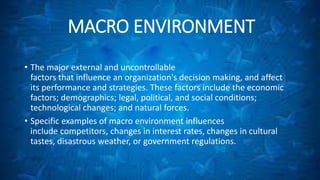
MACRO ENVIRONMENT 
• The major external and uncontrollable 
factors that influence an organization's decision making, and affect 
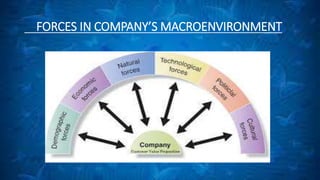
its performance and strategies. These factors include the economic 
factors; demographics; legal, political, and social conditions; 
technological changes; and natural forces. 
• Specific examples of macro environment influences 
include competitors, changes in interest rates, changes in cultural 
tastes, disastrous weather, or government regulations.
FORCES IN COMPANY’S MACROENVIRONMENT
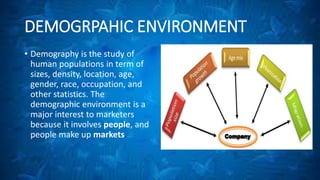
DEMOGRPAHIC ENVIRONMENT 
• Demography is the study of 
human populations in term of 
sizes, density, location, age, 
gender, race, occupation, and 
other statistics. The 
demographic environment is a 
major interest to marketers 
because it involves people, and 
people make up markets.
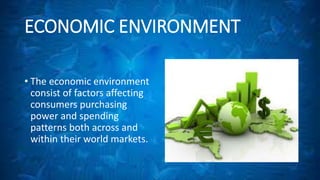
ECONOMIC ENVIRONMENT 
• The economic environment 
consist of factors affecting 
consumers purchasing 
power and spending 
patterns both across and 
within their world markets.
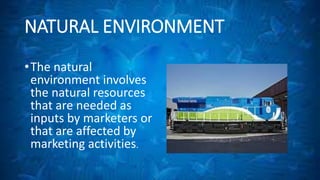
NATURAL ENVIRONMENT 
•The natural 
environment involves 
the natural resources 
that are needed as 
inputs by marketers or 
that are affected by 
marketing activities.
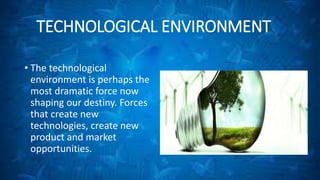
TECHNOLOGICAL ENVIRONMENT 
• The technological 
environment is perhaps the 
most dramatic force now 
shaping our destiny. Forces 
that create new 
technologies, create new 
product and market 
opportunities.
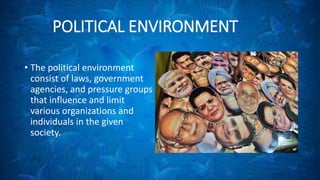
POLITICAL ENVIRONMENT 
• The political environment 
consist of laws, government 
agencies, and pressure groups 
that influence and limit 
various organizations and 
individuals in the given 
society.
CULTURAL ENVIRONMENT 
• The cultural environment 
is made up of institutions 
and other forces that 
affect a society’s basic 
values, perceptions, 
preferences, and 
behaviors.
CASE STUDY ON RELIANCE INDUSTRIES 
• Reliance Industries Limited (RIL) is 
an Indian conglomerate holding 
company headquartered in Mumbai, Maharashtra, 
India. The company operates in five major 
segments: exploration and production, refining and 
marketing, petrochemicals, retail and 
telecommunications. 
• The group is present in many business sectors 
across India including petrochemicals, 
construction, communications, energy, health care, 
science and technology, natural resources, retail, 
textiles, and logistics. 
• RIL is the second-largest publicly traded company 
in India by market capitalization and is the second 
largest company in India by revenue after the 
state-run Indian Oil Corporation. The company is 
ranked No. 99 on the Fortune Global 500 list of the 
world's biggest corporations, as of 2013.RIL 
contributes approximately 14% of India's total 
exports.
Is Mukesh Ambani falling out with the Narendra Modi government? Mukesh and Reliance Industries Ltd (RIL) 
have been at the receiving end of a couple of “strong” government decisions -- the biggest one being to keep gas 
price hike in abeyance. 
UPA-II had set April 1 as the date for the hike, but left it to the next government to take a final decision later. “It 
was expected that no sooner does Narendra Modi come to power, the hike would be announced. But that has 
not happened, giving the first indication that all was not well between Mukesh and the government,” said a 
source in the BJP. 
Sources also speculate that the government may be buying time before helping RIL. An e-mail sent to RIL late 
evening did not elicit any response. “It is too short a notice,” said the spokesperson. That has not happened in 
the first 45 days of Modi’s rule. This is being read as proof of a “rift between RIL and the Modi government”. 
That Reliance decided to hit back by deferring investments in fresh fields like the R-cluster in KG-D6 Block is 
also being taken as proof of a “fall from grace’ for RIL and Mukesh Ambani. A second reason, cited by sources 
in the BJP, for the alleged fallout between Mukesh and the government is linked to the CAG reports on 2G that 
indicated that RIL had rigged conditions in its favour to bag the 4G contract, and which it used to launder 
money. There is an AAP angle to this allegation, too. Supreme Court lawyer and AAP member Prashant 
Bhushan has filed a petition for the cancellation of RIL’s 4G deal. Coming in handy for Bhushan was the Modi 
government’s decision to bring back black money stashed away abroad in six months, for which the 
government set up a special investigation team (SIT).
The AAP troubleshooter forwarded a loaded letter to SIT on Black Money, alleging that Mukesh Ambani was a common 
money launderer, who used the 4G contract route to turn black money to white. “Reliance is laundering its ill-gotten 
profits from KG Basin through Singapore and depositing the same into accounts of Mr. Mukesh Ambani,” Bhushan 
wrote in his letter to ML Meena, member secretary, SIT on Black Money. “There have been two detailed CAG reports 
that says RIL is involved in inflation of capital expenditure, over-invoicing and siphoning of money from the KG 
Basin D6 Block. There is clear indication that such amounts are being laundered and funneled back into Reliance 
companies,” he said. The latest proof that RIL and the Modi government are not on the same page and that Modi 
will not go out of his way to smoothen things out for RIL is the $579million fine the government has slapped on RIL 
for continuous shortfall in KG Basin gas production. Gas price hike deferment led RIL and its other partners in KG-D6 
basin Niko Resources and British Petroleum to file arbitration against the government, which many considered as an 
arm-twisting exercise. Nonetheless, the new government has made it amply clear over the last two months through 
various announcements that it is not in favour of a sharp rise in gas price.. The oil ministry also slapped an 
additional penalty of $579 million for natural gas production shortfall from KG-D6 block for the financial year 2013- 
14. The penalty in the form of disallowing costs incurred on the field is for missing the target in 2013-14. With this, 
the total costs disallowed to RIL will increase to $2.375 billion. Another recent document which was passed by oil 
ministry to the cabinet committee also indicated that RIL should not be allowed new gas price for KG-D6 produce 
until it is able to meet the shortfall in gas output over the last four years.

Macro environment

  • 1.
    MARKETING MANAGEMENT SUBMITTEDBY: ABHISHEK TIWARI ASHISH PAWAR AYUSH MAHESHWARI PRATIK GHOSH PALLAVI RANI RICHA PURI
  • 2.
    MACRO ENVIRONMENT •The major external and uncontrollable factors that influence an organization's decision making, and affect its performance and strategies. These factors include the economic factors; demographics; legal, political, and social conditions; technological changes; and natural forces. • Specific examples of macro environment influences include competitors, changes in interest rates, changes in cultural tastes, disastrous weather, or government regulations.
  • 3.
    FORCES IN COMPANY’SMACROENVIRONMENT
  • 4.
    DEMOGRPAHIC ENVIRONMENT •Demography is the study of human populations in term of sizes, density, location, age, gender, race, occupation, and other statistics. The demographic environment is a major interest to marketers because it involves people, and people make up markets.
  • 5.
    ECONOMIC ENVIRONMENT •The economic environment consist of factors affecting consumers purchasing power and spending patterns both across and within their world markets.
  • 6.
    NATURAL ENVIRONMENT •Thenatural environment involves the natural resources that are needed as inputs by marketers or that are affected by marketing activities.
  • 7.
    TECHNOLOGICAL ENVIRONMENT •The technological environment is perhaps the most dramatic force now shaping our destiny. Forces that create new technologies, create new product and market opportunities.
  • 8.
    POLITICAL ENVIRONMENT •The political environment consist of laws, government agencies, and pressure groups that influence and limit various organizations and individuals in the given society.
  • 9.
    CULTURAL ENVIRONMENT •The cultural environment is made up of institutions and other forces that affect a society’s basic values, perceptions, preferences, and behaviors.
  • 10.
    CASE STUDY ONRELIANCE INDUSTRIES • Reliance Industries Limited (RIL) is an Indian conglomerate holding company headquartered in Mumbai, Maharashtra, India. The company operates in five major segments: exploration and production, refining and marketing, petrochemicals, retail and telecommunications. • The group is present in many business sectors across India including petrochemicals, construction, communications, energy, health care, science and technology, natural resources, retail, textiles, and logistics. • RIL is the second-largest publicly traded company in India by market capitalization and is the second largest company in India by revenue after the state-run Indian Oil Corporation. The company is ranked No. 99 on the Fortune Global 500 list of the world's biggest corporations, as of 2013.RIL contributes approximately 14% of India's total exports.
  • 11.
    Is Mukesh Ambanifalling out with the Narendra Modi government? Mukesh and Reliance Industries Ltd (RIL) have been at the receiving end of a couple of “strong” government decisions -- the biggest one being to keep gas price hike in abeyance. UPA-II had set April 1 as the date for the hike, but left it to the next government to take a final decision later. “It was expected that no sooner does Narendra Modi come to power, the hike would be announced. But that has not happened, giving the first indication that all was not well between Mukesh and the government,” said a source in the BJP. Sources also speculate that the government may be buying time before helping RIL. An e-mail sent to RIL late evening did not elicit any response. “It is too short a notice,” said the spokesperson. That has not happened in the first 45 days of Modi’s rule. This is being read as proof of a “rift between RIL and the Modi government”. That Reliance decided to hit back by deferring investments in fresh fields like the R-cluster in KG-D6 Block is also being taken as proof of a “fall from grace’ for RIL and Mukesh Ambani. A second reason, cited by sources in the BJP, for the alleged fallout between Mukesh and the government is linked to the CAG reports on 2G that indicated that RIL had rigged conditions in its favour to bag the 4G contract, and which it used to launder money. There is an AAP angle to this allegation, too. Supreme Court lawyer and AAP member Prashant Bhushan has filed a petition for the cancellation of RIL’s 4G deal. Coming in handy for Bhushan was the Modi government’s decision to bring back black money stashed away abroad in six months, for which the government set up a special investigation team (SIT).
  • 12.
    The AAP troubleshooterforwarded a loaded letter to SIT on Black Money, alleging that Mukesh Ambani was a common money launderer, who used the 4G contract route to turn black money to white. “Reliance is laundering its ill-gotten profits from KG Basin through Singapore and depositing the same into accounts of Mr. Mukesh Ambani,” Bhushan wrote in his letter to ML Meena, member secretary, SIT on Black Money. “There have been two detailed CAG reports that says RIL is involved in inflation of capital expenditure, over-invoicing and siphoning of money from the KG Basin D6 Block. There is clear indication that such amounts are being laundered and funneled back into Reliance companies,” he said. The latest proof that RIL and the Modi government are not on the same page and that Modi will not go out of his way to smoothen things out for RIL is the $579million fine the government has slapped on RIL for continuous shortfall in KG Basin gas production. Gas price hike deferment led RIL and its other partners in KG-D6 basin Niko Resources and British Petroleum to file arbitration against the government, which many considered as an arm-twisting exercise. Nonetheless, the new government has made it amply clear over the last two months through various announcements that it is not in favour of a sharp rise in gas price.. The oil ministry also slapped an additional penalty of $579 million for natural gas production shortfall from KG-D6 block for the financial year 2013- 14. The penalty in the form of disallowing costs incurred on the field is for missing the target in 2013-14. With this, the total costs disallowed to RIL will increase to $2.375 billion. Another recent document which was passed by oil ministry to the cabinet committee also indicated that RIL should not be allowed new gas price for KG-D6 produce until it is able to meet the shortfall in gas output over the last four years.