The PPP & ESA
teaching methods
Camila Roldán - Practice II - 2014
P
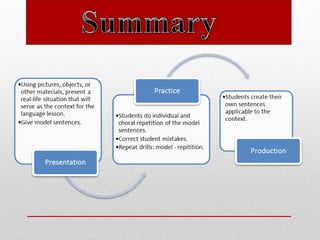
• The first stage, 'Presentation‘, is where the teacher firstly finds
out how much of the target language (for example
the grammar or vocabulary to be taught) the students know. This
is called "eliciting.“
• The teacher will then present the language structure, usually on a
board. 
• The students are generally expected to listen during this part of
the lesson and their opportunities to speak are limited.
• In the second part of the lesson, the students are given
controlled practice of the target language.
• This could be in the form of oral exercises, targeted at
individual students, or in the form of worksheets during early
stages.
• Again, this part of the lesson is very teacher-led. Often more
than one activity is given, each one allowing the students
progressively more freedom to produce the language
themselves.
• The third part of the lesson is where the students start to
produce language more freely. 
• For example, they might be given role play situations to devise
and act out, they may have free writing exercises, or there
may be other opportunities to produce the language they have
been working on.
1. Firstly, the amount of teacher talking time is disproportionately high
compared to the amount of student talking time, certainly in the first
part of the lesson.
2. It encourages accuracy over fluency, and this is not always the
desired outcome of a course.
3. Thirdly, it does not allow for recap, or movement between the
different stages. This is where the ESA method is often preferred
now.
ESA
• It allows for much more flexibility, and lessons often move
between the different stages. 
• However, the same basic structure is given, with the need for
presentation of some kind before any practice is given. 
• In the ESA method, there is more emphasis on student-led
grammar discovery, eliciting the grammar from students rather
than giving a detailed (and often boring!) teacher-led
presentation. 
• The final stage, with free practice, is the same as the last
stage of PPP.
The ESA teaching method
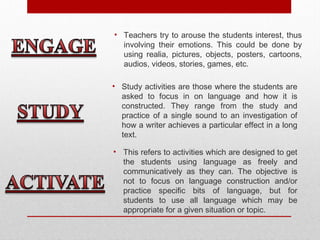
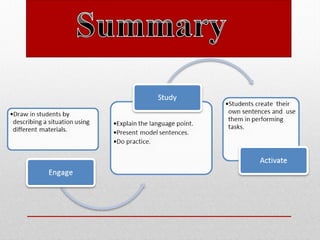
• Teachers try to arouse the students interest, thus
involving their emotions. This could be done by
using realia, pictures, objects, posters, cartoons,
audios, videos, stories, games, etc.
• Study activities are those where the students are
asked to focus in on language and how it is
constructed. They range from the study and
practice of a single sound to an investigation of
how a writer achieves a particular effect in a long
text.
• This refers to activities which are designed to get
the students using language as freely and
communicatively as they can. The objective is
not to focus on language construction and/or
practice specific bits of language, but for
students to use all language which may be
appropriate for a given situation or topic.
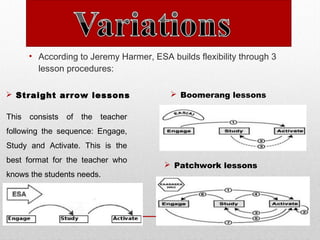
• According to Jeremy Harmer, ESA builds flexibility through 3
lesson procedures:
 Straight arrow lessons
This consists of the teacher
following the sequence: Engage,
Study and Activate. This is the
best format for the teacher who
knows the students needs.
 Boomerang lessons
 Patchwork lessons

The PPP & ESA teaching methods

  • 1.
    The PPP &ESA teaching methods Camila Roldán - Practice II - 2014
  • 2.
  • 3.
    • The firststage, 'Presentation‘, is where the teacher firstly finds out how much of the target language (for example the grammar or vocabulary to be taught) the students know. This is called "eliciting.“ • The teacher will then present the language structure, usually on a board.  • The students are generally expected to listen during this part of the lesson and their opportunities to speak are limited.
  • 4.
    • In thesecond part of the lesson, the students are given controlled practice of the target language. • This could be in the form of oral exercises, targeted at individual students, or in the form of worksheets during early stages. • Again, this part of the lesson is very teacher-led. Often more than one activity is given, each one allowing the students progressively more freedom to produce the language themselves.
  • 5.
    • The thirdpart of the lesson is where the students start to produce language more freely.  • For example, they might be given role play situations to devise and act out, they may have free writing exercises, or there may be other opportunities to produce the language they have been working on.
  • 7.
    1. Firstly, theamount of teacher talking time is disproportionately high compared to the amount of student talking time, certainly in the first part of the lesson. 2. It encourages accuracy over fluency, and this is not always the desired outcome of a course. 3. Thirdly, it does not allow for recap, or movement between the different stages. This is where the ESA method is often preferred now.
  • 8.
  • 9.
    • It allowsfor much more flexibility, and lessons often move between the different stages.  • However, the same basic structure is given, with the need for presentation of some kind before any practice is given.  • In the ESA method, there is more emphasis on student-led grammar discovery, eliciting the grammar from students rather than giving a detailed (and often boring!) teacher-led presentation.  • The final stage, with free practice, is the same as the last stage of PPP. The ESA teaching method
  • 10.
    • Teachers tryto arouse the students interest, thus involving their emotions. This could be done by using realia, pictures, objects, posters, cartoons, audios, videos, stories, games, etc. • Study activities are those where the students are asked to focus in on language and how it is constructed. They range from the study and practice of a single sound to an investigation of how a writer achieves a particular effect in a long text. • This refers to activities which are designed to get the students using language as freely and communicatively as they can. The objective is not to focus on language construction and/or practice specific bits of language, but for students to use all language which may be appropriate for a given situation or topic.
  • 12.
    • According toJeremy Harmer, ESA builds flexibility through 3 lesson procedures:  Straight arrow lessons This consists of the teacher following the sequence: Engage, Study and Activate. This is the best format for the teacher who knows the students needs.  Boomerang lessons  Patchwork lessons