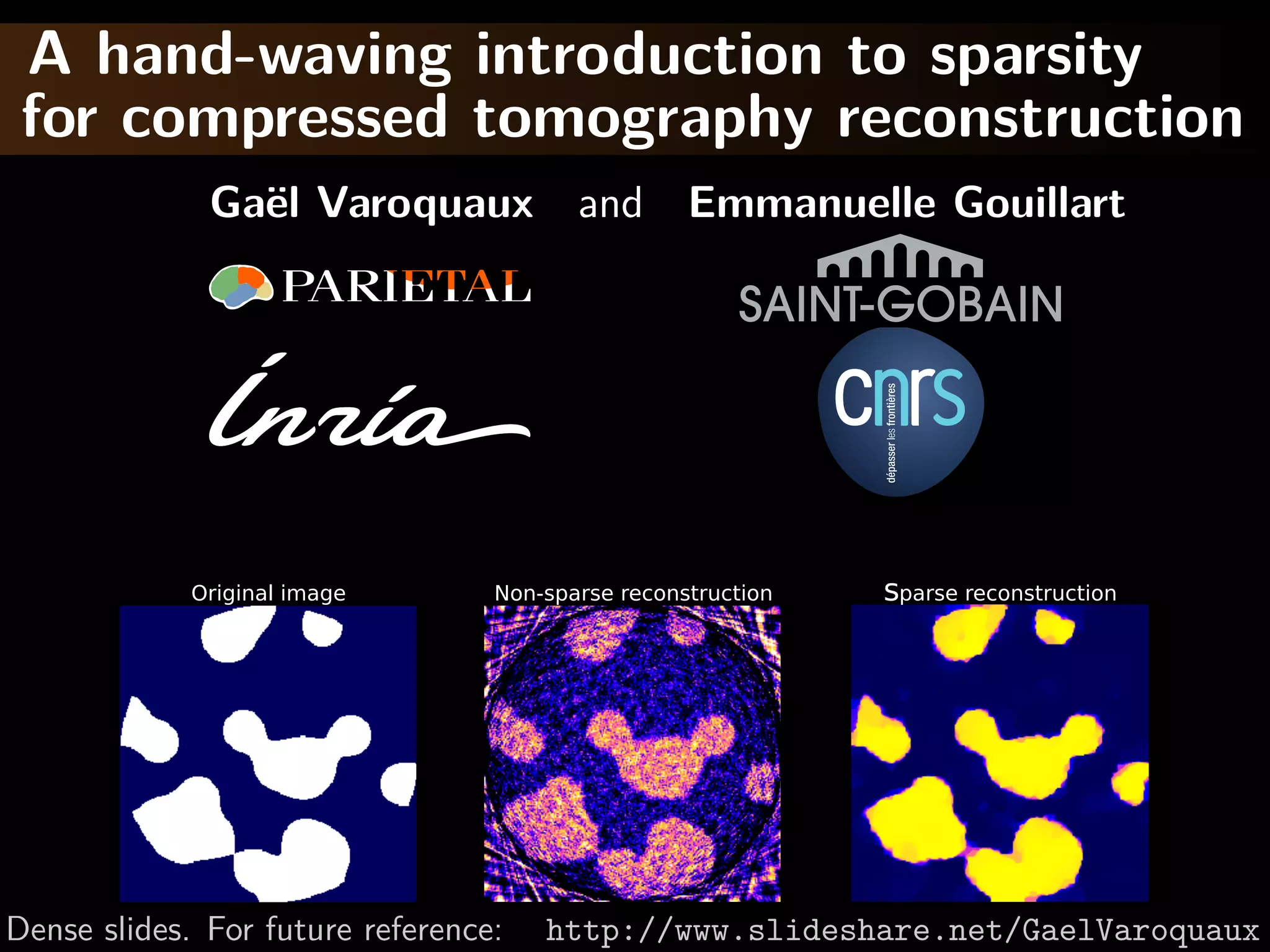
A hand-waving introduction to sparsity
 for compressed tomography reconstruction
              Ga¨l Varoquaux and Emmanuelle Gouillart
                e


Dense slides. For future reference:   http://www.slideshare.net/GaelVaroquaux
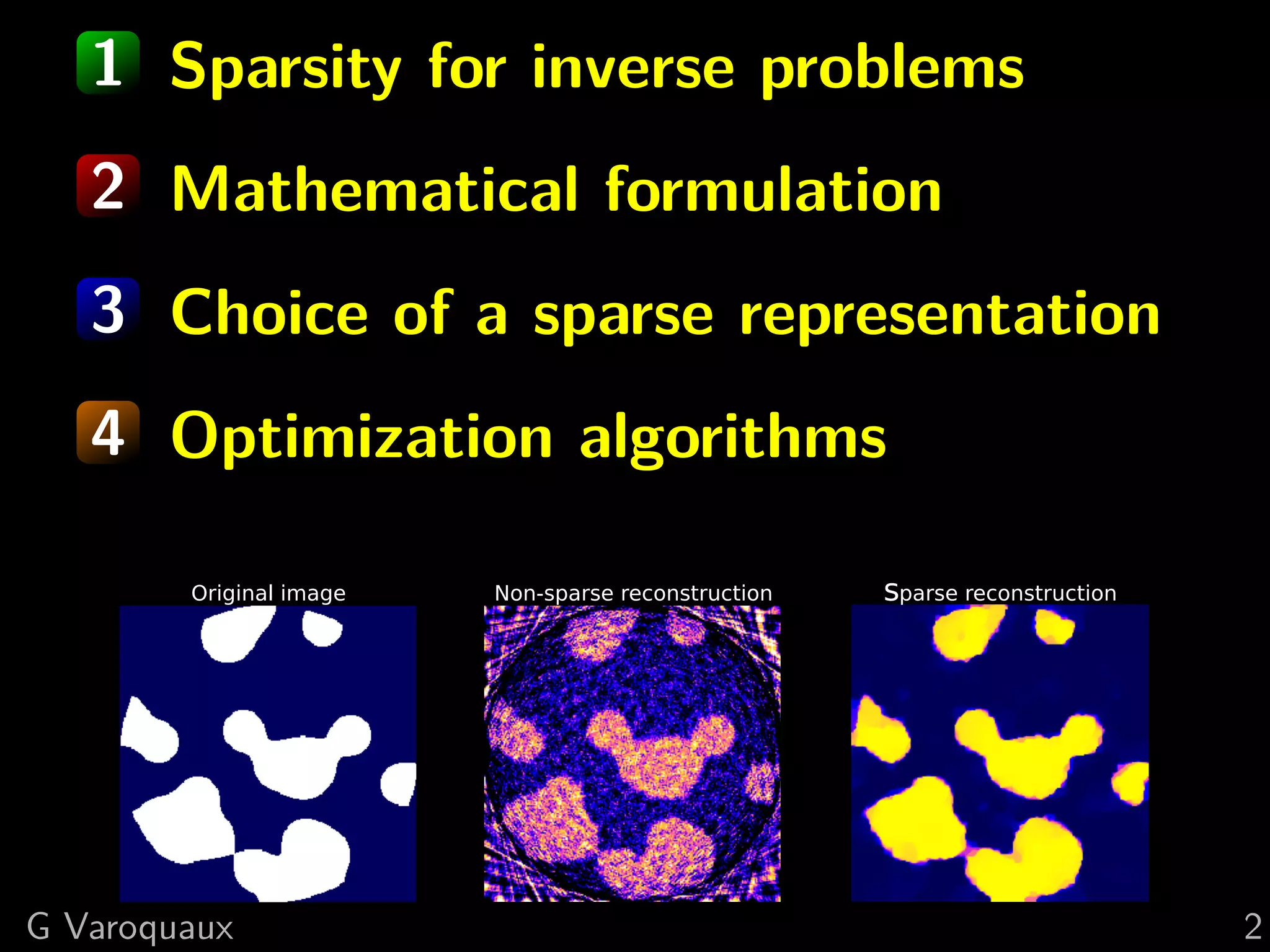
1 Sparsity for inverse problems
   2 Mathematical formulation
   3 Choice of a sparse representation
   4 Optimization algorithms


G Varoquaux                              2
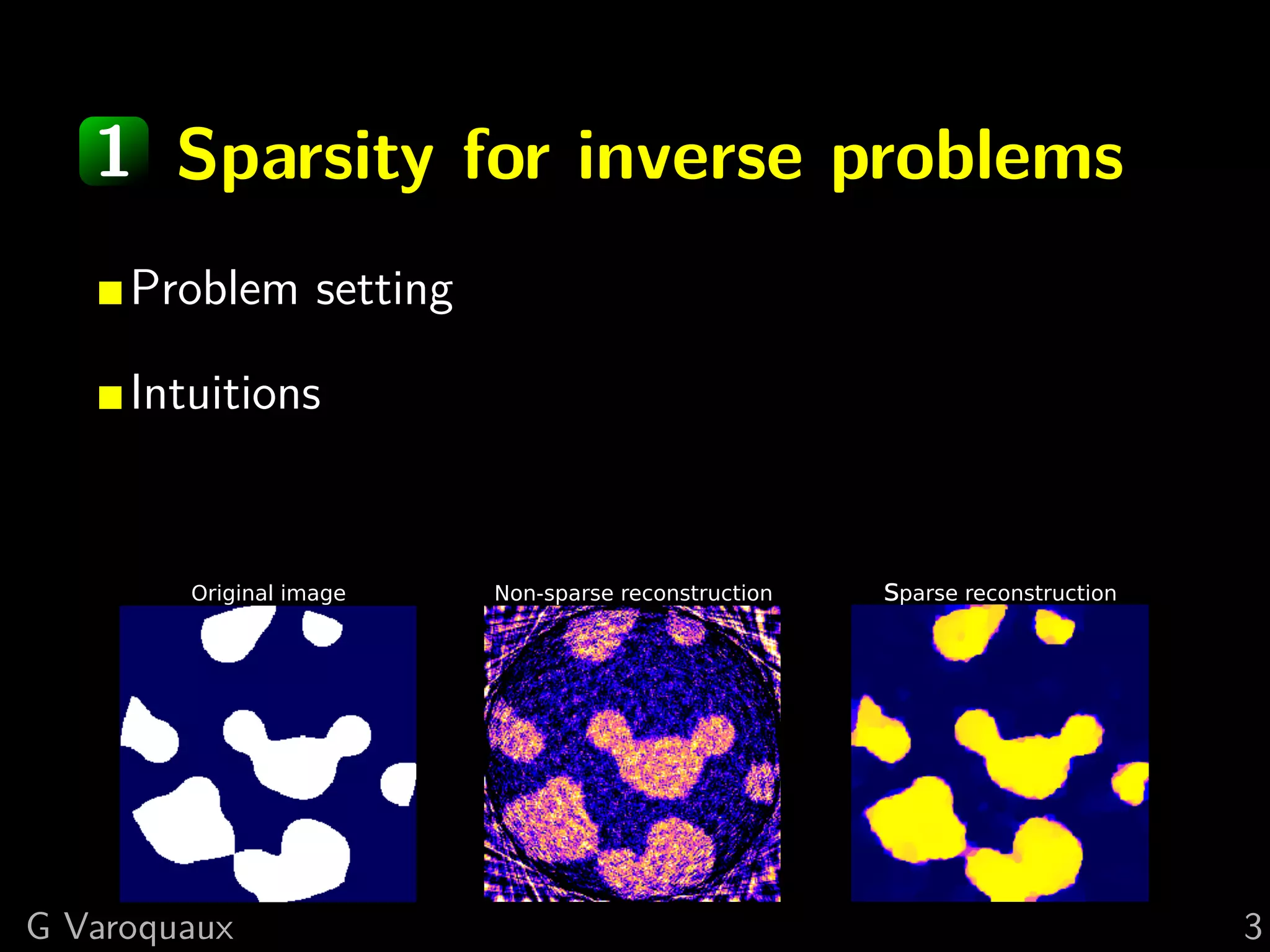
1 Sparsity for inverse problems
     Problem setting

     Intuitions


G Varoquaux                          3
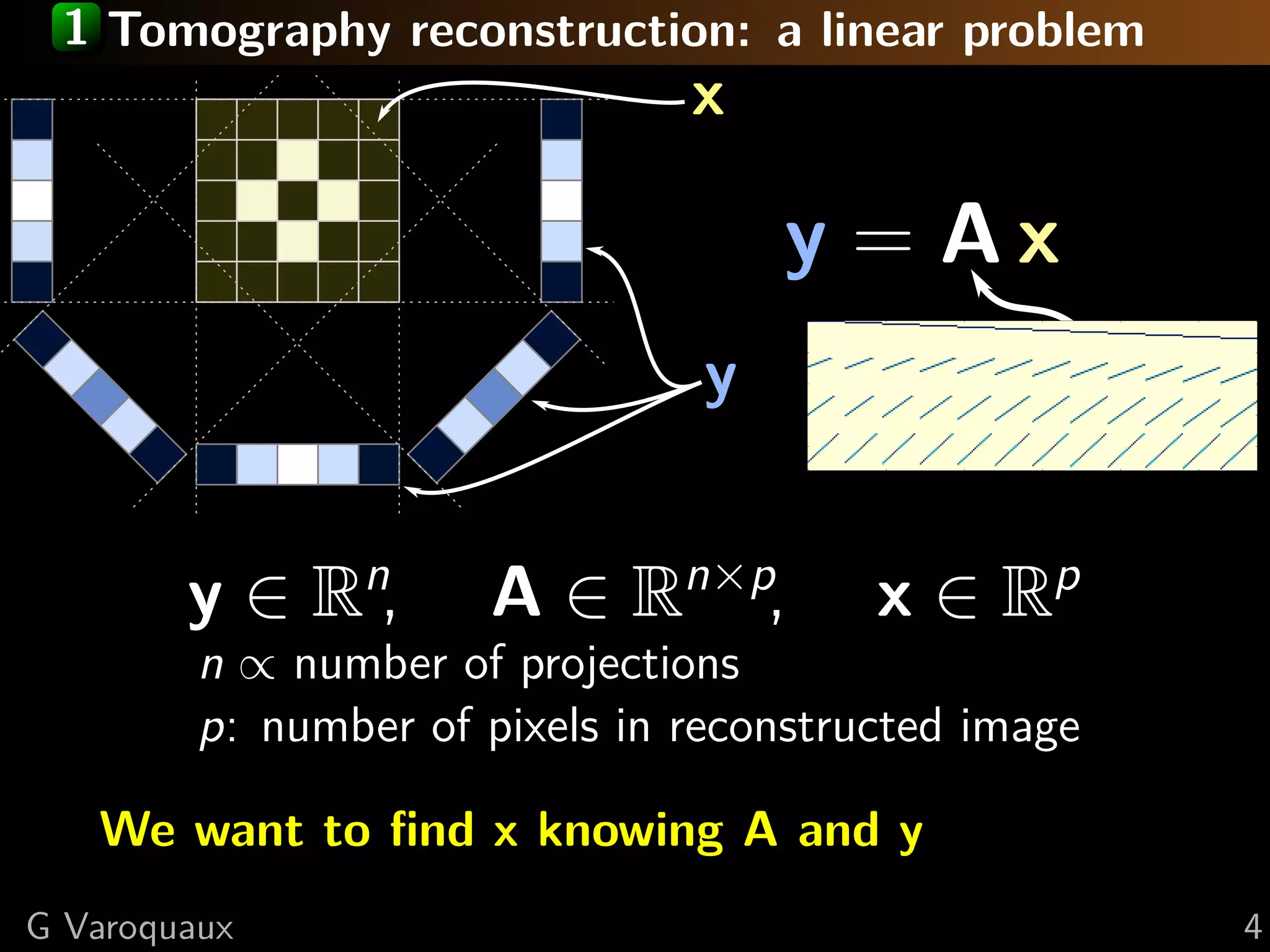
1 Tomography reconstruction: a linear problem


                                    y = Ax
                                      0


                                     20


                                     40


                                     60


                                     80


                                          0   50   100   150   200   250


        y ∈ Rn,       A ∈ Rn×p,               x ∈ Rp
         n ∝ number of projections
         p: number of pixels in reconstructed image

   We want to find x knowing A and y
G Varoquaux                                                                4
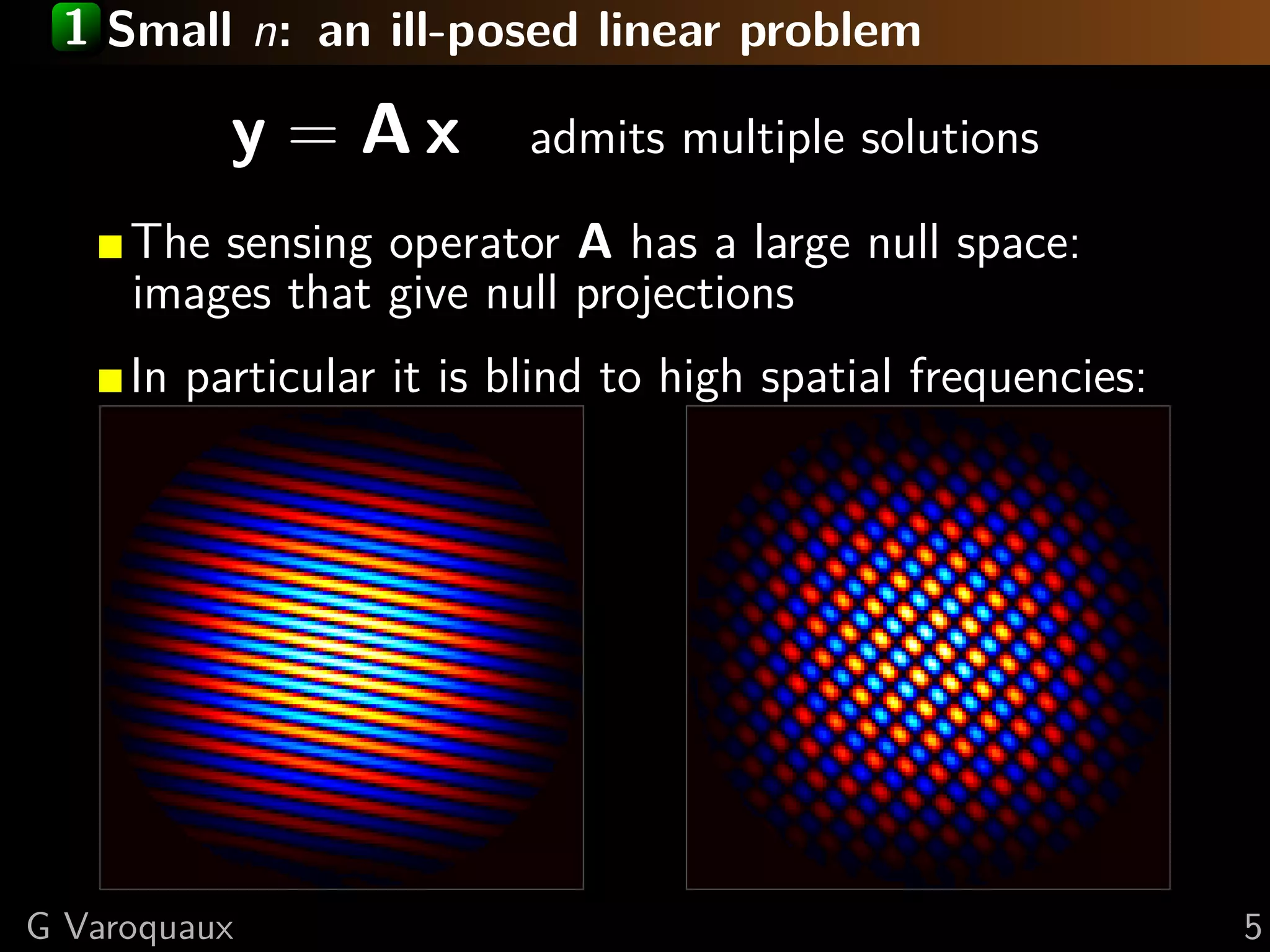
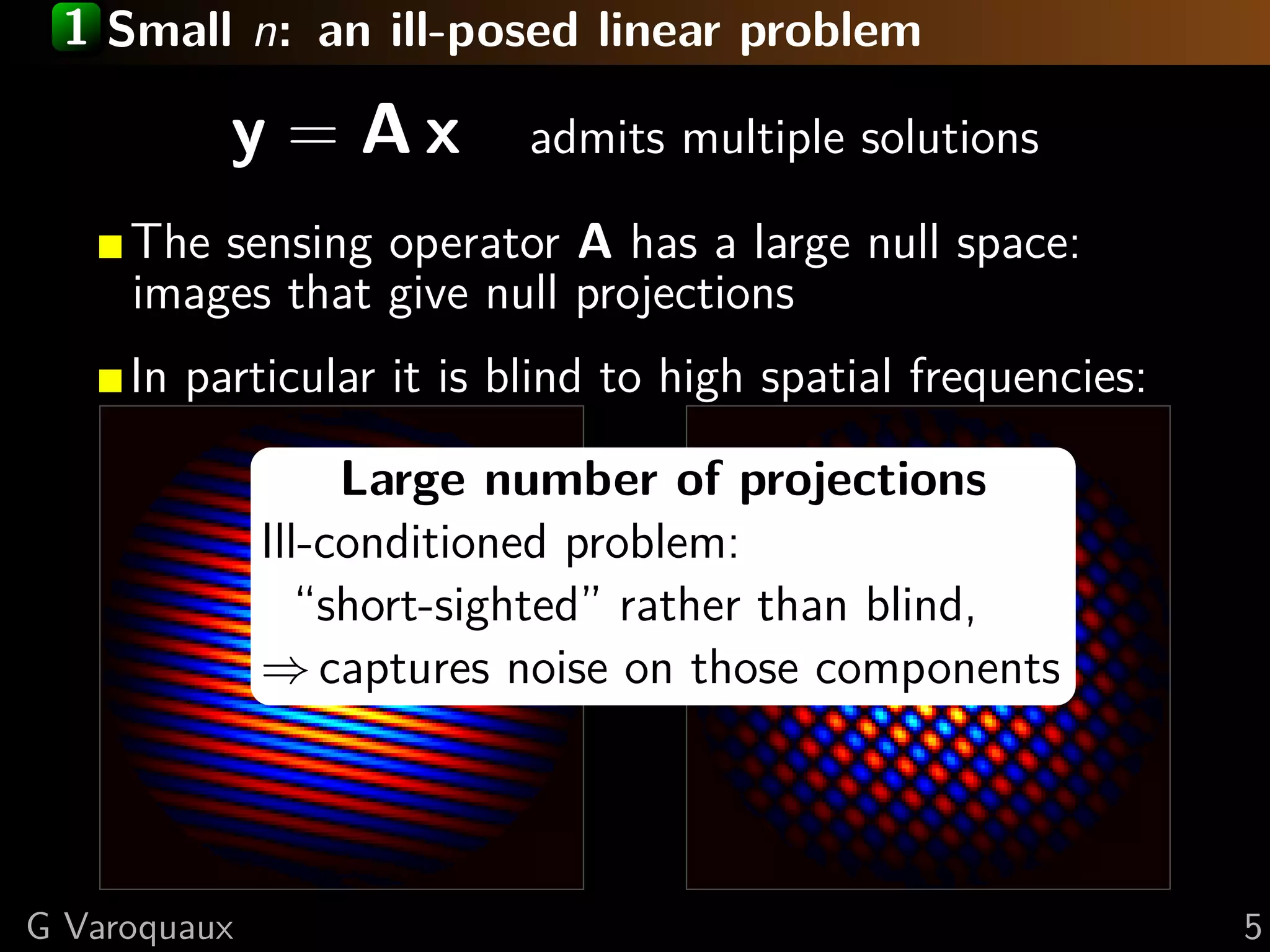
1 Small n: an ill-posed linear problem

          y = Ax          admits multiple solutions

     The sensing operator A has a large null space:
     images that give null projections
     In particular it is blind to high spatial frequencies:


G Varoquaux                                                   5
1 Small n: an ill-posed linear problem

          y = Ax          admits multiple solutions

     The sensing operator A has a large null space:
     images that give null projections
     In particular it is blind to high spatial frequencies:

                   Large number of projections
              Ill-conditioned problem:
                 “short-sighted” rather than blind,
              ⇒ captures noise on those components


G Varoquaux                                                   5
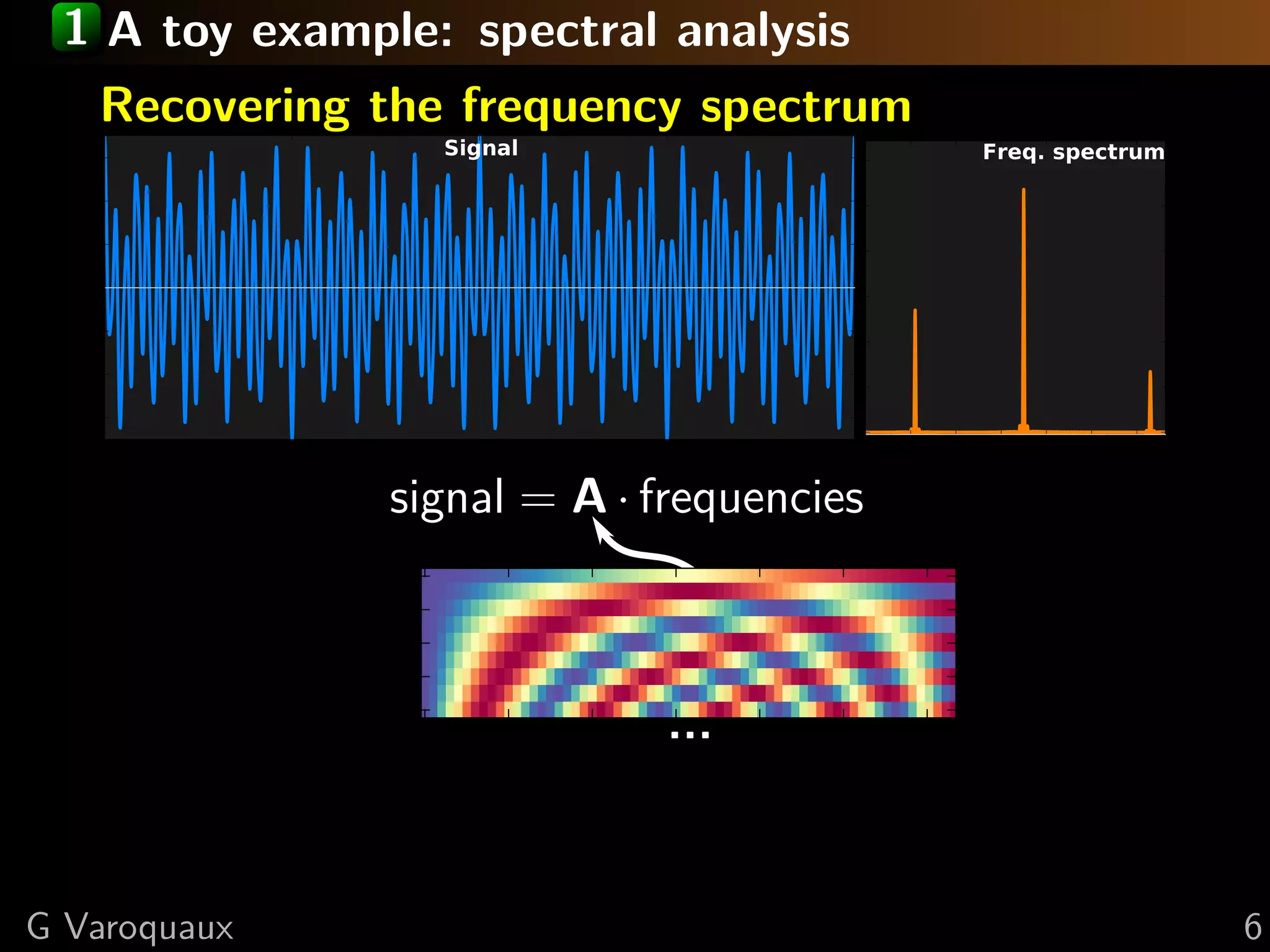
1 A toy example: spectral analysis
   Recovering the frequency spectrum
                       Signal                          Freq. spectrum


               signal = A · frequencies
               0
               2
               4
               6
               8                     ...
                   0      10    20   30 40   50   60


G Varoquaux                                                             6
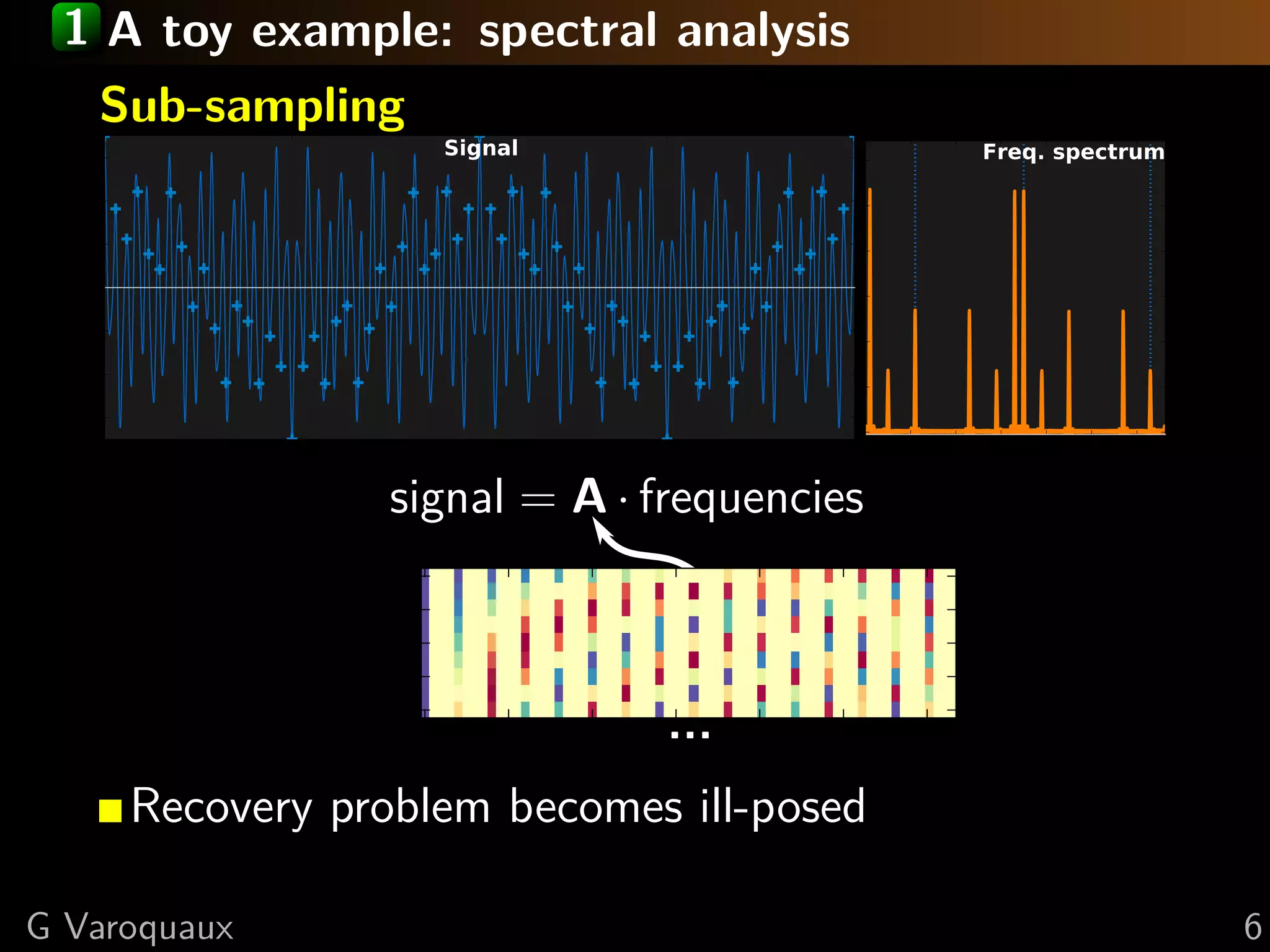
1 A toy example: spectral analysis
   Sub-sampling
                         Signal                          Freq. spectrum


                signal = A · frequencies
                 0
                 2
                 4
                 6
                 8                     ...
                     0      10    20   30 40   50   60
     Recovery problem becomes ill-posed

G Varoquaux                                                               6
1 A toy example: spectral analysis
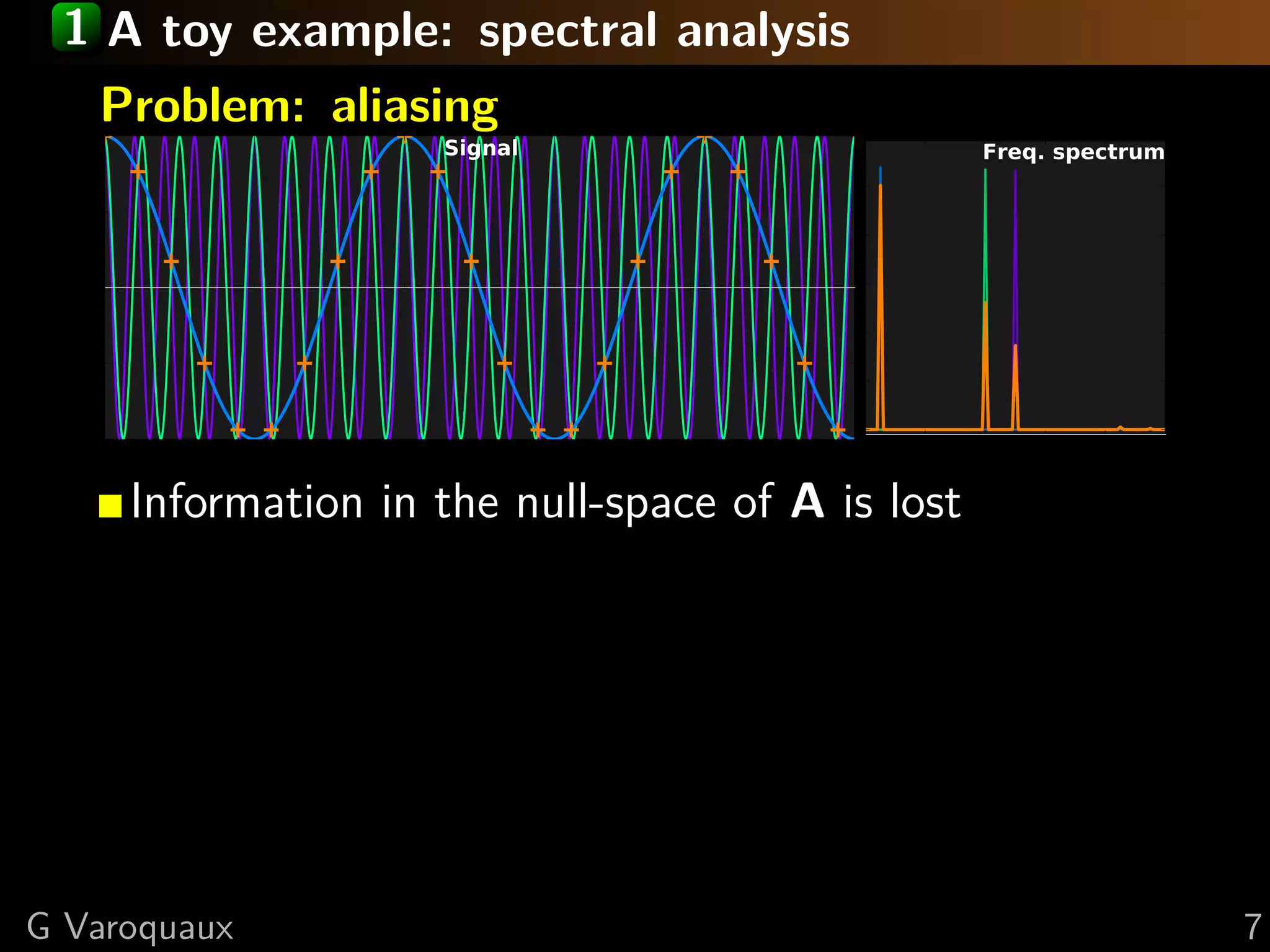
   Problem: aliasing
                    Signal                        Freq. spectrum


     Information in the null-space of A is lost


G Varoquaux                                                        7
1 A toy example: spectral analysis
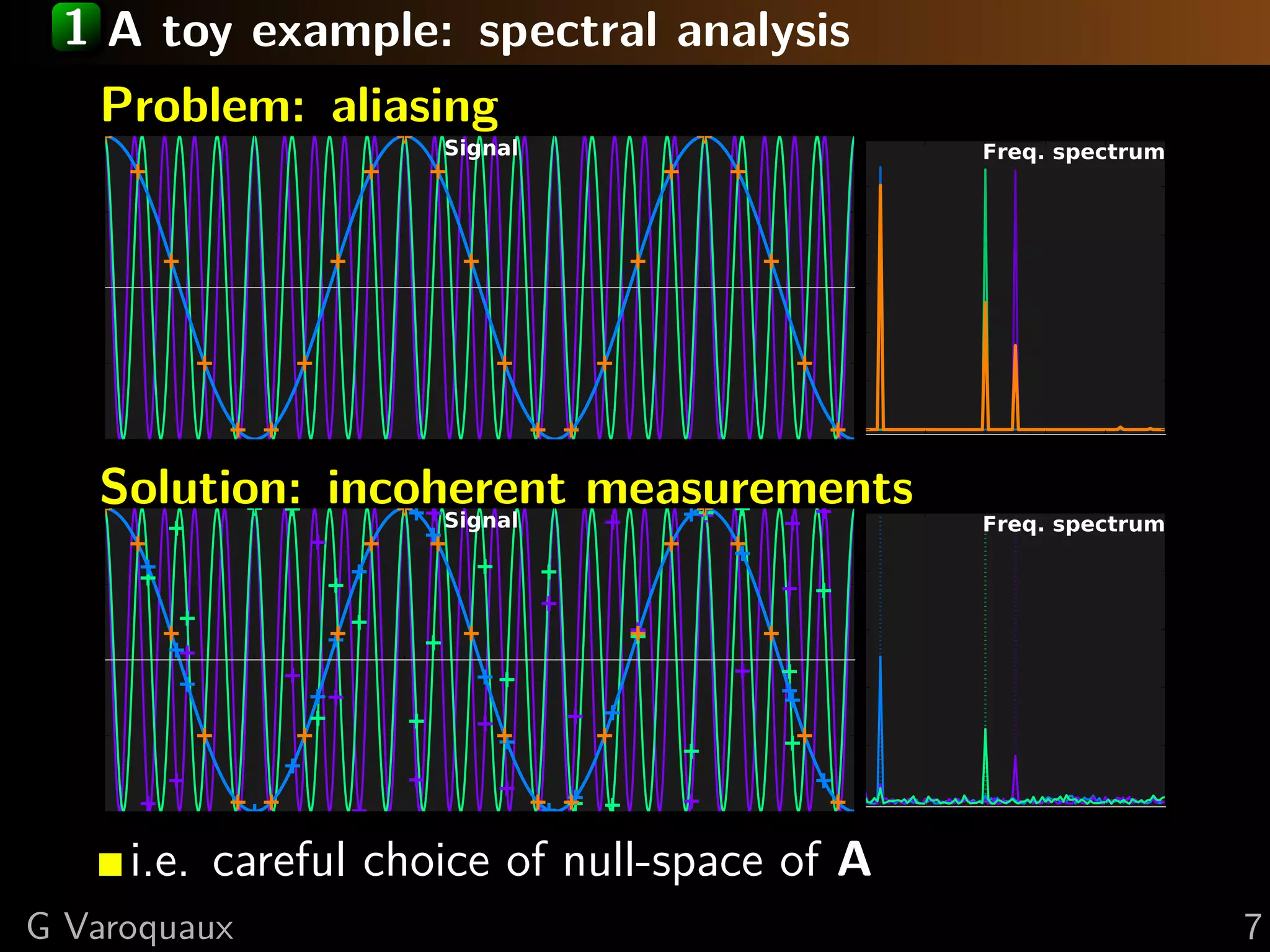
   Problem: aliasing
                     Signal                   Freq. spectrum


   Solution: incoherent measurements
                  Signal                      Freq. spectrum


     i.e. careful choice of null-space of A
G Varoquaux                                                    7
1 A toy example: spectral analysis
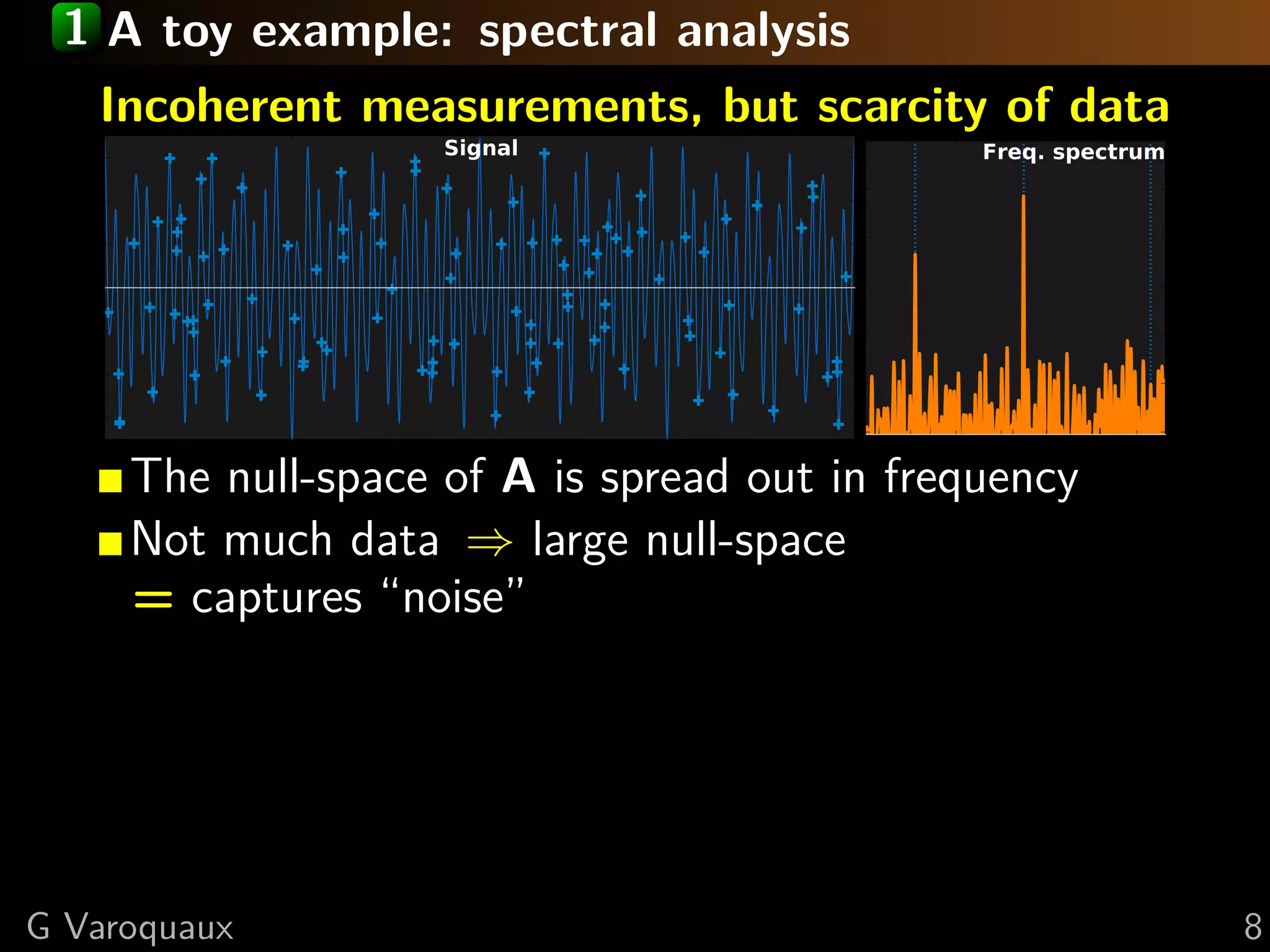
   Incoherent measurements, but scarcity of data
                    Signal                    Freq. spectrum


     The null-space of A is spread out in frequency
     Not much data ⇒ large null-space
     = captures “noise”


G Varoquaux                                                    8
1 A toy example: spectral analysis
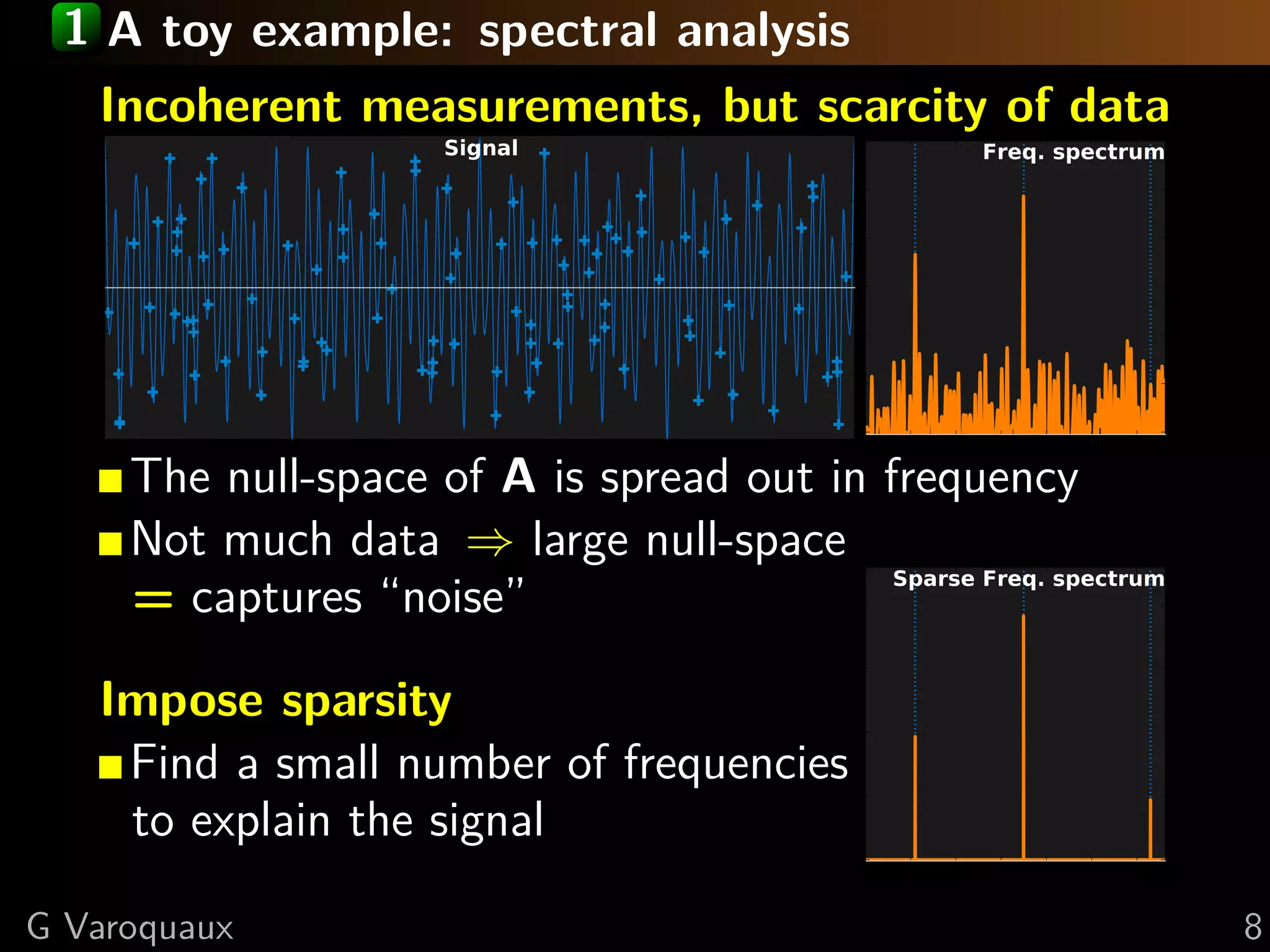
   Incoherent measurements, but scarcity of data
                      Signal                         Freq. spectrum


     The null-space of A is spread out in frequency
     Not much data ⇒ large null-space
                                           Sparse Freq. spectrum
     = captures “noise”

   Impose sparsity
    Find a small number of frequencies
    to explain the signal

G Varoquaux                                                           8
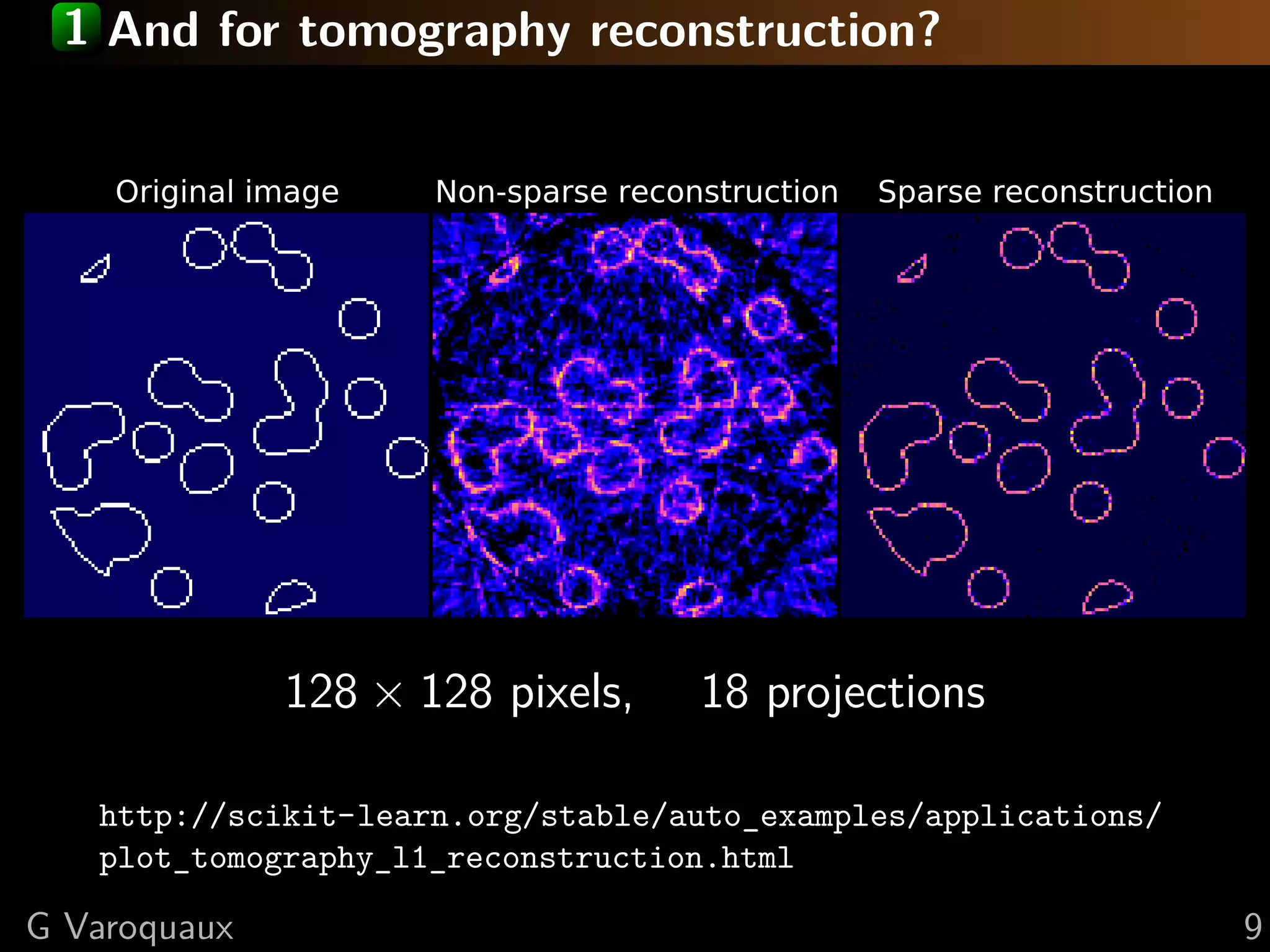
1 And for tomography reconstruction?


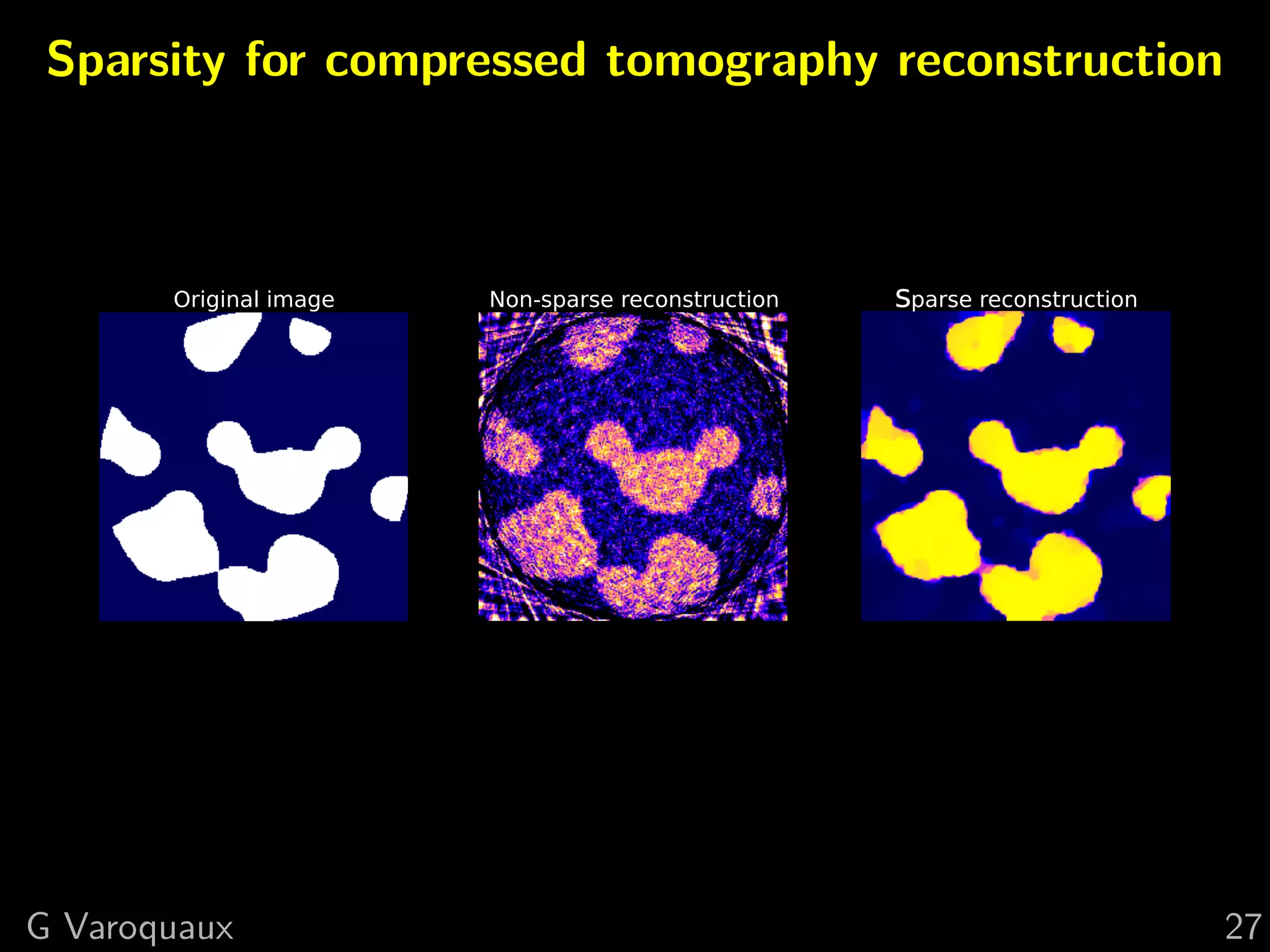
    Original image   Non-sparse reconstruction Sparse reconstruction


              128 × 128 pixels,      18 projections

   http://scikit-learn.org/stable/auto_examples/applications/
   plot_tomography_l1_reconstruction.html

G Varoquaux                                                            9
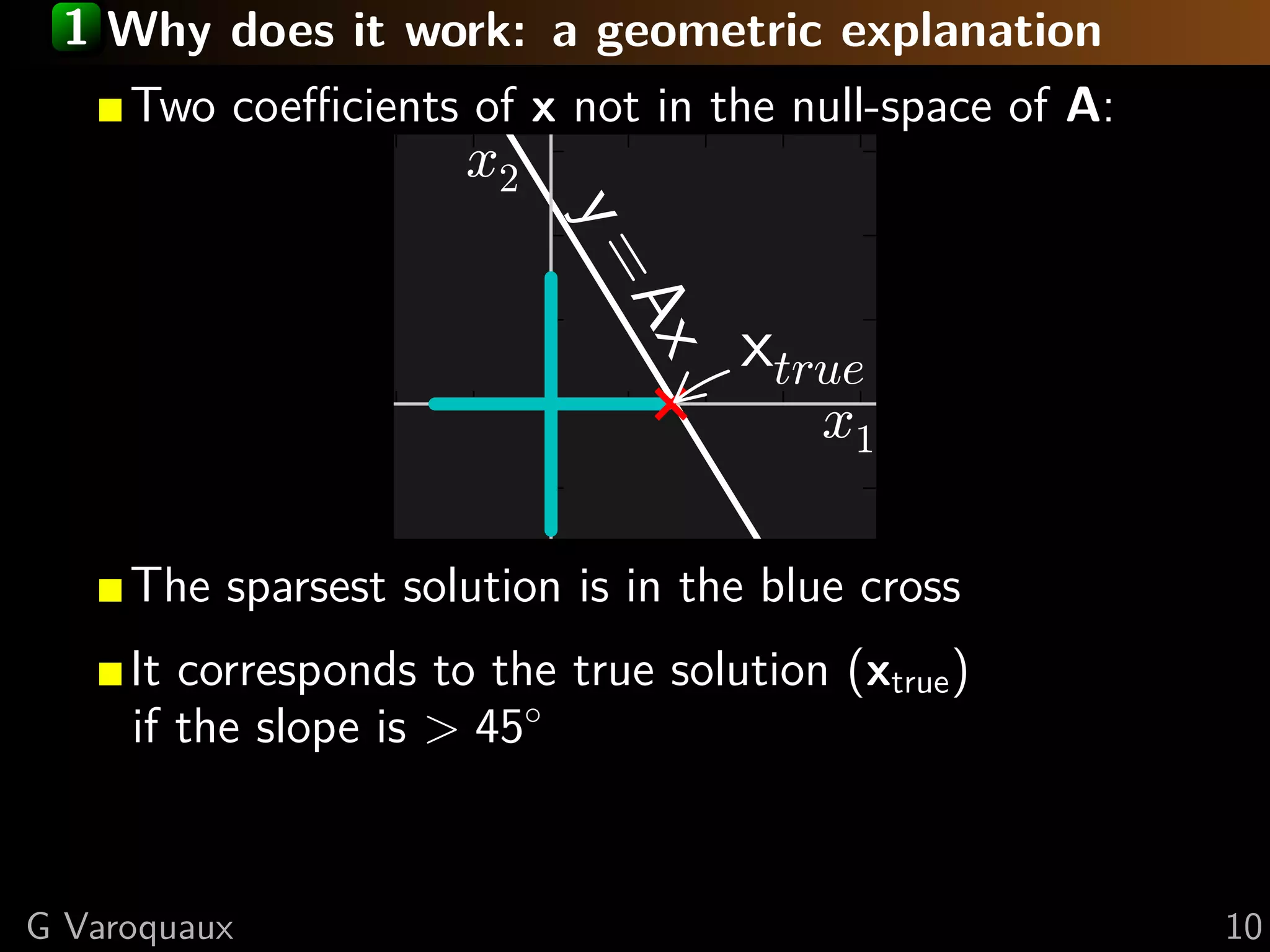
1 Why does it work: a geometric explanation
     Two coefficients of x not in the null-space of A:
                      x2


                           y=
                              Ax
                                     xtrue
                                         x1
     The sparsest solution is in the blue cross
     It corresponds to the true solution (xtrue )
     if the slope is > 45◦


G Varoquaux                                            10
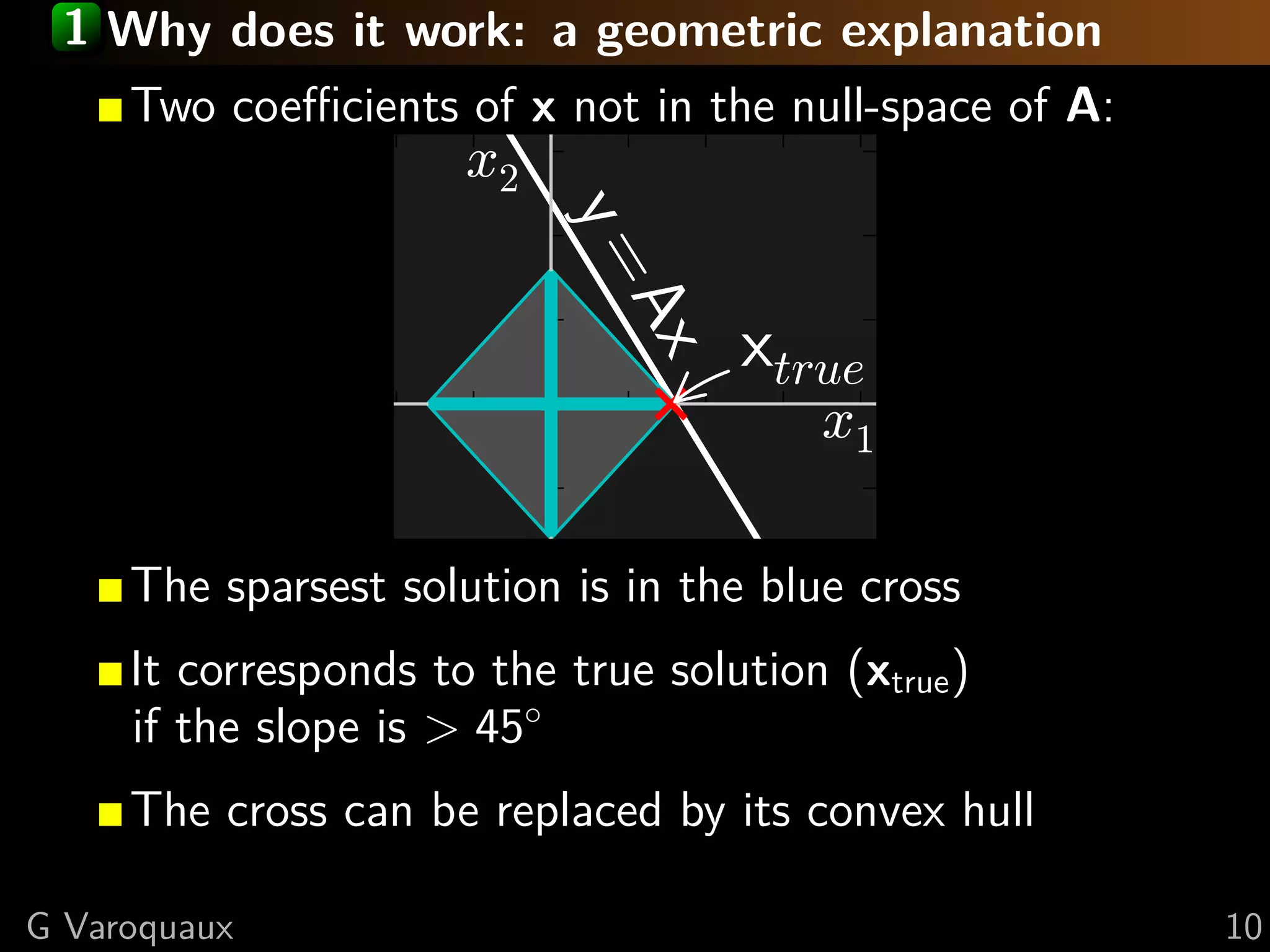
1 Why does it work: a geometric explanation
     Two coefficients of x not in the null-space of A:
                      x2


                           y=
                              Ax
                                     xtrue
                                         x1
     The sparsest solution is in the blue cross
     It corresponds to the true solution (xtrue )
     if the slope is > 45◦
     The cross can be replaced by its convex hull

G Varoquaux                                            10
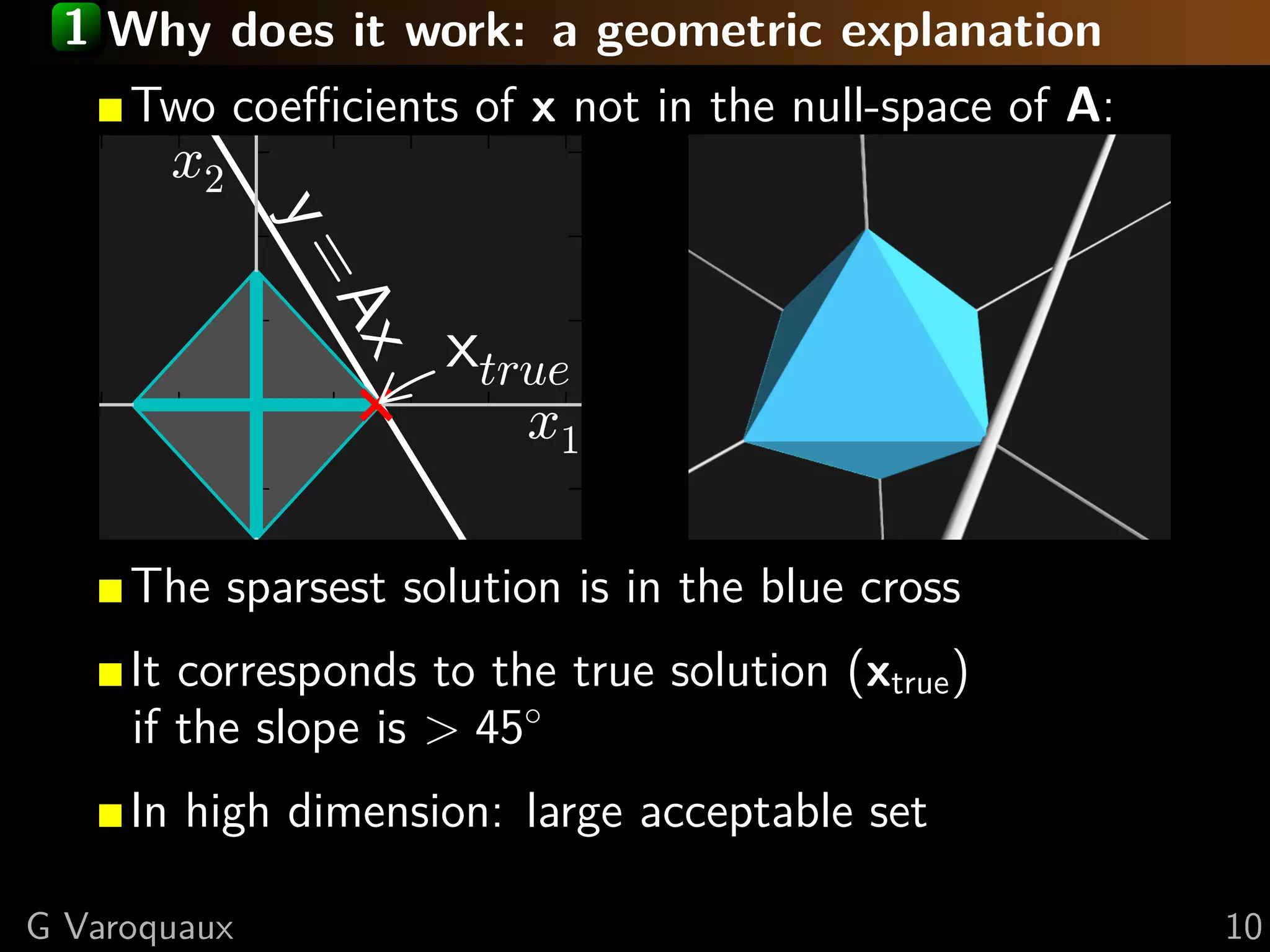
1 Why does it work: a geometric explanation
     Two coefficients of x not in the null-space of A:
       x2
              y=
              Ax     xtrue
                         x1
     The sparsest solution is in the blue cross
     It corresponds to the true solution (xtrue )
     if the slope is > 45◦
     In high dimension: large acceptable set

G Varoquaux                                            10
Recovery of sparse signal

     Null space of sensing operator incoherent
     with sparse representation

  ⇒ Excellent sparse recovery with little projections

      Minimum number of observations necessary:
      nmin ∼ k log p, with k: number of non zeros

                                           [Candes 2006]
   Rmk Theory for i.i.d. samples
       Related to “compressive sensing”
G Varoquaux                                                11
2 Mathematical formulation
     Variational formulation

     Introduction of noise


G Varoquaux                     12
2 Maximizing the sparsity
      0   number of non-zeros
              min 0(x)
               x
                                s.t. y = A x
                       x2


                            y=
                                Ax
                                     xtrue
                                        x1
     “Matching pursuit” problem         [Mallat, Zhang 1993]
     “Orthogonal matching pursuit”           [Pati, et al 1993]

              Problem: Non-convex optimization
G Varoquaux                                                       13
2 Maximizing the sparsity
      1 (x)   =   i   |xi |
              min 1(x)
               x
                                    s.t. y = A x
                              x2


                                   y=
                                   Ax
                                         xtrue
                                             x1
     “Basis pursuit”                [Chen, Donoho, Saunders 1998]


G Varoquaux                                                         13
2 Modeling observation noise

      y = Ax + e             e = observation noise
     New formulation:
                                              2
      min 1 (x)
       x
                   s.t. y = A x      y − Ax   2   ≤ ε2

     Equivalent: “Lasso estimator”       [Tibshirani 1996]

                      2
   min y − Ax
    x                 2   + λ 1(x)


G Varoquaux                                                  14
2 Modeling observation noise

      y = Ax + e               e = observation noise
     New formulation:
                                                       2
      min 1 (x)
       x
                   s.t. y = A x          y − Ax        2    ≤ ε2

     Equivalent: “Lasso estimator”               [Tibshirani 1996]

                      2
                                                x2
   min y − Ax
    x                 2   + λ 1(x)

         Data fit          Penalization                                        x1
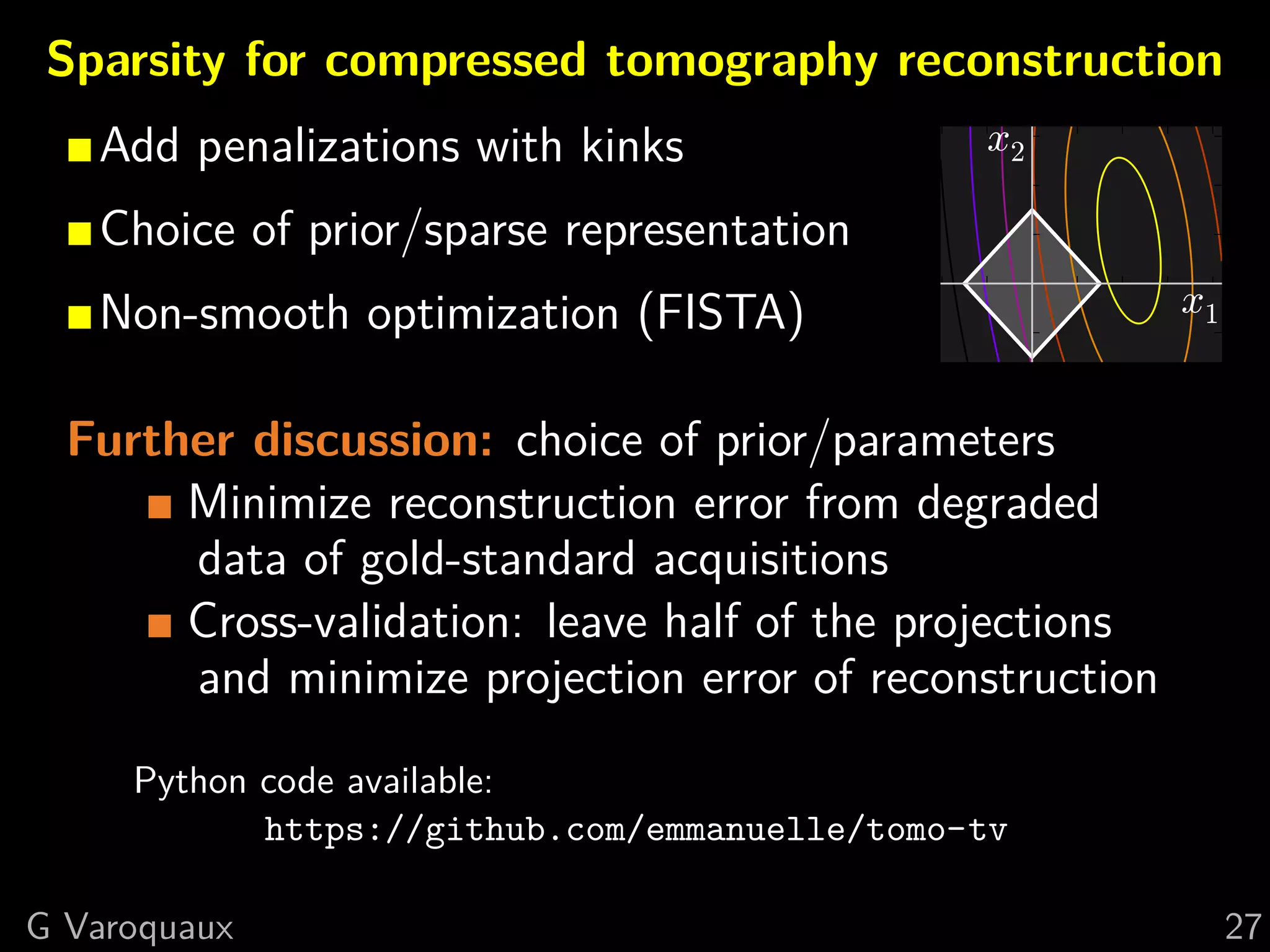
                                         Rmk: kink in the   1   ball creates sparsity

G Varoquaux                                                                       14
2 Probabilistic modeling: Bayesian interpretation
                        P(x|y) ∝ P(y|x) P(x)                                     ( )

 “Posterior”                   Forward model                                “Prior”
 Quantity of interest                                                 Expectations on x

     Forward model: y = A x + e, e: Gaussian noise
          ⇒ P(y|x) ∝ exp − 2 1 2 y − A x 2
                             σ           2

                                               1
     Prior: Laplacian             P(x) ∝ exp − µ x                     1


                                       1                      2       1
   Negated log of ( ):                2σ 2    y − Ax          2   +   µ 1 (x)

           Maximum of posterior is Lasso estimate
                Note that this picture is limited and the Lasso is not a good
G Varoquaux      Bayesian estimator for the Laplace prior [Gribonval 2011].            15
3 Choice of a sparse
     representation
     Sparse in wavelet domain

     Total variation


G Varoquaux                     16
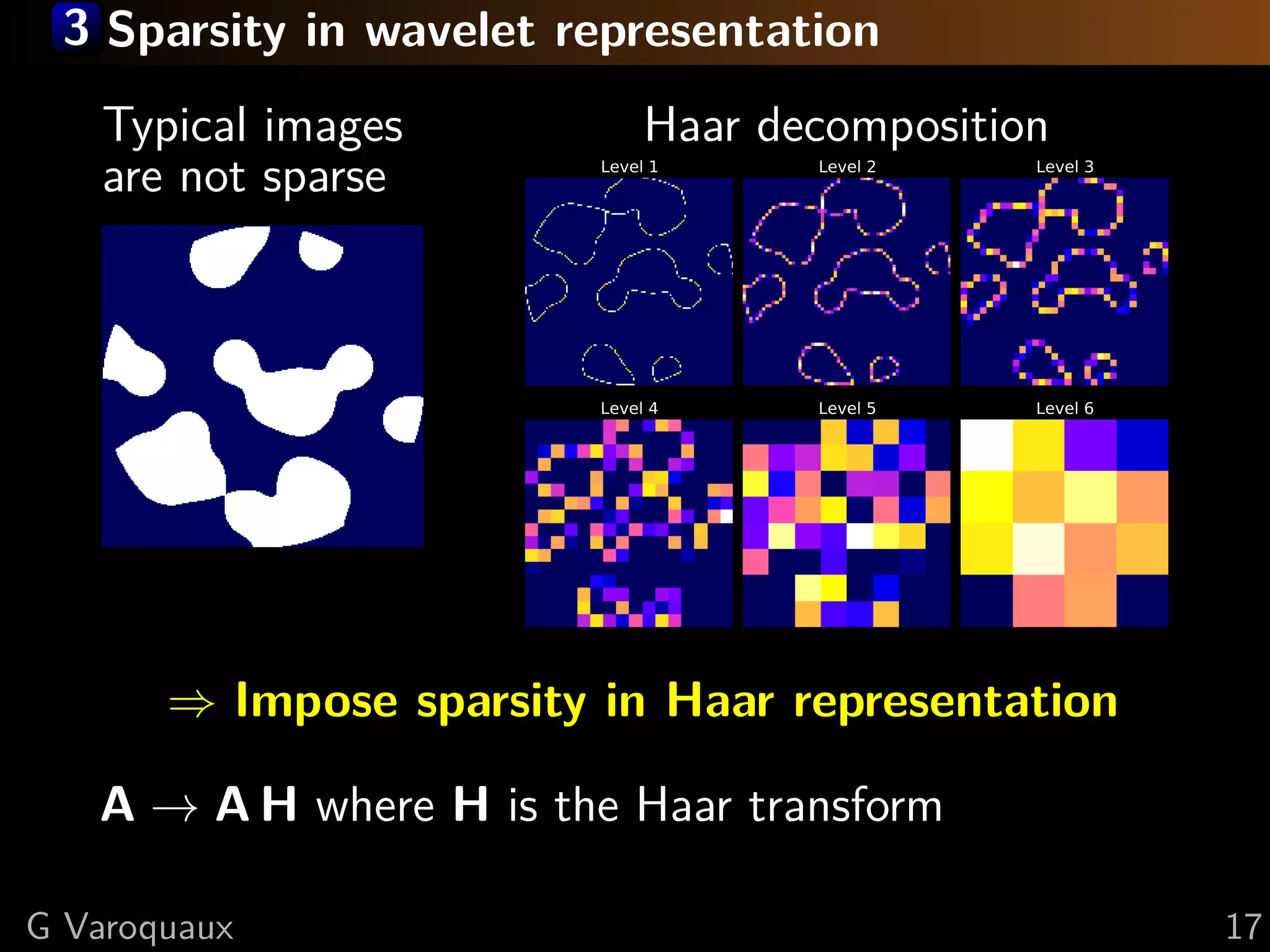
3 Sparsity in wavelet representation
    Typical images            Haar decomposition
                         Level 1     Level 2   Level 3
    are not sparse


                         Level 4     Level 5   Level 6


       ⇒ Impose sparsity in Haar representation

   A → A H where H is the Haar transform

G Varoquaux                                              17
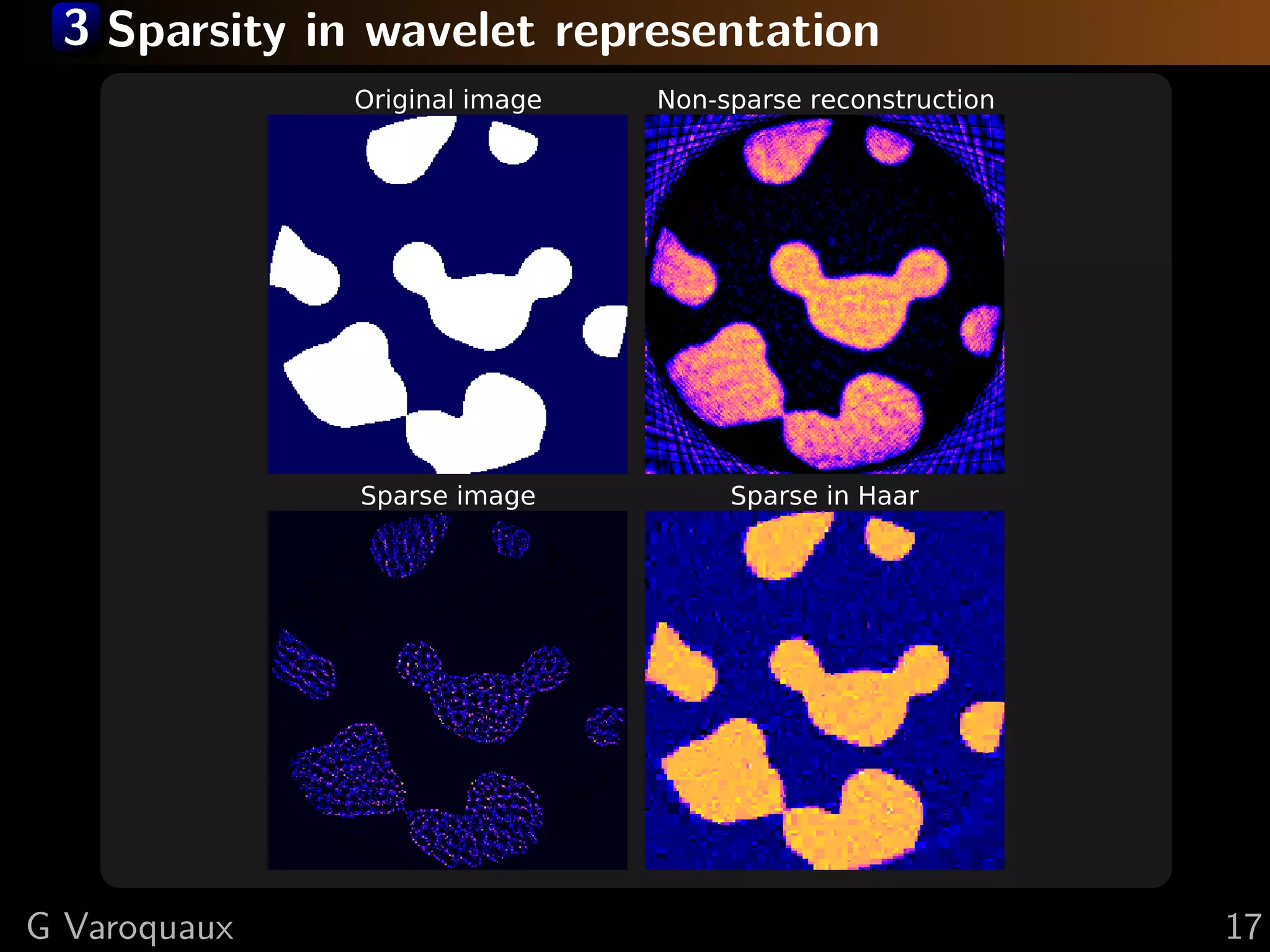
3 Sparsity in wavelet representation
               Original image         Non-sparse reconstruction
    Typical images                   Haar decomposition
                                Level 1          Level 2          Level 3
    are not sparse


                                Level 4          Level 5          Level 6


                Sparse image               Sparse in Haar


       ⇒ Impose sparsity in Haar representation

   A → A H where H is the Haar transform

G Varoquaux                                                                 17
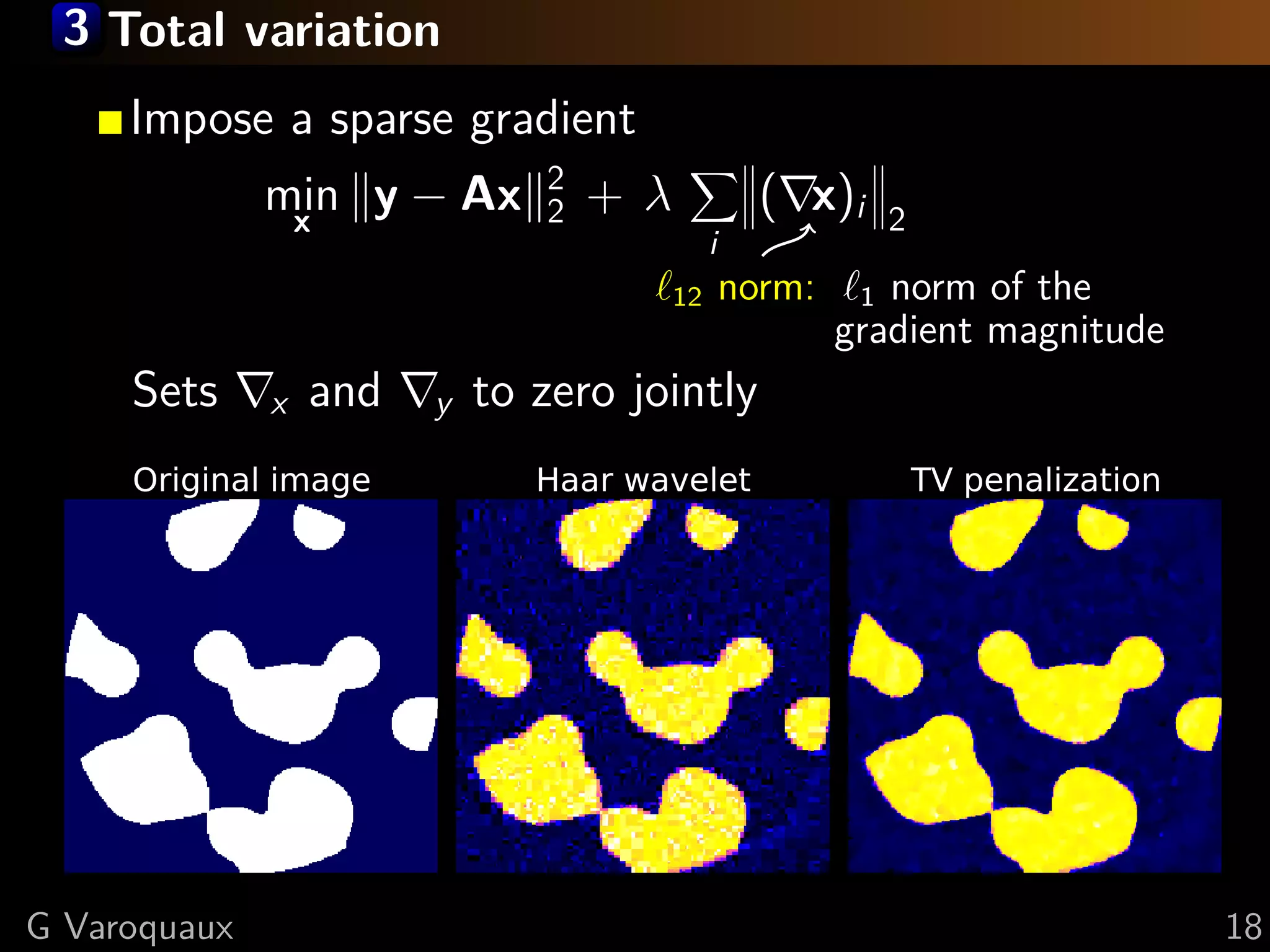
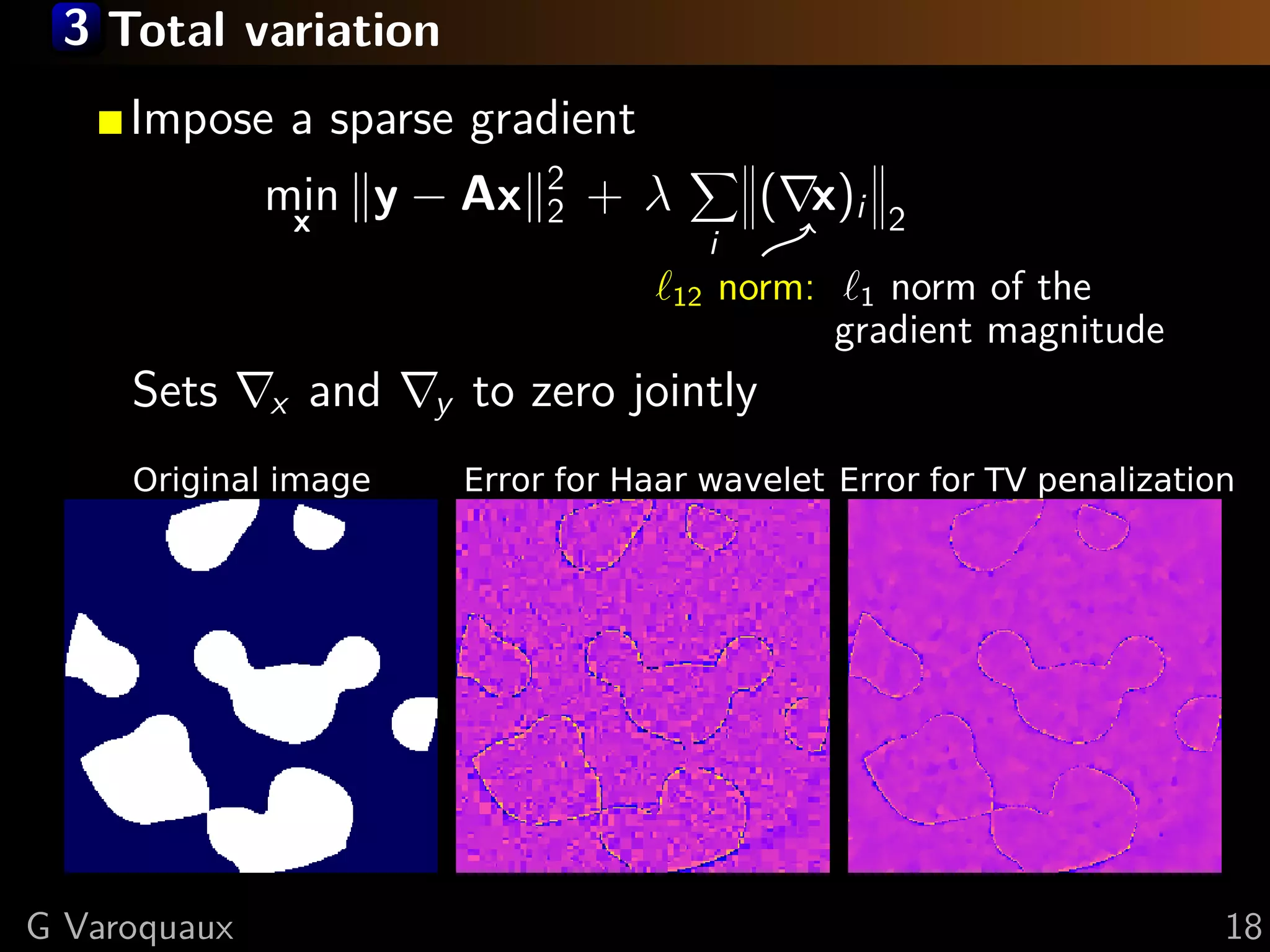
3 Total variation
     Impose a sparse gradient
                               2
              min y − Ax
               x               2   +λ              ( x)i   2
                                             i
                                        12       norm:    1 norm of the
                                                         gradient magnitude
     Sets     x   and   y   to zero jointly
     Original image            Haar wavelet                    TV penalization


G Varoquaux                                                                      18
3 Total variation
     Impose a sparse gradient
                                 2
              min y − Ax
               x                 2   +λ              ( x)i   2
                                               i
                                          12       norm:    1 norm of the
                                                           gradient magnitude
     Sets     x   and   y   to zero jointly
     Original image         Error for Haar wavelet Error for TV penalization


G Varoquaux                                                                     18
3 Total variation + interval
     Bound x in [0, 1]
                              2
                  min y−Ax
                    x         2+λ           ( x)i 2 +I([0, 1])
                                        i


     Original image   TV penalization          TV + interval


G Varoquaux                                                      19
3 Total variation + interval
     Bound x in [0, 1]
                                2
                  min y−Ax
                    x           2+λ             ( x)i 2 +I([0, 1])
                                            i
                            TV                         Rmk:      Constraint

   Histograms:              TV + interval              does more than fold-
                                                       ing values outside of
                                                       the range back in.
                  0.0         0.5                1.0
     Original image     TV penalization            TV + interval


G Varoquaux                                                                    19
3 Total variation + interval
     Bound x in [0, 1]
                                     2
                  min y−Ax
                    x                2+λ             ( x)i 2 +I([0, 1])
                                                 i
                                 TV                         Rmk:      Constraint

   Histograms:                   TV + interval              does more than fold-
                                                            ing values outside of
                                                            the range back in.
                  0.0              0.5                1.0
     Original image     Error for TV penalization Error for TV + interval


G Varoquaux                                                                         19
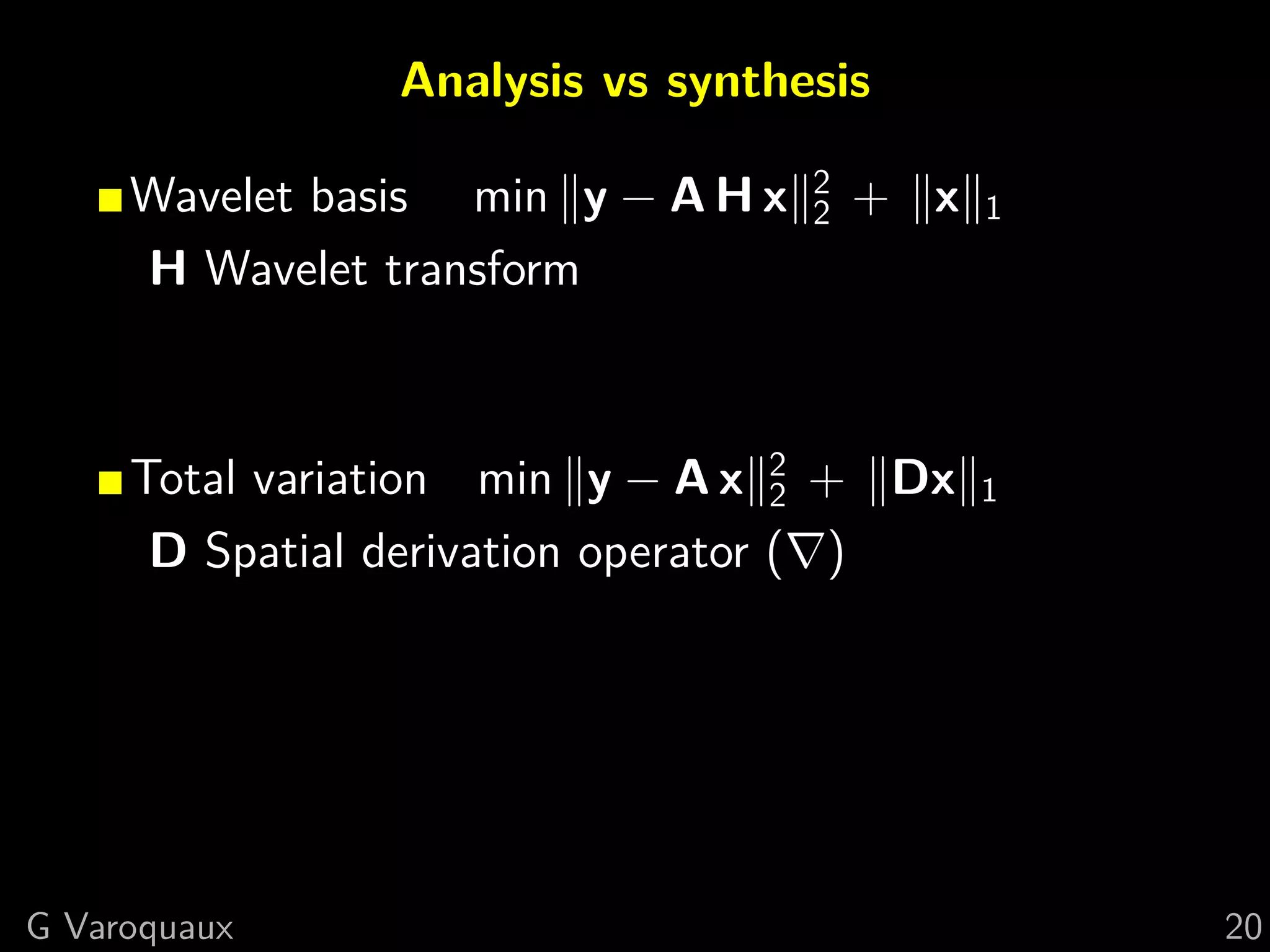
Analysis vs synthesis
                                   2
     Wavelet basis min y − A H x   2   + x   1
     H Wavelet transform


     Total variation min y − A x 2 + Dx
                                    2        1
      D Spatial derivation operator ( )


G Varoquaux                                      20
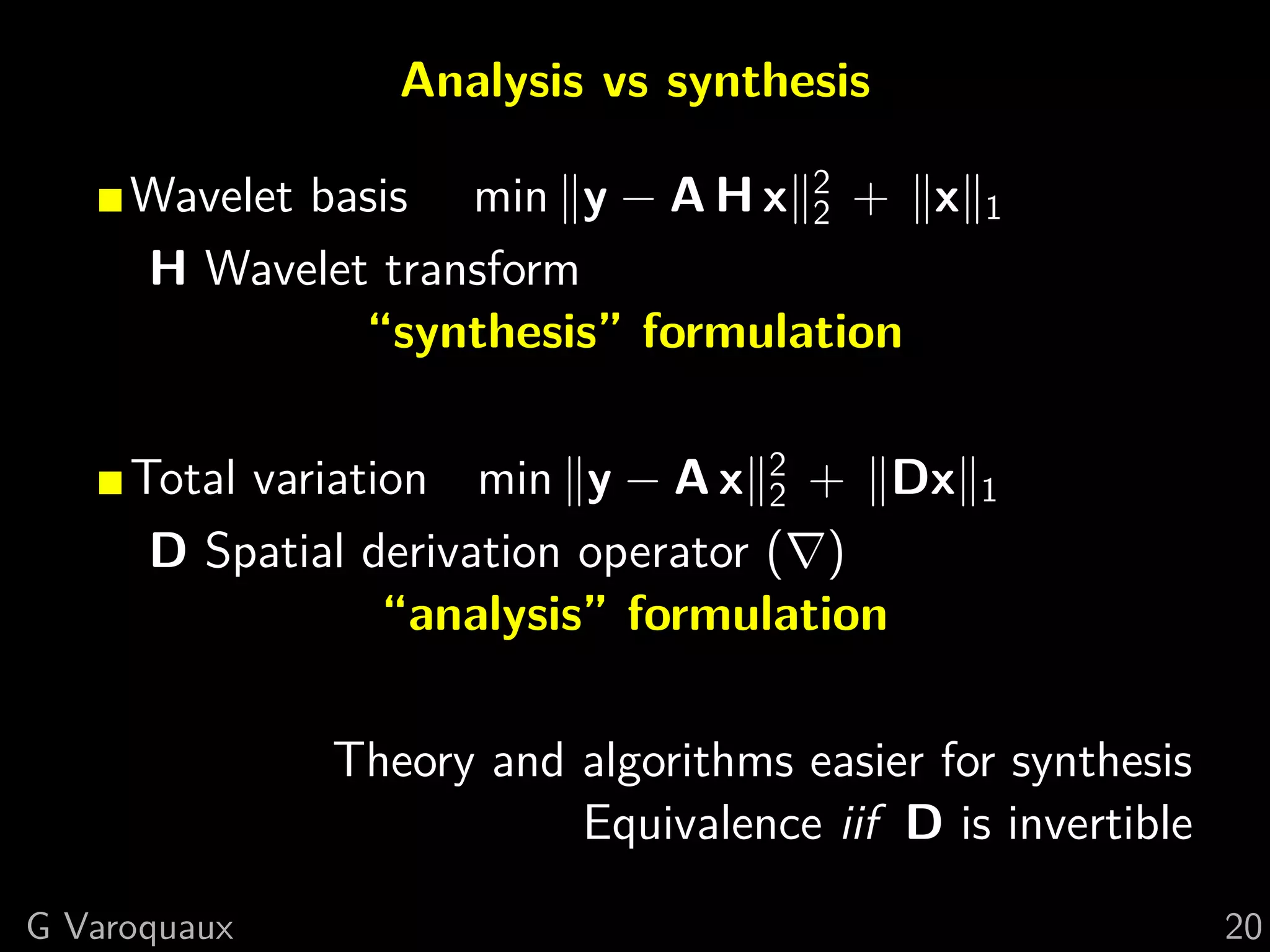
Analysis vs synthesis

     Wavelet basis min y − A H x 2 + x
                                  2          1
     H Wavelet transform
               “synthesis” formulation

     Total variation min y − A x 2 + Dx
                                    2        1
      D Spatial derivation operator ( )
                  “analysis” formulation

              Theory and algorithms easier for synthesis
                         Equivalence iif D is invertible
G Varoquaux                                                20
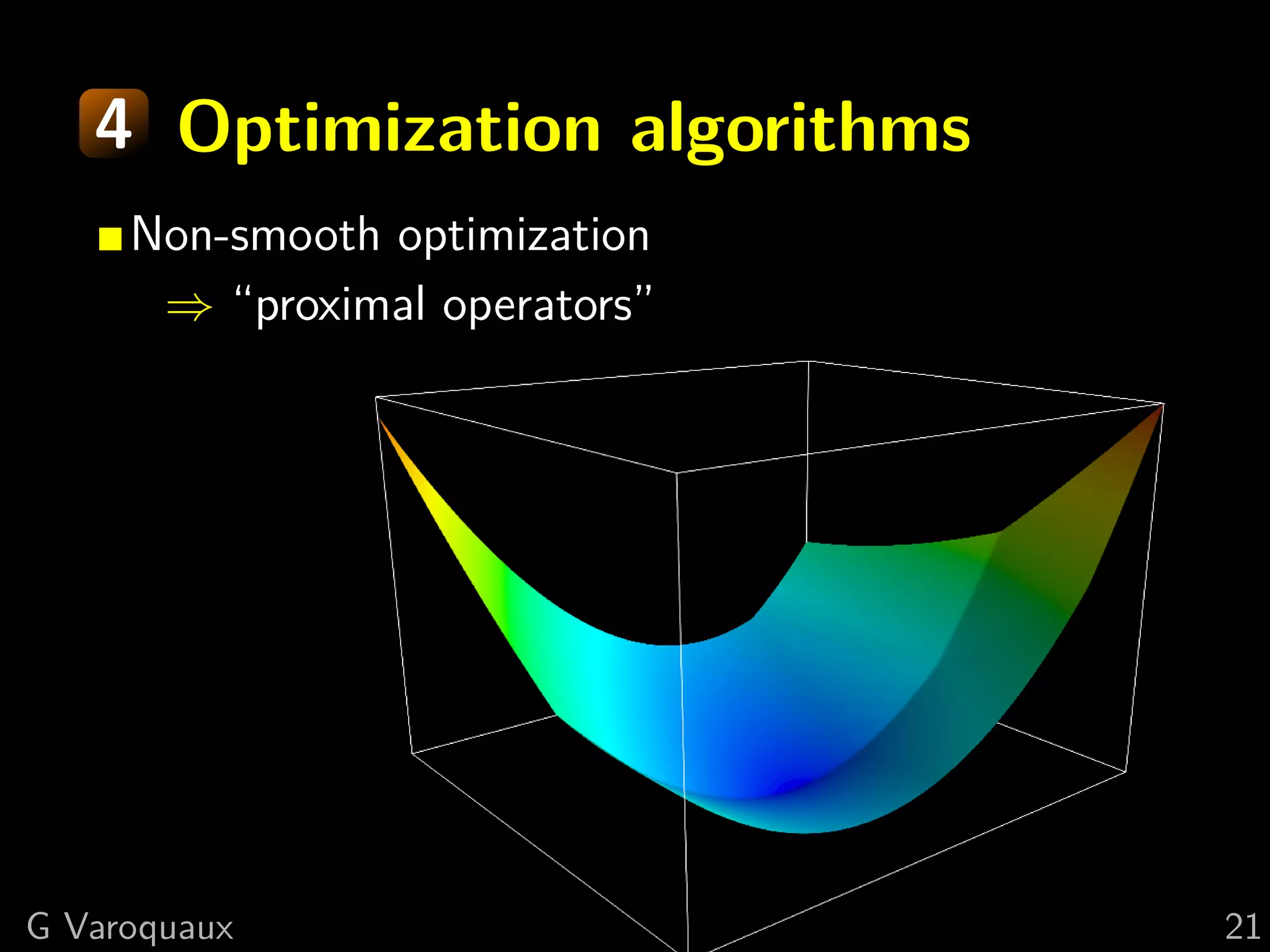
4 Optimization algorithms
     Non-smooth optimization
      ⇒ “proximal operators”


G Varoquaux                    21
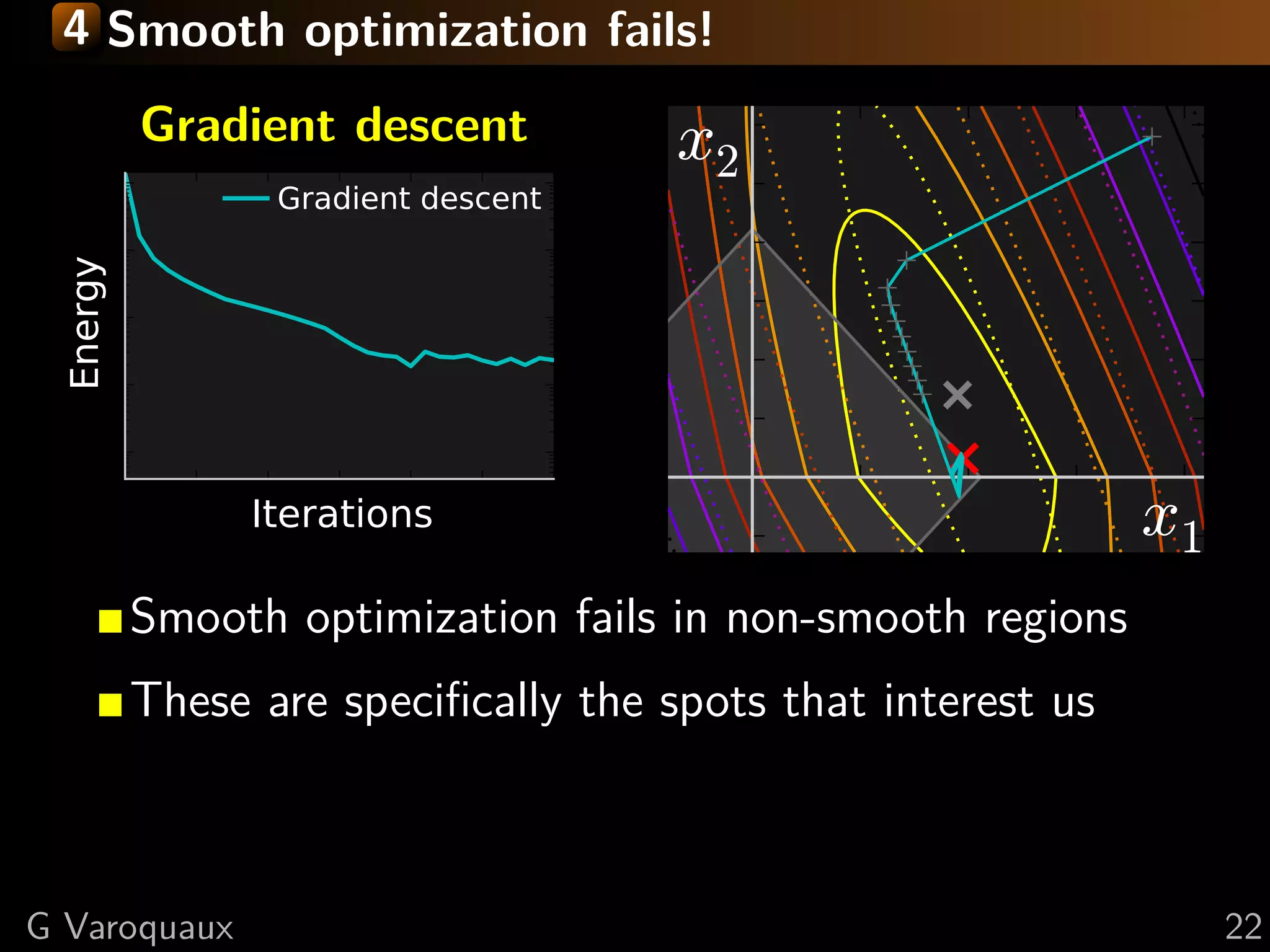
4 Smooth optimization fails!
         Gradient descent
               Gradient descent
                                    x2
Energy


               Iterations                                   x1
         Smooth optimization fails in non-smooth regions
         These are specifically the spots that interest us


G Varoquaux                                                      22
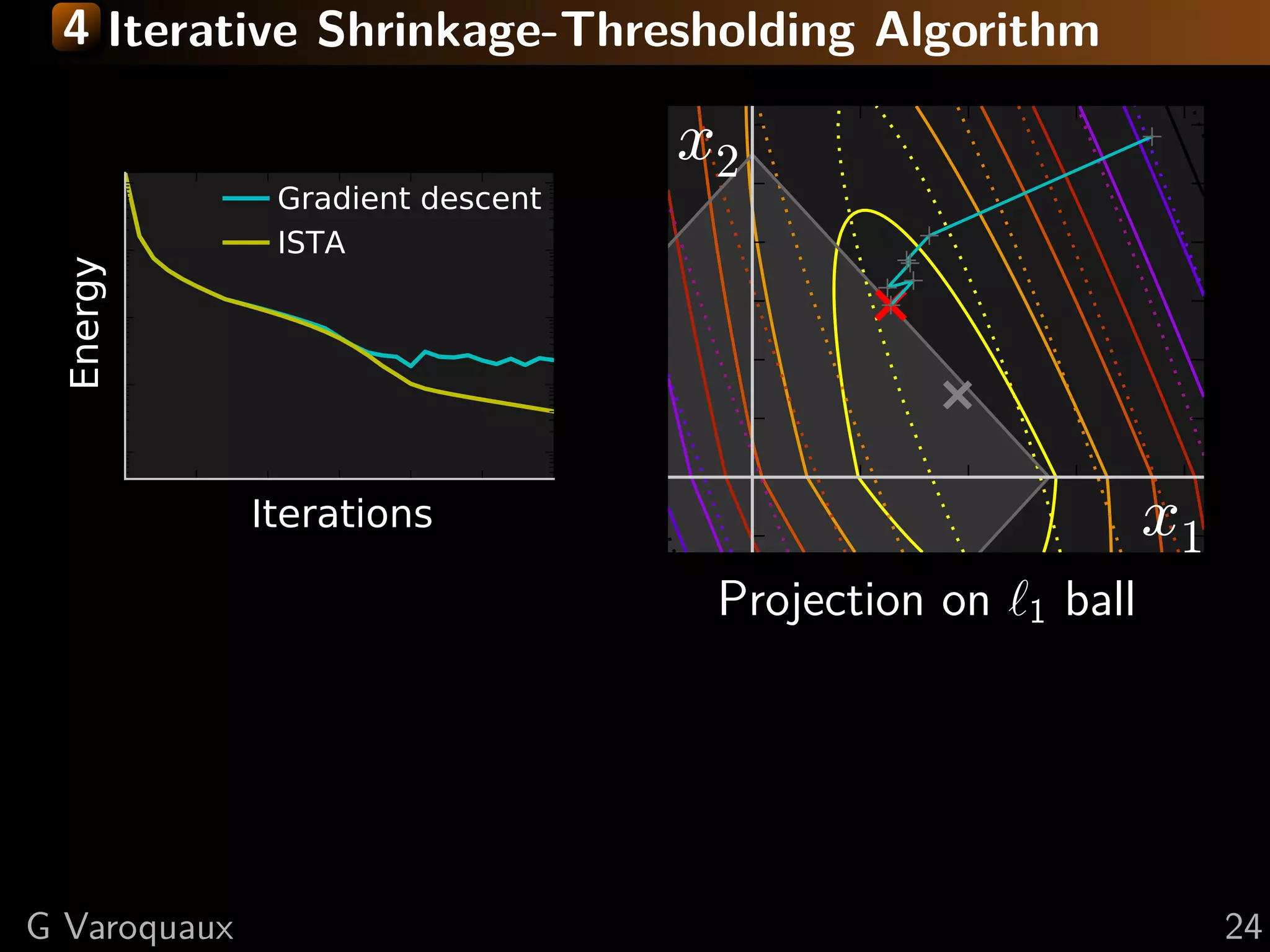
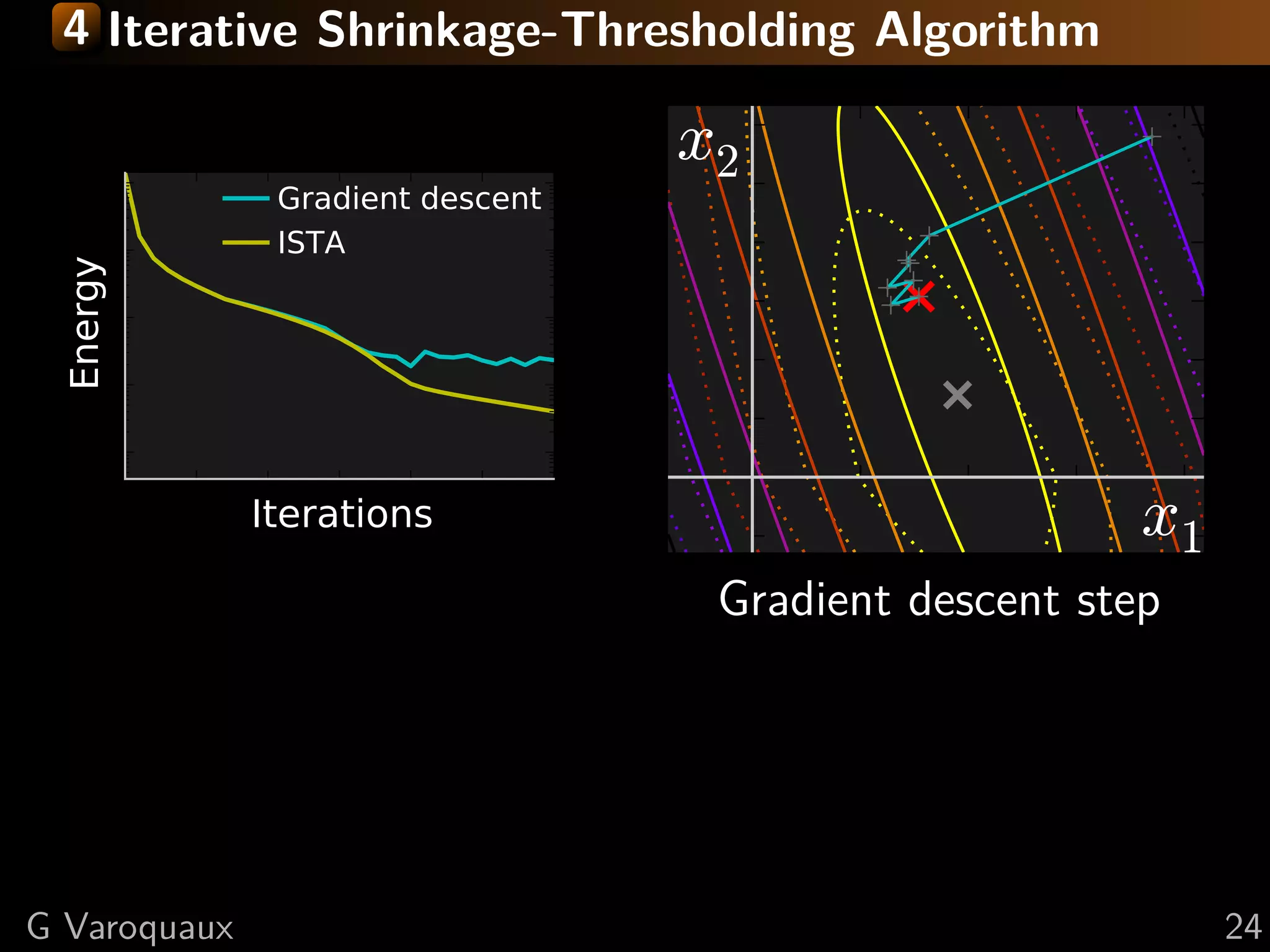
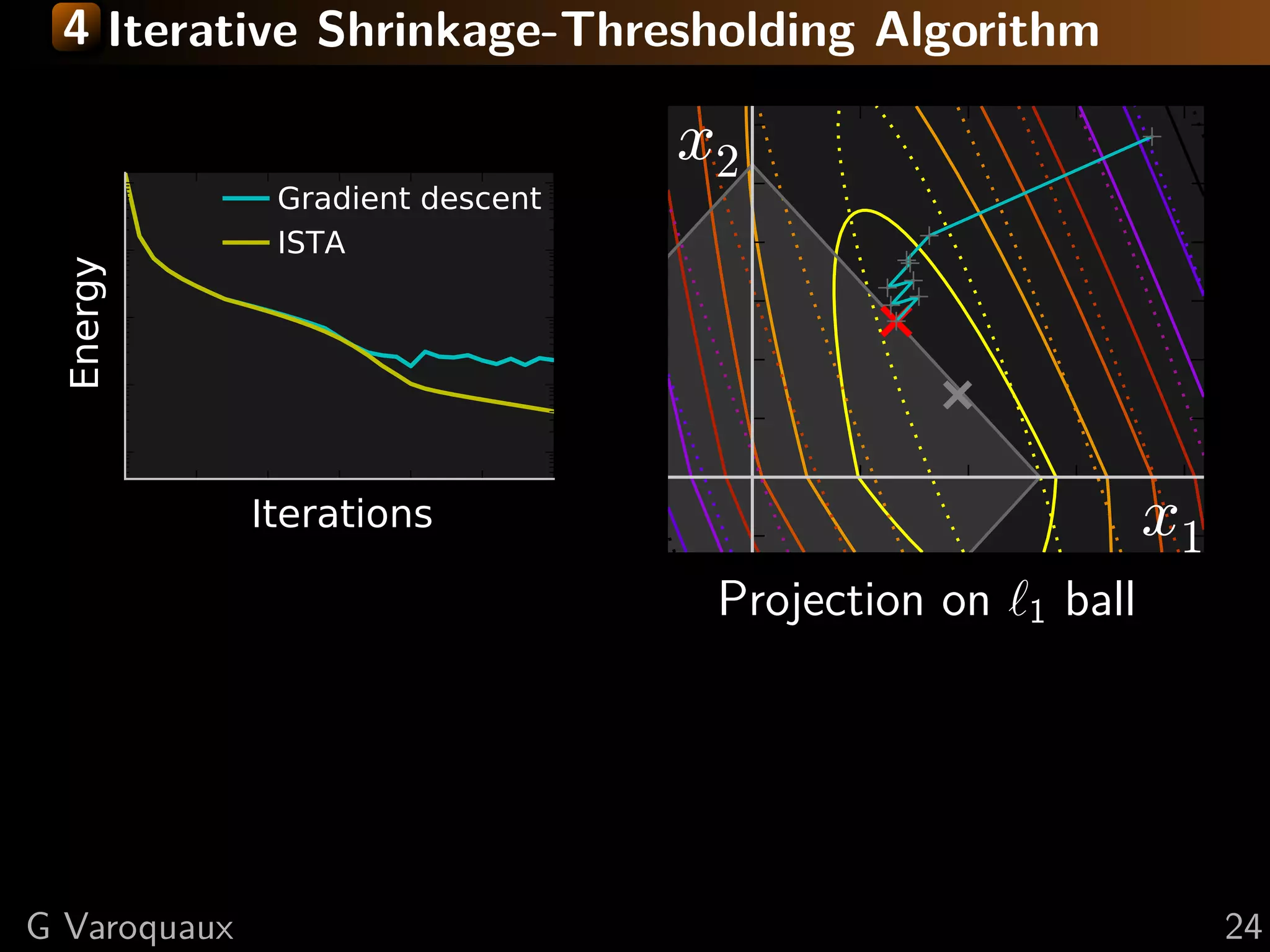
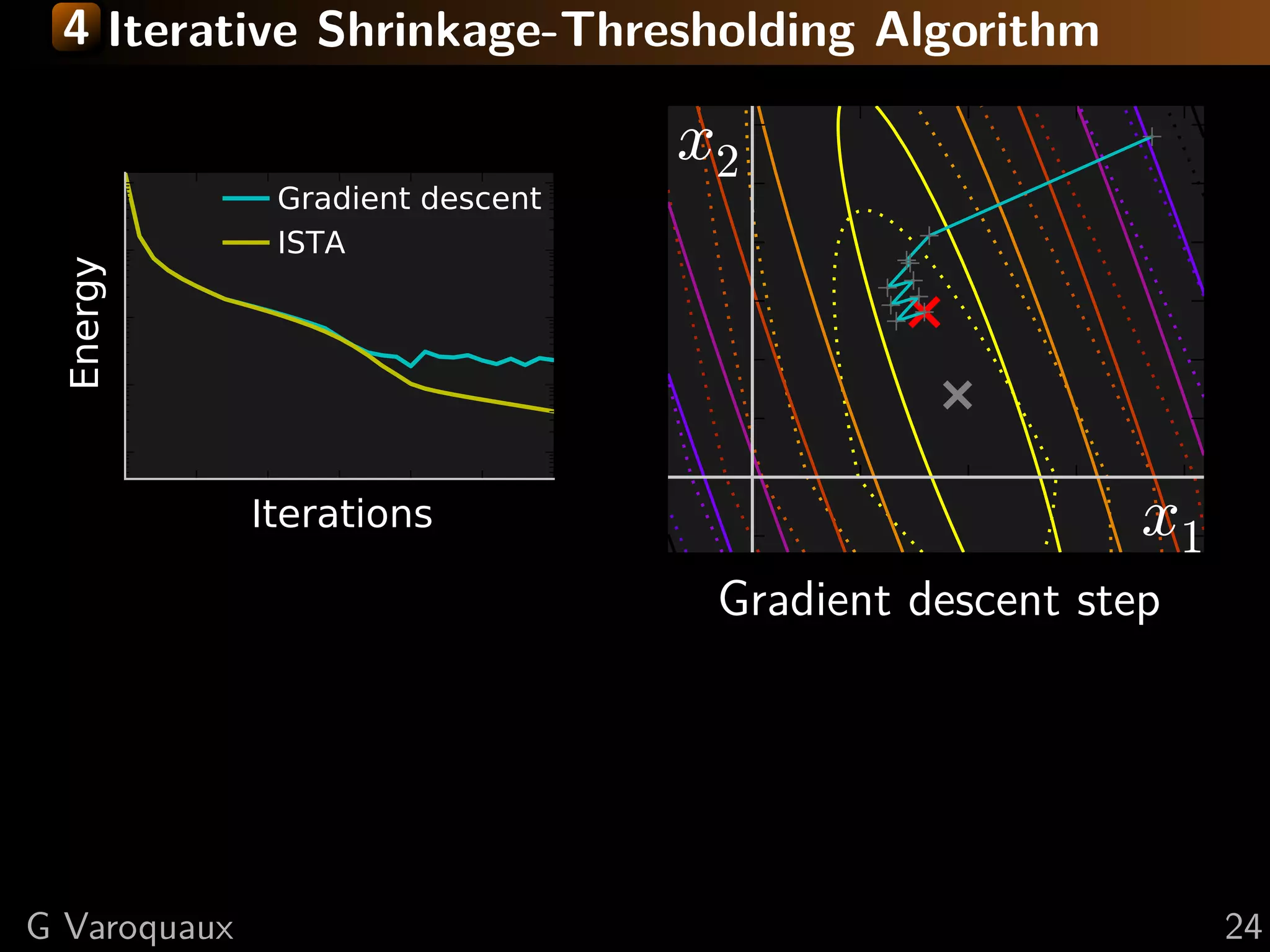
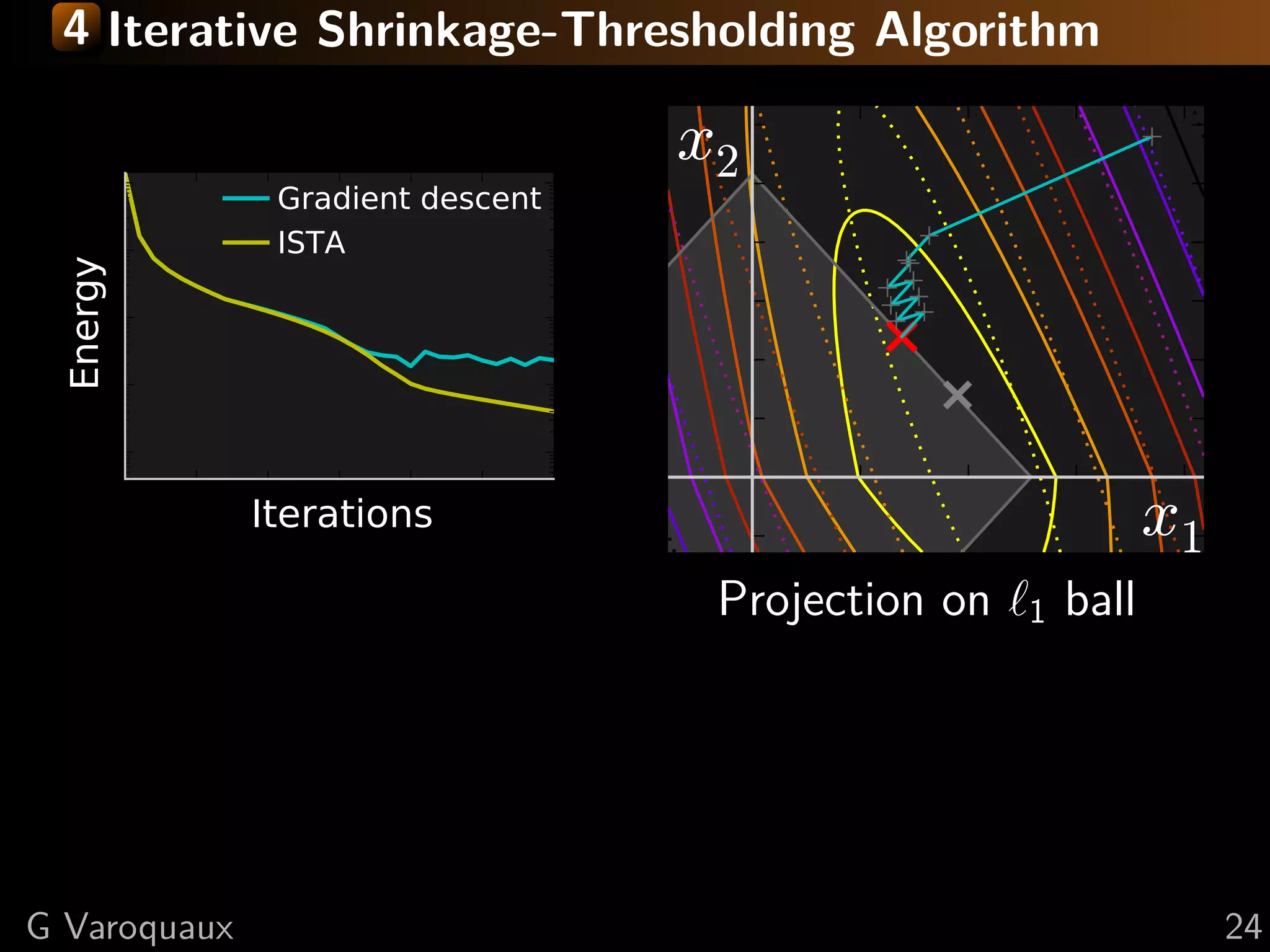
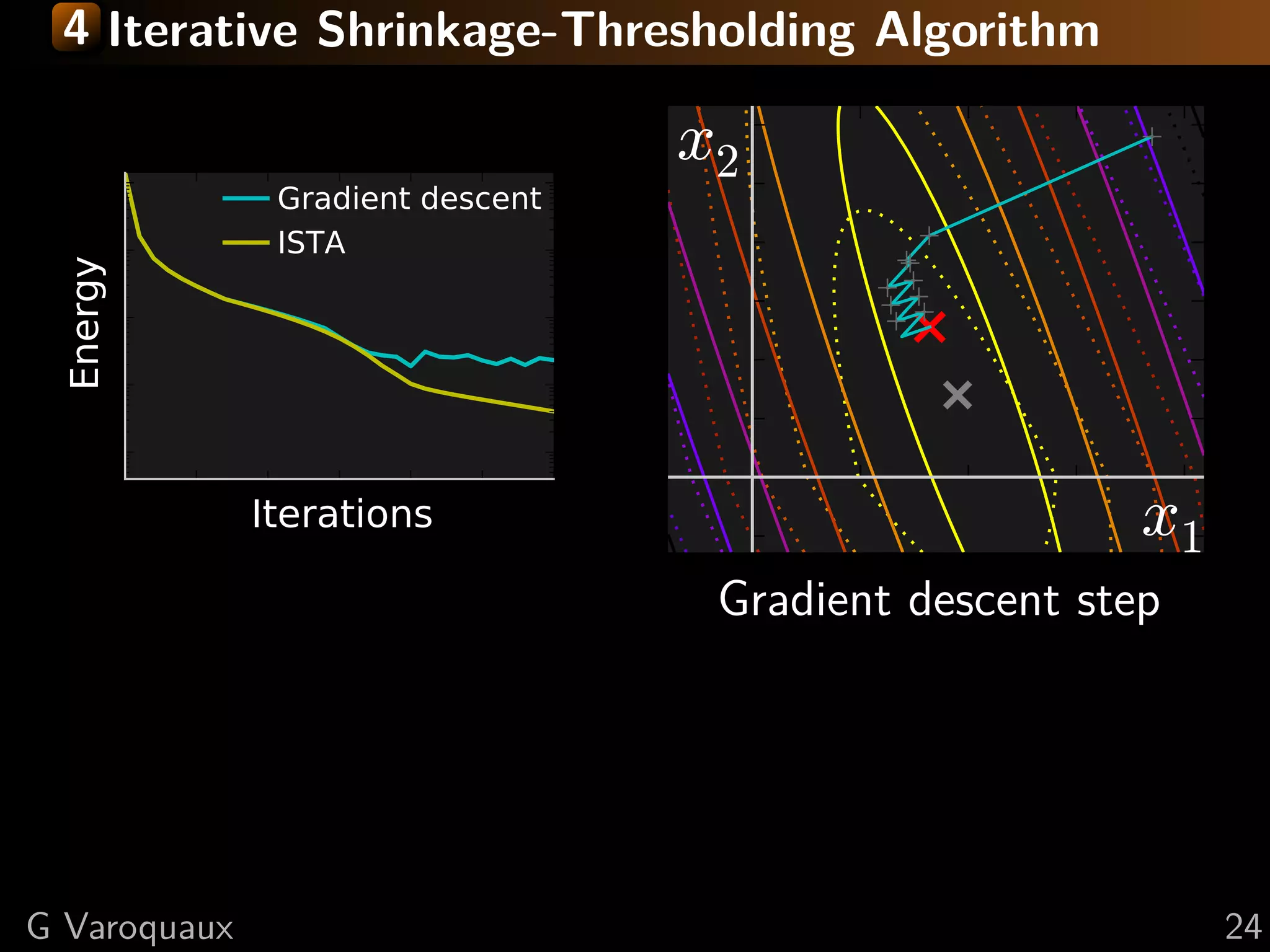
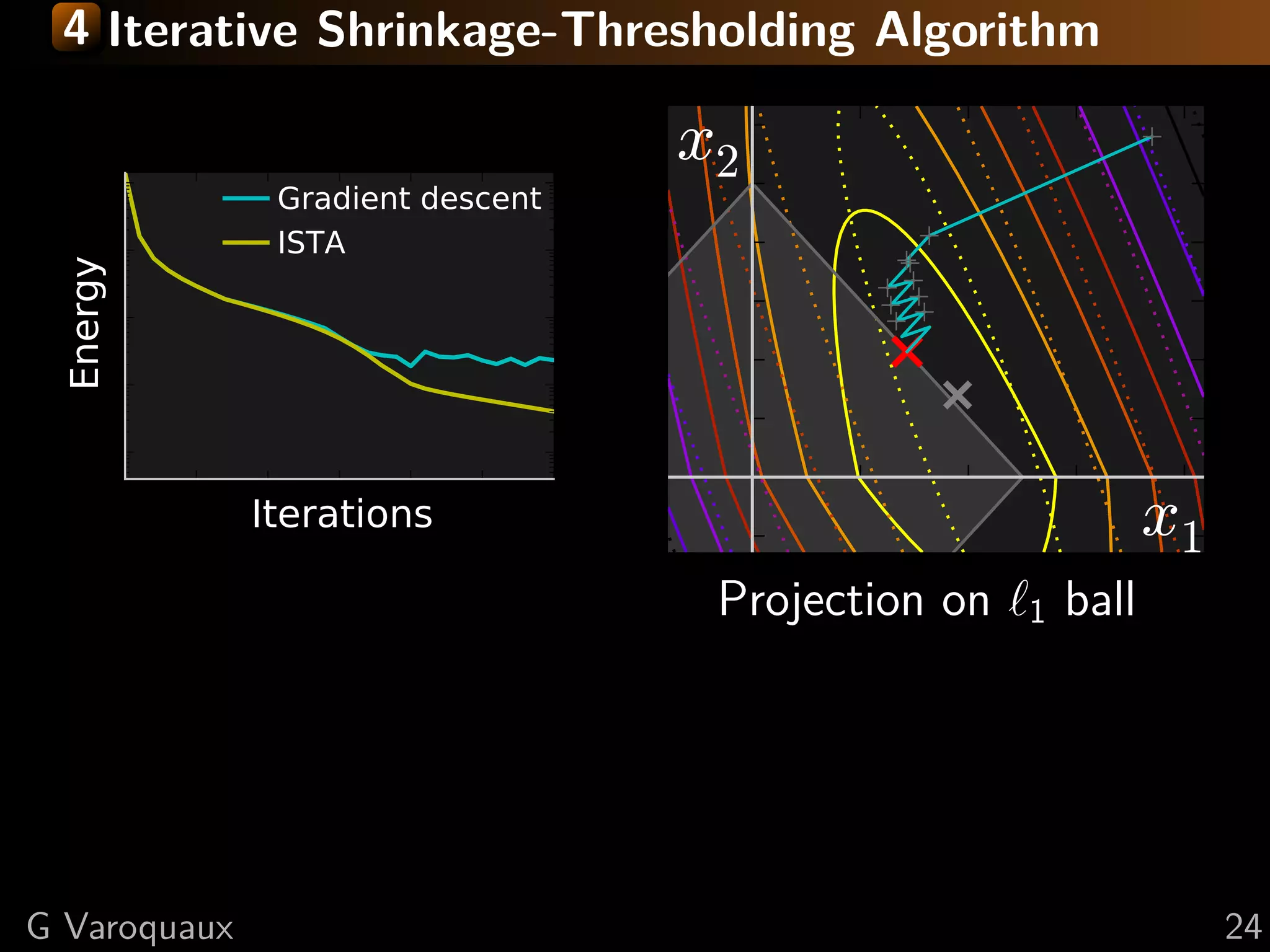
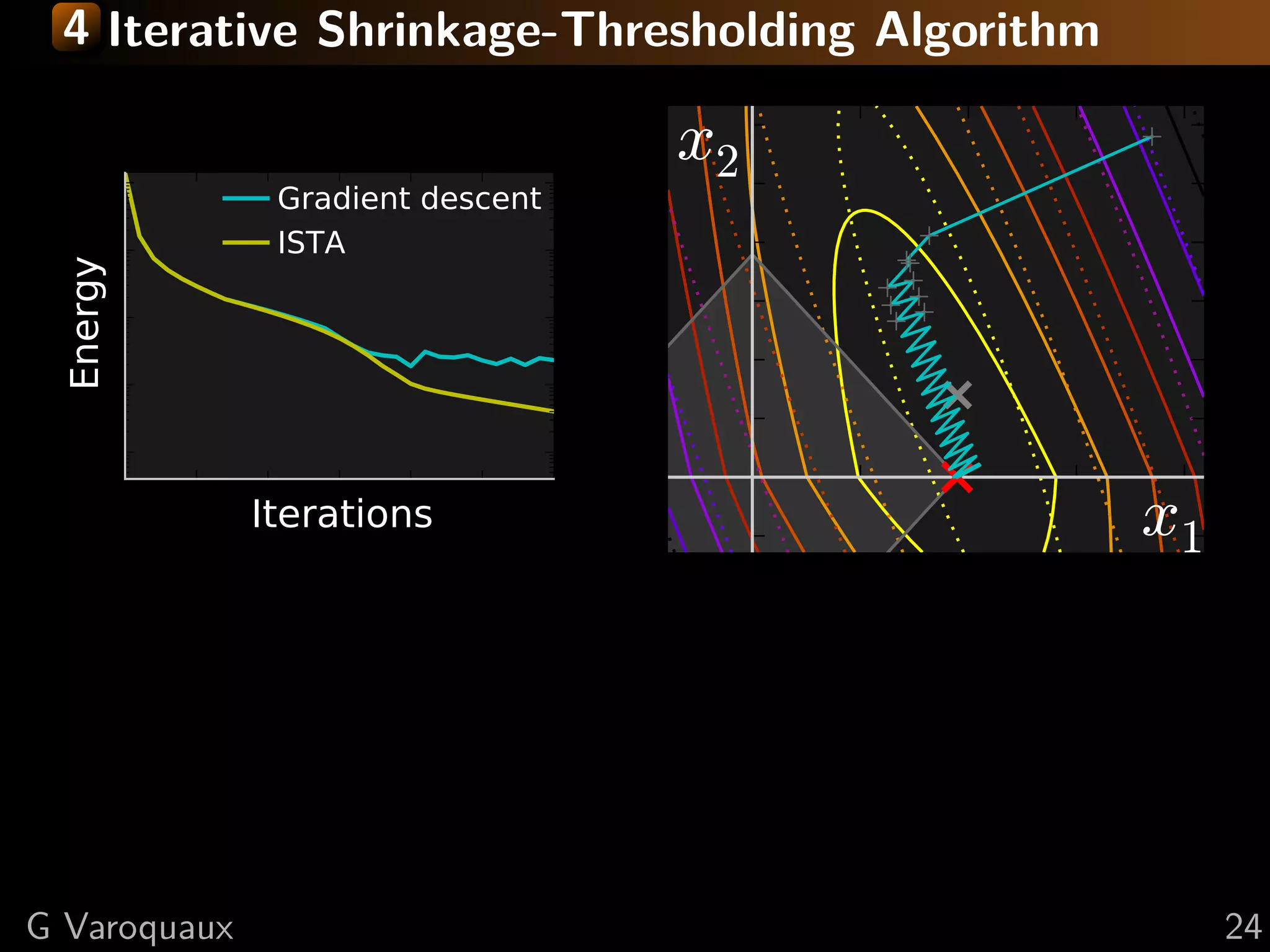
4 Iterative Shrinkage-Thresholding Algorithm
   Settings: min f + g; f smooth, g non-smooth
   f and g convex, f L-Lipschitz

   Typically f is the data fit term, and g the penalty
                   1              2       1
   ex:    Lasso   2σ 2   y − Ax   2   +   µ 1 (x)


G Varoquaux                                             23
4 Iterative Shrinkage-Thresholding Algorithm
    Settings: min f + g; f smooth, g non-smooth
    f and g convex, f L-Lipschitz

    Minimize successively:
    (quadratic approx of f ) + g

  f (x) < f (y) + x − y, f (y)
                                                        2
                      +L x − y
                        2                               2
  Proof: by convexity f (y) ≤ f (x) + f (y) (y − x)
        in the second term: f (y) → f (x) + ( f (y) − f (x))
        upper bound last term with Lipschitz continuity of f


                                                                          
                               L         1                               2
      xk+1     = argmin g(x) + x − xk −   f (xk )                       2
                                                                           
                    x          2         L
                                                               [Daubechies 2004]
G Varoquaux                                                                        23
4 Iterative Shrinkage-Thresholding Algorithm
 Step 1: Gradient descentsmooth, g non-smooth
   Settings: min f + g; f on f
    f and g convex, f L-Lipschitz
 Step 2: Proximal operator of g:
   Minimize proxλg (x) def argmin y − x 2 + λ g(y)
              successively:
                         =                   2
                               y
    (quadratic approx of f ) + g
     Generalization of Euclidean projection
  f (x) < f (y) + x − y, f (y)1}
     on convex set {x, g(x) ≤ 2          Rmk: if g is the indicator function
                        +L x − y 2
                           2
                                           of a set S, the proximal operator
                                           is the Euclidean projection.

  Proof: by convexity f (y) ≤ f (x) + f (y) (y − x)
      prox
        in theλ
                1
                  (x) = sign(x ) x − λ
              second term: f (y) → f (x) + ( i f (y) − f (x))
                                        i                 +
        upper bound last term with Lipschitz continuity of f
                       “soft thresholding”
                                                                           
                               L         1                                2
      xk+1     = argmin g(x) + x − xk −   f (xk )                        2
                                                                            
                    x          2         L
                                                                [Daubechies 2004]
G Varoquaux                                                                         23
4 Iterative Shrinkage-Thresholding Algorithm


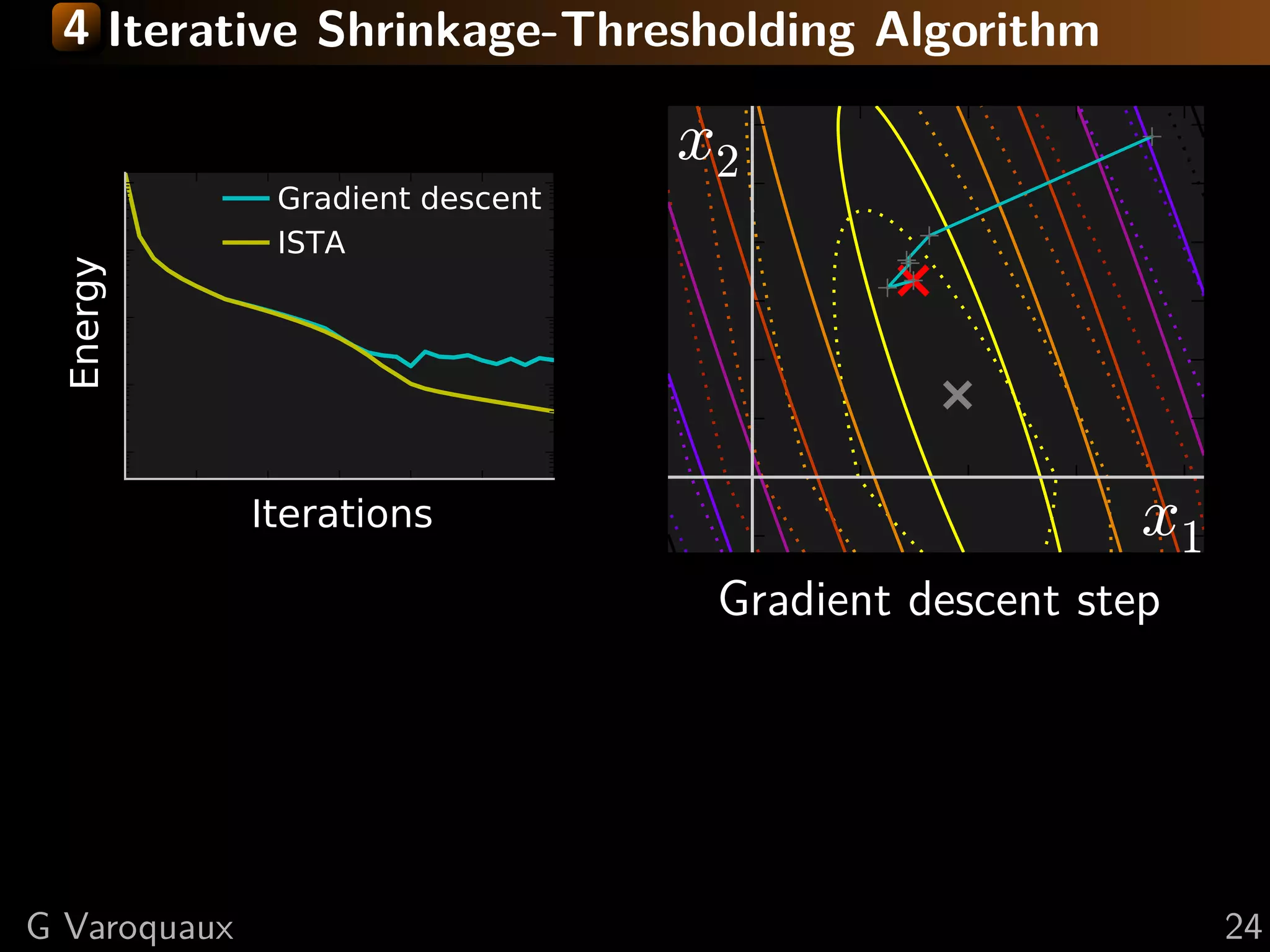
               Gradient descent
                                  x2
               ISTA
Energy


              Iterations                               x1
                                   Gradient descent step


G Varoquaux                                                 24
4 Iterative Shrinkage-Thresholding Algorithm


               Gradient descent
                                  x2
               ISTA
Energy


              Iterations                                      x1
                                   Projection on   1   ball


G Varoquaux                                                        24
4 Iterative Shrinkage-Thresholding Algorithm


               Gradient descent
                                  x2
               ISTA
Energy


              Iterations                               x1
                                   Gradient descent step


G Varoquaux                                                 24
4 Iterative Shrinkage-Thresholding Algorithm


               Gradient descent
                                  x2
               ISTA
Energy


              Iterations                                      x1
                                   Projection on   1   ball


G Varoquaux                                                        24
4 Iterative Shrinkage-Thresholding Algorithm


               Gradient descent
                                  x2
               ISTA
Energy


              Iterations                               x1
                                   Gradient descent step


G Varoquaux                                                 24
4 Iterative Shrinkage-Thresholding Algorithm


               Gradient descent
                                  x2
               ISTA
Energy


              Iterations                                      x1
                                   Projection on   1   ball


G Varoquaux                                                        24
4 Iterative Shrinkage-Thresholding Algorithm


               Gradient descent
                                  x2
               ISTA
Energy


              Iterations                               x1
                                   Gradient descent step


G Varoquaux                                                 24
4 Iterative Shrinkage-Thresholding Algorithm


               Gradient descent
                                  x2
               ISTA
Energy


              Iterations                                      x1
                                   Projection on   1   ball


G Varoquaux                                                        24
4 Iterative Shrinkage-Thresholding Algorithm


               Gradient descent
                                  x2
               ISTA
Energy


              Iterations                        x1


G Varoquaux                                          24
4 Fast Iterative Shrinkage-Thresholding Algorithm
               FISTA
                Gradient descent
                                      x2
                ISTA
                FISTA
Energy


               Iterations                                           x1
         As with conjugate gradient: add a memory term
                   ISTA       tk −1
         dxk+1 = dxk+1 +      tk+1 (dxk   − dxk−1 )             √
                                                           1+        2
                                                                1+4 tk
                                          t1 = 1, tk+1 =        2
         ⇒ O(k −2 ) convergence                 [Beck Teboulle 2009]
G Varoquaux                                                              25
4 Proximal operator for total variation
   Reformulate to smooth + non-smooth with a simple
   projection step and use FISTA:   [Chambolle 2004]

                                 2
      proxλTV x = argmin y − x   2   +λ       ( x)i   2
                     x                    i


G Varoquaux                                               26
4 Proximal operator for total variation
   Reformulate to smooth + non-smooth with a simple
   projection step and use FISTA:   [Chambolle 2004]

                                              2
      proxλTV x = argmin y − x                2   +λ           ( x)i   2
                            x                              i
                                                       2
                   = argmax λ div z + y                2
                       z, z     ∞ ≤1


  Proof:
    “dual norm”:        v   1   = max v, z
                                   z   ∞ ≤1


     div is the adjoint of         :      v, z = v, −div z
     Swap min and max and solve for x
              Duality: [Boyd 2004]                This proof: [Michel 2011]
G Varoquaux                                                                   26
Sparsity for compressed tomography reconstruction


  @GaelVaroquaux                                    27
Sparsity for compressed tomography reconstruction
  Add penalizations with kinks                x2
  Choice of prior/sparse representation
  Non-smooth optimization (FISTA)                          x1

Further discussion: choice of prior/parameters
     Minimize reconstruction error from degraded
     data of gold-standard acquisitions
     Cross-validation: leave half of the projections
     and minimize projection error of reconstruction
           Python code available:
                   https://github.com/emmanuelle/tomo-tv

  @GaelVaroquaux                                                27
Bibliography (1/3)

[Candes 2006] E. Cand`s, J. Romberg and T. Tao, Robust uncertainty
                        e
principles: Exact signal reconstruction from highly incomplete frequency
information, Trans Inf Theory, (52) 2006

[Wainwright 2009] M. Wainwright, Sharp Thresholds for
High-Dimensional and Noisy Sparsity Recovery Using 1 constrained
quadratic programming (Lasso), Trans Inf Theory, (55) 2009

[Mallat, Zhang 1993] S. Mallat and Z. Zhang, Matching pursuits with
Time-Frequency dictionaries, Trans Sign Proc (41) 1993

[Pati, et al 1993] Y. Pati, R. Rezaiifar, P. Krishnaprasad, Orthogonal
matching pursuit: Recursive function approximation with plications to
wavelet decomposition, 27th Signals, Systems and Computers Conf 1993


   @GaelVaroquaux                                                          28
Bibliography (2/3)

[Chen, Donoho, Saunders 1998] S. Chen, D. Donoho, M. Saunders,
Atomic decomposition by basis pursuit, SIAM J Sci Computing (20) 1998

[Tibshirani 1996] R. Tibshirani, Regression shrinkage and selection via the
lasso, J Roy Stat Soc B, 1996

[Gribonval 2011] R. Gribonval, Should penalized least squares regression
be interpreted as Maximum A Posteriori estimation?, Trans Sig Proc,
(59) 2011

[Daubechies 2004] I. Daubechies, M. Defrise, C. De Mol, An iterative
thresholding algorithm for linear inverse problems with a sparsity
constraint, Comm Pure Appl Math, (57) 2004


   @GaelVaroquaux                                                             29
Bibliography (2/3)

[Beck Teboulle 2009], A. Beck and M. Teboulle, A fast iterative
shrinkage-thresholding algorithm for linear inverse problems, SIAM J
Imaging Sciences, (2) 2009

[Chambolle 2004], A. Chambolle, An algorithm for total variation
minimization and applications, J Math imag vision, (20) 2004

[Boyd 2004], S. Boyd and L. Vandenberghe, Convex Optimization,
Cambridge University Press 2004
                    — Reference on convex optimization and duality

[Michel 2011], V. Michel et al., Total variation regularization for
fMRI-based prediction of behaviour, Trans Med Imag (30) 2011
                           — Proof of TV reformulation: appendix C


   @GaelVaroquaux                                                      30

A hand-waving introduction to sparsity for compressed tomography reconstruction

  • 1.
    A hand-waving introductionto sparsity for compressed tomography reconstruction Ga¨l Varoquaux and Emmanuelle Gouillart e Dense slides. For future reference: http://www.slideshare.net/GaelVaroquaux
  • 2.
    1 Sparsity forinverse problems 2 Mathematical formulation 3 Choice of a sparse representation 4 Optimization algorithms G Varoquaux 2
  • 3.
    1 Sparsity forinverse problems Problem setting Intuitions G Varoquaux 3
  • 4.
    1 Tomography reconstruction:a linear problem y = Ax 0 20 40 60 80 0 50 100 150 200 250 y ∈ Rn, A ∈ Rn×p, x ∈ Rp n ∝ number of projections p: number of pixels in reconstructed image We want to find x knowing A and y G Varoquaux 4
  • 5.
    1 Small n:an ill-posed linear problem y = Ax admits multiple solutions The sensing operator A has a large null space: images that give null projections In particular it is blind to high spatial frequencies: G Varoquaux 5
  • 6.
    1 Small n:an ill-posed linear problem y = Ax admits multiple solutions The sensing operator A has a large null space: images that give null projections In particular it is blind to high spatial frequencies: Large number of projections Ill-conditioned problem: “short-sighted” rather than blind, ⇒ captures noise on those components G Varoquaux 5
  • 7.
    1 A toyexample: spectral analysis Recovering the frequency spectrum Signal Freq. spectrum signal = A · frequencies 0 2 4 6 8 ... 0 10 20 30 40 50 60 G Varoquaux 6
  • 8.
    1 A toyexample: spectral analysis Sub-sampling Signal Freq. spectrum signal = A · frequencies 0 2 4 6 8 ... 0 10 20 30 40 50 60 Recovery problem becomes ill-posed G Varoquaux 6
  • 9.
    1 A toyexample: spectral analysis Problem: aliasing Signal Freq. spectrum Information in the null-space of A is lost G Varoquaux 7
  • 10.
    1 A toyexample: spectral analysis Problem: aliasing Signal Freq. spectrum Solution: incoherent measurements Signal Freq. spectrum i.e. careful choice of null-space of A G Varoquaux 7
  • 11.
    1 A toyexample: spectral analysis Incoherent measurements, but scarcity of data Signal Freq. spectrum The null-space of A is spread out in frequency Not much data ⇒ large null-space = captures “noise” G Varoquaux 8
  • 12.
    1 A toyexample: spectral analysis Incoherent measurements, but scarcity of data Signal Freq. spectrum The null-space of A is spread out in frequency Not much data ⇒ large null-space Sparse Freq. spectrum = captures “noise” Impose sparsity Find a small number of frequencies to explain the signal G Varoquaux 8
  • 13.
    1 And fortomography reconstruction? Original image Non-sparse reconstruction Sparse reconstruction 128 × 128 pixels, 18 projections http://scikit-learn.org/stable/auto_examples/applications/ plot_tomography_l1_reconstruction.html G Varoquaux 9
  • 14.
    1 Why doesit work: a geometric explanation Two coefficients of x not in the null-space of A: x2 y= Ax xtrue x1 The sparsest solution is in the blue cross It corresponds to the true solution (xtrue ) if the slope is > 45◦ G Varoquaux 10
  • 15.
    1 Why doesit work: a geometric explanation Two coefficients of x not in the null-space of A: x2 y= Ax xtrue x1 The sparsest solution is in the blue cross It corresponds to the true solution (xtrue ) if the slope is > 45◦ The cross can be replaced by its convex hull G Varoquaux 10
  • 16.
    1 Why doesit work: a geometric explanation Two coefficients of x not in the null-space of A: x2 y= Ax xtrue x1 The sparsest solution is in the blue cross It corresponds to the true solution (xtrue ) if the slope is > 45◦ In high dimension: large acceptable set G Varoquaux 10
  • 17.
    Recovery of sparsesignal Null space of sensing operator incoherent with sparse representation ⇒ Excellent sparse recovery with little projections Minimum number of observations necessary: nmin ∼ k log p, with k: number of non zeros [Candes 2006] Rmk Theory for i.i.d. samples Related to “compressive sensing” G Varoquaux 11
  • 18.
    2 Mathematical formulation Variational formulation Introduction of noise G Varoquaux 12
  • 19.
    2 Maximizing thesparsity 0 number of non-zeros min 0(x) x s.t. y = A x x2 y= Ax xtrue x1 “Matching pursuit” problem [Mallat, Zhang 1993] “Orthogonal matching pursuit” [Pati, et al 1993] Problem: Non-convex optimization G Varoquaux 13
  • 20.
    2 Maximizing thesparsity 1 (x) = i |xi | min 1(x) x s.t. y = A x x2 y= Ax xtrue x1 “Basis pursuit” [Chen, Donoho, Saunders 1998] G Varoquaux 13
  • 21.
    2 Modeling observationnoise y = Ax + e e = observation noise New formulation: 2 min 1 (x) x s.t. y = A x y − Ax 2 ≤ ε2 Equivalent: “Lasso estimator” [Tibshirani 1996] 2 min y − Ax x 2 + λ 1(x) G Varoquaux 14
  • 22.
    2 Modeling observationnoise y = Ax + e e = observation noise New formulation: 2 min 1 (x) x s.t. y = A x y − Ax 2 ≤ ε2 Equivalent: “Lasso estimator” [Tibshirani 1996] 2 x2 min y − Ax x 2 + λ 1(x) Data fit Penalization x1 Rmk: kink in the 1 ball creates sparsity G Varoquaux 14
  • 23.
    2 Probabilistic modeling:Bayesian interpretation P(x|y) ∝ P(y|x) P(x) ( ) “Posterior” Forward model “Prior” Quantity of interest Expectations on x Forward model: y = A x + e, e: Gaussian noise ⇒ P(y|x) ∝ exp − 2 1 2 y − A x 2 σ 2 1 Prior: Laplacian P(x) ∝ exp − µ x 1 1 2 1 Negated log of ( ): 2σ 2 y − Ax 2 + µ 1 (x) Maximum of posterior is Lasso estimate Note that this picture is limited and the Lasso is not a good G Varoquaux Bayesian estimator for the Laplace prior [Gribonval 2011]. 15
  • 24.
    3 Choice ofa sparse representation Sparse in wavelet domain Total variation G Varoquaux 16
  • 25.
    3 Sparsity inwavelet representation Typical images Haar decomposition Level 1 Level 2 Level 3 are not sparse Level 4 Level 5 Level 6 ⇒ Impose sparsity in Haar representation A → A H where H is the Haar transform G Varoquaux 17
  • 26.
    3 Sparsity inwavelet representation Original image Non-sparse reconstruction Typical images Haar decomposition Level 1 Level 2 Level 3 are not sparse Level 4 Level 5 Level 6 Sparse image Sparse in Haar ⇒ Impose sparsity in Haar representation A → A H where H is the Haar transform G Varoquaux 17
  • 27.
    3 Total variation Impose a sparse gradient 2 min y − Ax x 2 +λ ( x)i 2 i 12 norm: 1 norm of the gradient magnitude Sets x and y to zero jointly Original image Haar wavelet TV penalization G Varoquaux 18
  • 28.
    3 Total variation Impose a sparse gradient 2 min y − Ax x 2 +λ ( x)i 2 i 12 norm: 1 norm of the gradient magnitude Sets x and y to zero jointly Original image Error for Haar wavelet Error for TV penalization G Varoquaux 18
  • 29.
    3 Total variation+ interval Bound x in [0, 1] 2 min y−Ax x 2+λ ( x)i 2 +I([0, 1]) i Original image TV penalization TV + interval G Varoquaux 19
  • 30.
    3 Total variation+ interval Bound x in [0, 1] 2 min y−Ax x 2+λ ( x)i 2 +I([0, 1]) i TV Rmk: Constraint Histograms: TV + interval does more than fold- ing values outside of the range back in. 0.0 0.5 1.0 Original image TV penalization TV + interval G Varoquaux 19
  • 31.
    3 Total variation+ interval Bound x in [0, 1] 2 min y−Ax x 2+λ ( x)i 2 +I([0, 1]) i TV Rmk: Constraint Histograms: TV + interval does more than fold- ing values outside of the range back in. 0.0 0.5 1.0 Original image Error for TV penalization Error for TV + interval G Varoquaux 19
  • 32.
    Analysis vs synthesis 2 Wavelet basis min y − A H x 2 + x 1 H Wavelet transform Total variation min y − A x 2 + Dx 2 1 D Spatial derivation operator ( ) G Varoquaux 20
  • 33.
    Analysis vs synthesis Wavelet basis min y − A H x 2 + x 2 1 H Wavelet transform “synthesis” formulation Total variation min y − A x 2 + Dx 2 1 D Spatial derivation operator ( ) “analysis” formulation Theory and algorithms easier for synthesis Equivalence iif D is invertible G Varoquaux 20
  • 34.
    4 Optimization algorithms Non-smooth optimization ⇒ “proximal operators” G Varoquaux 21
  • 35.
    4 Smooth optimizationfails! Gradient descent Gradient descent x2 Energy Iterations x1 Smooth optimization fails in non-smooth regions These are specifically the spots that interest us G Varoquaux 22
  • 36.
    4 Iterative Shrinkage-ThresholdingAlgorithm Settings: min f + g; f smooth, g non-smooth f and g convex, f L-Lipschitz Typically f is the data fit term, and g the penalty 1 2 1 ex: Lasso 2σ 2 y − Ax 2 + µ 1 (x) G Varoquaux 23
  • 37.
    4 Iterative Shrinkage-ThresholdingAlgorithm Settings: min f + g; f smooth, g non-smooth f and g convex, f L-Lipschitz Minimize successively: (quadratic approx of f ) + g f (x) < f (y) + x − y, f (y) 2 +L x − y 2 2 Proof: by convexity f (y) ≤ f (x) + f (y) (y − x) in the second term: f (y) → f (x) + ( f (y) − f (x)) upper bound last term with Lipschitz continuity of f   L 1 2 xk+1 = argmin g(x) + x − xk − f (xk ) 2  x 2 L [Daubechies 2004] G Varoquaux 23
  • 38.
    4 Iterative Shrinkage-ThresholdingAlgorithm Step 1: Gradient descentsmooth, g non-smooth Settings: min f + g; f on f f and g convex, f L-Lipschitz Step 2: Proximal operator of g: Minimize proxλg (x) def argmin y − x 2 + λ g(y) successively: = 2 y (quadratic approx of f ) + g Generalization of Euclidean projection f (x) < f (y) + x − y, f (y)1} on convex set {x, g(x) ≤ 2 Rmk: if g is the indicator function +L x − y 2 2 of a set S, the proximal operator is the Euclidean projection. Proof: by convexity f (y) ≤ f (x) + f (y) (y − x) prox in theλ 1 (x) = sign(x ) x − λ second term: f (y) → f (x) + ( i f (y) − f (x)) i + upper bound last term with Lipschitz continuity of f “soft thresholding”   L 1 2 xk+1 = argmin g(x) + x − xk − f (xk ) 2  x 2 L [Daubechies 2004] G Varoquaux 23
  • 39.
    4 Iterative Shrinkage-ThresholdingAlgorithm Gradient descent x2 ISTA Energy Iterations x1 Gradient descent step G Varoquaux 24
  • 40.
    4 Iterative Shrinkage-ThresholdingAlgorithm Gradient descent x2 ISTA Energy Iterations x1 Projection on 1 ball G Varoquaux 24
  • 41.
    4 Iterative Shrinkage-ThresholdingAlgorithm Gradient descent x2 ISTA Energy Iterations x1 Gradient descent step G Varoquaux 24
  • 42.
    4 Iterative Shrinkage-ThresholdingAlgorithm Gradient descent x2 ISTA Energy Iterations x1 Projection on 1 ball G Varoquaux 24
  • 43.
    4 Iterative Shrinkage-ThresholdingAlgorithm Gradient descent x2 ISTA Energy Iterations x1 Gradient descent step G Varoquaux 24
  • 44.
    4 Iterative Shrinkage-ThresholdingAlgorithm Gradient descent x2 ISTA Energy Iterations x1 Projection on 1 ball G Varoquaux 24
  • 45.
    4 Iterative Shrinkage-ThresholdingAlgorithm Gradient descent x2 ISTA Energy Iterations x1 Gradient descent step G Varoquaux 24
  • 46.
    4 Iterative Shrinkage-ThresholdingAlgorithm Gradient descent x2 ISTA Energy Iterations x1 Projection on 1 ball G Varoquaux 24
  • 47.
    4 Iterative Shrinkage-ThresholdingAlgorithm Gradient descent x2 ISTA Energy Iterations x1 G Varoquaux 24
  • 48.
    4 Fast IterativeShrinkage-Thresholding Algorithm FISTA Gradient descent x2 ISTA FISTA Energy Iterations x1 As with conjugate gradient: add a memory term ISTA tk −1 dxk+1 = dxk+1 + tk+1 (dxk − dxk−1 ) √ 1+ 2 1+4 tk t1 = 1, tk+1 = 2 ⇒ O(k −2 ) convergence [Beck Teboulle 2009] G Varoquaux 25
  • 49.
    4 Proximal operatorfor total variation Reformulate to smooth + non-smooth with a simple projection step and use FISTA: [Chambolle 2004] 2 proxλTV x = argmin y − x 2 +λ ( x)i 2 x i G Varoquaux 26
  • 50.
    4 Proximal operatorfor total variation Reformulate to smooth + non-smooth with a simple projection step and use FISTA: [Chambolle 2004] 2 proxλTV x = argmin y − x 2 +λ ( x)i 2 x i 2 = argmax λ div z + y 2 z, z ∞ ≤1 Proof: “dual norm”: v 1 = max v, z z ∞ ≤1 div is the adjoint of : v, z = v, −div z Swap min and max and solve for x Duality: [Boyd 2004] This proof: [Michel 2011] G Varoquaux 26
  • 51.
    Sparsity for compressedtomography reconstruction @GaelVaroquaux 27
  • 52.
    Sparsity for compressedtomography reconstruction Add penalizations with kinks x2 Choice of prior/sparse representation Non-smooth optimization (FISTA) x1 Further discussion: choice of prior/parameters Minimize reconstruction error from degraded data of gold-standard acquisitions Cross-validation: leave half of the projections and minimize projection error of reconstruction Python code available: https://github.com/emmanuelle/tomo-tv @GaelVaroquaux 27
  • 53.
    Bibliography (1/3) [Candes 2006]E. Cand`s, J. Romberg and T. Tao, Robust uncertainty e principles: Exact signal reconstruction from highly incomplete frequency information, Trans Inf Theory, (52) 2006 [Wainwright 2009] M. Wainwright, Sharp Thresholds for High-Dimensional and Noisy Sparsity Recovery Using 1 constrained quadratic programming (Lasso), Trans Inf Theory, (55) 2009 [Mallat, Zhang 1993] S. Mallat and Z. Zhang, Matching pursuits with Time-Frequency dictionaries, Trans Sign Proc (41) 1993 [Pati, et al 1993] Y. Pati, R. Rezaiifar, P. Krishnaprasad, Orthogonal matching pursuit: Recursive function approximation with plications to wavelet decomposition, 27th Signals, Systems and Computers Conf 1993 @GaelVaroquaux 28
  • 54.
    Bibliography (2/3) [Chen, Donoho,Saunders 1998] S. Chen, D. Donoho, M. Saunders, Atomic decomposition by basis pursuit, SIAM J Sci Computing (20) 1998 [Tibshirani 1996] R. Tibshirani, Regression shrinkage and selection via the lasso, J Roy Stat Soc B, 1996 [Gribonval 2011] R. Gribonval, Should penalized least squares regression be interpreted as Maximum A Posteriori estimation?, Trans Sig Proc, (59) 2011 [Daubechies 2004] I. Daubechies, M. Defrise, C. De Mol, An iterative thresholding algorithm for linear inverse problems with a sparsity constraint, Comm Pure Appl Math, (57) 2004 @GaelVaroquaux 29
  • 55.
    Bibliography (2/3) [Beck Teboulle2009], A. Beck and M. Teboulle, A fast iterative shrinkage-thresholding algorithm for linear inverse problems, SIAM J Imaging Sciences, (2) 2009 [Chambolle 2004], A. Chambolle, An algorithm for total variation minimization and applications, J Math imag vision, (20) 2004 [Boyd 2004], S. Boyd and L. Vandenberghe, Convex Optimization, Cambridge University Press 2004 — Reference on convex optimization and duality [Michel 2011], V. Michel et al., Total variation regularization for fMRI-based prediction of behaviour, Trans Med Imag (30) 2011 — Proof of TV reformulation: appendix C @GaelVaroquaux 30