Section 1.5
                      Continuity

                V63.0121.002.2010Su, Calculus I

                        New York University


                         May 20, 2010


Announcements

   Office Hours: MR 5:00–5:45, TW 7:50–8:30, CIWW 102 (here)
   Quiz 1 Thursday on 1.1–1.4

                                              .   .   .   .   .   .
Announcements


           Office Hours: MR
           5:00–5:45, TW 7:50–8:30,
           CIWW 102 (here)
           Quiz 1 Thursday on
           1.1–1.4


                                                                 .   .   .     .      .     .

V63.0121.002.2010Su, Calculus I (NYU)   Section 1.5 Continuity               May 20, 2010       2 / 46
Objectives

           Understand and apply the
           definition of continuity for a
           function at a point or on an
           interval.
           Given a piecewise defined
           function, decide where it is
           continuous or
           discontinuous.
           State and understand the
           Intermediate Value
           Theorem.
           Use the IVT to show that a
           function takes a certain
           value, or that an equation
           has a solution
                                                                 .   .   .     .      .     .

V63.0121.002.2010Su, Calculus I (NYU)   Section 1.5 Continuity               May 20, 2010       3 / 46
Last time


 Definition
 We write
                                         lim f(x) = L
                                        x→a

 and say

                      “the limit of f(x), as x approaches a, equals L”

 if we can make the values of f(x) arbitrarily close to L (as close to L as
 we like) by taking x to be sufficiently close to a (on either side of a) but
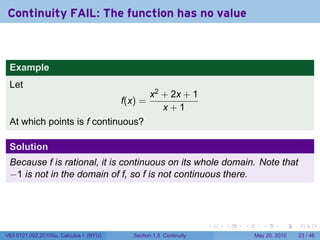
 not equal to a.


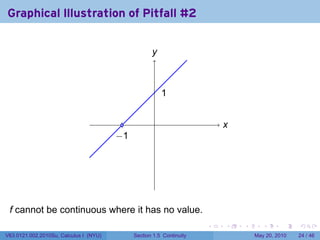
                                                                 .   .   .     .      .     .

V63.0121.002.2010Su, Calculus I (NYU)   Section 1.5 Continuity               May 20, 2010       4 / 46
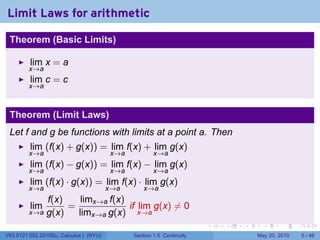
Limit Laws for arithmetic

 Theorem (Basic Limits)

         lim x = a
         x→a
         lim c = c
         x→a


 Theorem (Limit Laws)
 Let f and g be functions with limits at a point a. Then
         lim (f(x) + g(x)) = lim f(x) + lim g(x)
         x→a                            x→a           x→a
         lim (f(x) − g(x)) = lim f(x) − lim g(x)
         x→a                            x→a           x→a
         lim (f(x) · g(x)) = lim f(x) · lim g(x)
         x→a                            x→a       x→a
             f(x)    limx→a f(x)
         lim      =              if lim g(x) ̸= 0
         x→a g(x)   limx→a g(x) x→a
                                                                       .   .   .     .      .     .

V63.0121.002.2010Su, Calculus I (NYU)         Section 1.5 Continuity               May 20, 2010       5 / 46
Hatsumon

 Here are some discussion questions to start.
 True or False
 At some point in your life you were exactly three feet tall.


                                                                 .   .   .     .      .     .

V63.0121.002.2010Su, Calculus I (NYU)   Section 1.5 Continuity               May 20, 2010       6 / 46
Hatsumon

 Here are some discussion questions to start.
 True or False
 At some point in your life you were exactly three feet tall.

 True or False
 At some point in your life your height (in inches) was equal to your
 weight (in pounds).


                                                                 .   .   .     .      .     .

V63.0121.002.2010Su, Calculus I (NYU)   Section 1.5 Continuity               May 20, 2010       6 / 46
Hatsumon

 Here are some discussion questions to start.
 True or False
 At some point in your life you were exactly three feet tall.

 True or False
 At some point in your life your height (in inches) was equal to your
 weight (in pounds).

 True or False
 Right now there are a pair of points on opposite sides of the world
 measuring the exact same temperature.


                                                                 .   .   .     .      .     .

V63.0121.002.2010Su, Calculus I (NYU)   Section 1.5 Continuity               May 20, 2010       6 / 46
Outline


 Continuity


 The Intermediate Value Theorem


 Back to the Questions


                                                                 .   .   .     .      .     .

V63.0121.002.2010Su, Calculus I (NYU)   Section 1.5 Continuity               May 20, 2010       7 / 46
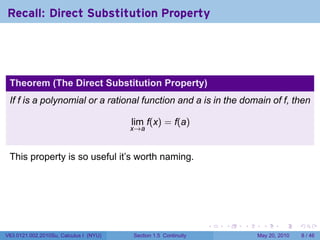
Recall: Direct Substitution Property


 Theorem (The Direct Substitution Property)
 If f is a polynomial or a rational function and a is in the domain of f, then

                                        lim f(x) = f(a)
                                        x→a


 This property is so useful it’s worth naming.


                                                                 .   .   .     .      .     .

V63.0121.002.2010Su, Calculus I (NYU)   Section 1.5 Continuity               May 20, 2010       8 / 46
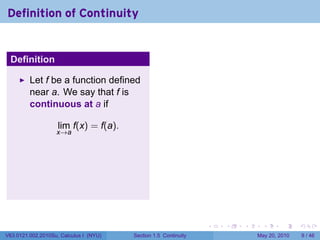
Definition of Continuity


 Definition

         Let f be a function defined
         near a. We say that f is
         continuous at a if

                    lim f(x) = f(a).
                   x→a


                                                                 .   .   .     .      .     .

V63.0121.002.2010Su, Calculus I (NYU)   Section 1.5 Continuity               May 20, 2010       9 / 46
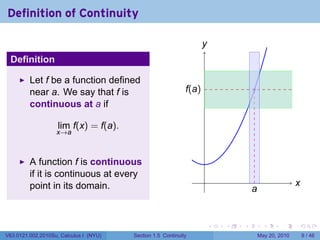
Definition of Continuity

                                                                    y
                                                                    .
 Definition

         Let f be a function defined
                                                             f
                                                             .(a)                   .
         near a. We say that f is
         continuous at a if

                    lim f(x) = f(a).
                   x→a


         A function f is continuous
         if it is continuous at every
                                                                    .                                  x
                                                                                                       .
         point in its domain.                                                       a
                                                                                    .


                                                                        .   .   .         .      .     .

V63.0121.002.2010Su, Calculus I (NYU)   Section 1.5 Continuity                          May 20, 2010       9 / 46
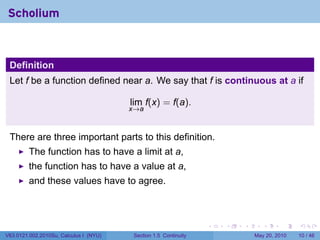
Scholium


 Definition
 Let f be a function defined near a. We say that f is continuous at a if

                                        lim f(x) = f(a).
                                        x→a


 There are three important parts to this definition.
         The function has to have a limit at a,
         the function has to have a value at a,
         and these values have to agree.


                                                                 .   .   .      .      .    .

V63.0121.002.2010Su, Calculus I (NYU)   Section 1.5 Continuity               May 20, 2010   10 / 46
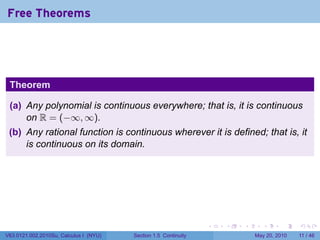
Free Theorems


 Theorem

 (a) Any polynomial is continuous everywhere; that is, it is continuous
     on R = (−∞, ∞).
 (b) Any rational function is continuous wherever it is defined; that is, it
     is continuous on its domain.


                                                                 .   .   .     .      .     .

V63.0121.002.2010Su, Calculus I (NYU)   Section 1.5 Continuity               May 20, 2010   11 / 46
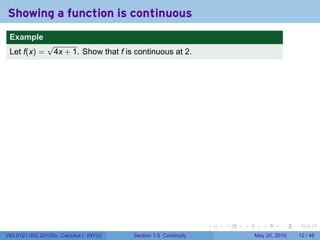
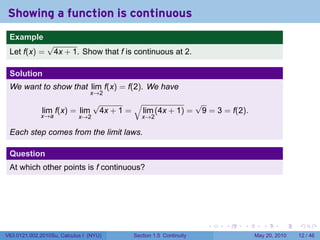
Showing a function is continuous
 .
 Example
                √
 Let f(x) =      4x + 1. Show that f is continuous at 2.


 .                                                               .   .   .      .      .    .

V63.0121.002.2010Su, Calculus I (NYU)   Section 1.5 Continuity               May 20, 2010   12 / 46
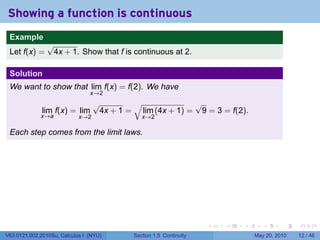
Showing a function is continuous
 .
 Example
                √
 Let f(x) =      4x + 1. Show that f is continuous at 2.

 Solution
 We want to show that lim f(x) = f(2). We have
                                x→2
                                  √        √              √
              lim f(x) = lim       4x + 1 = lim (4x + 1) = 9 = 3 = f(2).
             x→a            x→2               x→2

 Each step comes from the limit laws.


 .                                                                  .   .   .      .      .    .

V63.0121.002.2010Su, Calculus I (NYU)      Section 1.5 Continuity               May 20, 2010   12 / 46
Showing a function is continuous
 .
 Example
                √
 Let f(x) =      4x + 1. Show that f is continuous at 2.

 Solution
 We want to show that lim f(x) = f(2). We have
                                x→2
                                  √        √              √
              lim f(x) = lim       4x + 1 = lim (4x + 1) = 9 = 3 = f(2).
             x→a            x→2               x→2

 Each step comes from the limit laws.

 Question
 At which other points is f continuous?


 .                                                                  .   .   .      .      .    .

V63.0121.002.2010Su, Calculus I (NYU)      Section 1.5 Continuity               May 20, 2010   12 / 46
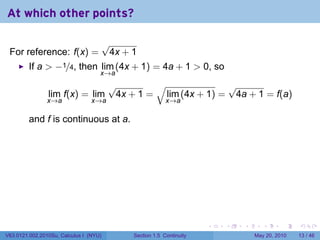
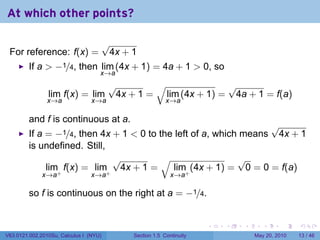
At which other points?

                                        √
 For reference: f(x) =                   4x + 1
         If a > −1/4, then lim (4x + 1) = 4a + 1 > 0, so
                                    x→a
                                         √        √              √
                lim f(x) = lim            4x + 1 = lim (4x + 1) = 4a + 1 = f(a)
                x→a              x→a                       x→a

         and f is continuous at a.


                                                                       .   .   .      .      .    .

V63.0121.002.2010Su, Calculus I (NYU)         Section 1.5 Continuity               May 20, 2010   13 / 46
At which other points?

                                        √
 For reference: f(x) =                   4x + 1
         If a > −1/4, then lim (4x + 1) = 4a + 1 > 0, so
                                    x→a
                                         √        √              √
                lim f(x) = lim            4x + 1 = lim (4x + 1) = 4a + 1 = f(a)
                x→a              x→a                       x→a

         and f is continuous at a.
                                                                   √
         If a = −1/4, then 4x + 1 < 0 to the left of a, which means 4x + 1
         is undefined. Still,
                              √           √                  √
              lim+ f(x) = lim+ 4x + 1 =     lim+ (4x + 1) = 0 = 0 = f(a)
              x→a                x→a                         x→a

         so f is continuous on the right at a = −1/4.


                                                                       .   .   .      .      .    .

V63.0121.002.2010Su, Calculus I (NYU)         Section 1.5 Continuity               May 20, 2010   13 / 46
Showing a function is continuous
 Example
                  √
 Let f(x) =        4x + 1. Show that f is continuous at 2.

 Solution
 We want to show that lim f(x) = f(2). We have
                                        x→2
                           √        √              √
             lim f(x) = lim 4x + 1 = lim (4x + 1) = 9 = 3 = f(2).
            x→a              x→2                       x→2

 Each step comes from the limit laws.

 Question
 At which other points is f continuous?

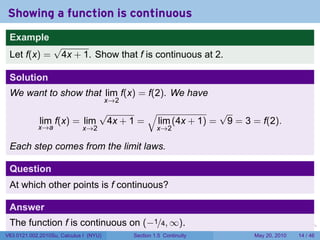
 Answer
 The function f is continuous on (−1/4, ∞).                            .   .   .      .      .    .

V63.0121.002.2010Su, Calculus I (NYU)         Section 1.5 Continuity               May 20, 2010   14 / 46
Showing a function is continuous
 Example
               √
 Let f(x) =     4x + 1. Show that f is continuous at 2.

 Solution
 We want to show that lim f(x) = f(2). We have
                           x→2
                       √        √              √
         lim f(x) = lim 4x + 1 = lim (4x + 1) = 9 = 3 = f(2).
         x→a         x→2                  x→2

 Each step comes from the limit laws.

 Question
 At which other points is f continuous?

 Answer
 The function f is continuous on (−1/4, ∞). It is right continuous at
                                                        .    .    .    .    .      .

 −1/4 since lim f(x)
V63.0121.002.2010Su, Calculus I (NYU) = f(−1 Section 1.5 Continuity
                                            /4).                    May 20, 2010   14 / 46
The Limit Laws give Continuity Laws


 Theorem
 If f(x) and g(x) are continuous at a and c is a constant, then the
 following functions are also continuous at a:
         (f + g)(x)
         (f − g)(x)
         (cf)(x)
         (fg)(x)
          f
            (x) (if g(a) ̸= 0)
         g


                                                                 .   .   .      .      .    .

V63.0121.002.2010Su, Calculus I (NYU)   Section 1.5 Continuity               May 20, 2010   15 / 46
Why a sum of continuous functions is continuous

 We want to show that

                                        lim (f + g)(x) = (f + g)(a).
                                        x→a

 We just follow our nose:

        lim (f + g)(x) = lim [f(x) + g(x)]                                               (def of f + g)
       x→a                       x→a
                             = lim f(x) + lim g(x)                               (if these limits exist)
                                 x→a            x→a
                             = f(a) + g(a)                              (they do; f and g are cts.)
                             = (f + g)(a)                                         (def of f + g again)


                                                                             .       .    .      .      .    .

V63.0121.002.2010Su, Calculus I (NYU)          Section 1.5 Continuity                         May 20, 2010   16 / 46
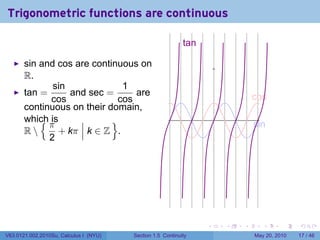
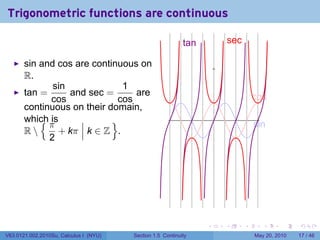
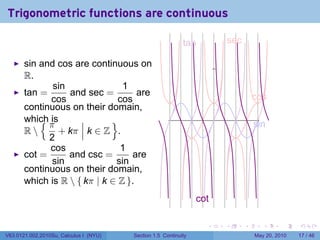
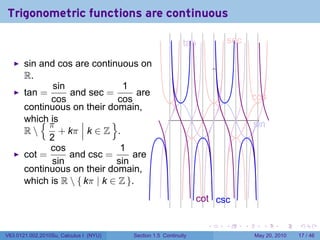
Trigonometric functions are continuous


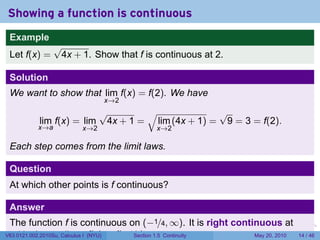
       sin and cos are continuous on
       R.


                                                                     .
                                                                                 s
                                                                                 . in


                                                                 .       .   .      .      .    .

V63.0121.002.2010Su, Calculus I (NYU)   Section 1.5 Continuity                   May 20, 2010   17 / 46
Trigonometric functions are continuous


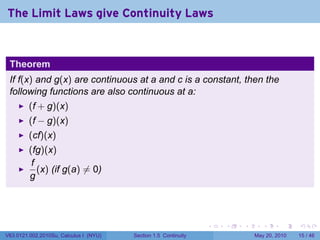
       sin and cos are continuous on
       R.

                                                                                 c
                                                                                 . os

                                                                     .
                                                                                 s
                                                                                 . in


                                                                 .       .   .      .      .    .

V63.0121.002.2010Su, Calculus I (NYU)   Section 1.5 Continuity                   May 20, 2010   17 / 46
Trigonometric functions are continuous

                                                            t
                                                            .an

       sin and cos are continuous on
       R.
              sin             1
       tan =      and sec =      are                                              c
                                                                                  . os
             cos             cos
       continuous on their domain,
           {π
       which is             }                                         .
                                                                                  s
                                                                                  . in
       R      + kπ k ∈ Z .
             2


                                                                  .       .   .      .      .    .

V63.0121.002.2010Su, Calculus I (NYU)   Section 1.5 Continuity                    May 20, 2010   17 / 46
Trigonometric functions are continuous

                                                            t
                                                            .an               s
                                                                              . ec

       sin and cos are continuous on
       R.
              sin             1
       tan =      and sec =      are                                                     c
                                                                                         . os
             cos             cos
       continuous on their domain,
           {π
       which is             }                                         .
                                                                                         s
                                                                                         . in
       R      + kπ k ∈ Z .
             2


                                                                  .       .          .      .      .    .

V63.0121.002.2010Su, Calculus I (NYU)   Section 1.5 Continuity                           May 20, 2010   17 / 46
Trigonometric functions are continuous

                                                            t
                                                            .an                 s
                                                                                . ec

       sin and cos are continuous on
       R.
              sin               1
       tan =      and sec =         are                                                    c
                                                                                           . os
             cos               cos
       continuous on their domain,
           {π
       which is              }                                          .
                                                                                           s
                                                                                           . in
       R       + kπ k ∈ Z .
             2
             cos               1
       cot =      and csc =       are
              sin             sin
       continuous on their domain,
       which is R  { kπ | k ∈ Z }.
                                                                 c
                                                                 . ot

                                                                    .       .          .      .      .    .

V63.0121.002.2010Su, Calculus I (NYU)   Section 1.5 Continuity                             May 20, 2010   17 / 46
Trigonometric functions are continuous

                                                            t
                                                            .an                s
                                                                               . ec

       sin and cos are continuous on
       R.
              sin               1
       tan =      and sec =         are                                                   c
                                                                                          . os
             cos               cos
       continuous on their domain,
           {π
       which is              }                                         .
                                                                                          s
                                                                                          . in
       R       + kπ k ∈ Z .
             2
             cos               1
       cot =      and csc =       are
              sin             sin
       continuous on their domain,
       which is R  { kπ | k ∈ Z }.
                                                                 c
                                                                 . ot . sc
                                                                      c

                                                                   .       .          .      .      .    .

V63.0121.002.2010Su, Calculus I (NYU)   Section 1.5 Continuity                            May 20, 2010   17 / 46
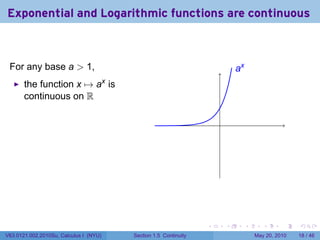
Exponential and Logarithmic functions are continuous


 For any base a > 1,                                                         .x
                                                                             a
       the function x → ax is
       continuous on R

                                                                     .


                                                                 .       .        .      .      .    .

V63.0121.002.2010Su, Calculus I (NYU)   Section 1.5 Continuity                        May 20, 2010   18 / 46
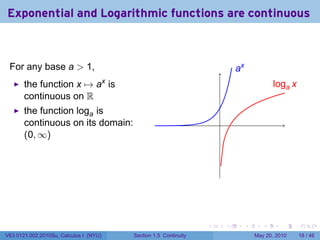
Exponential and Logarithmic functions are continuous


 For any base a > 1,                                                         .x
                                                                             a
       the function x → ax is                                                                l
                                                                                             .oga x
       continuous on R
       the function loga is
       continuous on its domain:                                     .
       (0, ∞)


                                                                 .       .        .      .      .     .

V63.0121.002.2010Su, Calculus I (NYU)   Section 1.5 Continuity                        May 20, 2010    18 / 46
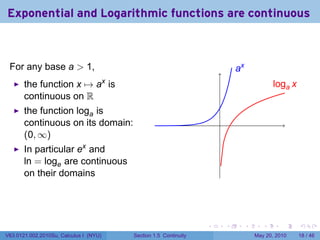
Exponential and Logarithmic functions are continuous


 For any base a > 1,                                                         .x
                                                                             a
       the function x → ax is                                                                l
                                                                                             .oga x
       continuous on R
       the function loga is
       continuous on its domain:                                     .
       (0, ∞)
       In particular ex and
       ln = loge are continuous
       on their domains


                                                                 .       .        .      .      .     .

V63.0121.002.2010Su, Calculus I (NYU)   Section 1.5 Continuity                        May 20, 2010    18 / 46
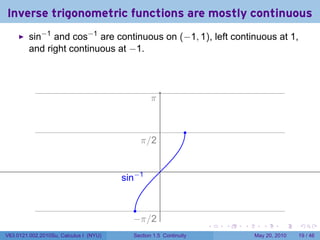
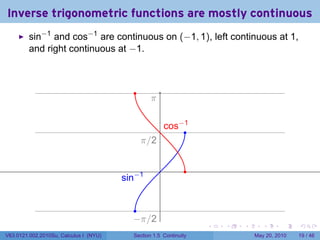
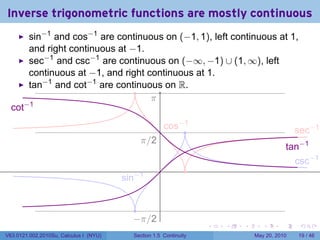
Inverse trigonometric functions are mostly continuous
         sin−1 and cos−1 are continuous on (−1, 1), left continuous at 1,
         and right continuous at −1.


                                                  .
                                                  π


                                                                .
                                             . /2
                                             π

                                                      .
                                        . in−1
                                        s


                                            .
                                           −
                                           . π/2
                                                                    .   .   .      .      .    .

V63.0121.002.2010Su, Calculus I (NYU)      Section 1.5 Continuity               May 20, 2010   19 / 46
Inverse trigonometric functions are mostly continuous
         sin−1 and cos−1 are continuous on (−1, 1), left continuous at 1,
         and right continuous at −1.


                                           .
                                                  .
                                                  π

                                                          . os−1
                                                          c    .
                                               . /2
                                               π

                                                      .         .
                                        . in−1
                                        s


                                            .
                                           −
                                           . π/2
                                                                    .   .   .      .      .    .

V63.0121.002.2010Su, Calculus I (NYU)      Section 1.5 Continuity               May 20, 2010   19 / 46
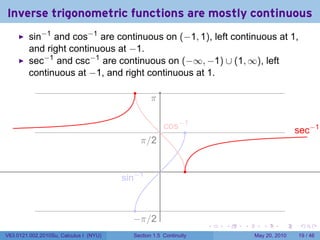
Inverse trigonometric functions are mostly continuous
         sin−1 and cos−1 are continuous on (−1, 1), left continuous at 1,
         and right continuous at −1.
         sec−1 and csc−1 are continuous on (−∞, −1) ∪ (1, ∞), left
         continuous at −1, and right continuous at 1.
                                           .
                                                  .
                                                  π

                                                          . os−1
                                                          c    .                               . ec−1
                                                                                               s
                                               . /2
                                               π

                                                      .         .
                                        . in−1
                                        s


                                            .
                                           −
                                           . π/2
                                                                    .   .   .      .      .     .

V63.0121.002.2010Su, Calculus I (NYU)      Section 1.5 Continuity               May 20, 2010   19 / 46
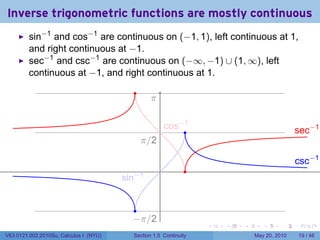
Inverse trigonometric functions are mostly continuous
         sin−1 and cos−1 are continuous on (−1, 1), left continuous at 1,
         and right continuous at −1.
         sec−1 and csc−1 are continuous on (−∞, −1) ∪ (1, ∞), left
         continuous at −1, and right continuous at 1.
                                           .
                                                  .
                                                  π

                                                          . os−1
                                                          c    .                               . ec−1
                                                                                               s
                                               . /2
                                               π

                                                                                               . sc−1
                                                                                               c
                                                      .         .
                                        . in−1
                                        s


                                            .
                                           −
                                           . π/2
                                                                    .   .   .      .      .     .

V63.0121.002.2010Su, Calculus I (NYU)      Section 1.5 Continuity               May 20, 2010   19 / 46
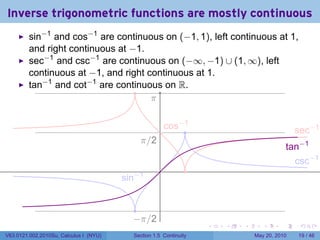
Inverse trigonometric functions are mostly continuous
         sin−1 and cos−1 are continuous on (−1, 1), left continuous at 1,
         and right continuous at −1.
         sec−1 and csc−1 are continuous on (−∞, −1) ∪ (1, ∞), left
         continuous at −1, and right continuous at 1.
         tan−1 and cot−1 are continuous on R.
                                  .
                                      .
                                      π

                                                          . os−1
                                                          c    .                                . ec−1
                                                                                                s
                                             . /2
                                             π
                                                                                              .an−1
                                                                                              t
                                                                                                . sc−1
                                                                                                c
                                                      .         .
                                        . in−1
                                        s


                                            .
                                           −
                                           . π/2
                                                                    .   .   .      .      .      .

V63.0121.002.2010Su, Calculus I (NYU)      Section 1.5 Continuity               May 20, 2010     19 / 46
Inverse trigonometric functions are mostly continuous
         sin−1 and cos−1 are continuous on (−1, 1), left continuous at 1,
         and right continuous at −1.
         sec−1 and csc−1 are continuous on (−∞, −1) ∪ (1, ∞), left
         continuous at −1, and right continuous at 1.
         tan−1 and cot−1 are continuous on R.
                                  .
                                      .
                                      π
  . ot−1
  c
                                                          . os−1
                                                          c    .                                . ec−1
                                                                                                s
                                             . /2
                                             π
                                                                                              .an−1
                                                                                              t
                                                                                                . sc−1
                                                                                                c
                                                      .         .
                                        . in−1
                                        s


                                            .
                                           −
                                           . π/2
                                                                    .   .   .      .      .      .

V63.0121.002.2010Su, Calculus I (NYU)      Section 1.5 Continuity               May 20, 2010     19 / 46
What could go wrong?


 In what ways could a function f fail to be continuous at a point a? Look
 again at the definition:
                             lim f(x) = f(a)
                                        x→a


                                                                 .   .   .      .      .    .

V63.0121.002.2010Su, Calculus I (NYU)   Section 1.5 Continuity               May 20, 2010   20 / 46
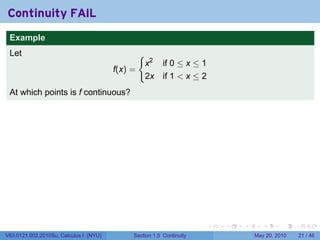
Continuity FAIL
 .
 Example
 Let                                             {
                                                     x2   if 0 ≤ x ≤ 1
                                        f(x) =
                                                     2x   if 1 < x ≤ 2
 At which points is f continuous?


 .
                                                                         .   .   .      .      .    .

V63.0121.002.2010Su, Calculus I (NYU)        Section 1.5 Continuity                  May 20, 2010   21 / 46
Continuity FAIL: The limit does not exist
 .
 Example
 Let                                               {
                                                       x2    if 0 ≤ x ≤ 1
                                          f(x) =
                                                       2x    if 1 < x ≤ 2
 At which points is f continuous?

 Solution
 At any point a in [0, 2] besides 1, lim f(x) = f(a) because f is represented by a
                                                   x→a
 polynomial near a, and polynomials have the direct substitution property.
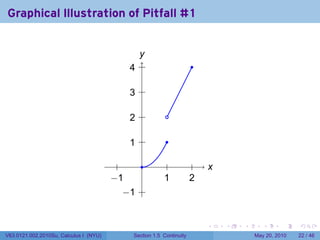
 However,

                                        lim f(x) = lim x2 = 12 = 1
                                        x→1−           x→1−
                                        lim f(x) = lim+ 2x = 2(1) = 2
                                        x→1+           x→1

 So f has no limit at 1. Therefore f is not continuous at 1.
 .
                                                                            .   .   .      .      .    .

V63.0121.002.2010Su, Calculus I (NYU)          Section 1.5 Continuity                   May 20, 2010   21 / 46
Graphical Illustration of Pitfall #1


                                               y
                                               .
                                             . .
                                             4                          .

                                             . .
                                             3

                                             . .
                                             2             .

                                             . .
                                             1             .

                                          .     .           .            .   x
                                                                             .
                                        −
                                        . 1               1
                                                          .            2
                                                                       .
                                            . 1 .
                                            −


                                                                             .   .   .      .      .    .

V63.0121.002.2010Su, Calculus I (NYU)         Section 1.5 Continuity                     May 20, 2010   22 / 46
Continuity FAIL


 Example
 Let
                                                 x2 + 2x + 1
                                        f(x) =
                                                    x+1
 At which points is f continuous?


                                                                    .   .   .      .      .    .

V63.0121.002.2010Su, Calculus I (NYU)      Section 1.5 Continuity               May 20, 2010   23 / 46
Continuity FAIL: The function has no value


 Example
 Let
                                                 x2 + 2x + 1
                                        f(x) =
                                                    x+1
 At which points is f continuous?

 Solution
 Because f is rational, it is continuous on its whole domain. Note that
 −1 is not in the domain of f, so f is not continuous there.


                                                                    .   .   .      .      .    .

V63.0121.002.2010Su, Calculus I (NYU)      Section 1.5 Continuity               May 20, 2010   23 / 46
Graphical Illustration of Pitfall #2

                                                     y
                                                     .


                                                      . .
                                                        1


                                          .           .                    x
                                                                           .
                                        −
                                        . 1


 f cannot be continuous where it has no value.
                                                                       .   .   .      .      .    .

V63.0121.002.2010Su, Calculus I (NYU)         Section 1.5 Continuity               May 20, 2010   24 / 46
Continuity FAIL


 Example
 Let                                             {
                                                     7    if x ̸= 1
                                        f(x) =
                                                     π    if x = 1
 At which points is f continuous?


                                                                      .   .   .      .      .    .

V63.0121.002.2010Su, Calculus I (NYU)      Section 1.5 Continuity                 May 20, 2010   25 / 46
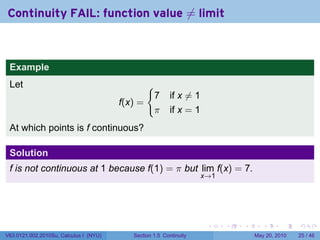
Continuity FAIL: function value ̸= limit


 Example
 Let                                             {
                                                     7    if x ̸= 1
                                        f(x) =
                                                     π    if x = 1
 At which points is f continuous?

 Solution
 f is not continuous at 1 because f(1) = π but lim f(x) = 7.
                                                                      x→1


                                                                       .    .   .      .      .    .

V63.0121.002.2010Su, Calculus I (NYU)      Section 1.5 Continuity                   May 20, 2010   25 / 46
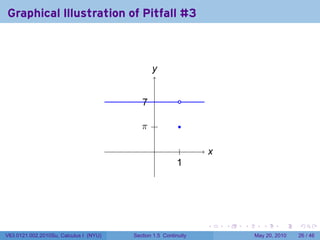
Graphical Illustration of Pitfall #3


                                               y
                                               .


                                           . .
                                           7               .

                                           . .
                                           π               .

                                                .           .    x
                                                                 .
                                                          1
                                                          .


                                                                 .   .   .      .      .    .

V63.0121.002.2010Su, Calculus I (NYU)   Section 1.5 Continuity               May 20, 2010   26 / 46
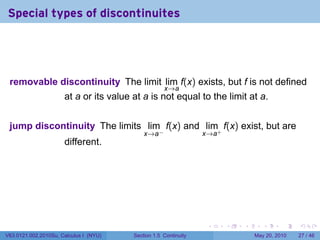
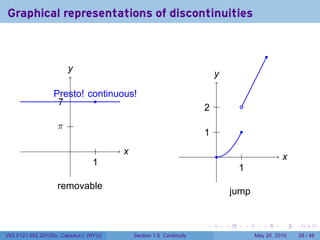
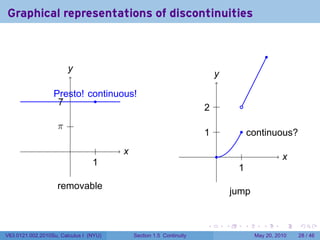
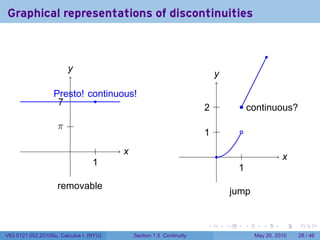
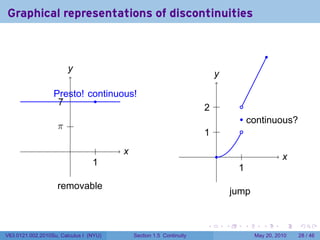
Special types of discontinuites


 removable discontinuity The limit lim f(x) exists, but f is not defined
                                                    x→a
                      at a or its value at a is not equal to the limit at a.


 jump discontinuity The limits lim f(x) and lim+ f(x) exist, but are
                                            x→a−                 x→a
                      different.


                                                                  .    .   .      .      .    .

V63.0121.002.2010Su, Calculus I (NYU)   Section 1.5 Continuity                 May 20, 2010   27 / 46
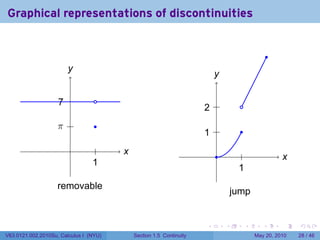
Graphical representations of discontinuities


                                                                                                   .
                        y
                        .
                                                                         y
                                                                         .

                    . .
                    7             .
                                                                     . .
                                                                     2             .

                    . .
                    π             .
                                                                     . .
                                                                     1             .

                         .         .    x
                                        .                                .          .                  x
                                                                                                       .
                                 1
                                 .
                                                                                  1
                                                                                  .
                    removable
                                                                                 jump


                                                                     .       .          .      .       .   .

V63.0121.002.2010Su, Calculus I (NYU)       Section 1.5 Continuity                          May 20, 2010   28 / 46
Graphical representations of discontinuities


                                                                                                   .
                        y
                        .
                                                                         y
                                                                         .

                  P
                  . resto! continuous!
                   . .
                   7         .
                                                                     . .
                                                                     2             .

                    . .
                    π
                                                                     . .
                                                                     1             .

                         .         .    x
                                        .                                .          .                  x
                                                                                                       .
                                 1
                                 .
                                                                                  1
                                                                                  .
                    removable
                                                                                 jump


                                                                     .       .          .      .       .   .

V63.0121.002.2010Su, Calculus I (NYU)       Section 1.5 Continuity                          May 20, 2010   28 / 46
Graphical representations of discontinuities


                                                                                                   .
                        y
                        .
                                                                         y
                                                                         .

                  P
                  . resto! continuous!
                   . .
                   7         .
                                                                     . .
                                                                     2             .

                    . .
                    π
                                                                     . .
                                                                     1             . . ontinuous?
                                                                                     c
                         .         .    x
                                        .                                .          .                  x
                                                                                                       .
                                 1
                                 .
                                                                                  1
                                                                                  .
                    removable
                                                                                 jump


                                                                     .       .          .      .       .   .

V63.0121.002.2010Su, Calculus I (NYU)       Section 1.5 Continuity                          May 20, 2010   28 / 46
Graphical representations of discontinuities


                                                                                                   .
                        y
                        .
                                                                         y
                                                                         .

                  P
                  . resto! continuous!
                   . .
                   7         .
                                                                     . .
                                                                     2             . . ontinuous?
                                                                                     c
                    . .
                    π
                                                                     . .
                                                                     1             .

                         .         .    x
                                        .                                .          .                  x
                                                                                                       .
                                 1
                                 .
                                                                                  1
                                                                                  .
                    removable
                                                                                 jump


                                                                     .       .          .      .       .   .

V63.0121.002.2010Su, Calculus I (NYU)       Section 1.5 Continuity                          May 20, 2010   28 / 46
Graphical representations of discontinuities


                                                                                                   .
                        y
                        .
                                                                         y
                                                                         .

                  P
                  . resto! continuous!
                   . .
                   7         .
                                                                     . .
                                                                     2             .
                                                                                   . . ontinuous?
                                                                                     c
                    . .
                    π
                                                                     . .
                                                                     1             .

                         .         .    x
                                        .                                .          .                  x
                                                                                                       .
                                 1
                                 .
                                                                                  1
                                                                                  .
                    removable
                                                                                 jump


                                                                     .       .          .      .       .   .

V63.0121.002.2010Su, Calculus I (NYU)       Section 1.5 Continuity                          May 20, 2010   28 / 46
Special types of discontinuites


 removable discontinuity The limit lim f(x) exists, but f is not defined
                                                    x→a
                      at a or its value at a is not equal to the limit at a. By
                      re-defining f(a) = lim f(x), f can be made continuous at a
                                           x→a
 jump discontinuity The limits lim f(x) and lim+ f(x) exist, but are
                                            x→a−                 x→a
                      different.


                                                                  .    .   .      .      .    .

V63.0121.002.2010Su, Calculus I (NYU)   Section 1.5 Continuity                 May 20, 2010   29 / 46
Special types of discontinuites


 removable discontinuity The limit lim f(x) exists, but f is not defined
                                                    x→a
                      at a or its value at a is not equal to the limit at a. By
                      re-defining f(a) = lim f(x), f can be made continuous at a
                                           x→a
 jump discontinuity The limits lim f(x) and lim+ f(x) exist, but are
                                            x→a−                 x→a
                      different. The function cannot be made continuous by
                      changing a single value.


                                                                  .    .   .      .      .    .

V63.0121.002.2010Su, Calculus I (NYU)   Section 1.5 Continuity                 May 20, 2010   29 / 46
The greatest integer function

 [[x]] is the greatest integer ≤ x.
                                                              y
                                                              .

                                                          . .
                                                          3
           x        [[x]]                                                              y
                                                                                       . = [[x]]
           0           0                                  . .
                                                          2                       .       .
           1           1
         1.5           1                                  . .
                                                          1             .         .
         1.9           1
         2.1           2                  .         .    .               .         .           .          x
                                                                                                          .
        −0.5        −1                  −
                                        . 2       −
                                                  . 1                  1
                                                                       .         2
                                                                                 .           3
                                                                                             .
        −0.9        −1                              .. 1 .
                                                      −
        −1.1        −2
                                         .          .. 2 .
                                                     −

                                                                             .    .      .            .       .   .

V63.0121.002.2010Su, Calculus I (NYU)         Section 1.5 Continuity                               May 20, 2010   30 / 46
The greatest integer function

 [[x]] is the greatest integer ≤ x.
                                                              y
                                                              .

                                                          . .
                                                          3
           x        [[x]]                                                              y
                                                                                       . = [[x]]
           0           0                                  . .
                                                          2                       .       .
           1           1
         1.5           1                                  . .
                                                          1             .         .
         1.9           1
         2.1           2                  .         .    .               .         .           .          x
                                                                                                          .
        −0.5        −1                  −
                                        . 2       −
                                                  . 1                  1
                                                                       .         2
                                                                                 .           3
                                                                                             .
        −0.9        −1                              .. 1 .
                                                      −
        −1.1        −2
                                         .          .. 2 .
                                                     −
 This function has a jump discontinuity at each integer.
                                                                             .    .      .            .       .   .

V63.0121.002.2010Su, Calculus I (NYU)         Section 1.5 Continuity                               May 20, 2010   30 / 46
Outline


 Continuity


 The Intermediate Value Theorem


 Back to the Questions


                                                                 .   .   .      .      .    .

V63.0121.002.2010Su, Calculus I (NYU)   Section 1.5 Continuity               May 20, 2010   31 / 46
A Big Time Theorem


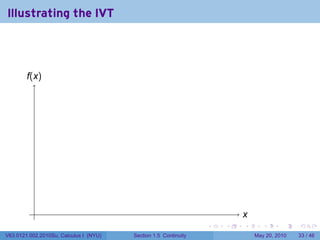
 Theorem (The Intermediate Value Theorem)
 Suppose that f is continuous on the closed interval [a, b] and let N be
 any number between f(a) and f(b), where f(a) ̸= f(b). Then there
 exists a number c in (a, b) such that f(c) = N.


                                                                 .   .   .      .      .    .

V63.0121.002.2010Su, Calculus I (NYU)   Section 1.5 Continuity               May 20, 2010   32 / 46
Illustrating the IVT


        f
        .(x)


           .                                                             x
                                                                         .
                                                                 .   .   .      .      .    .

V63.0121.002.2010Su, Calculus I (NYU)   Section 1.5 Continuity               May 20, 2010   33 / 46
Illustrating the IVT
 Suppose that f is continuous on the closed interval [a, b]


        f
        .(x)


                                                                     .


                              .


           .                                                                 x
                                                                             .
                                                                 .       .   .      .      .    .

V63.0121.002.2010Su, Calculus I (NYU)   Section 1.5 Continuity                   May 20, 2010   33 / 46
Illustrating the IVT
 Suppose that f is continuous on the closed interval [a, b]


        f
        .(x)


  f
  .(b)                                                               .


  f
  .(a)                        .


           .                                                                     x
                                                                                 .
                                  a
                                  .                                      b
                                                                         .
                                                                 .           .   .      .      .    .

V63.0121.002.2010Su, Calculus I (NYU)   Section 1.5 Continuity                       May 20, 2010   33 / 46
Illustrating the IVT
 Suppose that f is continuous on the closed interval [a, b] and let N be
 any number between f(a) and f(b), where f(a) ̸= f(b).


        f
        .(x)


  f
  .(b)                                                               .

      N
      .

  f
  .(a)                        .


           .                                                                     x
                                                                                 .
                                  a
                                  .                                      b
                                                                         .
                                                                 .           .   .      .      .    .

V63.0121.002.2010Su, Calculus I (NYU)   Section 1.5 Continuity                       May 20, 2010   33 / 46
Illustrating the IVT
 Suppose that f is continuous on the closed interval [a, b] and let N be
 any number between f(a) and f(b), where f(a) ̸= f(b). Then there
 exists a number c in (a, b) such that f(c) = N.
        f
        .(x)


  f
  .(b)                                                                       .

      N
      .                                 .

  f
  .(a)                        .


           .                                                                             x
                                                                                         .
                                  a
                                  .         c
                                            .                                    b
                                                                                 .
                                                                         .           .   .      .      .    .

V63.0121.002.2010Su, Calculus I (NYU)           Section 1.5 Continuity                       May 20, 2010   33 / 46
Illustrating the IVT
 Suppose that f is continuous on the closed interval [a, b] and let N be
 any number between f(a) and f(b), where f(a) ̸= f(b). Then there
 exists a number c in (a, b) such that f(c) = N.
        f
        .(x)


  f
  .(b)                                                               .

      N
      .

  f
  .(a)                        .


           .                                                                     x
                                                                                 .
                                  a
                                  .                                      b
                                                                         .
                                                                 .           .   .      .      .    .

V63.0121.002.2010Su, Calculus I (NYU)   Section 1.5 Continuity                       May 20, 2010   33 / 46
Illustrating the IVT
 Suppose that f is continuous on the closed interval [a, b] and let N be
 any number between f(a) and f(b), where f(a) ̸= f(b). Then there
 exists a number c in (a, b) such that f(c) = N.
        f
        .(x)


  f
  .(b)                                                                               .

      N
      .                            .     .                                 .

  f
  .(a)                        .


           .                                                                                 x
                                                                                             .
                                  ac
                                  . .1       c
                                             .2                                c b
                                                                               .3 .
                                                                                 .       .   .      .      .    .

V63.0121.002.2010Su, Calculus I (NYU)             Section 1.5 Continuity                         May 20, 2010   33 / 46
What the IVT does not say


 The Intermediate Value Theorem is an “existence” theorem.
         It does not say how many such c exist.
         It also does not say how to find c.
 Still, it can be used in iteration or in conjunction with other theorems to
 answer these questions.


                                                                 .   .   .      .      .    .

V63.0121.002.2010Su, Calculus I (NYU)   Section 1.5 Continuity               May 20, 2010   34 / 46
Using the IVT


 Example
 Suppose we are unaware of the square root function and that it’s
 continuous. Prove that the square root of two exists.


                                                                 .   .   .      .      .    .

V63.0121.002.2010Su, Calculus I (NYU)   Section 1.5 Continuity               May 20, 2010   35 / 46
Using the IVT


 Example
 Suppose we are unaware of the square root function and that it’s
 continuous. Prove that the square root of two exists.

 Proof.
 Let f(x) = x2 , a continuous function on [1, 2].


                                                                 .   .   .      .      .    .

V63.0121.002.2010Su, Calculus I (NYU)   Section 1.5 Continuity               May 20, 2010   35 / 46
Using the IVT


 Example
 Suppose we are unaware of the square root function and that it’s
 continuous. Prove that the square root of two exists.

 Proof.
 Let f(x) = x2 , a continuous function on [1, 2]. Note f(1) = 1 and
 f(2) = 4. Since 2 is between 1 and 4, there exists a point c in (1, 2)
 such that
                                f(c) = c2 = 2.


                                                                 .   .   .      .      .    .

V63.0121.002.2010Su, Calculus I (NYU)   Section 1.5 Continuity               May 20, 2010   35 / 46
Using the IVT


 Example
 Suppose we are unaware of the square root function and that it’s
 continuous. Prove that the square root of two exists.

 Proof.
 Let f(x) = x2 , a continuous function on [1, 2]. Note f(1) = 1 and
 f(2) = 4. Since 2 is between 1 and 4, there exists a point c in (1, 2)
 such that
                                f(c) = c2 = 2.


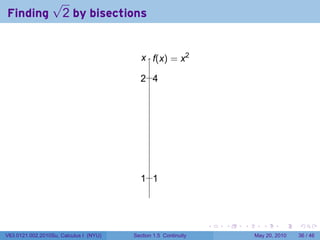
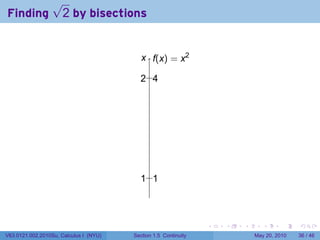
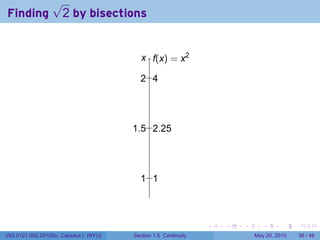
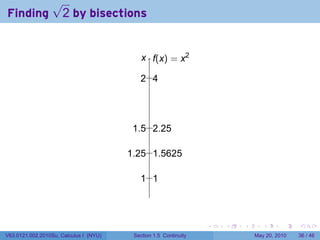
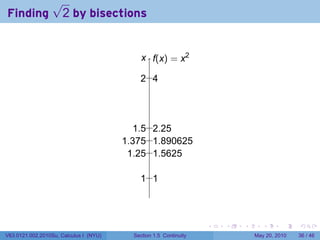
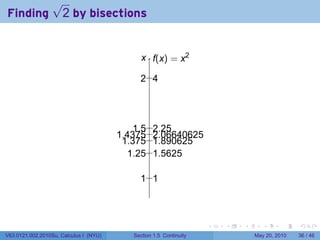
 In fact, we can “narrow in” on the square root of 2 by the method of
 bisections.

                                                                 .   .   .      .      .    .

V63.0121.002.2010Su, Calculus I (NYU)   Section 1.5 Continuity               May 20, 2010   35 / 46
√
Finding               2 by bisections


                                           . .(x) = x2
                                           x f

                                          . ..
                                          2 4


                                          . ..
                                          1 1


                                                                 .   .   .      .      .    .

V63.0121.002.2010Su, Calculus I (NYU)   Section 1.5 Continuity               May 20, 2010   36 / 46
√
Finding               2 by bisections


                                           . .(x) = x2
                                           x f

                                          . ..
                                          2 4


                                          . ..
                                          1 1


                                                                 .   .   .      .      .    .

V63.0121.002.2010Su, Calculus I (NYU)   Section 1.5 Continuity               May 20, 2010   36 / 46
√
Finding               2 by bisections


                                           . .(x) = x2
                                           x f

                                          . ..
                                          2 4


                                        . .5 . . .25
                                        1      2


                                          . ..
                                          1 1


                                                                 .   .   .      .      .    .

V63.0121.002.2010Su, Calculus I (NYU)   Section 1.5 Continuity               May 20, 2010   36 / 46
√
Finding               2 by bisections


                                            . .(x) = x2
                                            x f

                                           . ..
                                           2 4


                                         . .5 . . .25
                                         1      2

                                        . .25 . . .5625
                                        1       1

                                           . ..
                                           1 1


                                                                  .   .   .      .      .    .

V63.0121.002.2010Su, Calculus I (NYU)    Section 1.5 Continuity               May 20, 2010   36 / 46
√
Finding               2 by bisections


                                              . .(x) = x2
                                              x f

                                              . ..
                                              2 4


                                            1
                                            . .5   . . .25
                                                     2
                                        1
                                        . .375     . . .890625
                                                     1
                                          1
                                          . .25    . . .5625
                                                     1

                                              . ..
                                              1 1


                                                                    .   .   .      .      .    .

V63.0121.002.2010Su, Calculus I (NYU)      Section 1.5 Continuity               May 20, 2010   36 / 46
√
Finding               2 by bisections


                                                . .(x) = x2
                                                x f

                                                . ..
                                                2 4


                                              1
                                              . .5   . . .25
                                        1
                                        . .4375      . 2.06640625
                                          1
                                          . .375     . . .890625
                                                       2
                                                       1
                                                       .
                                            1
                                            . .25    . . .5625
                                                       1

                                                . ..
                                                1 1


                                                                      .   .   .      .      .    .

V63.0121.002.2010Su, Calculus I (NYU)        Section 1.5 Continuity               May 20, 2010   36 / 46
Using the IVT


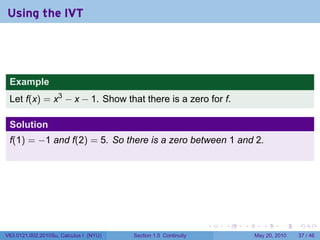
 Example
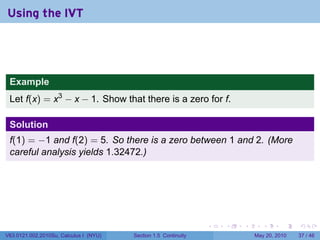
 Let f(x) = x3 − x − 1. Show that there is a zero for f.

 Solution
 f(1) = −1 and f(2) = 5. So there is a zero between 1 and 2.


                                                                 .   .   .      .      .    .

V63.0121.002.2010Su, Calculus I (NYU)   Section 1.5 Continuity               May 20, 2010   37 / 46
Using the IVT


 Example
 Let f(x) = x3 − x − 1. Show that there is a zero for f.

 Solution
 f(1) = −1 and f(2) = 5. So there is a zero between 1 and 2. (More
 careful analysis yields 1.32472.)


                                                                 .   .   .      .      .    .

V63.0121.002.2010Su, Calculus I (NYU)   Section 1.5 Continuity               May 20, 2010   37 / 46
Outline


 Continuity


 The Intermediate Value Theorem


 Back to the Questions


                                                                 .   .   .      .      .    .

V63.0121.002.2010Su, Calculus I (NYU)   Section 1.5 Continuity               May 20, 2010   38 / 46
Back to the Questions


 True or False
 At one point in your life you were exactly three feet tall.


                                                                 .   .   .      .      .    .

V63.0121.002.2010Su, Calculus I (NYU)   Section 1.5 Continuity               May 20, 2010   39 / 46
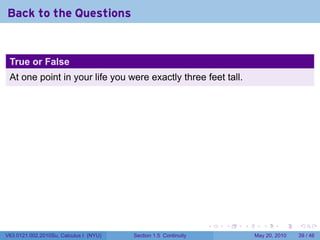
Question 1: True!


         Let h(t) be height, which varies continuously over time.
         Then h(birth) < 3 ft and h(now) > 3 ft.
         So by the IVT there is a point c in (birth, now) where h(c) = 3.


                                                                 .   .   .      .      .    .

V63.0121.002.2010Su, Calculus I (NYU)   Section 1.5 Continuity               May 20, 2010   40 / 46
Back to the Questions


 True or False
 At one point in your life you were exactly three feet tall.

 True or False
 At one point in your life your height in inches equaled your weight in
 pounds.


                                                                 .   .   .      .      .    .

V63.0121.002.2010Su, Calculus I (NYU)   Section 1.5 Continuity               May 20, 2010   41 / 46
Question 2: True!


         Let h(t) be height in inches and w(t) be weight in pounds, both
         varying continuously over time.
         Let f(t) = h(t) − w(t).
         For most of us (call your mom), f(birth) > 0 and f(now) < 0.
         So by the IVT there is a point c in (birth, now) where f(c) = 0.
         In other words,

                                  h(c) − w(c) = 0 ⇐⇒ h(c) = w(c).


                                                                  .   .   .      .      .    .

V63.0121.002.2010Su, Calculus I (NYU)    Section 1.5 Continuity               May 20, 2010   42 / 46
Back to the Questions


 True or False
 At one point in your life you were exactly three feet tall.

 True or False
 At one point in your life your height in inches equaled your weight in
 pounds.

 True or False
 Right now there are two points on opposite sides of the Earth with
 exactly the same temperature.


                                                                 .   .   .      .      .    .

V63.0121.002.2010Su, Calculus I (NYU)   Section 1.5 Continuity               May 20, 2010   43 / 46
Question 3


         Let T(θ) be the temperature at the point on the equator at
         longitude θ.
         How can you express the statement that the temperature on
         opposite sides is the same?
         How can you ensure this is true?


                                                                 .   .   .      .      .    .

V63.0121.002.2010Su, Calculus I (NYU)   Section 1.5 Continuity               May 20, 2010   44 / 46
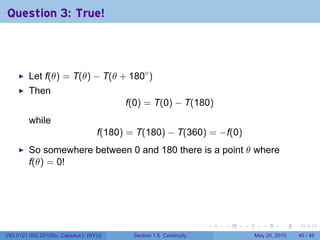
Question 3: True!


         Let f(θ) = T(θ) − T(θ + 180◦ )
         Then
                                         f(0) = T(0) − T(180)
         while
                                   f(180) = T(180) − T(360) = −f(0)
         So somewhere between 0 and 180 there is a point θ where
         f(θ) = 0!


                                                                    .   .   .      .      .    .

V63.0121.002.2010Su, Calculus I (NYU)      Section 1.5 Continuity               May 20, 2010   45 / 46
What have we learned today?


         Definition: a function is continuous at a point if the limit of the
         function at that point agrees with the value of the function at that
         point.
         We often make a fundamental assumption that functions we meet
         in nature are continuous.
         The Intermediate Value Theorem is a basic property of real
         numbers that we need and use a lot.


                                                                 .   .   .      .      .    .

V63.0121.002.2010Su, Calculus I (NYU)   Section 1.5 Continuity               May 20, 2010   46 / 46

Lesson 4: Continuity

  • 1.
    Section 1.5 Continuity V63.0121.002.2010Su, Calculus I New York University May 20, 2010 Announcements Office Hours: MR 5:00–5:45, TW 7:50–8:30, CIWW 102 (here) Quiz 1 Thursday on 1.1–1.4 . . . . . .
  • 2.
    Announcements Office Hours: MR 5:00–5:45, TW 7:50–8:30, CIWW 102 (here) Quiz 1 Thursday on 1.1–1.4 . . . . . . V63.0121.002.2010Su, Calculus I (NYU) Section 1.5 Continuity May 20, 2010 2 / 46
  • 3.
    Objectives Understand and apply the definition of continuity for a function at a point or on an interval. Given a piecewise defined function, decide where it is continuous or discontinuous. State and understand the Intermediate Value Theorem. Use the IVT to show that a function takes a certain value, or that an equation has a solution . . . . . . V63.0121.002.2010Su, Calculus I (NYU) Section 1.5 Continuity May 20, 2010 3 / 46
  • 4.
    Last time Definition We write lim f(x) = L x→a and say “the limit of f(x), as x approaches a, equals L” if we can make the values of f(x) arbitrarily close to L (as close to L as we like) by taking x to be sufficiently close to a (on either side of a) but not equal to a. . . . . . . V63.0121.002.2010Su, Calculus I (NYU) Section 1.5 Continuity May 20, 2010 4 / 46
  • 5.
    Limit Laws forarithmetic Theorem (Basic Limits) lim x = a x→a lim c = c x→a Theorem (Limit Laws) Let f and g be functions with limits at a point a. Then lim (f(x) + g(x)) = lim f(x) + lim g(x) x→a x→a x→a lim (f(x) − g(x)) = lim f(x) − lim g(x) x→a x→a x→a lim (f(x) · g(x)) = lim f(x) · lim g(x) x→a x→a x→a f(x) limx→a f(x) lim = if lim g(x) ̸= 0 x→a g(x) limx→a g(x) x→a . . . . . . V63.0121.002.2010Su, Calculus I (NYU) Section 1.5 Continuity May 20, 2010 5 / 46
  • 6.
    Hatsumon Here aresome discussion questions to start. True or False At some point in your life you were exactly three feet tall. . . . . . . V63.0121.002.2010Su, Calculus I (NYU) Section 1.5 Continuity May 20, 2010 6 / 46
  • 7.
    Hatsumon Here aresome discussion questions to start. True or False At some point in your life you were exactly three feet tall. True or False At some point in your life your height (in inches) was equal to your weight (in pounds). . . . . . . V63.0121.002.2010Su, Calculus I (NYU) Section 1.5 Continuity May 20, 2010 6 / 46
  • 8.
    Hatsumon Here aresome discussion questions to start. True or False At some point in your life you were exactly three feet tall. True or False At some point in your life your height (in inches) was equal to your weight (in pounds). True or False Right now there are a pair of points on opposite sides of the world measuring the exact same temperature. . . . . . . V63.0121.002.2010Su, Calculus I (NYU) Section 1.5 Continuity May 20, 2010 6 / 46
  • 9.
    Outline Continuity TheIntermediate Value Theorem Back to the Questions . . . . . . V63.0121.002.2010Su, Calculus I (NYU) Section 1.5 Continuity May 20, 2010 7 / 46
  • 10.
    Recall: Direct SubstitutionProperty Theorem (The Direct Substitution Property) If f is a polynomial or a rational function and a is in the domain of f, then lim f(x) = f(a) x→a This property is so useful it’s worth naming. . . . . . . V63.0121.002.2010Su, Calculus I (NYU) Section 1.5 Continuity May 20, 2010 8 / 46
  • 11.
    Definition of Continuity Definition Let f be a function defined near a. We say that f is continuous at a if lim f(x) = f(a). x→a . . . . . . V63.0121.002.2010Su, Calculus I (NYU) Section 1.5 Continuity May 20, 2010 9 / 46
  • 12.
    Definition of Continuity y . Definition Let f be a function defined f .(a) . near a. We say that f is continuous at a if lim f(x) = f(a). x→a A function f is continuous if it is continuous at every . x . point in its domain. a . . . . . . . V63.0121.002.2010Su, Calculus I (NYU) Section 1.5 Continuity May 20, 2010 9 / 46
  • 13.
    Scholium Definition Letf be a function defined near a. We say that f is continuous at a if lim f(x) = f(a). x→a There are three important parts to this definition. The function has to have a limit at a, the function has to have a value at a, and these values have to agree. . . . . . . V63.0121.002.2010Su, Calculus I (NYU) Section 1.5 Continuity May 20, 2010 10 / 46
  • 14.
    Free Theorems Theorem (a) Any polynomial is continuous everywhere; that is, it is continuous on R = (−∞, ∞). (b) Any rational function is continuous wherever it is defined; that is, it is continuous on its domain. . . . . . . V63.0121.002.2010Su, Calculus I (NYU) Section 1.5 Continuity May 20, 2010 11 / 46
  • 15.
    Showing a functionis continuous . Example √ Let f(x) = 4x + 1. Show that f is continuous at 2. . . . . . . . V63.0121.002.2010Su, Calculus I (NYU) Section 1.5 Continuity May 20, 2010 12 / 46
  • 16.
    Showing a functionis continuous . Example √ Let f(x) = 4x + 1. Show that f is continuous at 2. Solution We want to show that lim f(x) = f(2). We have x→2 √ √ √ lim f(x) = lim 4x + 1 = lim (4x + 1) = 9 = 3 = f(2). x→a x→2 x→2 Each step comes from the limit laws. . . . . . . . V63.0121.002.2010Su, Calculus I (NYU) Section 1.5 Continuity May 20, 2010 12 / 46
  • 17.
    Showing a functionis continuous . Example √ Let f(x) = 4x + 1. Show that f is continuous at 2. Solution We want to show that lim f(x) = f(2). We have x→2 √ √ √ lim f(x) = lim 4x + 1 = lim (4x + 1) = 9 = 3 = f(2). x→a x→2 x→2 Each step comes from the limit laws. Question At which other points is f continuous? . . . . . . . V63.0121.002.2010Su, Calculus I (NYU) Section 1.5 Continuity May 20, 2010 12 / 46
  • 18.
    At which otherpoints? √ For reference: f(x) = 4x + 1 If a > −1/4, then lim (4x + 1) = 4a + 1 > 0, so x→a √ √ √ lim f(x) = lim 4x + 1 = lim (4x + 1) = 4a + 1 = f(a) x→a x→a x→a and f is continuous at a. . . . . . . V63.0121.002.2010Su, Calculus I (NYU) Section 1.5 Continuity May 20, 2010 13 / 46
  • 19.
    At which otherpoints? √ For reference: f(x) = 4x + 1 If a > −1/4, then lim (4x + 1) = 4a + 1 > 0, so x→a √ √ √ lim f(x) = lim 4x + 1 = lim (4x + 1) = 4a + 1 = f(a) x→a x→a x→a and f is continuous at a. √ If a = −1/4, then 4x + 1 < 0 to the left of a, which means 4x + 1 is undefined. Still, √ √ √ lim+ f(x) = lim+ 4x + 1 = lim+ (4x + 1) = 0 = 0 = f(a) x→a x→a x→a so f is continuous on the right at a = −1/4. . . . . . . V63.0121.002.2010Su, Calculus I (NYU) Section 1.5 Continuity May 20, 2010 13 / 46
  • 20.
    Showing a functionis continuous Example √ Let f(x) = 4x + 1. Show that f is continuous at 2. Solution We want to show that lim f(x) = f(2). We have x→2 √ √ √ lim f(x) = lim 4x + 1 = lim (4x + 1) = 9 = 3 = f(2). x→a x→2 x→2 Each step comes from the limit laws. Question At which other points is f continuous? Answer The function f is continuous on (−1/4, ∞). . . . . . . V63.0121.002.2010Su, Calculus I (NYU) Section 1.5 Continuity May 20, 2010 14 / 46
  • 21.
    Showing a functionis continuous Example √ Let f(x) = 4x + 1. Show that f is continuous at 2. Solution We want to show that lim f(x) = f(2). We have x→2 √ √ √ lim f(x) = lim 4x + 1 = lim (4x + 1) = 9 = 3 = f(2). x→a x→2 x→2 Each step comes from the limit laws. Question At which other points is f continuous? Answer The function f is continuous on (−1/4, ∞). It is right continuous at . . . . . . −1/4 since lim f(x) V63.0121.002.2010Su, Calculus I (NYU) = f(−1 Section 1.5 Continuity /4). May 20, 2010 14 / 46
  • 22.
    The Limit Lawsgive Continuity Laws Theorem If f(x) and g(x) are continuous at a and c is a constant, then the following functions are also continuous at a: (f + g)(x) (f − g)(x) (cf)(x) (fg)(x) f (x) (if g(a) ̸= 0) g . . . . . . V63.0121.002.2010Su, Calculus I (NYU) Section 1.5 Continuity May 20, 2010 15 / 46
  • 23.
    Why a sumof continuous functions is continuous We want to show that lim (f + g)(x) = (f + g)(a). x→a We just follow our nose: lim (f + g)(x) = lim [f(x) + g(x)] (def of f + g) x→a x→a = lim f(x) + lim g(x) (if these limits exist) x→a x→a = f(a) + g(a) (they do; f and g are cts.) = (f + g)(a) (def of f + g again) . . . . . . V63.0121.002.2010Su, Calculus I (NYU) Section 1.5 Continuity May 20, 2010 16 / 46
  • 24.
    Trigonometric functions arecontinuous sin and cos are continuous on R. . s . in . . . . . . V63.0121.002.2010Su, Calculus I (NYU) Section 1.5 Continuity May 20, 2010 17 / 46
  • 25.
    Trigonometric functions arecontinuous sin and cos are continuous on R. c . os . s . in . . . . . . V63.0121.002.2010Su, Calculus I (NYU) Section 1.5 Continuity May 20, 2010 17 / 46
  • 26.
    Trigonometric functions arecontinuous t .an sin and cos are continuous on R. sin 1 tan = and sec = are c . os cos cos continuous on their domain, {π which is } . s . in R + kπ k ∈ Z . 2 . . . . . . V63.0121.002.2010Su, Calculus I (NYU) Section 1.5 Continuity May 20, 2010 17 / 46
  • 27.
    Trigonometric functions arecontinuous t .an s . ec sin and cos are continuous on R. sin 1 tan = and sec = are c . os cos cos continuous on their domain, {π which is } . s . in R + kπ k ∈ Z . 2 . . . . . . V63.0121.002.2010Su, Calculus I (NYU) Section 1.5 Continuity May 20, 2010 17 / 46
  • 28.
    Trigonometric functions arecontinuous t .an s . ec sin and cos are continuous on R. sin 1 tan = and sec = are c . os cos cos continuous on their domain, {π which is } . s . in R + kπ k ∈ Z . 2 cos 1 cot = and csc = are sin sin continuous on their domain, which is R { kπ | k ∈ Z }. c . ot . . . . . . V63.0121.002.2010Su, Calculus I (NYU) Section 1.5 Continuity May 20, 2010 17 / 46
  • 29.
    Trigonometric functions arecontinuous t .an s . ec sin and cos are continuous on R. sin 1 tan = and sec = are c . os cos cos continuous on their domain, {π which is } . s . in R + kπ k ∈ Z . 2 cos 1 cot = and csc = are sin sin continuous on their domain, which is R { kπ | k ∈ Z }. c . ot . sc c . . . . . . V63.0121.002.2010Su, Calculus I (NYU) Section 1.5 Continuity May 20, 2010 17 / 46
  • 30.
    Exponential and Logarithmicfunctions are continuous For any base a > 1, .x a the function x → ax is continuous on R . . . . . . . V63.0121.002.2010Su, Calculus I (NYU) Section 1.5 Continuity May 20, 2010 18 / 46
  • 31.
    Exponential and Logarithmicfunctions are continuous For any base a > 1, .x a the function x → ax is l .oga x continuous on R the function loga is continuous on its domain: . (0, ∞) . . . . . . V63.0121.002.2010Su, Calculus I (NYU) Section 1.5 Continuity May 20, 2010 18 / 46
  • 32.
    Exponential and Logarithmicfunctions are continuous For any base a > 1, .x a the function x → ax is l .oga x continuous on R the function loga is continuous on its domain: . (0, ∞) In particular ex and ln = loge are continuous on their domains . . . . . . V63.0121.002.2010Su, Calculus I (NYU) Section 1.5 Continuity May 20, 2010 18 / 46
  • 33.
    Inverse trigonometric functionsare mostly continuous sin−1 and cos−1 are continuous on (−1, 1), left continuous at 1, and right continuous at −1. . π . . /2 π . . in−1 s . − . π/2 . . . . . . V63.0121.002.2010Su, Calculus I (NYU) Section 1.5 Continuity May 20, 2010 19 / 46
  • 34.
    Inverse trigonometric functionsare mostly continuous sin−1 and cos−1 are continuous on (−1, 1), left continuous at 1, and right continuous at −1. . . π . os−1 c . . /2 π . . . in−1 s . − . π/2 . . . . . . V63.0121.002.2010Su, Calculus I (NYU) Section 1.5 Continuity May 20, 2010 19 / 46
  • 35.
    Inverse trigonometric functionsare mostly continuous sin−1 and cos−1 are continuous on (−1, 1), left continuous at 1, and right continuous at −1. sec−1 and csc−1 are continuous on (−∞, −1) ∪ (1, ∞), left continuous at −1, and right continuous at 1. . . π . os−1 c . . ec−1 s . /2 π . . . in−1 s . − . π/2 . . . . . . V63.0121.002.2010Su, Calculus I (NYU) Section 1.5 Continuity May 20, 2010 19 / 46
  • 36.
    Inverse trigonometric functionsare mostly continuous sin−1 and cos−1 are continuous on (−1, 1), left continuous at 1, and right continuous at −1. sec−1 and csc−1 are continuous on (−∞, −1) ∪ (1, ∞), left continuous at −1, and right continuous at 1. . . π . os−1 c . . ec−1 s . /2 π . sc−1 c . . . in−1 s . − . π/2 . . . . . . V63.0121.002.2010Su, Calculus I (NYU) Section 1.5 Continuity May 20, 2010 19 / 46
  • 37.
    Inverse trigonometric functionsare mostly continuous sin−1 and cos−1 are continuous on (−1, 1), left continuous at 1, and right continuous at −1. sec−1 and csc−1 are continuous on (−∞, −1) ∪ (1, ∞), left continuous at −1, and right continuous at 1. tan−1 and cot−1 are continuous on R. . . π . os−1 c . . ec−1 s . /2 π .an−1 t . sc−1 c . . . in−1 s . − . π/2 . . . . . . V63.0121.002.2010Su, Calculus I (NYU) Section 1.5 Continuity May 20, 2010 19 / 46
  • 38.
    Inverse trigonometric functionsare mostly continuous sin−1 and cos−1 are continuous on (−1, 1), left continuous at 1, and right continuous at −1. sec−1 and csc−1 are continuous on (−∞, −1) ∪ (1, ∞), left continuous at −1, and right continuous at 1. tan−1 and cot−1 are continuous on R. . . π . ot−1 c . os−1 c . . ec−1 s . /2 π .an−1 t . sc−1 c . . . in−1 s . − . π/2 . . . . . . V63.0121.002.2010Su, Calculus I (NYU) Section 1.5 Continuity May 20, 2010 19 / 46
  • 39.
    What could gowrong? In what ways could a function f fail to be continuous at a point a? Look again at the definition: lim f(x) = f(a) x→a . . . . . . V63.0121.002.2010Su, Calculus I (NYU) Section 1.5 Continuity May 20, 2010 20 / 46
  • 40.
    Continuity FAIL . Example Let { x2 if 0 ≤ x ≤ 1 f(x) = 2x if 1 < x ≤ 2 At which points is f continuous? . . . . . . . V63.0121.002.2010Su, Calculus I (NYU) Section 1.5 Continuity May 20, 2010 21 / 46
  • 41.
    Continuity FAIL: Thelimit does not exist . Example Let { x2 if 0 ≤ x ≤ 1 f(x) = 2x if 1 < x ≤ 2 At which points is f continuous? Solution At any point a in [0, 2] besides 1, lim f(x) = f(a) because f is represented by a x→a polynomial near a, and polynomials have the direct substitution property. However, lim f(x) = lim x2 = 12 = 1 x→1− x→1− lim f(x) = lim+ 2x = 2(1) = 2 x→1+ x→1 So f has no limit at 1. Therefore f is not continuous at 1. . . . . . . . V63.0121.002.2010Su, Calculus I (NYU) Section 1.5 Continuity May 20, 2010 21 / 46
  • 42.
    Graphical Illustration ofPitfall #1 y . . . 4 . . . 3 . . 2 . . . 1 . . . . . x . − . 1 1 . 2 . . 1 . − . . . . . . V63.0121.002.2010Su, Calculus I (NYU) Section 1.5 Continuity May 20, 2010 22 / 46
  • 43.
    Continuity FAIL Example Let x2 + 2x + 1 f(x) = x+1 At which points is f continuous? . . . . . . V63.0121.002.2010Su, Calculus I (NYU) Section 1.5 Continuity May 20, 2010 23 / 46
  • 44.
    Continuity FAIL: Thefunction has no value Example Let x2 + 2x + 1 f(x) = x+1 At which points is f continuous? Solution Because f is rational, it is continuous on its whole domain. Note that −1 is not in the domain of f, so f is not continuous there. . . . . . . V63.0121.002.2010Su, Calculus I (NYU) Section 1.5 Continuity May 20, 2010 23 / 46
  • 45.
    Graphical Illustration ofPitfall #2 y . . . 1 . . x . − . 1 f cannot be continuous where it has no value. . . . . . . V63.0121.002.2010Su, Calculus I (NYU) Section 1.5 Continuity May 20, 2010 24 / 46
  • 46.
    Continuity FAIL Example Let { 7 if x ̸= 1 f(x) = π if x = 1 At which points is f continuous? . . . . . . V63.0121.002.2010Su, Calculus I (NYU) Section 1.5 Continuity May 20, 2010 25 / 46
  • 47.
    Continuity FAIL: functionvalue ̸= limit Example Let { 7 if x ̸= 1 f(x) = π if x = 1 At which points is f continuous? Solution f is not continuous at 1 because f(1) = π but lim f(x) = 7. x→1 . . . . . . V63.0121.002.2010Su, Calculus I (NYU) Section 1.5 Continuity May 20, 2010 25 / 46
  • 48.
    Graphical Illustration ofPitfall #3 y . . . 7 . . . π . . . x . 1 . . . . . . . V63.0121.002.2010Su, Calculus I (NYU) Section 1.5 Continuity May 20, 2010 26 / 46
  • 49.
    Special types ofdiscontinuites removable discontinuity The limit lim f(x) exists, but f is not defined x→a at a or its value at a is not equal to the limit at a. jump discontinuity The limits lim f(x) and lim+ f(x) exist, but are x→a− x→a different. . . . . . . V63.0121.002.2010Su, Calculus I (NYU) Section 1.5 Continuity May 20, 2010 27 / 46
  • 50.
    Graphical representations ofdiscontinuities . y . y . . . 7 . . . 2 . . . π . . . 1 . . . x . . . x . 1 . 1 . removable jump . . . . . . V63.0121.002.2010Su, Calculus I (NYU) Section 1.5 Continuity May 20, 2010 28 / 46
  • 51.
    Graphical representations ofdiscontinuities . y . y . P . resto! continuous! . . 7 . . . 2 . . . π . . 1 . . . x . . . x . 1 . 1 . removable jump . . . . . . V63.0121.002.2010Su, Calculus I (NYU) Section 1.5 Continuity May 20, 2010 28 / 46
  • 52.
    Graphical representations ofdiscontinuities . y . y . P . resto! continuous! . . 7 . . . 2 . . . π . . 1 . . ontinuous? c . . x . . . x . 1 . 1 . removable jump . . . . . . V63.0121.002.2010Su, Calculus I (NYU) Section 1.5 Continuity May 20, 2010 28 / 46
  • 53.
    Graphical representations ofdiscontinuities . y . y . P . resto! continuous! . . 7 . . . 2 . . ontinuous? c . . π . . 1 . . . x . . . x . 1 . 1 . removable jump . . . . . . V63.0121.002.2010Su, Calculus I (NYU) Section 1.5 Continuity May 20, 2010 28 / 46
  • 54.
    Graphical representations ofdiscontinuities . y . y . P . resto! continuous! . . 7 . . . 2 . . . ontinuous? c . . π . . 1 . . . x . . . x . 1 . 1 . removable jump . . . . . . V63.0121.002.2010Su, Calculus I (NYU) Section 1.5 Continuity May 20, 2010 28 / 46
  • 55.
    Special types ofdiscontinuites removable discontinuity The limit lim f(x) exists, but f is not defined x→a at a or its value at a is not equal to the limit at a. By re-defining f(a) = lim f(x), f can be made continuous at a x→a jump discontinuity The limits lim f(x) and lim+ f(x) exist, but are x→a− x→a different. . . . . . . V63.0121.002.2010Su, Calculus I (NYU) Section 1.5 Continuity May 20, 2010 29 / 46
  • 56.
    Special types ofdiscontinuites removable discontinuity The limit lim f(x) exists, but f is not defined x→a at a or its value at a is not equal to the limit at a. By re-defining f(a) = lim f(x), f can be made continuous at a x→a jump discontinuity The limits lim f(x) and lim+ f(x) exist, but are x→a− x→a different. The function cannot be made continuous by changing a single value. . . . . . . V63.0121.002.2010Su, Calculus I (NYU) Section 1.5 Continuity May 20, 2010 29 / 46
  • 57.
    The greatest integerfunction [[x]] is the greatest integer ≤ x. y . . . 3 x [[x]] y . = [[x]] 0 0 . . 2 . . 1 1 1.5 1 . . 1 . . 1.9 1 2.1 2 . . . . . . x . −0.5 −1 − . 2 − . 1 1 . 2 . 3 . −0.9 −1 .. 1 . − −1.1 −2 . .. 2 . − . . . . . . V63.0121.002.2010Su, Calculus I (NYU) Section 1.5 Continuity May 20, 2010 30 / 46
  • 58.
    The greatest integerfunction [[x]] is the greatest integer ≤ x. y . . . 3 x [[x]] y . = [[x]] 0 0 . . 2 . . 1 1 1.5 1 . . 1 . . 1.9 1 2.1 2 . . . . . . x . −0.5 −1 − . 2 − . 1 1 . 2 . 3 . −0.9 −1 .. 1 . − −1.1 −2 . .. 2 . − This function has a jump discontinuity at each integer. . . . . . . V63.0121.002.2010Su, Calculus I (NYU) Section 1.5 Continuity May 20, 2010 30 / 46
  • 59.
    Outline Continuity TheIntermediate Value Theorem Back to the Questions . . . . . . V63.0121.002.2010Su, Calculus I (NYU) Section 1.5 Continuity May 20, 2010 31 / 46
  • 60.
    A Big TimeTheorem Theorem (The Intermediate Value Theorem) Suppose that f is continuous on the closed interval [a, b] and let N be any number between f(a) and f(b), where f(a) ̸= f(b). Then there exists a number c in (a, b) such that f(c) = N. . . . . . . V63.0121.002.2010Su, Calculus I (NYU) Section 1.5 Continuity May 20, 2010 32 / 46
  • 61.
    Illustrating the IVT f .(x) . x . . . . . . . V63.0121.002.2010Su, Calculus I (NYU) Section 1.5 Continuity May 20, 2010 33 / 46
  • 62.
    Illustrating the IVT Suppose that f is continuous on the closed interval [a, b] f .(x) . . . x . . . . . . . V63.0121.002.2010Su, Calculus I (NYU) Section 1.5 Continuity May 20, 2010 33 / 46
  • 63.
    Illustrating the IVT Suppose that f is continuous on the closed interval [a, b] f .(x) f .(b) . f .(a) . . x . a . b . . . . . . . V63.0121.002.2010Su, Calculus I (NYU) Section 1.5 Continuity May 20, 2010 33 / 46
  • 64.
    Illustrating the IVT Suppose that f is continuous on the closed interval [a, b] and let N be any number between f(a) and f(b), where f(a) ̸= f(b). f .(x) f .(b) . N . f .(a) . . x . a . b . . . . . . . V63.0121.002.2010Su, Calculus I (NYU) Section 1.5 Continuity May 20, 2010 33 / 46
  • 65.
    Illustrating the IVT Suppose that f is continuous on the closed interval [a, b] and let N be any number between f(a) and f(b), where f(a) ̸= f(b). Then there exists a number c in (a, b) such that f(c) = N. f .(x) f .(b) . N . . f .(a) . . x . a . c . b . . . . . . . V63.0121.002.2010Su, Calculus I (NYU) Section 1.5 Continuity May 20, 2010 33 / 46
  • 66.
    Illustrating the IVT Suppose that f is continuous on the closed interval [a, b] and let N be any number between f(a) and f(b), where f(a) ̸= f(b). Then there exists a number c in (a, b) such that f(c) = N. f .(x) f .(b) . N . f .(a) . . x . a . b . . . . . . . V63.0121.002.2010Su, Calculus I (NYU) Section 1.5 Continuity May 20, 2010 33 / 46
  • 67.
    Illustrating the IVT Suppose that f is continuous on the closed interval [a, b] and let N be any number between f(a) and f(b), where f(a) ̸= f(b). Then there exists a number c in (a, b) such that f(c) = N. f .(x) f .(b) . N . . . . f .(a) . . x . ac . .1 c .2 c b .3 . . . . . . . V63.0121.002.2010Su, Calculus I (NYU) Section 1.5 Continuity May 20, 2010 33 / 46
  • 68.
    What the IVTdoes not say The Intermediate Value Theorem is an “existence” theorem. It does not say how many such c exist. It also does not say how to find c. Still, it can be used in iteration or in conjunction with other theorems to answer these questions. . . . . . . V63.0121.002.2010Su, Calculus I (NYU) Section 1.5 Continuity May 20, 2010 34 / 46
  • 69.
    Using the IVT Example Suppose we are unaware of the square root function and that it’s continuous. Prove that the square root of two exists. . . . . . . V63.0121.002.2010Su, Calculus I (NYU) Section 1.5 Continuity May 20, 2010 35 / 46
  • 70.
    Using the IVT Example Suppose we are unaware of the square root function and that it’s continuous. Prove that the square root of two exists. Proof. Let f(x) = x2 , a continuous function on [1, 2]. . . . . . . V63.0121.002.2010Su, Calculus I (NYU) Section 1.5 Continuity May 20, 2010 35 / 46
  • 71.
    Using the IVT Example Suppose we are unaware of the square root function and that it’s continuous. Prove that the square root of two exists. Proof. Let f(x) = x2 , a continuous function on [1, 2]. Note f(1) = 1 and f(2) = 4. Since 2 is between 1 and 4, there exists a point c in (1, 2) such that f(c) = c2 = 2. . . . . . . V63.0121.002.2010Su, Calculus I (NYU) Section 1.5 Continuity May 20, 2010 35 / 46
  • 72.
    Using the IVT Example Suppose we are unaware of the square root function and that it’s continuous. Prove that the square root of two exists. Proof. Let f(x) = x2 , a continuous function on [1, 2]. Note f(1) = 1 and f(2) = 4. Since 2 is between 1 and 4, there exists a point c in (1, 2) such that f(c) = c2 = 2. In fact, we can “narrow in” on the square root of 2 by the method of bisections. . . . . . . V63.0121.002.2010Su, Calculus I (NYU) Section 1.5 Continuity May 20, 2010 35 / 46
  • 73.
    √ Finding 2 by bisections . .(x) = x2 x f . .. 2 4 . .. 1 1 . . . . . . V63.0121.002.2010Su, Calculus I (NYU) Section 1.5 Continuity May 20, 2010 36 / 46
  • 74.
    √ Finding 2 by bisections . .(x) = x2 x f . .. 2 4 . .. 1 1 . . . . . . V63.0121.002.2010Su, Calculus I (NYU) Section 1.5 Continuity May 20, 2010 36 / 46
  • 75.
    √ Finding 2 by bisections . .(x) = x2 x f . .. 2 4 . .5 . . .25 1 2 . .. 1 1 . . . . . . V63.0121.002.2010Su, Calculus I (NYU) Section 1.5 Continuity May 20, 2010 36 / 46
  • 76.
    √ Finding 2 by bisections . .(x) = x2 x f . .. 2 4 . .5 . . .25 1 2 . .25 . . .5625 1 1 . .. 1 1 . . . . . . V63.0121.002.2010Su, Calculus I (NYU) Section 1.5 Continuity May 20, 2010 36 / 46
  • 77.
    √ Finding 2 by bisections . .(x) = x2 x f . .. 2 4 1 . .5 . . .25 2 1 . .375 . . .890625 1 1 . .25 . . .5625 1 . .. 1 1 . . . . . . V63.0121.002.2010Su, Calculus I (NYU) Section 1.5 Continuity May 20, 2010 36 / 46
  • 78.
    √ Finding 2 by bisections . .(x) = x2 x f . .. 2 4 1 . .5 . . .25 1 . .4375 . 2.06640625 1 . .375 . . .890625 2 1 . 1 . .25 . . .5625 1 . .. 1 1 . . . . . . V63.0121.002.2010Su, Calculus I (NYU) Section 1.5 Continuity May 20, 2010 36 / 46
  • 79.
    Using the IVT Example Let f(x) = x3 − x − 1. Show that there is a zero for f. Solution f(1) = −1 and f(2) = 5. So there is a zero between 1 and 2. . . . . . . V63.0121.002.2010Su, Calculus I (NYU) Section 1.5 Continuity May 20, 2010 37 / 46
  • 80.
    Using the IVT Example Let f(x) = x3 − x − 1. Show that there is a zero for f. Solution f(1) = −1 and f(2) = 5. So there is a zero between 1 and 2. (More careful analysis yields 1.32472.) . . . . . . V63.0121.002.2010Su, Calculus I (NYU) Section 1.5 Continuity May 20, 2010 37 / 46
  • 81.
    Outline Continuity TheIntermediate Value Theorem Back to the Questions . . . . . . V63.0121.002.2010Su, Calculus I (NYU) Section 1.5 Continuity May 20, 2010 38 / 46
  • 82.
    Back to theQuestions True or False At one point in your life you were exactly three feet tall. . . . . . . V63.0121.002.2010Su, Calculus I (NYU) Section 1.5 Continuity May 20, 2010 39 / 46
  • 83.
    Question 1: True! Let h(t) be height, which varies continuously over time. Then h(birth) < 3 ft and h(now) > 3 ft. So by the IVT there is a point c in (birth, now) where h(c) = 3. . . . . . . V63.0121.002.2010Su, Calculus I (NYU) Section 1.5 Continuity May 20, 2010 40 / 46
  • 84.
    Back to theQuestions True or False At one point in your life you were exactly three feet tall. True or False At one point in your life your height in inches equaled your weight in pounds. . . . . . . V63.0121.002.2010Su, Calculus I (NYU) Section 1.5 Continuity May 20, 2010 41 / 46
  • 85.
    Question 2: True! Let h(t) be height in inches and w(t) be weight in pounds, both varying continuously over time. Let f(t) = h(t) − w(t). For most of us (call your mom), f(birth) > 0 and f(now) < 0. So by the IVT there is a point c in (birth, now) where f(c) = 0. In other words, h(c) − w(c) = 0 ⇐⇒ h(c) = w(c). . . . . . . V63.0121.002.2010Su, Calculus I (NYU) Section 1.5 Continuity May 20, 2010 42 / 46
  • 86.
    Back to theQuestions True or False At one point in your life you were exactly three feet tall. True or False At one point in your life your height in inches equaled your weight in pounds. True or False Right now there are two points on opposite sides of the Earth with exactly the same temperature. . . . . . . V63.0121.002.2010Su, Calculus I (NYU) Section 1.5 Continuity May 20, 2010 43 / 46
  • 87.
    Question 3 Let T(θ) be the temperature at the point on the equator at longitude θ. How can you express the statement that the temperature on opposite sides is the same? How can you ensure this is true? . . . . . . V63.0121.002.2010Su, Calculus I (NYU) Section 1.5 Continuity May 20, 2010 44 / 46
  • 88.
    Question 3: True! Let f(θ) = T(θ) − T(θ + 180◦ ) Then f(0) = T(0) − T(180) while f(180) = T(180) − T(360) = −f(0) So somewhere between 0 and 180 there is a point θ where f(θ) = 0! . . . . . . V63.0121.002.2010Su, Calculus I (NYU) Section 1.5 Continuity May 20, 2010 45 / 46
  • 89.
    What have welearned today? Definition: a function is continuous at a point if the limit of the function at that point agrees with the value of the function at that point. We often make a fundamental assumption that functions we meet in nature are continuous. The Intermediate Value Theorem is a basic property of real numbers that we need and use a lot. . . . . . . V63.0121.002.2010Su, Calculus I (NYU) Section 1.5 Continuity May 20, 2010 46 / 46