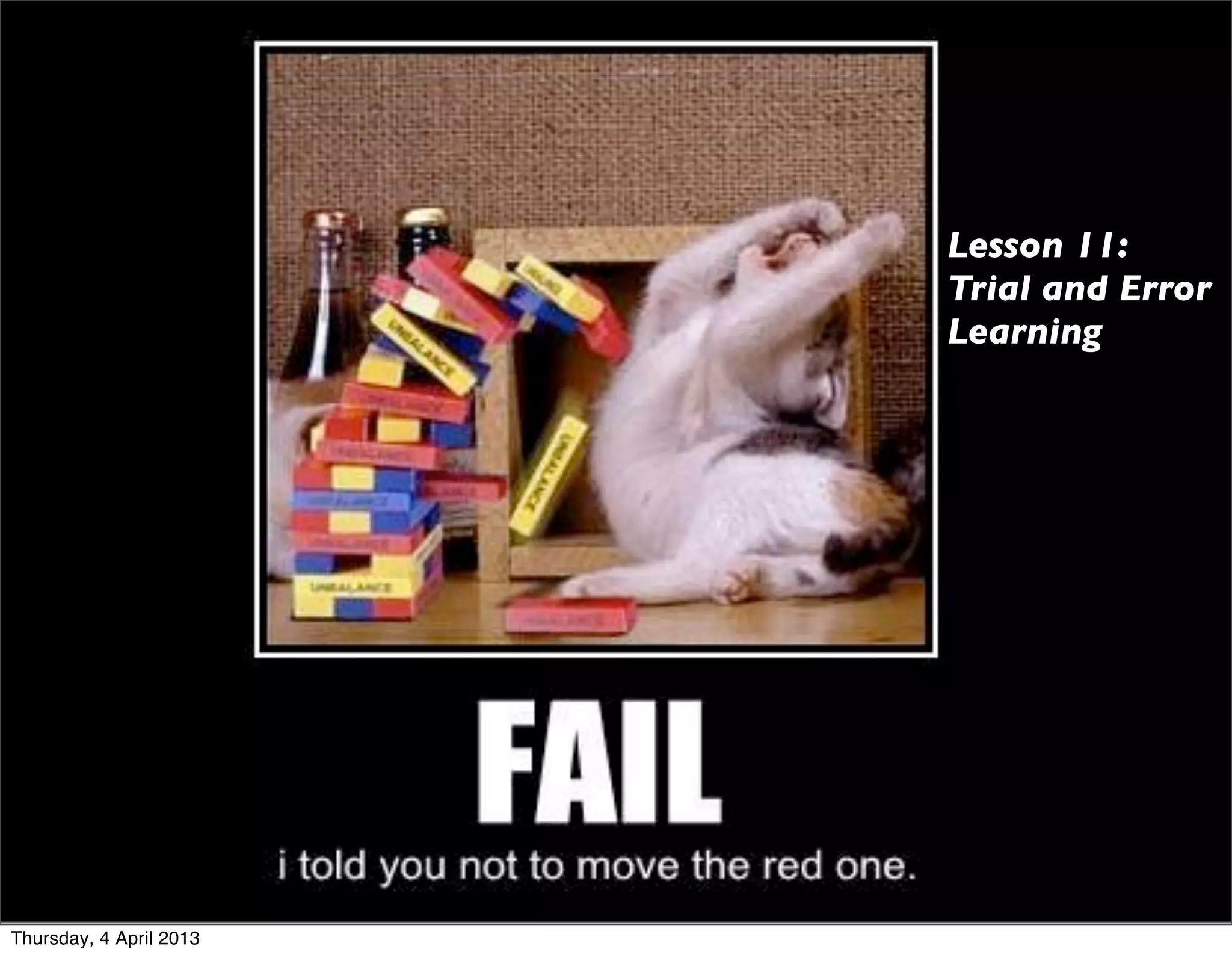
Lesson 11:
                         Trial and Error
                         Learning


Thursday, 4 April 2013
From last lesson......
 What role does the learner play in each of the different
 types of conditioning?


Thursday, 4 April 2013
From last lesson......
 What role does the learner play in each of the different
 types of conditioning?


    In classical conditioning, the learner is passive, whereas in
    operant conditioning the learner actively chooses to respond
    in a particular manner to gain reinforcement or avoid
    punishment


Thursday, 4 April 2013
This lesson........


    • Explain and apply trial-and-error learning


Thursday, 4 April 2013
Trial and error learning involves learning by
   trying alternative possibilities until the desired
   outcome is achieved


Thursday, 4 April 2013
Trial and error learning involves learning by
   trying alternative possibilities until the desired
   outcome is achieved

A simple way of learning to cope with the environmental
demands


Thursday, 4 April 2013
Trial and error learning involves learning by
   trying alternative possibilities until the desired
   outcome is achieved

A simple way of learning to cope with the environmental
demands

    Required that an individual (or animal) be motivated to
    explore and respond to the environment


Thursday, 4 April 2013
Trial and error learning involves learning by
   trying alternative possibilities until the desired
   outcome is achieved

A simple way of learning to cope with the environmental
demands

    Required that an individual (or animal) be motivated to
    explore and respond to the environment

                     Correct Responses (trials) must be rewarded


Thursday, 4 April 2013
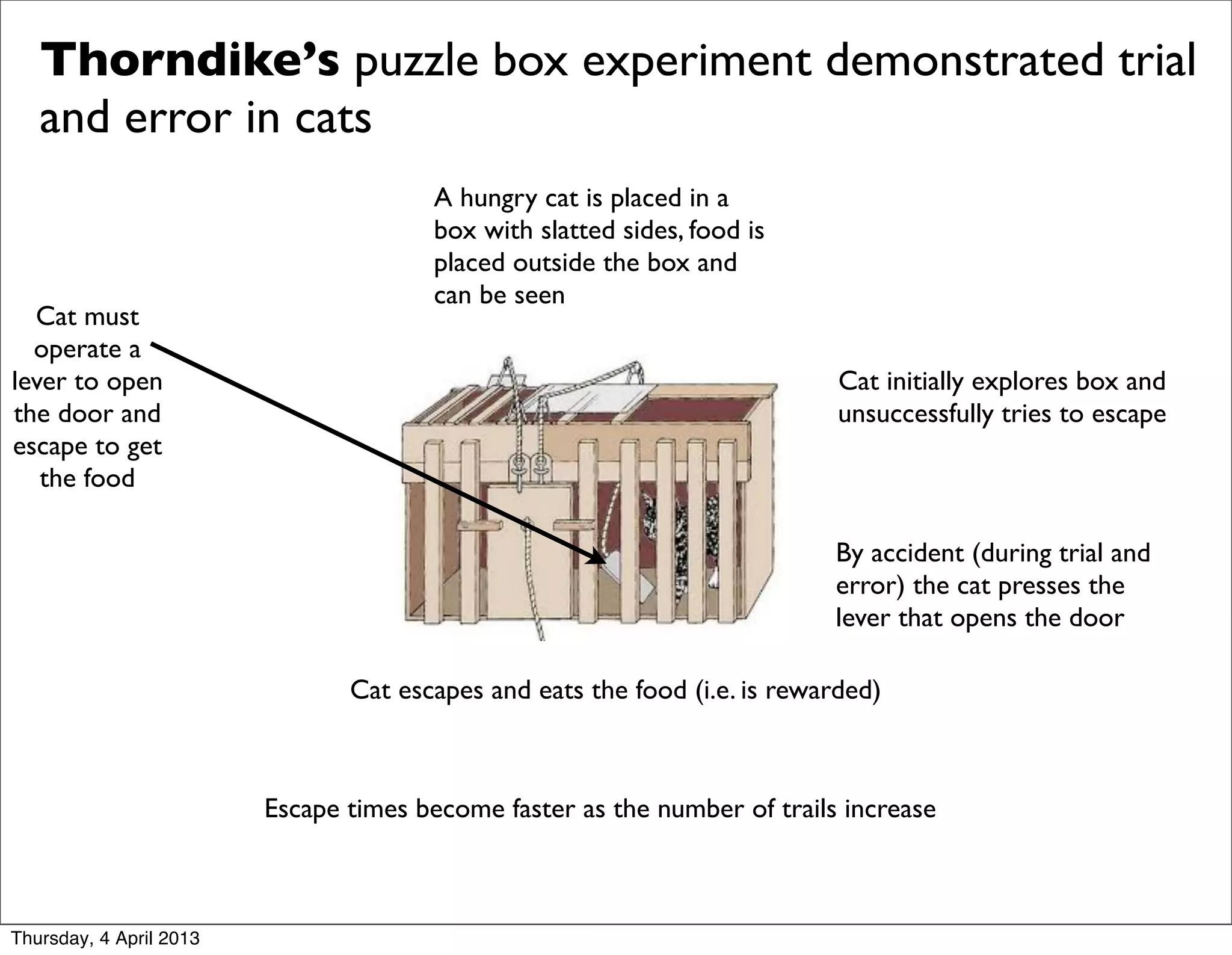
Thorndike’s puzzle box experiment demonstrated trial
   and error in cats
                                       A hungry cat is placed in a
                                       box with slatted sides, food is
                                       placed outside the box and
                                       can be seen
  Cat must
  operate a
lever to open                                                               Cat initially explores box and
the door and                                                                unsuccessfully tries to escape
escape to get
   the food

                                                                           By accident (during trial and
                                                                           error) the cat presses the
                                                                           lever that opens the door

                                Cat escapes and eats the food (i.e. is rewarded)


                         Escape times become faster as the number of trails increase


Thursday, 4 April 2013
Cat is ‘instrumental’ in learning the correct response
and ‘operated’ on the environment to get the desired
outcome. Thorndike called this ‘instrumental
learning’

The results of this experiment led Thorndike to develop the
law of effect.

The law of effect essentially states that a behaviour that is
accompanied or closely followed by ‘satisfying‘ consequences is
more likely to recur, and a behaviour that is followed by ‘annoying‘
consequences or discomfort is less likely to recur.


Thursday, 4 April 2013
Activities
1) Review Questions:

1) What is trial-error learning?
2) a. Describe Thorndike's puzzle-box experiment
b. Draw a graph to illustrate change in 'time to escape' compared with
number of trials.
3) State Thorndike's 'law of effect'. What form of learning is described by
this 'law'?
2) Exam Questions:

 1) Write five short answer questions that could be asked in the exam.
 With mark allocations. Knowledge to answer the questions could come
 from any lesson from the topic ‘learning’ we have studied thus far, with at
 least one involving Trail and Error learning

 2) Partner up - swap questions and answer each others questions. When
 finished swap back and assess each others work.

Thursday, 4 April 2013

Lesson 11 trial error learning 2013

  • 1.
    Lesson 11: Trial and Error Learning Thursday, 4 April 2013
  • 2.
    From last lesson...... What role does the learner play in each of the different types of conditioning? Thursday, 4 April 2013
  • 3.
    From last lesson...... What role does the learner play in each of the different types of conditioning? In classical conditioning, the learner is passive, whereas in operant conditioning the learner actively chooses to respond in a particular manner to gain reinforcement or avoid punishment Thursday, 4 April 2013
  • 4.
    This lesson........   • Explain and apply trial-and-error learning Thursday, 4 April 2013
  • 5.
    Trial and errorlearning involves learning by trying alternative possibilities until the desired outcome is achieved Thursday, 4 April 2013
  • 6.
    Trial and errorlearning involves learning by trying alternative possibilities until the desired outcome is achieved A simple way of learning to cope with the environmental demands Thursday, 4 April 2013
  • 7.
    Trial and errorlearning involves learning by trying alternative possibilities until the desired outcome is achieved A simple way of learning to cope with the environmental demands Required that an individual (or animal) be motivated to explore and respond to the environment Thursday, 4 April 2013
  • 8.
    Trial and errorlearning involves learning by trying alternative possibilities until the desired outcome is achieved A simple way of learning to cope with the environmental demands Required that an individual (or animal) be motivated to explore and respond to the environment Correct Responses (trials) must be rewarded Thursday, 4 April 2013
  • 9.
  • 10.
    Thorndike’s puzzle boxexperiment demonstrated trial and error in cats A hungry cat is placed in a box with slatted sides, food is placed outside the box and can be seen Cat must operate a lever to open Cat initially explores box and the door and unsuccessfully tries to escape escape to get the food By accident (during trial and error) the cat presses the lever that opens the door Cat escapes and eats the food (i.e. is rewarded) Escape times become faster as the number of trails increase Thursday, 4 April 2013
  • 11.
  • 12.
    Cat is ‘instrumental’in learning the correct response and ‘operated’ on the environment to get the desired outcome. Thorndike called this ‘instrumental learning’ The results of this experiment led Thorndike to develop the law of effect. The law of effect essentially states that a behaviour that is accompanied or closely followed by ‘satisfying‘ consequences is more likely to recur, and a behaviour that is followed by ‘annoying‘ consequences or discomfort is less likely to recur. Thursday, 4 April 2013
  • 13.
    Activities 1) Review Questions: 1)What is trial-error learning? 2) a. Describe Thorndike's puzzle-box experiment b. Draw a graph to illustrate change in 'time to escape' compared with number of trials. 3) State Thorndike's 'law of effect'. What form of learning is described by this 'law'? 2) Exam Questions: 1) Write five short answer questions that could be asked in the exam. With mark allocations. Knowledge to answer the questions could come from any lesson from the topic ‘learning’ we have studied thus far, with at least one involving Trail and Error learning 2) Partner up - swap questions and answer each others questions. When finished swap back and assess each others work. Thursday, 4 April 2013