Some notes on behaviourism (This is in no way intended to constitute a proper introduction, but to accompany the selective discussion in class.) 3 February 2010 See also  www.learningandteaching.info/learning/behaviour.htm  and links from there. JSA
Behavioural objectives JSA  On completion of this session you should be able to: Describe   two   features which distinguish behaviourism from other approaches to learning Name   three   major figures in the development of behaviourist theory and  specify  their contributions Name   the   two   major strands of behaviourism Describe   the experimental basis of : Classical conditioning Operant conditioning Give   two   examples   of how each can be applied to teaching and learning in education Give   one   example   of how the social environment of the classroom may hinder the application of behavioural principles This is how the “instructional designers” (behaviourists allowed out into the real world) tell us we should plan our sessions.
That was a mouthful …why? Behaviourism’s influence on education has been to make all tasks very  explicit Described in “behavioural outcomes/objectives” which: Are expressed in active verbs describing  directly observable behaviour Are  pre-determined  before you start teaching What impact might such a discipline have? Think about it for a minute. JSA  a.k.a. “SMART” (Look it up)
Behaviourism is (was?) Attempt to put psychology on a  scientific  footing … by  rejecting  references to mind or mental states Or anything which could not be directly observed To create a  science of behaviour JSA  Its influence has seriously declined in the past quarter-century with the “cognitive revolution”
Characterised by: Rigorous  experimental  methodology Usually using animals but In  laboratory situations,  and Na ïve  application to human beings JSA
Figures in the history of behaviourism JSA
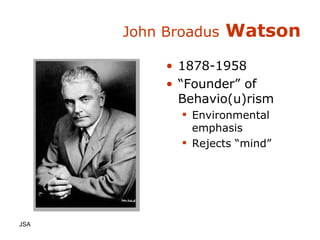
John Broadus  Watson 1878-1958 “ Founder” of Behavio(u)rism Environmental emphasis Rejects “mind” JSA
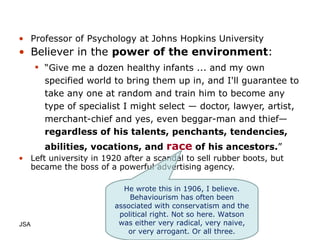
Professor of Psychology at Johns Hopkins University  Believer in the  power of the environment : “ Give me a dozen healthy infants ... and my own specified world to bring them up in, and I'll guarantee to take any one at random and train him to become any type of specialist I might select — doctor, lawyer, artist, merchant-chief and yes, even beggar-man and thief—  regardless of his talents, penchants, tendencies, abilities, vocations, and  race  of his ancestors. ” Left university in 1920 after a scandal to sell rubber boots, but became the boss of a powerful advertising agency. JSA  He wrote this in 1906, I believe. Behaviourism has often been associated with conservatism and the political right. Not so here. Watson was either very radical, very naive, or very arrogant. Or all three.
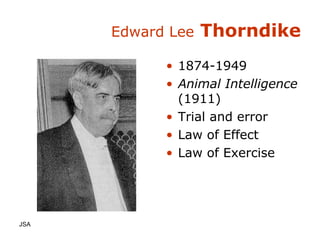
Edward Lee  Thorndike 1874-1949 Animal Intelligence  (1911) Trial and error Law of Effect Law of Exercise JSA
Law of Effect: “ A response is more or less likely to occur depending on whether it produces a  satisfying or annoying  state of affairs” (1898) and  Law of Exercise: Learning improves with practice JSA  He would not have been allowed to get away with this subjective language by later hard-line behaviourists
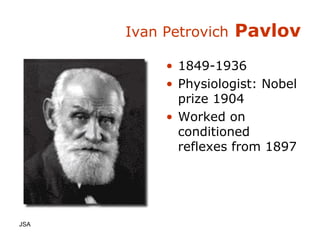
Ivan Petrovich  Pavlov 1849-1936 Physiologist: Nobel prize 1904 Worked on conditioned reflexes from 1897 JSA
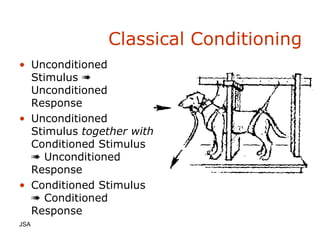
Classical Conditioning Unconditioned Stimulus    Unconditioned Response  Unconditioned Stimulus  together with  Conditioned Stimulus    Unconditioned Response Conditioned Stimulus    Conditioned Response JSA
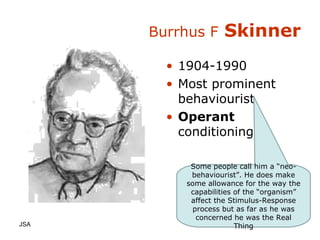
Burrhus F  Skinner 1904-1990 Most prominent behaviourist Operant  conditioning JSA  Some people call him a “neo-behaviourist”. He does make some allowance for the way the capabilities of the “organism” affect the Stimulus-Response process but as far as he was concerned he was the Real Thing
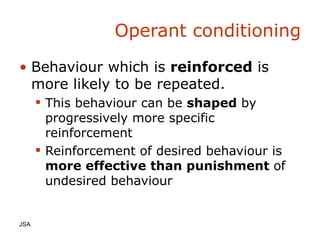
Operant conditioning Behaviour which is  reinforced  is more likely to be repeated. This behaviour can be  shaped  by progressively more specific reinforcement Reinforcement of desired behaviour is  more effective than punishment  of undesired behaviour JSA
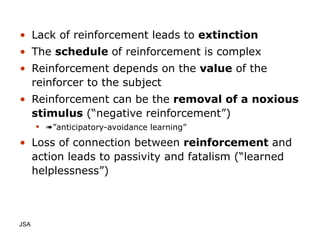
Lack of reinforcement leads to  extinction The  schedule  of reinforcement is complex Reinforcement depends on the  value  of the reinforcer to the subject Reinforcement can be the  removal of a noxious stimulus  (“negative reinforcement”)  ” anticipatory-avoidance learning” Loss of connection between  reinforcement  and action leads to passivity and fatalism (“learned helplessness”) JSA
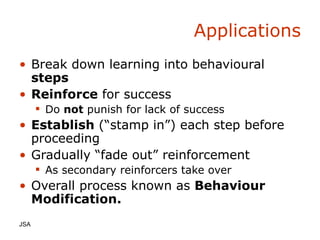
Applications Break down learning into behavioural  steps Reinforce  for success Do  not  punish for lack of success Establish  (“stamp in”) each step before proceeding Gradually “fade out” reinforcement As secondary reinforcers take over Overall process known as  Behaviour Modification. JSA
Skinner’s project Teaching machines and instructional technology Perfect communities—  Walden Two   (1948) Beyond Freedom and Dignity  (1973) JSA
Critique Limited by self-imposed constraints of diminishing relevance Limited applicability in real-world human learning Project undermined by “ Cognitive Revolution ” from mid-70s onwards: Understanding of genetic influences Ability to trace brain activity Chomsky on language JSA
Significant points It works, but it is not the whole story It is minute-to-minute stuff It is (properly) reflex stuff It happens willy-nilly JSA
Did we meet the objectives? On completion of this session you should be able to: Describe   two   features which distinguish behaviourism from other approaches to learning Name   three   major figures in the development of behaviourist theory and   specify   their contributions Name   the   two   major strands of behaviourism Describe   the experimental basis of : Classical conditioning Operant conditioning Give   two   examples   of how each can be applied to teaching and learning in education Give   one   example   of how the social environment of the classroom may hinder the application of behavioural principles JSA
I hope not. If we did I have wasted my time and yours. Discuss! JSA

Notes on Behaviourism

  • 1.
    Some notes onbehaviourism (This is in no way intended to constitute a proper introduction, but to accompany the selective discussion in class.) 3 February 2010 See also www.learningandteaching.info/learning/behaviour.htm and links from there. JSA
  • 2.
    Behavioural objectives JSA On completion of this session you should be able to: Describe two features which distinguish behaviourism from other approaches to learning Name three major figures in the development of behaviourist theory and specify their contributions Name the two major strands of behaviourism Describe the experimental basis of : Classical conditioning Operant conditioning Give two examples of how each can be applied to teaching and learning in education Give one example of how the social environment of the classroom may hinder the application of behavioural principles This is how the “instructional designers” (behaviourists allowed out into the real world) tell us we should plan our sessions.
  • 3.
    That was amouthful …why? Behaviourism’s influence on education has been to make all tasks very explicit Described in “behavioural outcomes/objectives” which: Are expressed in active verbs describing directly observable behaviour Are pre-determined before you start teaching What impact might such a discipline have? Think about it for a minute. JSA a.k.a. “SMART” (Look it up)
  • 4.
    Behaviourism is (was?)Attempt to put psychology on a scientific footing … by rejecting references to mind or mental states Or anything which could not be directly observed To create a science of behaviour JSA Its influence has seriously declined in the past quarter-century with the “cognitive revolution”
  • 5.
    Characterised by: Rigorous experimental methodology Usually using animals but In laboratory situations, and Na ïve application to human beings JSA
  • 6.
    Figures in thehistory of behaviourism JSA
  • 7.
    John Broadus Watson 1878-1958 “ Founder” of Behavio(u)rism Environmental emphasis Rejects “mind” JSA
  • 8.
    Professor of Psychologyat Johns Hopkins University Believer in the power of the environment : “ Give me a dozen healthy infants ... and my own specified world to bring them up in, and I'll guarantee to take any one at random and train him to become any type of specialist I might select — doctor, lawyer, artist, merchant-chief and yes, even beggar-man and thief— regardless of his talents, penchants, tendencies, abilities, vocations, and race of his ancestors. ” Left university in 1920 after a scandal to sell rubber boots, but became the boss of a powerful advertising agency. JSA He wrote this in 1906, I believe. Behaviourism has often been associated with conservatism and the political right. Not so here. Watson was either very radical, very naive, or very arrogant. Or all three.
  • 9.
    Edward Lee Thorndike 1874-1949 Animal Intelligence (1911) Trial and error Law of Effect Law of Exercise JSA
  • 10.
    Law of Effect:“ A response is more or less likely to occur depending on whether it produces a satisfying or annoying state of affairs” (1898) and Law of Exercise: Learning improves with practice JSA He would not have been allowed to get away with this subjective language by later hard-line behaviourists
  • 11.
    Ivan Petrovich Pavlov 1849-1936 Physiologist: Nobel prize 1904 Worked on conditioned reflexes from 1897 JSA
  • 12.
    Classical Conditioning UnconditionedStimulus  Unconditioned Response Unconditioned Stimulus together with Conditioned Stimulus  Unconditioned Response Conditioned Stimulus  Conditioned Response JSA
  • 13.
    Burrhus F Skinner 1904-1990 Most prominent behaviourist Operant conditioning JSA Some people call him a “neo-behaviourist”. He does make some allowance for the way the capabilities of the “organism” affect the Stimulus-Response process but as far as he was concerned he was the Real Thing
  • 14.
    Operant conditioning Behaviourwhich is reinforced is more likely to be repeated. This behaviour can be shaped by progressively more specific reinforcement Reinforcement of desired behaviour is more effective than punishment of undesired behaviour JSA
  • 15.
    Lack of reinforcementleads to extinction The schedule of reinforcement is complex Reinforcement depends on the value of the reinforcer to the subject Reinforcement can be the removal of a noxious stimulus (“negative reinforcement”)  ” anticipatory-avoidance learning” Loss of connection between reinforcement and action leads to passivity and fatalism (“learned helplessness”) JSA
  • 16.
    Applications Break downlearning into behavioural steps Reinforce for success Do not punish for lack of success Establish (“stamp in”) each step before proceeding Gradually “fade out” reinforcement As secondary reinforcers take over Overall process known as Behaviour Modification. JSA
  • 17.
    Skinner’s project Teachingmachines and instructional technology Perfect communities— Walden Two (1948) Beyond Freedom and Dignity (1973) JSA
  • 18.
    Critique Limited byself-imposed constraints of diminishing relevance Limited applicability in real-world human learning Project undermined by “ Cognitive Revolution ” from mid-70s onwards: Understanding of genetic influences Ability to trace brain activity Chomsky on language JSA
  • 19.
    Significant points Itworks, but it is not the whole story It is minute-to-minute stuff It is (properly) reflex stuff It happens willy-nilly JSA
  • 20.
    Did we meetthe objectives? On completion of this session you should be able to: Describe two features which distinguish behaviourism from other approaches to learning Name three major figures in the development of behaviourist theory and specify their contributions Name the two major strands of behaviourism Describe the experimental basis of : Classical conditioning Operant conditioning Give two examples of how each can be applied to teaching and learning in education Give one example of how the social environment of the classroom may hinder the application of behavioural principles JSA
  • 21.
    I hope not.If we did I have wasted my time and yours. Discuss! JSA

Editor's Notes

  • #2 Behaviourism notes 04/02/10
  • #3 Behaviourism notes 04/02/10 This is the kind of objective behaviourists would have for a teaching session Comment on the explicitness of the objectives: active verbs about what you should be able to do : Explicit statements about the level: number of items specified in each objective
  • #4 Behaviourism notes 04/02/10
  • #5 Behaviourism notes 04/02/10
  • #6 Behaviourism notes 04/02/10
  • #7 Behaviourism notes 04/02/10
  • #8 Behaviourism notes 04/02/10
  • #9 Behaviourism notes 04/02/10
  • #10 Behaviourism notes 04/02/10
  • #11 Behaviourism notes 04/02/10
  • #12 Behaviourism notes 04/02/10
  • #13 Behaviourism notes 04/02/10
  • #14 Behaviourism notes 04/02/10
  • #15 Behaviourism notes 04/02/10
  • #16 Behaviourism notes 04/02/10
  • #17 Behaviourism notes 04/02/10
  • #18 Behaviourism notes 04/02/10
  • #19 Behaviourism notes 04/02/10
  • #20 Behaviourism notes 04/02/10
  • #21 Behaviourism notes 04/02/10 This is the kind of objective behaviourists would have for a teaching session Comment on the explicitness of the objectives: active verbs about what you should be able to do : Explicit statements about the level: number of items specified in each objective
  • #22 Behaviourism notes 04/02/10