INTRODUCTION TO
PSYCHOLOGY
MAM UROOJ MIRZA
TOPICS:
What is learning ?
Factors of learning?
Trail and error learning?
Laws of learning?
GROUP MEMBERS:
SYED ALI HAMZA(222063)
IFTIKHAR ZAHOOR(221944)
ROMESA SAJID(222553)
RAMEEN QAMAR(221973)
Alishba ijaz(222045)
Yumna imran (222039)
LEARNING
What is learning?
learning is a process that
leads to change which is a
result of experiences. In
other words when we
understand something, any
concept or skill it is also
known as learning.
Learning
process
Steps in learning process
 Learning process is carried over through
various steps according to HP Smith.
 A motive or drive
 An attractive goal
 And a block to the attainment of goal.
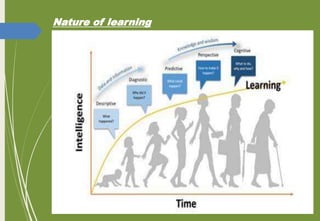
Nature of learning
How learning works?
The process of learning is not always is not
always the same. Learning can happen in a
wide variety of ways. To explain how and when
learning occurs, psychologists have proposed a
number of different theories.
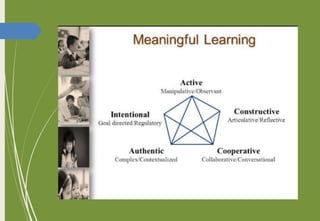
ACTIVE LEARNING
The term “Active learning” is often used to describe
an intractive process , such as doing a hands-on
experiment to learn a concept rather than reading
about it. But “passive learning” (reading a text,
listening to a lecture, watching a movie) is still
learning, and can be effective.
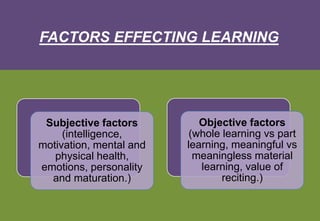
FACTORS EFFECTING LEARNING
Subjective factors
(intelligence,
motivation, mental and
physical health,
emotions, personality
and maturation.)
Objective factors
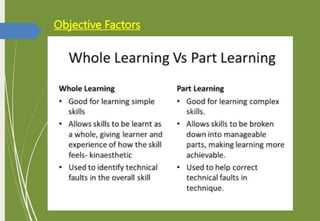
(whole learning vs part
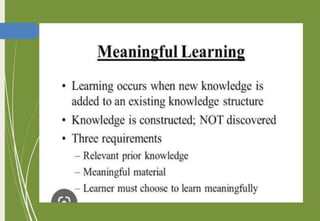
learning, meaningful vs
meaningless material
learning, value of
reciting.)
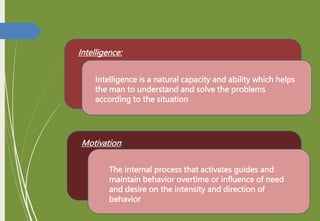
Intelligence:
Intelligence is a natural capacity and ability which helps
the man to understand and solve the problems
according to the situation
Motivation:
The internal process that activates guides and
maintain behavior overtime or influence of need
and desire on the intensity and direction of
behavior
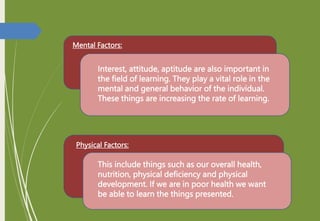
Mental Factors:
Interest, attitude, aptitude are also important in
the field of learning. They play a vital role in the
mental and general behavior of the individual.
These things are increasing the rate of learning.
Physical Factors:
This include things such as our overall health,
nutrition, physical deficiency and physical
development. If we are in poor health we want
be able to learn the things presented.
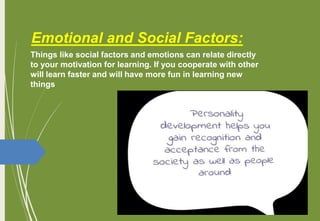
Emotional and Social Factors:
Things like social factors and emotions can relate directly
to your motivation for learning. If you cooperate with other
will learn faster and will have more fun in learning new
things
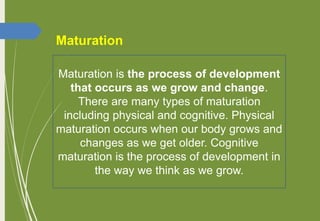
Maturation is the process of development
that occurs as we grow and change.
There are many types of maturation
including physical and cognitive. Physical
maturation occurs when our body grows and
changes as we get older. Cognitive
maturation is the process of development in
the way we think as we grow.
Maturation
Objective Factors
Trail and error Learning:
Edward Lee Thorndike (1874-1949) gave this theory of trail and error
learning in 1913 which is also known as “learning by selection of
successful variant.
In this theory he stated that, when no ready-made solution of a
problem is available to the learner, he adopts the method of trial
and error. He first, tries one solution. If it does not help him, he
rejects it, then, he tries another and so on. In this way he eliminates
errors or irrelevant responses which do not serve the purpose and
finally discovers the correct solution. Thus, in trial and error method,
the learner makes random activities and finally reaches the goal
accidently.
Example of Trail and error
learning:
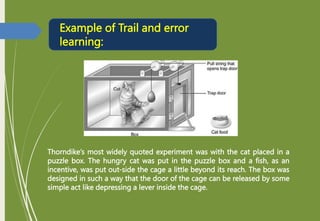
Thorndike’s most widely quoted experiment was with the cat placed in a
puzzle box. The hungry cat was put in the puzzle box and a fish, as an
incentive, was put out-side the cage a little beyond its reach. The box was
designed in such a way that the door of the cage can be released by some
simple act like depressing a lever inside the cage.
At first, the cat made a great deal of varied attempts to
reach the food in a trial and error fashion such as jumping
up and down, clawing at the bars, scratching the cage,
whaling around trying to push the bars, pawing and
shaking movable parts of the cage etc., but all attempts
proved to ineffective.
Ultimately by chance her paw fell on the loop of the rope
and the door opened. The cat jumped out immediately and
ate the fish. When next day, the cat was put in the box
again, this time she took less time in coming out and in the
subsequent trials the time decreased further so much so
that the stage reached when the cat came out soon after
being put inside by directly striking the latch with her paw
without any random movement. This is how she learnt to
reach its goal.
Laws of Learning
=> The three primary laws of learning was given by Edward L. Thorndike
1. Law of Readiness:
• It states that Individual learns best when they are physically,
mentally, and emotionally ready to learn.
• If they are unwilling to learn so they don't learn.
2. Law of Effect:
• It states that consequences of behavior act to modify the
future probability of occurrence of that behavior
3. Law of Exercise/Law of Practice:
• It states that repetition of some act makes that act more
probable in the future. There are two parts of this law:
• Law of Use: It states that the more an association is used, the
stronger it becomes.
• Law of Disuse: It states that the less an association is used, the
weaker it becomes.

learning presentation.pptx

  • 1.
  • 2.
    TOPICS: What is learning? Factors of learning? Trail and error learning? Laws of learning? GROUP MEMBERS: SYED ALI HAMZA(222063) IFTIKHAR ZAHOOR(221944) ROMESA SAJID(222553) RAMEEN QAMAR(221973) Alishba ijaz(222045) Yumna imran (222039)
  • 3.
    LEARNING What is learning? learningis a process that leads to change which is a result of experiences. In other words when we understand something, any concept or skill it is also known as learning.
  • 4.
    Learning process Steps in learningprocess  Learning process is carried over through various steps according to HP Smith.  A motive or drive  An attractive goal  And a block to the attainment of goal.
  • 5.
  • 6.
    How learning works? Theprocess of learning is not always is not always the same. Learning can happen in a wide variety of ways. To explain how and when learning occurs, psychologists have proposed a number of different theories.
  • 7.
    ACTIVE LEARNING The term“Active learning” is often used to describe an intractive process , such as doing a hands-on experiment to learn a concept rather than reading about it. But “passive learning” (reading a text, listening to a lecture, watching a movie) is still learning, and can be effective.
  • 8.
    FACTORS EFFECTING LEARNING Subjectivefactors (intelligence, motivation, mental and physical health, emotions, personality and maturation.) Objective factors (whole learning vs part learning, meaningful vs meaningless material learning, value of reciting.)
  • 9.
    Intelligence: Intelligence is anatural capacity and ability which helps the man to understand and solve the problems according to the situation Motivation: The internal process that activates guides and maintain behavior overtime or influence of need and desire on the intensity and direction of behavior
  • 10.
    Mental Factors: Interest, attitude,aptitude are also important in the field of learning. They play a vital role in the mental and general behavior of the individual. These things are increasing the rate of learning. Physical Factors: This include things such as our overall health, nutrition, physical deficiency and physical development. If we are in poor health we want be able to learn the things presented.
  • 11.
    Emotional and SocialFactors: Things like social factors and emotions can relate directly to your motivation for learning. If you cooperate with other will learn faster and will have more fun in learning new things
  • 12.
    Maturation is theprocess of development that occurs as we grow and change. There are many types of maturation including physical and cognitive. Physical maturation occurs when our body grows and changes as we get older. Cognitive maturation is the process of development in the way we think as we grow. Maturation
  • 13.
  • 18.
    Trail and errorLearning: Edward Lee Thorndike (1874-1949) gave this theory of trail and error learning in 1913 which is also known as “learning by selection of successful variant. In this theory he stated that, when no ready-made solution of a problem is available to the learner, he adopts the method of trial and error. He first, tries one solution. If it does not help him, he rejects it, then, he tries another and so on. In this way he eliminates errors or irrelevant responses which do not serve the purpose and finally discovers the correct solution. Thus, in trial and error method, the learner makes random activities and finally reaches the goal accidently.
  • 19.
    Example of Trailand error learning: Thorndike’s most widely quoted experiment was with the cat placed in a puzzle box. The hungry cat was put in the puzzle box and a fish, as an incentive, was put out-side the cage a little beyond its reach. The box was designed in such a way that the door of the cage can be released by some simple act like depressing a lever inside the cage.
  • 20.
    At first, thecat made a great deal of varied attempts to reach the food in a trial and error fashion such as jumping up and down, clawing at the bars, scratching the cage, whaling around trying to push the bars, pawing and shaking movable parts of the cage etc., but all attempts proved to ineffective. Ultimately by chance her paw fell on the loop of the rope and the door opened. The cat jumped out immediately and ate the fish. When next day, the cat was put in the box again, this time she took less time in coming out and in the subsequent trials the time decreased further so much so that the stage reached when the cat came out soon after being put inside by directly striking the latch with her paw without any random movement. This is how she learnt to reach its goal.
  • 21.
    Laws of Learning =>The three primary laws of learning was given by Edward L. Thorndike 1. Law of Readiness: • It states that Individual learns best when they are physically, mentally, and emotionally ready to learn. • If they are unwilling to learn so they don't learn. 2. Law of Effect: • It states that consequences of behavior act to modify the future probability of occurrence of that behavior
  • 22.
    3. Law ofExercise/Law of Practice: • It states that repetition of some act makes that act more probable in the future. There are two parts of this law: • Law of Use: It states that the more an association is used, the stronger it becomes. • Law of Disuse: It states that the less an association is used, the weaker it becomes.

Editor's Notes

  • #5 Sensory receptors are either specialized cells associated with sensory neurons or the specialized ends of sensory neurons that are a part of the peripheral nervous system, and they are used to receive information about the environment (internal or external).