




U402 B ENGAGING IN
JUSTICE
Adversary System and Juries
Key Knowledge
 major features of the adversary system of trial, including:
 the role of the parties;
 the role of the judge;
 the need for the rules of evidence and procedure;
 standard and burden of proof; and
 the need for legal representation.
 strengths and weaknesses of the adversary system of trial;
 major features of the inquisitorial system of trial;
 possible reforms to the adversary system of trial;
 the role of juries, and factors that influence their composition;
 strengths and weaknesses of the jury system;
 reforms and alternatives to the jury system;
 problems and difficulties faced by individuals in using the legal system; and
 recent changes and recommendations for change in the legal system designed to
enhance its effective operation.
Elements of an effective
legal system:
F ~ fair and unbiased
hearing;
A ~ effective access to
the legal system;
T ~ timely resolution of
disputes.
Key Skills
 define key legal terminology and use it
appropriately;
 discuss, interpret and analyse legal information;
 apply legal principles to relevant cases and issues;
 critically evaluate the adversary system of trial;
 compare the operation and features of the
adversary system with the inquisitorial system;
 critically evaluate the effectiveness of juries; and
 suggest and discuss reforms and alternatives to the
adversary system and the jury system
SAC Details
 SAC 2B Tuesday 8th Sept (Term 3 Week 9)
2.30PM
Adversary System
Adversary System of trial
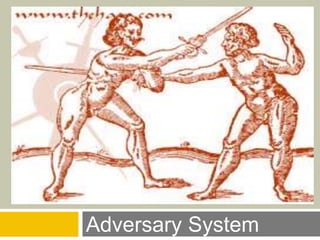
 The adversary system of trial is where two opposing parties, or adversaries,
fight in court to win their legal battle.
 The trial is presided over by an independent and impartial umpire, and is
conducted according to rules of evidence and procedure.
 The role of the adversary system is to provide a procedure for the parties to
present and resolve their case, in as fair a manner as possible.
 The adversary system operates in both civil and criminal cases.
 In a criminal case the state is trying to prove the guilt of the accused, and
the accused is fighting to be found not guilty.
 In a civil case the party bringing the case is trying to prove that the other
party was in the wrong and the person who is defending the case is trying
to show that he or she was not in the wrong.
Major features of the Adversary
System
 Role of the parties
 Role of the judge
 Rules of evidence and procedure
 Burden and standard of proof
 Need for legal representation
Role of the parties
 In the adversary system of trial each
party controls their own case and has
complete control over decisions about
how the case will be run as long as the
rules of evidence and procedure are
followed.
 This is known as ‘party control’.
 The parties in the adversary system are
responsible for instigating proceedings,
investigating the facts, deciding which
evidence to present, investigating the
law, deciding whether to have a jury in a
civil case and choosing whether to have
legal representation.
Evaluation of role of the parties
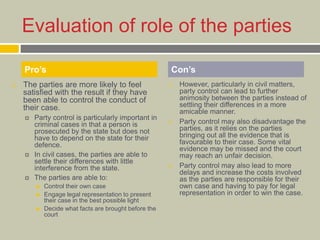
 The parties are more likely to feel
satisfied with the result if they have
been able to control the conduct of
their case.
 Party control is particularly important in
criminal cases in that a person is
prosecuted by the state but does not
have to depend on the state for their
defence.
 In civil cases, the parties are able to
settle their differences with little
interference from the state.
 The parties are able to:
 Control their own case
 Engage legal representation to present
their case in the best possible light
 Decide what facts are brought before the
court
 However, particularly in civil matters,
party control can lead to further
animosity between the parties instead of
settling their differences in a more
amicable manner.
 Party control may also disadvantage the
parties, as it relies on the parties
bringing out all the evidence that is
favourable to their case. Some vital
evidence may be missed and the court
may reach an unfair decision.
 Party control may also lead to more
delays and increase the costs involved
as the parties are responsible for their
own case and having to pay for legal
representation in order to win the case.
Pro’s Con’s
Role of the Judge
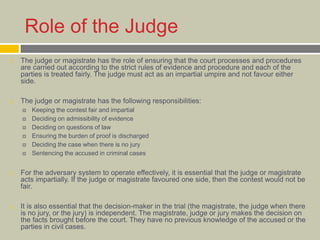
 The judge or magistrate has the role of ensuring that the court processes and procedures
are carried out according to the strict rules of evidence and procedure and each of the
parties is treated fairly. The judge must act as an impartial umpire and not favour either
side.
 The judge or magistrate has the following responsibilities:
 Keeping the contest fair and impartial
 Deciding on admissibility of evidence
 Deciding on questions of law
 Ensuring the burden of proof is discharged
 Deciding the case when there is no jury
 Sentencing the accused in criminal cases
 For the adversary system to operate effectively, it is essential that the judge or magistrate
acts impartially. If the judge or magistrate favoured one side, then the contest would not be
fair.
 It is also essential that the decision-maker in the trial (the magistrate, the judge when there
is no jury, or the jury) is independent. The magistrate, judge or jury makes the decision on
the facts brought before the court. They have no previous knowledge of the accused or the
parties in civil cases.
Evaluation of the role of the
judge
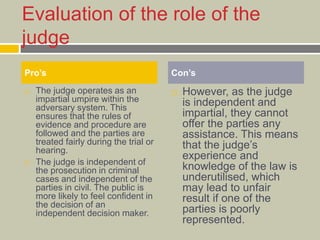
 The judge operates as an
impartial umpire within the
adversary system. This
ensures that the rules of
evidence and procedure are
followed and the parties are
treated fairly during the trial or
hearing.
 The judge is independent of
the prosecution in criminal
cases and independent of the
parties in civil. The public is
more likely to feel confident in
the decision of an
independent decision maker.
 However, as the judge
is independent and
impartial, they cannot
offer the parties any
assistance. This means
that the judge’s
experience and
knowledge of the law is
underutilised, which
may lead to unfair
result if one of the
parties is poorly
represented.
Pro’s Con’s
Rules of evidence and
procedure
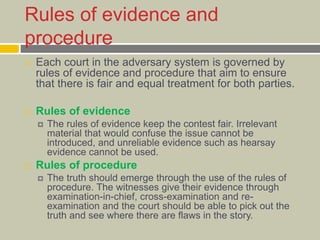
 Each court in the adversary system is governed by
rules of evidence and procedure that aim to ensure
that there is fair and equal treatment for both parties.
 Rules of evidence
 The rules of evidence keep the contest fair. Irrelevant
material that would confuse the issue cannot be
introduced, and unreliable evidence such as hearsay
evidence cannot be used.
 Rules of procedure
 The truth should emerge through the use of the rules of
procedure. The witnesses give their evidence through
examination-in-chief, cross-examination and re-
examination and the court should be able to pick out the
truth and see where there are flaws in the story.
Evaluation of rules of evidence and
procedure
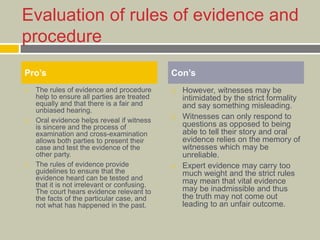
 The rules of evidence and procedure
help to ensure all parties are treated
equally and that there is a fair and
unbiased hearing.
 Oral evidence helps reveal if witness
is sincere and the process of
examination and cross-examination
allows both parties to present their
case and test the evidence of the
other party.
 The rules of evidence provide
guidelines to ensure that the
evidence heard can be tested and
that it is not irrelevant or confusing.
The court hears evidence relevant to
the facts of the particular case, and
not what has happened in the past.
 However, witnesses may be
intimidated by the strict formality
and say something misleading.
 Witnesses can only respond to
questions as opposed to being
able to tell their story and oral
evidence relies on the memory of
witnesses which may be
unreliable.
 Expert evidence may carry too
much weight and the strict rules
may mean that vital evidence
may be inadmissible and thus
the truth may not come out
leading to an unfair outcome.
Pro’s Con’s
Burden & standard of proof
 The burden of proof relates to the question of which party has to prove
the facts of the case. It lies with the person who is bringing the case.
This means that the person who brings the case has to prove that their
view of the facts is correct.
 In a criminal case, it lies with the prosecution;
 in a civil case the plaintiff carries the burden of proof.
 This follows the concept of control by the parties within the adversary
system; someone who thinks they have been wronged, brings the
matter to court to prove the case or, in a criminal case, if society has
been wronged the prosecution brings the case.
 The other party then has the opportunity to show that the evidence does
not support the facts alleged.
Evaluation of standard & burden of
proof
 The burden and
standard of proof are
designed to ensure that
the party bringing the
case has to prove the
facts to the standard of
proof required.
 This is a fairer system
than having the judge
solely responsible for
discovering the truth.
 However, the adversary
system is more concerned
with winning rather than
finding out the truth.
 Each side brings out the facts
of the case to benefit their
side. This is particularly
relevant if one party is poorly
represented. If the court does
not hear all the facts, the
party in the right may not win
the case.
 The prosecution is however,
obliged to present all the
evidence they are aware of.
Pro’s Con’s
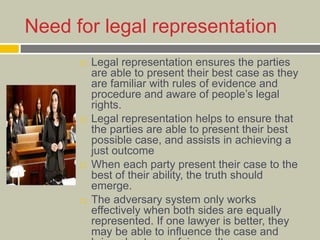
Need for legal representation
 Legal representation ensures the parties
are able to present their best case as they
are familiar with rules of evidence and
procedure and aware of people’s legal
rights.
 Legal representation helps to ensure that
the parties are able to present their best
possible case, and assists in achieving a
just outcome
 When each party present their case to the
best of their ability, the truth should
emerge.
 The adversary system only works
effectively when both sides are equally
represented. If one lawyer is better, they
may be able to influence the case and
Evaluation of the need for legal
representation
 The ability to be represented
by legal personnel provides
those accused of a crime or
parties to a civil case with the
opportunity to present their
side of the facts in the best
light possible.
 The parties can choose the
best legal representation (that
they can afford) to bring out
the evidence in an objective
and logical manner that will
best benefit their case.
 However, legal representation
is very expensive. If one party
is not able to afford legal
representation or is poorly
represented, they are
significantly disadvantaged in
the adversary system.
 Both sides need to be equally
represented for adversary
system to be effective. If one
side has inferior legal
representation, this may lead
to an unfair outcome.
Pro’s Con’s
INQUISITORIAL
SYSTEM OF
TRIAL
Inquisitorial System of trial
 The inquisitorial system (also called the
investigatory system) is a system of
trial where the court is actively involved
in determining the facts and conduct of
a trial.
 Its main role is to find out the truth of
an issue.
 The inquisitorial system is based on
the idea that the effective operation of
the legal system is of benefit to society
as a whole and that it is the
responsibility of the state to ensure all
relevant information is examined and
that the truth is reached.
Major features of the Inquisitorial
System
 Role of the parties
 Role of the judge
 Rules of evidence and procedure
 Burden and standard of proof
 Need for legal representation
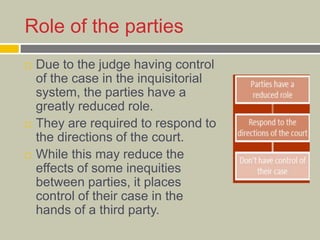
Role of the parties
 Due to the judge having control
of the case in the inquisitorial
system, the parties have a
greatly reduced role.
 They are required to respond to
the directions of the court.
 While this may reduce the
effects of some inequities
between parties, it places
control of their case in the
hands of a third party.
Role of the Judge
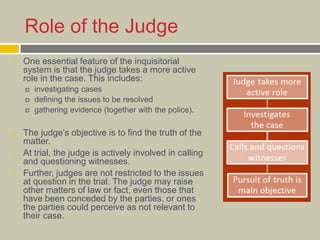
 One essential feature of the inquisitorial
system is that the judge takes a more active
role in the case. This includes:
 investigating cases
 defining the issues to be resolved
 gathering evidence (together with the police).
 The judge’s objective is to find the truth of the
matter.
 At trial, the judge is actively involved in calling
and questioning witnesses.
 Further, judges are not restricted to the issues
at question in the trial. The judge may raise
other matters of law or fact, even those that
have been conceded by the parties, or ones
the parties could perceive as not relevant to
their case.
Rules of evidence and
procedure
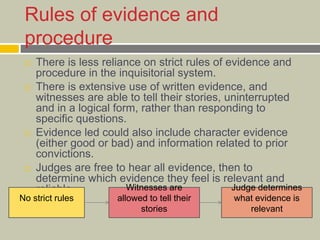
 There is less reliance on strict rules of evidence and
procedure in the inquisitorial system.
 There is extensive use of written evidence, and
witnesses are able to tell their stories, uninterrupted
and in a logical form, rather than responding to
specific questions.
 Evidence led could also include character evidence
(either good or bad) and information related to prior
convictions.
 Judges are free to hear all evidence, then to
determine which evidence they feel is relevant and
reliable.
No strict rules
Witnesses are
allowed to tell their
stories
Judge determines
what evidence is
relevant
Burden and standard of proof
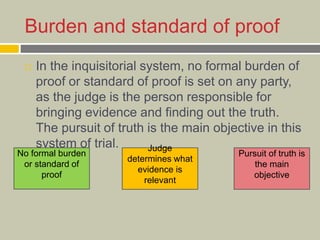
 In the inquisitorial system, no formal burden of
proof or standard of proof is set on any party,
as the judge is the person responsible for
bringing evidence and finding out the truth.
The pursuit of truth is the main objective in this
system of trial.
No formal burden
or standard of
proof
Judge
determines what
evidence is
relevant
Pursuit of truth is
the main
objective
Need for legal representation
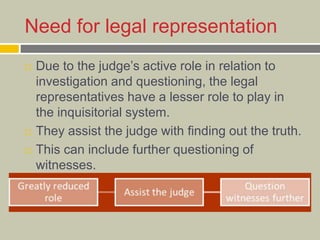
 Due to the judge’s active role in relation to
investigation and questioning, the legal
representatives have a lesser role to play in
the inquisitorial system.
 They assist the judge with finding out the truth.
 This can include further questioning of
witnesses.
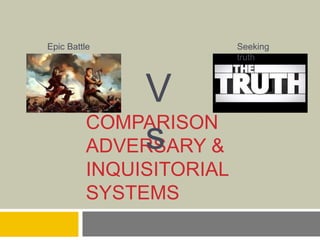
COMPARISON
ADVERSARY &
INQUISITORIAL
SYSTEMS
V
s
Epic Battle Seeking
truth
Comparing Adversary &
Inquisitorial
 You need to be able to compare ALL features
between:
 Adversary system
 Inquisitorial system
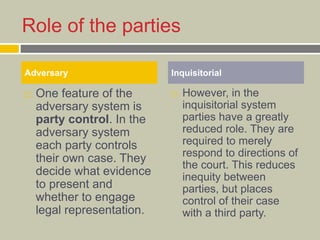
Role of the parties
 One feature of the
adversary system is
party control. In the
adversary system
each party controls
their own case. They
decide what evidence
to present and
whether to engage
legal representation.
 However, in the
inquisitorial system
parties have a greatly
reduced role. They are
required to merely
respond to directions of
the court. This reduces
inequity between
parties, but places
control of their case
with a third party.
Adversary Inquisitorial
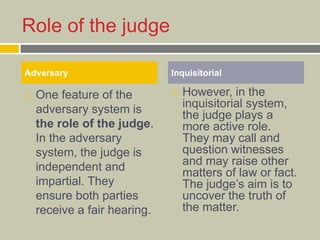
Role of the judge
 One feature of the
adversary system is
the role of the judge.
In the adversary
system, the judge is
independent and
impartial. They
ensure both parties
receive a fair hearing.
 However, in the
inquisitorial system,
the judge plays a
more active role.
They may call and
question witnesses
and may raise other
matters of law or fact.
The judge’s aim is to
uncover the truth of
the matter.
Adversary Inquisitorial
Rules of evidence and
procedure
 One feature of the
adversary system is
strict rules of
evidence and
procedure. They aim
to keep the contest
fair and ensure the
truth should emerge
through questioning.
 However, in the
inquisitorial system
there are no strict rules
of evidence and
procedure. The judge
determines what
evidence is permissible
and witnesses are
allowed to tell their
stories rather than
respond to questioning.
Adversary Inquisitorial
Burden and standard of proof
 One feature of the
adversary system is
the burden and
standard of proof.
This ensures the
party bringing the
case has to prove it
to the required
standard.
 However, in the
inquisitorial system
there is no formal
burden or standard of
proof. The judge is
responsible for
bringing evidence and
the pursuit of truth is
the main objective.
Adversary Inquisitorial
Need for legal representation
 One feature of the
adversary system is the
need for legal
representation. Legal
representation ensures
parties are able to
present their best case
as they are familiar with
rules of evidence and
procedure. This assists
in achieving a just
outcome.
 However, in the
inquisitorial system
legal representation
have a lesser role.
They assist the judge
to find out the truth
which may include
further questioning of
witnesses.
Adversary Inquisitorial
REFORMS TO THE
ADVERSARY SYSTEM
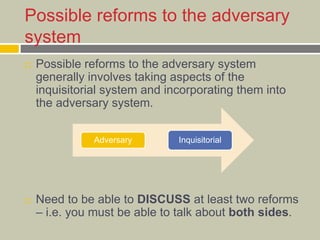
Possible reforms to the adversary
system
 Possible reforms to the adversary system
generally involves taking aspects of the
inquisitorial system and incorporating them into
the adversary system.
 Need to be able to DISCUSS at least two reforms
– i.e. you must be able to talk about both sides.
Adversary Inquisitorial
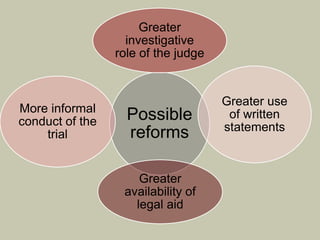
Possible
reforms
Greater
investigative
role of the judge
Greater use
of written
statements
Greater
availability of
legal aid
More informal
conduct of the
trial
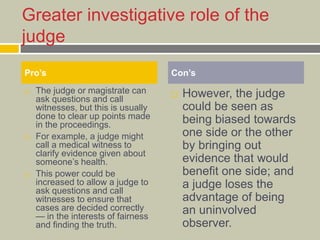
Greater investigative role of the
judge
 The judge or magistrate can
ask questions and call
witnesses, but this is usually
done to clear up points made
in the proceedings.
 For example, a judge might
call a medical witness to
clarify evidence given about
someone’s health.
 This power could be
increased to allow a judge to
ask questions and call
witnesses to ensure that
cases are decided correctly
— in the interests of fairness
and finding the truth.
 However, the judge
could be seen as
being biased towards
one side or the other
by bringing out
evidence that would
benefit one side; and
a judge loses the
advantage of being
an uninvolved
observer.
Pro’s Con’s
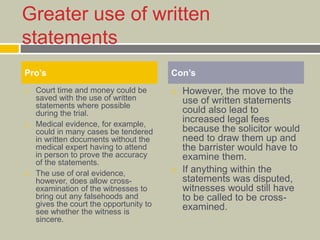
Greater use of written
statements
 Court time and money could be
saved with the use of written
statements where possible
during the trial.
 Medical evidence, for example,
could in many cases be tendered
in written documents without the
medical expert having to attend
in person to prove the accuracy
of the statements.
 The use of oral evidence,
however, does allow cross-
examination of the witnesses to
bring out any falsehoods and
gives the court the opportunity to
see whether the witness is
sincere.
 However, the move to the
use of written statements
could also lead to
increased legal fees
because the solicitor would
need to draw them up and
the barrister would have to
examine them.
 If anything within the
statements was disputed,
witnesses would still have
to be called to be cross-
examined.
Pro’s Con’s
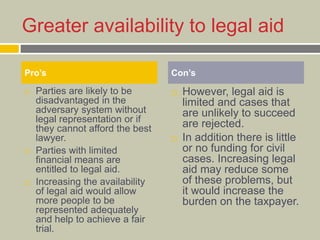
Greater availability to legal aid
 Parties are likely to be
disadvantaged in the
adversary system without
legal representation or if
they cannot afford the best
lawyer.
 Parties with limited
financial means are
entitled to legal aid.
 Increasing the availability
of legal aid would allow
more people to be
represented adequately
and help to achieve a fair
trial.
 However, legal aid is
limited and cases that
are unlikely to succeed
are rejected.
 In addition there is little
or no funding for civil
cases. Increasing legal
aid may reduce some
of these problems, but
it would increase the
burden on the taxpayer.
Pro’s Con’s
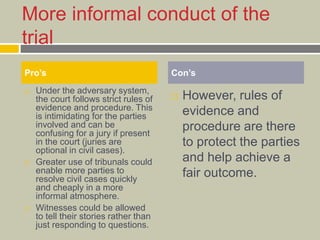
More informal conduct of the
trial
 Under the adversary system,
the court follows strict rules of
evidence and procedure. This
is intimidating for the parties
involved and can be
confusing for a jury if present
in the court (juries are
optional in civil cases).
 Greater use of tribunals could
enable more parties to
resolve civil cases quickly
and cheaply in a more
informal atmosphere.
 Witnesses could be allowed
to tell their stories rather than
just responding to questions.
 However, rules of
evidence and
procedure are there
to protect the parties
and help achieve a
fair outcome.
Pro’s Con’s
EVALUATION OF THE
ADVERSARY SYSTEM
F
A
T
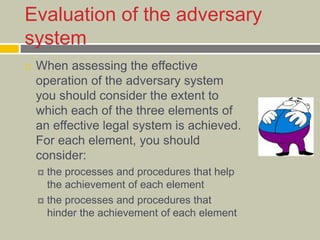
Evaluation of the adversary
system
 When assessing the effective
operation of the adversary system
you should consider the extent to
which each of the three elements of
an effective legal system is achieved.
For each element, you should
consider:
 the processes and procedures that help
the achievement of each element
 the processes and procedures that
hinder the achievement of each element
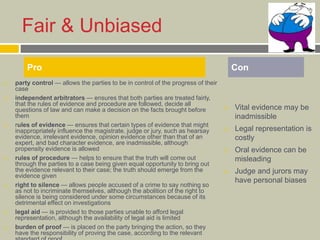
Fair & Unbiased
 party control — allows the parties to be in control of the progress of their
case
 independent arbitrators — ensures that both parties are treated fairly,
that the rules of evidence and procedure are followed, decide all
questions of law and can make a decision on the facts brought before
them
 rules of evidence — ensures that certain types of evidence that might
inappropriately influence the magistrate, judge or jury, such as hearsay
evidence, irrelevant evidence, opinion evidence other than that of an
expert, and bad character evidence, are inadmissible, although
propensity evidence is allowed
 rules of procedure — helps to ensure that the truth will come out
through the parties to a case being given equal opportunity to bring out
the evidence relevant to their case; the truth should emerge from the
evidence given
 right to silence — allows people accused of a crime to say nothing so
as not to incriminate themselves, although the abolition of the right to
silence is being considered under some circumstances because of its
detrimental effect on investigations
 legal aid — is provided to those parties unable to afford legal
representation, although the availability of legal aid is limited
 burden of proof — is placed on the party bringing the action, so they
have the responsibility of proving the case, according to the relevant
 Vital evidence may be
inadmissible
 Legal representation is
costly
 Oral evidence can be
misleading
 Judge and jurors may
have personal biases
Pro Con
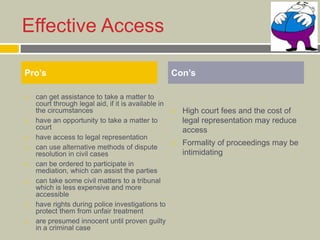
Effective Access
 can get assistance to take a matter to
court through legal aid, if it is available in
the circumstances
 have an opportunity to take a matter to
court
 have access to legal representation
 can use alternative methods of dispute
resolution in civil cases
 can be ordered to participate in
mediation, which can assist the parties
 can take some civil matters to a tribunal
which is less expensive and more
accessible
 have rights during police investigations to
protect them from unfair treatment
 are presumed innocent until proven guilty
in a criminal case
 High court fees and the cost of
legal representation may reduce
access
 Formality of proceedings may be
intimidating
Pro’s Con’s
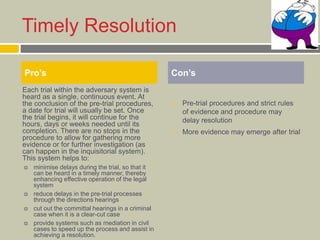
Timely Resolution
 Each trial within the adversary system is
heard as a single, continuous event. At
the conclusion of the pre-trial procedures,
a date for trial will usually be set. Once
the trial begins, it will continue for the
hours, days or weeks needed until its
completion. There are no stops in the
procedure to allow for gathering more
evidence or for further investigation (as
can happen in the inquisitorial system).
This system helps to:
 minimise delays during the trial, so that it
can be heard in a timely manner, thereby
enhancing effective operation of the legal
system
 reduce delays in the pre-trial processes
through the directions hearings
 cut out the committal hearings in a criminal
case when it is a clear-cut case
 provide systems such as mediation in civil
cases to speed up the process and assist in
achieving a resolution.
 Pre-trial procedures and strict rules
of evidence and procedure may
delay resolution
 More evidence may emerge after trial
Pro’s Con’s
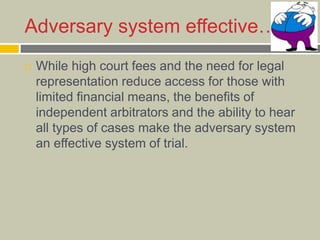
Adversary system effective…
 While high court fees and the need for legal
representation reduce access for those with
limited financial means, the benefits of
independent arbitrators and the ability to hear
all types of cases make the adversary system
an effective system of trial.
JURY SYSTEM
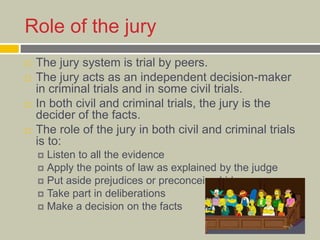
Role of the jury
 The jury system is trial by peers.
 The jury acts as an independent decision-maker
in criminal trials and in some civil trials.
 In both civil and criminal trials, the jury is the
decider of the facts.
 The role of the jury in both civil and criminal trials
is to:
 Listen to all the evidence
 Apply the points of law as explained by the judge
 Put aside prejudices or preconceived ideas
 Take part in deliberations
 Make a decision on the facts
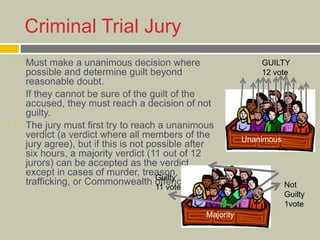
Criminal Trial Jury
 Must make a unanimous decision where
possible and determine guilt beyond
reasonable doubt.
 If they cannot be sure of the guilt of the
accused, they must reach a decision of not
guilty.
 The jury must first try to reach a unanimous
verdict (a verdict where all members of the
jury agree), but if this is not possible after
six hours, a majority verdict (11 out of 12
jurors) can be accepted as the verdict
except in cases of murder, treason, drug
trafficking, or Commonwealth offences.
GUILTY
12 vote
Unanimous
Not
Guilty
1vote
Majority
Guilty
11 vote
Civil Trial Jury
 In a civil trial, the jury must make a decision on the
balance of probabilities, that is, which party is most
probably in the right and which party is most
probably in the wrong.
 The jury also has to decide on the amount of
damages to be paid to the plaintiff if the plaintiff is
successful.
 In a civil trial the decision can be a majority decision
(five out of six) if they are unable to reach a
unanimous decision after at least three hours of
deliberation.
Composition of Juries
 A number of factors affect
the composition of juries
which occur during the
selection and
empanelment of juries
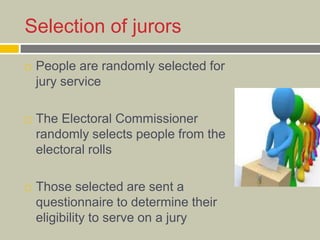
Selection of jurors
 People are randomly selected for
jury service
 The Electoral Commissioner
randomly selects people from the
electoral rolls
 Those selected are sent a
questionnaire to determine their
eligibility to serve on a jury
Liability for jury service
 The Juries Act 2000 (Vic) outlines
requirements for the composition for juries
 Every person 18+ who is enrolled to vote is
liable for jury service expect if
 Disqualified
 Ineligible
 Excused
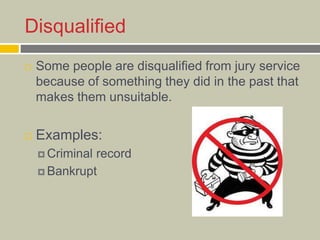
Disqualified
 Some people are disqualified from jury service
because of something they did in the past that
makes them unsuitable.
 Examples:
 Criminal record
 Bankrupt
Ineligible
 Someone might be ineligible
because of their occupation or
their inability to comprehend the
task of a juror.
 Examples:
 Members of legal profession
(too influential)
 Poor English, visually impaired,
deaf or intellectually disabled
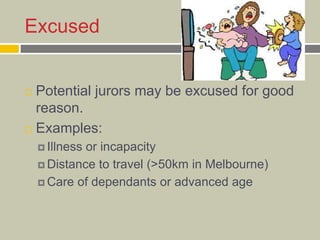
Excused
 Potential jurors may be excused for good
reason.
 Examples:
 Illness or incapacity
 Distance to travel (>50km in Melbourne)
 Care of dependants or advanced age
Summons for jury duty
 If a person is not disqualified, ineligible or
excused, they are liable for jury service
 They will then receive a summons for jury
service
 It is an offence not to attend when called which
is punishable by a fine of 30 penalty units or 3
months imprisonment!
Jury Pool
 This is the selection pool from which jurors
maybe called for the empanelment process
 If liable for jury service, the person will be called
into the pool for one to two days
 From here a jury panel is called
 If the person is not called on, their jury service
is complete.
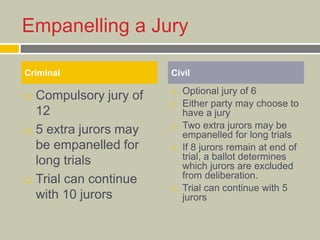
Empanelling a Jury
 Compulsory jury of
12
 5 extra jurors may
be empanelled for
long trials
 Trial can continue
with 10 jurors
 Optional jury of 6
 Either party may choose to
have a jury
 Two extra jurors may be
empanelled for long trials
 If 8 jurors remain at end of
trial, a ballot determines
which jurors are excluded
from deliberation.
 Trial can continue with 5
jurors
Criminal Civil
Challenges
 The parties to a case have some say in the
composition of the jury in that they may
challenge some of the jurors if they feel these
people would be unsuitable for their case.
 The jurors are called one by one. Their names
and occupations are called out. If one of the
parties decides to challenge one of the jurors,
the challenge must be made before the juror
sits down in the jury box.
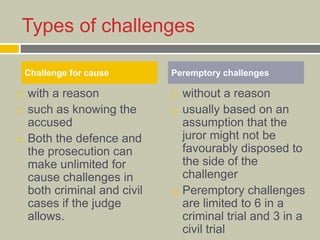
Types of challenges
 with a reason
 such as knowing the
accused
 Both the defence and
the prosecution can
make unlimited for
cause challenges in
both criminal and civil
cases if the judge
allows.
 without a reason
 usually based on an
assumption that the
juror might not be
favourably disposed to
the side of the
challenger
 Peremptory challenges
are limited to 6 in a
criminal trial and 3 in a
civil trial
Challenge for cause Peremptory challenges
Foreperson
 Once a jury is empanelled the jurors elect a
foreperson to act as their spokesperson.
 The foreperson will ask the judge questions
and deliver the verdict.
 During the jury’s deliberations, the foreperson
is responsible for the conduct of the
deliberations, although his or her vote does
not carry any extra weight, and he or she
should not try to influence the other jurors in
any way.
STRENGTHS AND
WEAKNESSES OF THE JURY
SYSTEM
Cross-section of the people
 An accused person can
therefore feel confident that
they are not being
oppressed by authority but
are being tried by people
like themselves from within
society.
 A jury is able to assess the
situation before it, not in
legalistic terms, but
according to the current
standards of the general
community.
 The jury may not be
a true cross-section
because some
people are
disqualified,
ineligible or
excused, and
because of
challenges made.
Pro Con
Involves the general community
 Serving as a juror is seen as
part of a citizen’s civic duty.
 A person who serves on a jury
is able to participate in the
legal system and see the legal
system in operation.
 This can help members of
society improve their
knowledge of how the legal
system works, allow the jurors
to see the plight of others in
society and generally help
those participating to gain a
feeling of confidence in the
legal system.
 Jury service is a difficult
task.
 The jury might
experience difficulty
understanding
complicated evidence
such as forensics or
medical evidence or
simply coping with the
sheer volume of
evidence in lengthy
trials and the number of
witnesses.
Pro Con
Spreads responsibility
 The use of a jury
allows the decision-
making to be spread
over more
shoulders, rather
than being placed
solely in the hands
of a judge.
 As the jury is made up
of average people,
most of whom would
have little knowledge or
experience of
courtroom procedure.
 They may feel quite
confused and
overwhelmed by the
courtroom formalities
and unable to
concentrate on the task
at hand.
Pro Con
Reflects community values
 The jury is able to
reflect community
values and bring a
common sense
approach to decision
making in the court.
 A jury does not need to
give a reason for its
decision, so the jury
members can follow the
law, or ignore it if they
disagree with it.
 As the jury doesn’t
need to give a reason
for its decision, there
is no way of telling
what reasoning was
used in reaching their
decision.
 Therefore there it is
not possible to know if
the law was followed
or applied correctly.
Pro Con
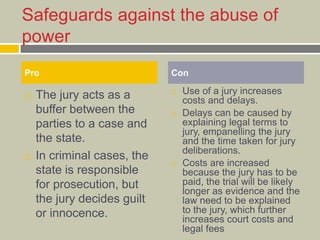
Safeguards against the abuse of
power
 The jury acts as a
buffer between the
parties to a case and
the state.
 In criminal cases, the
state is responsible
for prosecution, but
the jury decides guilt
or innocence.
 Use of a jury increases
costs and delays.
 Delays can be caused by
explaining legal terms to
jury, empanelling the jury
and the time taken for jury
deliberations.
 Costs are increased
because the jury has to be
paid, the trial will be likely
longer as evidence and the
law need to be explained
to the jury, which further
increases court costs and
legal fees
Pro Con
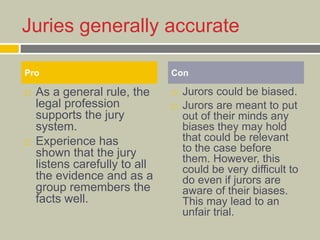
Juries generally accurate
 As a general rule, the
legal profession
supports the jury
system.
 Experience has
shown that the jury
listens carefully to all
the evidence and as a
group remembers the
facts well.
 Jurors could be biased.
 Jurors are meant to put
out of their minds any
biases they may hold
that could be relevant
to the case before
them. However, this
could be very difficult to
do even if jurors are
aware of their biases.
This may lead to an
unfair trial.
Pro Con
IMPROVING THE JURY
SYSTEM
Reform Vs Alternative
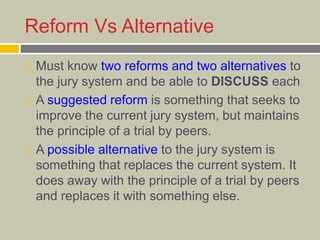
 Must know two reforms and two alternatives to
the jury system and be able to DISCUSS each
 A suggested reform is something that seeks to
improve the current jury system, but maintains
the principle of a trial by peers.
 A possible alternative to the jury system is
something that replaces the current system. It
does away with the principle of a trial by peers
and replaces it with something else.
REFORMS TO THE
JURY SYSTEM
Juror’s give reasons for
decisions
 Parties would know
the reasons for the
jury’s decision and
whether due
attention had been
given to points of
law.
 However, this could lead to
more appeals if it was
thought that the jury had
not followed the law as
explained by the judge.
 It could also be difficult for
twelve jurors to come up
with one reason for their
decision.
 It would also reduce the
flexibility of the jury to
make decisions that reflect
community values.
Pro Con
Have a specialist foreperson
 A specialist
foreperson would be
able to inform the
jury on the relevant
law and court
procedure and could
assist the jury to
make the right
decision.
 However, their
opinion might carry
too much weight.
Jurors may take too
much notice of what
the foreperson feels is
the right decision,
rather than basing
their decision on the
facts.
Pro Con
Introduce ‘not proven’ verdicts
 ‘Not proven’ verdicts
would allow the
accused to be
retried if new
evidence surfaces
after trial.
 However, this may lead
to the jury taking the
‘soft option’ of not
proven rather than
examining the evidence
and reaching a
decision.
 This could lead to more
re-trials, which would
increase costs and
delays and add to the
stress of not knowing
the outcome.
Pro Con
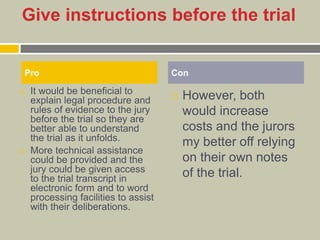
Give instructions before the trial
 It would be beneficial to
explain legal procedure and
rules of evidence to the jury
before the trial so they are
better able to understand
the trial as it unfolds.
 More technical assistance
could be provided and the
jury could be given access
to the trial transcript in
electronic form and to word
processing facilities to assist
with their deliberations.
 However, both
would increase
costs and the jurors
my better off relying
on their own notes
of the trial.
Pro Con
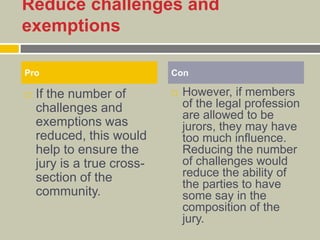
Reduce challenges and
exemptions
 If the number of
challenges and
exemptions was
reduced, this would
help to ensure the
jury is a true cross-
section of the
community.
 However, if members
of the legal profession
are allowed to be
jurors, they may have
too much influence.
Reducing the number
of challenges would
reduce the ability of
the parties to have
some say in the
composition of the
jury.
Pro Con
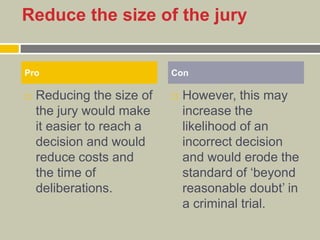
Reduce the size of the jury
 Reducing the size of
the jury would make
it easier to reach a
decision and would
reduce costs and
the time of
deliberations.
 However, this may
increase the
likelihood of an
incorrect decision
and would erode the
standard of ‘beyond
reasonable doubt’ in
a criminal trial.
Pro Con
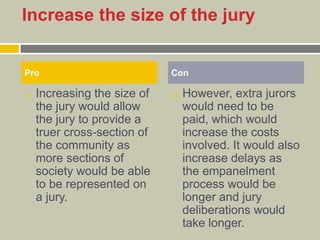
Increase the size of the jury
 Increasing the size of
the jury would allow
the jury to provide a
truer cross-section of
the community as
more sections of
society would be able
to be represented on
a jury.
 However, extra jurors
would need to be
paid, which would
increase the costs
involved. It would also
increase delays as
the empanelment
process would be
longer and jury
deliberations would
take longer.
Pro Con
ALTERNATIVES TO THE
JURY SYSTEM
Judge sitting alone
 One possible
alternative to the jury
system is to have the
judge sitting alone.
 The judge has a better
understanding of the
law than the jury
members, so is more
likely to get the decision
right.
 However, the judge
would be less able
to reflect community
values and the
parties may feel
more confident in
the decision of
peers.
Pro Con
Professional jurors
 Professional jurors
would have a better
understanding of the
law and court room
procedures.
 They could develop
expertise in certain
cases and would be
more likely to get the
decision right.
 However,
professional jurors
may develop biases
from hearing similar
cases and would
lose the advantage
of being
independent.
Pro Con
Specialist jurors
 Specialist jurors such
as medical experts
could be empanelled
for cases.
 They would be better
able to understand
the evidence as they
are experts in the
area.
 However, the may
have biases
for/against members
of profession. In
addition, this would
be practically
difficult and
expensive.
Pro Con
EVALUATION OF THE
JURY SYSTEM
F
A
T
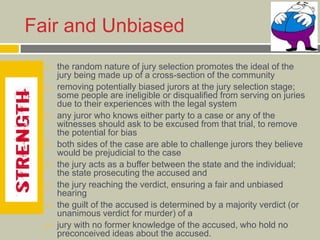
Fair and Unbiased
 the random nature of jury selection promotes the ideal of the
jury being made up of a cross-section of the community
 removing potentially biased jurors at the jury selection stage;
some people are ineligible or disqualified from serving on juries
due to their experiences with the legal system
 any juror who knows either party to a case or any of the
witnesses should ask to be excused from that trial, to remove
the potential for bias
 both sides of the case are able to challenge jurors they believe
would be prejudicial to the case
 the jury acts as a buffer between the state and the individual;
the state prosecuting the accused and
 the jury reaching the verdict, ensuring a fair and unbiased
hearing
 the guilt of the accused is determined by a majority verdict (or
unanimous verdict for murder) of a
 jury with no former knowledge of the accused, who hold no
preconceived ideas about the accused.
Fair and Unbiased
 juries are not necessarily made up of a cross-section of the
community, as some people are ineligible, disqualified or
excused from jury service; other potential jurors could be
challenged by either of the parties to the case
 some people are unlikely to be tried by their peers — for
example, few Indigenous people are chosen for jury service,
which could result in an Indigenous accused having their
case heard before an all- white jury
 a juror may find it difficult to set aside a bias that they hold
against particular groups in the community, such as racial
biases
 the jury could be influenced by things they may have read or
heard in the media before a case begins, and have difficulty
setting this aside
 jurors may have difficulty in understanding the complicated
nature of a trial and any complex evidence in a case, which
could mean that the accused is not given a fair hearing on
the evidence.
Effective Access
 Provides the general public with the chance
to be apart of legal system – greater
knowledge and understanding
 Gives people confidence their trial will be
heard by peers
Effective Access
 In civil cases, the jury is optional and the
costs therefore lie with the party
requesting the jury
 This limits the access of financially
disadvantaged parties
Timely Resolution
Timely Resolution
 The use of juries adds to the time taken for a trial for a
number of reasons including:
 the empanelment process can often take hours or even
days for long trials
 during the course of the trial, proceedings may need to be
halted and jurors removed from the
 courtroom while legal counsel argues a point of law
 the trial itself can often take longer because the legal
counsel are at pains to explain concepts to the
 jury so that members of the jury can understand the
evidence given
 the time taken for jury deliberations
 if there is a hung jury, then the whole trial will need to be
re-heard, which increases the costs and
 delays involved.
Jury System Effective….
 Although it may appear not (access and
timely), must balance the negative aspects of
the jury system, such as costs and delays with
the positive contribution of juries to fair and
unbiased hearings.
 Overall, the jury system is an important
element of an effective legal system.
END OF U402 B
GOOD LUCK
LEGAL STUDIES CONTENT COMPLETE …
Yes that’s right …
We have FINISHED!

U402 B Engaging in Justice

  • 1.
    U402 B ENGAGINGIN JUSTICE Adversary System and Juries
  • 2.
    Key Knowledge  majorfeatures of the adversary system of trial, including:  the role of the parties;  the role of the judge;  the need for the rules of evidence and procedure;  standard and burden of proof; and  the need for legal representation.  strengths and weaknesses of the adversary system of trial;  major features of the inquisitorial system of trial;  possible reforms to the adversary system of trial;  the role of juries, and factors that influence their composition;  strengths and weaknesses of the jury system;  reforms and alternatives to the jury system;  problems and difficulties faced by individuals in using the legal system; and  recent changes and recommendations for change in the legal system designed to enhance its effective operation. Elements of an effective legal system: F ~ fair and unbiased hearing; A ~ effective access to the legal system; T ~ timely resolution of disputes.
  • 3.
    Key Skills  definekey legal terminology and use it appropriately;  discuss, interpret and analyse legal information;  apply legal principles to relevant cases and issues;  critically evaluate the adversary system of trial;  compare the operation and features of the adversary system with the inquisitorial system;  critically evaluate the effectiveness of juries; and  suggest and discuss reforms and alternatives to the adversary system and the jury system
  • 4.
    SAC Details  SAC2B Tuesday 8th Sept (Term 3 Week 9) 2.30PM
  • 5.
  • 6.
    Adversary System oftrial  The adversary system of trial is where two opposing parties, or adversaries, fight in court to win their legal battle.  The trial is presided over by an independent and impartial umpire, and is conducted according to rules of evidence and procedure.  The role of the adversary system is to provide a procedure for the parties to present and resolve their case, in as fair a manner as possible.  The adversary system operates in both civil and criminal cases.  In a criminal case the state is trying to prove the guilt of the accused, and the accused is fighting to be found not guilty.  In a civil case the party bringing the case is trying to prove that the other party was in the wrong and the person who is defending the case is trying to show that he or she was not in the wrong.
  • 7.
    Major features ofthe Adversary System  Role of the parties  Role of the judge  Rules of evidence and procedure  Burden and standard of proof  Need for legal representation
  • 8.
    Role of theparties  In the adversary system of trial each party controls their own case and has complete control over decisions about how the case will be run as long as the rules of evidence and procedure are followed.  This is known as ‘party control’.  The parties in the adversary system are responsible for instigating proceedings, investigating the facts, deciding which evidence to present, investigating the law, deciding whether to have a jury in a civil case and choosing whether to have legal representation.
  • 9.
    Evaluation of roleof the parties  The parties are more likely to feel satisfied with the result if they have been able to control the conduct of their case.  Party control is particularly important in criminal cases in that a person is prosecuted by the state but does not have to depend on the state for their defence.  In civil cases, the parties are able to settle their differences with little interference from the state.  The parties are able to:  Control their own case  Engage legal representation to present their case in the best possible light  Decide what facts are brought before the court  However, particularly in civil matters, party control can lead to further animosity between the parties instead of settling their differences in a more amicable manner.  Party control may also disadvantage the parties, as it relies on the parties bringing out all the evidence that is favourable to their case. Some vital evidence may be missed and the court may reach an unfair decision.  Party control may also lead to more delays and increase the costs involved as the parties are responsible for their own case and having to pay for legal representation in order to win the case. Pro’s Con’s
  • 10.
    Role of theJudge  The judge or magistrate has the role of ensuring that the court processes and procedures are carried out according to the strict rules of evidence and procedure and each of the parties is treated fairly. The judge must act as an impartial umpire and not favour either side.  The judge or magistrate has the following responsibilities:  Keeping the contest fair and impartial  Deciding on admissibility of evidence  Deciding on questions of law  Ensuring the burden of proof is discharged  Deciding the case when there is no jury  Sentencing the accused in criminal cases  For the adversary system to operate effectively, it is essential that the judge or magistrate acts impartially. If the judge or magistrate favoured one side, then the contest would not be fair.  It is also essential that the decision-maker in the trial (the magistrate, the judge when there is no jury, or the jury) is independent. The magistrate, judge or jury makes the decision on the facts brought before the court. They have no previous knowledge of the accused or the parties in civil cases.
  • 11.
    Evaluation of therole of the judge  The judge operates as an impartial umpire within the adversary system. This ensures that the rules of evidence and procedure are followed and the parties are treated fairly during the trial or hearing.  The judge is independent of the prosecution in criminal cases and independent of the parties in civil. The public is more likely to feel confident in the decision of an independent decision maker.  However, as the judge is independent and impartial, they cannot offer the parties any assistance. This means that the judge’s experience and knowledge of the law is underutilised, which may lead to unfair result if one of the parties is poorly represented. Pro’s Con’s
  • 12.
    Rules of evidenceand procedure  Each court in the adversary system is governed by rules of evidence and procedure that aim to ensure that there is fair and equal treatment for both parties.  Rules of evidence  The rules of evidence keep the contest fair. Irrelevant material that would confuse the issue cannot be introduced, and unreliable evidence such as hearsay evidence cannot be used.  Rules of procedure  The truth should emerge through the use of the rules of procedure. The witnesses give their evidence through examination-in-chief, cross-examination and re- examination and the court should be able to pick out the truth and see where there are flaws in the story.
  • 13.
    Evaluation of rulesof evidence and procedure  The rules of evidence and procedure help to ensure all parties are treated equally and that there is a fair and unbiased hearing.  Oral evidence helps reveal if witness is sincere and the process of examination and cross-examination allows both parties to present their case and test the evidence of the other party.  The rules of evidence provide guidelines to ensure that the evidence heard can be tested and that it is not irrelevant or confusing. The court hears evidence relevant to the facts of the particular case, and not what has happened in the past.  However, witnesses may be intimidated by the strict formality and say something misleading.  Witnesses can only respond to questions as opposed to being able to tell their story and oral evidence relies on the memory of witnesses which may be unreliable.  Expert evidence may carry too much weight and the strict rules may mean that vital evidence may be inadmissible and thus the truth may not come out leading to an unfair outcome. Pro’s Con’s
  • 14.
    Burden & standardof proof  The burden of proof relates to the question of which party has to prove the facts of the case. It lies with the person who is bringing the case. This means that the person who brings the case has to prove that their view of the facts is correct.  In a criminal case, it lies with the prosecution;  in a civil case the plaintiff carries the burden of proof.  This follows the concept of control by the parties within the adversary system; someone who thinks they have been wronged, brings the matter to court to prove the case or, in a criminal case, if society has been wronged the prosecution brings the case.  The other party then has the opportunity to show that the evidence does not support the facts alleged.
  • 15.
    Evaluation of standard& burden of proof  The burden and standard of proof are designed to ensure that the party bringing the case has to prove the facts to the standard of proof required.  This is a fairer system than having the judge solely responsible for discovering the truth.  However, the adversary system is more concerned with winning rather than finding out the truth.  Each side brings out the facts of the case to benefit their side. This is particularly relevant if one party is poorly represented. If the court does not hear all the facts, the party in the right may not win the case.  The prosecution is however, obliged to present all the evidence they are aware of. Pro’s Con’s
  • 16.
    Need for legalrepresentation  Legal representation ensures the parties are able to present their best case as they are familiar with rules of evidence and procedure and aware of people’s legal rights.  Legal representation helps to ensure that the parties are able to present their best possible case, and assists in achieving a just outcome  When each party present their case to the best of their ability, the truth should emerge.  The adversary system only works effectively when both sides are equally represented. If one lawyer is better, they may be able to influence the case and
  • 17.
    Evaluation of theneed for legal representation  The ability to be represented by legal personnel provides those accused of a crime or parties to a civil case with the opportunity to present their side of the facts in the best light possible.  The parties can choose the best legal representation (that they can afford) to bring out the evidence in an objective and logical manner that will best benefit their case.  However, legal representation is very expensive. If one party is not able to afford legal representation or is poorly represented, they are significantly disadvantaged in the adversary system.  Both sides need to be equally represented for adversary system to be effective. If one side has inferior legal representation, this may lead to an unfair outcome. Pro’s Con’s
  • 18.
  • 19.
    Inquisitorial System oftrial  The inquisitorial system (also called the investigatory system) is a system of trial where the court is actively involved in determining the facts and conduct of a trial.  Its main role is to find out the truth of an issue.  The inquisitorial system is based on the idea that the effective operation of the legal system is of benefit to society as a whole and that it is the responsibility of the state to ensure all relevant information is examined and that the truth is reached.
  • 20.
    Major features ofthe Inquisitorial System  Role of the parties  Role of the judge  Rules of evidence and procedure  Burden and standard of proof  Need for legal representation
  • 21.
    Role of theparties  Due to the judge having control of the case in the inquisitorial system, the parties have a greatly reduced role.  They are required to respond to the directions of the court.  While this may reduce the effects of some inequities between parties, it places control of their case in the hands of a third party.
  • 22.
    Role of theJudge  One essential feature of the inquisitorial system is that the judge takes a more active role in the case. This includes:  investigating cases  defining the issues to be resolved  gathering evidence (together with the police).  The judge’s objective is to find the truth of the matter.  At trial, the judge is actively involved in calling and questioning witnesses.  Further, judges are not restricted to the issues at question in the trial. The judge may raise other matters of law or fact, even those that have been conceded by the parties, or ones the parties could perceive as not relevant to their case.
  • 23.
    Rules of evidenceand procedure  There is less reliance on strict rules of evidence and procedure in the inquisitorial system.  There is extensive use of written evidence, and witnesses are able to tell their stories, uninterrupted and in a logical form, rather than responding to specific questions.  Evidence led could also include character evidence (either good or bad) and information related to prior convictions.  Judges are free to hear all evidence, then to determine which evidence they feel is relevant and reliable. No strict rules Witnesses are allowed to tell their stories Judge determines what evidence is relevant
  • 24.
    Burden and standardof proof  In the inquisitorial system, no formal burden of proof or standard of proof is set on any party, as the judge is the person responsible for bringing evidence and finding out the truth. The pursuit of truth is the main objective in this system of trial. No formal burden or standard of proof Judge determines what evidence is relevant Pursuit of truth is the main objective
  • 25.
    Need for legalrepresentation  Due to the judge’s active role in relation to investigation and questioning, the legal representatives have a lesser role to play in the inquisitorial system.  They assist the judge with finding out the truth.  This can include further questioning of witnesses.
  • 26.
  • 27.
    Comparing Adversary & Inquisitorial You need to be able to compare ALL features between:  Adversary system  Inquisitorial system
  • 28.
    Role of theparties  One feature of the adversary system is party control. In the adversary system each party controls their own case. They decide what evidence to present and whether to engage legal representation.  However, in the inquisitorial system parties have a greatly reduced role. They are required to merely respond to directions of the court. This reduces inequity between parties, but places control of their case with a third party. Adversary Inquisitorial
  • 29.
    Role of thejudge  One feature of the adversary system is the role of the judge. In the adversary system, the judge is independent and impartial. They ensure both parties receive a fair hearing.  However, in the inquisitorial system, the judge plays a more active role. They may call and question witnesses and may raise other matters of law or fact. The judge’s aim is to uncover the truth of the matter. Adversary Inquisitorial
  • 30.
    Rules of evidenceand procedure  One feature of the adversary system is strict rules of evidence and procedure. They aim to keep the contest fair and ensure the truth should emerge through questioning.  However, in the inquisitorial system there are no strict rules of evidence and procedure. The judge determines what evidence is permissible and witnesses are allowed to tell their stories rather than respond to questioning. Adversary Inquisitorial
  • 31.
    Burden and standardof proof  One feature of the adversary system is the burden and standard of proof. This ensures the party bringing the case has to prove it to the required standard.  However, in the inquisitorial system there is no formal burden or standard of proof. The judge is responsible for bringing evidence and the pursuit of truth is the main objective. Adversary Inquisitorial
  • 32.
    Need for legalrepresentation  One feature of the adversary system is the need for legal representation. Legal representation ensures parties are able to present their best case as they are familiar with rules of evidence and procedure. This assists in achieving a just outcome.  However, in the inquisitorial system legal representation have a lesser role. They assist the judge to find out the truth which may include further questioning of witnesses. Adversary Inquisitorial
  • 33.
  • 34.
    Possible reforms tothe adversary system  Possible reforms to the adversary system generally involves taking aspects of the inquisitorial system and incorporating them into the adversary system.  Need to be able to DISCUSS at least two reforms – i.e. you must be able to talk about both sides. Adversary Inquisitorial
  • 35.
    Possible reforms Greater investigative role of thejudge Greater use of written statements Greater availability of legal aid More informal conduct of the trial
  • 36.
    Greater investigative roleof the judge  The judge or magistrate can ask questions and call witnesses, but this is usually done to clear up points made in the proceedings.  For example, a judge might call a medical witness to clarify evidence given about someone’s health.  This power could be increased to allow a judge to ask questions and call witnesses to ensure that cases are decided correctly — in the interests of fairness and finding the truth.  However, the judge could be seen as being biased towards one side or the other by bringing out evidence that would benefit one side; and a judge loses the advantage of being an uninvolved observer. Pro’s Con’s
  • 37.
    Greater use ofwritten statements  Court time and money could be saved with the use of written statements where possible during the trial.  Medical evidence, for example, could in many cases be tendered in written documents without the medical expert having to attend in person to prove the accuracy of the statements.  The use of oral evidence, however, does allow cross- examination of the witnesses to bring out any falsehoods and gives the court the opportunity to see whether the witness is sincere.  However, the move to the use of written statements could also lead to increased legal fees because the solicitor would need to draw them up and the barrister would have to examine them.  If anything within the statements was disputed, witnesses would still have to be called to be cross- examined. Pro’s Con’s
  • 38.
    Greater availability tolegal aid  Parties are likely to be disadvantaged in the adversary system without legal representation or if they cannot afford the best lawyer.  Parties with limited financial means are entitled to legal aid.  Increasing the availability of legal aid would allow more people to be represented adequately and help to achieve a fair trial.  However, legal aid is limited and cases that are unlikely to succeed are rejected.  In addition there is little or no funding for civil cases. Increasing legal aid may reduce some of these problems, but it would increase the burden on the taxpayer. Pro’s Con’s
  • 39.
    More informal conductof the trial  Under the adversary system, the court follows strict rules of evidence and procedure. This is intimidating for the parties involved and can be confusing for a jury if present in the court (juries are optional in civil cases).  Greater use of tribunals could enable more parties to resolve civil cases quickly and cheaply in a more informal atmosphere.  Witnesses could be allowed to tell their stories rather than just responding to questions.  However, rules of evidence and procedure are there to protect the parties and help achieve a fair outcome. Pro’s Con’s
  • 40.
  • 41.
    Evaluation of theadversary system  When assessing the effective operation of the adversary system you should consider the extent to which each of the three elements of an effective legal system is achieved. For each element, you should consider:  the processes and procedures that help the achievement of each element  the processes and procedures that hinder the achievement of each element
  • 42.
    Fair & Unbiased party control — allows the parties to be in control of the progress of their case  independent arbitrators — ensures that both parties are treated fairly, that the rules of evidence and procedure are followed, decide all questions of law and can make a decision on the facts brought before them  rules of evidence — ensures that certain types of evidence that might inappropriately influence the magistrate, judge or jury, such as hearsay evidence, irrelevant evidence, opinion evidence other than that of an expert, and bad character evidence, are inadmissible, although propensity evidence is allowed  rules of procedure — helps to ensure that the truth will come out through the parties to a case being given equal opportunity to bring out the evidence relevant to their case; the truth should emerge from the evidence given  right to silence — allows people accused of a crime to say nothing so as not to incriminate themselves, although the abolition of the right to silence is being considered under some circumstances because of its detrimental effect on investigations  legal aid — is provided to those parties unable to afford legal representation, although the availability of legal aid is limited  burden of proof — is placed on the party bringing the action, so they have the responsibility of proving the case, according to the relevant  Vital evidence may be inadmissible  Legal representation is costly  Oral evidence can be misleading  Judge and jurors may have personal biases Pro Con
  • 43.
    Effective Access  canget assistance to take a matter to court through legal aid, if it is available in the circumstances  have an opportunity to take a matter to court  have access to legal representation  can use alternative methods of dispute resolution in civil cases  can be ordered to participate in mediation, which can assist the parties  can take some civil matters to a tribunal which is less expensive and more accessible  have rights during police investigations to protect them from unfair treatment  are presumed innocent until proven guilty in a criminal case  High court fees and the cost of legal representation may reduce access  Formality of proceedings may be intimidating Pro’s Con’s
  • 44.
    Timely Resolution  Eachtrial within the adversary system is heard as a single, continuous event. At the conclusion of the pre-trial procedures, a date for trial will usually be set. Once the trial begins, it will continue for the hours, days or weeks needed until its completion. There are no stops in the procedure to allow for gathering more evidence or for further investigation (as can happen in the inquisitorial system). This system helps to:  minimise delays during the trial, so that it can be heard in a timely manner, thereby enhancing effective operation of the legal system  reduce delays in the pre-trial processes through the directions hearings  cut out the committal hearings in a criminal case when it is a clear-cut case  provide systems such as mediation in civil cases to speed up the process and assist in achieving a resolution.  Pre-trial procedures and strict rules of evidence and procedure may delay resolution  More evidence may emerge after trial Pro’s Con’s
  • 45.
    Adversary system effective… While high court fees and the need for legal representation reduce access for those with limited financial means, the benefits of independent arbitrators and the ability to hear all types of cases make the adversary system an effective system of trial.
  • 46.
  • 47.
    Role of thejury  The jury system is trial by peers.  The jury acts as an independent decision-maker in criminal trials and in some civil trials.  In both civil and criminal trials, the jury is the decider of the facts.  The role of the jury in both civil and criminal trials is to:  Listen to all the evidence  Apply the points of law as explained by the judge  Put aside prejudices or preconceived ideas  Take part in deliberations  Make a decision on the facts
  • 48.
    Criminal Trial Jury Must make a unanimous decision where possible and determine guilt beyond reasonable doubt.  If they cannot be sure of the guilt of the accused, they must reach a decision of not guilty.  The jury must first try to reach a unanimous verdict (a verdict where all members of the jury agree), but if this is not possible after six hours, a majority verdict (11 out of 12 jurors) can be accepted as the verdict except in cases of murder, treason, drug trafficking, or Commonwealth offences. GUILTY 12 vote Unanimous Not Guilty 1vote Majority Guilty 11 vote
  • 49.
    Civil Trial Jury In a civil trial, the jury must make a decision on the balance of probabilities, that is, which party is most probably in the right and which party is most probably in the wrong.  The jury also has to decide on the amount of damages to be paid to the plaintiff if the plaintiff is successful.  In a civil trial the decision can be a majority decision (five out of six) if they are unable to reach a unanimous decision after at least three hours of deliberation.
  • 50.
    Composition of Juries A number of factors affect the composition of juries which occur during the selection and empanelment of juries
  • 51.
    Selection of jurors People are randomly selected for jury service  The Electoral Commissioner randomly selects people from the electoral rolls  Those selected are sent a questionnaire to determine their eligibility to serve on a jury
  • 52.
    Liability for juryservice  The Juries Act 2000 (Vic) outlines requirements for the composition for juries  Every person 18+ who is enrolled to vote is liable for jury service expect if  Disqualified  Ineligible  Excused
  • 53.
    Disqualified  Some peopleare disqualified from jury service because of something they did in the past that makes them unsuitable.  Examples:  Criminal record  Bankrupt
  • 54.
    Ineligible  Someone mightbe ineligible because of their occupation or their inability to comprehend the task of a juror.  Examples:  Members of legal profession (too influential)  Poor English, visually impaired, deaf or intellectually disabled
  • 55.
    Excused  Potential jurorsmay be excused for good reason.  Examples:  Illness or incapacity  Distance to travel (>50km in Melbourne)  Care of dependants or advanced age
  • 56.
    Summons for juryduty  If a person is not disqualified, ineligible or excused, they are liable for jury service  They will then receive a summons for jury service  It is an offence not to attend when called which is punishable by a fine of 30 penalty units or 3 months imprisonment!
  • 57.
    Jury Pool  Thisis the selection pool from which jurors maybe called for the empanelment process  If liable for jury service, the person will be called into the pool for one to two days  From here a jury panel is called  If the person is not called on, their jury service is complete.
  • 58.
    Empanelling a Jury Compulsory jury of 12  5 extra jurors may be empanelled for long trials  Trial can continue with 10 jurors  Optional jury of 6  Either party may choose to have a jury  Two extra jurors may be empanelled for long trials  If 8 jurors remain at end of trial, a ballot determines which jurors are excluded from deliberation.  Trial can continue with 5 jurors Criminal Civil
  • 59.
    Challenges  The partiesto a case have some say in the composition of the jury in that they may challenge some of the jurors if they feel these people would be unsuitable for their case.  The jurors are called one by one. Their names and occupations are called out. If one of the parties decides to challenge one of the jurors, the challenge must be made before the juror sits down in the jury box.
  • 60.
    Types of challenges with a reason  such as knowing the accused  Both the defence and the prosecution can make unlimited for cause challenges in both criminal and civil cases if the judge allows.  without a reason  usually based on an assumption that the juror might not be favourably disposed to the side of the challenger  Peremptory challenges are limited to 6 in a criminal trial and 3 in a civil trial Challenge for cause Peremptory challenges
  • 61.
    Foreperson  Once ajury is empanelled the jurors elect a foreperson to act as their spokesperson.  The foreperson will ask the judge questions and deliver the verdict.  During the jury’s deliberations, the foreperson is responsible for the conduct of the deliberations, although his or her vote does not carry any extra weight, and he or she should not try to influence the other jurors in any way.
  • 62.
  • 63.
    Cross-section of thepeople  An accused person can therefore feel confident that they are not being oppressed by authority but are being tried by people like themselves from within society.  A jury is able to assess the situation before it, not in legalistic terms, but according to the current standards of the general community.  The jury may not be a true cross-section because some people are disqualified, ineligible or excused, and because of challenges made. Pro Con
  • 64.
    Involves the generalcommunity  Serving as a juror is seen as part of a citizen’s civic duty.  A person who serves on a jury is able to participate in the legal system and see the legal system in operation.  This can help members of society improve their knowledge of how the legal system works, allow the jurors to see the plight of others in society and generally help those participating to gain a feeling of confidence in the legal system.  Jury service is a difficult task.  The jury might experience difficulty understanding complicated evidence such as forensics or medical evidence or simply coping with the sheer volume of evidence in lengthy trials and the number of witnesses. Pro Con
  • 65.
    Spreads responsibility  Theuse of a jury allows the decision- making to be spread over more shoulders, rather than being placed solely in the hands of a judge.  As the jury is made up of average people, most of whom would have little knowledge or experience of courtroom procedure.  They may feel quite confused and overwhelmed by the courtroom formalities and unable to concentrate on the task at hand. Pro Con
  • 66.
    Reflects community values The jury is able to reflect community values and bring a common sense approach to decision making in the court.  A jury does not need to give a reason for its decision, so the jury members can follow the law, or ignore it if they disagree with it.  As the jury doesn’t need to give a reason for its decision, there is no way of telling what reasoning was used in reaching their decision.  Therefore there it is not possible to know if the law was followed or applied correctly. Pro Con
  • 67.
    Safeguards against theabuse of power  The jury acts as a buffer between the parties to a case and the state.  In criminal cases, the state is responsible for prosecution, but the jury decides guilt or innocence.  Use of a jury increases costs and delays.  Delays can be caused by explaining legal terms to jury, empanelling the jury and the time taken for jury deliberations.  Costs are increased because the jury has to be paid, the trial will be likely longer as evidence and the law need to be explained to the jury, which further increases court costs and legal fees Pro Con
  • 68.
    Juries generally accurate As a general rule, the legal profession supports the jury system.  Experience has shown that the jury listens carefully to all the evidence and as a group remembers the facts well.  Jurors could be biased.  Jurors are meant to put out of their minds any biases they may hold that could be relevant to the case before them. However, this could be very difficult to do even if jurors are aware of their biases. This may lead to an unfair trial. Pro Con
  • 69.
  • 70.
    Reform Vs Alternative Must know two reforms and two alternatives to the jury system and be able to DISCUSS each  A suggested reform is something that seeks to improve the current jury system, but maintains the principle of a trial by peers.  A possible alternative to the jury system is something that replaces the current system. It does away with the principle of a trial by peers and replaces it with something else.
  • 71.
  • 72.
    Juror’s give reasonsfor decisions  Parties would know the reasons for the jury’s decision and whether due attention had been given to points of law.  However, this could lead to more appeals if it was thought that the jury had not followed the law as explained by the judge.  It could also be difficult for twelve jurors to come up with one reason for their decision.  It would also reduce the flexibility of the jury to make decisions that reflect community values. Pro Con
  • 73.
    Have a specialistforeperson  A specialist foreperson would be able to inform the jury on the relevant law and court procedure and could assist the jury to make the right decision.  However, their opinion might carry too much weight. Jurors may take too much notice of what the foreperson feels is the right decision, rather than basing their decision on the facts. Pro Con
  • 74.
    Introduce ‘not proven’verdicts  ‘Not proven’ verdicts would allow the accused to be retried if new evidence surfaces after trial.  However, this may lead to the jury taking the ‘soft option’ of not proven rather than examining the evidence and reaching a decision.  This could lead to more re-trials, which would increase costs and delays and add to the stress of not knowing the outcome. Pro Con
  • 75.
    Give instructions beforethe trial  It would be beneficial to explain legal procedure and rules of evidence to the jury before the trial so they are better able to understand the trial as it unfolds.  More technical assistance could be provided and the jury could be given access to the trial transcript in electronic form and to word processing facilities to assist with their deliberations.  However, both would increase costs and the jurors my better off relying on their own notes of the trial. Pro Con
  • 76.
    Reduce challenges and exemptions If the number of challenges and exemptions was reduced, this would help to ensure the jury is a true cross- section of the community.  However, if members of the legal profession are allowed to be jurors, they may have too much influence. Reducing the number of challenges would reduce the ability of the parties to have some say in the composition of the jury. Pro Con
  • 77.
    Reduce the sizeof the jury  Reducing the size of the jury would make it easier to reach a decision and would reduce costs and the time of deliberations.  However, this may increase the likelihood of an incorrect decision and would erode the standard of ‘beyond reasonable doubt’ in a criminal trial. Pro Con
  • 78.
    Increase the sizeof the jury  Increasing the size of the jury would allow the jury to provide a truer cross-section of the community as more sections of society would be able to be represented on a jury.  However, extra jurors would need to be paid, which would increase the costs involved. It would also increase delays as the empanelment process would be longer and jury deliberations would take longer. Pro Con
  • 79.
  • 80.
    Judge sitting alone One possible alternative to the jury system is to have the judge sitting alone.  The judge has a better understanding of the law than the jury members, so is more likely to get the decision right.  However, the judge would be less able to reflect community values and the parties may feel more confident in the decision of peers. Pro Con
  • 81.
    Professional jurors  Professionaljurors would have a better understanding of the law and court room procedures.  They could develop expertise in certain cases and would be more likely to get the decision right.  However, professional jurors may develop biases from hearing similar cases and would lose the advantage of being independent. Pro Con
  • 82.
    Specialist jurors  Specialistjurors such as medical experts could be empanelled for cases.  They would be better able to understand the evidence as they are experts in the area.  However, the may have biases for/against members of profession. In addition, this would be practically difficult and expensive. Pro Con
  • 83.
  • 84.
    Fair and Unbiased the random nature of jury selection promotes the ideal of the jury being made up of a cross-section of the community  removing potentially biased jurors at the jury selection stage; some people are ineligible or disqualified from serving on juries due to their experiences with the legal system  any juror who knows either party to a case or any of the witnesses should ask to be excused from that trial, to remove the potential for bias  both sides of the case are able to challenge jurors they believe would be prejudicial to the case  the jury acts as a buffer between the state and the individual; the state prosecuting the accused and  the jury reaching the verdict, ensuring a fair and unbiased hearing  the guilt of the accused is determined by a majority verdict (or unanimous verdict for murder) of a  jury with no former knowledge of the accused, who hold no preconceived ideas about the accused.
  • 85.
    Fair and Unbiased juries are not necessarily made up of a cross-section of the community, as some people are ineligible, disqualified or excused from jury service; other potential jurors could be challenged by either of the parties to the case  some people are unlikely to be tried by their peers — for example, few Indigenous people are chosen for jury service, which could result in an Indigenous accused having their case heard before an all- white jury  a juror may find it difficult to set aside a bias that they hold against particular groups in the community, such as racial biases  the jury could be influenced by things they may have read or heard in the media before a case begins, and have difficulty setting this aside  jurors may have difficulty in understanding the complicated nature of a trial and any complex evidence in a case, which could mean that the accused is not given a fair hearing on the evidence.
  • 86.
    Effective Access  Providesthe general public with the chance to be apart of legal system – greater knowledge and understanding  Gives people confidence their trial will be heard by peers
  • 87.
    Effective Access  Incivil cases, the jury is optional and the costs therefore lie with the party requesting the jury  This limits the access of financially disadvantaged parties
  • 88.
  • 89.
    Timely Resolution  Theuse of juries adds to the time taken for a trial for a number of reasons including:  the empanelment process can often take hours or even days for long trials  during the course of the trial, proceedings may need to be halted and jurors removed from the  courtroom while legal counsel argues a point of law  the trial itself can often take longer because the legal counsel are at pains to explain concepts to the  jury so that members of the jury can understand the evidence given  the time taken for jury deliberations  if there is a hung jury, then the whole trial will need to be re-heard, which increases the costs and  delays involved.
  • 90.
    Jury System Effective…. Although it may appear not (access and timely), must balance the negative aspects of the jury system, such as costs and delays with the positive contribution of juries to fair and unbiased hearings.  Overall, the jury system is an important element of an effective legal system.
  • 91.
    END OF U402B GOOD LUCK LEGAL STUDIES CONTENT COMPLETE … Yes that’s right … We have FINISHED!