
Informal and Formal methods used to change the Law
ď‚—Tuesday 10th March
ď‚— the reasons why laws may need to change
ď‚— the means by which individuals and groups
influence legislative change, including petitions,
demonstrations and use of the media
ď‚— the role of the Victorian Law Reform
Commission
ď‚— the legislative process for the progress of a bill
through parliament
ď‚— strengths and weaknesses of parliament as a
law-making body.
Would laws also need to change????
https://www.youtube.com/watch?v=hrf8cPr6wUA
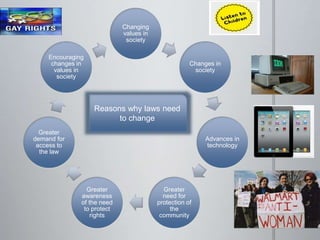
Changing
values in
society
Changes in
society
Advances in
technology
Greater
need for
protection of
the
community
Greater
awareness
of the need
to protect
rights
Greater
demand for
access to
the law
Encouraging
changes in
values in
society
Reasons why laws need
to change
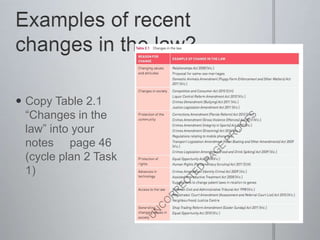
ď‚— Copy Table 2.1
“Changes in the
law” into your
notes page 46
(cycle plan 2 Task
1)
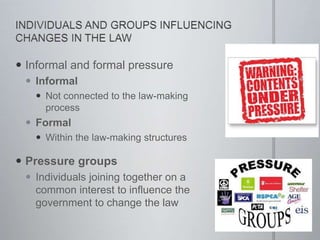
ď‚— Informal and formal pressure
ď‚— Informal
ď‚— Not connected to the law-making
process
ď‚— Formal
ď‚— Within the law-making structures
ď‚— Pressure groups
ď‚— Individuals joining together on a
common interest to influence the
government to change the law
ď‚— Petitions
ď‚— Demonstrations
ď‚— Media
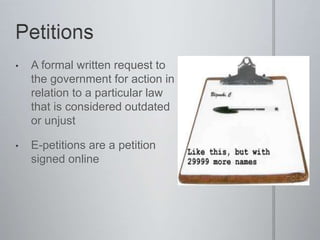
• A formal written request to
the government for action in
relation to a particular law
that is considered outdated
or unjust
• E-petitions are a petition
signed online
• Aka protests or rallies
• Held to alert government
to the need for a change
in the law
https://www.youtube.com/watch?v=iaySl5Xkh4c
ď‚— The media allows for petitions and
demonstrations to inform law makers of
the need to change a law by publicising
the issue
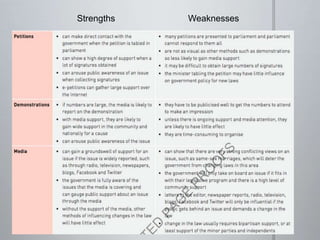
Strengths Weaknesses
ď‚— Formal law reform bodies are
employed by the government to
inform them of changes in society
that may require a change in the law.
ď‚— They are designed to be impartial
and provide advice to parliament to
which parliament may or may not
follow
ď‚— Given parliaments time constraints,
formal law reform bodies allow for
further research/investigation into
areas of law-making
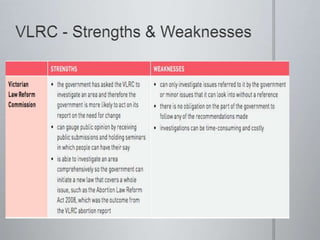
ď‚— Victorian Law Reform Commission
(VLRC)
ď‚— Established 6th April 2001
ď‚— Independent, government funded
organisation
ď‚— Designed to investigate areas of
law in which the government feels
there is a need for reform and to
monitor and coordinate law reform
activity in Victoria
ď‚— Make recommendations for law reform on
matters referred by the attorney-general
ď‚— Make recommendations on minor issues not
referred by the attorney-general
ď‚— Request to be referred to a particular area of law
ď‚— Educate the community on areas of law relevant
to VLRC
ď‚— Monitor and coordinate law reform activity in
Victoria
ď‚— Undertake initial research and consultation with
experts in area
ď‚— Publish an issues or discussion paper
ď‚— Invite and consider written submissions from
members of the public
ď‚— Undertake consultation with relevant bodies
ď‚— Asks experts to research further
ď‚— Publish a report with proposed reforms
ď‚— Table the report in the Victorian Parliament
ď‚— The VLRC conduct inquires into areas of law
recommended by the attorney-general that may require
change
ď‚— They employ many processes to review the area of law,
such as explained in previous slide
ď‚— From their findings they complete a report with
recommendations on changes, if any, to the current laws
related to the area
ď‚— This may be followed by a legislative response, or
change in the law.
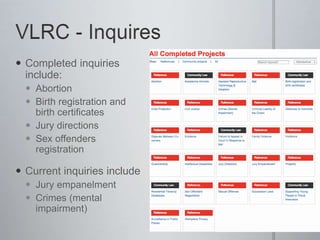
ď‚— Completed inquiries
include:
ď‚— Abortion
ď‚— Birth registration and
birth certificates
ď‚— Jury directions
ď‚— Sex offenders
registration
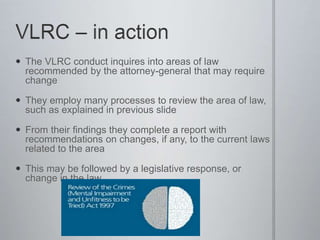
ď‚— Current inquiries include
ď‚— Jury empanelment
ď‚— Crimes (mental
impairment)
ď‚— In March 2013, the VLRC was asked to review
the jury empanelment process to ensure it
operates justly, effectively and efficiently.
ď‚— Considerations included:
ď‚— Peremptory challenges
ď‚— Calling of jurors by name or number
ď‚— Operation of S48 of the Juries Act (additional
jurors during deliberation)
ď‚— Reducing juror number to 12 (criminal) 6 (civil)
before jury retires to consider its verdict
ď‚— Submissions closed on 15th November 2013
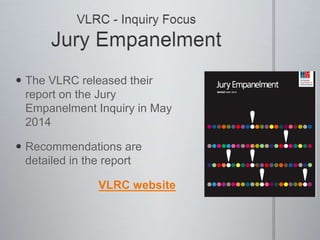
ď‚— The VLRC released their
report on the Jury
Empanelment Inquiry in May
2014
ď‚— Recommendations are
detailed in the report
VLRC website
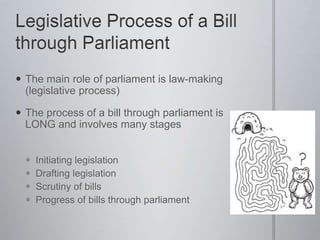
ď‚— The main role of parliament is law-making
(legislative process)
ď‚— The process of a bill through parliament is
LONG and involves many stages
ď‚— Initiating legislation
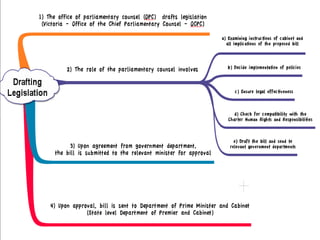
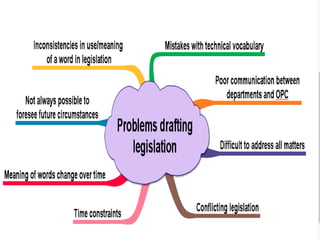
ď‚— Drafting legislation
ď‚— Scrutiny of bills
ď‚— Progress of bills through parliament
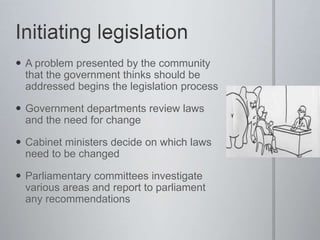
ď‚— A problem presented by the community
that the government thinks should be
addressed begins the legislation process
ď‚— Government departments review laws
and the need for change
ď‚— Cabinet ministers decide on which laws
need to be changed
ď‚— Parliamentary committees investigate
various areas and report to parliament
any recommendations
ď‚— Bills are scrutinised by parliamentary
committees either before or during the
progress of a bill through parliament
ď‚— This allows for
ď‚— Further scrutiny of proposed legislation
ď‚— Thorough investigation
ď‚— Hear from interest groups
ď‚— Public voice
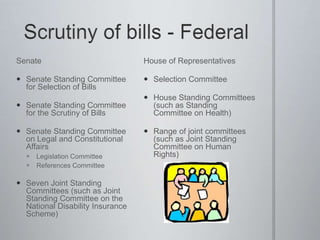
Senate
ď‚— Senate Standing Committee
for Selection of Bills
ď‚— Senate Standing Committee
for the Scrutiny of Bills
ď‚— Senate Standing Committee
on Legal and Constitutional
Affairs
ď‚— Legislation Committee
ď‚— References Committee
ď‚— Seven Joint Standing
Committees (such as Joint
Standing Committee on the
National Disability Insurance
Scheme)
House of Representatives
ď‚— Selection Committee
ď‚— House Standing Committees
(such as Standing
Committee on Health)
ď‚— Range of joint committees
(such as Joint Standing
Committee on Human
Rights)
ď‚— Scrutiny of Acts and Regulations
Committee considers all bills and reports
to parliament any breaches on
ď‚— Rights or freedoms
ď‚— Inappropriate use of legislative power
ď‚— Incompatibility with the Charter of Human
Rights and Responsibilities (statement of
compatibility)
ď‚— Interference with the jurisdiction of the
Supreme Court
ď‚— Upon second reading of the bill the senior
legal adviser of the committee carefully
examines all aspects of the bill
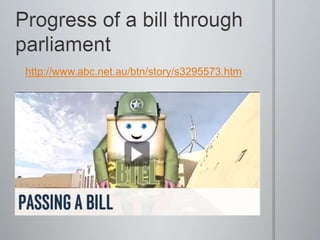
http://www.abc.net.au/btn/story/s3295573.htm
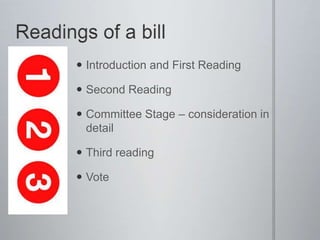
ď‚— Introduction and First Reading
ď‚— Second Reading
 Committee Stage – consideration in
detail
ď‚— Third reading
ď‚— Vote
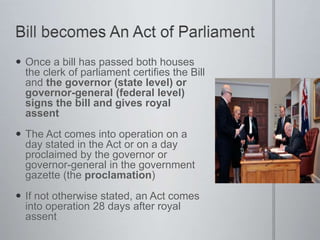
ď‚— Once a bill has passed both houses
the clerk of parliament certifies the Bill
and the governor (state level) or
governor-general (federal level)
signs the bill and gives royal
assent
ď‚— The Act comes into operation on a
day stated in the Act or on a day
proclaimed by the governor or
governor-general in the government
gazette (the proclamation)
ď‚— If not otherwise stated, an Act comes
into operation 28 days after royal
assent
Complete

U301 part b changing the law working progress

  • 1.
    Informal and Formalmethods used to change the Law
  • 2.
  • 3.
    ď‚— the reasonswhy laws may need to change ď‚— the means by which individuals and groups influence legislative change, including petitions, demonstrations and use of the media ď‚— the role of the Victorian Law Reform Commission ď‚— the legislative process for the progress of a bill through parliament ď‚— strengths and weaknesses of parliament as a law-making body.
  • 4.
    Would laws alsoneed to change???? https://www.youtube.com/watch?v=hrf8cPr6wUA
  • 5.
    Changing values in society Changes in society Advancesin technology Greater need for protection of the community Greater awareness of the need to protect rights Greater demand for access to the law Encouraging changes in values in society Reasons why laws need to change
  • 6.
     Copy Table2.1 “Changes in the law” into your notes page 46 (cycle plan 2 Task 1)
  • 7.
    ď‚— Informal andformal pressure ď‚— Informal ď‚— Not connected to the law-making process ď‚— Formal ď‚— Within the law-making structures ď‚— Pressure groups ď‚— Individuals joining together on a common interest to influence the government to change the law
  • 8.
  • 9.
    • A formalwritten request to the government for action in relation to a particular law that is considered outdated or unjust • E-petitions are a petition signed online
  • 10.
    • Aka protestsor rallies • Held to alert government to the need for a change in the law https://www.youtube.com/watch?v=iaySl5Xkh4c
  • 11.
    ď‚— The mediaallows for petitions and demonstrations to inform law makers of the need to change a law by publicising the issue
  • 12.
  • 13.
    ď‚— Formal lawreform bodies are employed by the government to inform them of changes in society that may require a change in the law. ď‚— They are designed to be impartial and provide advice to parliament to which parliament may or may not follow ď‚— Given parliaments time constraints, formal law reform bodies allow for further research/investigation into areas of law-making
  • 14.
    ď‚— Victorian LawReform Commission (VLRC) ď‚— Established 6th April 2001 ď‚— Independent, government funded organisation ď‚— Designed to investigate areas of law in which the government feels there is a need for reform and to monitor and coordinate law reform activity in Victoria
  • 15.
    ď‚— Make recommendationsfor law reform on matters referred by the attorney-general ď‚— Make recommendations on minor issues not referred by the attorney-general ď‚— Request to be referred to a particular area of law ď‚— Educate the community on areas of law relevant to VLRC ď‚— Monitor and coordinate law reform activity in Victoria
  • 16.
    ď‚— Undertake initialresearch and consultation with experts in area ď‚— Publish an issues or discussion paper ď‚— Invite and consider written submissions from members of the public ď‚— Undertake consultation with relevant bodies ď‚— Asks experts to research further ď‚— Publish a report with proposed reforms ď‚— Table the report in the Victorian Parliament
  • 17.
    ď‚— The VLRCconduct inquires into areas of law recommended by the attorney-general that may require change ď‚— They employ many processes to review the area of law, such as explained in previous slide ď‚— From their findings they complete a report with recommendations on changes, if any, to the current laws related to the area ď‚— This may be followed by a legislative response, or change in the law.
  • 18.
    ď‚— Completed inquiries include: ď‚—Abortion ď‚— Birth registration and birth certificates ď‚— Jury directions ď‚— Sex offenders registration ď‚— Current inquiries include ď‚— Jury empanelment ď‚— Crimes (mental impairment)
  • 19.
    ď‚— In March2013, the VLRC was asked to review the jury empanelment process to ensure it operates justly, effectively and efficiently. ď‚— Considerations included: ď‚— Peremptory challenges ď‚— Calling of jurors by name or number ď‚— Operation of S48 of the Juries Act (additional jurors during deliberation) ď‚— Reducing juror number to 12 (criminal) 6 (civil) before jury retires to consider its verdict ď‚— Submissions closed on 15th November 2013
  • 20.
    ď‚— The VLRCreleased their report on the Jury Empanelment Inquiry in May 2014 ď‚— Recommendations are detailed in the report VLRC website
  • 22.
    ď‚— The mainrole of parliament is law-making (legislative process) ď‚— The process of a bill through parliament is LONG and involves many stages ď‚— Initiating legislation ď‚— Drafting legislation ď‚— Scrutiny of bills ď‚— Progress of bills through parliament
  • 23.
    ď‚— A problempresented by the community that the government thinks should be addressed begins the legislation process ď‚— Government departments review laws and the need for change ď‚— Cabinet ministers decide on which laws need to be changed ď‚— Parliamentary committees investigate various areas and report to parliament any recommendations
  • 26.
    ď‚— Bills arescrutinised by parliamentary committees either before or during the progress of a bill through parliament ď‚— This allows for ď‚— Further scrutiny of proposed legislation ď‚— Thorough investigation ď‚— Hear from interest groups ď‚— Public voice
  • 27.
    Senate ď‚— Senate StandingCommittee for Selection of Bills ď‚— Senate Standing Committee for the Scrutiny of Bills ď‚— Senate Standing Committee on Legal and Constitutional Affairs ď‚— Legislation Committee ď‚— References Committee ď‚— Seven Joint Standing Committees (such as Joint Standing Committee on the National Disability Insurance Scheme) House of Representatives ď‚— Selection Committee ď‚— House Standing Committees (such as Standing Committee on Health) ď‚— Range of joint committees (such as Joint Standing Committee on Human Rights)
  • 28.
    ď‚— Scrutiny ofActs and Regulations Committee considers all bills and reports to parliament any breaches on ď‚— Rights or freedoms ď‚— Inappropriate use of legislative power ď‚— Incompatibility with the Charter of Human Rights and Responsibilities (statement of compatibility) ď‚— Interference with the jurisdiction of the Supreme Court ď‚— Upon second reading of the bill the senior legal adviser of the committee carefully examines all aspects of the bill
  • 29.
  • 30.
     Introduction andFirst Reading  Second Reading  Committee Stage – consideration in detail  Third reading  Vote
  • 31.
    ď‚— Once abill has passed both houses the clerk of parliament certifies the Bill and the governor (state level) or governor-general (federal level) signs the bill and gives royal assent ď‚— The Act comes into operation on a day stated in the Act or on a day proclaimed by the governor or governor-general in the government gazette (the proclamation) ď‚— If not otherwise stated, an Act comes into operation 28 days after royal assent
  • 33.