Keywords for Your Campaign Jim Jansen College of Information Sciences and Technology  The Pennsylvania State University  [email_address]
Why is Key Phrase Identification So Important?   This is the most important step in successful Search Engine Marketing (SEM)!  The keywords that you decide to target will be used throughout the entire SEM process     choosing the right keywords is essential .   If you choose the wrong keywords you will not be found in the search engines. If you are not found in the search engines how will anyone find your site and buy your products? Everything else  (i.e., campaign success, budget management, effective ads, etc.) depend on you being successful in the keyword phase!
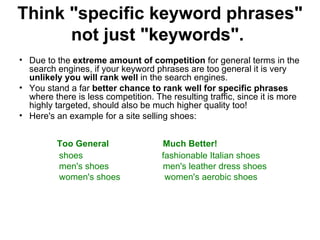
Think "specific keyword phrases" not just "keywords".   Due to the  extreme amount of competition  for general terms in the search engines, if your keyword phrases are too general it is very  unlikely you will rank well  in the search engines.  You stand a far  better chance to rank well for specific phrases  where there is less competition. The resulting traffic, since it is more highly targeted, should also be much higher quality too!  Here's an example for a site selling shoes: Too General  Much Better! shoes    fashionable Italian shoes  men's shoes  men's leather dress shoes women's shoes  women's aerobic shoes
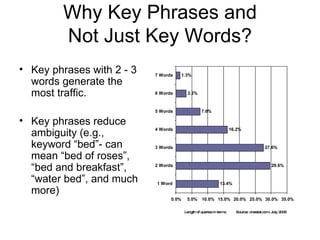
Why Key Phrases and Not Just Key Words? Key phrases with 2 - 3 words generate the most traffic. Key phrases reduce ambiguity (e.g., keyword “bed”- can mean “bed of roses”, “bed and breakfast”, “water bed”, and much more) Length of queries in terms  Source: onestat.com, July 2005
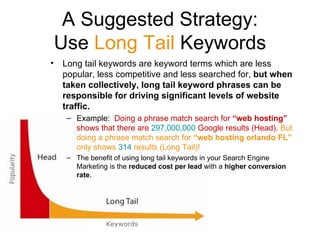
A Suggested Strategy: Use  Long Tail  Keywords Long tail keywords are keyword terms which are less popular, less competitive and less searched for,  but when taken collectively, long tail keyword phrases can be responsible for driving significant levels of website traffic.   Example:  Doing a phrase match search for  “web hosting”  shows that there are  297,000,000  Google results (Head).  But doing a phrase match search for  “web hosting orlando FL”  only shows  314  results (Long Tail)! The benefit of using long tail keywords in your Search Engine Marketing is the  reduced cost per lead  with a  higher conversion rate .
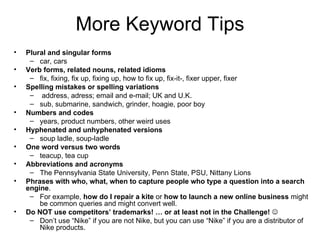
More Keyword Tips Plural and singular forms car, cars Verb forms, related nouns, related idioms   fix, fixing, fix up, fixing up, how to fix up, fix-it-, fixer upper, fixer Spelling mistakes or spelling variations   address, adress; email and e-mail; UK and U.K. sub, submarine, sandwich, grinder, hoagie, poor boy Numbers and codes   years, product numbers, other weird uses Hyphenated and unhyphenated versions   soup ladle, soup-ladle One word versus two words   teacup, tea cup Abbreviations and acronyms The Pennsylvania State University, Penn State, PSU, Nittany Lions Phrases with who, what, when to capture people who type a question into a search engine .  For example,  how do I repair a kite  or  how to launch a new online business  might be common queries and might convert well. Do NOT use competitors’ trademarks! … or at least not in the Challenge!    Don’t use “Nike” if you are not Nike, but you can use “Nike” if you are a distributor of Nike products.
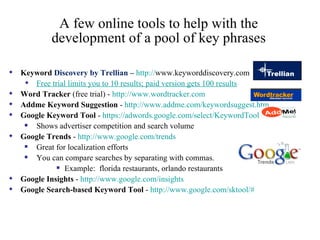
A few online tools to help with the development of a pool of key phrases Keyword  Discovery by Trellian –  http:// www.keyworddiscovery.com   Free trial limits you to 10 results; paid version gets 100 results Word Tracker  (free trial) -  http://www.wordtracker.com   Addme Keyword Suggestion  -  http:// www.addme.com/keywordsuggest.htm   Google Keyword Tool  -  https://adwords.google.com/select/KeywordTool   Shows advertiser competition and search volume Google Trends  -  http:// www.google.com /trends Great for localization efforts You can compare searches by separating with commas.  Example:  florida restaurants, orlando restaurants Google Insights  -  http://www.google.com/insights   Google Search-based Keyword Tool  -  http://www.google.com/sktool/#
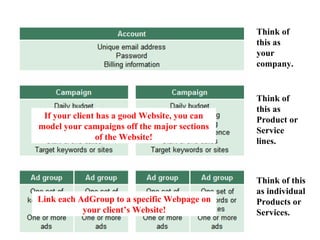
Think of this as Product or Service lines. Think of this as your company. Think of this as individual Products or Services. If your client has a good Website, you can model your campaigns off the major sections of the Website! Link each AdGroup to a specific Webpage on your client’s Website!
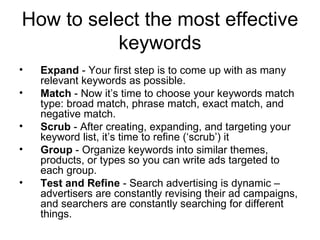
How to select the most effective keywords Expand  - Your first step is to come up with as many relevant keywords as possible. Match  - Now it’s time to choose your keywords match type: broad match, phrase match, exact match, and negative match. Scrub  - After creating, expanding, and targeting your keyword list, it’s time to refine (‘scrub’) it  Group  - Organize keywords into similar themes, products, or types so you can write ads targeted to each group.  Test and Refine  - Search advertising is dynamic – advertisers are constantly revising their ad campaigns, and searchers are constantly searching for different things.
Exercise for Designing an Effective Keyword Campaign The  team captain  sets up a campaign in AdWords (or use the one you did last class). Each  team member  creates an Ad Group for their theme (3 - 5 keywords or phrases; quick on the Ad). Or, use the one you did last class. When all team members are done, team members  individually  evaluate the other 4 Ad Group keyword list. List positives and negatives (best you write them down somewhere). Does each Ad Group fit with the overall campaign? – they should. Are the keywords logically grouped? – they should be. Are there duplicate keywords across Ad Groups? – there shouldn’t be). Discuss findings as a  team . (Team leader, note lessons learned for real campaign. … Be thinking about selecting an AdWords Coordinator for your team!) Once done with #4,  individually , correct issues with your Ad Group.
Exercise for Designing an Effective Keyword Campaign Individually , using your Ad Group, do: What is the estimated daily traffic for your Ad Group? What is an estimated daily cost for your Ad Group? (See Tools -> Traffic Estimator.) Add one broad match keyword. Add one match exact phrase. Add one exact match keyword. Add one phrase with a negative keyword. As a  team , what is the cost for running this campaign (i.e., all Ad Groups) for 21 days (based on the calculations in #2)? As a  team , work your account to a total spent of $9 per day (assume only this one campaign).
Thank you! (reminder to do your daily logs) Jim Jansen College of Information Sciences and Technology  The Pennsylvania State University  [email_address]

Lesson 07 Ist402 Keywords Take 02

  • 1.
    Keywords for YourCampaign Jim Jansen College of Information Sciences and Technology The Pennsylvania State University [email_address]
  • 2.
    Why is KeyPhrase Identification So Important? This is the most important step in successful Search Engine Marketing (SEM)! The keywords that you decide to target will be used throughout the entire SEM process  choosing the right keywords is essential . If you choose the wrong keywords you will not be found in the search engines. If you are not found in the search engines how will anyone find your site and buy your products? Everything else (i.e., campaign success, budget management, effective ads, etc.) depend on you being successful in the keyword phase!
  • 3.
    Think "specific keywordphrases" not just "keywords". Due to the extreme amount of competition for general terms in the search engines, if your keyword phrases are too general it is very unlikely you will rank well in the search engines. You stand a far better chance to rank well for specific phrases where there is less competition. The resulting traffic, since it is more highly targeted, should also be much higher quality too! Here's an example for a site selling shoes: Too General Much Better! shoes fashionable Italian shoes men's shoes men's leather dress shoes women's shoes women's aerobic shoes
  • 4.
    Why Key Phrasesand Not Just Key Words? Key phrases with 2 - 3 words generate the most traffic. Key phrases reduce ambiguity (e.g., keyword “bed”- can mean “bed of roses”, “bed and breakfast”, “water bed”, and much more) Length of queries in terms Source: onestat.com, July 2005
  • 5.
    A Suggested Strategy:Use Long Tail Keywords Long tail keywords are keyword terms which are less popular, less competitive and less searched for, but when taken collectively, long tail keyword phrases can be responsible for driving significant levels of website traffic. Example: Doing a phrase match search for “web hosting” shows that there are 297,000,000 Google results (Head). But doing a phrase match search for “web hosting orlando FL” only shows 314 results (Long Tail)! The benefit of using long tail keywords in your Search Engine Marketing is the reduced cost per lead with a higher conversion rate .
  • 6.
    More Keyword TipsPlural and singular forms car, cars Verb forms, related nouns, related idioms fix, fixing, fix up, fixing up, how to fix up, fix-it-, fixer upper, fixer Spelling mistakes or spelling variations address, adress; email and e-mail; UK and U.K. sub, submarine, sandwich, grinder, hoagie, poor boy Numbers and codes years, product numbers, other weird uses Hyphenated and unhyphenated versions soup ladle, soup-ladle One word versus two words teacup, tea cup Abbreviations and acronyms The Pennsylvania State University, Penn State, PSU, Nittany Lions Phrases with who, what, when to capture people who type a question into a search engine . For example, how do I repair a kite or how to launch a new online business might be common queries and might convert well. Do NOT use competitors’ trademarks! … or at least not in the Challenge!  Don’t use “Nike” if you are not Nike, but you can use “Nike” if you are a distributor of Nike products.
  • 7.
    A few onlinetools to help with the development of a pool of key phrases Keyword Discovery by Trellian – http:// www.keyworddiscovery.com Free trial limits you to 10 results; paid version gets 100 results Word Tracker (free trial) - http://www.wordtracker.com Addme Keyword Suggestion - http:// www.addme.com/keywordsuggest.htm Google Keyword Tool - https://adwords.google.com/select/KeywordTool Shows advertiser competition and search volume Google Trends - http:// www.google.com /trends Great for localization efforts You can compare searches by separating with commas. Example: florida restaurants, orlando restaurants Google Insights - http://www.google.com/insights Google Search-based Keyword Tool - http://www.google.com/sktool/#
  • 8.
    Think of thisas Product or Service lines. Think of this as your company. Think of this as individual Products or Services. If your client has a good Website, you can model your campaigns off the major sections of the Website! Link each AdGroup to a specific Webpage on your client’s Website!
  • 9.
    How to selectthe most effective keywords Expand - Your first step is to come up with as many relevant keywords as possible. Match - Now it’s time to choose your keywords match type: broad match, phrase match, exact match, and negative match. Scrub - After creating, expanding, and targeting your keyword list, it’s time to refine (‘scrub’) it Group - Organize keywords into similar themes, products, or types so you can write ads targeted to each group. Test and Refine - Search advertising is dynamic – advertisers are constantly revising their ad campaigns, and searchers are constantly searching for different things.
  • 10.
    Exercise for Designingan Effective Keyword Campaign The team captain sets up a campaign in AdWords (or use the one you did last class). Each team member creates an Ad Group for their theme (3 - 5 keywords or phrases; quick on the Ad). Or, use the one you did last class. When all team members are done, team members individually evaluate the other 4 Ad Group keyword list. List positives and negatives (best you write them down somewhere). Does each Ad Group fit with the overall campaign? – they should. Are the keywords logically grouped? – they should be. Are there duplicate keywords across Ad Groups? – there shouldn’t be). Discuss findings as a team . (Team leader, note lessons learned for real campaign. … Be thinking about selecting an AdWords Coordinator for your team!) Once done with #4, individually , correct issues with your Ad Group.
  • 11.
    Exercise for Designingan Effective Keyword Campaign Individually , using your Ad Group, do: What is the estimated daily traffic for your Ad Group? What is an estimated daily cost for your Ad Group? (See Tools -> Traffic Estimator.) Add one broad match keyword. Add one match exact phrase. Add one exact match keyword. Add one phrase with a negative keyword. As a team , what is the cost for running this campaign (i.e., all Ad Groups) for 21 days (based on the calculations in #2)? As a team , work your account to a total spent of $9 per day (assume only this one campaign).
  • 12.
    Thank you! (reminderto do your daily logs) Jim Jansen College of Information Sciences and Technology The Pennsylvania State University [email_address]

Editor's Notes

  • #6 Additional Resources on Long Tail: http://www.searchengineguide.com/matt-bailey/keyword-strategies-the-long-tail.php http://www.wilsonweb.com/paid-search/goodman-torso.htm
  • #7 Many common word and phrases, such as email (e-mail) and Web sites (websites) have legitimate alternate spellings. In the traditional print world, this ambiguity is tackled by consistency—you pick one spelling and stick to it. But on the Web, this is a rule you should break. Since you cannot control the spelling a searcher may use, anticipate them all. If you provide a "business to business" service, you'll want to express the phrase in its common aliases, including "business-to-business," "B-to-B," and "B2B." (Just as there are exceptions to rules, there are exceptions to breaking them: If your site's reputation rests on editorial quality, you may want to sacrifice some search engine optimization by sticking to consistent spellings and maintaining the integrity of your brand identity.) Print out your Web pages—or the drafts of the Web pages you intend to post—and grab a yellow highlighter. Mark every phrase that reeks of broad abstraction ("enterprise process solutions"), vague promises ("exceeding customer expectations") and empty boasting ("best in class services.") Now take a look at your page. Good copy should have very few, if any, streaks of yellow. Bad copy will look like a field of dandelions. Pull the weeds. Replace all the yellow copy with specific promises, facts, benefits, features and other pieces of concrete evidence that can support your causes and claims. You might transform the previous parenthetical examples thus: "enterprise process solutions" becomes "browser-based manufacturing and inventory control"; "exceeding customer expectations" becomes "a 30% decrease in material waste in just 60 days, guaranteed"; and "best in class services" becomes "recognized as the industry standard by the Institute for Chemical Forensics."