



Networked Consumers:
How networked and how important?


              Jim Jansen
             Senior Fellow
  Pew Internet & American Life Project
Thanks!
Who’s Jim Jansen?
• Senior Fellow at the Pew Research Center (Pew Internet
  & American Life Project) - http://www.pewinternet.org
• Associate professor at College of Information Sciences
  and Technology, The Pennsylvania State University, USA
• Active research and teaching efforts in the web searching
  area - http://ist.psu.edu/faculty_pages/jjansen/
• New book, Understanding Sponsored Search (Cambridge
  University Press) … theory of keyword advertising
• Recent Pew Internet reports focusing on purchasing
  digital content, income effect on internet usage, online
  product research, religious and their technology.
• Academic Panelist for The Google Online Marketing
  Challenge
What is Pew Internet?
• Part of the Pew Research Center
• A nonpartisan ‘fact tank’ based in
  Washington, DC
• Provide quality and objective data
  to thought leaders and policy
  makers
• Pew Internet & American Life is
  one project of the Center
• All findings are based on
  nationally representative
  telephone surveys …
   – U.S. adults age 18+ or U.S. teens ages 12-
     17
   – Drawn from dual-frame (landline/cell
     phone) samples
   – English or English and Spanish
Are consumers really networked?
• Yes, they are …
In fact, ….
• 71% of online adults now use video-sharing
  sites (e.g., YouTube)
• 66% of online adults use social networking
  sites (e.g., Facebook, LinkedIn)
• 58% of Americans with smart phones use
  mobile and social location-based services
  (e.g., FourSquare)
•  the networked consumer is engaged, via
  technology, with the ‘offline’ world (getting
  harder to separate offline from online)
Is this important?
• Yes, it is …
In fact, ….
 • 95% of those earning $75,000 or more a year
   use the internet at least occasionally,
   compared with 70% for those earning less
   than $75,000.
 • 88% of those earning $75,000 or more a year
   conduct online product research compared to
   58% for the overall internet population

There is a positive correlation between income and …  use of the web, use
of the internet, and ownership of electronic devices.
                     The more income = more networked.
Before we look at the details, …
• Let’s examine the context in which this is
  occurring.
• There are three on-going revolutions in
  technology and access …
#1 Internet and
Broadband Revolution


                       10
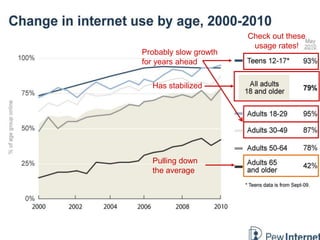
Check out these
                        usage rates!
Probably slow growth
for years ahead

  Has stabilized


  Pulling down
  the average
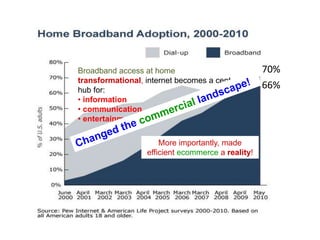
Broadband access at home                           70%
transformational, internet becomes a central
hub for:
                                                   66%
• information
• communication
• entertainment


                      More importantly, made
                  efficient ecommerce a reality!
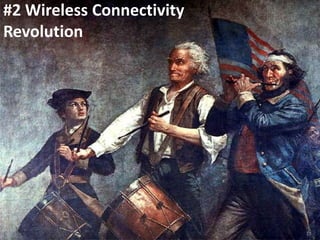
#2 Wireless Connectivity
Revolution


                           13
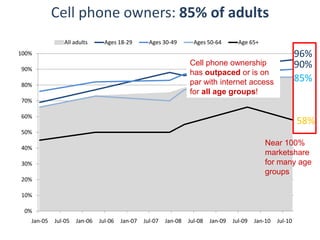
Cell phone owners: 85% of adults
               All adults       Ages 18-29        Ages 30-49        Ages 50-64        Age 65+
100%                                                                                                           96%
90%
                                                                  Cell phone ownership                         90%
                                                                  has outpaced or is on
                                                                  par with internet access                     85%
80%
                                                                  for all age groups!
70%

60%
                                                                                                               58%
50%
                                                                                                Near 100%
40%
                                                                                                marketshare
30%                                                                                             for many age
                                                                                                groups
20%

10%

 0%
   Jan-05   Jul-05   Jan-06   Jul-06   Jan-07   Jul-07   Jan-08   Jul-08   Jan-09   Jul-09   Jan-10   Jul-10
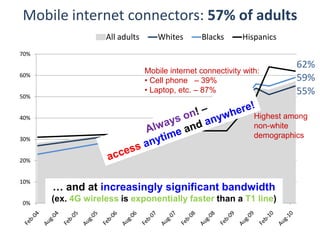
Mobile internet connectors: 57% of adults
                   All adults      Whites       Blacks      Hispanics
70%
                                                                          62%
60%
                                Mobile internet connectivity with:
                                • Cell phone – 39%                        59%
                                • Laptop, etc. – 87%                      55%
50%


40%                                                             Highest among
                                                                non-white
30%
                                                                demographics


20%


10%
      … and at increasingly significant bandwidth
0%
      (ex. 4G wireless is exponentially faster than a T1 line)
#3 Social Networking
     Revolution


                       16
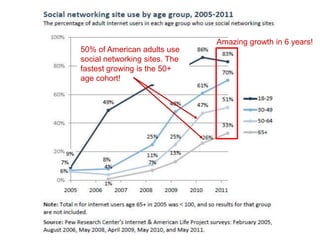
Amazing growth in 6 years!
50% of American adults use
social networking sites. The
fastest growing is the 50+
age cohort!
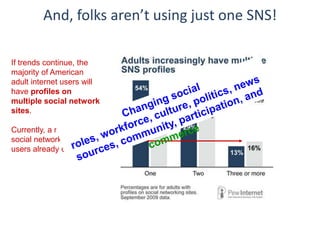
And, folks aren’t using just one SNS!

If trends continue, the
majority of American
adult internet users will
have profiles on
multiple social network
sites.

Currently, a majority of
social networking site
users already do (52%).
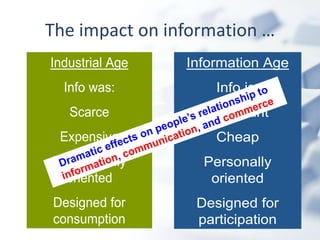
The impact on information …
Industrial Age    Information Age
  Info was:           Info is:
   Scarce           Abundant
 Expensive            Cheap
Institutionally     Personally
   oriented          oriented
Designed for       Designed for
consumption        participation
So, what does this mean for networked
             consumer?
This is what we are seeing …
Snapshot of the networked consumer

• 79% of American adults use the internet
• Half of adults (50%) or 66% of internet
  users, say they use at least one social
  network site (92% use Facebook)
• Half of all adult cell owners (51%) use
  their phone to access information
• 92% of smart phone users send or
  receive text messages
The networked consumer: cell phones

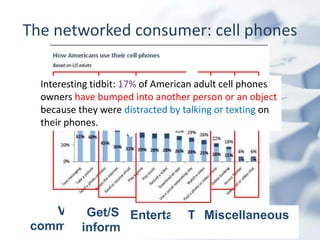
  Interesting tidbit: 17% of American adult cell phones
  owners have bumped into another person or an object
  because they were distracted by talking or texting on
  their phones.


   Visual
        Get/Share
               Entertainment
                        Transacting
                           Miscellaneous
communication
       information
Social media and the networked consumer
 • 66% of online American adults use social
   media platforms (Facebook, Twitter, etc.)
 • 43% of online adults use social media
   sites use on a typical day. Only email
   (61%) and search engines (59%) are used
   more frequently.
 • Social media sites most popular with
   women (69%) and adults under
   30, especially those 18-29 (83%)
The State of Online Shopping
         • 58% of Americans perform online research concerning
           the products and services that they are considering
           purchasing
         • 21% of Americans do research about products on any
           given day
         • 78% of American internet users, at least occasionally
           conduct online product research
         • 74% of American internet users have bought products
           such as books, music, toys or clothing online
         • 74% American internet users have made travel
           reservations or bought travel services such airline tickets,
           hotel rooms, or rental cars
         • a              lot business online!
Source: Jansen, B.J. (2010) Online Product Research. 29 September 2010. Pew Research Center. Available at http://pewinternet.org/Reports/2010/Online-Product-Research.aspx
Purchasing Online Content (i.e.,
          bits vs atoms)
• 65% of internet users have paid for online
  content and they spend about $10 per month
What do we mean by online content?
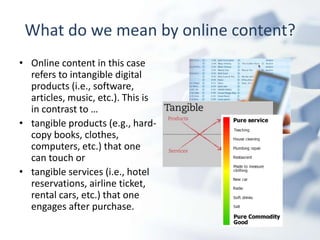
• Online content in this case
  refers to intangible digital
  products (i.e., software,
  articles, music, etc.). This is
  in contrast to …
• tangible products (e.g., hard-
  copy books, clothes,
  computers, etc.) that one
  can touch or
• tangible services (i.e., hotel
  reservations, airline ticket,
  rental cars, etc.) that one
  engages after purchase.
Breakdown by type of content
                                Music and software
High of 33% •   33% of internet users have paid for digital music online
            •   33% have paid Apps. Games, and Articles
                                for software
            •   21% have paid for apps for their cell phones or tablet computers
            •   19% have paid for digital games
            •   18% have paid for digital newspaper, magazine, or journal articles
                or reports          Videos and Ringtones
            •   16% have paid for videos, movies, or TV shows
            •   15% have paid for ringtones content, and e-books
                           Photos, Premium
            •   12% have paid for digital photos
            •   11% have paid for members-only premium content from a website
                that has other free material on it
            •   10% have paid for Stuff for Games, and Services
                        Podcasts, e-books
            •   7% have paid for podcasts
            •   5% have paid for virtual items to use in video or computer games
            •   5% have paid for “cheats or codes” to help them in video games
            •   5% have paid to access particular websites such as online dating
                sites or services            Porn
Low of 2%   •   2% have paid for adult content
Information on Local Businesses
• Some 55% of adults say they get news
  and information about local
  restaurants, bars, and clubs.
• 51% use the internet, including:
  – 38% use search engines
  – 17% use specialty websites
  – 3% use social networking sites
• 47% use the internet for news & information
  about other types of local businesses
Take Aways
• Technology and access is changing (has
  changed) the value, dissemination, and
  relationship attributes of information
• The networked consumer is leveraging
  technology, especially social, to engage with
  the physical world.
• Near majorities of American adults are now
  (or soon will be) networked consumers. For
  some networked activities and consumer
  demographic groups, near saturation levels.
Follow-on Discussion
•   Happy to chat (either today or contact me)
•   Email jjansen@acm.org
•   LinkedIn http://www.linkedin.com/in/jjansen
•   Twitter jimjansen
Related Reports Available at Pew Internet

• Use of the internet in higher-income households
  http://www.pewinternet.org/Reports/2010/Better-off-households.aspx

• Online product research
  http://www.pewinternet.org/Reports/2010/Online-Product-Research.aspx

• Generations and their gadgets
  http://www.pewinternet.org/Reports/2011/Generations-and-gadgets.aspx

• Adults and cell phone distractions
  http://www.pewinternet.org/Reports/2010/Cell-Phone-
  Distractions/Major-Findings/5-Bumping-into-people-and-objects.aspx

• Generations 2010
  http://www.pewinternet.org/Reports/2010/Generations-2010.aspx
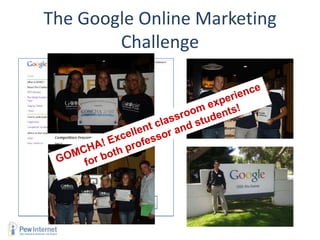
The Google Online Marketing
        Challenge
Thanks!
     (welcome questions!)
Consumers are increasingly networked
  … and it’s increasingly important!

              Jim Jansen
             Senior Fellow
  Pew Internet & American Life Project

Networked Consumers: How networked and how important?

  • 1.
    Networked Consumers: How networkedand how important? Jim Jansen Senior Fellow Pew Internet & American Life Project
  • 2.
  • 3.
    Who’s Jim Jansen? •Senior Fellow at the Pew Research Center (Pew Internet & American Life Project) - http://www.pewinternet.org • Associate professor at College of Information Sciences and Technology, The Pennsylvania State University, USA • Active research and teaching efforts in the web searching area - http://ist.psu.edu/faculty_pages/jjansen/ • New book, Understanding Sponsored Search (Cambridge University Press) … theory of keyword advertising • Recent Pew Internet reports focusing on purchasing digital content, income effect on internet usage, online product research, religious and their technology. • Academic Panelist for The Google Online Marketing Challenge
  • 4.
    What is PewInternet? • Part of the Pew Research Center • A nonpartisan ‘fact tank’ based in Washington, DC • Provide quality and objective data to thought leaders and policy makers • Pew Internet & American Life is one project of the Center • All findings are based on nationally representative telephone surveys … – U.S. adults age 18+ or U.S. teens ages 12- 17 – Drawn from dual-frame (landline/cell phone) samples – English or English and Spanish
  • 5.
    Are consumers reallynetworked? • Yes, they are …
  • 6.
    In fact, …. •71% of online adults now use video-sharing sites (e.g., YouTube) • 66% of online adults use social networking sites (e.g., Facebook, LinkedIn) • 58% of Americans with smart phones use mobile and social location-based services (e.g., FourSquare) •  the networked consumer is engaged, via technology, with the ‘offline’ world (getting harder to separate offline from online)
  • 7.
    Is this important? •Yes, it is …
  • 8.
    In fact, …. • 95% of those earning $75,000 or more a year use the internet at least occasionally, compared with 70% for those earning less than $75,000. • 88% of those earning $75,000 or more a year conduct online product research compared to 58% for the overall internet population There is a positive correlation between income and …  use of the web, use of the internet, and ownership of electronic devices. The more income = more networked.
  • 9.
    Before we lookat the details, … • Let’s examine the context in which this is occurring. • There are three on-going revolutions in technology and access …
  • 10.
  • 11.
    Check out these usage rates! Probably slow growth for years ahead Has stabilized Pulling down the average
  • 12.
    Broadband access athome 70% transformational, internet becomes a central hub for: 66% • information • communication • entertainment More importantly, made efficient ecommerce a reality!
  • 13.
  • 14.
    Cell phone owners:85% of adults All adults Ages 18-29 Ages 30-49 Ages 50-64 Age 65+ 100% 96% 90% Cell phone ownership 90% has outpaced or is on par with internet access 85% 80% for all age groups! 70% 60% 58% 50% Near 100% 40% marketshare 30% for many age groups 20% 10% 0% Jan-05 Jul-05 Jan-06 Jul-06 Jan-07 Jul-07 Jan-08 Jul-08 Jan-09 Jul-09 Jan-10 Jul-10
  • 15.
    Mobile internet connectors:57% of adults All adults Whites Blacks Hispanics 70% 62% 60% Mobile internet connectivity with: • Cell phone – 39% 59% • Laptop, etc. – 87% 55% 50% 40% Highest among non-white 30% demographics 20% 10% … and at increasingly significant bandwidth 0% (ex. 4G wireless is exponentially faster than a T1 line)
  • 16.
    #3 Social Networking Revolution 16
  • 17.
    Amazing growth in6 years! 50% of American adults use social networking sites. The fastest growing is the 50+ age cohort!
  • 18.
    And, folks aren’tusing just one SNS! If trends continue, the majority of American adult internet users will have profiles on multiple social network sites. Currently, a majority of social networking site users already do (52%).
  • 19.
    The impact oninformation … Industrial Age Information Age Info was: Info is: Scarce Abundant Expensive Cheap Institutionally Personally oriented oriented Designed for Designed for consumption participation
  • 20.
    So, what doesthis mean for networked consumer? This is what we are seeing …
  • 21.
    Snapshot of thenetworked consumer • 79% of American adults use the internet • Half of adults (50%) or 66% of internet users, say they use at least one social network site (92% use Facebook) • Half of all adult cell owners (51%) use their phone to access information • 92% of smart phone users send or receive text messages
  • 22.
    The networked consumer:cell phones Interesting tidbit: 17% of American adult cell phones owners have bumped into another person or an object because they were distracted by talking or texting on their phones. Visual Get/Share Entertainment Transacting Miscellaneous communication information
  • 23.
    Social media andthe networked consumer • 66% of online American adults use social media platforms (Facebook, Twitter, etc.) • 43% of online adults use social media sites use on a typical day. Only email (61%) and search engines (59%) are used more frequently. • Social media sites most popular with women (69%) and adults under 30, especially those 18-29 (83%)
  • 24.
    The State ofOnline Shopping • 58% of Americans perform online research concerning the products and services that they are considering purchasing • 21% of Americans do research about products on any given day • 78% of American internet users, at least occasionally conduct online product research • 74% of American internet users have bought products such as books, music, toys or clothing online • 74% American internet users have made travel reservations or bought travel services such airline tickets, hotel rooms, or rental cars • a lot business online! Source: Jansen, B.J. (2010) Online Product Research. 29 September 2010. Pew Research Center. Available at http://pewinternet.org/Reports/2010/Online-Product-Research.aspx
  • 25.
    Purchasing Online Content(i.e., bits vs atoms) • 65% of internet users have paid for online content and they spend about $10 per month
  • 26.
    What do wemean by online content? • Online content in this case refers to intangible digital products (i.e., software, articles, music, etc.). This is in contrast to … • tangible products (e.g., hard- copy books, clothes, computers, etc.) that one can touch or • tangible services (i.e., hotel reservations, airline ticket, rental cars, etc.) that one engages after purchase.
  • 27.
    Breakdown by typeof content Music and software High of 33% • 33% of internet users have paid for digital music online • 33% have paid Apps. Games, and Articles for software • 21% have paid for apps for their cell phones or tablet computers • 19% have paid for digital games • 18% have paid for digital newspaper, magazine, or journal articles or reports Videos and Ringtones • 16% have paid for videos, movies, or TV shows • 15% have paid for ringtones content, and e-books Photos, Premium • 12% have paid for digital photos • 11% have paid for members-only premium content from a website that has other free material on it • 10% have paid for Stuff for Games, and Services Podcasts, e-books • 7% have paid for podcasts • 5% have paid for virtual items to use in video or computer games • 5% have paid for “cheats or codes” to help them in video games • 5% have paid to access particular websites such as online dating sites or services Porn Low of 2% • 2% have paid for adult content
  • 28.
    Information on LocalBusinesses • Some 55% of adults say they get news and information about local restaurants, bars, and clubs. • 51% use the internet, including: – 38% use search engines – 17% use specialty websites – 3% use social networking sites • 47% use the internet for news & information about other types of local businesses
  • 29.
    Take Aways • Technologyand access is changing (has changed) the value, dissemination, and relationship attributes of information • The networked consumer is leveraging technology, especially social, to engage with the physical world. • Near majorities of American adults are now (or soon will be) networked consumers. For some networked activities and consumer demographic groups, near saturation levels.
  • 30.
    Follow-on Discussion • Happy to chat (either today or contact me) • Email jjansen@acm.org • LinkedIn http://www.linkedin.com/in/jjansen • Twitter jimjansen
  • 31.
    Related Reports Availableat Pew Internet • Use of the internet in higher-income households http://www.pewinternet.org/Reports/2010/Better-off-households.aspx • Online product research http://www.pewinternet.org/Reports/2010/Online-Product-Research.aspx • Generations and their gadgets http://www.pewinternet.org/Reports/2011/Generations-and-gadgets.aspx • Adults and cell phone distractions http://www.pewinternet.org/Reports/2010/Cell-Phone- Distractions/Major-Findings/5-Bumping-into-people-and-objects.aspx • Generations 2010 http://www.pewinternet.org/Reports/2010/Generations-2010.aspx
  • 32.
    The Google OnlineMarketing Challenge
  • 33.
    Thanks! (welcome questions!) Consumers are increasingly networked … and it’s increasingly important! Jim Jansen Senior Fellow Pew Internet & American Life Project

Editor's Notes

  • #13 Rise of broadband at home was transformative – internet becomes a central info and communications hub in the home after the switch from dial-up. People do more stuff online; privilege the internet over other info sources in many cases; report better outcomes from internet use, and, most importantly become content creators. Two thirds of adults and 80% of teens are content creators. This is the big change the internet has introduced to media landscape. Probably take a minute to say this.
  • #15 Quick rundown of growth of cell ownership – 30 seconds
  • #16 Rundown of mobile connectivity Cell phones – 39% of cell owners Laptops – 87% of laptop ownersOverall that adds up to 57% of adults
  • #18 Quick rundown of our data on rise of social networking. This amplifies long term trends dating to 20th century in technology, new social roles, workforce structure, politics and culture. Right now, 48% of American adults use social networking sites and fastest growth is taking place in the 50+ age cohort