Ads Jim Jansen College of Information Sciences and Technology  The Pennsylvania State University  [email_address]
Pre-Campaign Strategy Maximum four pages Pre-Campaign Strategy - Two components   Client Overview AdWords Strategy Written Reports – review pages 14 – 18  Student Text Need to review and make a check list – review your Pre-campaign Strategy report item by item.
Structure of Pre-Campaign Strategy Client Overview (approximately 2 pages) Client profile Market analysis Current marketing Conclusion AdWords Strategy (approximately 2 pages)
Client Overview (Pre-Campaign Strategy) Provides a brief overview of the client and their marketing Serves as a foundation for the proposed AdWords Strategy.
Client Overview Part 01  (Pre-Campaign Strategy) Client profile (a few sentences including some of the following)  Name, location  Sales and number of employees  Goods and services offered  Key online marketing personnel  Age of the company URL Website age, website management  Company presence and sales via online and offline channels Other relevant information
Client Overview Part 02  (Pre-Campaign Strategy) Market analysis (a couple of paragraphs including some of the following) Current and potential customers  Current and potential competitors  Overview of the industry (key characteristics, competitive/saturated/mature)  Projected and historical online spend for the industry  Market position/specialties  Unique selling points of the goods/services offered Seasonality of their goods/services or seasonality that the company has identified Other relevant market information
Client Overview Part 03  (Pre-Campaign Strategy) Current marketing (a couple of paragraphs including some of the following) Website uses, e.g. sales, customer service  Website strengths and weaknesses  Website visibility, such as Google PageRank, incoming links, a few keyword search results, online advertising, and offline promotion of the url.  If available, summary information from Google Analytics or other third party web tracking software  Email campaigns  Offline advertising Other online or offline marketing
Client Overview Part 04  (Pre-Campaign Strategy) Conclusion on how the Ad Words campaign should align with the client’s business (a few sentences)
Ad Words Strategy  (Pre-Campaign Strategy) About two pages including  sample ads  and  keywords Based on an analysis of the client, their Website and their marketing, teams should craft an appropriate AdWords Strategy and metrics for their campaign.
Ad Words Strategy  (Pre-Campaign Strategy) The AdWords Strategy should include: Number of Ad Groups and the focus for each Ad Group  Keywords and negative keywords  Text for at least two AdWords versions for some Ad Groups  Daily and weekly plans for spending their campaign budget Network(s) for their AdWords ads Target audience settings  Ad Serving options  Keyword Bidding  Geotargeting  Goals for impressions, clicks, CPC and CTR  Proposed success metrics Other relevant information
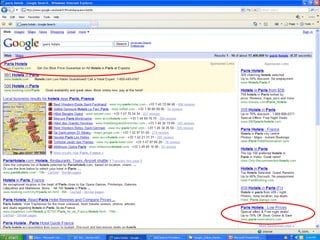
Keyword Advertising Exercise Individually, think of a product that you would like to purchase. Go to Google and search for this product. Review the first couple results pages. Find an AdWords ad that you believe is well written. Be prepared to discuss why. Find an AdWords ad that you believe is not well written. Be prepared to discuss why. You have 10 minutes. Begin
Writing Key Words Ads Your ad has three goals, which are: Generating clicks from potential customers Discouraging clicks from unlikely customers Setting customer expectations for the landing page (i.e., want a positive customer experience)
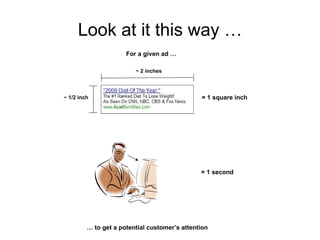
Look at it this way … …  to get a potential customer’s attention ~ 2 inches ~ 1/2 inch = 1 square inch = 1 second For a given ad …
Writing Key Words Ads You get 4 lines of 25, 35, 35, and 35 characters Line 1 (headline): Make the  potential customer  read the second and third lines Line 2 and 3: Set expectations for what is on the landing page Line 4: Points to a relevant landing page and establishes trust
 
Successful Keyword Advertising Clear and well written. Keywords in the title. An action verb (i.e., a call to action). Include some details (i.e. price, sales, etc.). Capitalize keywords in the URL (i.e., www.JimJansen.com). Choose destination URL that points to good landing page.
Keyword Advertising Exercise Select the top 5 keywords one AdGroup from your account Search on Google and analyze the competition’s ads. (reminder of Ad Diagnostic in AdWords) Things to look for: structure, tone, promise, variation, features, price, trust, and call to action. Discuss with your teammates: How will you make your ads  different  and  better ? You have 20 minutes. Begin
What to do next? Before class on Monday 23 February: your pre-campaign report uploaded to ANGEL dropbox in Lesson 12. your AdWords account set with multiple Campaigns, AdGroups for each Campaign, keywords and ads for each AdGroup. Reasonable traffic and budget. We will have guest speakers from IMPAQT (the PA company who is sponsoring our $1,000 competition). Be polite (i.e., on time, off the computers, pay attention, ask questions, etc.)! Valuable time so use it!
Thank you! (reminder to do your daily logs) Jim Jansen College of Information Sciences and Technology  The Pennsylvania State University  [email_address]

Lesson 11 Writing Good Ads

  • 1.
    Ads Jim JansenCollege of Information Sciences and Technology The Pennsylvania State University [email_address]
  • 2.
    Pre-Campaign Strategy Maximumfour pages Pre-Campaign Strategy - Two components Client Overview AdWords Strategy Written Reports – review pages 14 – 18 Student Text Need to review and make a check list – review your Pre-campaign Strategy report item by item.
  • 3.
    Structure of Pre-CampaignStrategy Client Overview (approximately 2 pages) Client profile Market analysis Current marketing Conclusion AdWords Strategy (approximately 2 pages)
  • 4.
    Client Overview (Pre-CampaignStrategy) Provides a brief overview of the client and their marketing Serves as a foundation for the proposed AdWords Strategy.
  • 5.
    Client Overview Part01 (Pre-Campaign Strategy) Client profile (a few sentences including some of the following) Name, location Sales and number of employees Goods and services offered Key online marketing personnel Age of the company URL Website age, website management Company presence and sales via online and offline channels Other relevant information
  • 6.
    Client Overview Part02 (Pre-Campaign Strategy) Market analysis (a couple of paragraphs including some of the following) Current and potential customers Current and potential competitors Overview of the industry (key characteristics, competitive/saturated/mature) Projected and historical online spend for the industry Market position/specialties Unique selling points of the goods/services offered Seasonality of their goods/services or seasonality that the company has identified Other relevant market information
  • 7.
    Client Overview Part03 (Pre-Campaign Strategy) Current marketing (a couple of paragraphs including some of the following) Website uses, e.g. sales, customer service Website strengths and weaknesses Website visibility, such as Google PageRank, incoming links, a few keyword search results, online advertising, and offline promotion of the url. If available, summary information from Google Analytics or other third party web tracking software Email campaigns Offline advertising Other online or offline marketing
  • 8.
    Client Overview Part04 (Pre-Campaign Strategy) Conclusion on how the Ad Words campaign should align with the client’s business (a few sentences)
  • 9.
    Ad Words Strategy (Pre-Campaign Strategy) About two pages including sample ads and keywords Based on an analysis of the client, their Website and their marketing, teams should craft an appropriate AdWords Strategy and metrics for their campaign.
  • 10.
    Ad Words Strategy (Pre-Campaign Strategy) The AdWords Strategy should include: Number of Ad Groups and the focus for each Ad Group Keywords and negative keywords Text for at least two AdWords versions for some Ad Groups Daily and weekly plans for spending their campaign budget Network(s) for their AdWords ads Target audience settings Ad Serving options Keyword Bidding Geotargeting Goals for impressions, clicks, CPC and CTR Proposed success metrics Other relevant information
  • 11.
    Keyword Advertising ExerciseIndividually, think of a product that you would like to purchase. Go to Google and search for this product. Review the first couple results pages. Find an AdWords ad that you believe is well written. Be prepared to discuss why. Find an AdWords ad that you believe is not well written. Be prepared to discuss why. You have 10 minutes. Begin
  • 12.
    Writing Key WordsAds Your ad has three goals, which are: Generating clicks from potential customers Discouraging clicks from unlikely customers Setting customer expectations for the landing page (i.e., want a positive customer experience)
  • 13.
    Look at itthis way … … to get a potential customer’s attention ~ 2 inches ~ 1/2 inch = 1 square inch = 1 second For a given ad …
  • 14.
    Writing Key WordsAds You get 4 lines of 25, 35, 35, and 35 characters Line 1 (headline): Make the potential customer read the second and third lines Line 2 and 3: Set expectations for what is on the landing page Line 4: Points to a relevant landing page and establishes trust
  • 15.
  • 16.
    Successful Keyword AdvertisingClear and well written. Keywords in the title. An action verb (i.e., a call to action). Include some details (i.e. price, sales, etc.). Capitalize keywords in the URL (i.e., www.JimJansen.com). Choose destination URL that points to good landing page.
  • 17.
    Keyword Advertising ExerciseSelect the top 5 keywords one AdGroup from your account Search on Google and analyze the competition’s ads. (reminder of Ad Diagnostic in AdWords) Things to look for: structure, tone, promise, variation, features, price, trust, and call to action. Discuss with your teammates: How will you make your ads different and better ? You have 20 minutes. Begin
  • 18.
    What to donext? Before class on Monday 23 February: your pre-campaign report uploaded to ANGEL dropbox in Lesson 12. your AdWords account set with multiple Campaigns, AdGroups for each Campaign, keywords and ads for each AdGroup. Reasonable traffic and budget. We will have guest speakers from IMPAQT (the PA company who is sponsoring our $1,000 competition). Be polite (i.e., on time, off the computers, pay attention, ask questions, etc.)! Valuable time so use it!
  • 19.
    Thank you! (reminderto do your daily logs) Jim Jansen College of Information Sciences and Technology The Pennsylvania State University [email_address]

Editor's Notes

  • #3 So what did we actually decide on? We didn’t want to solely look at performance so we ended up incorporating 30 different signals within 5 distinct categories. Performance, as discussed earlier. Account structure Tool and feature usage Advertiser savviness Budget management To come up w/ the final list, we worked closely with focus groups consisting of AdWords Optimizers, Managers and Engineers and determined the ideal mix of signals, thresholds and weights based on their feedback. We then validated and refined the initial algorithm using Beta competition groups that started before the actual challenge. And based on qualitative rankings of those accounts, we fine-tuned and measured the performance of the algorithm.
  • #4 So what did we actually decide on? We didn’t want to solely look at performance so we ended up incorporating 30 different signals within 5 distinct categories. Performance, as discussed earlier. Account structure Tool and feature usage Advertiser savviness Budget management To come up w/ the final list, we worked closely with focus groups consisting of AdWords Optimizers, Managers and Engineers and determined the ideal mix of signals, thresholds and weights based on their feedback. We then validated and refined the initial algorithm using Beta competition groups that started before the actual challenge. And based on qualitative rankings of those accounts, we fine-tuned and measured the performance of the algorithm.
  • #5 So what did we actually decide on? We didn’t want to solely look at performance so we ended up incorporating 30 different signals within 5 distinct categories. Performance, as discussed earlier. Account structure Tool and feature usage Advertiser savviness Budget management To come up w/ the final list, we worked closely with focus groups consisting of AdWords Optimizers, Managers and Engineers and determined the ideal mix of signals, thresholds and weights based on their feedback. We then validated and refined the initial algorithm using Beta competition groups that started before the actual challenge. And based on qualitative rankings of those accounts, we fine-tuned and measured the performance of the algorithm.
  • #6 So what did we actually decide on? We didn’t want to solely look at performance so we ended up incorporating 30 different signals within 5 distinct categories. Performance, as discussed earlier. Account structure Tool and feature usage Advertiser savviness Budget management To come up w/ the final list, we worked closely with focus groups consisting of AdWords Optimizers, Managers and Engineers and determined the ideal mix of signals, thresholds and weights based on their feedback. We then validated and refined the initial algorithm using Beta competition groups that started before the actual challenge. And based on qualitative rankings of those accounts, we fine-tuned and measured the performance of the algorithm.
  • #7 So what did we actually decide on? We didn’t want to solely look at performance so we ended up incorporating 30 different signals within 5 distinct categories. Performance, as discussed earlier. Account structure Tool and feature usage Advertiser savviness Budget management To come up w/ the final list, we worked closely with focus groups consisting of AdWords Optimizers, Managers and Engineers and determined the ideal mix of signals, thresholds and weights based on their feedback. We then validated and refined the initial algorithm using Beta competition groups that started before the actual challenge. And based on qualitative rankings of those accounts, we fine-tuned and measured the performance of the algorithm.
  • #8 So what did we actually decide on? We didn’t want to solely look at performance so we ended up incorporating 30 different signals within 5 distinct categories. Performance, as discussed earlier. Account structure Tool and feature usage Advertiser savviness Budget management To come up w/ the final list, we worked closely with focus groups consisting of AdWords Optimizers, Managers and Engineers and determined the ideal mix of signals, thresholds and weights based on their feedback. We then validated and refined the initial algorithm using Beta competition groups that started before the actual challenge. And based on qualitative rankings of those accounts, we fine-tuned and measured the performance of the algorithm.
  • #9 So what did we actually decide on? We didn’t want to solely look at performance so we ended up incorporating 30 different signals within 5 distinct categories. Performance, as discussed earlier. Account structure Tool and feature usage Advertiser savviness Budget management To come up w/ the final list, we worked closely with focus groups consisting of AdWords Optimizers, Managers and Engineers and determined the ideal mix of signals, thresholds and weights based on their feedback. We then validated and refined the initial algorithm using Beta competition groups that started before the actual challenge. And based on qualitative rankings of those accounts, we fine-tuned and measured the performance of the algorithm.
  • #10 So what did we actually decide on? We didn’t want to solely look at performance so we ended up incorporating 30 different signals within 5 distinct categories. Performance, as discussed earlier. Account structure Tool and feature usage Advertiser savviness Budget management To come up w/ the final list, we worked closely with focus groups consisting of AdWords Optimizers, Managers and Engineers and determined the ideal mix of signals, thresholds and weights based on their feedback. We then validated and refined the initial algorithm using Beta competition groups that started before the actual challenge. And based on qualitative rankings of those accounts, we fine-tuned and measured the performance of the algorithm.
  • #11 So what did we actually decide on? We didn’t want to solely look at performance so we ended up incorporating 30 different signals within 5 distinct categories. Performance, as discussed earlier. Account structure Tool and feature usage Advertiser savviness Budget management To come up w/ the final list, we worked closely with focus groups consisting of AdWords Optimizers, Managers and Engineers and determined the ideal mix of signals, thresholds and weights based on their feedback. We then validated and refined the initial algorithm using Beta competition groups that started before the actual challenge. And based on qualitative rankings of those accounts, we fine-tuned and measured the performance of the algorithm.