The Quiz! 1. What is a visitor to your Website worth? 2. When a visitor comes to your Website, what do you want them to do? Each visitor has both potential costs and benefits – dollarize each visit! The goal of each visit is some type of convert.
The Quiz! 3. How would a potential visitor find your Website? 4. What would bring a potential visitor to your Website? 75 percent of people use search engines as an entry point (Nielsen) Expression of a need - informational, navigational, transactional. (Broder 2000)
The Quiz! 5. What sites are your Website’s competitors? These sites are also dollarizing each visit, trying to convert each visitor, leveraging search, and trying to bring visitors to their Website! Part of your overall campaign to achieve these goals should be  sponsored search (a.k.a, keyword advertising) !
Sponsored Search   Jim Jansen College of Information Sciences and Technology  The Pennsylvania State University  [email_address]
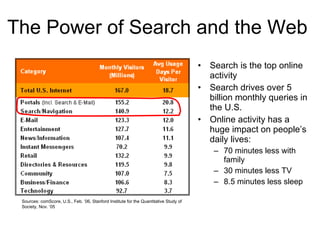
The Power of Search and the Web  Search is the top online activity Search drives over 5 billion monthly queries in the U.S. Online activity has a huge impact on people’s daily lives: 70 minutes less with family 30 minutes less TV 8.5 minutes less sleep Sources: comScore, U.S., Feb. ’06, Stanford Institute for the Quantitative Study of Society, Nov. ‘05
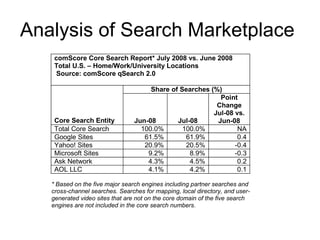
Analysis of Search Marketplace
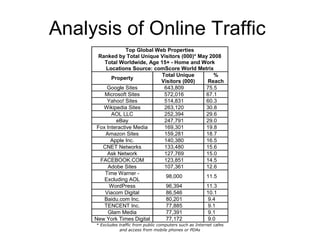
Analysis of Online Traffic
The Power of Sponsored Search  Online advertising $ are increasing faster than any other medium . The search model is aligned with the consumer need – pull vs push  Lowest acquisition cost of any medium – online or offline Low barriers to entry – cost, bias, knowledge
Sponsored Search Web search engines require significant revenue streams!  to support the free access that these search engines provide every day to millions of customers.  Primary business model for these search engines is sponsored links, which entities pay for.  These sponsored links appear on search engine results pages when users enter certain key phrases as queries.  The search engines provide the overall mechanism for this sponsored search process to occur.  Sponsored search is a multi-billion industry. AOL, Google, and Yahoo! receive substantial portions of their revenue from sponsored search.
Analysis of Online Advertising Keyword advertising, the fastest growing advertising medium.  Revenue base for major search engines such as Google and Yahoo!, as well as many content-based Web sites.  In 2007, Google earned $16.4 billion; more than 90% of this revenue came from keyword advertising (Google 2007).
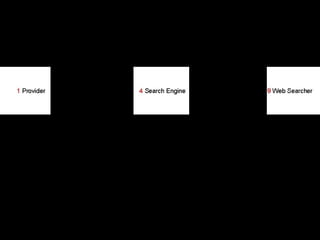
Sponsored Search Elements 1. Provider  2. Provider Content 3. Provider Bids 4. Search Engine  5. Search Engine Review Process 6. Search Engine Keyword and Content Index 7. Search Engine User Interface 8. Search Engine Tracking 9. Searcher Jansen, B. J. and Mullen, T. (2008)  Sponsored search: An overview of the concept, history, and technology,   International Journal of Electronic Business .
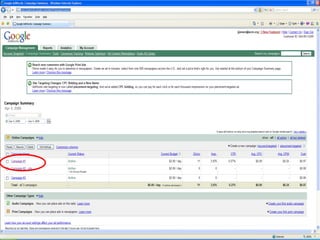
The Sponsored Search Process
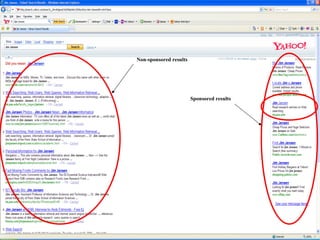
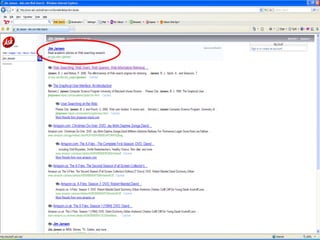
Non-sponsored results Sponsored results
 
 
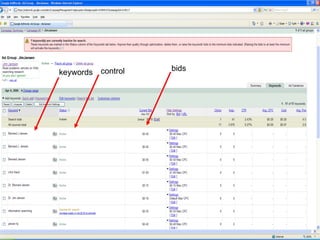
keywords control bids
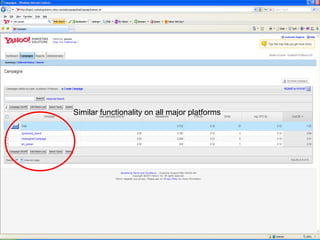
Similar functionality on all major platforms
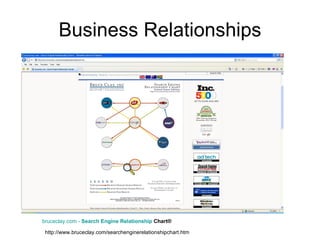
Business Relationships bruceclay.com  -  Search   Engine   Relationship  Chart®   http://www.bruceclay.com/searchenginerelationshipchart.htm
GOOGLE ONLINE MARKETING CHALLENGE OVERVIEW Jamie Murphy Department of Marketing Business School University of Western Australia [email_address]   Lee Hunter Product Manager Google Inc [email_address]
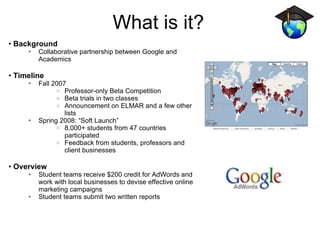
What is it? Background Collaborative partnership between Google and Academics Timeline Fall 2007 Professor-only Beta Competition Beta trials in two classes Announcement on ELMAR and a few other lists Spring 2008: “Soft Launch” 8,000+ students from 47 countries participated Feedback from students, professors and client businesses  Overview Student teams receive $200 credit for AdWords and work with local businesses to devise effective online marketing campaigns Student teams submit two written reports
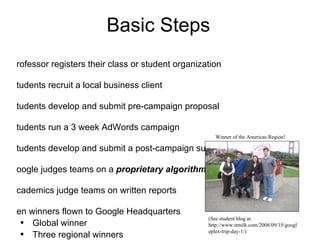
Basic Steps Professor registers their class or student organization Students recruit a local business client Students develop and submit pre-campaign proposal Students run a 3 week AdWords campaign Students develop and submit a post-campaign summary Google judges teams on a  proprietary algorithm Academics judge teams on written reports Ten winners flown to Google Headquarters  Global winner Three regional winners  (Americas, EMEA, Asia Pacific) Six regional finalists  (Americas, EMEA, Asia Pacific) (See student blog at http://www.itmilk.com/2008/09/15/googleplex-trip-day-1/) Winner of the Americas Region!
The Scoring Algorithm Did not want to just look at performance Final algorithm incorporates 30 different signals in 5 categories Performance  Account structure Tool and feature usage Advertiser savviness Budget management Worked with focus groups to determine initial signals, thresholds, and weights Google AdWords Account Optimizers, Managers and Engineers  Validated and refined algorithm using Beta competition groups Numerical results from the algorithm compared to qualitative ratings given by Google Account Optimizers
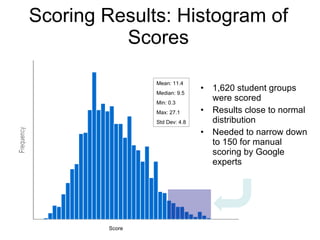
Scoring Results: Histogram of Scores 1,620 student groups were scored Results close to normal distribution Needed to narrow down to 150 for manual scoring by Google experts Mean: 11.4 Median: 9.5 Min: 0.3 Max: 27.1 Std Dev: 4.8 Score
 
Thank you! Jim Jansen College of Information Sciences and Technology  The Pennsylvania State University  [email_address]

Ist402 Google Marketing Challenge V02

  • 1.
    The Quiz! 1.What is a visitor to your Website worth? 2. When a visitor comes to your Website, what do you want them to do? Each visitor has both potential costs and benefits – dollarize each visit! The goal of each visit is some type of convert.
  • 2.
    The Quiz! 3.How would a potential visitor find your Website? 4. What would bring a potential visitor to your Website? 75 percent of people use search engines as an entry point (Nielsen) Expression of a need - informational, navigational, transactional. (Broder 2000)
  • 3.
    The Quiz! 5.What sites are your Website’s competitors? These sites are also dollarizing each visit, trying to convert each visitor, leveraging search, and trying to bring visitors to their Website! Part of your overall campaign to achieve these goals should be sponsored search (a.k.a, keyword advertising) !
  • 4.
    Sponsored Search Jim Jansen College of Information Sciences and Technology The Pennsylvania State University [email_address]
  • 5.
    The Power ofSearch and the Web Search is the top online activity Search drives over 5 billion monthly queries in the U.S. Online activity has a huge impact on people’s daily lives: 70 minutes less with family 30 minutes less TV 8.5 minutes less sleep Sources: comScore, U.S., Feb. ’06, Stanford Institute for the Quantitative Study of Society, Nov. ‘05
  • 6.
    Analysis of SearchMarketplace
  • 7.
  • 8.
    The Power ofSponsored Search Online advertising $ are increasing faster than any other medium . The search model is aligned with the consumer need – pull vs push Lowest acquisition cost of any medium – online or offline Low barriers to entry – cost, bias, knowledge
  • 9.
    Sponsored Search Websearch engines require significant revenue streams! to support the free access that these search engines provide every day to millions of customers. Primary business model for these search engines is sponsored links, which entities pay for. These sponsored links appear on search engine results pages when users enter certain key phrases as queries. The search engines provide the overall mechanism for this sponsored search process to occur. Sponsored search is a multi-billion industry. AOL, Google, and Yahoo! receive substantial portions of their revenue from sponsored search.
  • 10.
    Analysis of OnlineAdvertising Keyword advertising, the fastest growing advertising medium. Revenue base for major search engines such as Google and Yahoo!, as well as many content-based Web sites. In 2007, Google earned $16.4 billion; more than 90% of this revenue came from keyword advertising (Google 2007).
  • 11.
    Sponsored Search Elements1. Provider 2. Provider Content 3. Provider Bids 4. Search Engine 5. Search Engine Review Process 6. Search Engine Keyword and Content Index 7. Search Engine User Interface 8. Search Engine Tracking 9. Searcher Jansen, B. J. and Mullen, T. (2008) Sponsored search: An overview of the concept, history, and technology, International Journal of Electronic Business .
  • 12.
  • 13.
  • 14.
  • 15.
  • 16.
  • 17.
    Similar functionality onall major platforms
  • 18.
    Business Relationships bruceclay.com - Search Engine Relationship Chart® http://www.bruceclay.com/searchenginerelationshipchart.htm
  • 19.
    GOOGLE ONLINE MARKETINGCHALLENGE OVERVIEW Jamie Murphy Department of Marketing Business School University of Western Australia [email_address] Lee Hunter Product Manager Google Inc [email_address]
  • 20.
    What is it?Background Collaborative partnership between Google and Academics Timeline Fall 2007 Professor-only Beta Competition Beta trials in two classes Announcement on ELMAR and a few other lists Spring 2008: “Soft Launch” 8,000+ students from 47 countries participated Feedback from students, professors and client businesses Overview Student teams receive $200 credit for AdWords and work with local businesses to devise effective online marketing campaigns Student teams submit two written reports
  • 21.
    Basic Steps Professorregisters their class or student organization Students recruit a local business client Students develop and submit pre-campaign proposal Students run a 3 week AdWords campaign Students develop and submit a post-campaign summary Google judges teams on a proprietary algorithm Academics judge teams on written reports Ten winners flown to Google Headquarters Global winner Three regional winners (Americas, EMEA, Asia Pacific) Six regional finalists (Americas, EMEA, Asia Pacific) (See student blog at http://www.itmilk.com/2008/09/15/googleplex-trip-day-1/) Winner of the Americas Region!
  • 22.
    The Scoring AlgorithmDid not want to just look at performance Final algorithm incorporates 30 different signals in 5 categories Performance Account structure Tool and feature usage Advertiser savviness Budget management Worked with focus groups to determine initial signals, thresholds, and weights Google AdWords Account Optimizers, Managers and Engineers Validated and refined algorithm using Beta competition groups Numerical results from the algorithm compared to qualitative ratings given by Google Account Optimizers
  • 23.
    Scoring Results: Histogramof Scores 1,620 student groups were scored Results close to normal distribution Needed to narrow down to 150 for manual scoring by Google experts Mean: 11.4 Median: 9.5 Min: 0.3 Max: 27.1 Std Dev: 4.8 Score
  • 24.
  • 25.
    Thank you! JimJansen College of Information Sciences and Technology The Pennsylvania State University [email_address]

Editor's Notes

  • #23 So what did we actually decide on? We didn’t want to solely look at performance so we ended up incorporating 30 different signals within 5 distinct categories. Performance, as discussed earlier. Account structure Tool and feature usage Advertiser savviness Budget management To come up w/ the final list, we worked closely with focus groups consisting of AdWords Optimizers, Managers and Engineers and determined the ideal mix of signals, thresholds and weights based on their feedback. We then validated and refined the initial algorithm using Beta competition groups that started before the actual challenge. And based on qualitative rankings of those accounts, we fine-tuned and measured the performance of the algorithm.