SEMINAR 'I'
SET-II | BATCH-II
23403695. Naveen K
23403696. Nithish Kumaar M
23403697. Nithish M
23403698. Parthiban A
23403699. Pradhiksha J
23403700. Priyadarshini R
ELECTRONICS AND COMMUNICATION ENGINEERING
II-YEAR
Electronics Devices And Communication
Light Emitting Diode
C O N T E N T S
What is a LED?
How does it works
Diode vs LEDiode
Types of LED
Advantages of LED
Applications of LED
Conclusion
1.
2.
3.
4.
5.
6.
7.
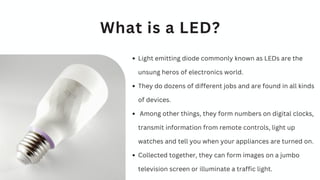
Light emitting diode commonly known as LEDs are the
unsung heros of electronics world.
They do dozens of different jobs and are found in all kinds
of devices.
Among other things, they form numbers on digital clocks,
transmit information from remote controls, light up
watches and tell you when your appliances are turned on.
Collected together, they can form images on a jumbo
television screen or illuminate a traffic light.
What is a LED?
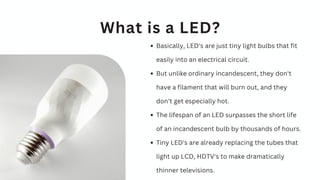
Basically, LED's are just tiny light bulbs that fit
easily into an electrical circuit.
But unlike ordinary incandescent, they don't
have a filament that will burn out, and they
don't get especially hot.
The lifespan of an LED surpasses the short life
of an incandescent bulb by thousands of hours.
Tiny LED's are already replacing the tubes that
light up LCD, HDTV's to make dramatically
thinner televisions.
What is a LED?
HOW DOES IT WORKS?
LEDs work on the principle of
Electroluminescence. On passing a
current through the diode, minority
charge carriers and majority charge
carriers recombine at the junction. On
recombination, energy is released in
the form of photons.
DIODE vs LE DIODE
In a ordinary diode, the semiconductor
material itself ends up absorbing a lot of the
light energy.LED's are specially constructed
to release a large number of photons
outward. They are housed in a plastic bulb
that concentrates a the light in a particular
direction.
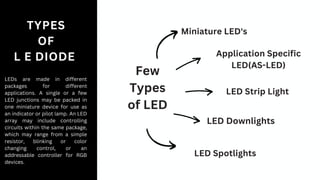
Few
Types
of LED
Miniature LED's
Application Specific
LED(AS-LED)
LED Strip Light
LED Downlights
LED Spotlights
TYPES
OF
L E DIODE
LEDs are made in different
packages for different
applications. A single or a few
LED junctions may be packed in
one miniature device for use as
an indicator or pilot lamp. An LED
array may include controlling
circuits within the same package,
which may range from a simple
resistor, blinking or color
changing control, or an
addressable controller for RGB
devices.
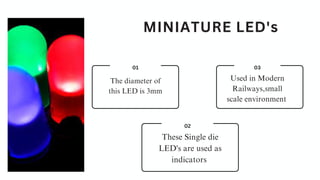
MINIATURE LED's
03
Used in Modern
Railways,small
scale environment
02
These Single die
LED's are used as
indicators
01
The diameter of
this LED is 3mm
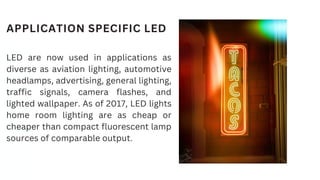
APPLICATION SPECIFIC LED
LED are now used in applications as
diverse as aviation lighting, automotive
headlamps, advertising, general lighting,
traffic signals, camera flashes, and
lighted wallpaper. As of 2017, LED lights
home room lighting are as cheap or
cheaper than compact fluorescent lamp
sources of comparable output.
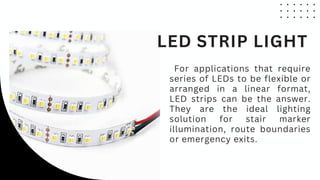
For applications that require
series of LEDs to be flexible or
arranged in a linear format,
LED strips can be the answer.
They are the ideal lighting
solution for stair marker
illumination, route boundaries
or emergency exits.
LED STRIP LIGHT
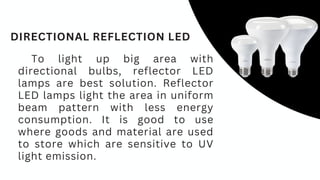
To light up big area with
directional bulbs, reflector LED
lamps are best solution. Reflector
LED lamps light the area in uniform
beam pattern with less energy
consumption. It is good to use
where goods and material are used
to store which are sensitive to UV
light emission.
DIRECTIONAL REFLECTION LED
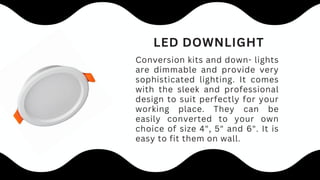
Conversion kits and down- lights
are dimmable and provide very
sophisticated lighting. It comes
with the sleek and professional
design to suit perfectly for your
working place. They can be
easily converted to your own
choice of size 4", 5" and 6". It is
easy to fit them on wall.
LED DOWNLIGHT
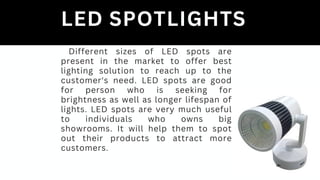
LED SPOTLIGHTS
Different sizes of LED spots are
present in the market to offer best
lighting solution to reach up to the
customer's need. LED spots are good
for person who is seeking for
brightness as well as longer lifespan of
lights. LED spots are very much useful
to individuals who owns big
showrooms. It will help them to spot
out their products to attract more
customers.
ADVANTAGES OF LED
1.Energy Efficiency
LEDs consume less powerand produce more light.
2.Longevity
LEDs have a significantly longerlifespan than traditional bulbs.
3.Durability
LEDs are highly resistant to shocks and vibrations.
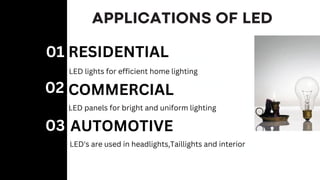
APPLICATIONS OF LED
01 RESIDENTIAL
LED lights for efficient home lighting
02 COMMERCIAL
03
LED panels for bright and uniform lighting
AUTOMOTIVE
LED's are used in headlights,Taillights and interior
We
CONCLUSION
LEDs have transformed the lighting industry
withtheir efficiency, longevity, and
versatility. Astechnology continues advance,
LEDs will play an increasingly significant
role in creating sustainable lighting
solutions for a wide range of
applications.Embracing LED lighting is not
only beneficial for energy conservation but
also contributes to agreener and brighter
future.
THANK YOU
23403695. Naveen K
23403696. Nithish Kumaar M
23403697. Nithish M
23403698. Parthiban A
23403699. Pradhiksha J
23403700. Priyadarshini R
SET-II | BATCH-II

Light Emitting Diode.pdf

  • 1.
    SEMINAR 'I' SET-II |BATCH-II 23403695. Naveen K 23403696. Nithish Kumaar M 23403697. Nithish M 23403698. Parthiban A 23403699. Pradhiksha J 23403700. Priyadarshini R ELECTRONICS AND COMMUNICATION ENGINEERING II-YEAR Electronics Devices And Communication
  • 2.
  • 3.
    C O NT E N T S What is a LED? How does it works Diode vs LEDiode Types of LED Advantages of LED Applications of LED Conclusion 1. 2. 3. 4. 5. 6. 7.
  • 4.
    Light emitting diodecommonly known as LEDs are the unsung heros of electronics world. They do dozens of different jobs and are found in all kinds of devices. Among other things, they form numbers on digital clocks, transmit information from remote controls, light up watches and tell you when your appliances are turned on. Collected together, they can form images on a jumbo television screen or illuminate a traffic light. What is a LED?
  • 5.
    Basically, LED's arejust tiny light bulbs that fit easily into an electrical circuit. But unlike ordinary incandescent, they don't have a filament that will burn out, and they don't get especially hot. The lifespan of an LED surpasses the short life of an incandescent bulb by thousands of hours. Tiny LED's are already replacing the tubes that light up LCD, HDTV's to make dramatically thinner televisions. What is a LED?
  • 6.
    HOW DOES ITWORKS? LEDs work on the principle of Electroluminescence. On passing a current through the diode, minority charge carriers and majority charge carriers recombine at the junction. On recombination, energy is released in the form of photons.
  • 7.
    DIODE vs LEDIODE In a ordinary diode, the semiconductor material itself ends up absorbing a lot of the light energy.LED's are specially constructed to release a large number of photons outward. They are housed in a plastic bulb that concentrates a the light in a particular direction.
  • 8.
    Few Types of LED Miniature LED's ApplicationSpecific LED(AS-LED) LED Strip Light LED Downlights LED Spotlights TYPES OF L E DIODE LEDs are made in different packages for different applications. A single or a few LED junctions may be packed in one miniature device for use as an indicator or pilot lamp. An LED array may include controlling circuits within the same package, which may range from a simple resistor, blinking or color changing control, or an addressable controller for RGB devices.
  • 9.
    MINIATURE LED's 03 Used inModern Railways,small scale environment 02 These Single die LED's are used as indicators 01 The diameter of this LED is 3mm
  • 10.
    APPLICATION SPECIFIC LED LEDare now used in applications as diverse as aviation lighting, automotive headlamps, advertising, general lighting, traffic signals, camera flashes, and lighted wallpaper. As of 2017, LED lights home room lighting are as cheap or cheaper than compact fluorescent lamp sources of comparable output.
  • 11.
    For applications thatrequire series of LEDs to be flexible or arranged in a linear format, LED strips can be the answer. They are the ideal lighting solution for stair marker illumination, route boundaries or emergency exits. LED STRIP LIGHT
  • 12.
    To light upbig area with directional bulbs, reflector LED lamps are best solution. Reflector LED lamps light the area in uniform beam pattern with less energy consumption. It is good to use where goods and material are used to store which are sensitive to UV light emission. DIRECTIONAL REFLECTION LED
  • 13.
    Conversion kits anddown- lights are dimmable and provide very sophisticated lighting. It comes with the sleek and professional design to suit perfectly for your working place. They can be easily converted to your own choice of size 4", 5" and 6". It is easy to fit them on wall. LED DOWNLIGHT
  • 14.
    LED SPOTLIGHTS Different sizesof LED spots are present in the market to offer best lighting solution to reach up to the customer's need. LED spots are good for person who is seeking for brightness as well as longer lifespan of lights. LED spots are very much useful to individuals who owns big showrooms. It will help them to spot out their products to attract more customers.
  • 15.
    ADVANTAGES OF LED 1.EnergyEfficiency LEDs consume less powerand produce more light. 2.Longevity LEDs have a significantly longerlifespan than traditional bulbs. 3.Durability LEDs are highly resistant to shocks and vibrations.
  • 16.
    APPLICATIONS OF LED 01RESIDENTIAL LED lights for efficient home lighting 02 COMMERCIAL 03 LED panels for bright and uniform lighting AUTOMOTIVE LED's are used in headlights,Taillights and interior
  • 17.
    We CONCLUSION LEDs have transformedthe lighting industry withtheir efficiency, longevity, and versatility. Astechnology continues advance, LEDs will play an increasingly significant role in creating sustainable lighting solutions for a wide range of applications.Embracing LED lighting is not only beneficial for energy conservation but also contributes to agreener and brighter future.
  • 18.
    THANK YOU 23403695. NaveenK 23403696. Nithish Kumaar M 23403697. Nithish M 23403698. Parthiban A 23403699. Pradhiksha J 23403700. Priyadarshini R SET-II | BATCH-II