Genetic Engineering &
Transformation methods
Manjunath, R
PALB6281
Jr.Msc. Plant Biotechnology
Introduction
Genetic engineering, is the manipulation of an organism's
genome using modern DNA technology. It is also called
genetic modification.
It involves the introduction of foreign DNA or synthetic genes
into the organism of interest or by altering the sequence of a
gene to convert it to a different gene or deletion of an
undesirable gene.
The resultant DNA is called recombinant DNA. Thus it is also
called recombinant DNA Technology.
• The gene that is transferred into a new host is known as
transgene.
• The organisms developed after successful gene transfer are
known as transgenics.
• The plants which carry the stably integrated foreign gene is
called transformed plants.
• Transformation was first demonstrated in 1928 by British bacteriologist
Frederick Griffith in Diplococcus pneumonia.
• In 1944 this "transforming principle" was identified as being genetic by
Oswald Avery, Colin MacLeod, and Maclyn McCarty .
• Transformation using electroporation was developed in the late 1980s.
• Particle bombardment discovered (gene gun) by John Sanford in the 1980s.
History
Transformation:
• Transformation is the process by which genetic makeup of an organism is
altered by the insertion of new gene(or exogenous DNA) into its genome
.This is usually done using vectors such as plasmids.
• The aim of producing transgenic plants is to-
a) Improve crop yields.
b) Improvement of varietal trait.
c) Give cultivated plants more protection against their pests, parasites and
harsh weather conditions.
Methods of plant transformation:
• INDIRECT METHOD :
Agrobacterium mediated gene transfer.
• DIRECT METHODS :
 Particle gun/biolistic/ballistic method of DNA delivery.
 Chemical method; Polyethylene glycol (PEG).
 Calcium phosphate mediated gene transfer.
 Microinjection.
 Electroporation.
 Fibre mediated gene transfer.
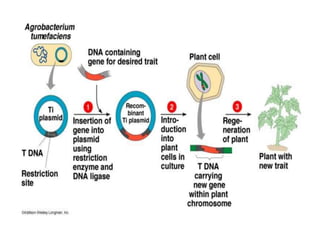
Agrobacterium mediated gene transfer:
• Agrobacterium tumaefaciens : – A Natural genetic engineer.
• It is achived by two ways are-
1) Co-culture with tissue explants. and
2) In planta transformation.
Agrobacterium tumefaciens
Characteristics:
 Soil born , gram –ve , rod shaped, motile bacteria found in
rhizosphere.
 Encodes a large (~250kbp) plasmid called Tumor-inducing (Ti)
plasmid, a vector which can transfer its T-DNA region into genome of
host plants.
 Causative agents of “Crown gall” disease of dicotyledons.
 Have ability to transfer bacterial genes to plant genome.
 Attracted to wound site via chemotoxins in response to chemicals
(Sugar and Phenolic molecules: Acetosyringone) released from
damaged plant cells.
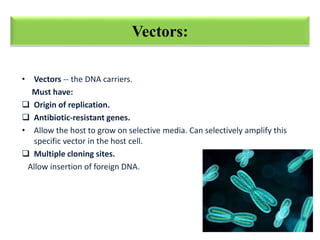
Vectors:
• Vectors -- the DNA carriers.
Must have:
 Origin of replication.
 Antibiotic-resistant genes.
• Allow the host to grow on selective media. Can selectively amplify this
specific vector in the host cell.
 Multiple cloning sites.
Allow insertion of foreign DNA.
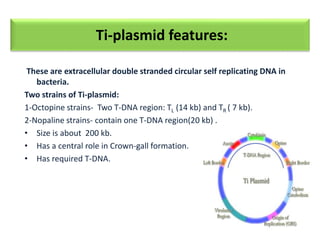
Ti-plasmid features:
These are extracellular double stranded circular self replicating DNA in
bacteria.
Two strains of Ti-plasmid:
1-Octopine strains- Two T-DNA region: TL (14 kb) and TR ( 7 kb).
2-Nopaline strains- contain one T-DNA region(20 kb) .
• Size is about 200 kb.
• Has a central role in Crown-gall formation.
• Has required T-DNA.
Process of T-DNA transfer and
integration
1. Signal recognition by Agrobacterium:
-Agrobacterium perceive signals such as sugar and phenolic
compounds(Acetosyringone) which are released from plants when got
wounded.
2. Attachment to plants cells:
Two step processes:
1. Initial attachment via polysaccharide.
2. Mesh of cellulose fiber is produced by bacteria.
Virulence genes are involved in the stable attachment of bacterial cells to
the plants cells.
3. Vir gene induction:
VirA senses phenolics and subsequently phosphorylating there by activating
VirG.
VirG then induces expression of all the vir genes.
4. T-strand production:
 The virD1 as topoisomerase activity which binds to RB and relaxes the super
coiling which facilitates the action of virD2 (as endonuclease activity).
 It nicks the RB & covalently binds to 5’ end. Similarly the 3’end produced at
the site of nick, serves as a primer. As a result single strand of T-DNA is
displaced by virE.
 VirE2 protects this from nuclases . virB is essential for virulence which also
has ATP-ase activity, therefore helps in deliver of T-DNA into plant cell,
mostly trough nuclear pore complex.
5. Transfer of the T-DNA and Vir proteins into the plant nuclear localization:
 The ss T-DNA is immediately converted to ds in nucleus by replication.
 The ds T- DNA integrates at random site in the host cell genome by
illegitimate recombination.
DIRECT METHODS
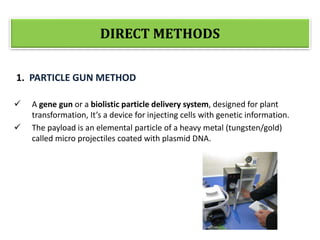
1. PARTICLE GUN METHOD
 A gene gun or a biolistic particle delivery system, designed for plant
transformation, It’s a device for injecting cells with genetic information.
 The payload is an elemental particle of a heavy metal (tungsten/gold)
called micro projectiles coated with plasmid DNA.
Principle:
 The gold or tungsten particles are coated with the DNA that is used to
transform in the plant tissue.
 The particles are propelled at high speed into the target plant material
where the DNA is released within the cell and can integrate into the
genome.
 Two types of plant tissues are used for particle bombardment:
a) Primary explants that are bombarded and then induced to become
embryogenic.
b) Proliferating embryonic cultures that are bombarded and then allowed
to proliferate further and subsequently regenerate.
Micro projectile bombardment or
biolistic-mediated DNA
transformation equipment
(a) lab version
(b) portable version
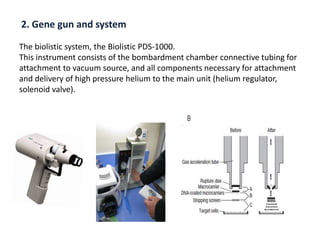
2. Gene gun and system
The biolistic system, the Biolistic PDS-1000.
This instrument consists of the bombardment chamber connective tubing for
attachment to vacuum source, and all components necessary for attachment
and delivery of high pressure helium to the main unit (helium regulator,
solenoid valve).
3. Polyethylene glycol (PEG) mediated transformation
 Plant protoplast can be transformed with naked DNA by treatment with
PEG in the presence of divalent cations .
e. g., Calcium.
 PEG and divalent cations destabilize the plasma membrane of the plant
protoplast and rendered it permeable to naked DNA.
 DNA enters the nucleus and integrates into the host genome.
4. Calcium phosphate mediated DNA transfer
• The process of transfection involves the admixture of isolated DNA (10-
100ug) with solution of calcium chloride and potassium phosphate so
precipitate of calcium phosphate to be formed.
• Cells are then incubated with precipitated DNA either in solution or in
tissue culture dish.
• A fraction of cells will take up the calcium phosphate DNA precipitate by
endocytosis.
5. Electroporation
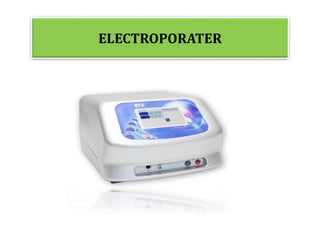
• It can be used to deliver DNA into plant
cells and protoplasts.
• The genes of interest require plant
regulatory sequence.
• Plant materials is incubated in a buffer
solution containing DNA and subjected to
high-voltage electric pulse.
• The DNA then migrates through high-
voltage-induced pores in the plasma
membrane and integrates into the
genome.
• It can be used to transform all the major
cereals.
• Eg: Rice, wheat, maize.
ELECTROPORATER
6. Fiber mediated DNA delivery -Whiskers
• Plant materials (Cells in suspension culture, embryos and embryo-derived
callus) is introduced into a buffer containing DNA and the silicon carbide
fibers which is then vortexed.
• The fibers (0.3-0.6 μm in diameter and 10-100μm long) penetrate the cell
wall and plasma membrane, allowing the DNA to gain access to the inside of
the cells.
• This method appears to be widely applicable, and is the most rapid and
inexpensive, provided stable integrations are achieved.
Disadvantages :
 The drawbacks of this technique relate to the availability of
suitable plant material and the inherent dangers of the fibers,
which require careful handling.
 Many cereals, produce embryonic callus that is hard and
compact and not transformed with this technique.
 Despite the some disadvantages, this method is recently used
for successful transformation of wheat, barley, and maize
without the need of cell suspension.
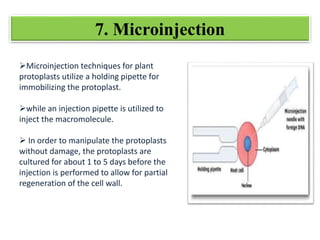
7. Microinjection
Microinjection techniques for plant
protoplasts utilize a holding pipette for
immobilizing the protoplast.
while an injection pipette is utilized to
inject the macromolecule.
 In order to manipulate the protoplasts
without damage, the protoplasts are
cultured for about 1 to 5 days before the
injection is performed to allow for partial
regeneration of the cell wall.
Advantages and disadvantages of direct
gene transfer :
 Advantage- Widespread use of transformation of cereal crops that initially
proved difficult to transformation with Agro bacterium.
 Disadvantage- They tend to lead higher frequency of transgene
rearrangement and higher copy number.
This can lead to high frequency of gene silencing.
Applications
• Medicine
Vaccination.
Gene therapy.
• Agriculture
Improved nutritional quality.
Better Nitrogen Fixation.
Disease resistant Plant.
Reduced post harvest losses.
• Industrial Application
Development strains for additional bioprocesses.
Manufacture of proteins.
Conclusion
• In general, Agrobacterium-mediated DNA delivery appears to be method of
choice wherever it can be used.
• Genetic engineering has helped produce quicker and more predictable way of
generating new cultivars. Further, the cultivar properties are better known
today than it was ever known before.
• Thus there are a number of ways by which the gene can be introduced into
the cells. With the advent of molecular tools and technologies it is now
comparatively easy to introduce gene into cells without loosing its integrity
and biological activity.
References
• Biotechnology-expanding horizons; B D Singh . Fourth revised edn,
2012 (page no.395-402).
• Genetic engineering of the chloroplast: novel tools and new
applications
Current Opinion in Biotechnology, Volume 26, Issue null, Pages 7-13
Ralph Bock.
• A genome-editing off switch. Ross Cloney Nature Reviews Genetics
(2016) doi:10.1038/nrg.2016.166 Published online 28 December 2016.
• Wikipedia
Genetic engineering and Transformation methods

Genetic engineering and Transformation methods

  • 1.
    Genetic Engineering & Transformationmethods Manjunath, R PALB6281 Jr.Msc. Plant Biotechnology
  • 2.
    Introduction Genetic engineering, isthe manipulation of an organism's genome using modern DNA technology. It is also called genetic modification. It involves the introduction of foreign DNA or synthetic genes into the organism of interest or by altering the sequence of a gene to convert it to a different gene or deletion of an undesirable gene. The resultant DNA is called recombinant DNA. Thus it is also called recombinant DNA Technology.
  • 3.
    • The genethat is transferred into a new host is known as transgene. • The organisms developed after successful gene transfer are known as transgenics. • The plants which carry the stably integrated foreign gene is called transformed plants.
  • 4.
    • Transformation wasfirst demonstrated in 1928 by British bacteriologist Frederick Griffith in Diplococcus pneumonia. • In 1944 this "transforming principle" was identified as being genetic by Oswald Avery, Colin MacLeod, and Maclyn McCarty . • Transformation using electroporation was developed in the late 1980s. • Particle bombardment discovered (gene gun) by John Sanford in the 1980s. History
  • 5.
    Transformation: • Transformation isthe process by which genetic makeup of an organism is altered by the insertion of new gene(or exogenous DNA) into its genome .This is usually done using vectors such as plasmids. • The aim of producing transgenic plants is to- a) Improve crop yields. b) Improvement of varietal trait. c) Give cultivated plants more protection against their pests, parasites and harsh weather conditions.
  • 6.
    Methods of planttransformation: • INDIRECT METHOD : Agrobacterium mediated gene transfer. • DIRECT METHODS :  Particle gun/biolistic/ballistic method of DNA delivery.  Chemical method; Polyethylene glycol (PEG).  Calcium phosphate mediated gene transfer.  Microinjection.  Electroporation.  Fibre mediated gene transfer.
  • 7.
    Agrobacterium mediated genetransfer: • Agrobacterium tumaefaciens : – A Natural genetic engineer. • It is achived by two ways are- 1) Co-culture with tissue explants. and 2) In planta transformation.
  • 8.
    Agrobacterium tumefaciens Characteristics:  Soilborn , gram –ve , rod shaped, motile bacteria found in rhizosphere.  Encodes a large (~250kbp) plasmid called Tumor-inducing (Ti) plasmid, a vector which can transfer its T-DNA region into genome of host plants.  Causative agents of “Crown gall” disease of dicotyledons.  Have ability to transfer bacterial genes to plant genome.  Attracted to wound site via chemotoxins in response to chemicals (Sugar and Phenolic molecules: Acetosyringone) released from damaged plant cells.
  • 9.
    Vectors: • Vectors --the DNA carriers. Must have:  Origin of replication.  Antibiotic-resistant genes. • Allow the host to grow on selective media. Can selectively amplify this specific vector in the host cell.  Multiple cloning sites. Allow insertion of foreign DNA.
  • 10.
    Ti-plasmid features: These areextracellular double stranded circular self replicating DNA in bacteria. Two strains of Ti-plasmid: 1-Octopine strains- Two T-DNA region: TL (14 kb) and TR ( 7 kb). 2-Nopaline strains- contain one T-DNA region(20 kb) . • Size is about 200 kb. • Has a central role in Crown-gall formation. • Has required T-DNA.
  • 11.
    Process of T-DNAtransfer and integration 1. Signal recognition by Agrobacterium: -Agrobacterium perceive signals such as sugar and phenolic compounds(Acetosyringone) which are released from plants when got wounded. 2. Attachment to plants cells: Two step processes: 1. Initial attachment via polysaccharide. 2. Mesh of cellulose fiber is produced by bacteria. Virulence genes are involved in the stable attachment of bacterial cells to the plants cells. 3. Vir gene induction: VirA senses phenolics and subsequently phosphorylating there by activating VirG. VirG then induces expression of all the vir genes.
  • 12.
    4. T-strand production: The virD1 as topoisomerase activity which binds to RB and relaxes the super coiling which facilitates the action of virD2 (as endonuclease activity).  It nicks the RB & covalently binds to 5’ end. Similarly the 3’end produced at the site of nick, serves as a primer. As a result single strand of T-DNA is displaced by virE.  VirE2 protects this from nuclases . virB is essential for virulence which also has ATP-ase activity, therefore helps in deliver of T-DNA into plant cell, mostly trough nuclear pore complex. 5. Transfer of the T-DNA and Vir proteins into the plant nuclear localization:  The ss T-DNA is immediately converted to ds in nucleus by replication.  The ds T- DNA integrates at random site in the host cell genome by illegitimate recombination.
  • 15.
    DIRECT METHODS 1. PARTICLEGUN METHOD  A gene gun or a biolistic particle delivery system, designed for plant transformation, It’s a device for injecting cells with genetic information.  The payload is an elemental particle of a heavy metal (tungsten/gold) called micro projectiles coated with plasmid DNA.
  • 16.
    Principle:  The goldor tungsten particles are coated with the DNA that is used to transform in the plant tissue.  The particles are propelled at high speed into the target plant material where the DNA is released within the cell and can integrate into the genome.  Two types of plant tissues are used for particle bombardment: a) Primary explants that are bombarded and then induced to become embryogenic. b) Proliferating embryonic cultures that are bombarded and then allowed to proliferate further and subsequently regenerate.
  • 17.
    Micro projectile bombardmentor biolistic-mediated DNA transformation equipment (a) lab version (b) portable version
  • 18.
    2. Gene gunand system The biolistic system, the Biolistic PDS-1000. This instrument consists of the bombardment chamber connective tubing for attachment to vacuum source, and all components necessary for attachment and delivery of high pressure helium to the main unit (helium regulator, solenoid valve).
  • 19.
    3. Polyethylene glycol(PEG) mediated transformation  Plant protoplast can be transformed with naked DNA by treatment with PEG in the presence of divalent cations . e. g., Calcium.  PEG and divalent cations destabilize the plasma membrane of the plant protoplast and rendered it permeable to naked DNA.  DNA enters the nucleus and integrates into the host genome.
  • 20.
    4. Calcium phosphatemediated DNA transfer • The process of transfection involves the admixture of isolated DNA (10- 100ug) with solution of calcium chloride and potassium phosphate so precipitate of calcium phosphate to be formed. • Cells are then incubated with precipitated DNA either in solution or in tissue culture dish. • A fraction of cells will take up the calcium phosphate DNA precipitate by endocytosis.
  • 21.
    5. Electroporation • Itcan be used to deliver DNA into plant cells and protoplasts. • The genes of interest require plant regulatory sequence. • Plant materials is incubated in a buffer solution containing DNA and subjected to high-voltage electric pulse. • The DNA then migrates through high- voltage-induced pores in the plasma membrane and integrates into the genome. • It can be used to transform all the major cereals. • Eg: Rice, wheat, maize.
  • 22.
  • 23.
    6. Fiber mediatedDNA delivery -Whiskers • Plant materials (Cells in suspension culture, embryos and embryo-derived callus) is introduced into a buffer containing DNA and the silicon carbide fibers which is then vortexed. • The fibers (0.3-0.6 μm in diameter and 10-100μm long) penetrate the cell wall and plasma membrane, allowing the DNA to gain access to the inside of the cells. • This method appears to be widely applicable, and is the most rapid and inexpensive, provided stable integrations are achieved.
  • 24.
    Disadvantages :  Thedrawbacks of this technique relate to the availability of suitable plant material and the inherent dangers of the fibers, which require careful handling.  Many cereals, produce embryonic callus that is hard and compact and not transformed with this technique.  Despite the some disadvantages, this method is recently used for successful transformation of wheat, barley, and maize without the need of cell suspension.
  • 25.
    7. Microinjection Microinjection techniquesfor plant protoplasts utilize a holding pipette for immobilizing the protoplast. while an injection pipette is utilized to inject the macromolecule.  In order to manipulate the protoplasts without damage, the protoplasts are cultured for about 1 to 5 days before the injection is performed to allow for partial regeneration of the cell wall.
  • 26.
    Advantages and disadvantagesof direct gene transfer :  Advantage- Widespread use of transformation of cereal crops that initially proved difficult to transformation with Agro bacterium.  Disadvantage- They tend to lead higher frequency of transgene rearrangement and higher copy number. This can lead to high frequency of gene silencing.
  • 27.
    Applications • Medicine Vaccination. Gene therapy. •Agriculture Improved nutritional quality. Better Nitrogen Fixation. Disease resistant Plant. Reduced post harvest losses. • Industrial Application Development strains for additional bioprocesses. Manufacture of proteins.
  • 28.
    Conclusion • In general,Agrobacterium-mediated DNA delivery appears to be method of choice wherever it can be used. • Genetic engineering has helped produce quicker and more predictable way of generating new cultivars. Further, the cultivar properties are better known today than it was ever known before. • Thus there are a number of ways by which the gene can be introduced into the cells. With the advent of molecular tools and technologies it is now comparatively easy to introduce gene into cells without loosing its integrity and biological activity.
  • 29.
    References • Biotechnology-expanding horizons;B D Singh . Fourth revised edn, 2012 (page no.395-402). • Genetic engineering of the chloroplast: novel tools and new applications Current Opinion in Biotechnology, Volume 26, Issue null, Pages 7-13 Ralph Bock. • A genome-editing off switch. Ross Cloney Nature Reviews Genetics (2016) doi:10.1038/nrg.2016.166 Published online 28 December 2016. • Wikipedia