GENE TRANSFER TECHNIQUES
Saji Mariam George
Associate Professor
Assumption Autonomous College
Changanacherry
GENE TRANSFER TECHNIQUES
(TRANSFORMATION TECHNIQUES)
• Genetic Engineering - Recent approach in
Biotechnology →Transfer and expression of
foreign genes into higher plants – involves the
transfer of specifically constructed gene
assemblies through various transformation
techniques.
• Plants obtained through genetic engineering
contain a gene or genes usually from an
unrelated organism – transgenes – transgenic
plants.
• Genetic modification (genetic manipulation) of higher
plants by introducing DNA into their cells extend
their gene pool- create genetic variability – helpful in
enhancing their agricultural efficiency.
• Uptake of foreign DNA or transgenes by plant cells –
Transformation.
Gene transfer techniques
i) Direct gene transfer techniques –without the
involvement of a biological agent.
ii) Indirect gene transfer technique – with the
involvement of a biological agent, Agrobacterium
tumefaciens.
(Agrobacterium mediated gene transfer technique)
Direct Gene Transfer Techniques
• Introduction of DNA into plant cells without
the involvement of a biological agent →
transformation.
• Spontaneous uptake of DNA by plant cells is
very low – employ chemical and physical
treatments – facilitate the entry of DNA into
plant cells.
1. Chemically stimulated DNA uptake
by Protoplast
 Chemicals – Polyethylene glycol (PEG)
Polyvinyl alcohol (PVA)
Calcium phosphate
Chemically stimulated DNA uptake by
Poly Ethylene Glycol (PEG)
 Mix freshly isolated protoplasts (protoplast
= cell without cell wall – prepared by using
cell wall degrading enzymes) with
DNA(linearised plasmid DNA containing the
gene construct ).
Add 15 – 20 % of PEG dissolved in a buffer
containing divalent cations (Mg ²+, Ca²+).
Incubate for 30 minutes - PEG causes
precipitation of ionic molecules like DNA –
stimulates their uptake by endocytosis –
transforms 0.1 to 0.4 % of the total protoplasts
treated.
Wash the protoplasts.
Treated protoplasts are plated in Petri dish for
culture and growth – regenerate cell wall →
callus colonies .
A selectable marker is used for the selection
of transformed protoplasts.
Regenerate into plants.
 Generally used for stable transformation of
monocot protoplasts.
Used for direct gene transfer in Nicotiana
protoplasts.
2. Transduction
( Zinder & Lederberg 1952)
 A mechanism of genetic recombination in Bacteria
mediated by a lysogenic (Temperate) phages.
 phage – serving as a vector , transferring a portion of
bacterial DNA (a few genes) from one bacterium to
another.
 Temperate phages (Lysogenic phages) – do not lyse
host bacterium.
 The phage DNA get integrated with the host bacterial
chromosome in a non- infectious stage – prophage .
• Sometimes the phage DNA may get excised
from the host bacterial chromosome
→initiates Lytic life cycle (Prophage
induction).
• Packaging error during assembly – may get
filled with bacterial chromosomal DNA or a
mixture of chromosomal and phage DNA
→aberrant or abnormal or transducing phages
– attach to other bacteria – introduce
bacterial DNA into them.
Types of Transduction
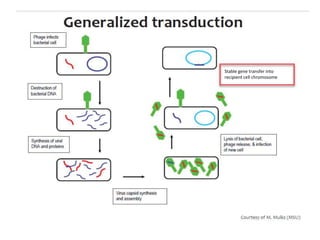
i) Generalized Transduction – a random
fragment of bacterial DNA is packaged in the
phage head in place of phage chromosome –
transducing phages – can transport any
bacterial gene from one bacterium to
another.
e.g. P22 in Salmonella typhimurium , P1 in
E.coli.
Stable gene transfer into
recipient cell chromosome
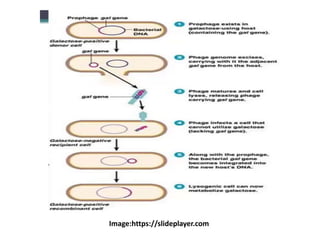
ii) Specialized Transduction -Transfer only
certain genes between bacteria.
E.g. Lambda phage carries only the gal
(required for the utilization of Galactose – a
monosaccharide- as the source of energy)
and bio ( essential for the synthesis of
Biotin) genes from one E.coli bacterium to
another.
Images:https://slideplayer.com
Image:https://slideplayer.com
3. Electroporation
• Done with an instrument – Electroporator.
• High voltage electricity for a very brief period is
used to introduce DNA into cells.
• Exposure of cells to high voltage induce
transient pores in the plasma membrane – a
passage – foreign DNA can enter into the
protoplasts – increase transformation frequency.
• Optimal voltage and time – depends on plant
species, source of protoplasts and resistance of
the medium.
Methods
1. Low voltage – long pulse method: 300 to
400 V cm⁻¹ for 10 – 50 ms (Milliseconds)
2. High voltage – short pulse method:1000-
1500 V cm ⁻¹ for 10 µs (Microseconds)→ high
rates of stable transformation.
• Suspend plant protoplasts in a suitable ionic solution
containing linear recombinant plasmid DNA.
• Expose to chosen voltage
• Culture → cell colonies → plants
Transformation frequency can be enhanced by
 Heat – shock to protoplasts just prior to
electroporation
 Presence of a low concentration (about 8%) of Poly
ethylene glycol during electroporation.
• Electroporation can also be used to introduce DNA
into intact cells – cell wall weakened by a mild
enzymatic treatment – DNA entry → cell.
• Used in Tobacco, Petunia, Maize etc.
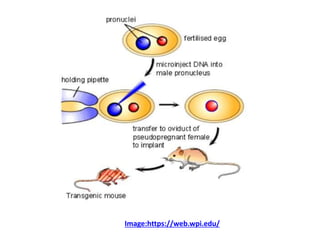
4. Microinjection
Microinjection of DNA into fertilized eggs or
Embryos → transgenic animals.
• Eggs are surgically removed from the female
parent.
• in vitro fertilization.
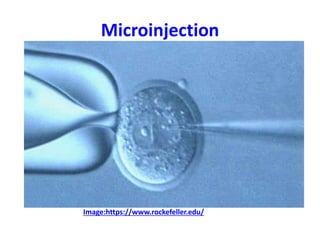
• Microinjection of DNA into the male pronucleus
(haploid nucleus contributed by sperm, prior to
nuclear fusion) of the fertilized egg through a
very fine – tipped glass needle.
Microinjection
Image:https://www.rockefeller.edu/
• The injected zygote is implanted into the
female to complete their development.
• Integration of injected DNA molecules may
occur early during embryonic development
at random sites in the genome.
• The animals that develop from the injected
eggs (G0 generation) – genetic mosaics- some
somatic cells carrying the transgene and
others not carrying.
• All cells of the progeny of initial transgenic
animals carry the transgene.
Image:https://web.wpi.edu/
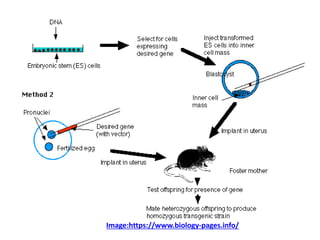
TRANSFECTION
• Uptake of DNA by a eukaryotic cell, followed
by its incorporation into the cell’s genome -
Transforming embryonic stem cells (ES cells)
growing in tissue culture with the desired
DNA
• Injection of DNA into large populations of cultured
cells derived from embryonic stem cells – introduce
these cells to other developing embryos – some form
adult tissues – progeny may contain its own cells and
those derived from the cultured transfected ES -cells
(Chimeras).
• If the ES cells contribute to the chimera’s germ line,
the introduced foreign DNA may be transmitted to
next generation.
Image:https://www.biology-pages.info/
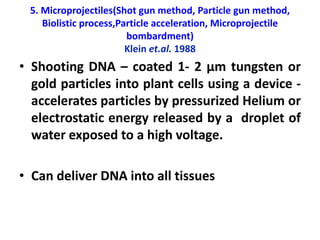
5. Microprojectiles(Shot gun method, Particle gun method,
Biolistic process,Particle acceleration, Microprojectile
bombardment)
Klein et.al. 1988
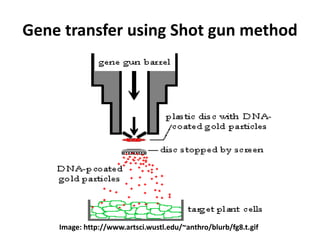
• Shooting DNA – coated 1- 2 µm tungsten or
gold particles into plant cells using a device -
accelerates particles by pressurized Helium or
electrostatic energy released by a droplet of
water exposed to a high voltage.
• Can deliver DNA into all tissues
Gene transfer using Shot gun method
Image: http://www.artsci.wustl.edu/~anthro/blurb/fg8.t.gif
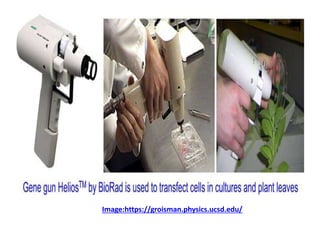
Image:https://groisman.physics.ucsd.edu/
Can be used to transform
 shoot apical meristem
 leaf blades
 immature and mature embryos
 mature pollen etc.
Used to produce stable gene transfers in
• Cotton
• Maize
• Rice
• Sugar cane
• Tobacco etc.
Indirect Gene Transfer Technique
Agrobacterium mediated gene transfer
Agrobacterium tumefaciens
• a gram negative, rod shaped, motile, soil
bacterium.
• Invades many dicots and some
gymnosperms- enters through fresh wound –
attach to the cell wall – transfers a part of its
Tumour inducing plasmid (Ti plasmid) known
as T-DNA (Transferred DNA) – integrates into
host chromosome – causes crown gall –
tumourous growth.
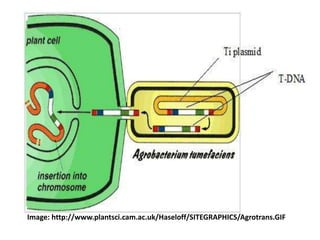
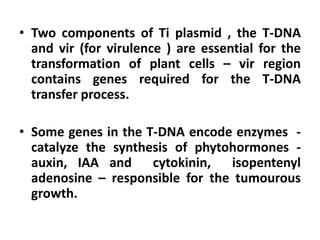
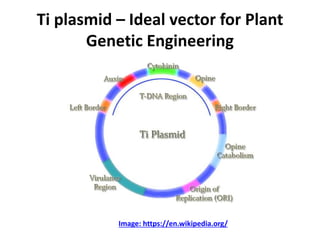
• Two components of Ti plasmid , the T-DNA
and vir (for virulence ) are essential for the
transformation of plant cells – vir region
contains genes required for the T-DNA
transfer process.
• Some genes in the T-DNA encode enzymes -
catalyze the synthesis of phytohormones -
auxin, IAA and cytokinin, isopentenyl
adenosine – responsible for the tumourous
growth.
Ti plasmid – Ideal vector for Plant
Genetic Engineering
Image: https://en.wikipedia.org/
Image: http://www.plantsci.cam.ac.uk/Haseloff/SITEGRAPHICS/Agrotrans.GIF
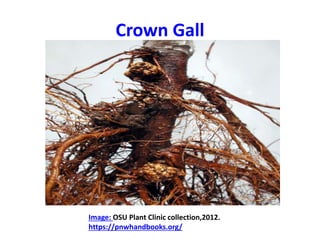
Crown Gall
Image: OSU Plant Clinic collection,2012.
https://pnwhandbooks.org/
Steps in Agrobacterium mediated
gene transfer
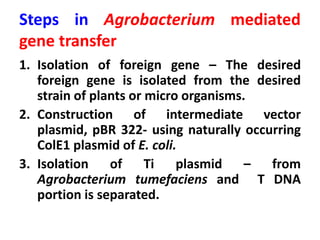
1. Isolation of foreign gene – The desired
foreign gene is isolated from the desired
strain of plants or micro organisms.
2. Construction of intermediate vector
plasmid, pBR 322- using naturally occurring
ColE1 plasmid of E. coli.
3. Isolation of Ti plasmid – from
Agrobacterium tumefaciens and T DNA
portion is separated.
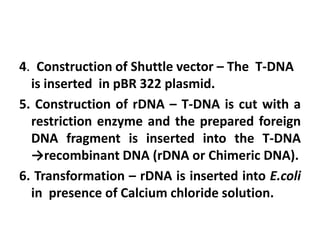
4. Construction of Shuttle vector – The T-DNA
is inserted in pBR 322 plasmid.
5. Construction of rDNA – T-DNA is cut with a
restriction enzyme and the prepared foreign
DNA fragment is inserted into the T-DNA
→recombinant DNA (rDNA or Chimeric DNA).
6. Transformation – rDNA is inserted into E.coli
in presence of Calcium chloride solution.
7. Transformation of Agrobacterium
tumefaciens – The mixture of transformed
E.coli and Agrobacterium tumefaciens are
incubated for a few hours → Conjugation
between E. coli and Agrobacterium →
transfer of rDNA (recombinant plasmid/
chimeric DNA) to Agrobacterium – rDNA
undergo genetic recombination with its Ti
plasmid- inserted foreign gene is transferred
to the unmanipulated Ti plasmid of
Agrobacterium.
8. Transformation of plant cells – The
transformed Agrobacterium are allowed to
infect the cultured plant cells whose
genomes are to be improved – This
Agrobacterium insert the foreign DNA into
plant cells – get integrated with the
homologous sequence of plant genome –
thus the plant cell is genetically transformed
to synthesize the product of the desired
gene.
THANK YOU

GENE TRANSFER TECHNIQUE SMG

  • 1.
    GENE TRANSFER TECHNIQUES SajiMariam George Associate Professor Assumption Autonomous College Changanacherry
  • 2.
    GENE TRANSFER TECHNIQUES (TRANSFORMATIONTECHNIQUES) • Genetic Engineering - Recent approach in Biotechnology →Transfer and expression of foreign genes into higher plants – involves the transfer of specifically constructed gene assemblies through various transformation techniques. • Plants obtained through genetic engineering contain a gene or genes usually from an unrelated organism – transgenes – transgenic plants.
  • 3.
    • Genetic modification(genetic manipulation) of higher plants by introducing DNA into their cells extend their gene pool- create genetic variability – helpful in enhancing their agricultural efficiency. • Uptake of foreign DNA or transgenes by plant cells – Transformation. Gene transfer techniques i) Direct gene transfer techniques –without the involvement of a biological agent. ii) Indirect gene transfer technique – with the involvement of a biological agent, Agrobacterium tumefaciens. (Agrobacterium mediated gene transfer technique)
  • 4.
    Direct Gene TransferTechniques • Introduction of DNA into plant cells without the involvement of a biological agent → transformation. • Spontaneous uptake of DNA by plant cells is very low – employ chemical and physical treatments – facilitate the entry of DNA into plant cells.
  • 5.
    1. Chemically stimulatedDNA uptake by Protoplast  Chemicals – Polyethylene glycol (PEG) Polyvinyl alcohol (PVA) Calcium phosphate
  • 6.
    Chemically stimulated DNAuptake by Poly Ethylene Glycol (PEG)  Mix freshly isolated protoplasts (protoplast = cell without cell wall – prepared by using cell wall degrading enzymes) with DNA(linearised plasmid DNA containing the gene construct ). Add 15 – 20 % of PEG dissolved in a buffer containing divalent cations (Mg ²+, Ca²+).
  • 7.
    Incubate for 30minutes - PEG causes precipitation of ionic molecules like DNA – stimulates their uptake by endocytosis – transforms 0.1 to 0.4 % of the total protoplasts treated. Wash the protoplasts. Treated protoplasts are plated in Petri dish for culture and growth – regenerate cell wall → callus colonies .
  • 8.
    A selectable markeris used for the selection of transformed protoplasts. Regenerate into plants.  Generally used for stable transformation of monocot protoplasts. Used for direct gene transfer in Nicotiana protoplasts.
  • 9.
    2. Transduction ( Zinder& Lederberg 1952)  A mechanism of genetic recombination in Bacteria mediated by a lysogenic (Temperate) phages.  phage – serving as a vector , transferring a portion of bacterial DNA (a few genes) from one bacterium to another.  Temperate phages (Lysogenic phages) – do not lyse host bacterium.  The phage DNA get integrated with the host bacterial chromosome in a non- infectious stage – prophage .
  • 10.
    • Sometimes thephage DNA may get excised from the host bacterial chromosome →initiates Lytic life cycle (Prophage induction). • Packaging error during assembly – may get filled with bacterial chromosomal DNA or a mixture of chromosomal and phage DNA →aberrant or abnormal or transducing phages – attach to other bacteria – introduce bacterial DNA into them.
  • 11.
    Types of Transduction i)Generalized Transduction – a random fragment of bacterial DNA is packaged in the phage head in place of phage chromosome – transducing phages – can transport any bacterial gene from one bacterium to another. e.g. P22 in Salmonella typhimurium , P1 in E.coli.
  • 12.
    Stable gene transferinto recipient cell chromosome
  • 13.
    ii) Specialized Transduction-Transfer only certain genes between bacteria. E.g. Lambda phage carries only the gal (required for the utilization of Galactose – a monosaccharide- as the source of energy) and bio ( essential for the synthesis of Biotin) genes from one E.coli bacterium to another.
  • 14.
  • 15.
  • 16.
    3. Electroporation • Donewith an instrument – Electroporator. • High voltage electricity for a very brief period is used to introduce DNA into cells. • Exposure of cells to high voltage induce transient pores in the plasma membrane – a passage – foreign DNA can enter into the protoplasts – increase transformation frequency. • Optimal voltage and time – depends on plant species, source of protoplasts and resistance of the medium.
  • 17.
    Methods 1. Low voltage– long pulse method: 300 to 400 V cm⁻¹ for 10 – 50 ms (Milliseconds) 2. High voltage – short pulse method:1000- 1500 V cm ⁻¹ for 10 µs (Microseconds)→ high rates of stable transformation.
  • 18.
    • Suspend plantprotoplasts in a suitable ionic solution containing linear recombinant plasmid DNA. • Expose to chosen voltage • Culture → cell colonies → plants Transformation frequency can be enhanced by  Heat – shock to protoplasts just prior to electroporation  Presence of a low concentration (about 8%) of Poly ethylene glycol during electroporation. • Electroporation can also be used to introduce DNA into intact cells – cell wall weakened by a mild enzymatic treatment – DNA entry → cell. • Used in Tobacco, Petunia, Maize etc.
  • 19.
    4. Microinjection Microinjection ofDNA into fertilized eggs or Embryos → transgenic animals. • Eggs are surgically removed from the female parent. • in vitro fertilization. • Microinjection of DNA into the male pronucleus (haploid nucleus contributed by sperm, prior to nuclear fusion) of the fertilized egg through a very fine – tipped glass needle.
  • 20.
  • 21.
    • The injectedzygote is implanted into the female to complete their development. • Integration of injected DNA molecules may occur early during embryonic development at random sites in the genome.
  • 22.
    • The animalsthat develop from the injected eggs (G0 generation) – genetic mosaics- some somatic cells carrying the transgene and others not carrying. • All cells of the progeny of initial transgenic animals carry the transgene.
  • 23.
  • 24.
    TRANSFECTION • Uptake ofDNA by a eukaryotic cell, followed by its incorporation into the cell’s genome - Transforming embryonic stem cells (ES cells) growing in tissue culture with the desired DNA
  • 25.
    • Injection ofDNA into large populations of cultured cells derived from embryonic stem cells – introduce these cells to other developing embryos – some form adult tissues – progeny may contain its own cells and those derived from the cultured transfected ES -cells (Chimeras). • If the ES cells contribute to the chimera’s germ line, the introduced foreign DNA may be transmitted to next generation.
  • 26.
  • 27.
    5. Microprojectiles(Shot gunmethod, Particle gun method, Biolistic process,Particle acceleration, Microprojectile bombardment) Klein et.al. 1988 • Shooting DNA – coated 1- 2 µm tungsten or gold particles into plant cells using a device - accelerates particles by pressurized Helium or electrostatic energy released by a droplet of water exposed to a high voltage. • Can deliver DNA into all tissues
  • 28.
    Gene transfer usingShot gun method Image: http://www.artsci.wustl.edu/~anthro/blurb/fg8.t.gif
  • 29.
  • 30.
    Can be usedto transform  shoot apical meristem  leaf blades  immature and mature embryos  mature pollen etc. Used to produce stable gene transfers in • Cotton • Maize • Rice • Sugar cane • Tobacco etc.
  • 31.
    Indirect Gene TransferTechnique Agrobacterium mediated gene transfer Agrobacterium tumefaciens • a gram negative, rod shaped, motile, soil bacterium. • Invades many dicots and some gymnosperms- enters through fresh wound – attach to the cell wall – transfers a part of its Tumour inducing plasmid (Ti plasmid) known as T-DNA (Transferred DNA) – integrates into host chromosome – causes crown gall – tumourous growth.
  • 32.
    • Two componentsof Ti plasmid , the T-DNA and vir (for virulence ) are essential for the transformation of plant cells – vir region contains genes required for the T-DNA transfer process. • Some genes in the T-DNA encode enzymes - catalyze the synthesis of phytohormones - auxin, IAA and cytokinin, isopentenyl adenosine – responsible for the tumourous growth.
  • 33.
    Ti plasmid –Ideal vector for Plant Genetic Engineering Image: https://en.wikipedia.org/
  • 34.
  • 35.
    Crown Gall Image: OSUPlant Clinic collection,2012. https://pnwhandbooks.org/
  • 36.
    Steps in Agrobacteriummediated gene transfer 1. Isolation of foreign gene – The desired foreign gene is isolated from the desired strain of plants or micro organisms. 2. Construction of intermediate vector plasmid, pBR 322- using naturally occurring ColE1 plasmid of E. coli. 3. Isolation of Ti plasmid – from Agrobacterium tumefaciens and T DNA portion is separated.
  • 37.
    4. Construction ofShuttle vector – The T-DNA is inserted in pBR 322 plasmid. 5. Construction of rDNA – T-DNA is cut with a restriction enzyme and the prepared foreign DNA fragment is inserted into the T-DNA →recombinant DNA (rDNA or Chimeric DNA). 6. Transformation – rDNA is inserted into E.coli in presence of Calcium chloride solution.
  • 38.
    7. Transformation ofAgrobacterium tumefaciens – The mixture of transformed E.coli and Agrobacterium tumefaciens are incubated for a few hours → Conjugation between E. coli and Agrobacterium → transfer of rDNA (recombinant plasmid/ chimeric DNA) to Agrobacterium – rDNA undergo genetic recombination with its Ti plasmid- inserted foreign gene is transferred to the unmanipulated Ti plasmid of Agrobacterium.
  • 39.
    8. Transformation ofplant cells – The transformed Agrobacterium are allowed to infect the cultured plant cells whose genomes are to be improved – This Agrobacterium insert the foreign DNA into plant cells – get integrated with the homologous sequence of plant genome – thus the plant cell is genetically transformed to synthesize the product of the desired gene.
  • 40.