IMMUNOLOGICAL
SCREENING
SUBMITTED TO : PRESENT BY :
NAME : MALA. P NAME : MAHALAKSHMI. B
UNIVERCITY NAME : PMIST, VALLAM, THANJAVUR REGISTER NO :123011356012
DESIGNATION : ASSISTANT PROFESSOR,DEPARTMENT OF BIOTECHNOLOGY YEAR : 1 YEAR MSC
DISTRICT : THANJAVUR BRANCH :BIOTECHNOLOGY
CONTENTS
• INTRODUCTION
• IMMUNOSCREENING
• TYPES
• METHODS
• SCREENING OF RECOMBINANTS
• IMPORTANCE OF IMMUNOLOGICALSCREENING
• MCQ
• REFERENCE
INTRODUCTION
• Immunoscreening is a method of biotechnology used to detect a polypeptide
produced from a cloned gene.
• The term encompasses several different techniques designed for protein
identification, such as Western blotting, using recombinant DNA, and analyzing
antibody-peptide interactions.
• cDNA is cloned Into the expression Vector under the Control of the Bacterial
lac promotor.
IMMUNOSCREENING
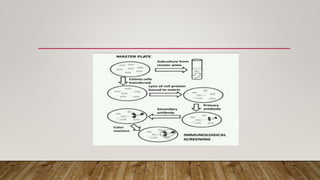
• Recombinant phages are plated out onto a suitable bacterial host on agar plates.
• Incubated untill small plaques appear
• Place a nitrocellulose sheet soaked in IPTG on top of the plaques.
• It bind the proteins produced by the E. Coli cells after lyse by the phage infection.
• Peel off the nitrocellulose membrane.
• Incubate membrane with a specific Antibody
• Incubated membarane with a labelled secondary antibody to detect the presence of
the bound primary antibody.
TYPES
Immunological techniques, such as
• ELISA [1], RIA [2] and fluorescence immunoassays [3], and chemoluminescence
immunoassays [4] have been conventionally applied in a wide range of areas,
including disease diagnosis, clinical therapy, environmental monitoring, and food
analysis.
• METHODS OF IMMUNOSCREENING :
• The term encompasses several different techniques designed for protein
identification, such as Western blotting, using recombinant DNA, and analyzing
antibody-peptide interactions.
ELISA
• The enzyme-linked immunosorbent assay (ELISA) is a commonly used analytical
biochemistry assay, first described by Eva Engvall and Peter Perlmann in 1971. The
assay is a solid-phase type of enzyme immunoassay (EIA) to detect the presence of a
ligand (commonly a protein) in a liquid sample using antibodies directed against the
protein to be measured. ELISA has been used as a diagnostic tool in medicine, plant
pathology, and biotechnology, as well as a quality control check in various industries.
• BLODS : A blot, in molecular biology and genetics, is a method of transferring
proteins, DNA or RNA onto a carrier (for example, a nitrocellulose, polyvinylidene
fluoride or nylon membrane). In many instances, this is done after a gel
electrophoresis, transferring the molecules from the gel onto the blotting membrane,
and other times adding the samples directly onto the membrane
• After the blotting, the transferred proteins, DNA or RNA are then visualized by
colorant staining (for example, silver staining of proteins), autoradiographic
visualization of radiolabelled molecules (performed before the blot), or specific
labelling of some proteins or nucleic acids
• RIA : The full form of RIA is Radioimmunoassay. Radioimmuno assay is a highly
sensitive method to determine an antigen’s concentration in a sample. This
technique was introduced by Rosalyn Yalow and Solomon Berson for the
detection of insulin in human blood.
IMPORTANCE OF IMMUNOLOGICAL SCREENING
• These methods have been used extensively for the detection and quantification
of foreign proteins in materials derived from a single major commodity, and to a
lesser extent to assist with establishing the pattern of sensitivity of a given
individual to the different proteins in a given food.
• Immunological tests can also be used to detect viruses. Examples include
hepatitis C, HIV or HPV viruses.
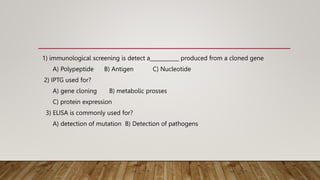
1) immunological screening is detect a___________ produced from a cloned gene
A) Polypeptide B) Antigen C) Nucleotide
2) IPTG used for?
A) gene cloning B) metabolic prosses
C) protein expression
3) ELISA is commonly used for?
A) detection of mutation B) Detection of pathogens
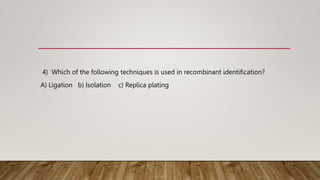
4) Which of the following techniques is used in recombinant identification?
A) Ligation b) Isolation c) Replica plating
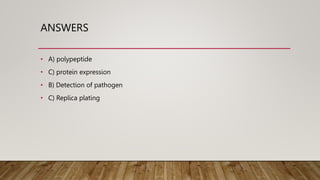
ANSWERS
• A) polypeptide
• C) protein expression
• B) Detection of pathogen
• C) Replica plating
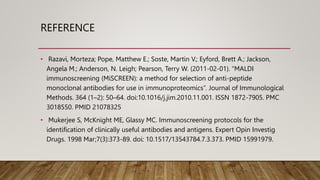
REFERENCE
• Razavi, Morteza; Pope, Matthew E.; Soste, Martin V.; Eyford, Brett A.; Jackson,
Angela M.; Anderson, N. Leigh; Pearson, Terry W. (2011-02-01). “MALDI
immunoscreening (MiSCREEN): a method for selection of anti-peptide
monoclonal antibodies for use in immunoproteomics”. Journal of Immunological
Methods. 364 (1–2): 50–64. doi:10.1016/j.jim.2010.11.001. ISSN 1872-7905. PMC
3018550. PMID 21078325
• Mukerjee S, McKnight ME, Glassy MC. Immunoscreening protocols for the
identification of clinically useful antibodies and antigens. Expert Opin Investig
Drugs. 1998 Mar;7(3):373-89. doi: 10.1517/13543784.7.3.373. PMID 15991979.
• Karam, James (November 26, 1990). Methods in Nucleic Acids Research. CRC
Press. P. 309. ISBN 0849353114.
Thank you

Recombinant DNA technology (Immunological screening)

  • 1.
    IMMUNOLOGICAL SCREENING SUBMITTED TO :PRESENT BY : NAME : MALA. P NAME : MAHALAKSHMI. B UNIVERCITY NAME : PMIST, VALLAM, THANJAVUR REGISTER NO :123011356012 DESIGNATION : ASSISTANT PROFESSOR,DEPARTMENT OF BIOTECHNOLOGY YEAR : 1 YEAR MSC DISTRICT : THANJAVUR BRANCH :BIOTECHNOLOGY
  • 2.
    CONTENTS • INTRODUCTION • IMMUNOSCREENING •TYPES • METHODS • SCREENING OF RECOMBINANTS • IMPORTANCE OF IMMUNOLOGICALSCREENING • MCQ • REFERENCE
  • 3.
    INTRODUCTION • Immunoscreening isa method of biotechnology used to detect a polypeptide produced from a cloned gene. • The term encompasses several different techniques designed for protein identification, such as Western blotting, using recombinant DNA, and analyzing antibody-peptide interactions. • cDNA is cloned Into the expression Vector under the Control of the Bacterial lac promotor.
  • 4.
    IMMUNOSCREENING • Recombinant phagesare plated out onto a suitable bacterial host on agar plates. • Incubated untill small plaques appear • Place a nitrocellulose sheet soaked in IPTG on top of the plaques. • It bind the proteins produced by the E. Coli cells after lyse by the phage infection. • Peel off the nitrocellulose membrane. • Incubate membrane with a specific Antibody • Incubated membarane with a labelled secondary antibody to detect the presence of the bound primary antibody.
  • 5.
    TYPES Immunological techniques, suchas • ELISA [1], RIA [2] and fluorescence immunoassays [3], and chemoluminescence immunoassays [4] have been conventionally applied in a wide range of areas, including disease diagnosis, clinical therapy, environmental monitoring, and food analysis. • METHODS OF IMMUNOSCREENING : • The term encompasses several different techniques designed for protein identification, such as Western blotting, using recombinant DNA, and analyzing antibody-peptide interactions.
  • 6.
    ELISA • The enzyme-linkedimmunosorbent assay (ELISA) is a commonly used analytical biochemistry assay, first described by Eva Engvall and Peter Perlmann in 1971. The assay is a solid-phase type of enzyme immunoassay (EIA) to detect the presence of a ligand (commonly a protein) in a liquid sample using antibodies directed against the protein to be measured. ELISA has been used as a diagnostic tool in medicine, plant pathology, and biotechnology, as well as a quality control check in various industries. • BLODS : A blot, in molecular biology and genetics, is a method of transferring proteins, DNA or RNA onto a carrier (for example, a nitrocellulose, polyvinylidene fluoride or nylon membrane). In many instances, this is done after a gel electrophoresis, transferring the molecules from the gel onto the blotting membrane, and other times adding the samples directly onto the membrane
  • 7.
    • After theblotting, the transferred proteins, DNA or RNA are then visualized by colorant staining (for example, silver staining of proteins), autoradiographic visualization of radiolabelled molecules (performed before the blot), or specific labelling of some proteins or nucleic acids • RIA : The full form of RIA is Radioimmunoassay. Radioimmuno assay is a highly sensitive method to determine an antigen’s concentration in a sample. This technique was introduced by Rosalyn Yalow and Solomon Berson for the detection of insulin in human blood.
  • 9.
    IMPORTANCE OF IMMUNOLOGICALSCREENING • These methods have been used extensively for the detection and quantification of foreign proteins in materials derived from a single major commodity, and to a lesser extent to assist with establishing the pattern of sensitivity of a given individual to the different proteins in a given food. • Immunological tests can also be used to detect viruses. Examples include hepatitis C, HIV or HPV viruses.
  • 10.
    1) immunological screeningis detect a___________ produced from a cloned gene A) Polypeptide B) Antigen C) Nucleotide 2) IPTG used for? A) gene cloning B) metabolic prosses C) protein expression 3) ELISA is commonly used for? A) detection of mutation B) Detection of pathogens
  • 11.
    4) Which ofthe following techniques is used in recombinant identification? A) Ligation b) Isolation c) Replica plating
  • 12.
    ANSWERS • A) polypeptide •C) protein expression • B) Detection of pathogen • C) Replica plating
  • 13.
    REFERENCE • Razavi, Morteza;Pope, Matthew E.; Soste, Martin V.; Eyford, Brett A.; Jackson, Angela M.; Anderson, N. Leigh; Pearson, Terry W. (2011-02-01). “MALDI immunoscreening (MiSCREEN): a method for selection of anti-peptide monoclonal antibodies for use in immunoproteomics”. Journal of Immunological Methods. 364 (1–2): 50–64. doi:10.1016/j.jim.2010.11.001. ISSN 1872-7905. PMC 3018550. PMID 21078325 • Mukerjee S, McKnight ME, Glassy MC. Immunoscreening protocols for the identification of clinically useful antibodies and antigens. Expert Opin Investig Drugs. 1998 Mar;7(3):373-89. doi: 10.1517/13543784.7.3.373. PMID 15991979.
  • 14.
    • Karam, James(November 26, 1990). Methods in Nucleic Acids Research. CRC Press. P. 309. ISBN 0849353114.
  • 15.