Internet, electronic genre,  and writing Multiliteracies and the changing landscape of communication when  we  are the arbiters of what gets published Lecture 1 in Writing in a Multiliterate Flat World Multiliterate approaches to writing and collaboration through social networking Vance Stevens, Petroleum Institute Abu Dhabi, United Arab Emirates XXVI Summer Courses of the University of the Basque Country San Sebastian, Spain, 11th-13th July 2007
Perspective: Three Lectures Lecture 1  – an explication of Web 2.0 and multiliteracy,  Impact of Web 2.0 on the nature of learning in general,  and on writing in particular.  Lecture 2 - writing and collaborating online Motivation and the need to communicate a point,  The importance of an audience The nature of that audience, both from the point of view of  collaborating 'writers'  and commenters on their blogs. Lecture 3 - more technical.  Taking the concepts laid out in the first two talks, how do we do it?  Writingmatrix and what we have learned about aggregation and tagging Similar work by Barbara Dieu, Rudolf Amman, and Aaron Campbell on  http://www.dekita.org   Tricks of newsmastering as shown me by Robin Good
Course Components A portal at http://www.vancestevens.com/writing.htm   Mirrored at:  http://www.prof2000.pt/users/vstevens/writing.htm   A Moodle here http://www.opensource.idv.tw/moodle/course/view.php?id=46   Please register! The key is  thewebisflat Introduce yourself Please take the survey at the Moodle Add your picture to the Frappr map
Web 2.0 and Multiliteracy New-age Expectations for Writing Several analogical literacy practices have migrated to Internet.  Now common genres of writing are  Emails and instant messages Wikis and blogs,  Web pages, and more.  As we increasingly read on screen and write with keyboard and mouse, we are faced with new expectations to understand, find, analyse, critique, organize, and assimilate information from numerous other media besides.  to create and communicate appropriately in numerous and often only just emerging media genres.  From Shift Happens:  http://www.glumbert.com/media/shift   We are training peole for jobs that haven’t been invented yet  4:16 Using technologiies that haven’t been developed yet  4:07
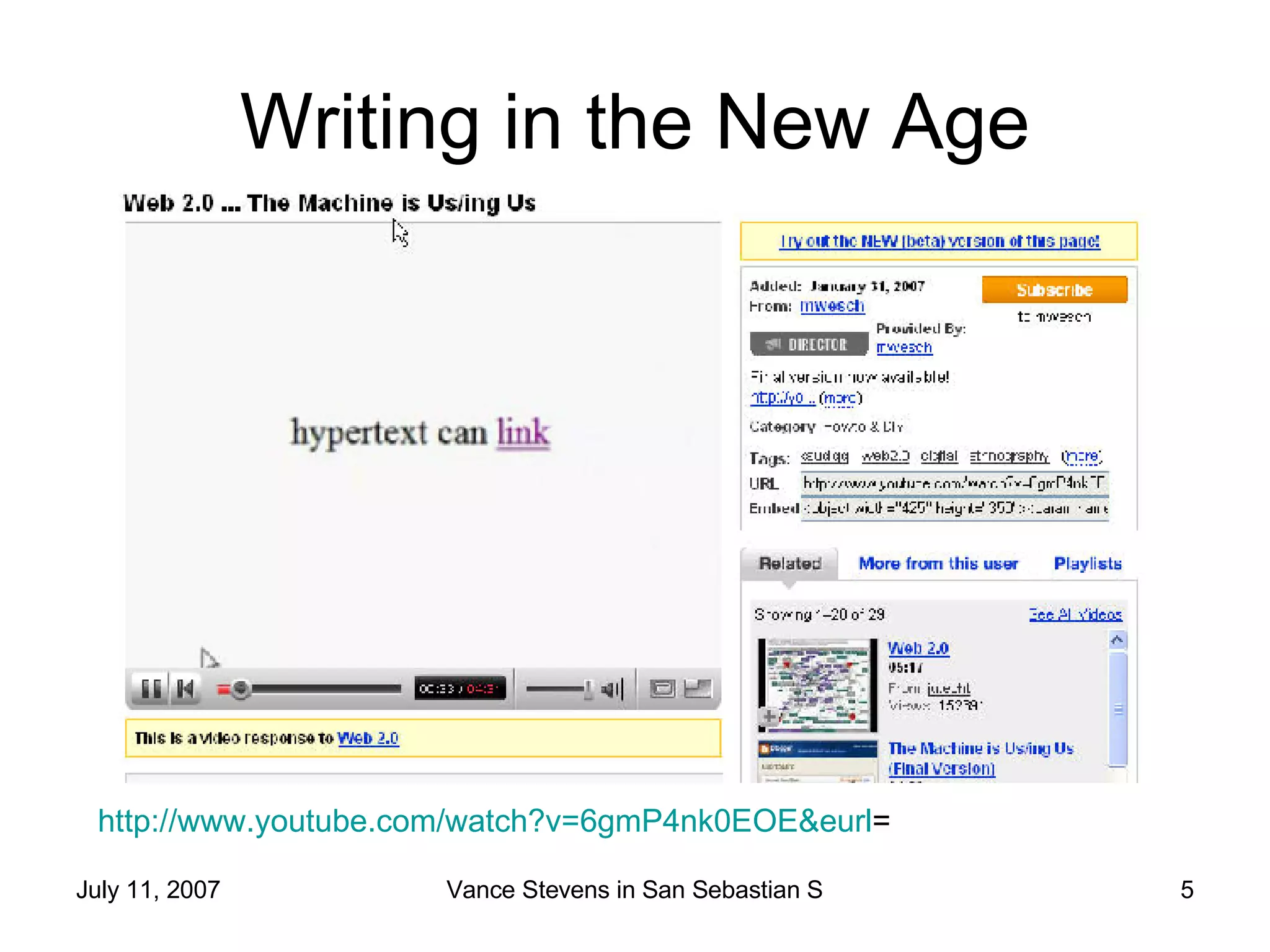
Writing in the New Age http://www.youtube.com/watch?v=6gmP4nk0EOE&eurl =
Multiliteracies:  Raising new-age questions New questions How has Internet changed literacy practices?  Which are the most relevant electronic genres in L2 learning in general, and writing in particular  How can we use them?  I address these questions and the multiliteracy issues involved in an online course I teach annually for the TESOL Certificate Program: Principles and Practices of Online Teaching http://www.homestead.com/prosites-vstevens/files/efi/papers/tesol/ppot/portal2007.htm
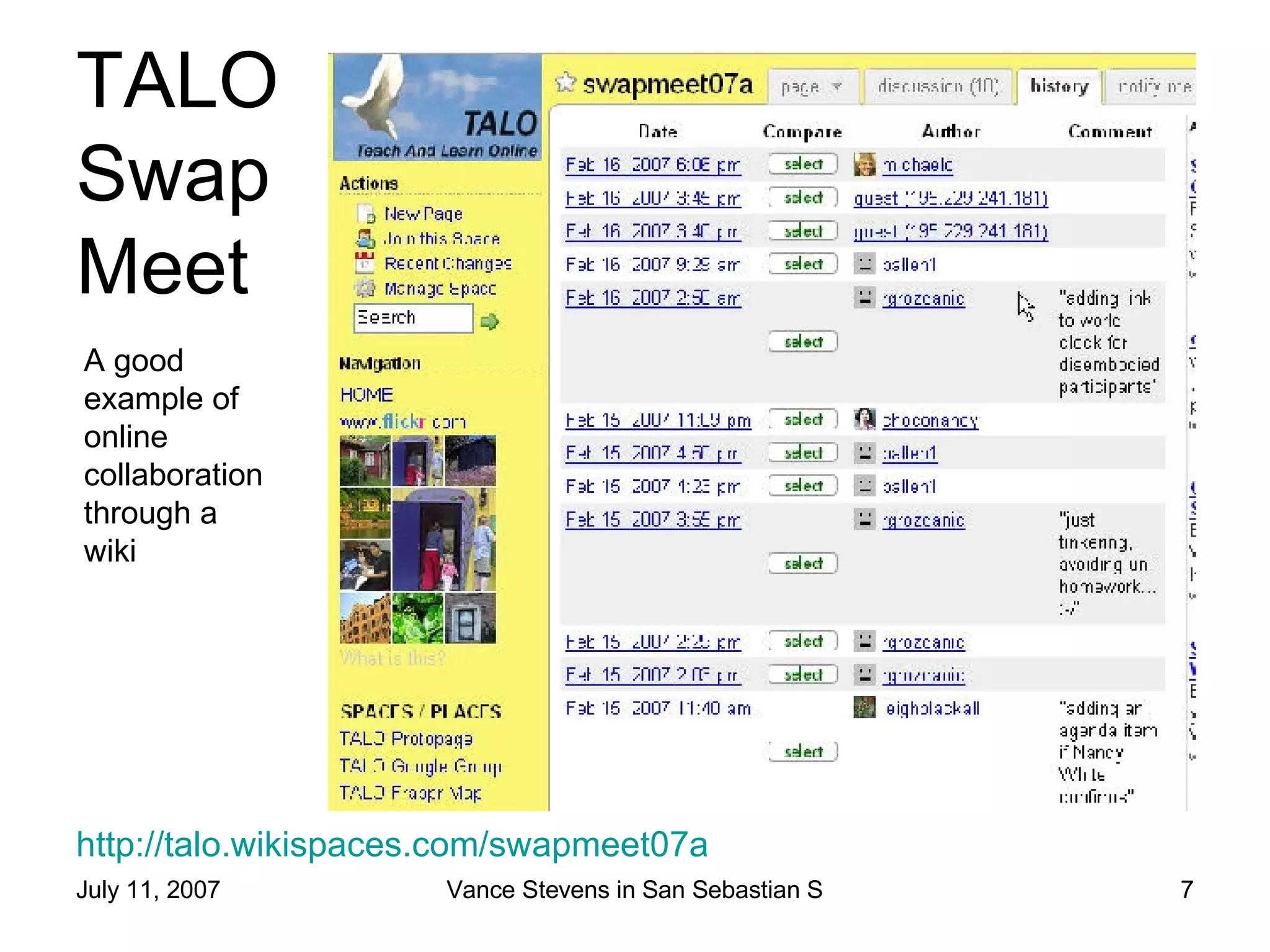
TALO Swap Meet http://talo.wikispaces.com/swapmeet07a   A good example of online collaboration through a wiki
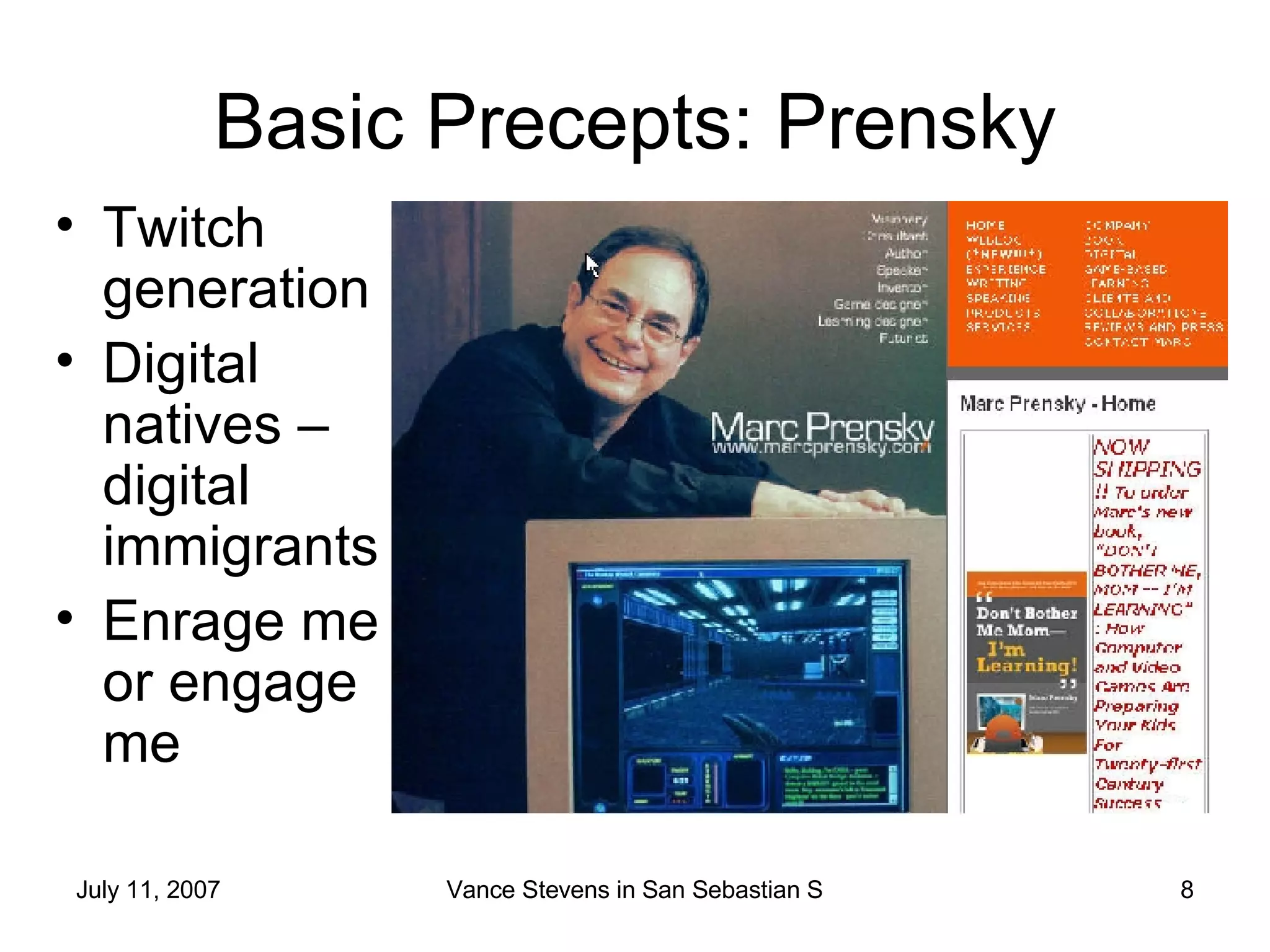
Basic Precepts: Prensky Twitch generation Digital natives – digital immigrants Enrage me or engage me
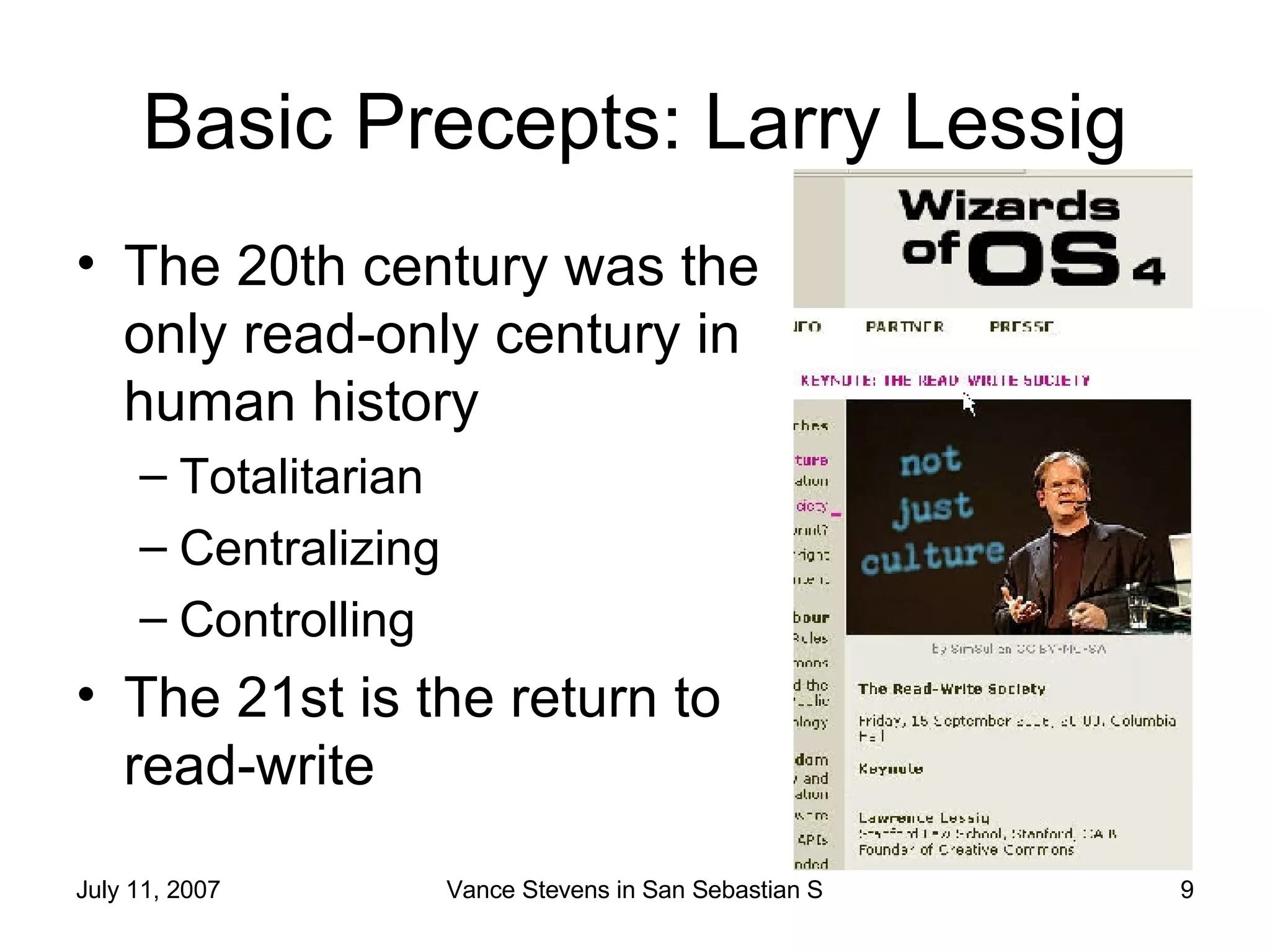
Basic Precepts: Larry Lessig The 20th century was the only read-only century in human history Totalitarian Centralizing Controlling The 21st is the return to read-write
Read-write Web: Conversations In most good web sites today, there are numerous ways you can interact. leave a comment,  take a poll,  rate the site,  review it use a service that tells you who else is on the site at the same time you are
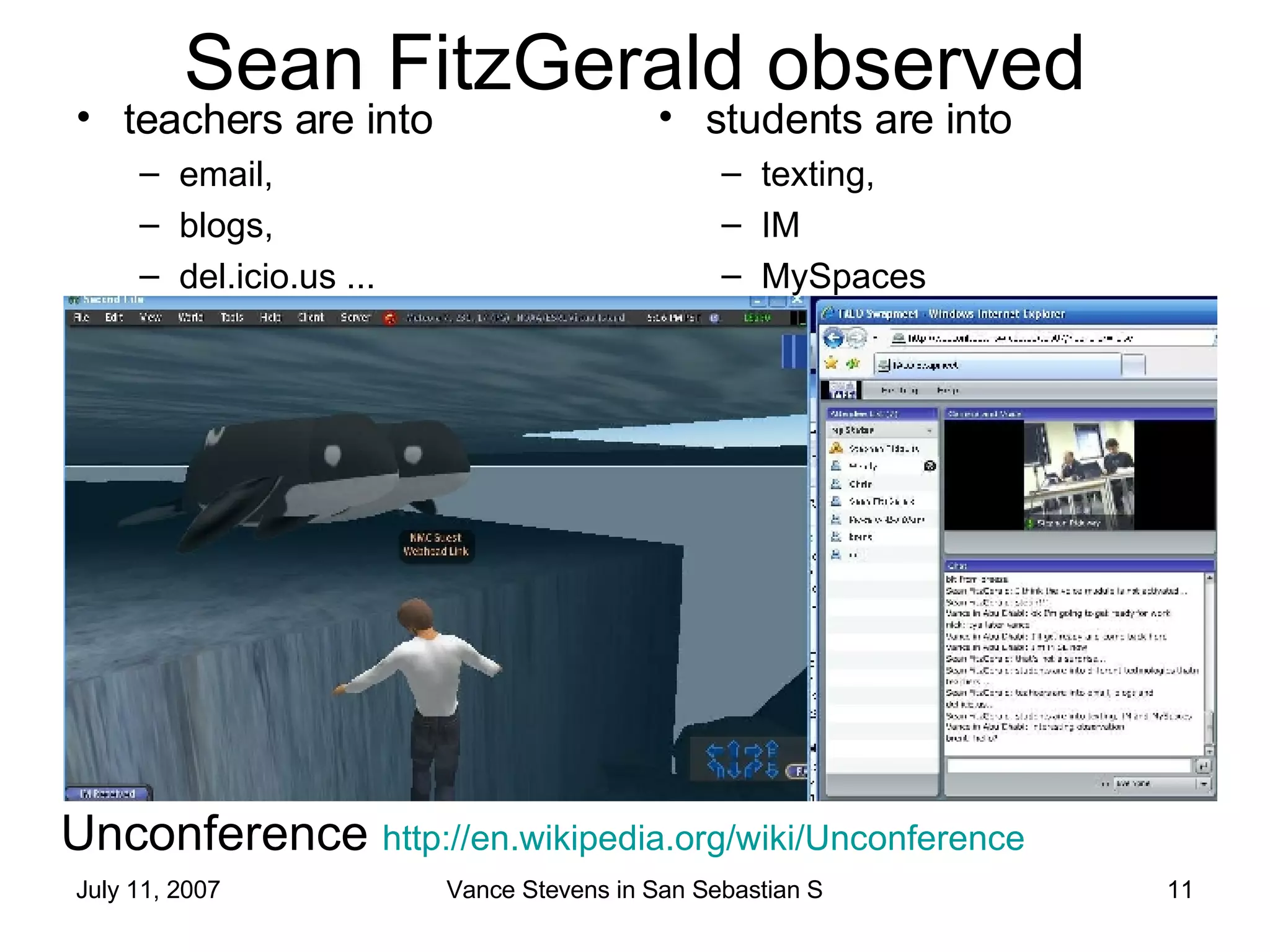
Sean FitzGerald observed teachers are into  email, blogs,  del.icio.us ...  students are into  texting,  IM MySpaces Unconference  http ://en.wikipedia.org/wiki/Unconference
Multiliteracies (per Selber) Functional - use technology fluidly, to the point where you use it comfortably, seamlessly, and control it rather than it controls you, Rhetorical - you know how to communicate with others about how you use, develop, and repair technology Critical - you are able to understand and articulate the many impacts of technology on our lives and those of others in other walks of life and economic strata
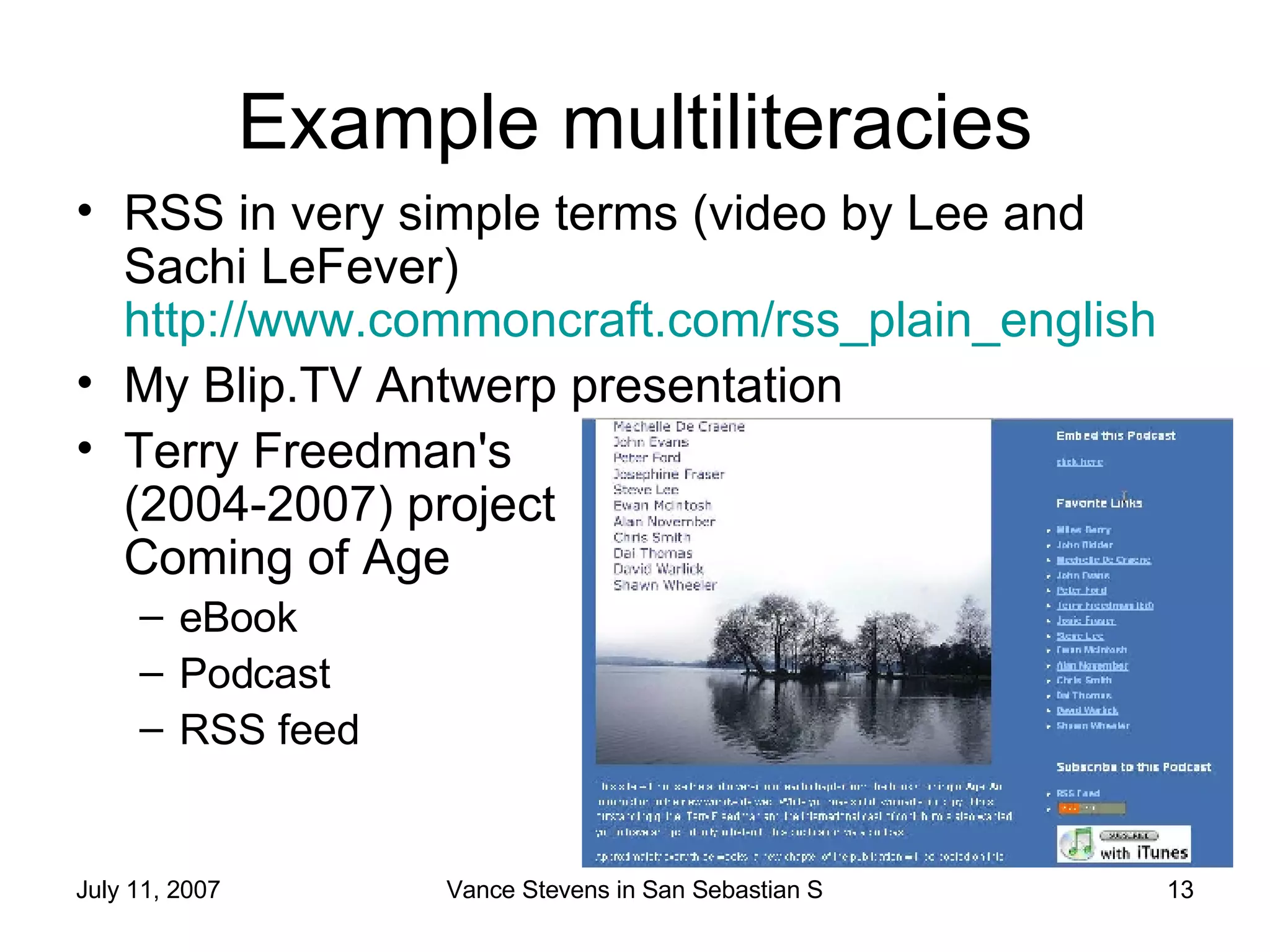
Example multiliteracies RSS in very simple terms (video by Lee and Sachi LeFever)  http://www.commoncraft.com/rss_plain_english   My Blip.TV Antwerp presentation  Terry Freedman's  (2004-2007) project  Coming of Age eBook Podcast RSS feed
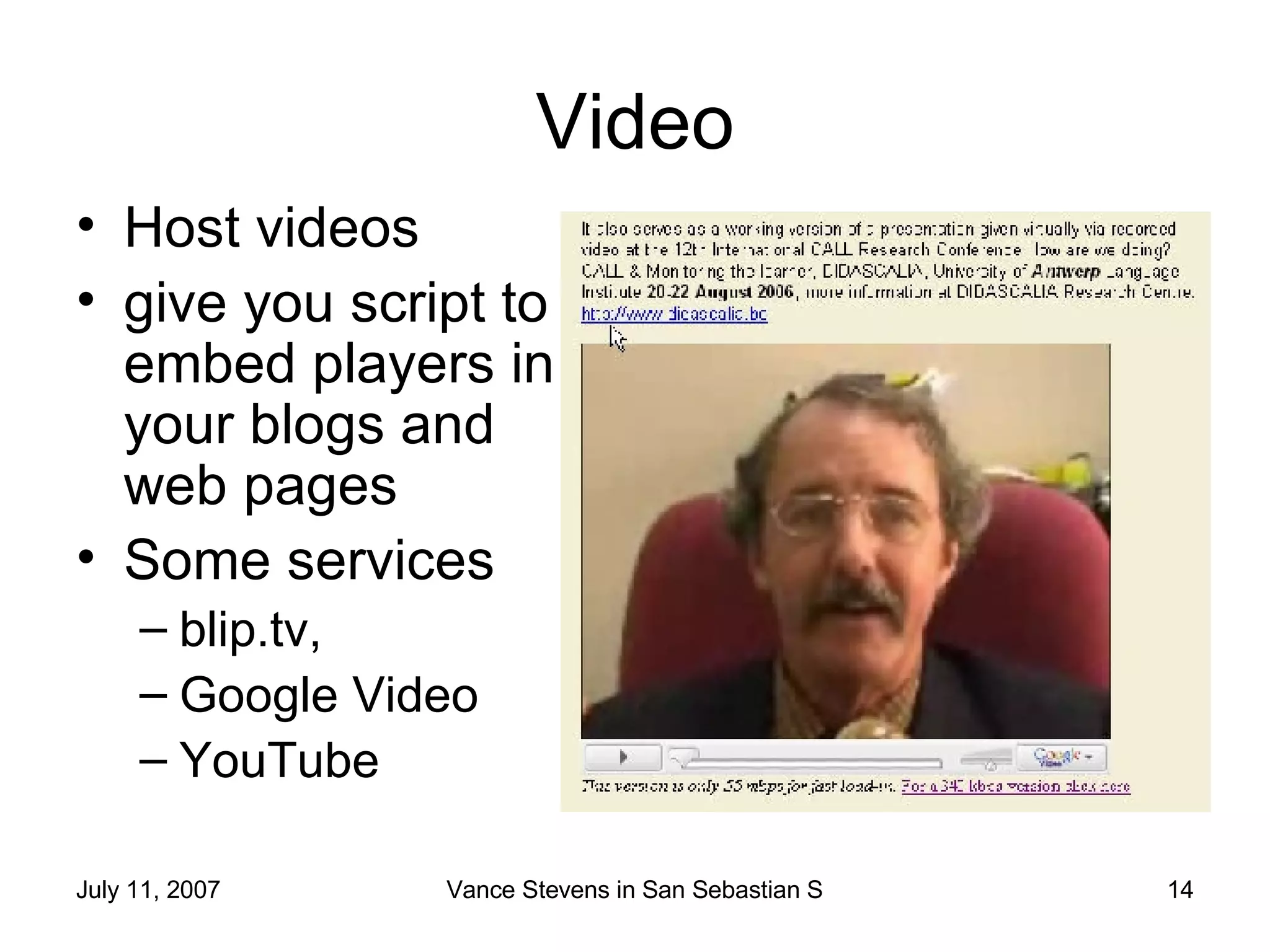
Video Host videos give you script to embed players in your blogs and web pages Some services blip.tv,  Google Video YouTube
Web 2.0 Tim Berners-Lee: “Web 2.0 is, of course, a piece of jargon, nobody even knows what it means. If Web 2.0 for you is blogs and wikis, then that is people to people. But that was what the Web was supposed to be all along."  trend on the Internet for tools to be created and shared for free at web sites which  allow users to create web artifacts  upload their own files  produce web artifacts which might be even hosted on the site, seemingly forever
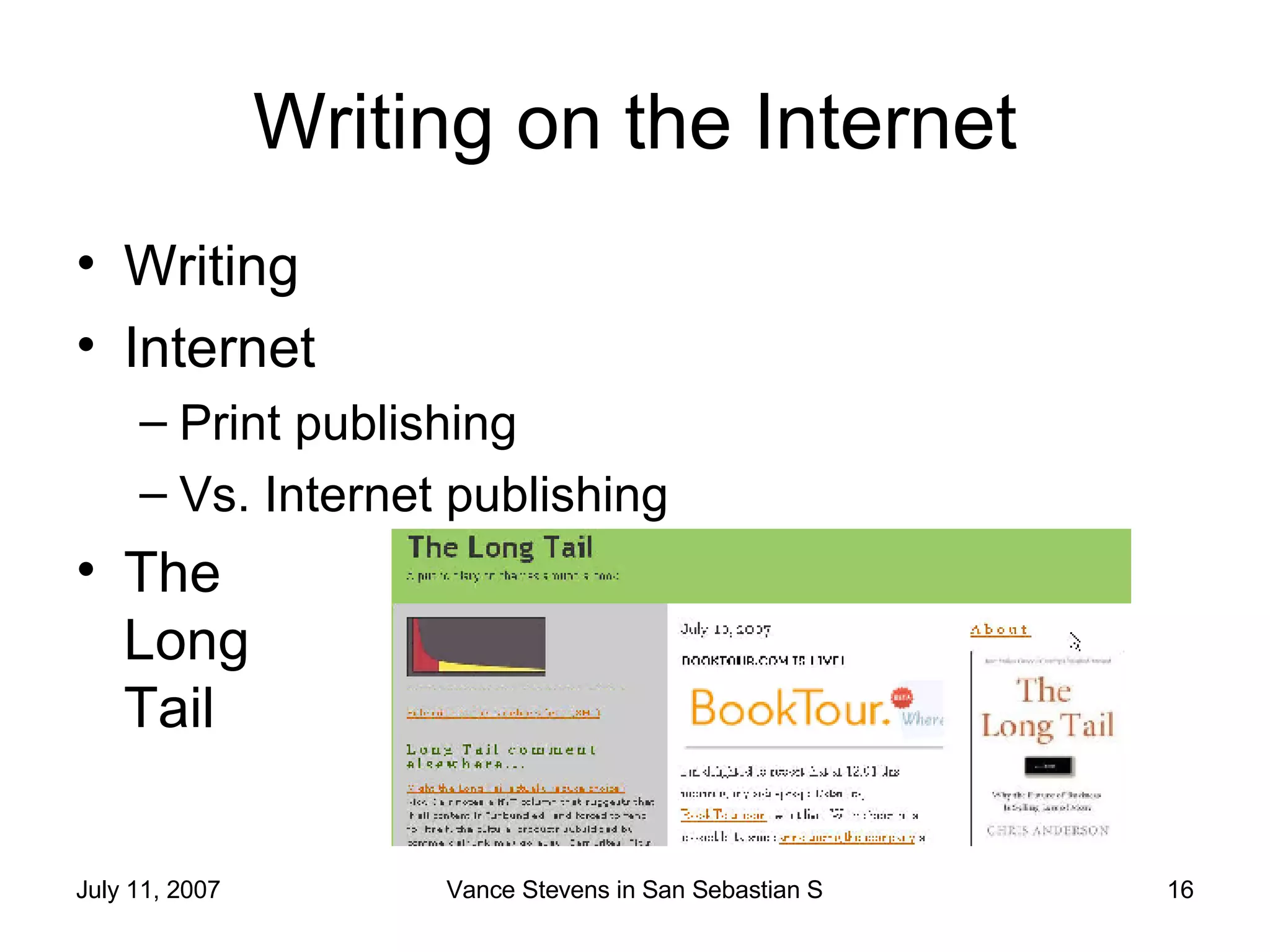
Writing on the Internet Writing Internet Print publishing Vs. Internet publishing The  Long  Tail
Digital Storytelling http://www.storycenter.org/index1.html   http://electronicportfolios.com/digistory/ Wesley Fryer http://www.speedofcreativity.org/category/edtech/digitalstorytelling/ http://teachdigital.pbwiki.com/digitalstorytelling
Webpresence of ‘You’ Time's Person of the Year:  You . Time Magazine, Wednesday, Dec. 13, 2006 http://tinyurl.com/3chjkb YOU can create a blog start a wiki post photos on Flickr create freely accessible and creative online presentations with those photos or with your PowerPoint slides.
YOU and others: Collaboration Share via creative commons, non-commercial, share and share alike, license (another significant break from traditional publishing).  Collaborate on  spreadsheets to manipulate data necessary to your work charts made in Gliffy  concept mapping tool talk with collaborators in real time, not just text chat record your conversations using free tools (like audacity, and virtual audio cables which you need to get both sides of a Skype conversation, or use Powergamo)  Manipulate and embed recordings that others have made
What do you lose? Quality? Encyclopedia or Wikipedia  currency is better with Wikipedia scope (something like 750,000 articles in Wikipedi Retrieval - words in those articles are machine-searchable vs. relatively crude index.  integrity and bias of that information?  article in Nature Heavy metal umlaut http://weblog.infoworld.com/udell/gems/umlaut.html
Conversations in Web text Interchanging roles of readers and writers reading and writing resemble conversations with  Text Thought wording, playing with words anticipating an audience reaction, a real or imaginary one.  Wikipedia Blogs
For next time (tomorrow) Start a blog if you don’t have one already http://www.vancestevens.com/blogs.htm   http://www.homestead.com/prosites-vstevens/files/efi/blogger_tutorial.htm   Create a post TAG the post thewebisflat Tomorrow, we’ll learn how to find and what to do with your tagged posts
See you tomorrow Vance Stevens http://www.vancestevens.com/vance.htm

Lecture1 San Sebastian 2007: Internet, electronic genre and writing

  • 1.
    Internet, electronic genre, and writing Multiliteracies and the changing landscape of communication when we are the arbiters of what gets published Lecture 1 in Writing in a Multiliterate Flat World Multiliterate approaches to writing and collaboration through social networking Vance Stevens, Petroleum Institute Abu Dhabi, United Arab Emirates XXVI Summer Courses of the University of the Basque Country San Sebastian, Spain, 11th-13th July 2007
  • 2.
    Perspective: Three LecturesLecture 1 – an explication of Web 2.0 and multiliteracy, Impact of Web 2.0 on the nature of learning in general, and on writing in particular. Lecture 2 - writing and collaborating online Motivation and the need to communicate a point, The importance of an audience The nature of that audience, both from the point of view of collaborating 'writers' and commenters on their blogs. Lecture 3 - more technical. Taking the concepts laid out in the first two talks, how do we do it? Writingmatrix and what we have learned about aggregation and tagging Similar work by Barbara Dieu, Rudolf Amman, and Aaron Campbell on http://www.dekita.org Tricks of newsmastering as shown me by Robin Good
  • 3.
    Course Components Aportal at http://www.vancestevens.com/writing.htm Mirrored at: http://www.prof2000.pt/users/vstevens/writing.htm A Moodle here http://www.opensource.idv.tw/moodle/course/view.php?id=46 Please register! The key is thewebisflat Introduce yourself Please take the survey at the Moodle Add your picture to the Frappr map
  • 4.
    Web 2.0 andMultiliteracy New-age Expectations for Writing Several analogical literacy practices have migrated to Internet. Now common genres of writing are Emails and instant messages Wikis and blogs, Web pages, and more. As we increasingly read on screen and write with keyboard and mouse, we are faced with new expectations to understand, find, analyse, critique, organize, and assimilate information from numerous other media besides. to create and communicate appropriately in numerous and often only just emerging media genres. From Shift Happens: http://www.glumbert.com/media/shift We are training peole for jobs that haven’t been invented yet 4:16 Using technologiies that haven’t been developed yet 4:07
  • 5.
    Writing in theNew Age http://www.youtube.com/watch?v=6gmP4nk0EOE&eurl =
  • 6.
    Multiliteracies: Raisingnew-age questions New questions How has Internet changed literacy practices? Which are the most relevant electronic genres in L2 learning in general, and writing in particular How can we use them? I address these questions and the multiliteracy issues involved in an online course I teach annually for the TESOL Certificate Program: Principles and Practices of Online Teaching http://www.homestead.com/prosites-vstevens/files/efi/papers/tesol/ppot/portal2007.htm
  • 7.
    TALO Swap Meethttp://talo.wikispaces.com/swapmeet07a A good example of online collaboration through a wiki
  • 8.
    Basic Precepts: PrenskyTwitch generation Digital natives – digital immigrants Enrage me or engage me
  • 9.
    Basic Precepts: LarryLessig The 20th century was the only read-only century in human history Totalitarian Centralizing Controlling The 21st is the return to read-write
  • 10.
    Read-write Web: ConversationsIn most good web sites today, there are numerous ways you can interact. leave a comment, take a poll, rate the site, review it use a service that tells you who else is on the site at the same time you are
  • 11.
    Sean FitzGerald observedteachers are into email, blogs, del.icio.us ... students are into texting, IM MySpaces Unconference http ://en.wikipedia.org/wiki/Unconference
  • 12.
    Multiliteracies (per Selber)Functional - use technology fluidly, to the point where you use it comfortably, seamlessly, and control it rather than it controls you, Rhetorical - you know how to communicate with others about how you use, develop, and repair technology Critical - you are able to understand and articulate the many impacts of technology on our lives and those of others in other walks of life and economic strata
  • 13.
    Example multiliteracies RSSin very simple terms (video by Lee and Sachi LeFever) http://www.commoncraft.com/rss_plain_english My Blip.TV Antwerp presentation Terry Freedman's (2004-2007) project Coming of Age eBook Podcast RSS feed
  • 14.
    Video Host videosgive you script to embed players in your blogs and web pages Some services blip.tv, Google Video YouTube
  • 15.
    Web 2.0 TimBerners-Lee: “Web 2.0 is, of course, a piece of jargon, nobody even knows what it means. If Web 2.0 for you is blogs and wikis, then that is people to people. But that was what the Web was supposed to be all along." trend on the Internet for tools to be created and shared for free at web sites which allow users to create web artifacts upload their own files produce web artifacts which might be even hosted on the site, seemingly forever
  • 16.
    Writing on theInternet Writing Internet Print publishing Vs. Internet publishing The Long Tail
  • 17.
    Digital Storytelling http://www.storycenter.org/index1.html http://electronicportfolios.com/digistory/ Wesley Fryer http://www.speedofcreativity.org/category/edtech/digitalstorytelling/ http://teachdigital.pbwiki.com/digitalstorytelling
  • 18.
    Webpresence of ‘You’Time's Person of the Year: You . Time Magazine, Wednesday, Dec. 13, 2006 http://tinyurl.com/3chjkb YOU can create a blog start a wiki post photos on Flickr create freely accessible and creative online presentations with those photos or with your PowerPoint slides.
  • 19.
    YOU and others:Collaboration Share via creative commons, non-commercial, share and share alike, license (another significant break from traditional publishing). Collaborate on spreadsheets to manipulate data necessary to your work charts made in Gliffy concept mapping tool talk with collaborators in real time, not just text chat record your conversations using free tools (like audacity, and virtual audio cables which you need to get both sides of a Skype conversation, or use Powergamo) Manipulate and embed recordings that others have made
  • 20.
    What do youlose? Quality? Encyclopedia or Wikipedia currency is better with Wikipedia scope (something like 750,000 articles in Wikipedi Retrieval - words in those articles are machine-searchable vs. relatively crude index. integrity and bias of that information? article in Nature Heavy metal umlaut http://weblog.infoworld.com/udell/gems/umlaut.html
  • 21.
    Conversations in Webtext Interchanging roles of readers and writers reading and writing resemble conversations with Text Thought wording, playing with words anticipating an audience reaction, a real or imaginary one. Wikipedia Blogs
  • 22.
    For next time(tomorrow) Start a blog if you don’t have one already http://www.vancestevens.com/blogs.htm http://www.homestead.com/prosites-vstevens/files/efi/blogger_tutorial.htm Create a post TAG the post thewebisflat Tomorrow, we’ll learn how to find and what to do with your tagged posts
  • 23.
    See you tomorrowVance Stevens http://www.vancestevens.com/vance.htm