Web 2.0 is Connecting Learners  Amanda Rablin Brisbane Catholic Education 13 October, 2008
A warning This presentation may contain: Over generalisations (to stimulate discussion) Sharing stories (mine and yours) Rhetorical & Philosophical Questions that I may invite you to reflect on and discuss Some theoretical and academic stuff Reflections on Connectedness from someone still learning to be “connected”
What do we mean by Web 2.0? Creating Participating Remixing Connecting & Collaborating Network as platform Its power is in connecting people
http://blog.getoutsmart.com/archives/2006/08/09/a-web-20-by-any-other-name/
http://au.youtube.com/watch?v=qiP79vYsfbo
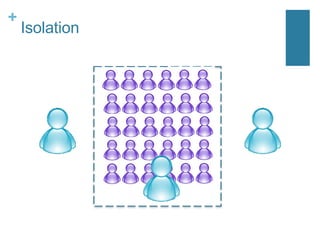
Isolation
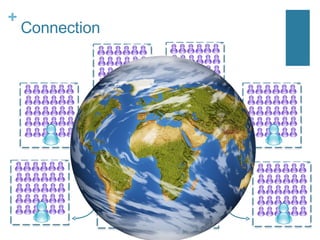
Connection
Trends in Technologies Horizon Report 2008 Grassroots Video    – anyone can capture, edit, upload and share Collaboration webs    – create, edit, share, hold meetings in a browser Mobile broadband    – mobile devices with internet connectivity Data mashups    – custom applications combining data in new ways Collective Intelligence    – knowledge emerging from large groups Social Operating Systems    – networks  organised around people www.nmc.org/pdf/2008-Horizon-Report.pdf
Categories for Online Learning Social (Learning) Networking and Collaboration ePortfolio Synchronous Communication Tools Virtual Worlds Course/Learning Management Digital Repository
So is Web 2.0 connecting learners? Do the connections exist only because of these technologies? What Web 2.0 tools do you use for your learning? Why? What tools have you used to support student learning for: Inquiring? Creating? Communicating? Participating?  and how?
What do we mean by Learning in a Web 2.0 world? We have the ability to contribute our own ideas and experiences to the sum of human knowledge that we are building online, the impact of the Web is even more powerful.  - Will Richardson -
George Siemens, Global Summit 2006
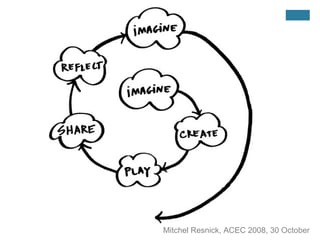
Mitchel Resnick, ACEC 2008 , 30 October
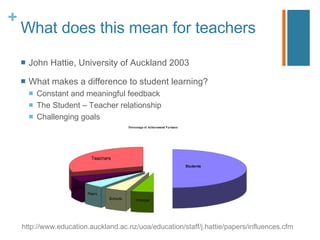
What does this mean for teachers John Hattie, University of Auckland 2003 What makes a difference to student learning? Constant and meaningful feedback  The Student – Teacher relationship  Challenging goals  http://www.education.auckland.ac.nz/uoa/education/staff/j.hattie/papers/influences.cfm
Paradigm Grid, Stephenson and Coomey, 2001 Metaphor, Brisbane Catholic Education, 2008
Practically Speaking… Social (Learning) Networking and Collaboration Global projects on think.com ePortfolio  + Students creating visible portfolios and reflections for open feedback Synchronous Communication Tools Using tools like skype to talk to other classrooms  Virtual Worlds  + Skoolaborate schools collaborating globally in Second Life Course/Learning Management Integrating collaborative and class content Digital Repository Sharing, creating and tagging content together.
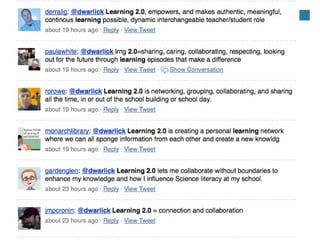
Some responses via we used a wiki with a school in Scotland & shared lifestyles, interests etc  Pam Thompson, Adelaide,  A collaborative wiki with Kenya  http://kiwisforkenya.wetpaint.com  plus our class blog  http://m3rbs.21classes.com   Erin Freeman, Christchurch, NZ I think we do every day thru blogs. Links to students all over world and Aus. My kids feel they know these other kids.  Denise Juler, Brisbane Students being globally CONNECTED and learning together  Amanda Marrinan, Brisbane  http://2mgems.blogspot.com/2008/09/talking-about-learning.html   5:48 – 6:31 global conections? From a student re connections  http://tinyurl.com/59c6pjSdf  & another great post on global connections from student  http://tinyurl.com/4apwbj   Anne Mirtschin, Victoria Sorry I missed this tweet. Have you seen Digiteen project? http://tiny.cc/YHutA and  http://digiteen.ning.com/   Anne Baird, Vic, Aust
http://cogdoghouse.wikispaces.com/TwitterCycle


On being CONNECTED Not just data cables REAL people that make a difference Using Web 2.0 tools within Professional Learning Networks the questions is not “What can I learn” (it’s all about me) but “What can I share” (it’s all about US) If we are what we share… What will you be sharing?  What are your students sharing?
Thank You! Email: arablin@bne.catholic.edu.au Twitter: Ackygirl Skype: Ackygirl Second Life: Ackygirl Trilling

Web 2.0 Is Connecting Learners

  • 1.
    Web 2.0 isConnecting Learners Amanda Rablin Brisbane Catholic Education 13 October, 2008
  • 2.
    A warning Thispresentation may contain: Over generalisations (to stimulate discussion) Sharing stories (mine and yours) Rhetorical & Philosophical Questions that I may invite you to reflect on and discuss Some theoretical and academic stuff Reflections on Connectedness from someone still learning to be “connected”
  • 3.
    What do wemean by Web 2.0? Creating Participating Remixing Connecting & Collaborating Network as platform Its power is in connecting people
  • 4.
  • 5.
  • 6.
  • 7.
  • 8.
    Trends in TechnologiesHorizon Report 2008 Grassroots Video – anyone can capture, edit, upload and share Collaboration webs – create, edit, share, hold meetings in a browser Mobile broadband – mobile devices with internet connectivity Data mashups – custom applications combining data in new ways Collective Intelligence – knowledge emerging from large groups Social Operating Systems – networks organised around people www.nmc.org/pdf/2008-Horizon-Report.pdf
  • 9.
    Categories for OnlineLearning Social (Learning) Networking and Collaboration ePortfolio Synchronous Communication Tools Virtual Worlds Course/Learning Management Digital Repository
  • 10.
    So is Web2.0 connecting learners? Do the connections exist only because of these technologies? What Web 2.0 tools do you use for your learning? Why? What tools have you used to support student learning for: Inquiring? Creating? Communicating? Participating? and how?
  • 11.
    What do wemean by Learning in a Web 2.0 world? We have the ability to contribute our own ideas and experiences to the sum of human knowledge that we are building online, the impact of the Web is even more powerful. - Will Richardson -
  • 12.
  • 13.
    Mitchel Resnick, ACEC2008 , 30 October
  • 14.
    What does thismean for teachers John Hattie, University of Auckland 2003 What makes a difference to student learning? Constant and meaningful feedback The Student – Teacher relationship Challenging goals http://www.education.auckland.ac.nz/uoa/education/staff/j.hattie/papers/influences.cfm
  • 15.
    Paradigm Grid, Stephensonand Coomey, 2001 Metaphor, Brisbane Catholic Education, 2008
  • 16.
    Practically Speaking… Social(Learning) Networking and Collaboration Global projects on think.com ePortfolio + Students creating visible portfolios and reflections for open feedback Synchronous Communication Tools Using tools like skype to talk to other classrooms Virtual Worlds + Skoolaborate schools collaborating globally in Second Life Course/Learning Management Integrating collaborative and class content Digital Repository Sharing, creating and tagging content together.
  • 17.
    Some responses viawe used a wiki with a school in Scotland & shared lifestyles, interests etc Pam Thompson, Adelaide, A collaborative wiki with Kenya http://kiwisforkenya.wetpaint.com plus our class blog http://m3rbs.21classes.com Erin Freeman, Christchurch, NZ I think we do every day thru blogs. Links to students all over world and Aus. My kids feel they know these other kids. Denise Juler, Brisbane Students being globally CONNECTED and learning together Amanda Marrinan, Brisbane http://2mgems.blogspot.com/2008/09/talking-about-learning.html 5:48 – 6:31 global conections? From a student re connections http://tinyurl.com/59c6pjSdf & another great post on global connections from student http://tinyurl.com/4apwbj Anne Mirtschin, Victoria Sorry I missed this tweet. Have you seen Digiteen project? http://tiny.cc/YHutA and http://digiteen.ning.com/ Anne Baird, Vic, Aust
  • 18.
  • 19.
  • 20.
  • 21.
  • 22.
  • 23.
    On being CONNECTEDNot just data cables REAL people that make a difference Using Web 2.0 tools within Professional Learning Networks the questions is not “What can I learn” (it’s all about me) but “What can I share” (it’s all about US) If we are what we share… What will you be sharing? What are your students sharing?
  • 24.
    Thank You! Email:arablin@bne.catholic.edu.au Twitter: Ackygirl Skype: Ackygirl Second Life: Ackygirl Trilling