Web 2.0, a new wave of teaching, and learning February 2008 UC Berkeley School of Information
Plan of the talk Pieces of Web 2.0 Pedagogies and publics Storytelling Policies, fears, and the great divide (Vermont trees and sky, winter 2008)
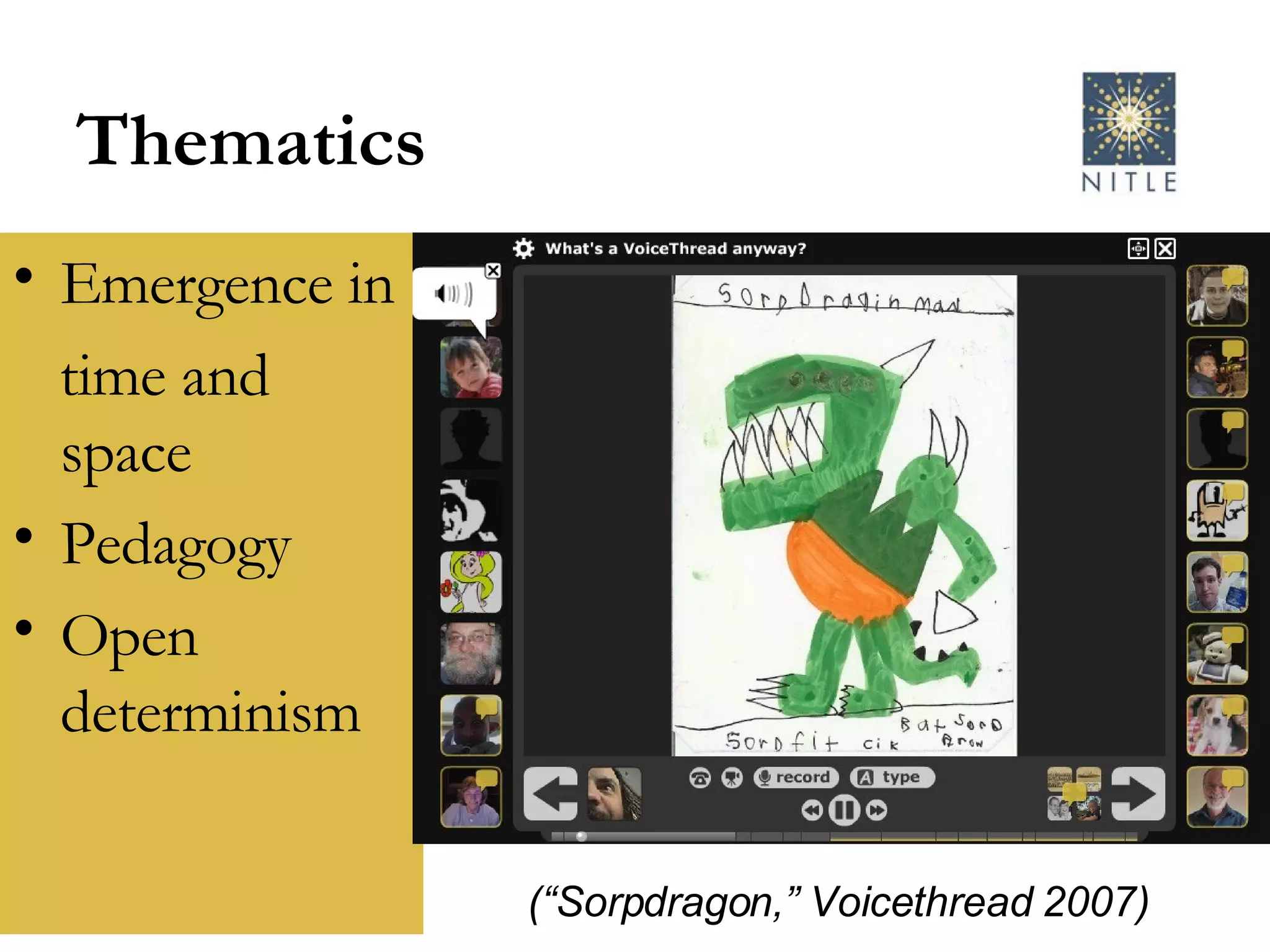
Thematics Emergence in time and space Pedagogy Open determinism (“Sorpdragon,” Voicethread 2007)
One problem How does academia apprehend emerging technologies? Panic/siege mode Vendors Futurism methods Networks
One odd metaphor Web 2.0 and education is like gaming and education:  awareness is challenging Huge, financially and quantitatively successful worlds Global and rapidly developing scope Bad anxieties, policies, and media coverage Perceived lack of seriousness
Five responses Web 2.0 and education is like gaming and education:  intersections are happening Take advantage of preexisting projects and services Mod/warp/hack  DIY Literacy: new media Influence (World of Warcraft)
Too much information? Early modern era  Gutenberg + religious struggle Glossators (Franciscus Accursius, Denis Godefroi) Then the Geneva Bible Another response: consider antecedents
Another response to overload Cyclopedia  (Ephraim Chambers, 1728) Encyclopedie  (1751-1772)
(Another precursor, lacking the technology: Isidore of Seville,  Etymologiae , 636) Another response to overload Cyclopedia  (Ephraim Chambers, 1728) Encyclopedie  (1751-1772)
I. Web 2.0 ( http://emptybottle.org/bullshit/ )
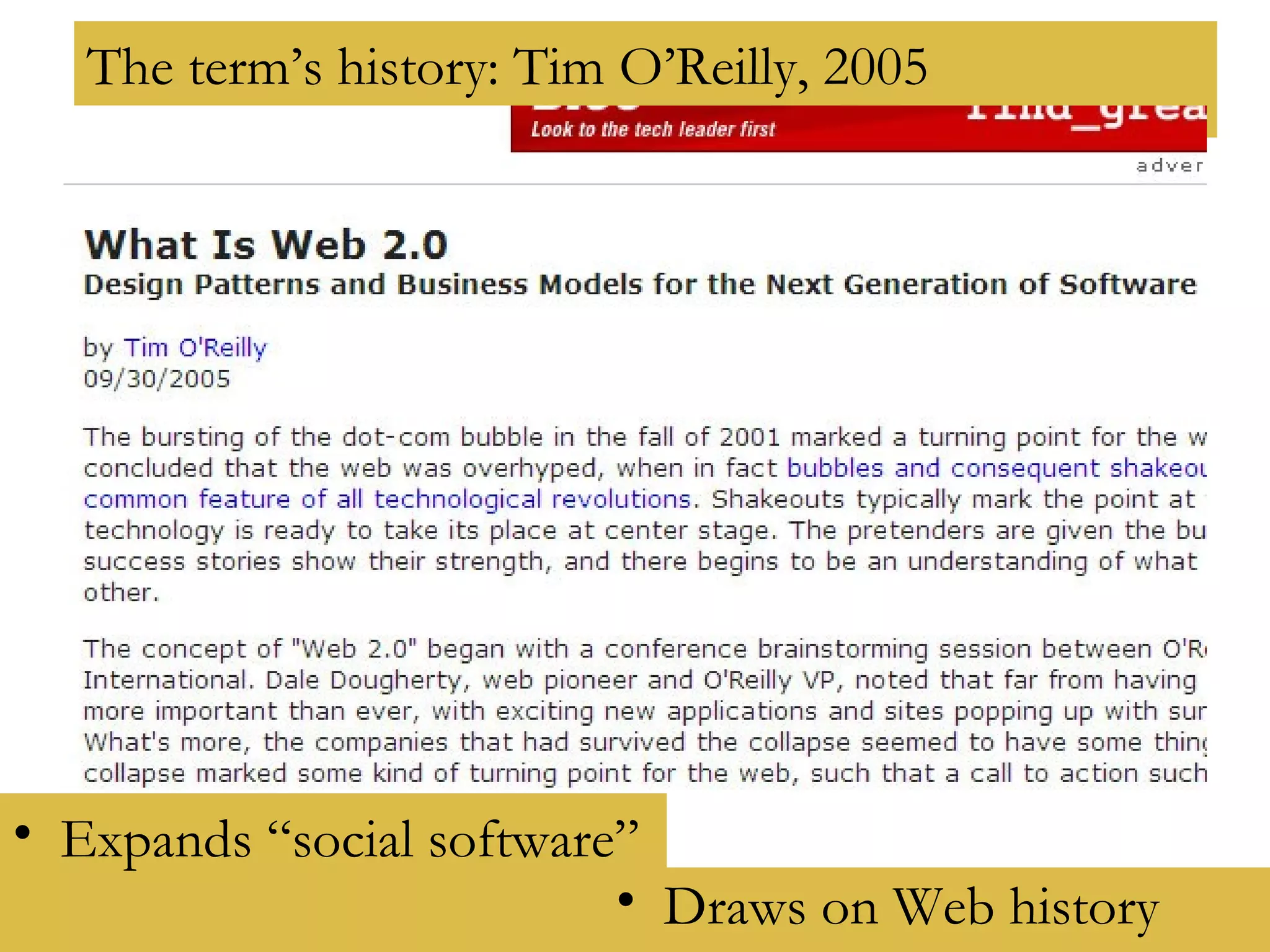
The term’s history: Tim O’Reilly, 2005 Expands “social software” Draws on Web history
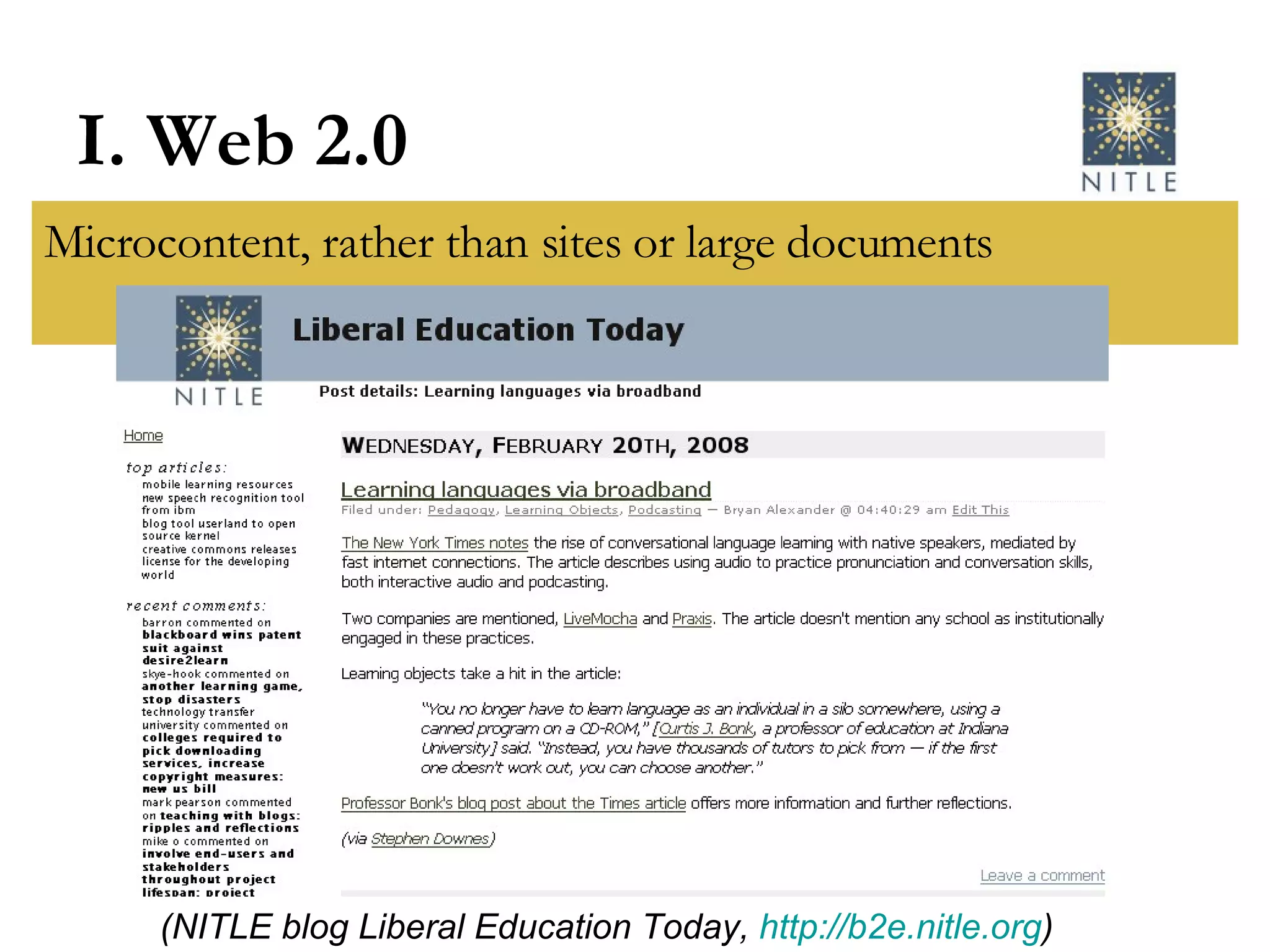
I. Web 2.0 Microcontent, rather than sites or large documents (NITLE blog Liberal Education Today,  http://b2e.nitle.org )
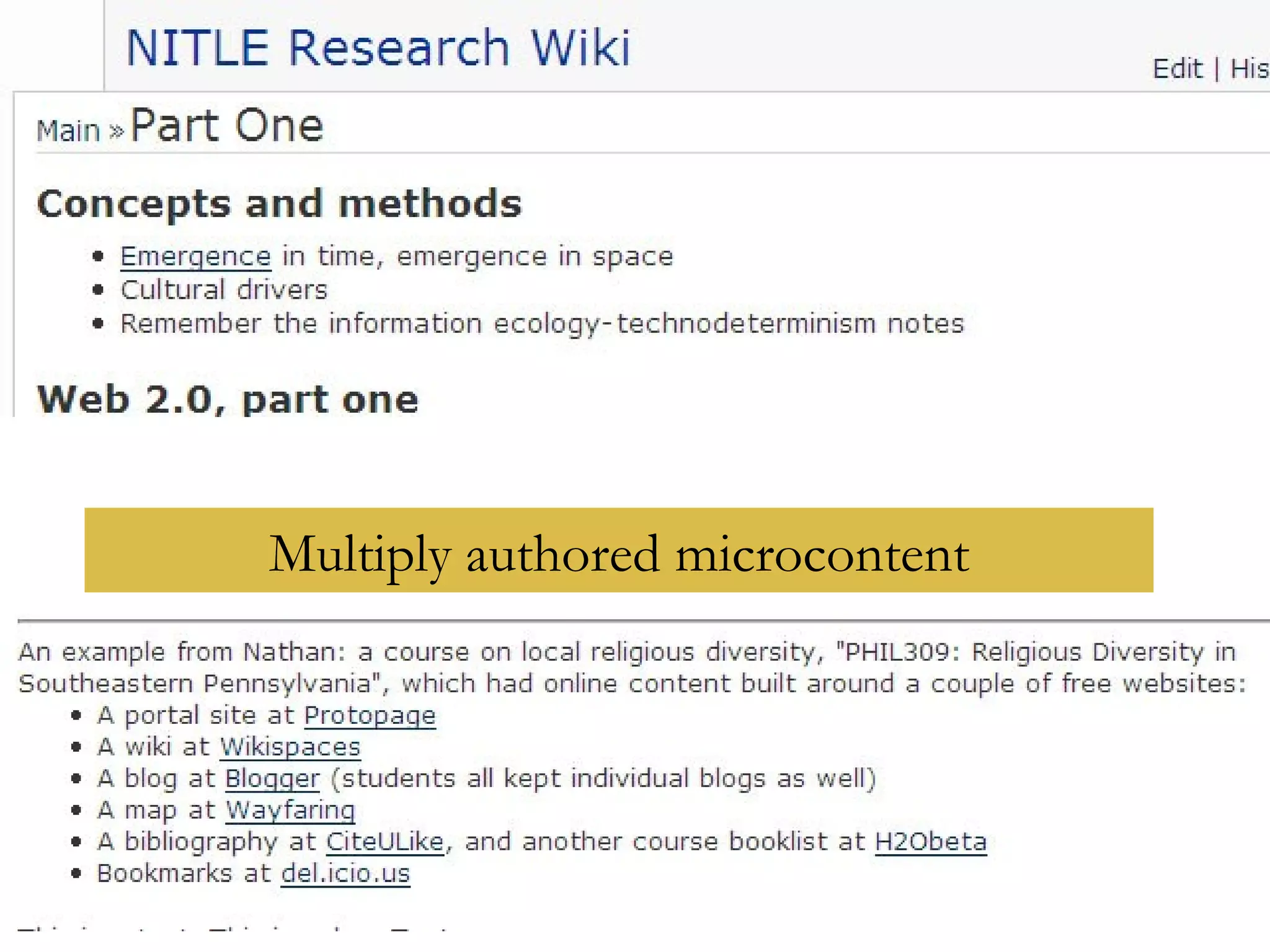
I. Web 2.0 Multiply authored microcontent
Open content and/or services and/or standards… (Pepysblog, 2003-)
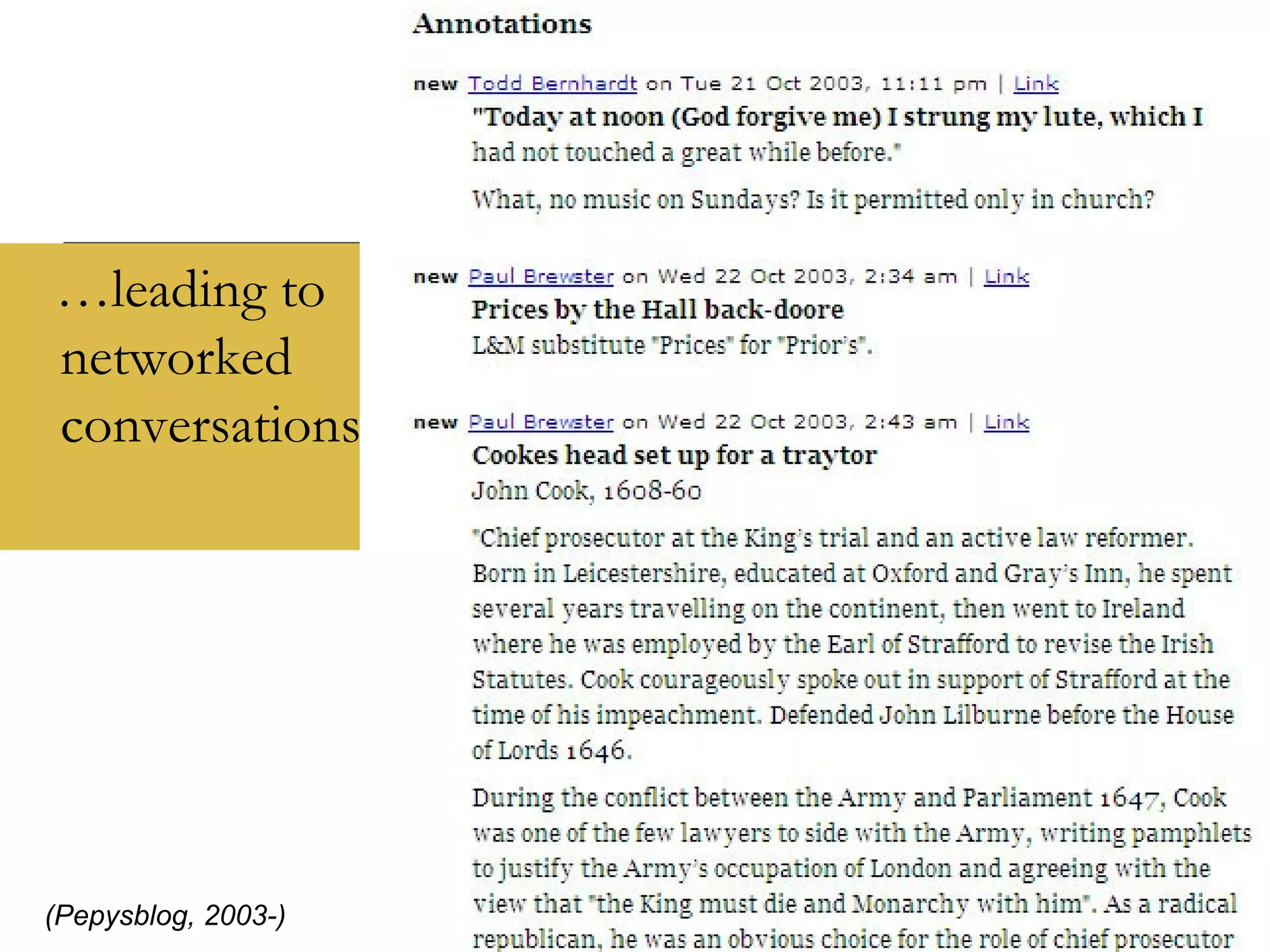
… leading to networked conversations (Pepysblog, 2003-)
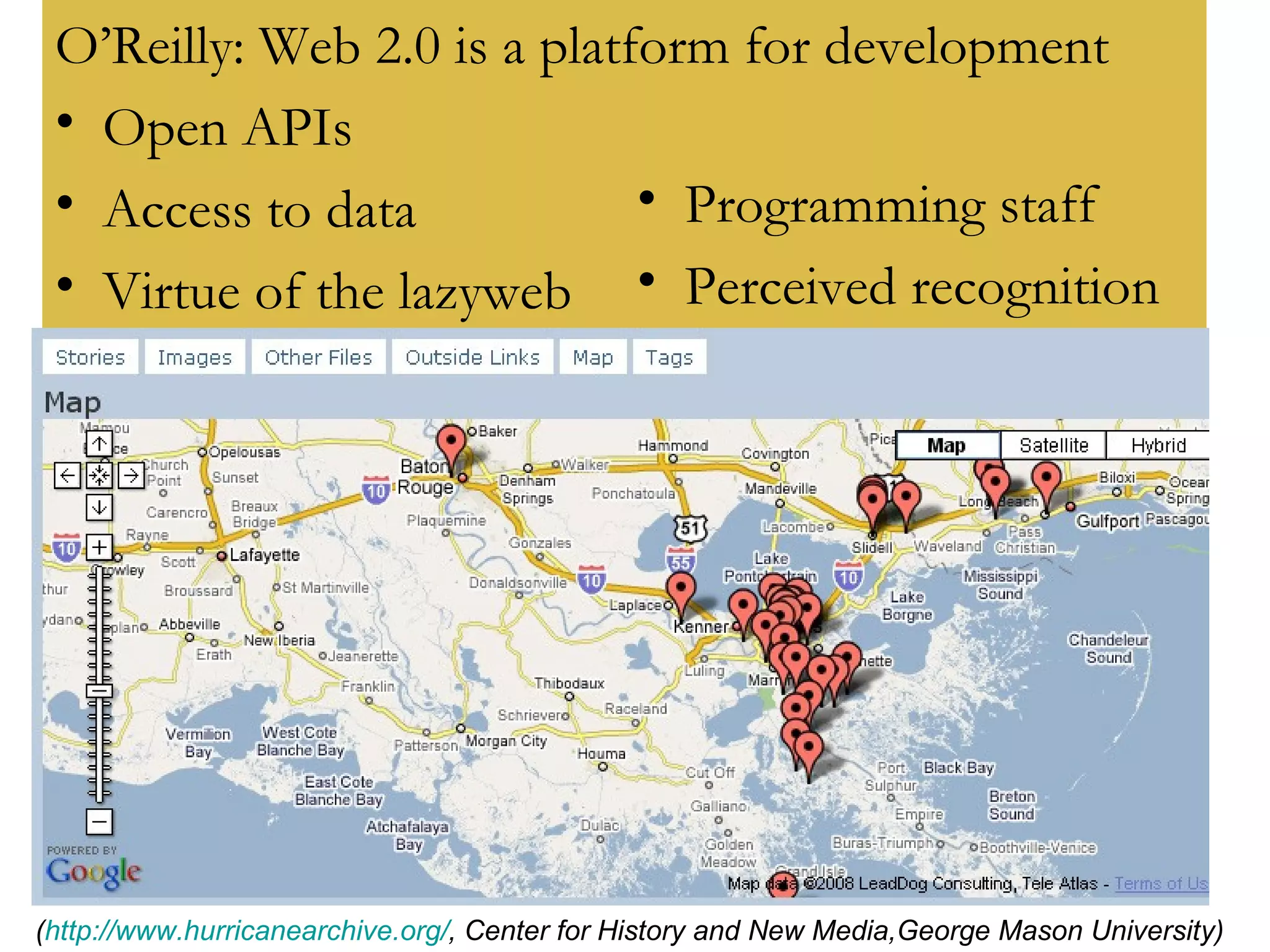
O’Reilly: Web 2.0 is a platform for development Open APIs Access to data Virtue of the lazyweb ( http://www.hurricanearchive.org/ , Center for History and New Media,George Mason University) Programming staff Perceived recognition
Perpetual beta (O’Reilly, now history)
Web 2.0 components, movements Collaborative writing platforms: the  wiki  way
Web 2.0 components, movements Consider the most notorious/famous
-Viégas, Wattenberg, Dave (Historyflow, IBM, 2004) Wikis are (often) textually productive
Web 2.0 components, movements collaborative writing platforms:  the blogosphere
Addressable content chunks…
… leading to distributed and/or attached  conversations (Radio Open Source blog/podcast)
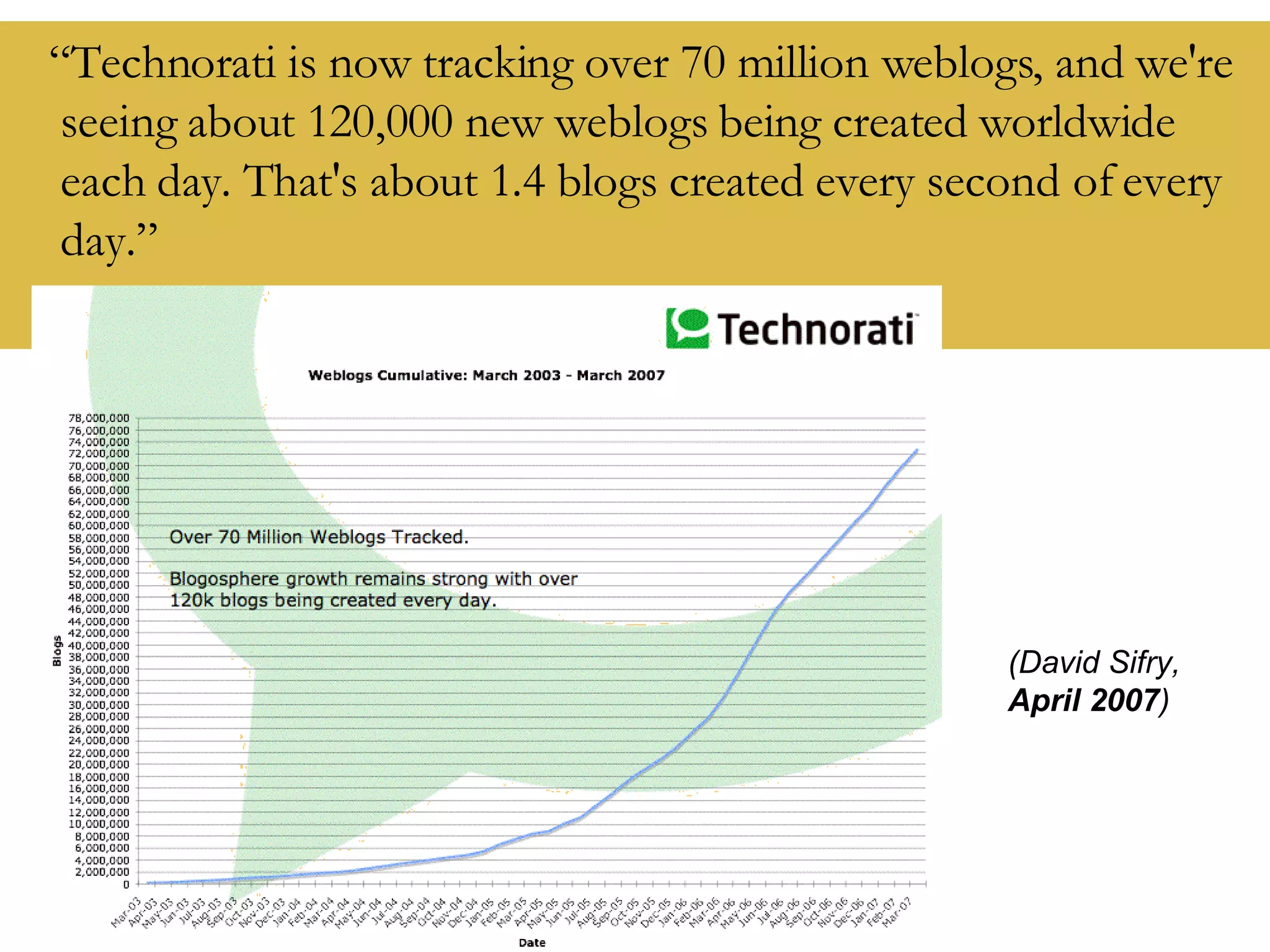
“ Technorati is now tracking over 70 million weblogs, and we're seeing about 120,000 new weblogs being created worldwide each day. That's about 1.4 blogs created every second of every day.” (David Sifry, April 2007 )
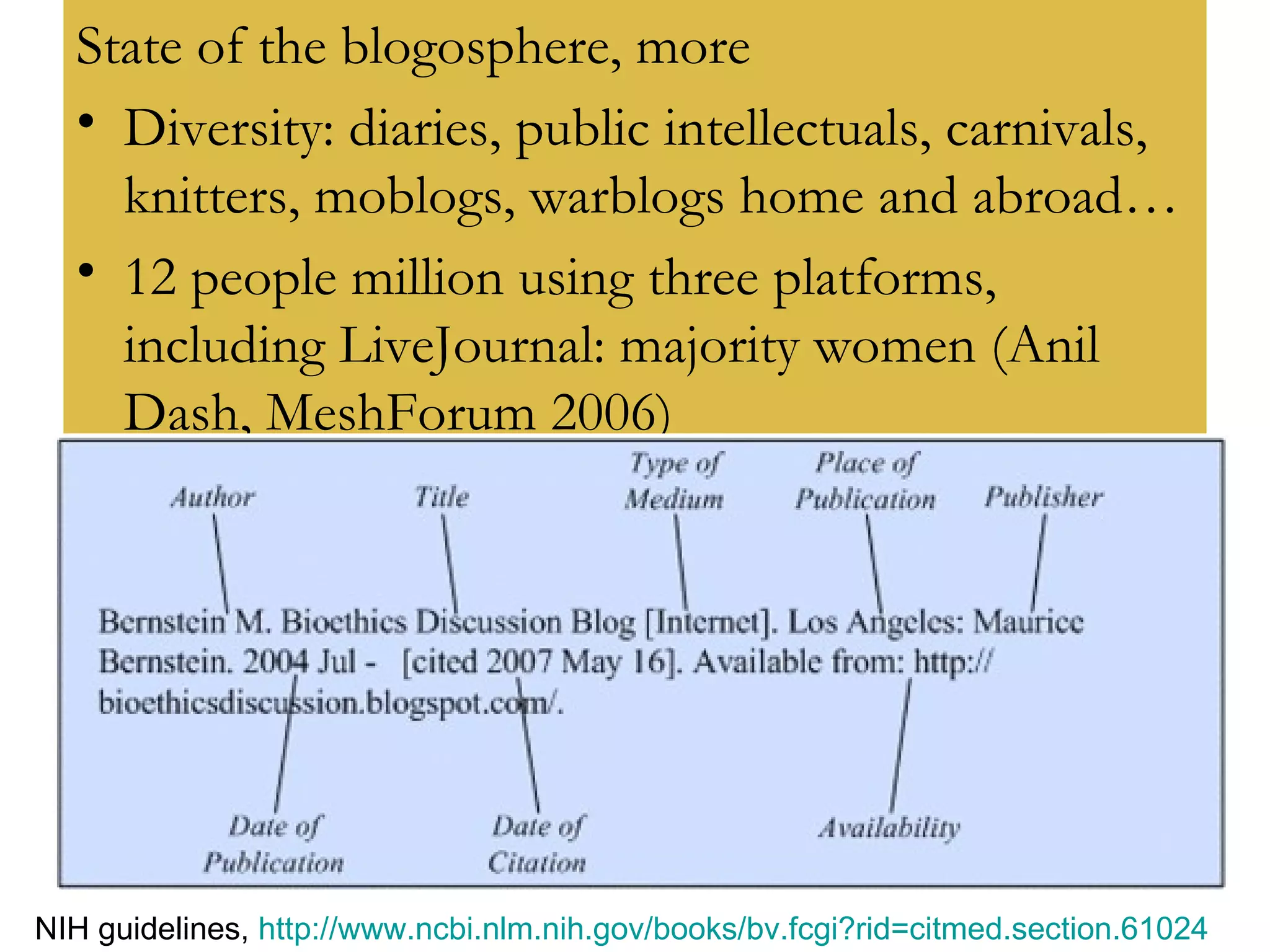
State of the blogosphere, more Diversity: diaries, public intellectuals, carnivals, knitters, moblogs, warblogs home and abroad… 12 people million using three platforms, including LiveJournal: majority women (Anil Dash, MeshForum 2006) NIH guidelines,  http://www.ncbi.nlm.nih.gov/books/bv.fcgi?rid=citmed.section.61024
Web 2.0 components, movements:  social photos
Reach of Flickr 26 million searchable,  shareable  images in Flickr (December 2006) Global, not national Metadata is good enough Gaming inspiration (Ben Harris-Roxas, 2006)
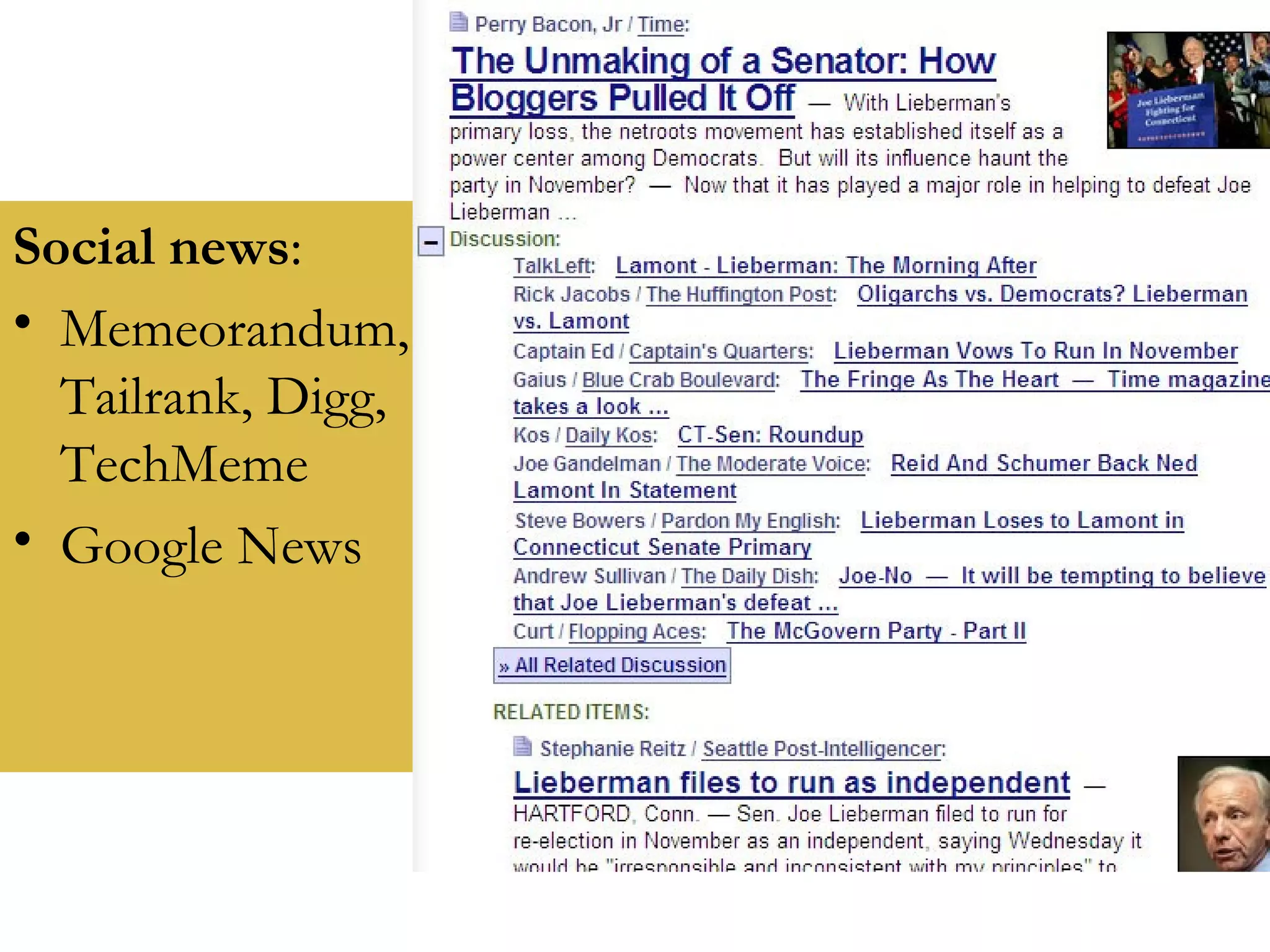
Social news : Memeorandum, Tailrank, Digg, TechMeme Google News
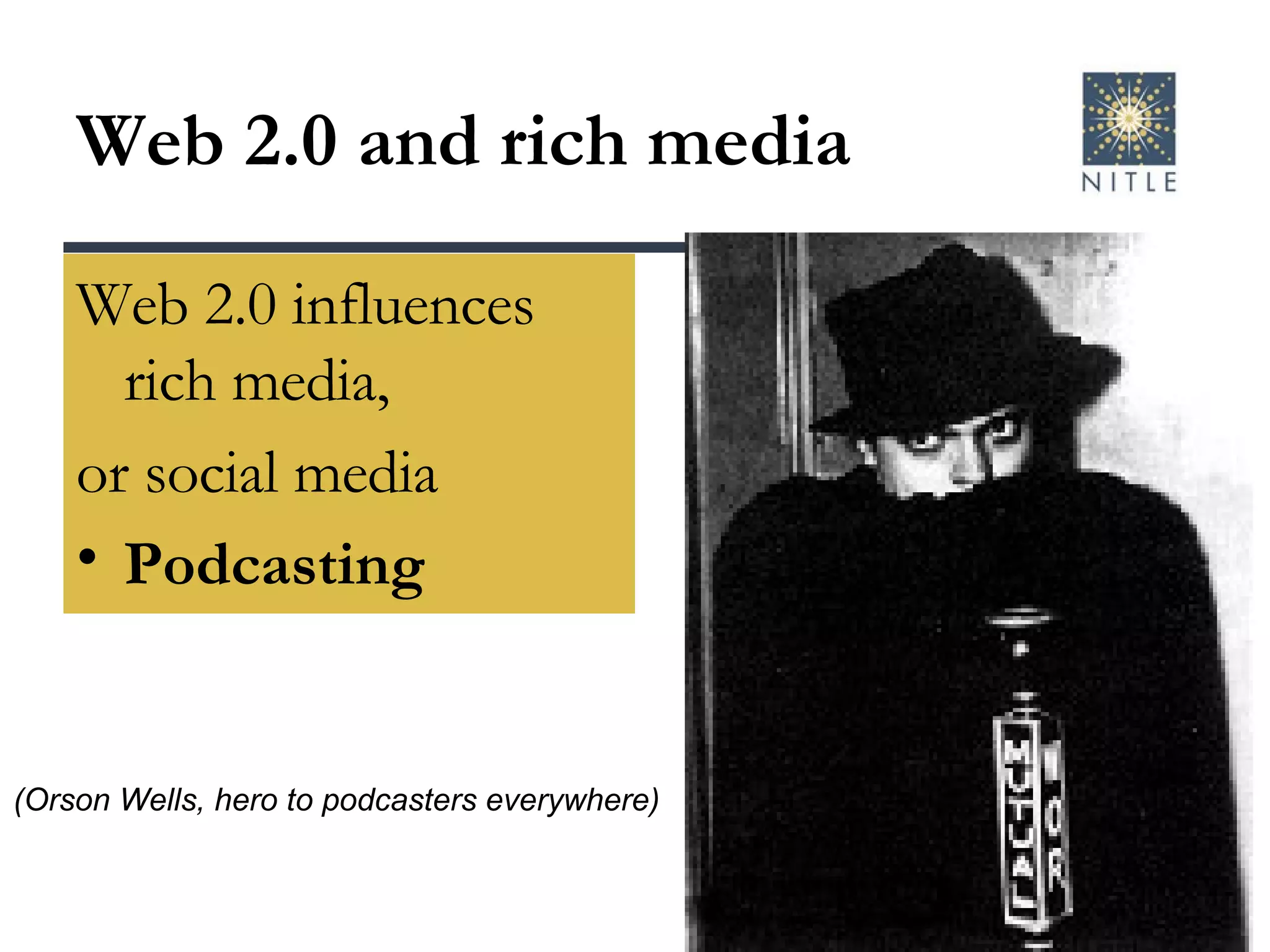
Web 2.0 and rich media Web 2.0 influences rich media,  or social media Podcasting
Web 2.0 and rich media Web 2.0 influences rich media,  or social media Podcasting (Orson Wells, hero to podcasters everywhere)
How old is the term?
How old is the term?  “…  all the ingredients are there for a new boom in amateur radio.   But what to call it? Audioblogging?  Podcasting ? GuerillaMedia?”   (Ben Hammersley,  The Guardian February 12, 2004)
How old is the term?  “… all the ingredients are there for a new boom in amateur radio.   But what to call it? Audioblogging?  Podcasting ? GuerillaMedia?”   (Ben Hammersley,  The Guardian February 12, 2004)
What’s happened since “podcasting” in 2004? Neologisms: godcasting nanocasting podfading podsafe podspamming podvertising porncasting
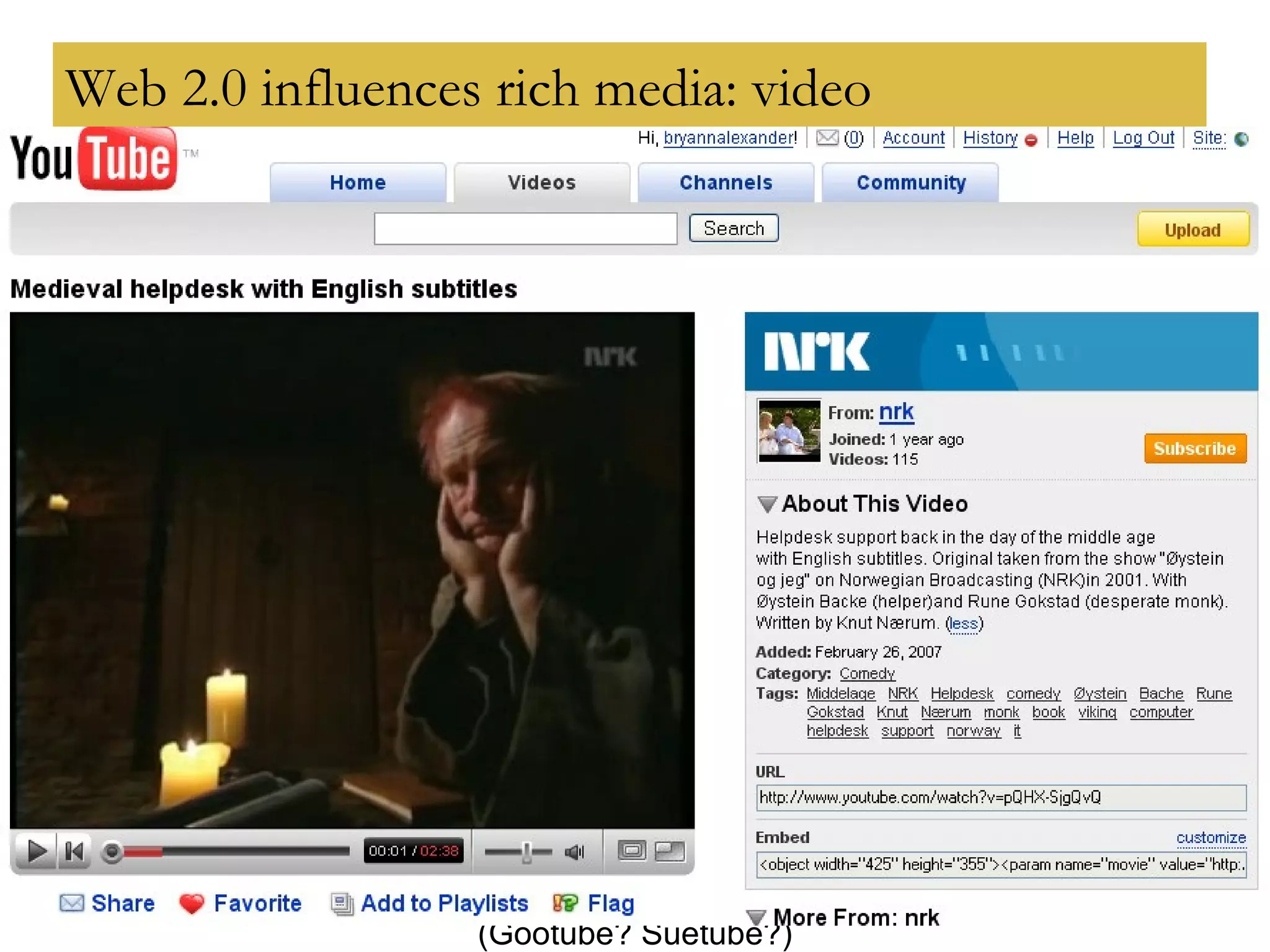
Web 2.0 influences rich media: video (Gootube? Suetube?)
Videoblogging (vlog? vog?) (Ask a Ninja; Rocketboom; Howard Rheingold)
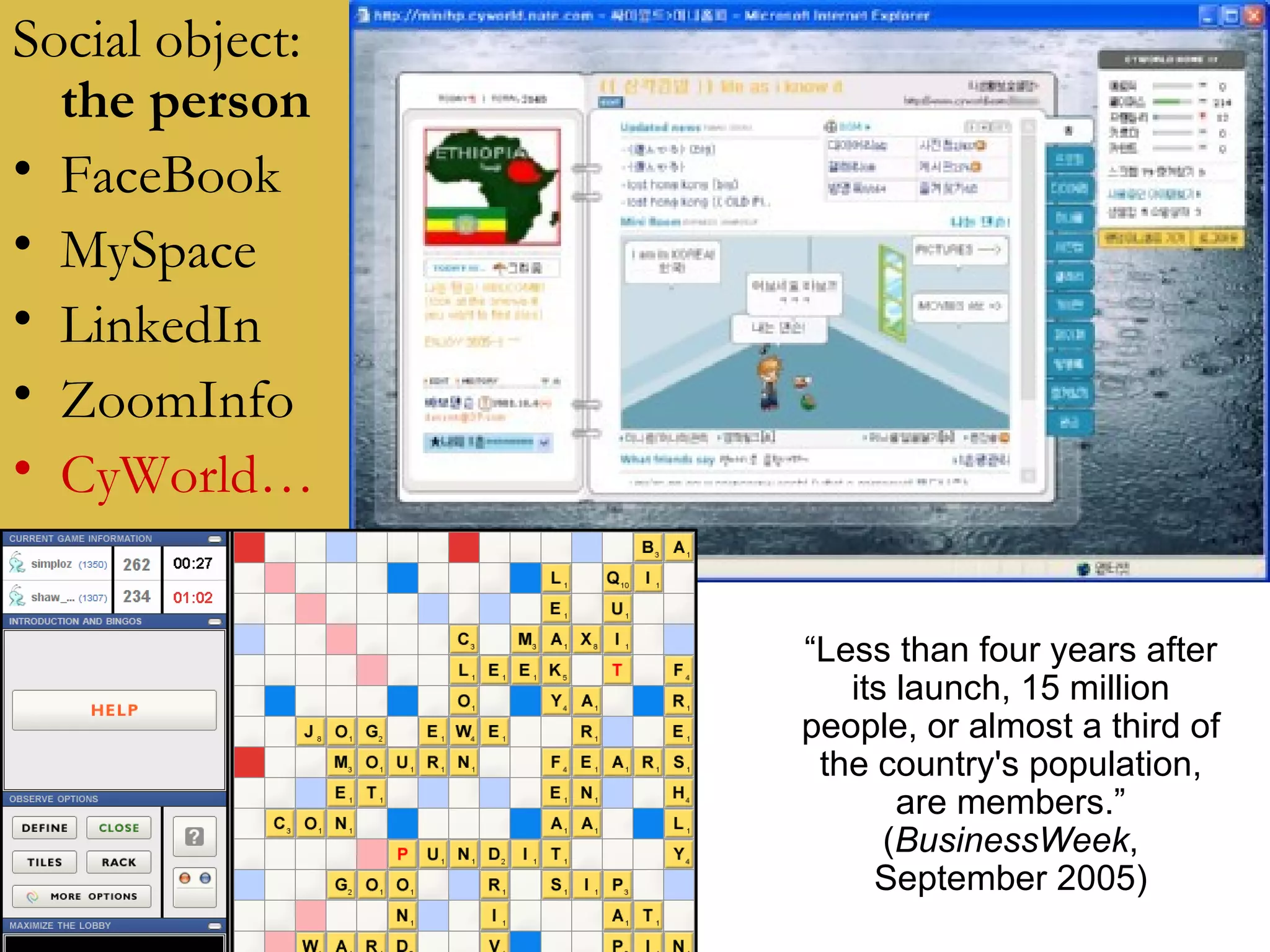
Social object:  the person FaceBook MySpace LinkedIn ZoomInfo CyWorld… “ Less than four years after its launch, 15 million people, or almost a third of the country's population, are members.” ( BusinessWeek , September 2005)
(Le Monde, 2008)
Social organization of information, new forms:  folksonomy  Search Retrieval Self-awareness http://del.icio.us/ for DoctorNemo
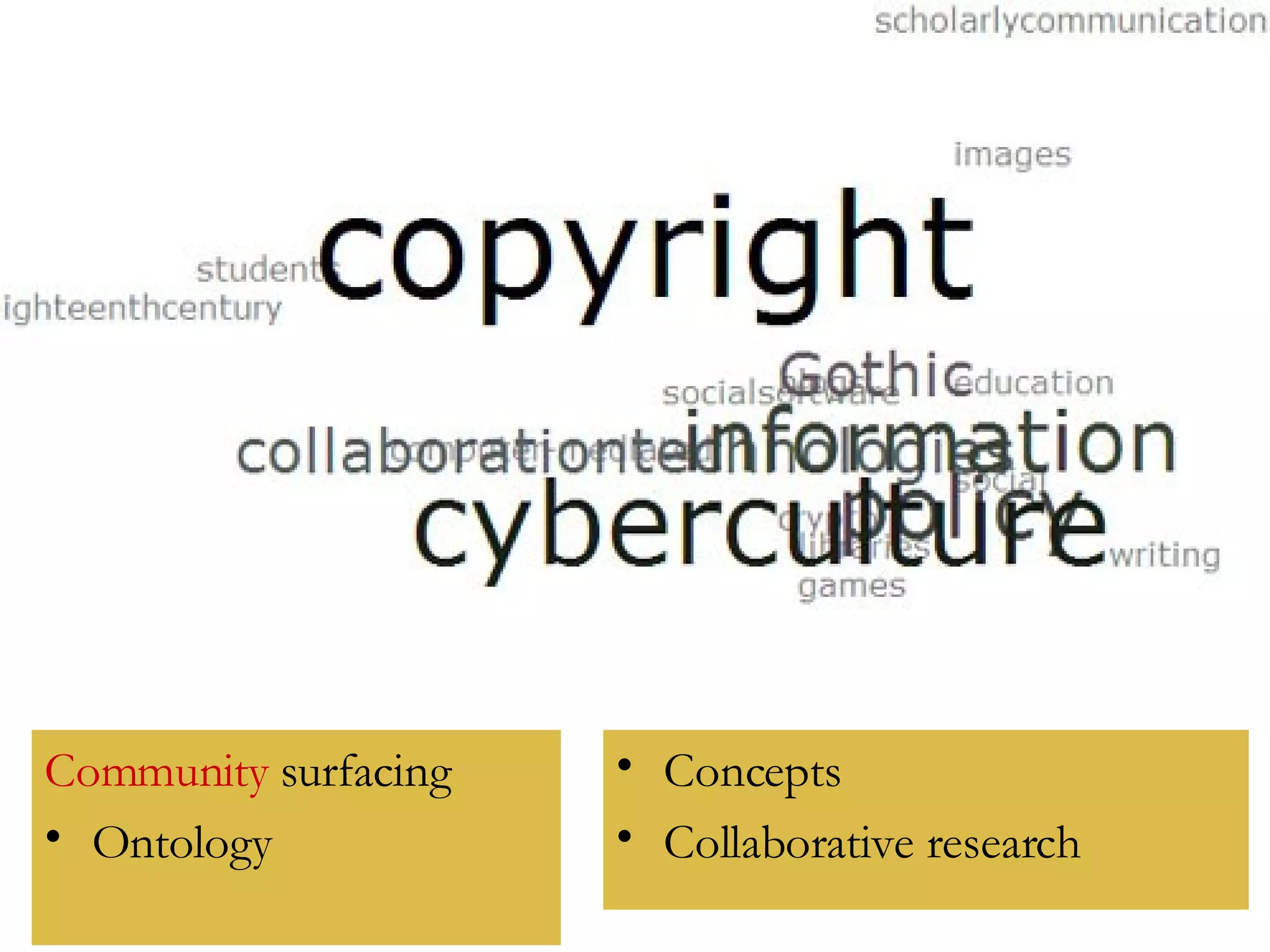
Community  surfacing Ontology Concepts  Collaborative research
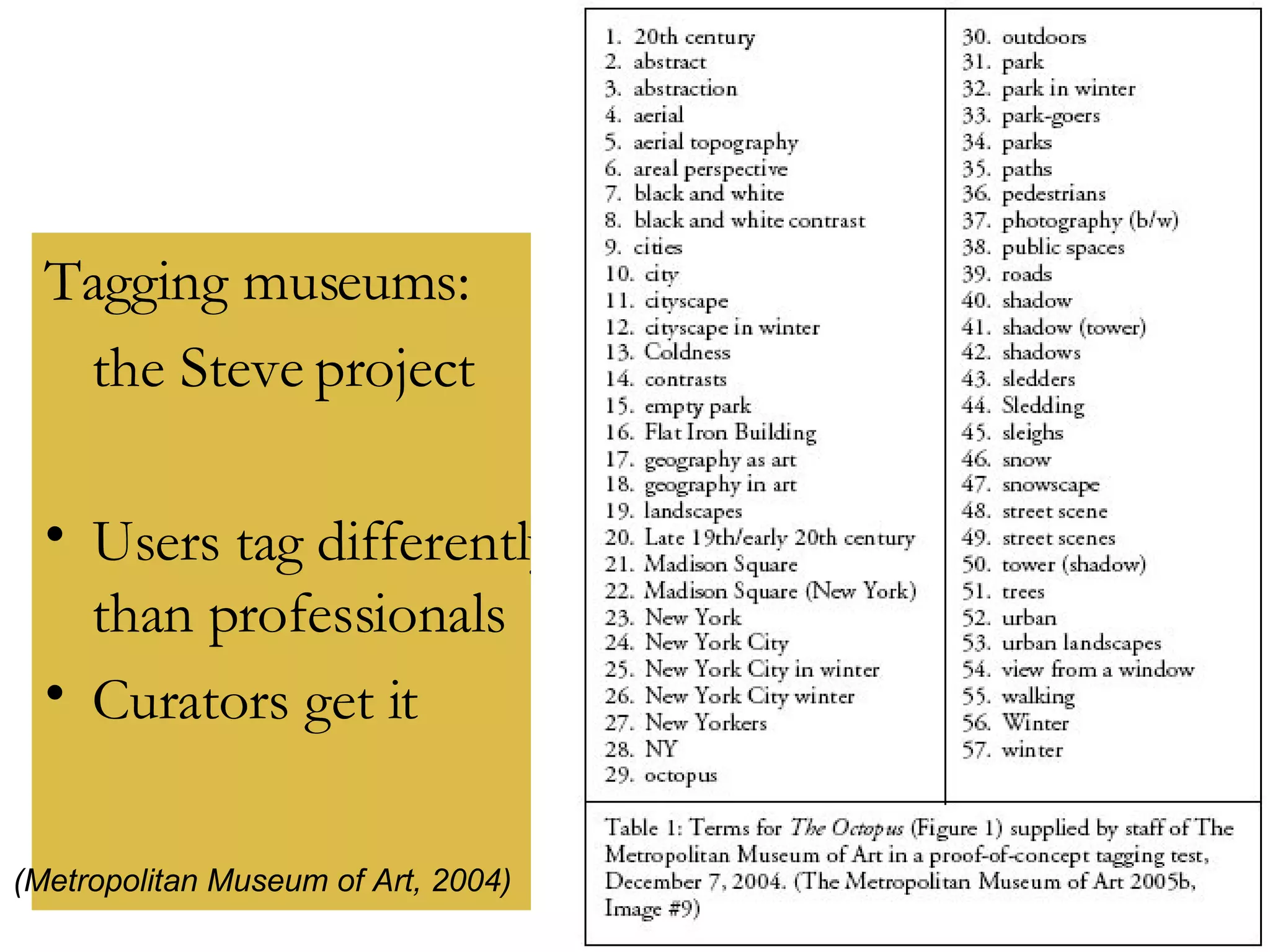
Tagging museums:  the Steve project Users tag differently than professionals Curators get it (Metropolitan Museum of Art, 2004)
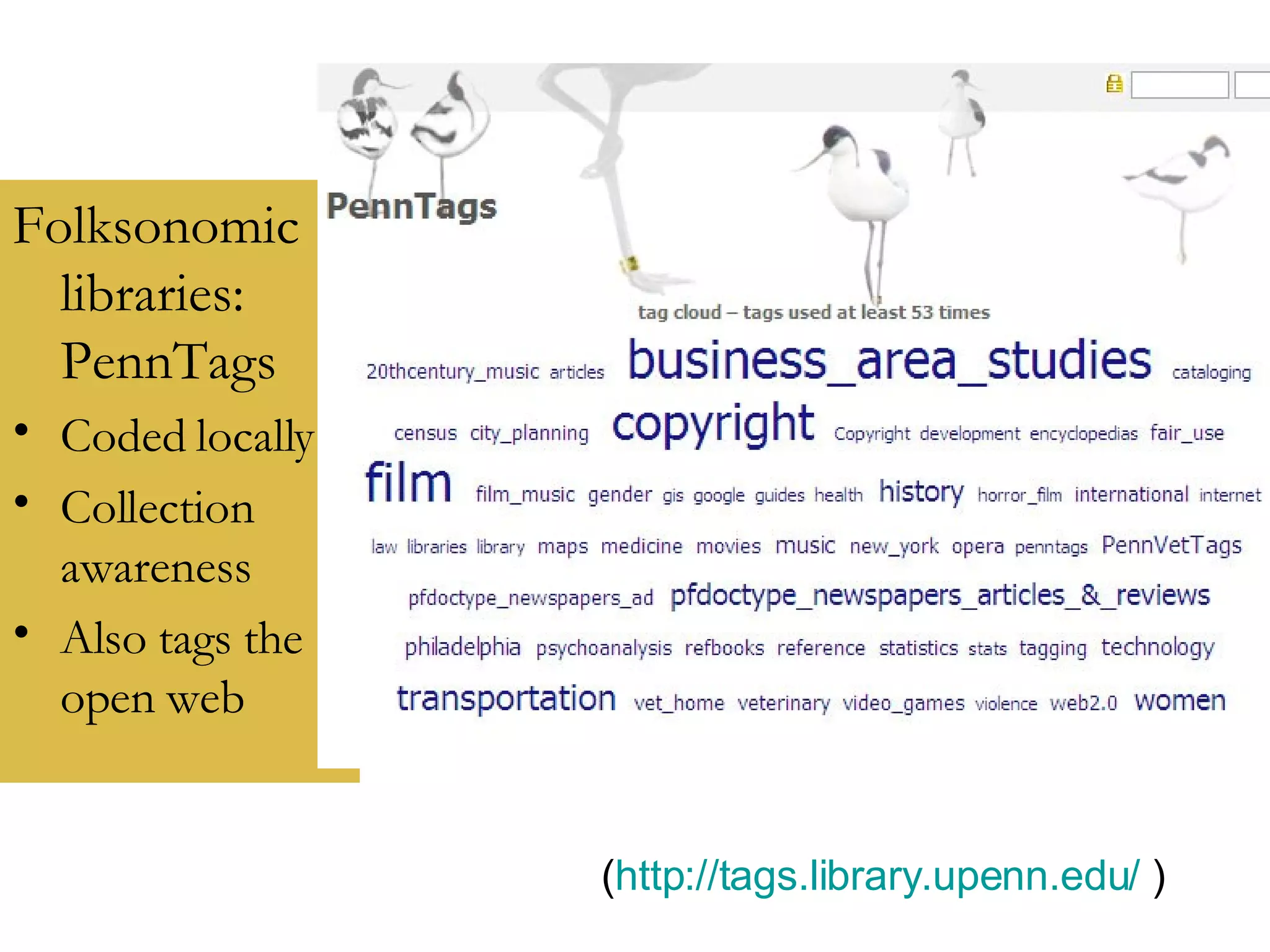
Folksonomic libraries: PennTags Coded locally Collection awareness Also tags the open web ( http://tags.library.upenn.edu/  )
Extrapolating principles: Ton Zylstra on the social object: “ In general you could say that both Flickr and del.icio.us work in a triangle: person, picture/ bookmark, and tag(s). Or more abstract a person, an  object of sociality , and some descriptor...” (Zylstra in Second Life, 2007)
“… In every triangle there always needs to be a person and  an object of sociality . The third point of the triangle is free to define[,] as it were.” - http://www.zylstra.org , 2006 (emphases added)
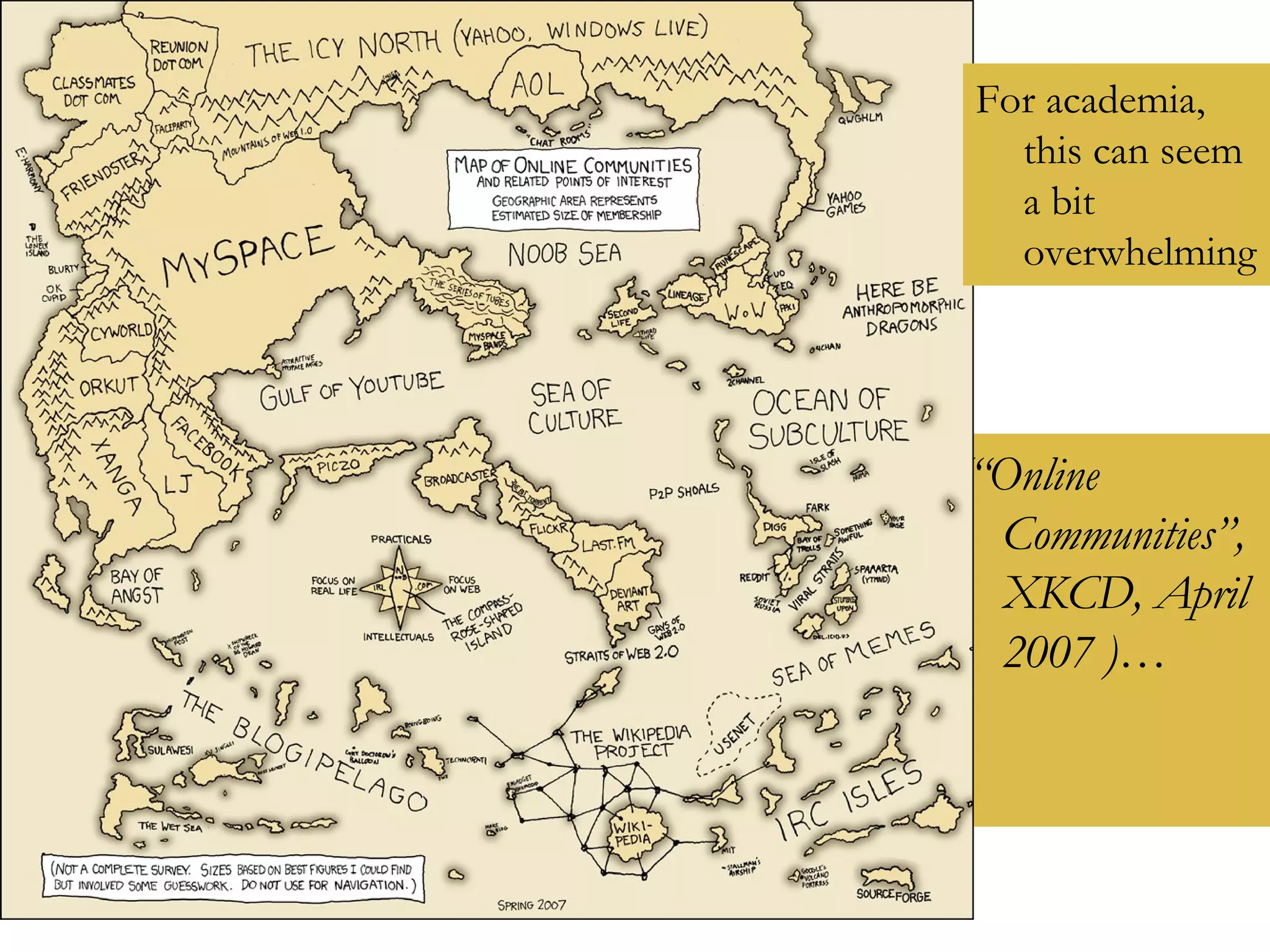
(“Online Communities”, XKCD, April 2007 )… For academia, this can seem a bit overwhelming
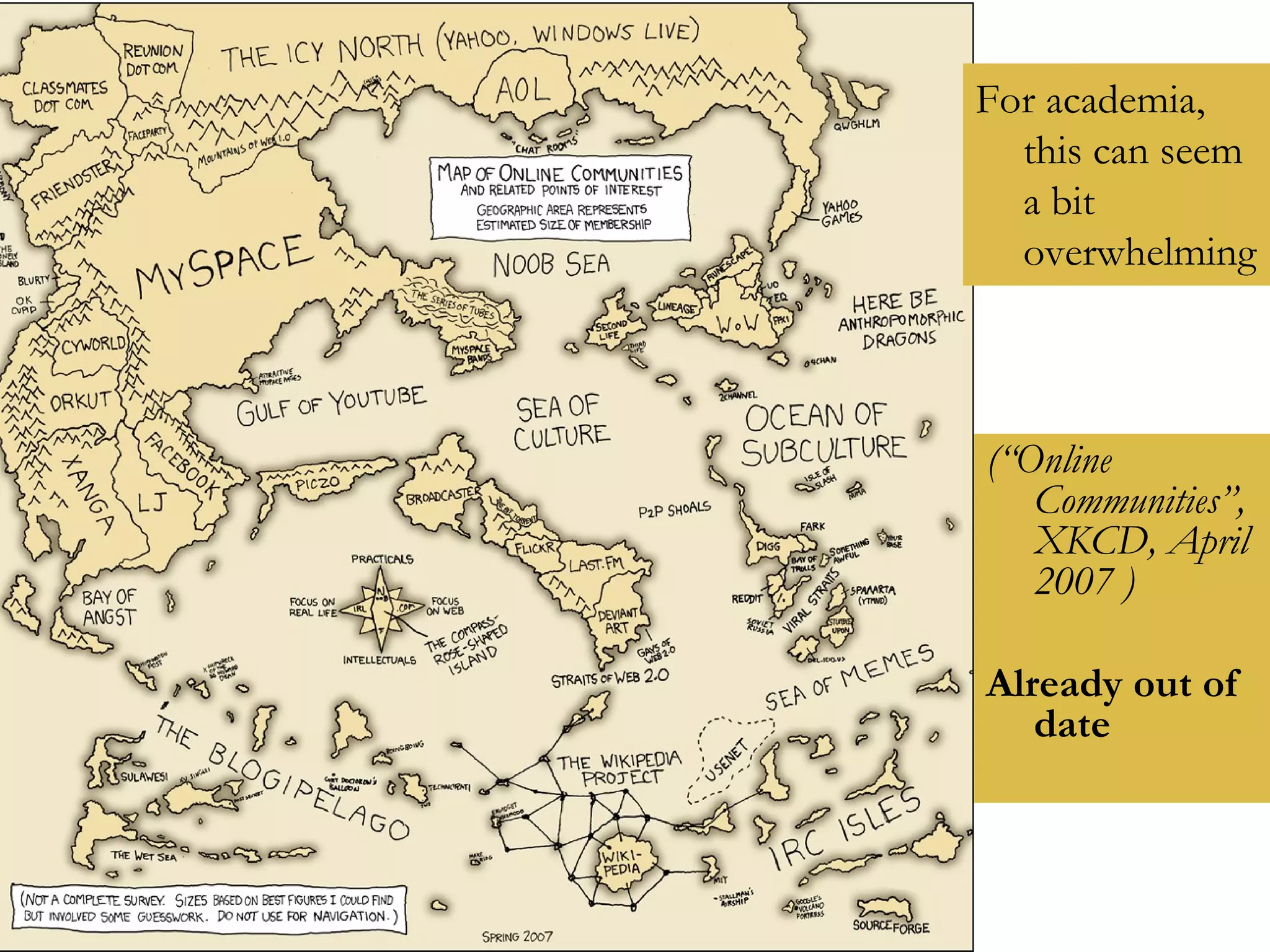
(“Online Communities”, XKCD, April 2007 ) Already out of date For academia, this can seem a bit overwhelming
Pedagogies and publications Teaching with Web 2.0: it’s not all new - Web 1.0, internet pedagogies Hypertext Web audience Discussion fora  Collaborative document authoring Groupware
Teaching with Web 2.0: it’s not all new Earlier pedagogies Journaling Media literacy
Teaching with Web 2.0: principles http://smarthistory.blogspot.com/   Distributed conversation Collaborative writing Object-oriented discussion Connectivism (G. Siemens, 2004)
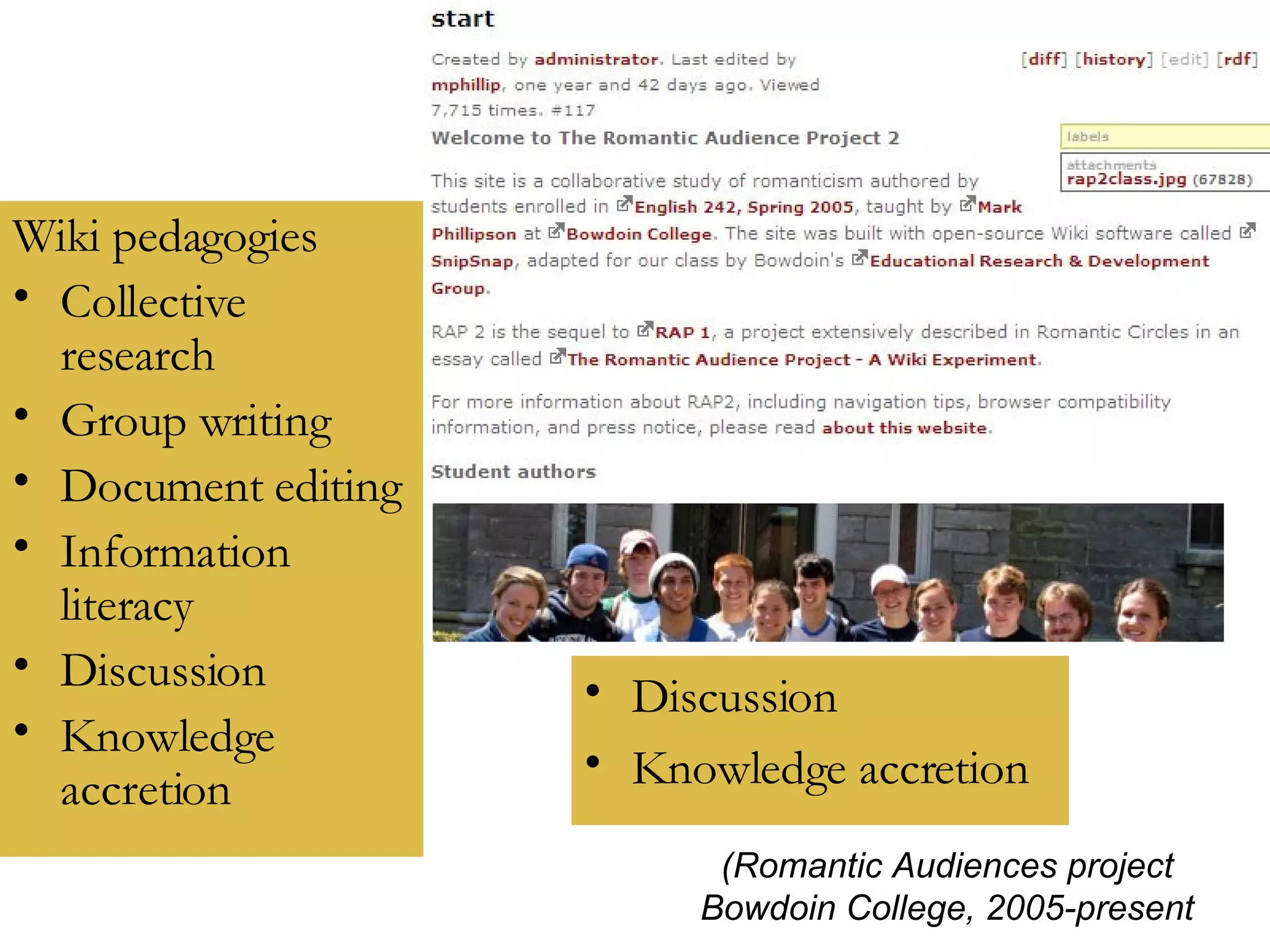
Wiki pedagogies Collective research Group writing Document editing Information literacy Discussion Knowledge accretion (Romantic Audiences project Bowdoin College, 2005-present Discussion Knowledge accretion
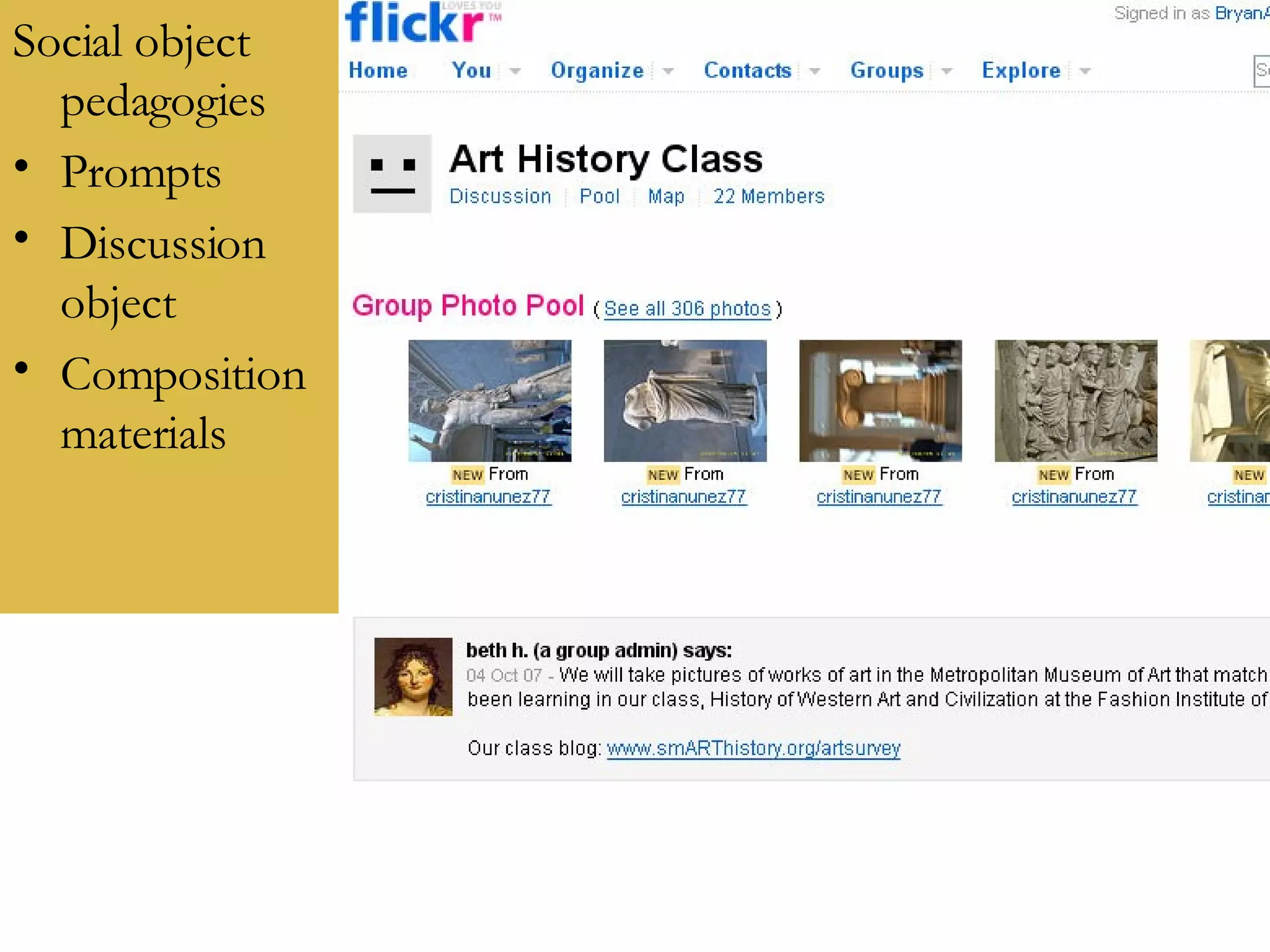
Social object pedagogies Prompts Discussion object Composition materials
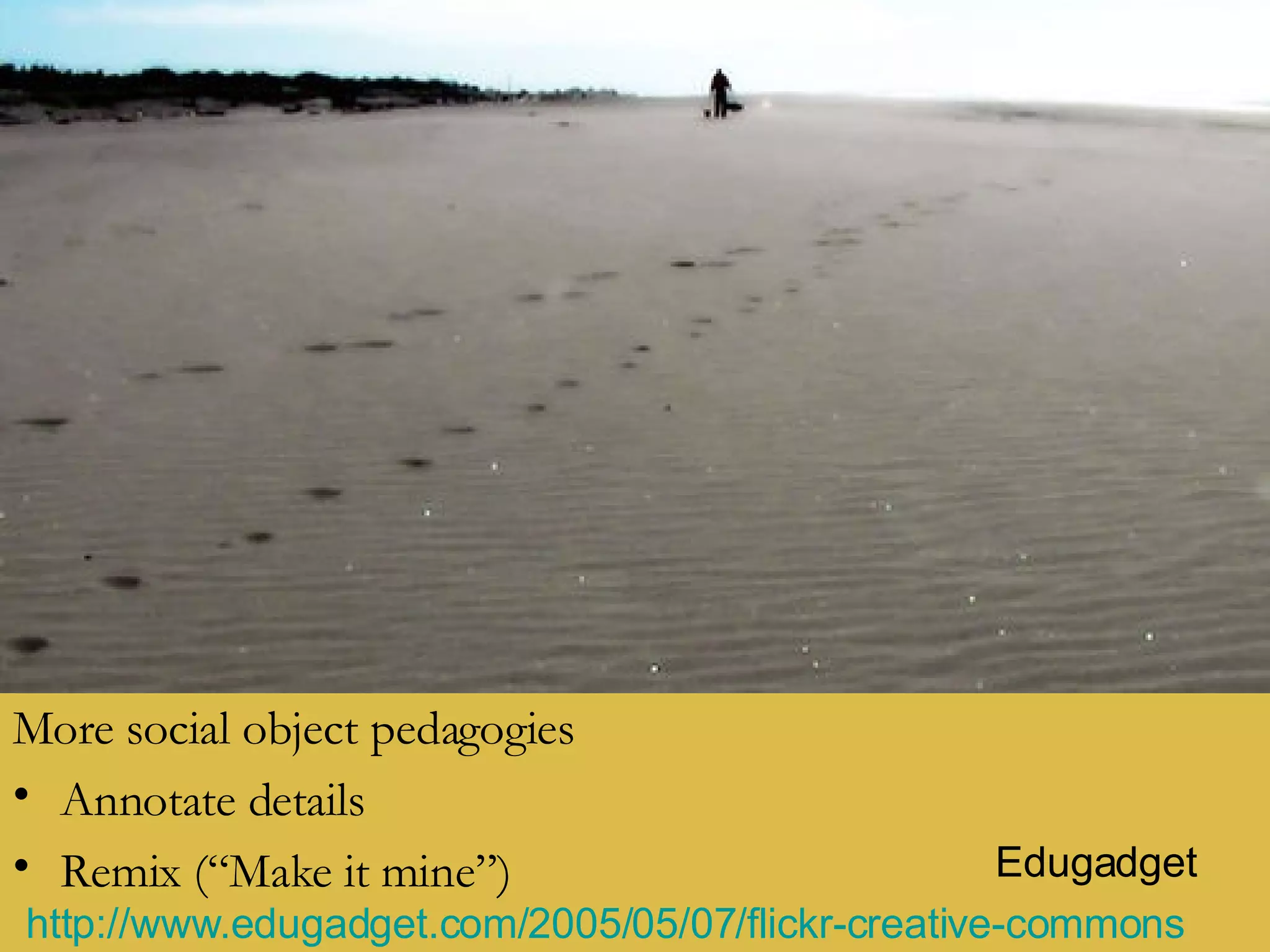
More social object pedagogies Annotate details Remix (“Make it mine”) Edugadget http://www.edugadget.com/2005/05/07/flickr-creative-commons
Teaching with Web 2.0: “ net.gen ”: “ Fully half of all teens and 57 percent of teens who use the Internet could be considered Content Creators, according to a survey by the Pew Internet & American Life Project.” http://www.pewtrusts.com/pdf/PIP_Teens_1105.pdf
“ [S]tudents… write words on paper, yes— but… also compose words and images and create audio files on Web logs (blogs), in word processors, with video editors and Web editors and in e-mail and on presentation software and in instant messaging and on listservs and on bulletin boards—and no doubt in whatever genre will emerge in the next ten minutes. Note that no one is making anyone do any of this writing .” Kathleen Blake Yancey, "Made Not Only in Words: Composition in a New Key."  CCC  56.2 (2004):297-328. Emphasis added.
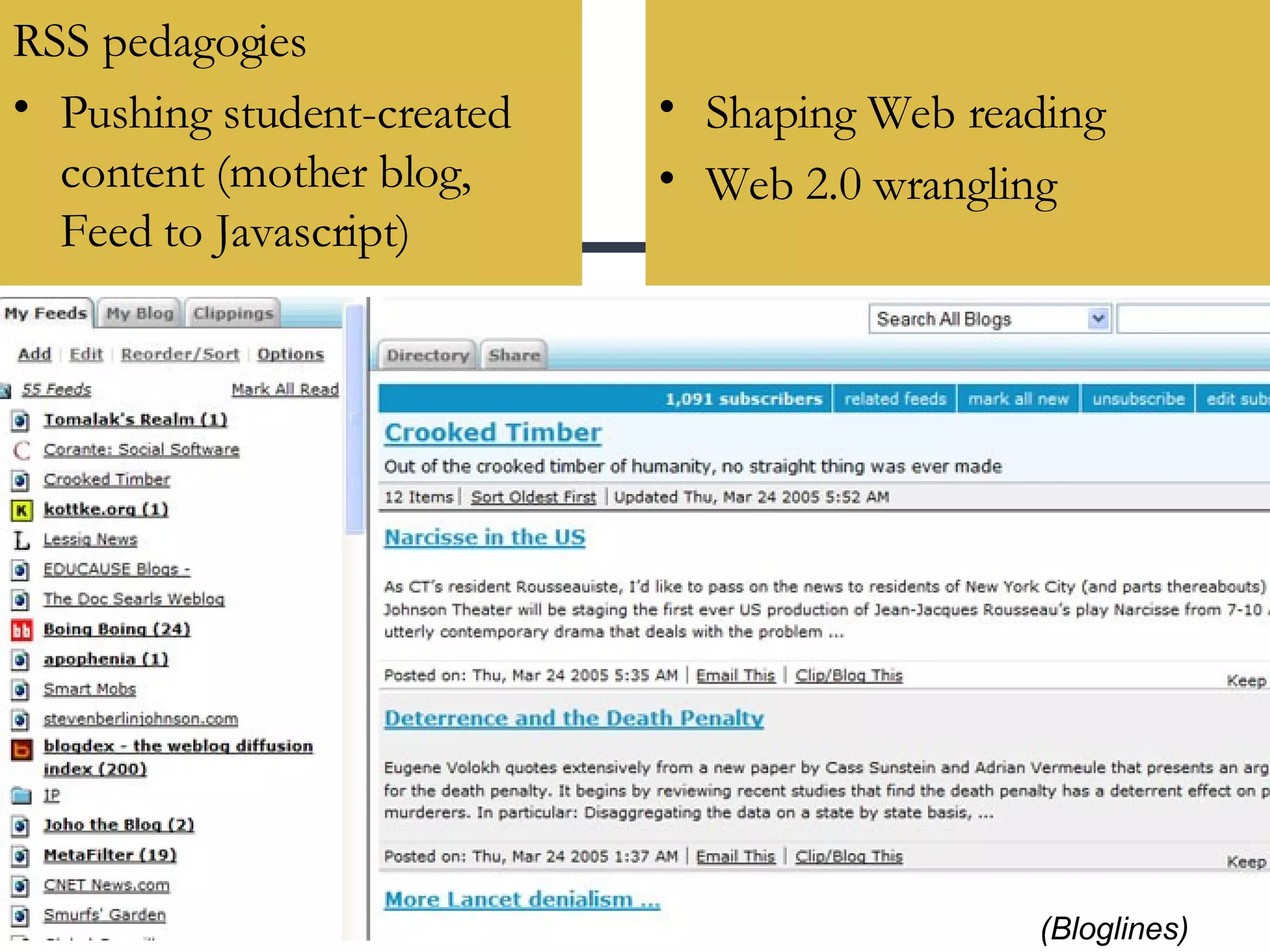
RSS pedagogies Pushing student-created content (mother blog, Feed to Javascript) (Bloglines) Shaping Web reading Web 2.0 wrangling
Academic open archives for social media Freesound archive DIY copyright Social networking values University of Pompeu Fabra (Barcelona) ( http://freesound.iua.upf.edu/ )
Podcasts and teaching:  profcasting Bryn Mawr College: Michelle Francl, chemistry Duke: “Classroom recording” Learning objects: Gardner Campbell, University of Richmond Duke: “Course content dissemination” Information literacy
Student program podcasting on campus War News Radio  (Swarthmore College) PEPI courses (University of British Columbia, department of Land and Food Resources)
Media to  enhance other media Podcast + pdfs: Allegheny College, Gothcast
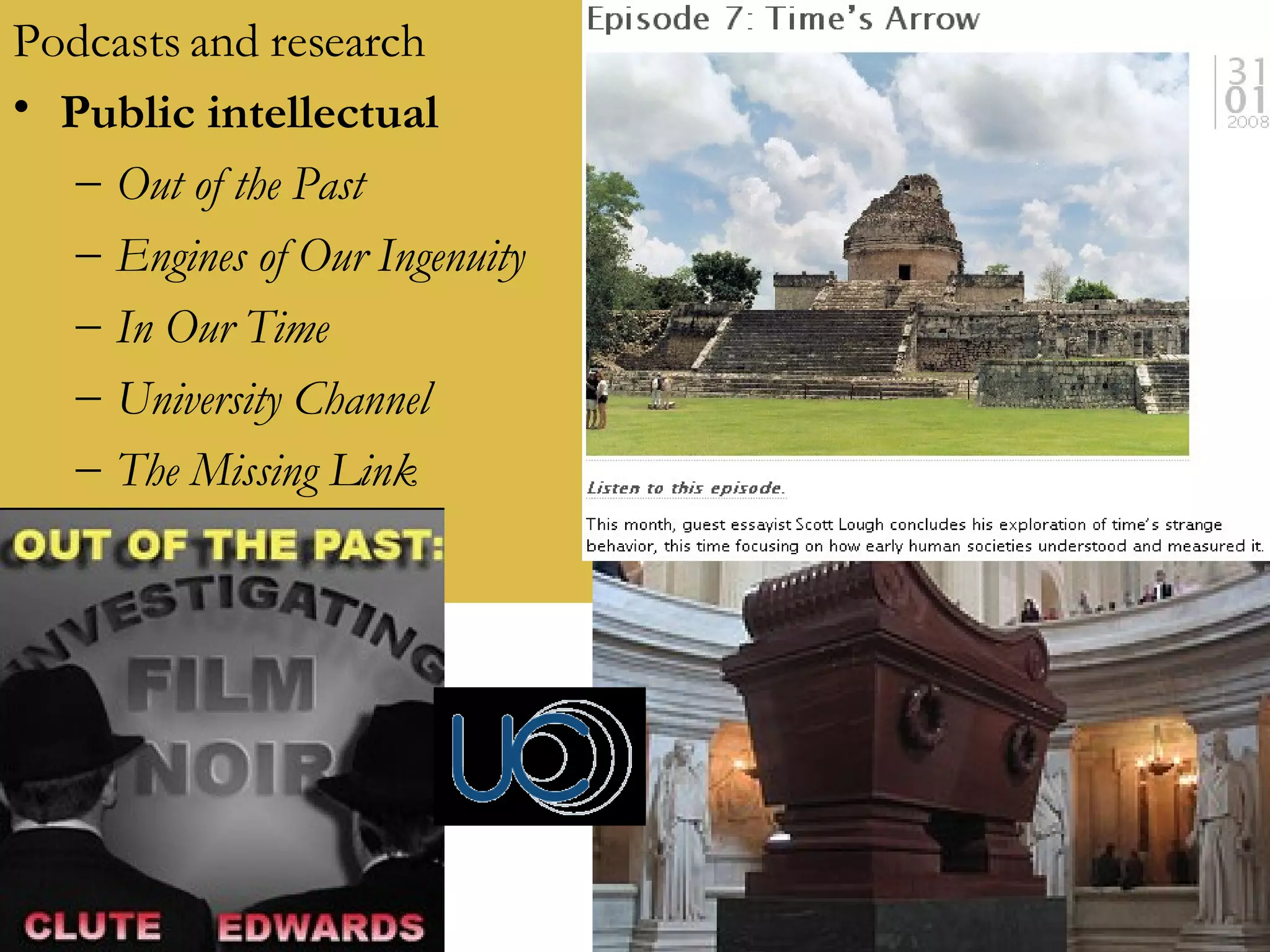
Podcasts and research Public intellectual Out of the Past Engines of Our Ingenuity  In Our Time University Channel The Missing Link
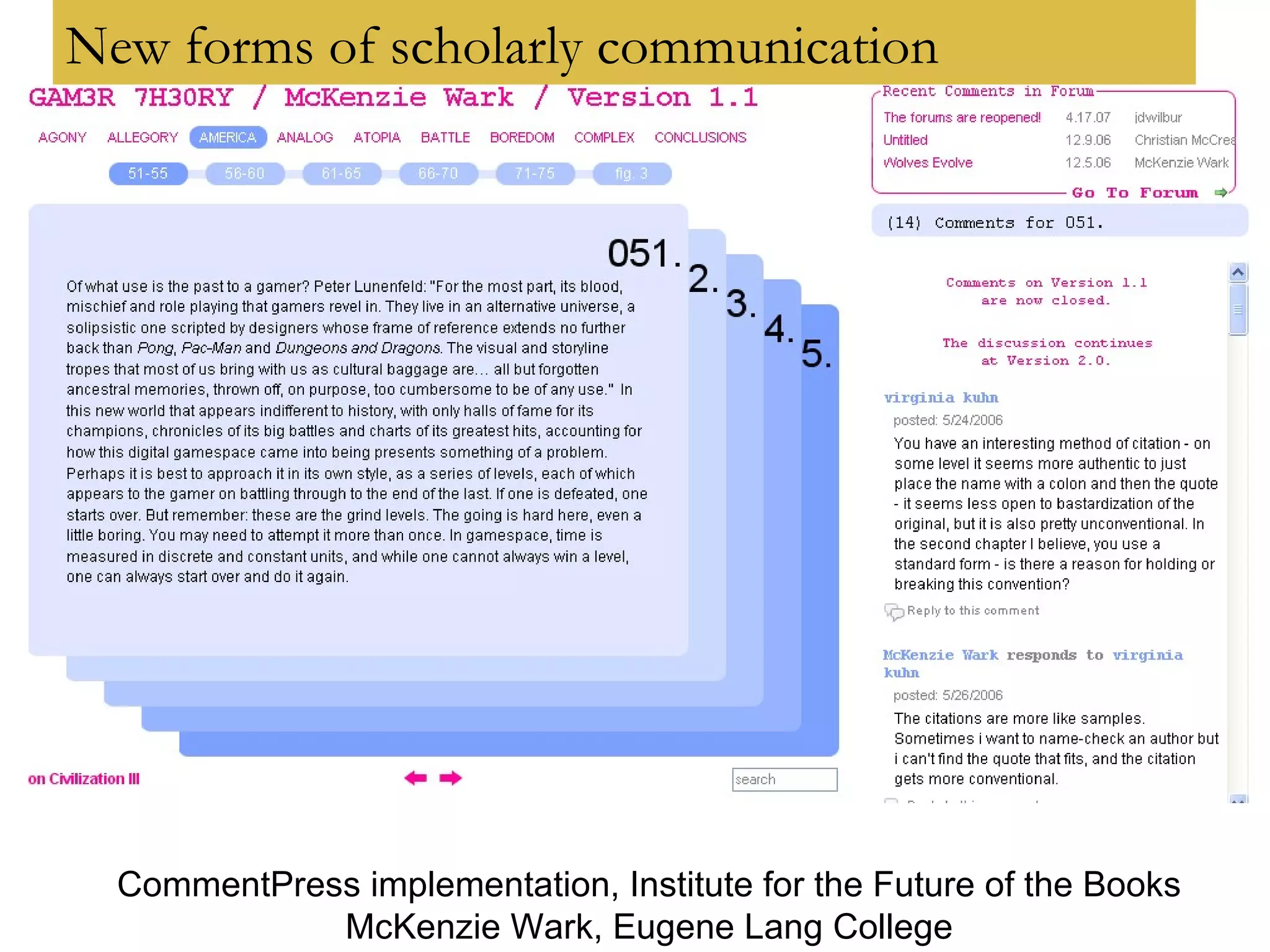
New forms of scholarly communication CommentPress implementation, Institute for the Future of the Books McKenzie Wark, Eugene Lang College
More bookblogging
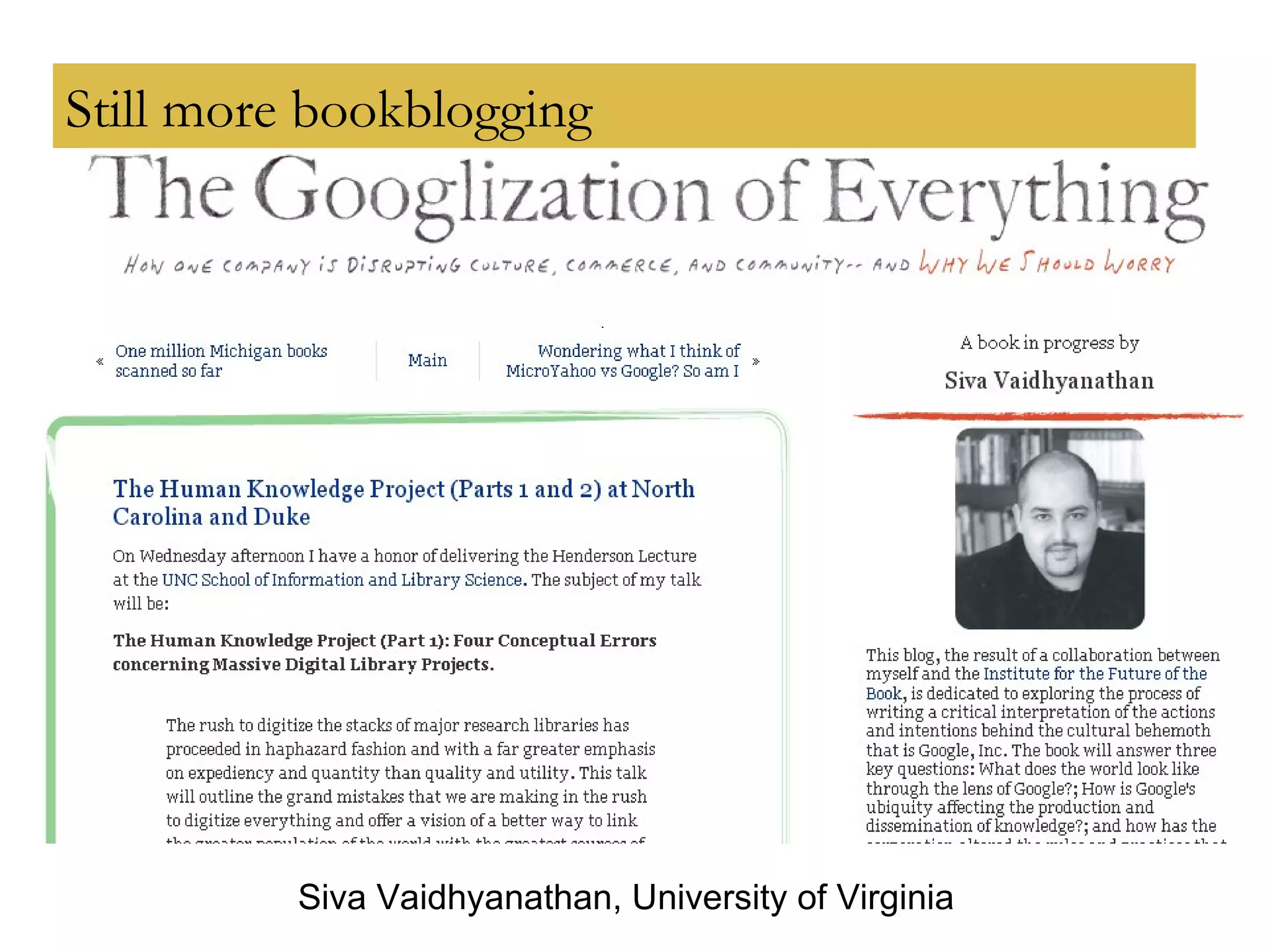
Still more bookblogging Siva Vaidhyanathan, University of Virginia
Combining Web 2.0 forms Podcasting Blogging Digital storytelling Web-based photography YouTube Video mashups Middlebury College, Jason Mittell and Barbara Ganley Blend teaching with research BG now involved in rural community media
Web 2.0 problems: privacy Contrary to class safe space (Gary Kornblith, Oberlin College) Culture of too much disclosure Problem increasing archivally Copyright?
Some responses Can block comments and/or readers Teachable moment: what is privacy in 2007? Complement other practices Create academic networks
Support strategies Local hosting  Campus identity Stability Integration into other services Preservation Time Offshore hosting Third party identity Stability Integration into their other services Preservation Different time
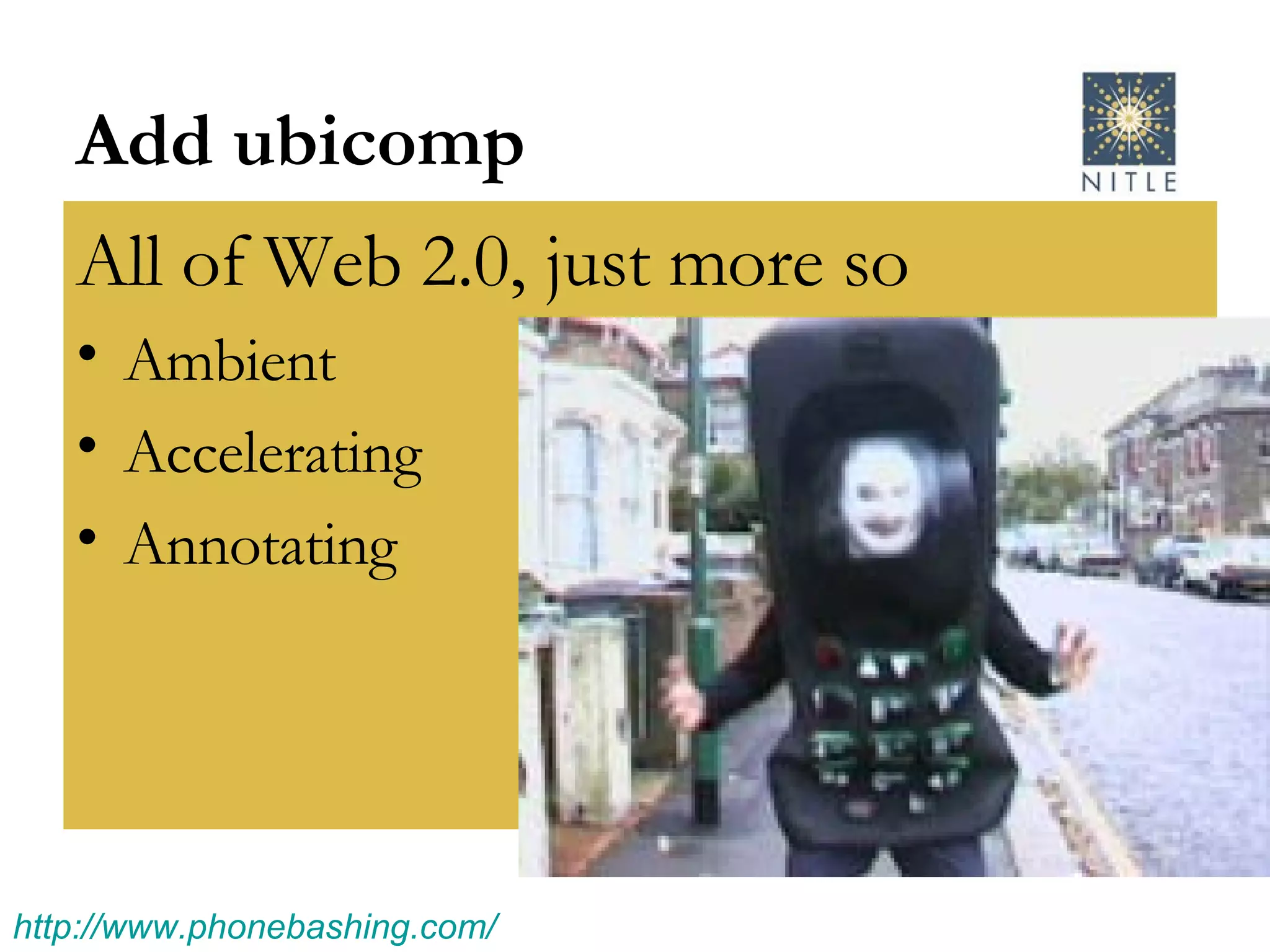
Add ubicomp  All of Web 2.0, just more so Ambient Accelerating  Annotating http:// www.phonebashing.com /
(Found on BBC site, June 2005) Except for American unilateralism
Pedagogies: new forms (John Schott, Carleton College, 2006)
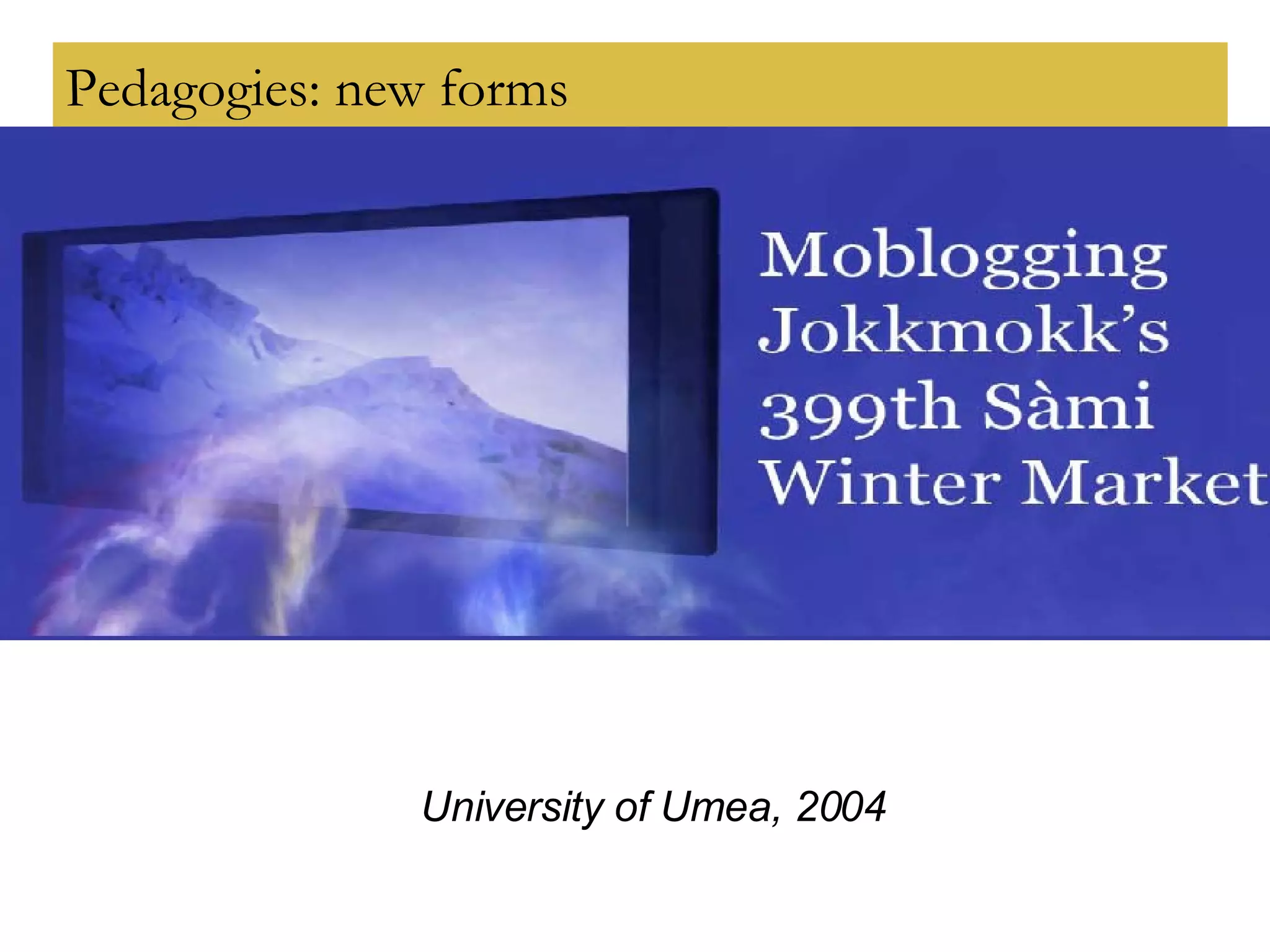
Pedagogies: new forms University of Umea, 2004
Challenges Platform profusion Walled gardens Network limitations Student privacy Faculty/staff privacy Copyright poaching (Blackbelt Jones, November 2007; Open Handset Alliance)
Virtual worlds as social software Pedagogy: team and community formation “ Emotional bandwidth” (Linden Labs) Social presence Self-expression  Second Life scene, Bryan Zelmanov
Pedagogy: good old virtual reality Visualization Collaborative objects Metaverse; Croquet, UBC
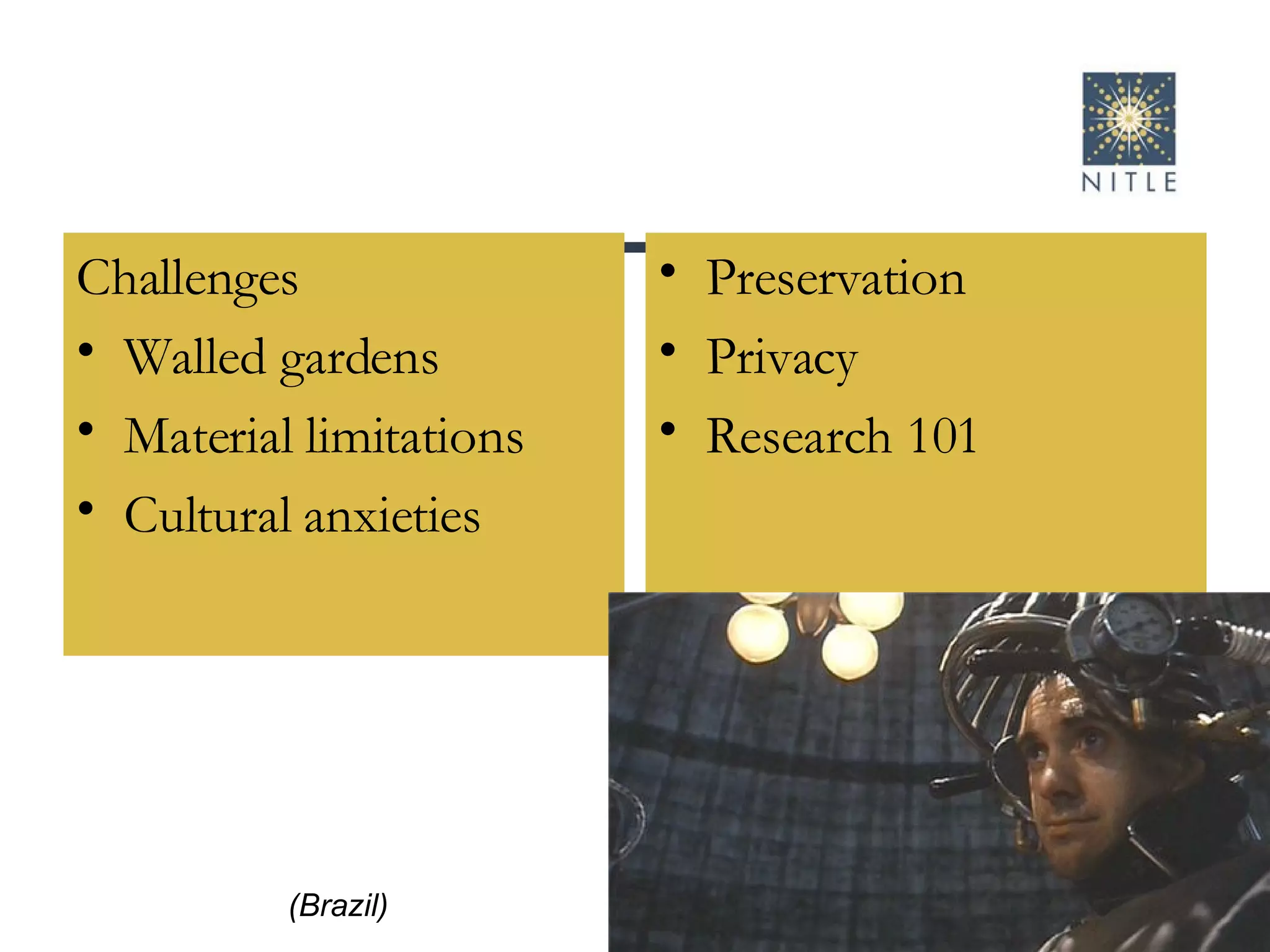
Challenges Walled gardens Material limitations Cultural anxieties Preservation Privacy Research 101 (Brazil)
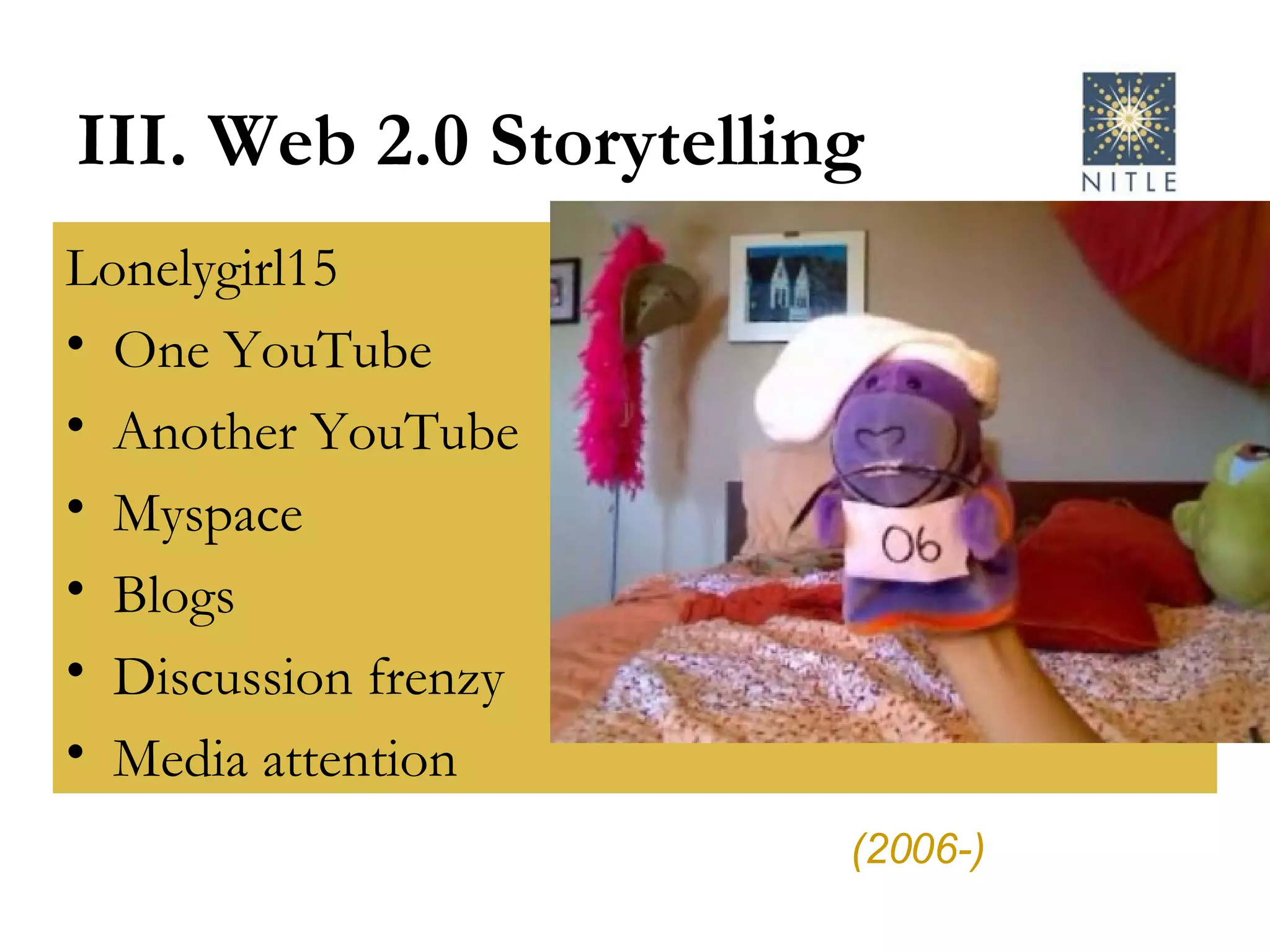
III. Web 2.0 Storytelling Lonelygirl15 One YouTube Another YouTube Myspace Blogs Discussion frenzy Media attention (2006-)
Alternate reality games ( ARG s) Permeability of game boundary (space and time) Focus on distributed, collaborative cognition Increased ephemerality  (Perplex City, 2003-2006; Silver Ladder, 2007-)
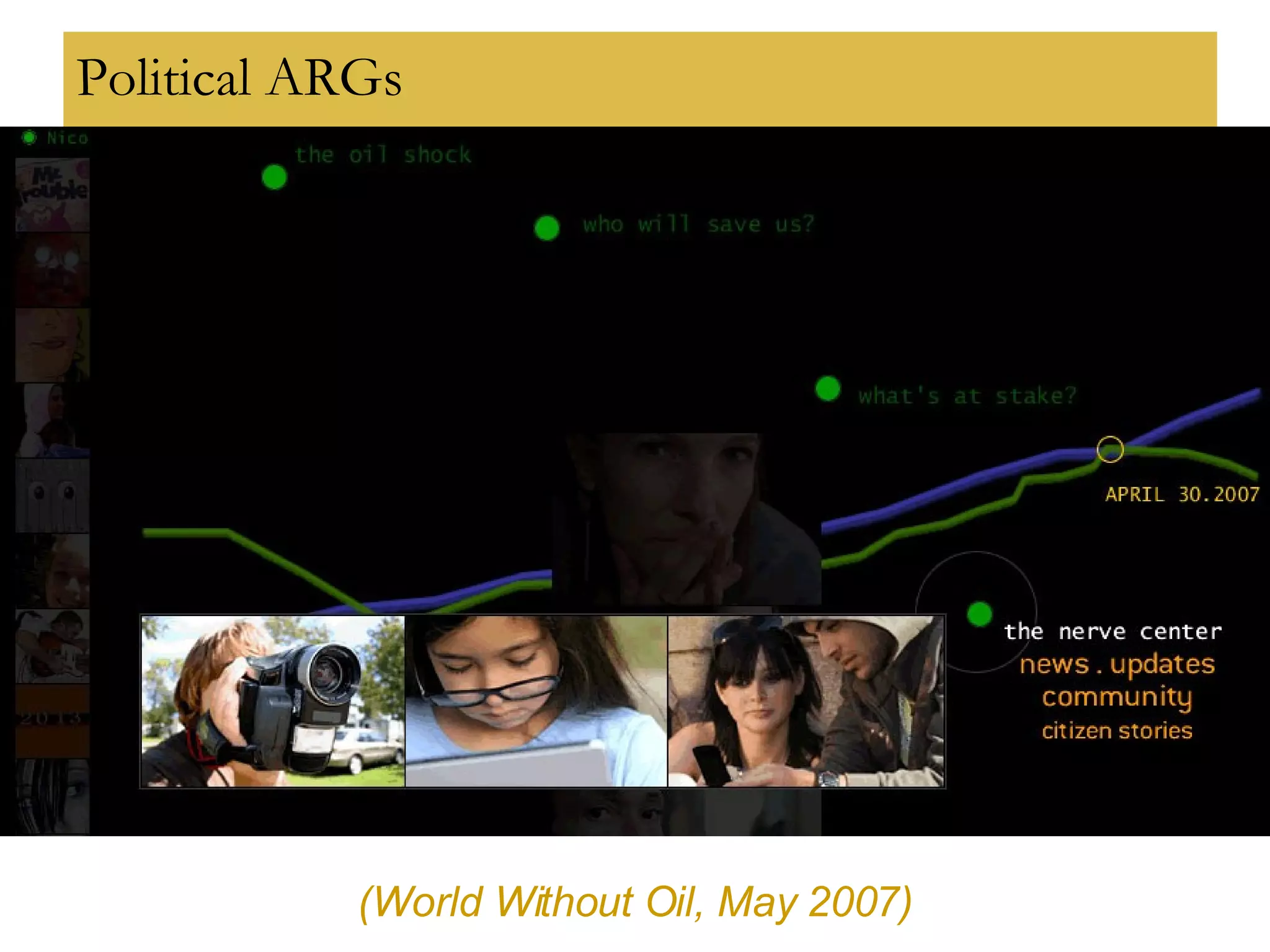
Political ARGs (World Without Oil, May 2007)
ARG pedagogy Creation for constructivism Information literacy Object of study (Trinity University library, 2007-; University of North Texas, 2007-)
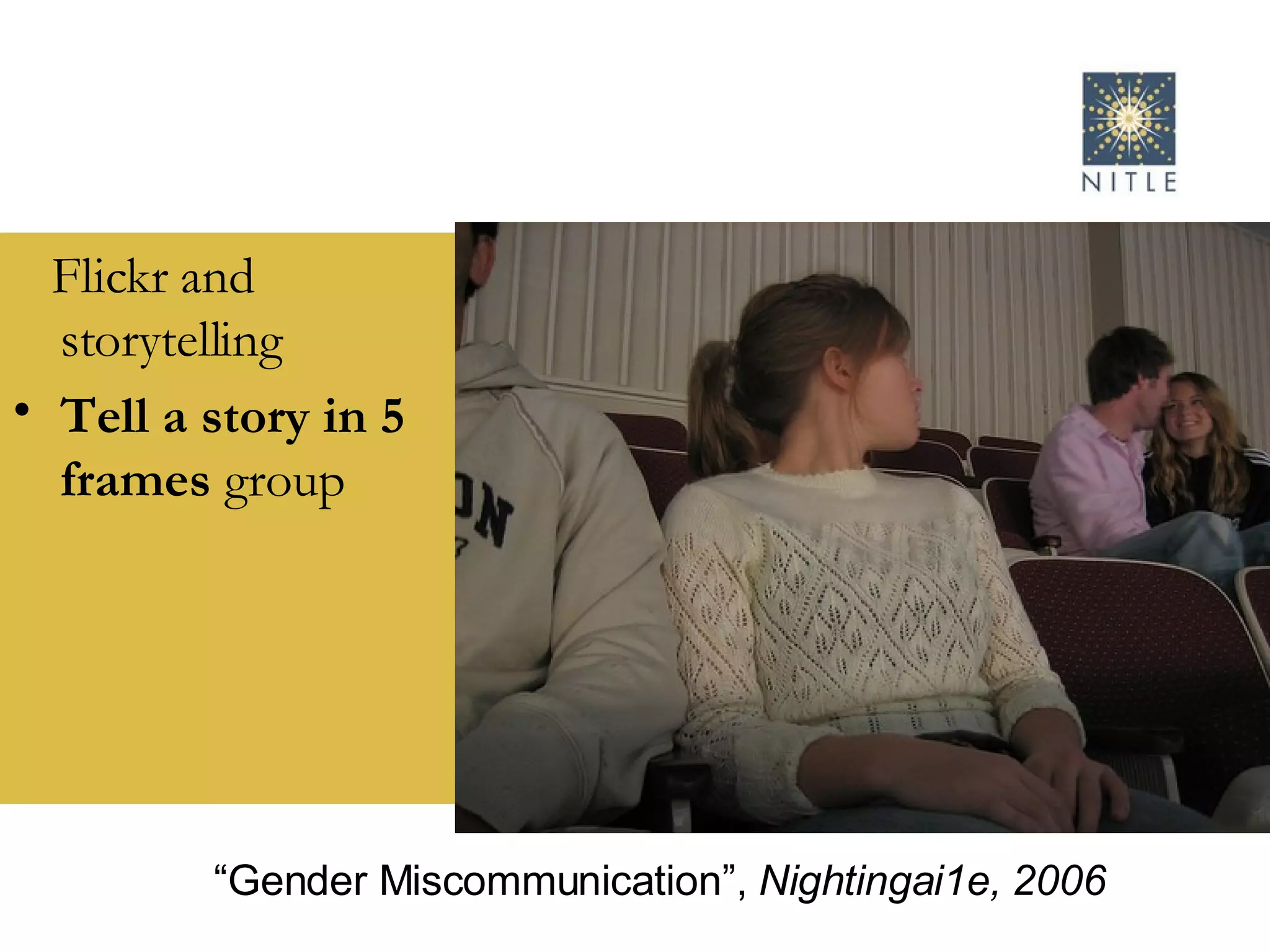
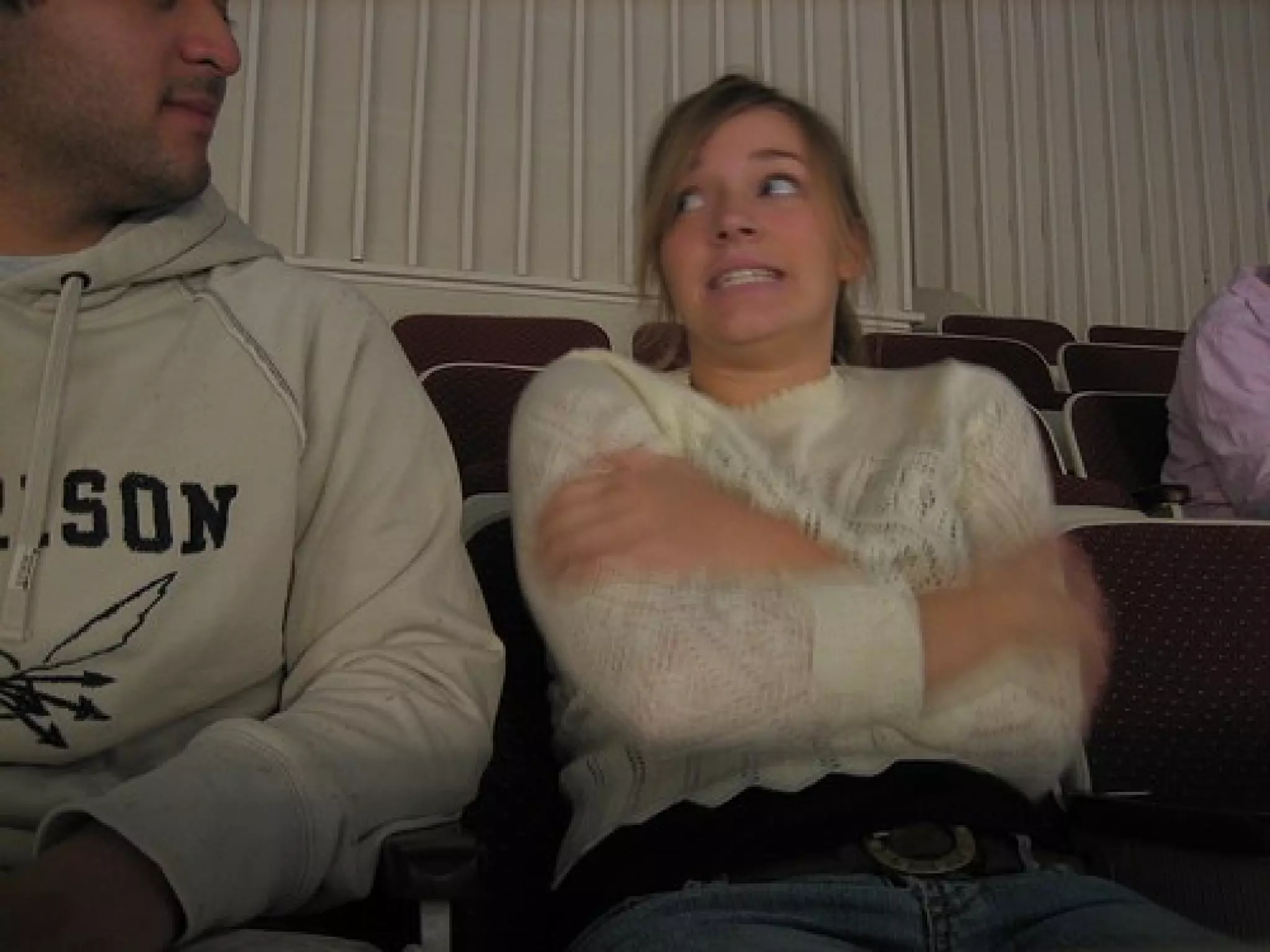
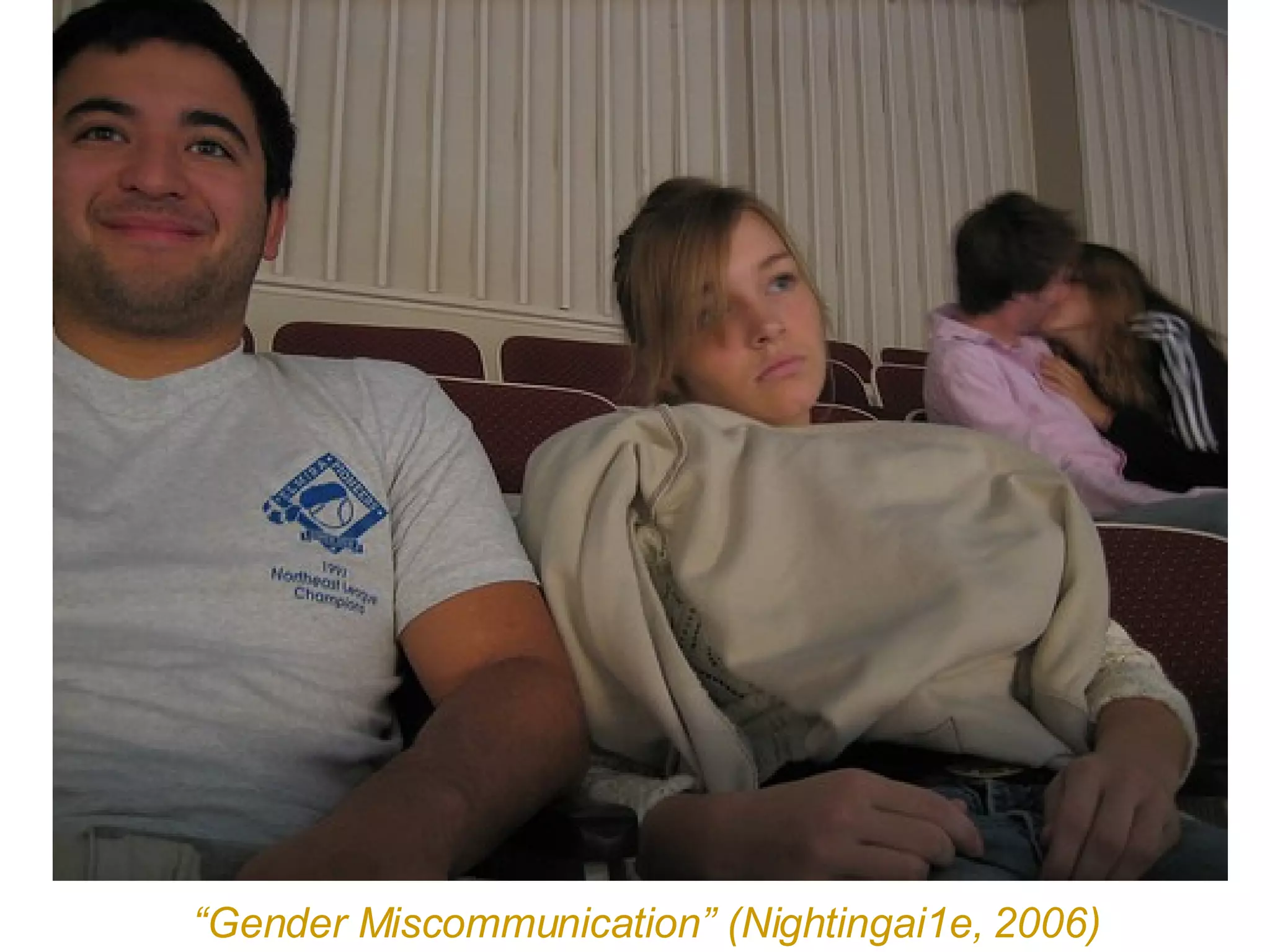
Flickr and storytelling Tell a story in 5 frames  group “ Gender Miscommunication”,  Nightingai1e, 2006


“ Gender Miscommunication” (Nightingai1e, 2006)
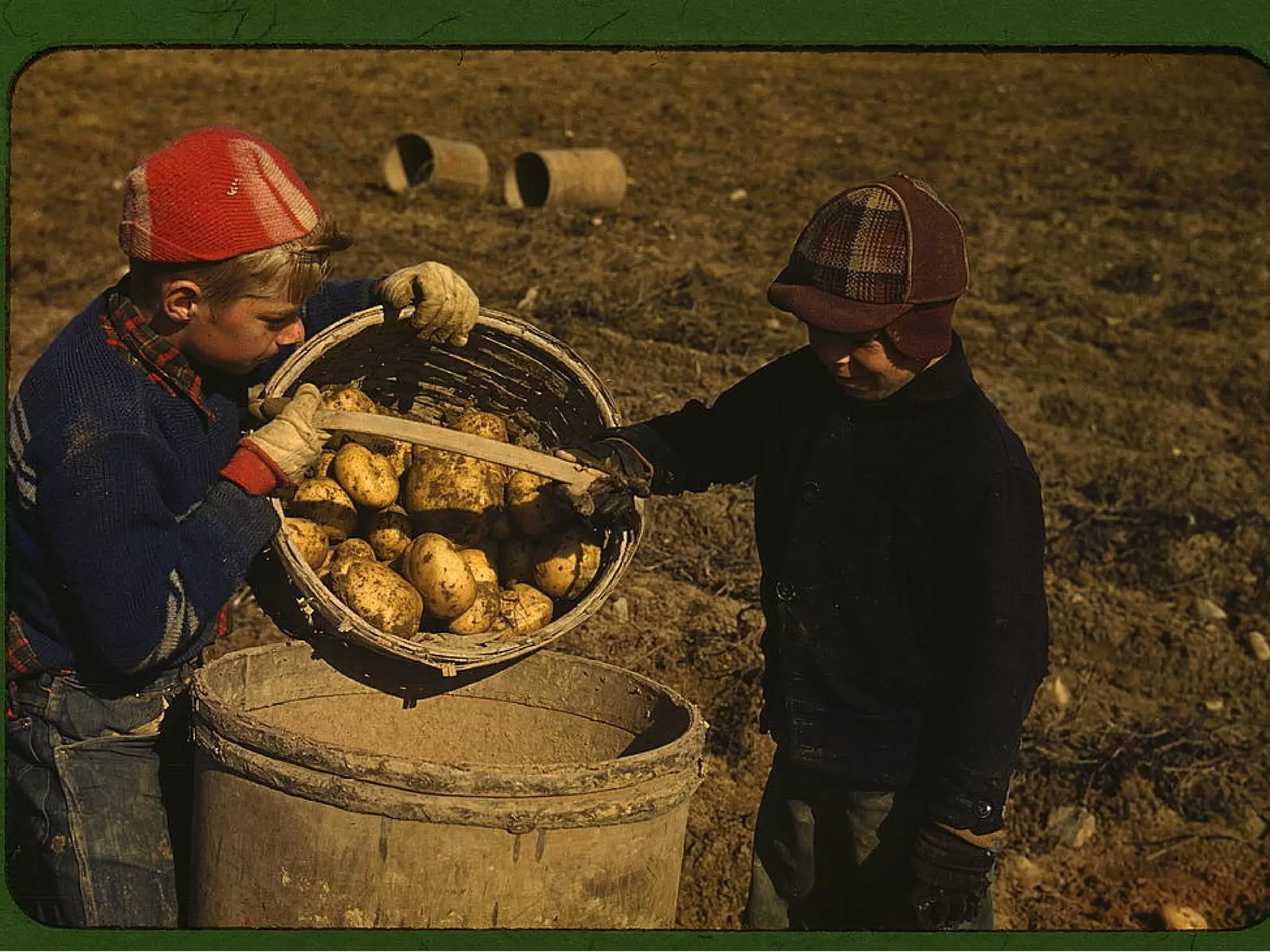
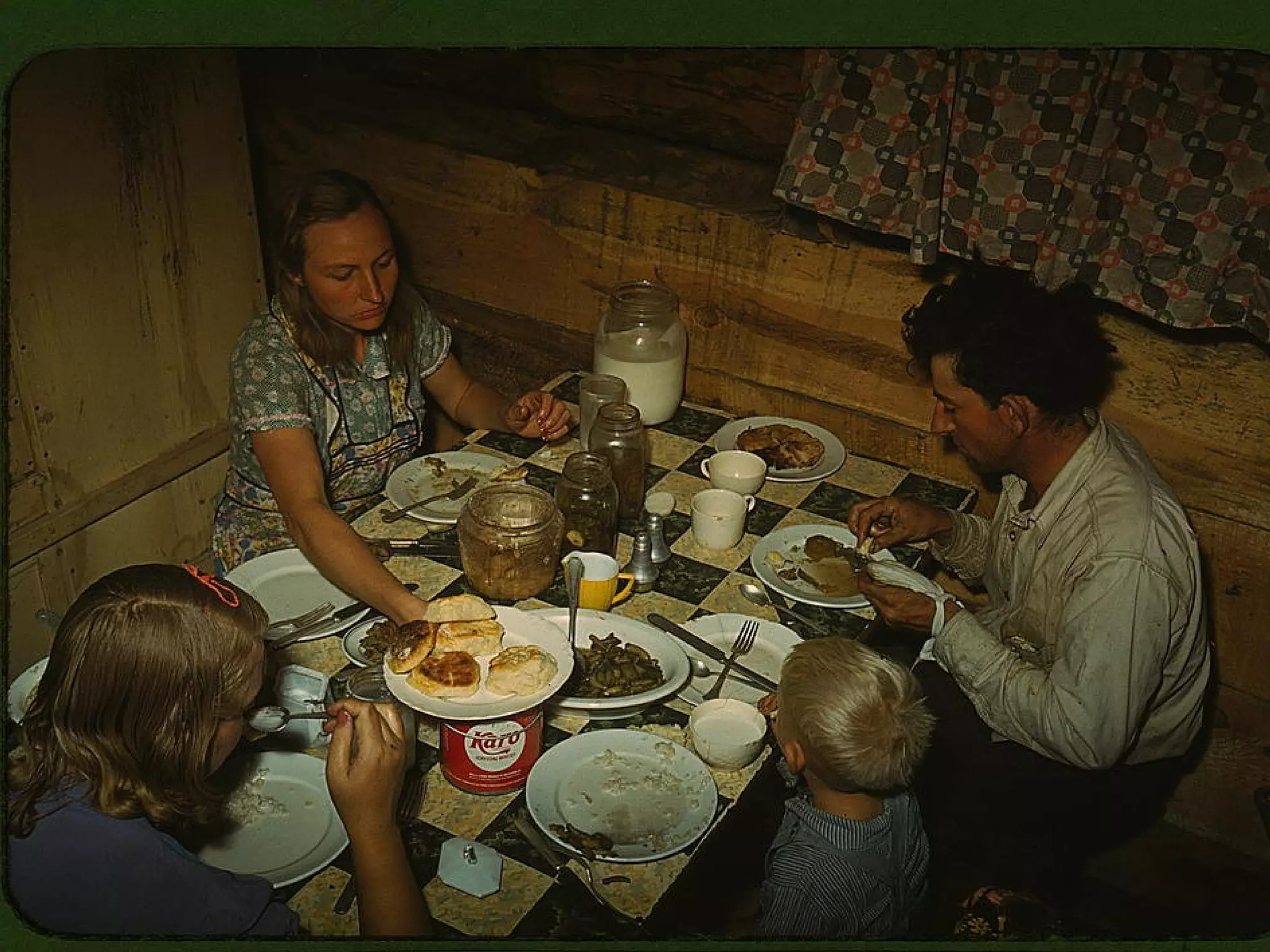
Social photo stories Or remix social media into narratives Example: "Food to Farm", Eli the Bearded (2008) Library of Congress collections
Social photo stories
Social photo stories Flickr, Tell A Story in Five Frames group ( http://www.flickr.com/groups/visualstory/ ) Example: "Food to Farm", Eli the Bearded (2008)
Social photo stories Example: "Food to Farm", Eli the Bearded (2008)
Social photo stories Pedagogies: Remix Archive work Social presentation Visual literacy ( http://www.flickr.com/groups/visualstory/discuss/72157603786255599/ ; http://www.flickr.com/photos/library_of_congress/  )
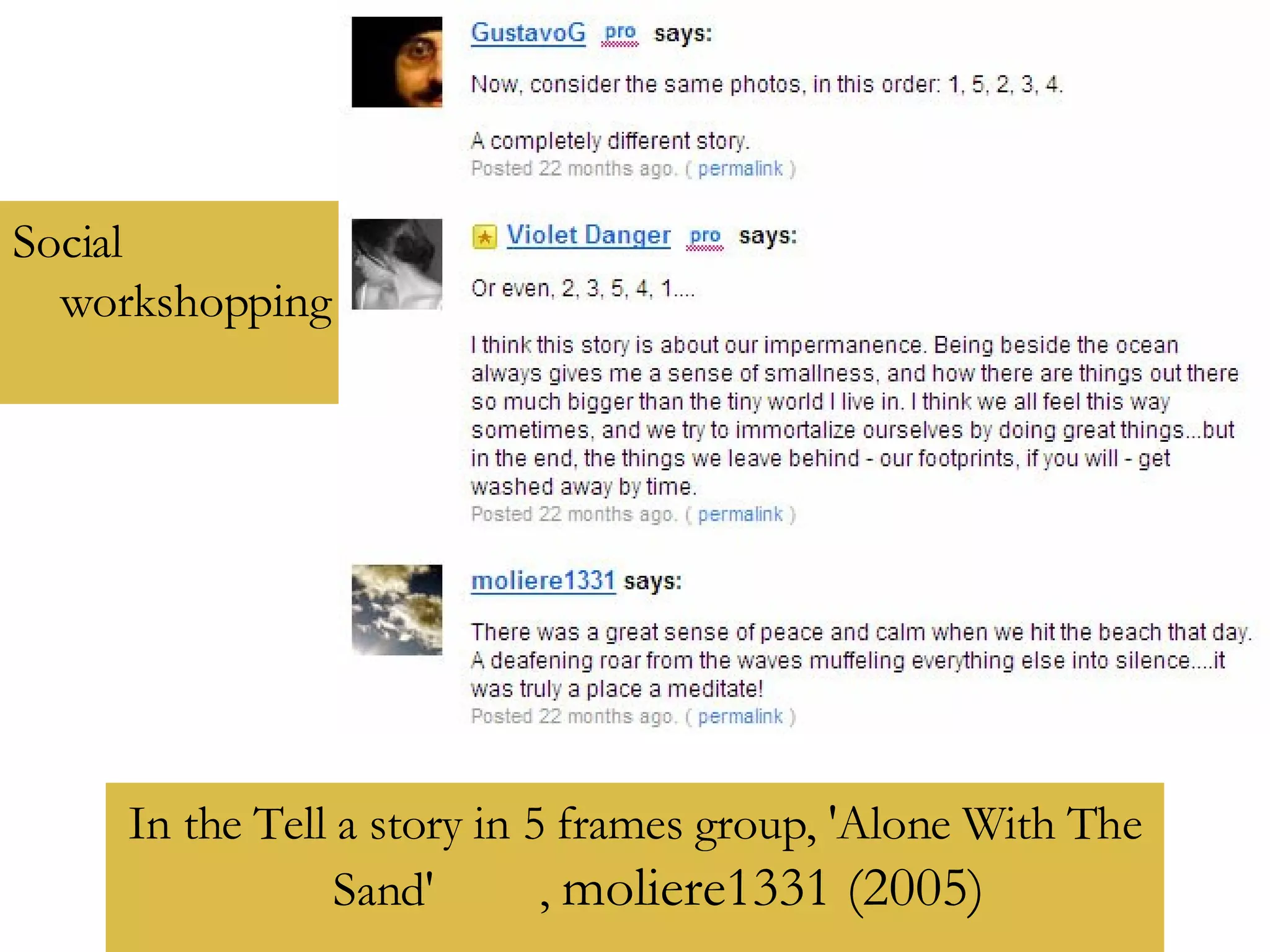
Social workshopping In the Tell a story in 5 frames group, 'Alone With The Sand' ,  moliere1331 (2005)
Folksonomizing stories: ManyEyes Project
IV. Policies, fears, and the great divide (Valdis Krebs, 2004)
(Blackboard)   Huge market share Copyright Privacy Familiarity Classroom Other online environments
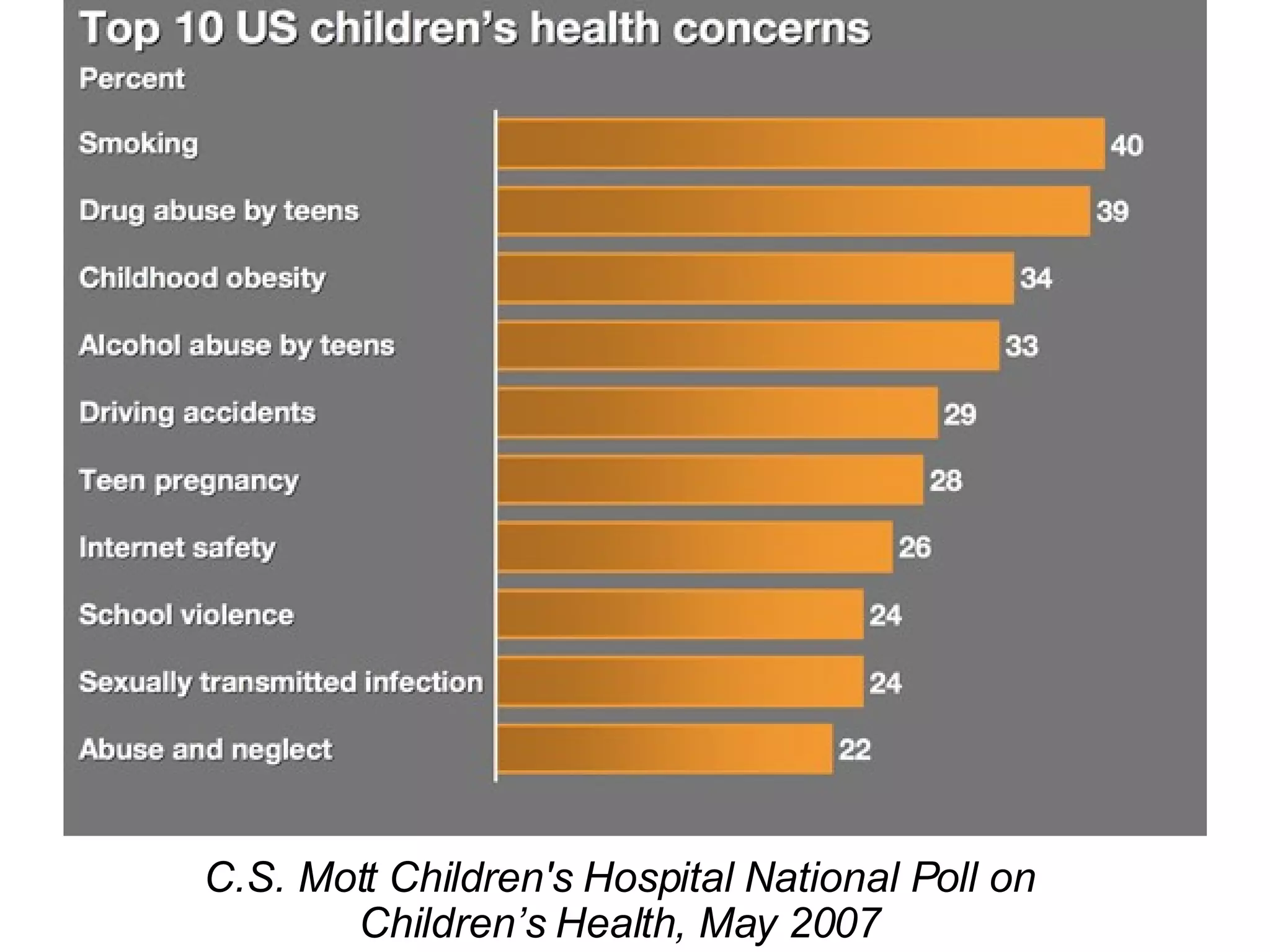
C.S. Mott Children's Hospital National Poll on Children’s Health, May 2007
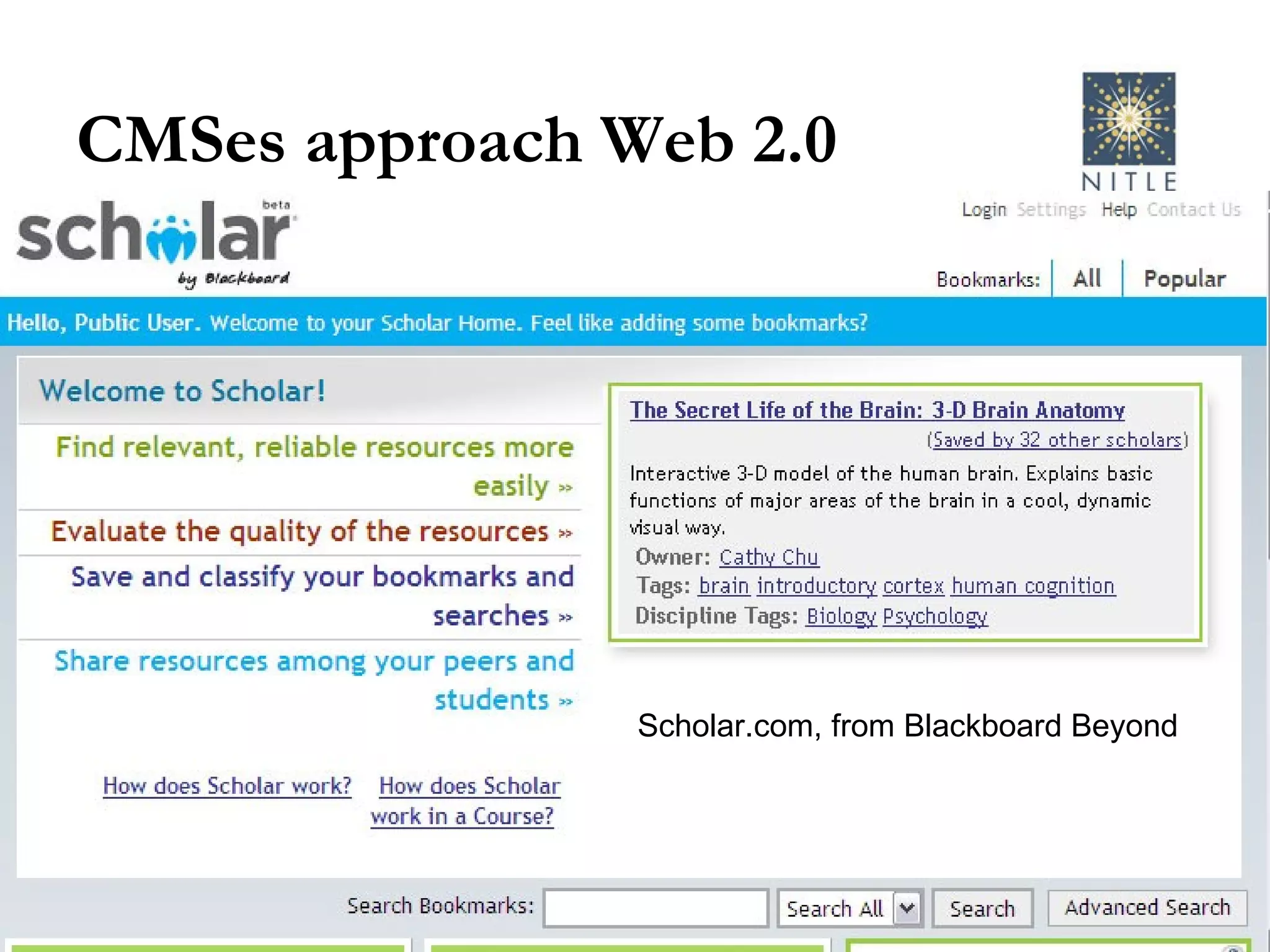
CMSes approach Web 2.0 Scholar.com, from Blackboard Beyond
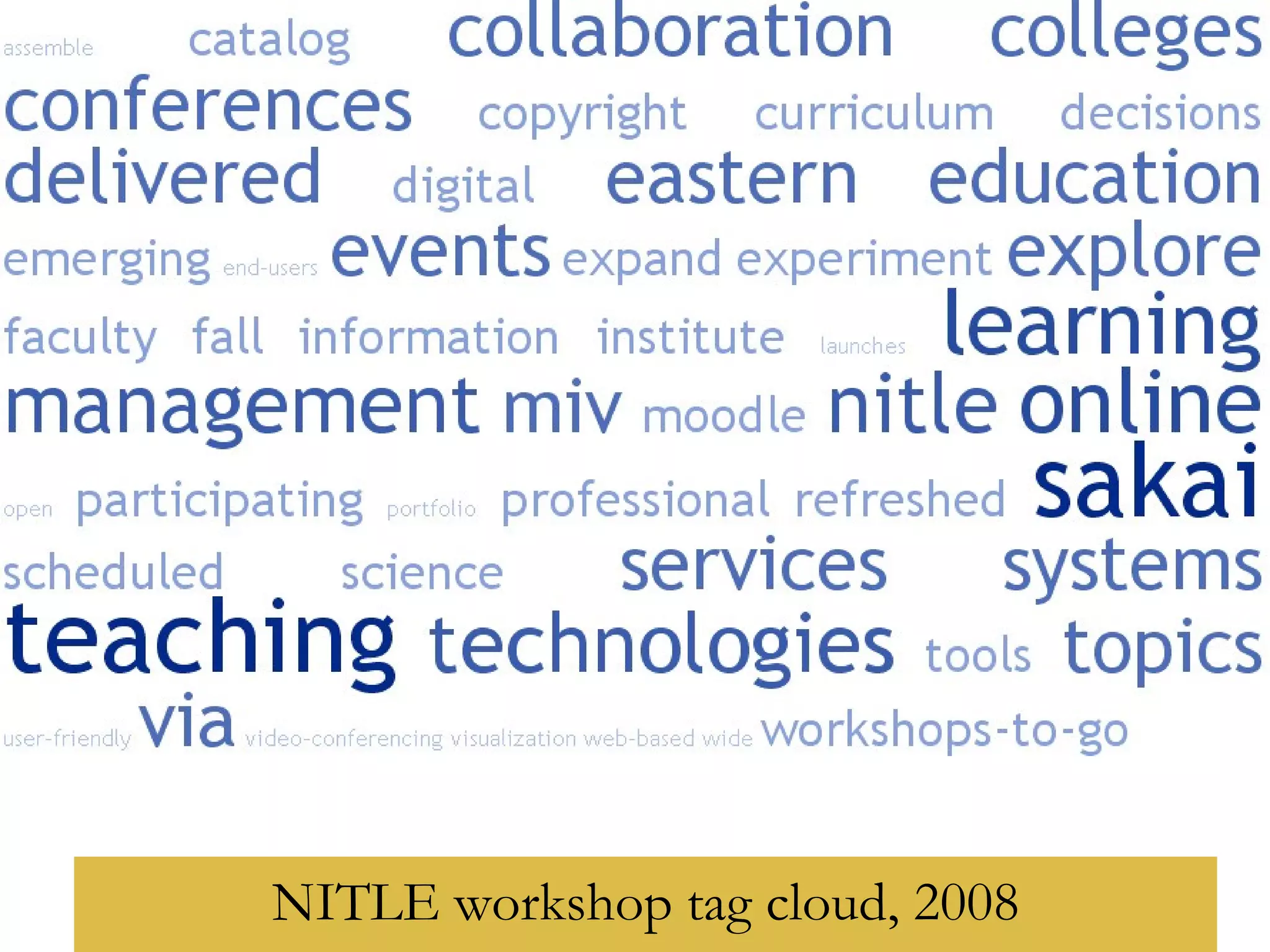
Keeping up NITLE workshop tag cloud, 2008
National Institute for Technology and Liberal Education (NITLE)  http://nitle.org Liberal Education Today blog  http://b2e.nitle.org

I School 2008 talk notes

  • 1.
    Web 2.0, anew wave of teaching, and learning February 2008 UC Berkeley School of Information
  • 2.
    Plan of thetalk Pieces of Web 2.0 Pedagogies and publics Storytelling Policies, fears, and the great divide (Vermont trees and sky, winter 2008)
  • 3.
    Thematics Emergence intime and space Pedagogy Open determinism (“Sorpdragon,” Voicethread 2007)
  • 4.
    One problem Howdoes academia apprehend emerging technologies? Panic/siege mode Vendors Futurism methods Networks
  • 5.
    One odd metaphorWeb 2.0 and education is like gaming and education: awareness is challenging Huge, financially and quantitatively successful worlds Global and rapidly developing scope Bad anxieties, policies, and media coverage Perceived lack of seriousness
  • 6.
    Five responses Web2.0 and education is like gaming and education: intersections are happening Take advantage of preexisting projects and services Mod/warp/hack DIY Literacy: new media Influence (World of Warcraft)
  • 7.
    Too much information?Early modern era Gutenberg + religious struggle Glossators (Franciscus Accursius, Denis Godefroi) Then the Geneva Bible Another response: consider antecedents
  • 8.
    Another response tooverload Cyclopedia (Ephraim Chambers, 1728) Encyclopedie (1751-1772)
  • 9.
    (Another precursor, lackingthe technology: Isidore of Seville, Etymologiae , 636) Another response to overload Cyclopedia (Ephraim Chambers, 1728) Encyclopedie (1751-1772)
  • 10.
    I. Web 2.0( http://emptybottle.org/bullshit/ )
  • 11.
    The term’s history:Tim O’Reilly, 2005 Expands “social software” Draws on Web history
  • 12.
    I. Web 2.0Microcontent, rather than sites or large documents (NITLE blog Liberal Education Today, http://b2e.nitle.org )
  • 13.
    I. Web 2.0Multiply authored microcontent
  • 14.
    Open content and/orservices and/or standards… (Pepysblog, 2003-)
  • 15.
    … leading tonetworked conversations (Pepysblog, 2003-)
  • 16.
    O’Reilly: Web 2.0is a platform for development Open APIs Access to data Virtue of the lazyweb ( http://www.hurricanearchive.org/ , Center for History and New Media,George Mason University) Programming staff Perceived recognition
  • 17.
  • 18.
    Web 2.0 components,movements Collaborative writing platforms: the wiki way
  • 19.
    Web 2.0 components,movements Consider the most notorious/famous
  • 20.
    -Viégas, Wattenberg, Dave(Historyflow, IBM, 2004) Wikis are (often) textually productive
  • 21.
    Web 2.0 components,movements collaborative writing platforms: the blogosphere
  • 22.
  • 23.
    … leading todistributed and/or attached conversations (Radio Open Source blog/podcast)
  • 24.
    “ Technorati isnow tracking over 70 million weblogs, and we're seeing about 120,000 new weblogs being created worldwide each day. That's about 1.4 blogs created every second of every day.” (David Sifry, April 2007 )
  • 25.
    State of theblogosphere, more Diversity: diaries, public intellectuals, carnivals, knitters, moblogs, warblogs home and abroad… 12 people million using three platforms, including LiveJournal: majority women (Anil Dash, MeshForum 2006) NIH guidelines, http://www.ncbi.nlm.nih.gov/books/bv.fcgi?rid=citmed.section.61024
  • 26.
    Web 2.0 components,movements: social photos
  • 27.
    Reach of Flickr26 million searchable, shareable images in Flickr (December 2006) Global, not national Metadata is good enough Gaming inspiration (Ben Harris-Roxas, 2006)
  • 28.
    Social news :Memeorandum, Tailrank, Digg, TechMeme Google News
  • 29.
    Web 2.0 andrich media Web 2.0 influences rich media, or social media Podcasting
  • 30.
    Web 2.0 andrich media Web 2.0 influences rich media, or social media Podcasting (Orson Wells, hero to podcasters everywhere)
  • 31.
    How old isthe term?
  • 32.
    How old isthe term? “… all the ingredients are there for a new boom in amateur radio. But what to call it? Audioblogging? Podcasting ? GuerillaMedia?” (Ben Hammersley, The Guardian February 12, 2004)
  • 33.
    How old isthe term? “… all the ingredients are there for a new boom in amateur radio. But what to call it? Audioblogging? Podcasting ? GuerillaMedia?” (Ben Hammersley, The Guardian February 12, 2004)
  • 34.
    What’s happened since“podcasting” in 2004? Neologisms: godcasting nanocasting podfading podsafe podspamming podvertising porncasting
  • 35.
    Web 2.0 influencesrich media: video (Gootube? Suetube?)
  • 36.
    Web 2.0 influencesrich media: video (Gootube? Suetube?)
  • 37.
    Videoblogging (vlog? vog?)(Ask a Ninja; Rocketboom; Howard Rheingold)
  • 38.
    Social object: the person FaceBook MySpace LinkedIn ZoomInfo CyWorld… “ Less than four years after its launch, 15 million people, or almost a third of the country's population, are members.” ( BusinessWeek , September 2005)
  • 39.
  • 40.
    Social organization ofinformation, new forms: folksonomy Search Retrieval Self-awareness http://del.icio.us/ for DoctorNemo
  • 41.
    Community surfacingOntology Concepts Collaborative research
  • 42.
    Tagging museums: the Steve project Users tag differently than professionals Curators get it (Metropolitan Museum of Art, 2004)
  • 43.
    Folksonomic libraries: PennTagsCoded locally Collection awareness Also tags the open web ( http://tags.library.upenn.edu/ )
  • 44.
    Extrapolating principles: TonZylstra on the social object: “ In general you could say that both Flickr and del.icio.us work in a triangle: person, picture/ bookmark, and tag(s). Or more abstract a person, an object of sociality , and some descriptor...” (Zylstra in Second Life, 2007)
  • 45.
    “… In everytriangle there always needs to be a person and an object of sociality . The third point of the triangle is free to define[,] as it were.” - http://www.zylstra.org , 2006 (emphases added)
  • 46.
    (“Online Communities”, XKCD,April 2007 )… For academia, this can seem a bit overwhelming
  • 47.
    (“Online Communities”, XKCD,April 2007 ) Already out of date For academia, this can seem a bit overwhelming
  • 48.
    Pedagogies and publicationsTeaching with Web 2.0: it’s not all new - Web 1.0, internet pedagogies Hypertext Web audience Discussion fora Collaborative document authoring Groupware
  • 49.
    Teaching with Web2.0: it’s not all new Earlier pedagogies Journaling Media literacy
  • 50.
    Teaching with Web2.0: principles http://smarthistory.blogspot.com/ Distributed conversation Collaborative writing Object-oriented discussion Connectivism (G. Siemens, 2004)
  • 51.
    Wiki pedagogies Collectiveresearch Group writing Document editing Information literacy Discussion Knowledge accretion (Romantic Audiences project Bowdoin College, 2005-present Discussion Knowledge accretion
  • 52.
    Social object pedagogiesPrompts Discussion object Composition materials
  • 53.
    More social objectpedagogies Annotate details Remix (“Make it mine”) Edugadget http://www.edugadget.com/2005/05/07/flickr-creative-commons
  • 54.
    Teaching with Web2.0: “ net.gen ”: “ Fully half of all teens and 57 percent of teens who use the Internet could be considered Content Creators, according to a survey by the Pew Internet & American Life Project.” http://www.pewtrusts.com/pdf/PIP_Teens_1105.pdf
  • 55.
    “ [S]tudents… writewords on paper, yes— but… also compose words and images and create audio files on Web logs (blogs), in word processors, with video editors and Web editors and in e-mail and on presentation software and in instant messaging and on listservs and on bulletin boards—and no doubt in whatever genre will emerge in the next ten minutes. Note that no one is making anyone do any of this writing .” Kathleen Blake Yancey, "Made Not Only in Words: Composition in a New Key." CCC 56.2 (2004):297-328. Emphasis added.
  • 56.
    RSS pedagogies Pushingstudent-created content (mother blog, Feed to Javascript) (Bloglines) Shaping Web reading Web 2.0 wrangling
  • 57.
    Academic open archivesfor social media Freesound archive DIY copyright Social networking values University of Pompeu Fabra (Barcelona) ( http://freesound.iua.upf.edu/ )
  • 58.
    Podcasts and teaching: profcasting Bryn Mawr College: Michelle Francl, chemistry Duke: “Classroom recording” Learning objects: Gardner Campbell, University of Richmond Duke: “Course content dissemination” Information literacy
  • 59.
    Student program podcastingon campus War News Radio (Swarthmore College) PEPI courses (University of British Columbia, department of Land and Food Resources)
  • 60.
    Media to enhance other media Podcast + pdfs: Allegheny College, Gothcast
  • 61.
    Podcasts and researchPublic intellectual Out of the Past Engines of Our Ingenuity In Our Time University Channel The Missing Link
  • 62.
    New forms ofscholarly communication CommentPress implementation, Institute for the Future of the Books McKenzie Wark, Eugene Lang College
  • 63.
  • 64.
    Still more bookbloggingSiva Vaidhyanathan, University of Virginia
  • 65.
    Combining Web 2.0forms Podcasting Blogging Digital storytelling Web-based photography YouTube Video mashups Middlebury College, Jason Mittell and Barbara Ganley Blend teaching with research BG now involved in rural community media
  • 66.
    Web 2.0 problems:privacy Contrary to class safe space (Gary Kornblith, Oberlin College) Culture of too much disclosure Problem increasing archivally Copyright?
  • 67.
    Some responses Canblock comments and/or readers Teachable moment: what is privacy in 2007? Complement other practices Create academic networks
  • 68.
    Support strategies Localhosting Campus identity Stability Integration into other services Preservation Time Offshore hosting Third party identity Stability Integration into their other services Preservation Different time
  • 69.
    Add ubicomp All of Web 2.0, just more so Ambient Accelerating Annotating http:// www.phonebashing.com /
  • 70.
    (Found on BBCsite, June 2005) Except for American unilateralism
  • 71.
    Pedagogies: new forms(John Schott, Carleton College, 2006)
  • 72.
    Pedagogies: new formsUniversity of Umea, 2004
  • 73.
    Challenges Platform profusionWalled gardens Network limitations Student privacy Faculty/staff privacy Copyright poaching (Blackbelt Jones, November 2007; Open Handset Alliance)
  • 74.
    Virtual worlds associal software Pedagogy: team and community formation “ Emotional bandwidth” (Linden Labs) Social presence Self-expression Second Life scene, Bryan Zelmanov
  • 75.
    Pedagogy: good oldvirtual reality Visualization Collaborative objects Metaverse; Croquet, UBC
  • 76.
    Challenges Walled gardensMaterial limitations Cultural anxieties Preservation Privacy Research 101 (Brazil)
  • 77.
    III. Web 2.0Storytelling Lonelygirl15 One YouTube Another YouTube Myspace Blogs Discussion frenzy Media attention (2006-)
  • 78.
    Alternate reality games( ARG s) Permeability of game boundary (space and time) Focus on distributed, collaborative cognition Increased ephemerality (Perplex City, 2003-2006; Silver Ladder, 2007-)
  • 79.
    Political ARGs (WorldWithout Oil, May 2007)
  • 80.
    ARG pedagogy Creationfor constructivism Information literacy Object of study (Trinity University library, 2007-; University of North Texas, 2007-)
  • 81.
    Flickr and storytellingTell a story in 5 frames group “ Gender Miscommunication”, Nightingai1e, 2006
  • 82.
  • 83.
  • 84.
  • 85.
    “ Gender Miscommunication”(Nightingai1e, 2006)
  • 86.
    Social photo storiesOr remix social media into narratives Example: "Food to Farm", Eli the Bearded (2008) Library of Congress collections
  • 87.
  • 88.
  • 89.
    Social photo storiesFlickr, Tell A Story in Five Frames group ( http://www.flickr.com/groups/visualstory/ ) Example: "Food to Farm", Eli the Bearded (2008)
  • 90.
    Social photo storiesExample: "Food to Farm", Eli the Bearded (2008)
  • 91.
    Social photo storiesPedagogies: Remix Archive work Social presentation Visual literacy ( http://www.flickr.com/groups/visualstory/discuss/72157603786255599/ ; http://www.flickr.com/photos/library_of_congress/ )
  • 92.
    Social workshopping Inthe Tell a story in 5 frames group, 'Alone With The Sand' , moliere1331 (2005)
  • 93.
  • 94.
    IV. Policies, fears,and the great divide (Valdis Krebs, 2004)
  • 95.
    (Blackboard) Huge market share Copyright Privacy Familiarity Classroom Other online environments
  • 96.
    C.S. Mott Children'sHospital National Poll on Children’s Health, May 2007
  • 97.
    CMSes approach Web2.0 Scholar.com, from Blackboard Beyond
  • 98.
    Keeping up NITLEworkshop tag cloud, 2008
  • 99.
    National Institute forTechnology and Liberal Education (NITLE) http://nitle.org Liberal Education Today blog http://b2e.nitle.org