http://webheads.info/

Once a Webhead
Always a Webhead
Social Media-Assisted
Lifelong Learning
Vance Stevens
February 11, 2014
http://ict4elt2014.pbworks.com/
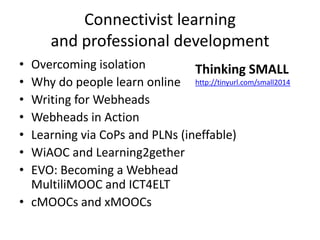
Connectivist learning
and professional development
•
•
•
•
•
•
•

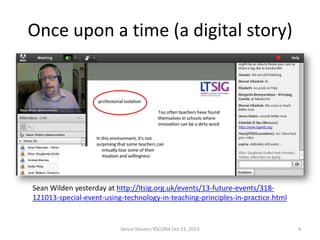
Overcoming isolation
Thinking SMALL
Why do people learn online http://tinyurl.com/small2014
Writing for Webheads
Webheads in Action
Learning via CoPs and PLNs (ineffable)
WiAOC and Learning2gether
EVO: Becoming a Webhead
MultiliMOOC and ICT4ELT
• cMOOCs and xMOOCs
Overcoming isolation
• Scarcity
• Abundance
Once upon a time (a digital story)

Sean Wilden yesterday at http://ltsig.org.uk/events/13-future-events/318121013-special-event-using-technology-in-teaching-principles-in-practice.html

Vance Stevens RSCON4 Oct 13, 2013

4
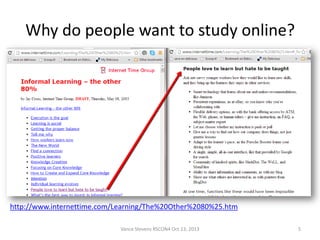
Why do people want to study online?
• Teachers instinctively prepared syllabuses

http://www.internettime.com/Learning/The%20Other%2080%25.htm
Vance Stevens RSCON4 Oct 13, 2013

5
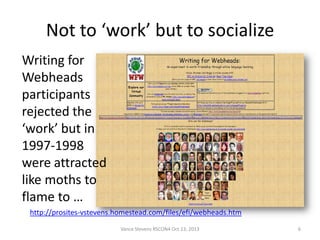
Not to ‘work’ but to socialize
Writing for
Webheads
participants
rejected the
‘work’ but in
1997-1998
were attracted
like moths to
flame to …
http://prosites-vstevens.homestead.com/files/efi/webheads.htm
Vance Stevens RSCON4 Oct 13, 2013

6
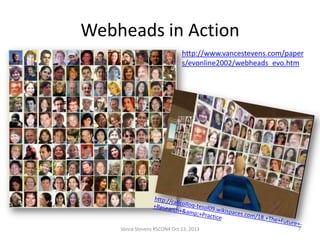
Webheads in Action
http://www.vancestevens.com/paper
s/evonline2002/webheads_evo.htm

Vance Stevens RSCON4 Oct 13, 2013

7
Learning the ineffable
• Groups
• Communities - CoPs
• Networks - PLNs

Stevens, Vance. (2009). Modeling Social Media in Groups, Communities, and Networks. TESLEJ, Volume 13, Number 3: http://www.tesl-ej.org/wordpress/pastissues/volume13/ej51/ej51int/
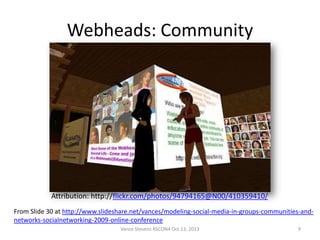
Webheads: Community

Attribution: http://flickr.com/photos/94794165@N00/410359410/
From Slide 30 at http://www.slideshare.net/vances/modeling-social-media-in-groups-communities-andnetworks-socialnetworking-2009-online-conference
Vance Stevens RSCON4 Oct 13, 2013

9
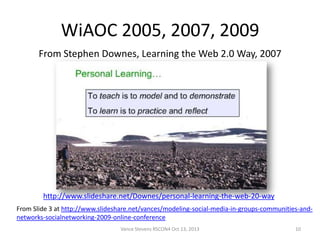
WiAOC 2005, 2007, 2009
From Stephen Downes, Learning the Web 2.0 Way, 2007

http://www.slideshare.net/Downes/personal-learning-the-web-20-way
From Slide 3 at http://www.slideshare.net/vances/modeling-social-media-in-groups-communities-andnetworks-socialnetworking-2009-online-conference
Vance Stevens RSCON4 Oct 13, 2013

10
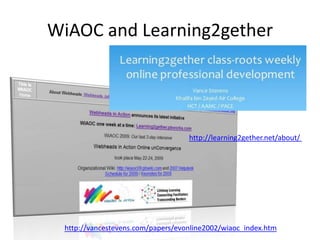
WiAOC and Learning2gether

http://learning2gether.net/about/

http://vancestevens.com/papers/evonline2002/wiaoc_index.htm
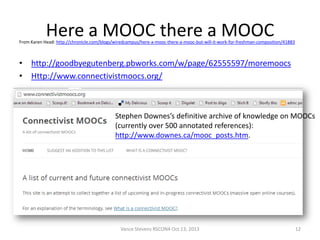
Here a MOOC there a MOOC

From Karen Head: http://chronicle.com/blogs/wiredcampus/here-a-mooc-there-a-mooc-but-will-it-work-for-freshman-composition/41883

• http://goodbyegutenberg.pbworks.com/w/page/62555597/moremoocs
• Http://www.connectivistmoocs.org/

Stephen Downes’s definitive archive of knowledge on MOOCs
(currently over 500 annotated references):
http://www.downes.ca/mooc_posts.htm.

Vance Stevens RSCON4 Oct 13, 2013

12
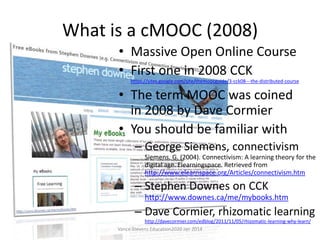
What is a cMOOC (2008)
• Massive Open Online Course
• First one in 2008 CCK
https://sites.google.com/site/themoocguide/3-cck08---the-distributed-course

• The term MOOC was coined
in 2008 by Dave Cormier
• You should be familiar with
– George Siemens, connectivism
Siemens, G. (2004). Connectivism: A learning theory for the
digital age. Elearningspace. Retrieved from
http://www.elearnspace.org/Articles/connectivism.htm

– Stephen Downes on CCK
http://www.downes.ca/me/mybooks.htm

– Dave Cormier, rhizomatic learning
http://davecormier.com/edblog/2011/11/05/rhizomatic-learning-why-learn/
Vance Stevens Education2020 Jan 2014
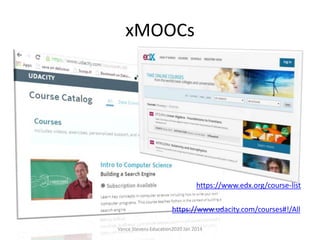
xMOOCs

https://www.edx.org/course-list
https://www.udacity.com/courses#!/All
Vance Stevens Education2020 Jan 2014
What’s with the MOOCs?
How MOOC Learning Reaches
Students through TPD
Vance Stevens
Higher Colleges of Technology, UAE
AAMC / PACE / KBZAC
Title slide from: http://www.slideshare.net/vances/how-mooc-learning-reaches-students-through-tpd
Stevens, V. (2013). What's with the MOOCs? TESL-EJ, Volume 16, Number 4, pp. 1-14: http://tesl-ej.org/pdf/ej64/int.pdf
Also available at: http://www.tesl-ej.org/wordpress/issues/volume16/ej64/ej64int/
Some articles about Webheads
•

Yilmaz, B, and Stevens, V. (2012). Webheads in Action: A community of practice scaffolding multiliteracies skills in teacher professional development.
Writing & Pedagogy 4,1:135–146.

•

Stevens, Vance. (2010). Webheads and Distributed Communities of Practice. Global Neighbors: Newsletter of TESOL's English as a Foreign Language
Interest Section, EFLIS News March 2010 Volume 9 Number 1:http://www.tesol.org//s_tesol/sec_issue.asp?nid=2994&iid=13069&sid=1

•

Stevens, Vance. (2007). Webheads as agents of change in overlapping clouds of distributed learning networks. APACALL Newsletter 11, pp. 3-8.
Retrieved December 18, 2007 from: http://www.apacall.org/news/Newsletter11.pdf.

•

Stevens, V. (2004). Webheads communities: Writing tasks interleaved with synchronous online communication and web page development. In
Leaver, B. and Willis, J. (Eds.). Task-based instruction in foreign language education: Practices and programes. Georgetown University Press. pp. 204217.
–
–
–

There is a full text of a late draft of my article here, though references are not included:
http://vancestevens.com/papers/webheads/taskbase_ch10june192003.htm
An earlier version has the references, and also images that were intended to illustrate the article:
http://vancestevens.com/papers/webheads/taskbase_full.htm
Here is a Commentary: from the Linguis list, May 2005. AUTHORS: Leaver, Betty Lou; Willis, Jane R. TITLE: Task-Based Instruction in Foreign Language
Education SUBTITLE: Practices and Programs PUBLISHER: Georgetown University Press YEAR: 2004 "CHAPTER TEN: Webhead communities: Writing tasks
interleaved with synchronous online communication and web page development (Vance Stevens) Another instance of virtual classroom implementing
writing tasks is described in this chapter. The author reports activities of groups of learners and teachers involved in online writing practices. The writing
tasks were aimed at purposeful interaction and technology was a vehicle of implementing pedagogical principles not the driving force. The author's initiative
for conducting an online writing and grammar course is reported to have been the starting point of this community of online writers called Webheads. The
group interactions involved various topics including projects on which teachers interacted and themes and tasks of interest to learners. Cost, ease of use,
multicasting capability, and cross platform adaptability were the criteria in selecting the tools for computer mediated communication. Email groups, web
pages, and synchronous chat were the major modalities of interaction and implementation of tasks. After a brief discussion on evaluation and in the
conclusion section the author mentions lowering affective obstacles and promoting a sense of community as the main message from the project and
recommends that the model be applied in other situations. In an appendix some technology related issues are dealt with.

•

Stevens, V. and Altun, A. (2002). The Webheads community of language learners online. In Syed, Z. (Ed.). The process of language learning: An EFL
perspective. Abu Dhabi: The Military Language Institute. pp. 285-318. 2001mli_stevens-altun2mb.pdf. There is a pre-publication version of this paper
at http://sites.hsprofessional.com/vstevens/files/efi/papers/t2t2001/proceeds.htm

•

Stevens, Vance. 1999. Writing for Webheads: An online writing course utilizing synchronous chat and student web pages. A paper submitted for the
4th Annual Teaching in the Community Colleges Online Conference: Best Practices In Delivering, Supporting & Managing Online Learning, April 7-9,
1999 - http://sites.hsprofessional.com/vstevens/files/efi/hawaii99.htm

Vance Stevens RSCON4 Oct 13, 2013

16
Find my slides with links intact at
http://slideshare.net/vances
Some slides in this presentation appeared in recent presentations of mine:
http://www.slideshare.net/vances/education-2020-presentation-how-can-the-mooc-model-be-applied-in-the-uae
And
http://www.slideshare.net/vances/rscon4-27141110

Feb 11 2014 MultiMOOC and ICT4ELT EVO sessions joint event - Once a Webhead always a Webhead

  • 1.
    http://webheads.info/ Once a Webhead Alwaysa Webhead Social Media-Assisted Lifelong Learning Vance Stevens February 11, 2014 http://ict4elt2014.pbworks.com/
  • 2.
    Connectivist learning and professionaldevelopment • • • • • • • Overcoming isolation Thinking SMALL Why do people learn online http://tinyurl.com/small2014 Writing for Webheads Webheads in Action Learning via CoPs and PLNs (ineffable) WiAOC and Learning2gether EVO: Becoming a Webhead MultiliMOOC and ICT4ELT • cMOOCs and xMOOCs
  • 3.
  • 4.
    Once upon atime (a digital story) Sean Wilden yesterday at http://ltsig.org.uk/events/13-future-events/318121013-special-event-using-technology-in-teaching-principles-in-practice.html Vance Stevens RSCON4 Oct 13, 2013 4
  • 5.
    Why do peoplewant to study online? • Teachers instinctively prepared syllabuses http://www.internettime.com/Learning/The%20Other%2080%25.htm Vance Stevens RSCON4 Oct 13, 2013 5
  • 6.
    Not to ‘work’but to socialize Writing for Webheads participants rejected the ‘work’ but in 1997-1998 were attracted like moths to flame to … http://prosites-vstevens.homestead.com/files/efi/webheads.htm Vance Stevens RSCON4 Oct 13, 2013 6
  • 7.
  • 8.
    Learning the ineffable •Groups • Communities - CoPs • Networks - PLNs Stevens, Vance. (2009). Modeling Social Media in Groups, Communities, and Networks. TESLEJ, Volume 13, Number 3: http://www.tesl-ej.org/wordpress/pastissues/volume13/ej51/ej51int/
  • 9.
    Webheads: Community Attribution: http://flickr.com/photos/94794165@N00/410359410/ FromSlide 30 at http://www.slideshare.net/vances/modeling-social-media-in-groups-communities-andnetworks-socialnetworking-2009-online-conference Vance Stevens RSCON4 Oct 13, 2013 9
  • 10.
    WiAOC 2005, 2007,2009 From Stephen Downes, Learning the Web 2.0 Way, 2007 http://www.slideshare.net/Downes/personal-learning-the-web-20-way From Slide 3 at http://www.slideshare.net/vances/modeling-social-media-in-groups-communities-andnetworks-socialnetworking-2009-online-conference Vance Stevens RSCON4 Oct 13, 2013 10
  • 11.
  • 12.
    Here a MOOCthere a MOOC From Karen Head: http://chronicle.com/blogs/wiredcampus/here-a-mooc-there-a-mooc-but-will-it-work-for-freshman-composition/41883 • http://goodbyegutenberg.pbworks.com/w/page/62555597/moremoocs • Http://www.connectivistmoocs.org/ Stephen Downes’s definitive archive of knowledge on MOOCs (currently over 500 annotated references): http://www.downes.ca/mooc_posts.htm. Vance Stevens RSCON4 Oct 13, 2013 12
  • 13.
    What is acMOOC (2008) • Massive Open Online Course • First one in 2008 CCK https://sites.google.com/site/themoocguide/3-cck08---the-distributed-course • The term MOOC was coined in 2008 by Dave Cormier • You should be familiar with – George Siemens, connectivism Siemens, G. (2004). Connectivism: A learning theory for the digital age. Elearningspace. Retrieved from http://www.elearnspace.org/Articles/connectivism.htm – Stephen Downes on CCK http://www.downes.ca/me/mybooks.htm – Dave Cormier, rhizomatic learning http://davecormier.com/edblog/2011/11/05/rhizomatic-learning-why-learn/ Vance Stevens Education2020 Jan 2014
  • 14.
  • 15.
    What’s with theMOOCs? How MOOC Learning Reaches Students through TPD Vance Stevens Higher Colleges of Technology, UAE AAMC / PACE / KBZAC Title slide from: http://www.slideshare.net/vances/how-mooc-learning-reaches-students-through-tpd Stevens, V. (2013). What's with the MOOCs? TESL-EJ, Volume 16, Number 4, pp. 1-14: http://tesl-ej.org/pdf/ej64/int.pdf Also available at: http://www.tesl-ej.org/wordpress/issues/volume16/ej64/ej64int/
  • 16.
    Some articles aboutWebheads • Yilmaz, B, and Stevens, V. (2012). Webheads in Action: A community of practice scaffolding multiliteracies skills in teacher professional development. Writing & Pedagogy 4,1:135–146. • Stevens, Vance. (2010). Webheads and Distributed Communities of Practice. Global Neighbors: Newsletter of TESOL's English as a Foreign Language Interest Section, EFLIS News March 2010 Volume 9 Number 1:http://www.tesol.org//s_tesol/sec_issue.asp?nid=2994&iid=13069&sid=1 • Stevens, Vance. (2007). Webheads as agents of change in overlapping clouds of distributed learning networks. APACALL Newsletter 11, pp. 3-8. Retrieved December 18, 2007 from: http://www.apacall.org/news/Newsletter11.pdf. • Stevens, V. (2004). Webheads communities: Writing tasks interleaved with synchronous online communication and web page development. In Leaver, B. and Willis, J. (Eds.). Task-based instruction in foreign language education: Practices and programes. Georgetown University Press. pp. 204217. – – – There is a full text of a late draft of my article here, though references are not included: http://vancestevens.com/papers/webheads/taskbase_ch10june192003.htm An earlier version has the references, and also images that were intended to illustrate the article: http://vancestevens.com/papers/webheads/taskbase_full.htm Here is a Commentary: from the Linguis list, May 2005. AUTHORS: Leaver, Betty Lou; Willis, Jane R. TITLE: Task-Based Instruction in Foreign Language Education SUBTITLE: Practices and Programs PUBLISHER: Georgetown University Press YEAR: 2004 "CHAPTER TEN: Webhead communities: Writing tasks interleaved with synchronous online communication and web page development (Vance Stevens) Another instance of virtual classroom implementing writing tasks is described in this chapter. The author reports activities of groups of learners and teachers involved in online writing practices. The writing tasks were aimed at purposeful interaction and technology was a vehicle of implementing pedagogical principles not the driving force. The author's initiative for conducting an online writing and grammar course is reported to have been the starting point of this community of online writers called Webheads. The group interactions involved various topics including projects on which teachers interacted and themes and tasks of interest to learners. Cost, ease of use, multicasting capability, and cross platform adaptability were the criteria in selecting the tools for computer mediated communication. Email groups, web pages, and synchronous chat were the major modalities of interaction and implementation of tasks. After a brief discussion on evaluation and in the conclusion section the author mentions lowering affective obstacles and promoting a sense of community as the main message from the project and recommends that the model be applied in other situations. In an appendix some technology related issues are dealt with. • Stevens, V. and Altun, A. (2002). The Webheads community of language learners online. In Syed, Z. (Ed.). The process of language learning: An EFL perspective. Abu Dhabi: The Military Language Institute. pp. 285-318. 2001mli_stevens-altun2mb.pdf. There is a pre-publication version of this paper at http://sites.hsprofessional.com/vstevens/files/efi/papers/t2t2001/proceeds.htm • Stevens, Vance. 1999. Writing for Webheads: An online writing course utilizing synchronous chat and student web pages. A paper submitted for the 4th Annual Teaching in the Community Colleges Online Conference: Best Practices In Delivering, Supporting & Managing Online Learning, April 7-9, 1999 - http://sites.hsprofessional.com/vstevens/files/efi/hawaii99.htm Vance Stevens RSCON4 Oct 13, 2013 16
  • 17.
    Find my slideswith links intact at http://slideshare.net/vances Some slides in this presentation appeared in recent presentations of mine: http://www.slideshare.net/vances/education-2020-presentation-how-can-the-mooc-model-be-applied-in-the-uae And http://www.slideshare.net/vances/rscon4-27141110