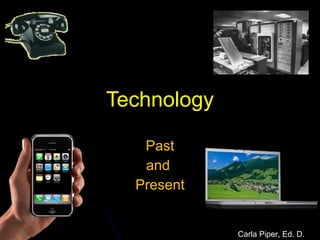
Technology Past and  Present Carla Piper, Ed. D.
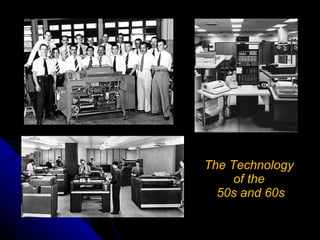
The Technology  of the  50s and 60s
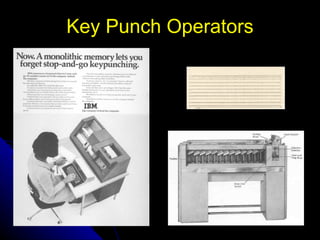
Key Punch Operators
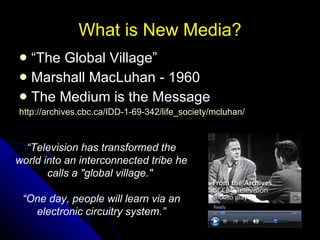
What is New Media? “ The Global Village” Marshall MacLuhan - 1960 The Medium is the Message http://archives.cbc.ca/IDD-1-69-342/life_society/mcluhan/   “ Television has transformed the world into an interconnected tribe he calls a "global village."  “ One day, people will learn via an electronic circuitry system.”
 
The Relevance of New Media for Teaching, Learning, and Creative Expression http://www.nmc.org/horizon/2007/report   The Horizon Report 2007
Key Trends for Universities The environment of higher education is changing rapidly. Costs are rising and budgets are shrinking, Student enrollments are declining.  There is an increasing need for distance education. Students seek flexible options.
Key Trends for Universities The “shape” of the average student is changing more students are working and commuting than ever before the residential, full-time student is not necessarily the model for today’s typical student. Competition from the for-profit educational sector and an increasing demand by students for instant access and interactive experiences.
Key Trends for Universities Increasing globalization is changing the way we work, collaborate, and communicate.   China, India, and other southeast Asian nations continue to develop skilled researchers and   thinkers who contribute significantly to the   global body of knowledge and whose work fuels   much innovation.  Students have wider perspectives and   resources than ever before, placing them in a   new and  continually changing learning space .
Key Trends for Universities Information literacy increasingly should not be considered a given.   Contrary to the conventional   wisdom, the information literacy skills of new   students are not improving as the post-1993   Internet boomlet enters college.  A sea of user-created content, collaborative work, and instant access to information   of varying quality, the skills of critical thinking,   research, and evaluation are increasingly required   to make sense of the world.
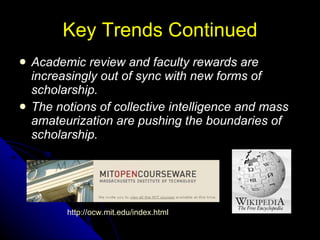
Key Trends Continued Academic review and faculty rewards are increasingly out of sync with new forms of scholarship. The notions of collective intelligence and mass amateurization are pushing the boundaries of scholarship.   http://ocw.mit.edu/index.html
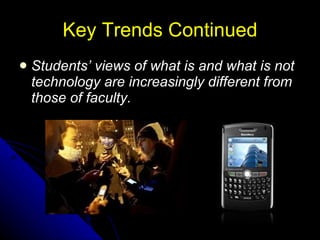
Key Trends Continued Students’ views of what is and what is not technology are increasingly different from those of faculty.
User-Created Content It’s all about the audience, and the “audience” is no longer merely listening.  User-created content is all around us, from  blogs  and  photostreams  to  wikibooks  and  machinima  clips.
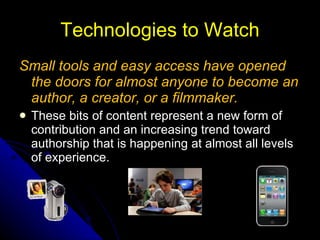
Technologies to Watch Small tools and easy access have opened the doors for almost anyone to become an author, a creator, or a filmmaker. These bits of content represent a new form of contribution and an increasing trend toward authorship that is happening at almost all levels of experience.
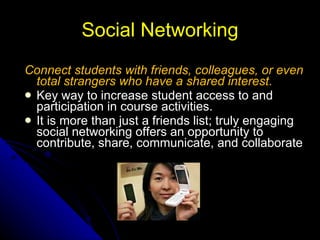
Social Networking Connect students with friends, colleagues, or even total strangers who have a shared interest. Key way to increase student access to and participation in course activities.  It is more than just a friends list; truly engaging social networking offers an opportunity to contribute, share, communicate, and collaborate
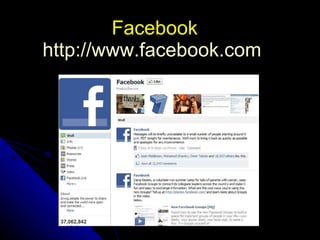
Facebook http://www.facebook.com
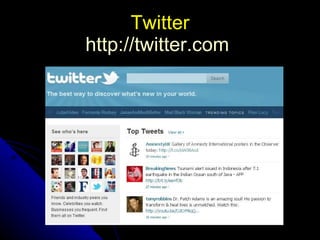
Twitter http://twitter.com
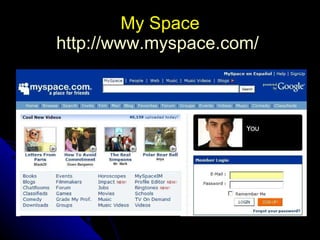
My Space http://www.myspace.com/
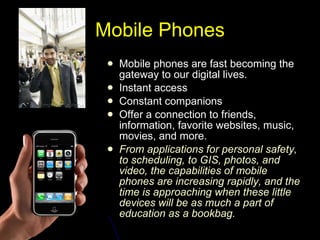
Mobile Phones Mobile phones are fast becoming the gateway to our digital lives.  Instant access Constant companions  Offer a connection to friends, information, favorite websites, music, movies, and more.  From applications for personal safety, to scheduling, to GIS, photos, and video, the capabilities of mobile phones are increasing rapidly, and the time is approaching when these little devices will be as much a part of education as a bookbag.
Virtual Worlds Customized settings that mirror the real world—or diverge wildly from it. Collaborate, explore, role-play, and experience other situations in a safe but compelling way. Offer opportunities for education that are almost limitless, bound only by our ability to imagine and create them.  Campuses, businesses, and other organizations increasingly have a presence in the virtual world. Trend is likely to take off in a way that will echo the rise of the web in the mid-1990s.
Second Life  http://secondlife.com/
The New Scholarship  Emerging Forms of Publication  The nature and practice of scholarship   is changing. New tools and new ways to   create, critique, and publish are influencing new   and old scholars alike.  We are beginning to see   what new publications might look like—and how   new scholars might work.
Wiki and Wikipedia http://www.wikipedia.com   A  wiki  ( IPA : [ˈwɪ.kiː] or [ˈwiː.kiː] [1] ) is a  website  that allows visitors to add, remove, and  edit  content. [2]  A collaborative technology for organizing information on Web sites, the first wiki ( WikiWikiWeb ) was developed by  Ward Cunningham  in the mid-1990s. [3] [4]   Wikis allow for  linking  among any number of pages.  This ease of interaction and operation makes a wiki an effective tool for mass  collaborative authoring . [5]   Wikipedia , an  online encyclopedia , is one of the best known wikis. [4]
Podcasts, Audio Books, YouTube http://www.youtube.com/watch?v=2eLPPxSdwJw
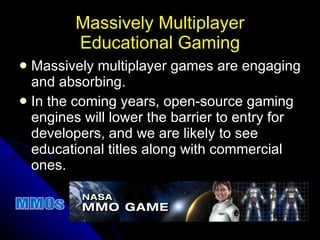
Massively Multiplayer Educational Gaming Massively multiplayer   games are engaging and absorbing.  In the   coming years, open-source gaming engines will   lower the barrier to entry for developers, and   we are likely to see educational titles along with commercial ones.  MMOs
New Learning Environments in the  21st Century Exploring the Edge John Seely Brown (Xerox PARC) and USC (2007)
How is 21 st  Century Learning Going to be Different? Skills learned today  are apt to be  out-of-date  all too soon.  John Seely Brown, 2007
Lifelong Learning “ The concept of lifelong learning—a term used all too glibly—is now more important than ever."  Lifelong, passion-based learning enabled by the Net Focus on “learning to be” through enculturation into a practice rather than “learning about” or “building up stocks of knowledge.” Students intrinsically motivated by being a member of a community of practice. Informal learning not conducted in a structured formal setting Interplay exists between the cognitive and social bases of learning John Seely Brown, 2007
Social learning is the greatest impact of the internet and the full impact has not yet been realized. Content is socially constructed through conversations about that content and through grounded interactions, especially with others, around problems or actions.  Informal learning is taking place both on and off campus via the online social networks. Social life of Internet-based virtual education can coexist with and extend traditional education. John Seely Brown and Richard P. Adler  (2008)
New culture of sharing content is freely contributed and distributed few restrictions or costs Open Source –  Mozilla, Open Office, Moodle MIT’s OpenCourseWare  (OCW) initiative  Open access to undergraduate- and graduate-level materials and modules More than 1,700 courses in virtually all disciplines. John Seely Brown and Richard P. Adler (2008)
A participatory medium that is ideal for supporting multiple modes of learning. New kinds of online resources social networking sites Blogs Wikis Virtual communities allow people with common interests to meet, share ideas, and collaborate in innovative ways. Blurs the line between  producers  and  consumers  of content Shifted attention from access to information toward access to other people. John Seely Brown and Richard P. Adler (2008)
The Internet encourages the practice of what John Dewey called “ productive inquiry ”— the process of seeking the knowledge when it is needed in order to carry out a particular situated task. Productive Inquiry John Seely Brown and Richard P. Adler (2008)
Students gain deep knowledge about a subject (“ learning about ”) Students participate in productive inquiry and peer-based learning (“ learning to be ”). Fosters  passion-based learning  within a particular community of practice Constructivism John Seely Brown and Richard P. Adler (2008)

Tech564

  • 1.
    Technology Past and Present Carla Piper, Ed. D.
  • 2.
    The Technology of the 50s and 60s
  • 3.
  • 4.
    What is NewMedia? “ The Global Village” Marshall MacLuhan - 1960 The Medium is the Message http://archives.cbc.ca/IDD-1-69-342/life_society/mcluhan/ “ Television has transformed the world into an interconnected tribe he calls a "global village." “ One day, people will learn via an electronic circuitry system.”
  • 5.
  • 6.
    The Relevance ofNew Media for Teaching, Learning, and Creative Expression http://www.nmc.org/horizon/2007/report The Horizon Report 2007
  • 7.
    Key Trends forUniversities The environment of higher education is changing rapidly. Costs are rising and budgets are shrinking, Student enrollments are declining. There is an increasing need for distance education. Students seek flexible options.
  • 8.
    Key Trends forUniversities The “shape” of the average student is changing more students are working and commuting than ever before the residential, full-time student is not necessarily the model for today’s typical student. Competition from the for-profit educational sector and an increasing demand by students for instant access and interactive experiences.
  • 9.
    Key Trends forUniversities Increasing globalization is changing the way we work, collaborate, and communicate. China, India, and other southeast Asian nations continue to develop skilled researchers and thinkers who contribute significantly to the global body of knowledge and whose work fuels much innovation. Students have wider perspectives and resources than ever before, placing them in a new and continually changing learning space .
  • 10.
    Key Trends forUniversities Information literacy increasingly should not be considered a given. Contrary to the conventional wisdom, the information literacy skills of new students are not improving as the post-1993 Internet boomlet enters college. A sea of user-created content, collaborative work, and instant access to information of varying quality, the skills of critical thinking, research, and evaluation are increasingly required to make sense of the world.
  • 11.
    Key Trends ContinuedAcademic review and faculty rewards are increasingly out of sync with new forms of scholarship. The notions of collective intelligence and mass amateurization are pushing the boundaries of scholarship. http://ocw.mit.edu/index.html
  • 12.
    Key Trends ContinuedStudents’ views of what is and what is not technology are increasingly different from those of faculty.
  • 13.
    User-Created Content It’sall about the audience, and the “audience” is no longer merely listening. User-created content is all around us, from blogs and photostreams to wikibooks and machinima clips.
  • 14.
    Technologies to WatchSmall tools and easy access have opened the doors for almost anyone to become an author, a creator, or a filmmaker. These bits of content represent a new form of contribution and an increasing trend toward authorship that is happening at almost all levels of experience.
  • 15.
    Social Networking Connectstudents with friends, colleagues, or even total strangers who have a shared interest. Key way to increase student access to and participation in course activities. It is more than just a friends list; truly engaging social networking offers an opportunity to contribute, share, communicate, and collaborate
  • 16.
  • 17.
  • 18.
  • 19.
    Mobile Phones Mobilephones are fast becoming the gateway to our digital lives. Instant access Constant companions Offer a connection to friends, information, favorite websites, music, movies, and more. From applications for personal safety, to scheduling, to GIS, photos, and video, the capabilities of mobile phones are increasing rapidly, and the time is approaching when these little devices will be as much a part of education as a bookbag.
  • 20.
    Virtual Worlds Customizedsettings that mirror the real world—or diverge wildly from it. Collaborate, explore, role-play, and experience other situations in a safe but compelling way. Offer opportunities for education that are almost limitless, bound only by our ability to imagine and create them. Campuses, businesses, and other organizations increasingly have a presence in the virtual world. Trend is likely to take off in a way that will echo the rise of the web in the mid-1990s.
  • 21.
    Second Life http://secondlife.com/
  • 22.
    The New Scholarship Emerging Forms of Publication The nature and practice of scholarship is changing. New tools and new ways to create, critique, and publish are influencing new and old scholars alike. We are beginning to see what new publications might look like—and how new scholars might work.
  • 23.
    Wiki and Wikipediahttp://www.wikipedia.com A wiki ( IPA : [ˈwɪ.kiː] or [ˈwiː.kiː] [1] ) is a website that allows visitors to add, remove, and edit content. [2] A collaborative technology for organizing information on Web sites, the first wiki ( WikiWikiWeb ) was developed by Ward Cunningham in the mid-1990s. [3] [4] Wikis allow for linking among any number of pages. This ease of interaction and operation makes a wiki an effective tool for mass collaborative authoring . [5] Wikipedia , an online encyclopedia , is one of the best known wikis. [4]
  • 24.
    Podcasts, Audio Books,YouTube http://www.youtube.com/watch?v=2eLPPxSdwJw
  • 25.
    Massively Multiplayer EducationalGaming Massively multiplayer games are engaging and absorbing. In the coming years, open-source gaming engines will lower the barrier to entry for developers, and we are likely to see educational titles along with commercial ones. MMOs
  • 26.
    New Learning Environmentsin the 21st Century Exploring the Edge John Seely Brown (Xerox PARC) and USC (2007)
  • 27.
    How is 21st Century Learning Going to be Different? Skills learned today are apt to be out-of-date all too soon. John Seely Brown, 2007
  • 28.
    Lifelong Learning “The concept of lifelong learning—a term used all too glibly—is now more important than ever." Lifelong, passion-based learning enabled by the Net Focus on “learning to be” through enculturation into a practice rather than “learning about” or “building up stocks of knowledge.” Students intrinsically motivated by being a member of a community of practice. Informal learning not conducted in a structured formal setting Interplay exists between the cognitive and social bases of learning John Seely Brown, 2007
  • 29.
    Social learning isthe greatest impact of the internet and the full impact has not yet been realized. Content is socially constructed through conversations about that content and through grounded interactions, especially with others, around problems or actions. Informal learning is taking place both on and off campus via the online social networks. Social life of Internet-based virtual education can coexist with and extend traditional education. John Seely Brown and Richard P. Adler (2008)
  • 30.
    New culture ofsharing content is freely contributed and distributed few restrictions or costs Open Source – Mozilla, Open Office, Moodle MIT’s OpenCourseWare (OCW) initiative Open access to undergraduate- and graduate-level materials and modules More than 1,700 courses in virtually all disciplines. John Seely Brown and Richard P. Adler (2008)
  • 31.
    A participatory mediumthat is ideal for supporting multiple modes of learning. New kinds of online resources social networking sites Blogs Wikis Virtual communities allow people with common interests to meet, share ideas, and collaborate in innovative ways. Blurs the line between producers and consumers of content Shifted attention from access to information toward access to other people. John Seely Brown and Richard P. Adler (2008)
  • 32.
    The Internet encouragesthe practice of what John Dewey called “ productive inquiry ”— the process of seeking the knowledge when it is needed in order to carry out a particular situated task. Productive Inquiry John Seely Brown and Richard P. Adler (2008)
  • 33.
    Students gain deepknowledge about a subject (“ learning about ”) Students participate in productive inquiry and peer-based learning (“ learning to be ”). Fosters passion-based learning within a particular community of practice Constructivism John Seely Brown and Richard P. Adler (2008)