Roy C Andrada, R.E.E., M.I.T.
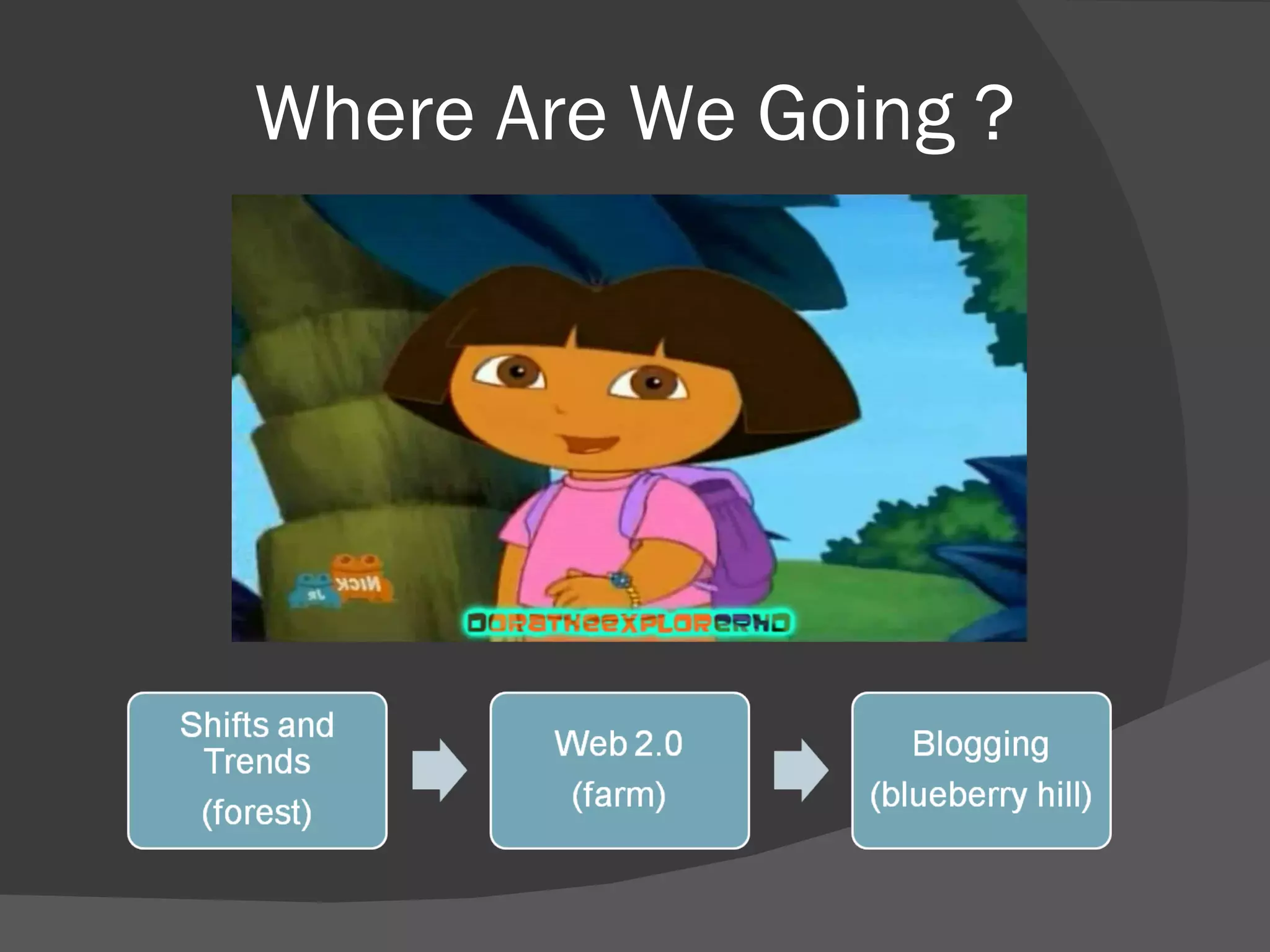
Where Are We Going ?
This Lecture Presentation… Is about the shifts and trends in the (technological) environment How these trends affect education  Is about Web 2.0 – the culminating event in the shift related to blogging Is about Types of  BLOG CONTENTS Is about Blog Content Development
Essential Questions What are the technological shifts and trends happening out there? In what ways do these changes affect education? How do I stay relevant in  education today? Where does blogging fit in the picture?
The Technological Environment Today is Shifting
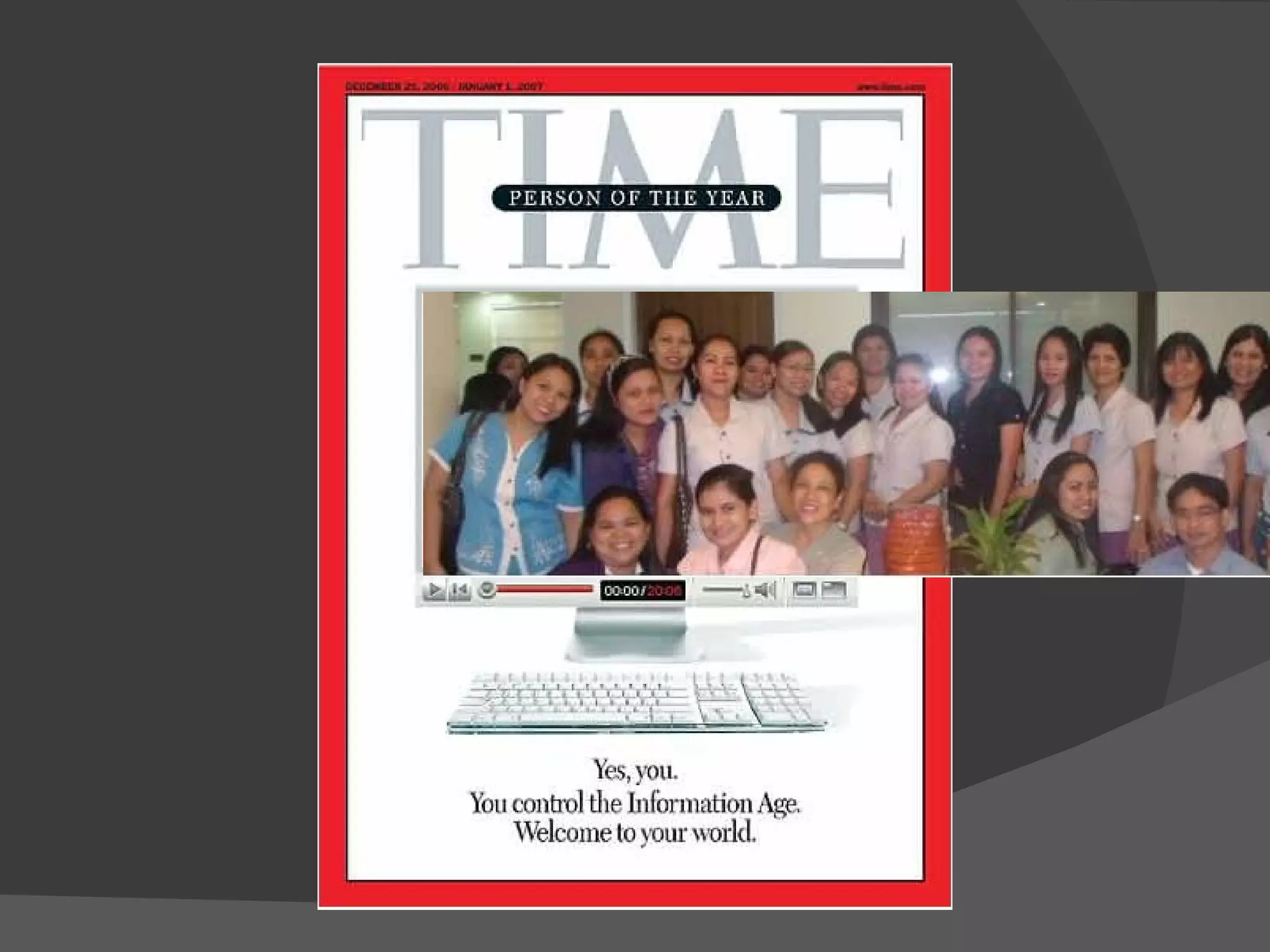
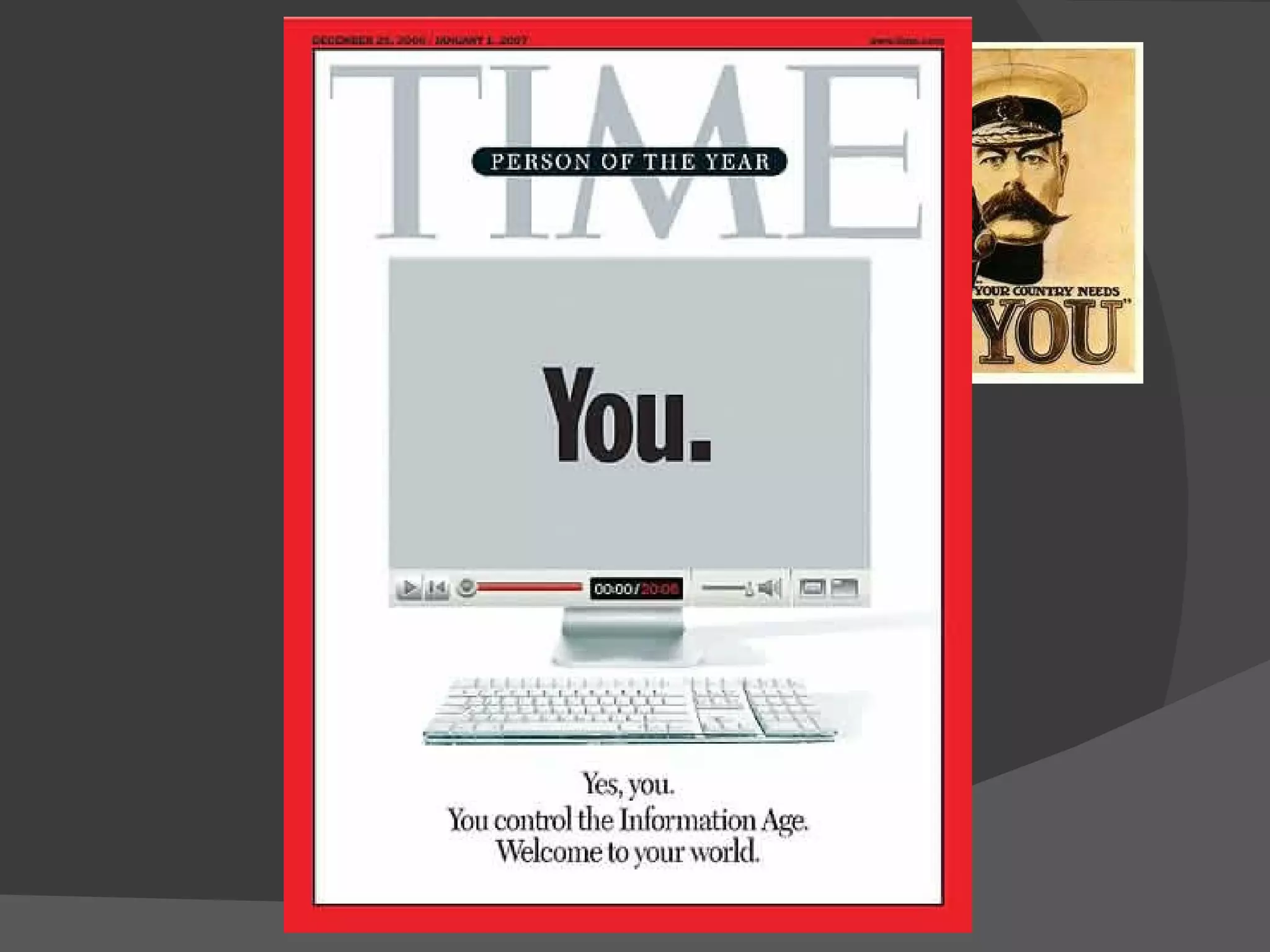
How would you like to be voted as… TIME MAGAZINE’S  Person of The Year?
 
See December, 2006 issue… it’s about you!!! You were voted as TIME Magazine’s Person of the Year
A Challenge To “The Great Man Theory” Thomas Carlyle wrote that "the history of the world is but the biography of great men."  He believed that it is the few, the powerful and the famous who shape our collective destiny as a species.  This THEORY took a beating last 2006.  There is a phenomenal shift in how history is being shaped today
… Not by GREAT MEN but by  YOU and ME … The Environment has shifted… While it is still true that GREAT MEN still influence the world’s trends, There is at the same time a global-scale COMMUNITY COLLABORATION going on. Mostly about the huge compendium of knowledge, “Wikipedia” , “Youtube”, “Facebook”, “MySpace”, etc.,  The transition is about wresting the power from the FEW, and “HELPING ONE ANOTHER FOR NOTHING”
A Quick Survey of the TRENDS... In Movies and Other Media… Superheroes have evolved now into more of becoming “LIKE ONE OF US”, hence showing more human-like weaknesses. REALITY shows have fluorished… “ Talentadong Pinoy”, American Idol, PGT, BGT… Survivors, Amazing Races, The Bachelors, Fear Factor, It Factor, “The X FACTOR” by Simon Cowell The Biggest Loser, Project Runway, etc Even News Reporting has those viewer collaboration today
TWO MAJOR SUB GENRES First – the big COMPETITION- EVENT shows (Survivor, etc) Second – REAL WORLD VOYEURISM – real life settings – (The Real Housewives of D.C. , etc), also cooking shows,  Source   Reality TV at 10: How It's Changed Television — and Us By  James Poniewozi TV shows have more participation from common people like YOU and ME.
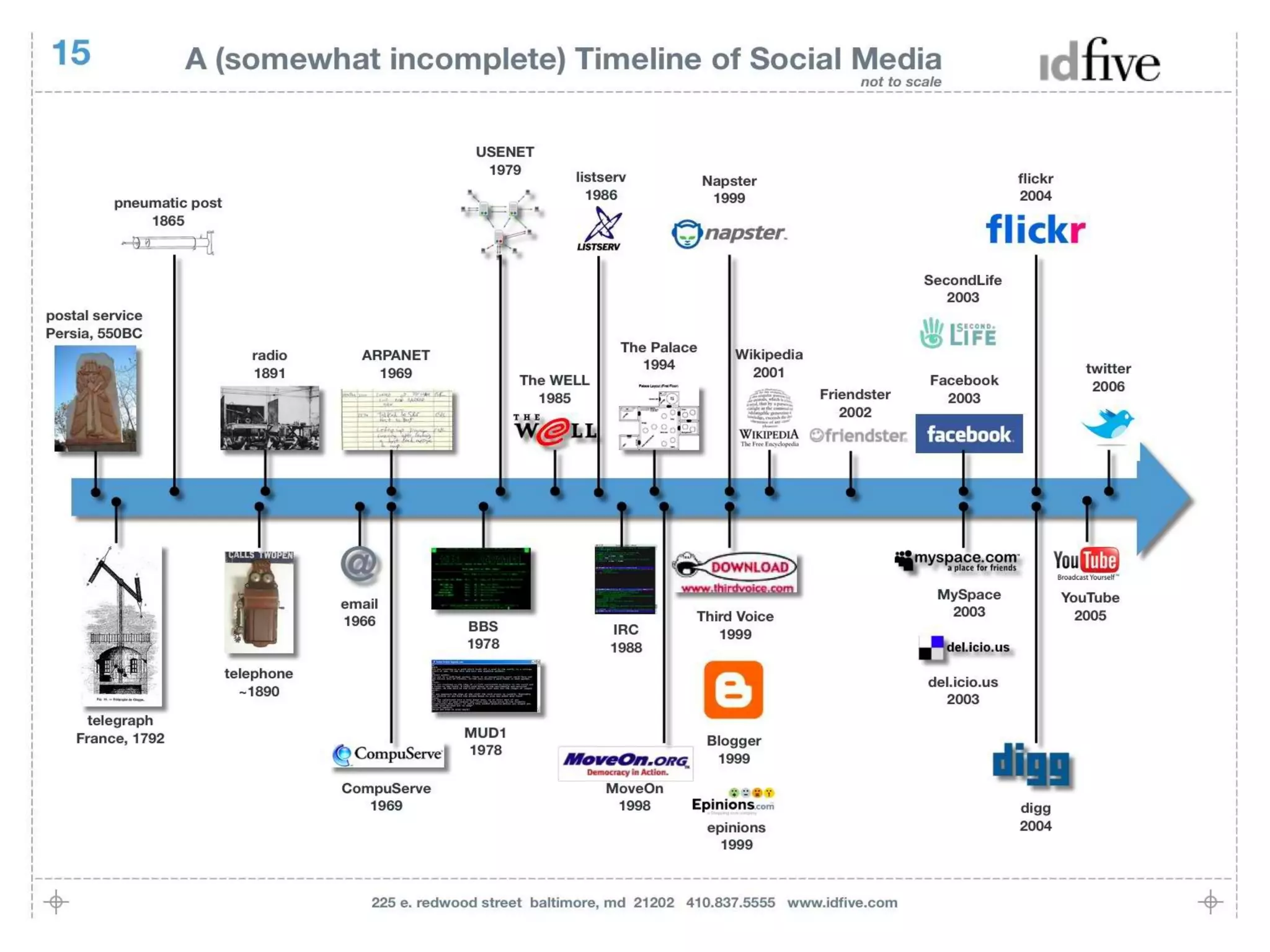
…  in TECHNOLOGY From Mainframe Computers  (big computers) To Desktop To Laptop To notebooks/netbooks Ipods Icloud What’s next? As to Function Organizational - Formal functions/Offices – Personal
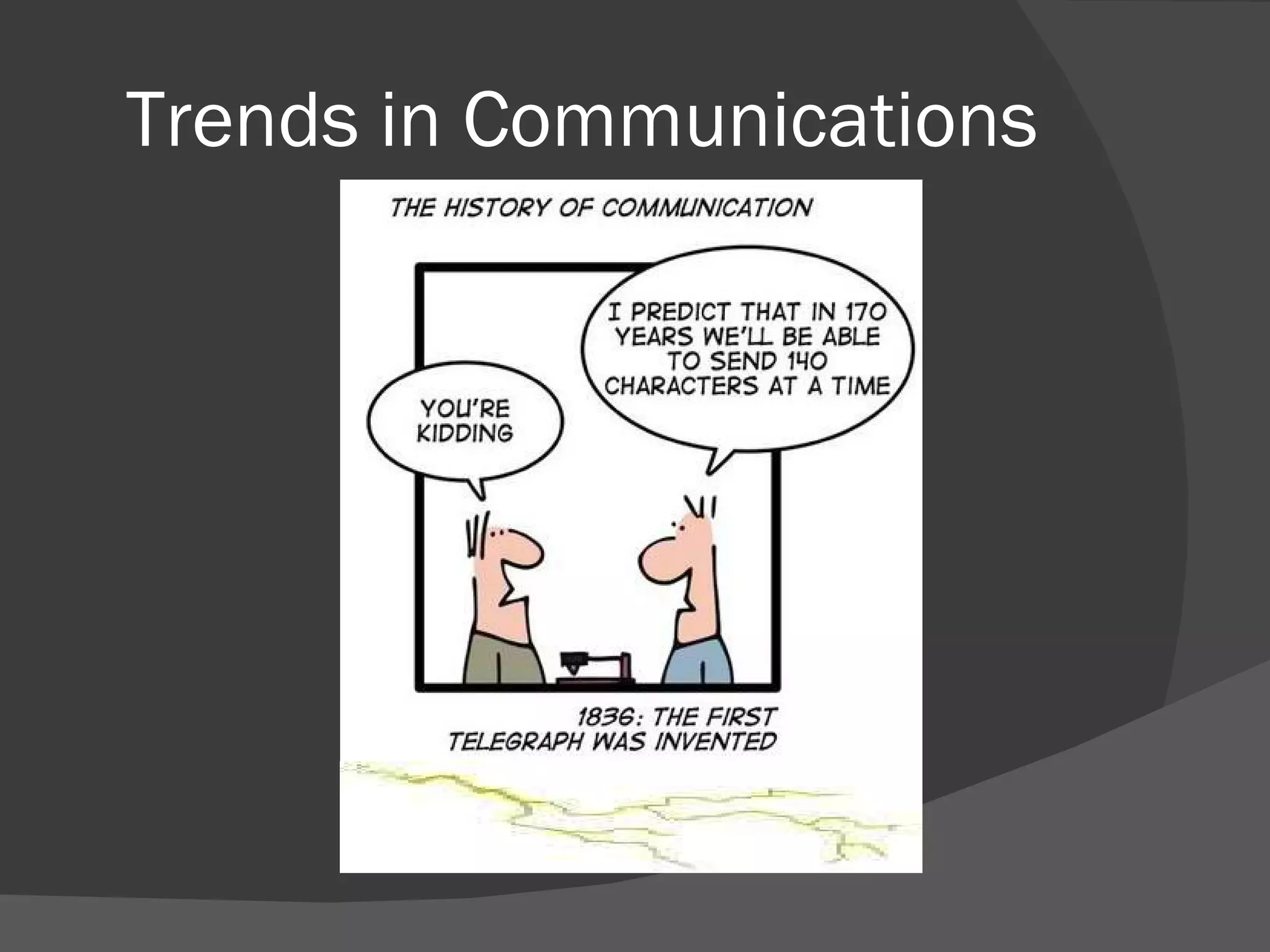
Trends in Communications
 
TRENDS IN EDUCATION
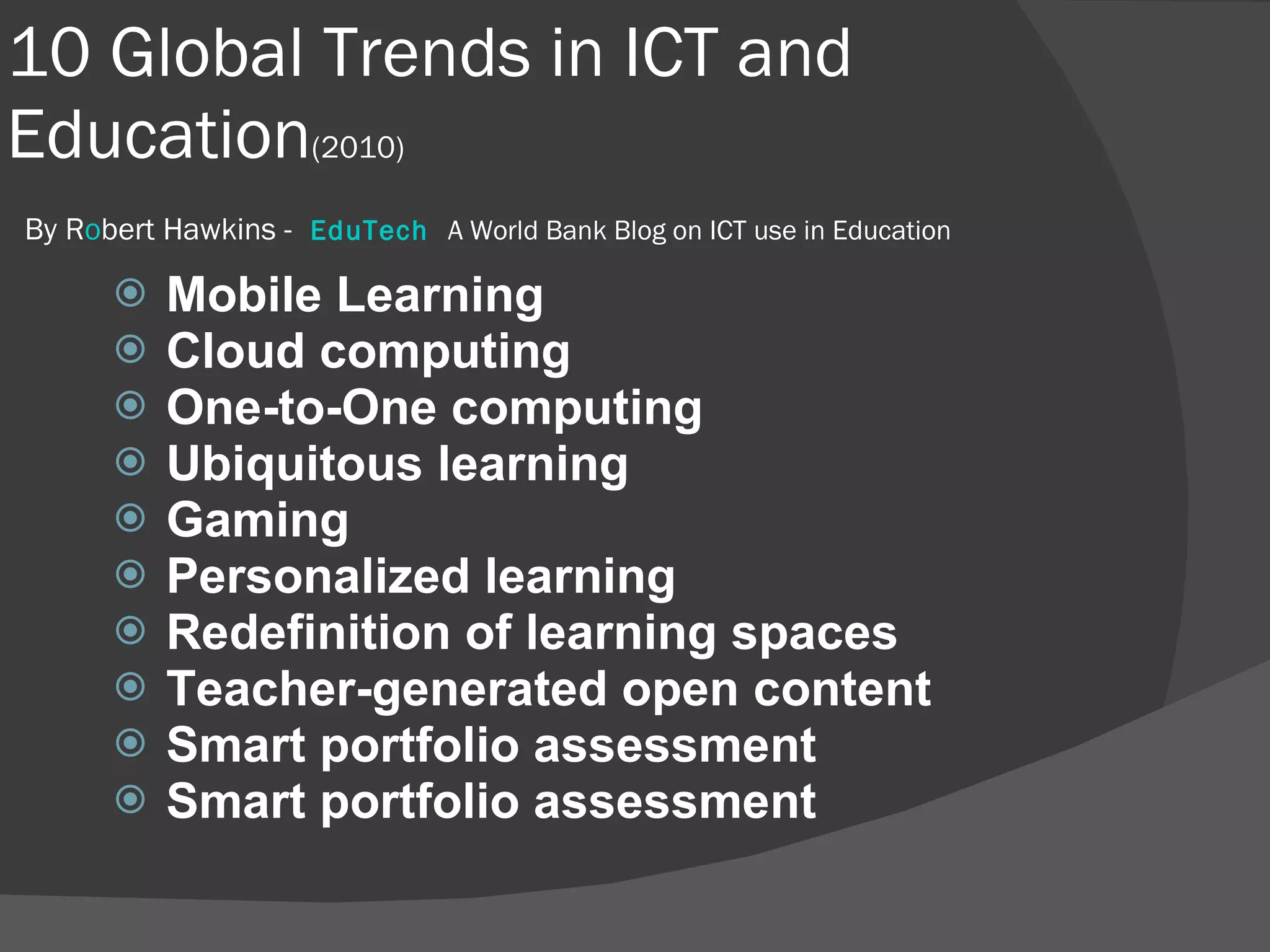
10 Global Trends in ICT and Education (2010)   By R o bert Hawkins -   EduTech    A World Bank Blog on ICT use in Education  Mobile Learning Cloud computing One-to-One computing Ubiquitous learning Gaming Personalized learning Redefinition of learning spaces Teacher-generated open content Smart portfolio assessment Smart portfolio assessment
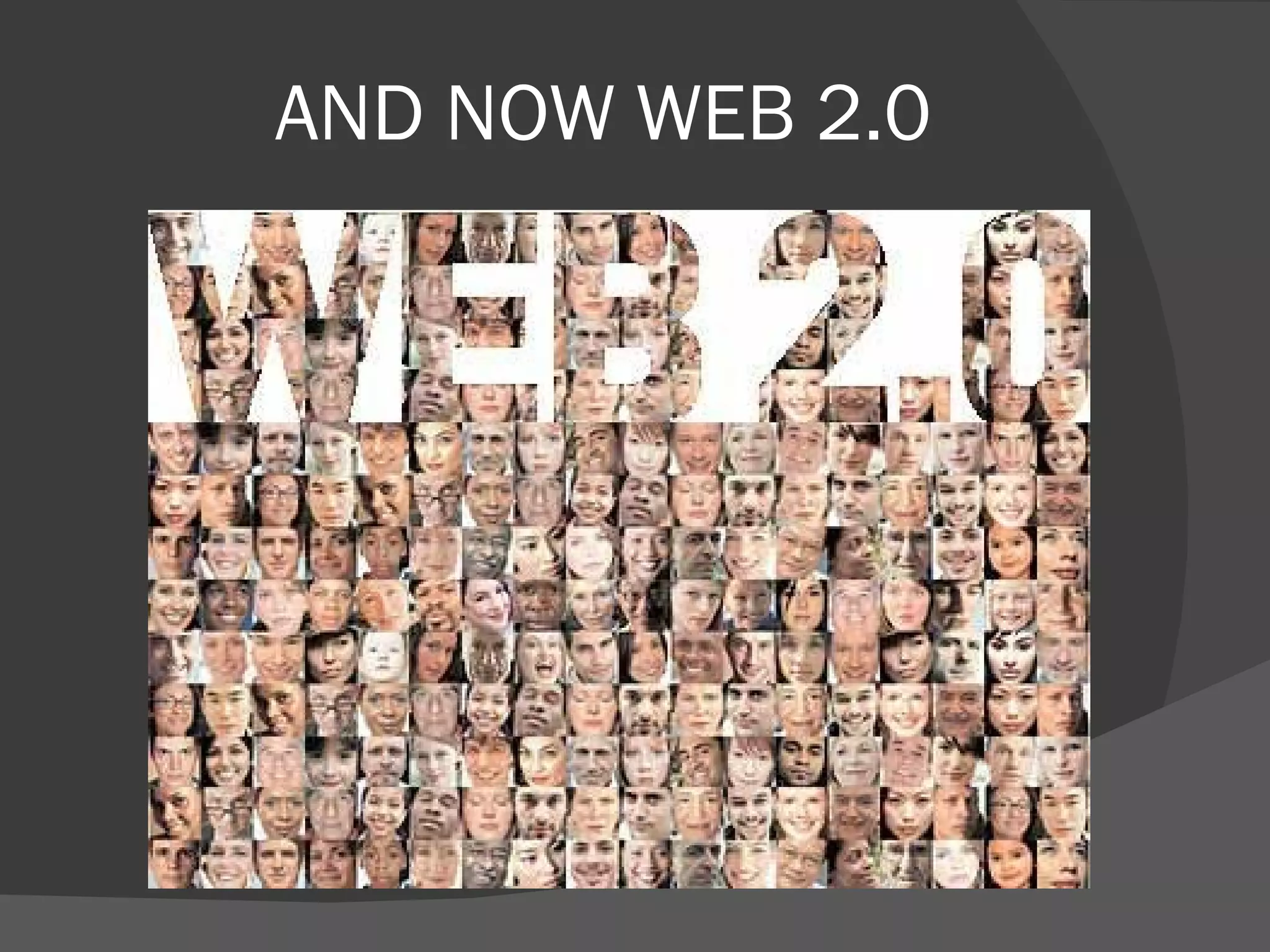
AND NOW WEB 2.0
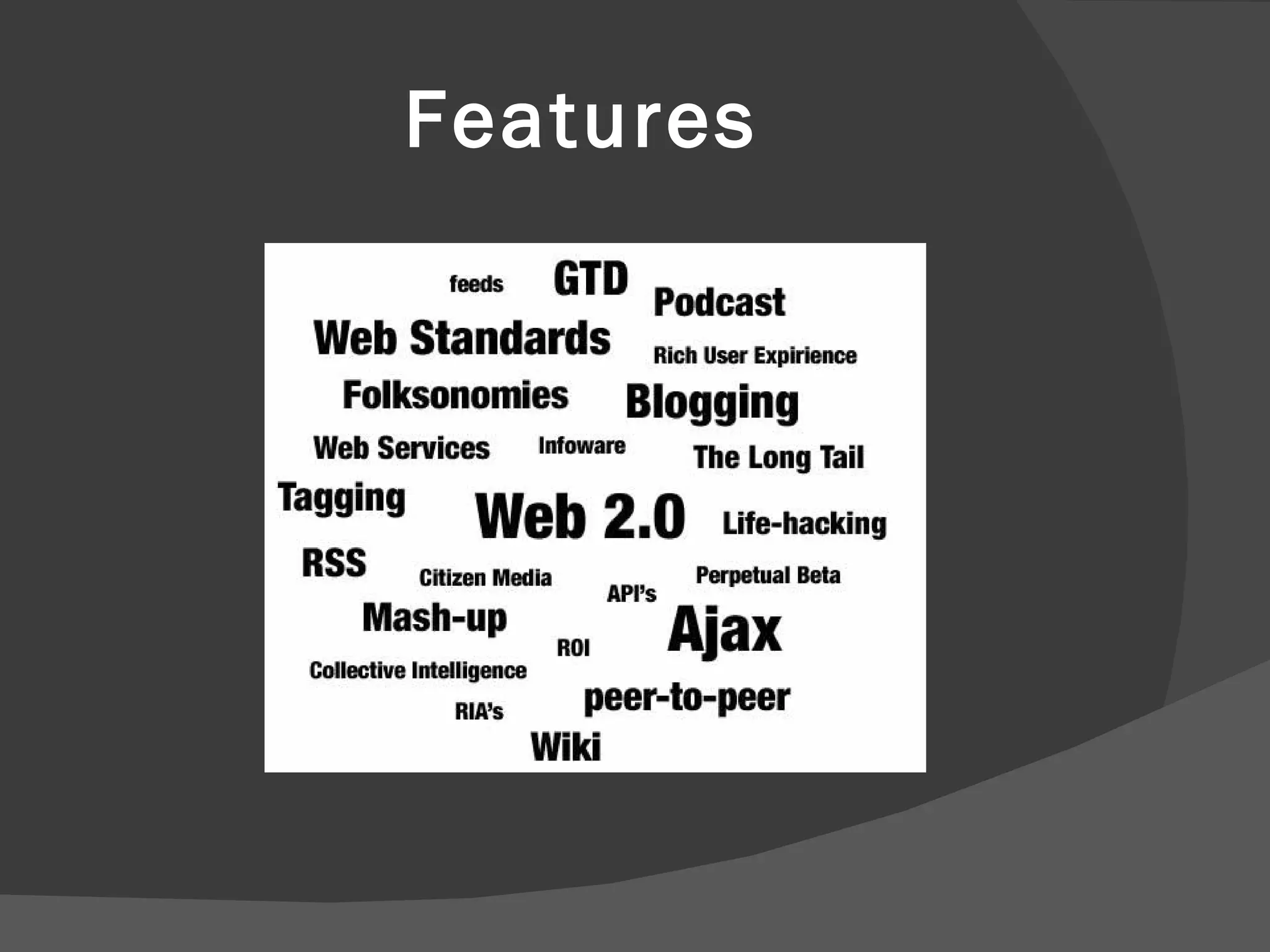
Features
Web 2.0 What IT IS NOT… Not a Technical Specification What IT IS… Cumulative changes in the ways software developers and end-users use the web Allows users to do more than just retrieve information (as in static websites), but provided the end-user with more user-interface, software and storage facilities all through their browsers – called “Network as a platform” computing.
According to Global Language Monitor “ Web 2.0”  is the  English Word 1 MILLIONTH
Characteristics of Web 2.0 According to BEST Rich user experience User Participation Dynamic Content Metadata Web Standards and Scalability Further Characteristics  Openness  Freedom Collective Intelligence By Way Of User Participation (or collaboration)
WEB 2.0 Technologies Just for the sake of coming up with a list  but we will not talk about them here in this training…  AJAX and Adobe Flash are the ones that stand out
Web 2.0 Features and Techniques (SLATES) Search  Finding information through keyword search.  Links Connects information together into a meaningful information ecosystem using the model of the Web, and provides low-barrier social tools.  Authoring  The ability to create and update content leads to the collaborative work of many rather than just a few web authors. In wikis, users may extend, undo and redo each other's work. In blogs, posts and the comments of individuals build up over time.  Tags  Categorization of content by users adding "tags"—short, usually one-word descriptions—to facilitate searching, without dependence on pre-made categories. Collections of tags created by many users within a single system may be referred to as " folksonomies " (i.e.,  folk   taxonomies ).
SLATES – Search, Link, Authoring, Tagging, Extensions, Signals  Extensions  Software that makes the Web an application platform as well as a document server.  These include software like Adobe Reader, Adobe Flash player, Microsoft  Silverlight ,  ActiveX , Oracle Java,  Quicktime , Windows Media, etc.  Signals  The use of syndication technology such as  RSS  to notify users of content changes.
Web 2.0 Was Championed By Bloggers  “ It's a  story about community  and  collaboration  on a scale never seen before. It's about the cosmic compendium of knowledge Wikipedia and the million-channel people's network  YouTube  and the online metropolis  MySpace . It's about the many wresting power from the few and helping one another for nothing and how that will not only change the world, but also change the way the world changes.” By Lev Grossman – TIME Magazine
SHIFT in the Way People Communicate Podcasting Blogging Tagging Contributing to RSS Social bookmarking Social networking The popularity of the term Web 2.0, along with the increasing use of blogs, wikis, and social networking technologies, has led many in academia and business to coin a flurry of 2.0s,   including:  Library 2.0, Social Work 2.0, Enterprise 2.0, PR 2.0,Classroom 2.0, Publishing 2.0, Medicine 2.0,   Telco 2.0, Travel 2.0, Government 2.0,
Blogging, In the Context of Technological Development Blogging is one of the exemplary manifestations of Web 2.0 Blogs, wikis and RSS are often held up as exemplary manifestations of Web 2.0. A reader of a blog or a wiki is provided with tools to add a comment or even, in the case of the wiki, to edit the content. This is what we call the Read/Write web.
Web 2.0 in Education Web 2.0 technologies provide teachers with new ways to engage students in a meaningful way.  "Children raised on new media technologies are less patient with filling out worksheets and listening to lectures” because students already participate on a global level.  The lack of participation in a traditional classroom stems more from the fact that students receive  better feedback  online. Traditional classrooms have students do assignments and when they are completed, they are just that, finished. However, Web 2.0 shows students that education is a constantly evolving entity. Whether it is participating in a class discussion, or participating in a forum discussion, the technologies available to students in a Web 2.0 classroom does increase the amount they participate.
Pros and Cons of Using New Platforms (like blogging) in Education Disadvantages narcissism, gossip, wasted time, 'friending', hurt feelings, ruined reputations, and sometimes unsavory, even dangerous activities teachers may no longer be in control of the discussions (?) Advantages  social networking sites promote conversations and interaction that is encouraged by educators. opportunity to learn for themselves and share that learning with their peers More student-centered environment
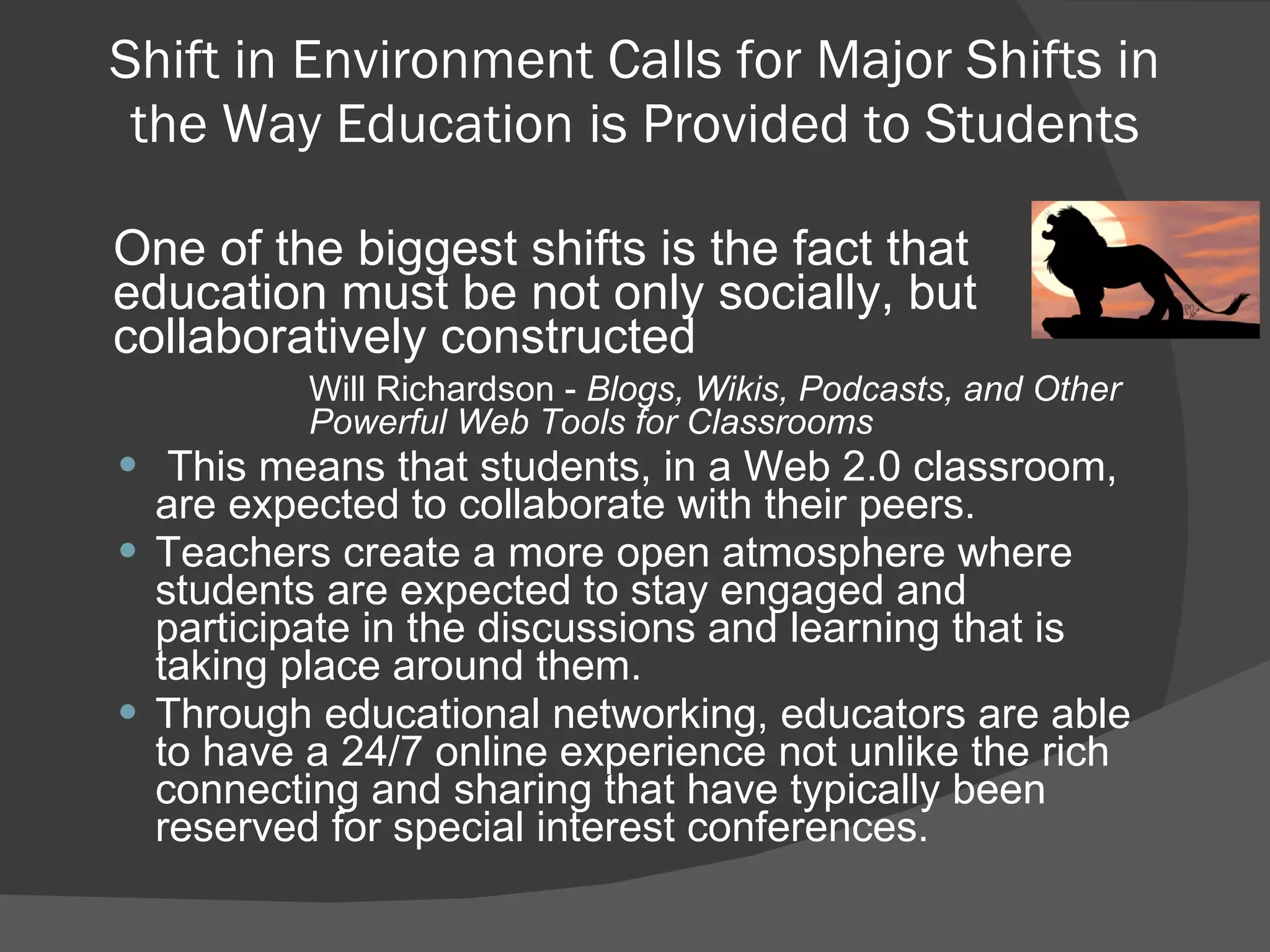
Shift in Environment Calls for Major Shifts in the Way Education is Provided to Students One of the biggest shifts is the fact that education must be not only socially, but collaboratively constructed Will Richardson -  Blogs, Wikis, Podcasts, and Other  Powerful Web Tools for Classrooms This means that students, in a Web 2.0 classroom, are expected to collaborate with their peers. Teachers create a more open atmosphere where students are expected to stay engaged and participate in the discussions and learning that is taking place around them. Through educational networking, educators are able to have a 24/7 online experience not unlike the rich connecting and sharing that have typically been reserved for special interest conferences.
Looking At The Educational Landscape From Another Perspective Students are already using these tools  (Web 2.0, etc ) But they still are expected to go to a school where using these tools is frowned upon or even punished. How Will You Synthesize This Issue?
Blog Content Development 2 Areas Of Development TECHNOLOGY - HOW TO s Even this in Web 2.0 is easy. Instead of static websites, designers created  templates , so that people can create their own web sites even without learning how to program. CONTENT – what to put in it, requires a mixture of different skills Technical, journalistic, artistic , etc.
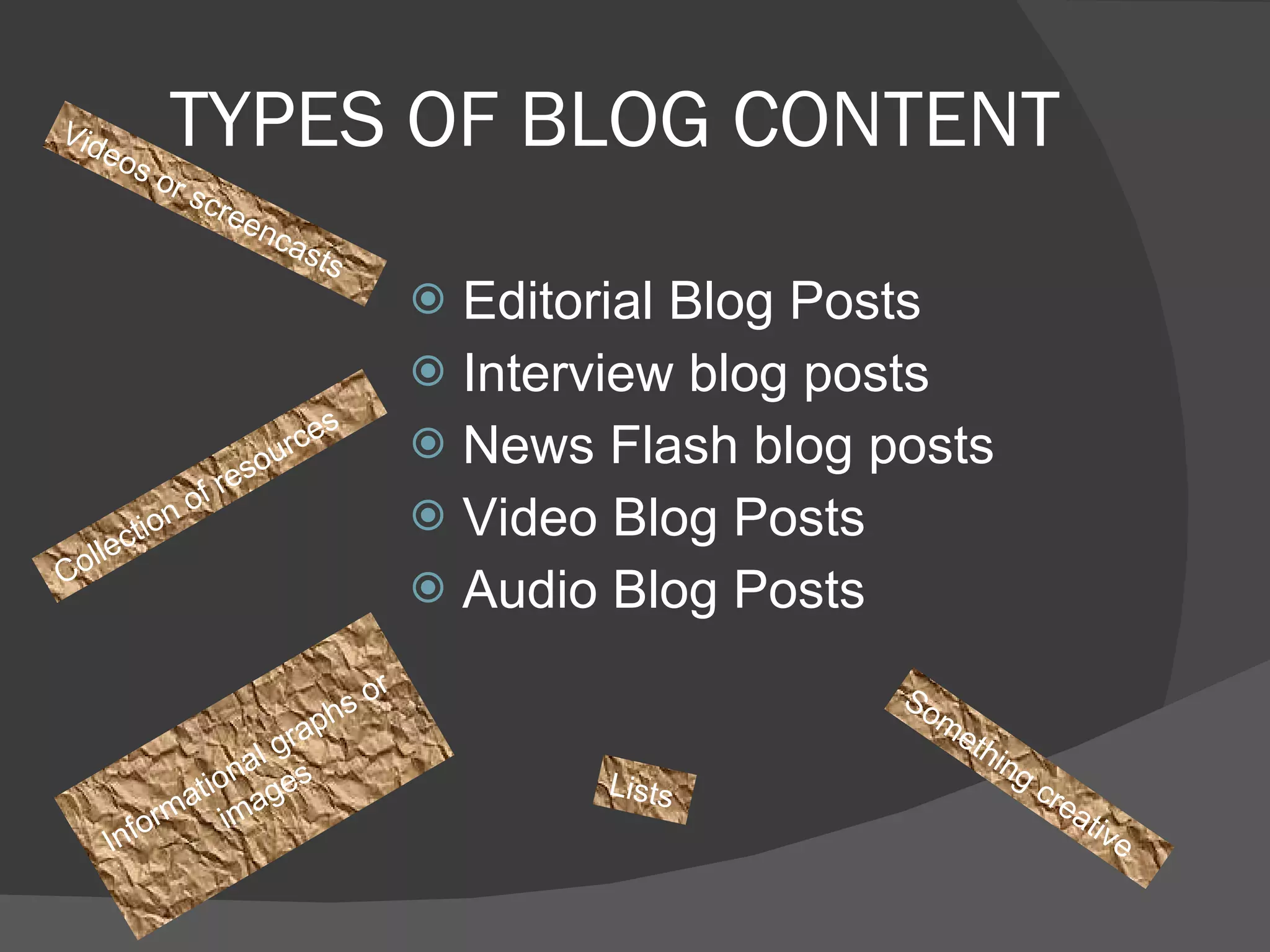
TYPES OF BLOG CONTENT  Editorial Blog Posts Interview blog posts News Flash blog posts Video Blog Posts Audio Blog Posts Lists  Informational graphs or images Videos or screencasts Collection of resources Something creative
Content Development Content comes from ideas, hence the succeeding 1 hour will be about getting ideas, capturing them and forming them in order to come up with a great looking blog post.
Reflections On a piece of paper or Microsoft Word Document … ponder on the following questions? Q1. SOURCES OF IDEAS Where do you get your ideas ? While driving, sitting on a jeepney station, doing house chores, from facebook?…
Reflections Q2. REASON/S  FOR BLOGGING Why do I blog?  And what goals do I want to achieve with my blog?
Reflections Q3. Success Indicator What does success in blogging look like for me?  How will I know that I have arrived at my goal/s?
Reflections Q4. AUDIENCE Who are my ideal readers? Get a photo of your ideal reader/s and paste it in front of you. If you don’t have any photo, just write their name/s while answering the question. If it is a group, jot names you can remember. Describe your reader/s
Reflections Q5. PURPOSE Who needs you? This is reminding you of your purpose. SOMEBODY NEEDS YOUR HELP. Describe that person/s. When you look into the computer, imagine who is at the other end looking back, needing your help.
Reflections Q6 TOPICS So what topics would help you achieve your purpose and be of value to your ideal readers? List down the topics you can think of. Next, put a mark next to the topics you really like most.
Summary of REFLECTION Questions  Q1. SOURCES OF IDEAS Where do you get your ideas ? Q2. REASON/S  FOR BLOGGING Why do I blog? Q3. SUCCESS INDICATOR What does success in blogging look like for me?  Q4. AUDIENCE Who are my ideal readers? Q5. PURPOSE Who needs you? Q6 TOPICS So what topics would help you achieve your purpose and be of value to your ideal readers?
Listening and Speaking Blogging requires both skills in speaking (writing), and/or listening.  Activity. Subdivide the class into groups of four. Each will discuss what they have written in the 6 questions, and one trainee per group will collectively report their answers. Trainees are to finalize activity by summarizing the lesson.
Tips On How To Create a Post Activity Go to this blogsite: http://100wordblog.wordpress.com/ Or  Read the blog post and notice its structure.
Analysis of a Blog Post Questions: What is the thesis of the blog post? Who do you think would be the aimed readers for this post? What do you notice about the structure? Can you classify its parts? Does the post contain echoes? Do you think that the length is just right? Is the content consistent with the thesis? Is there any phrase words or paragraphs that may have been written better? Can this be used for teaching/learning? In what way/s?
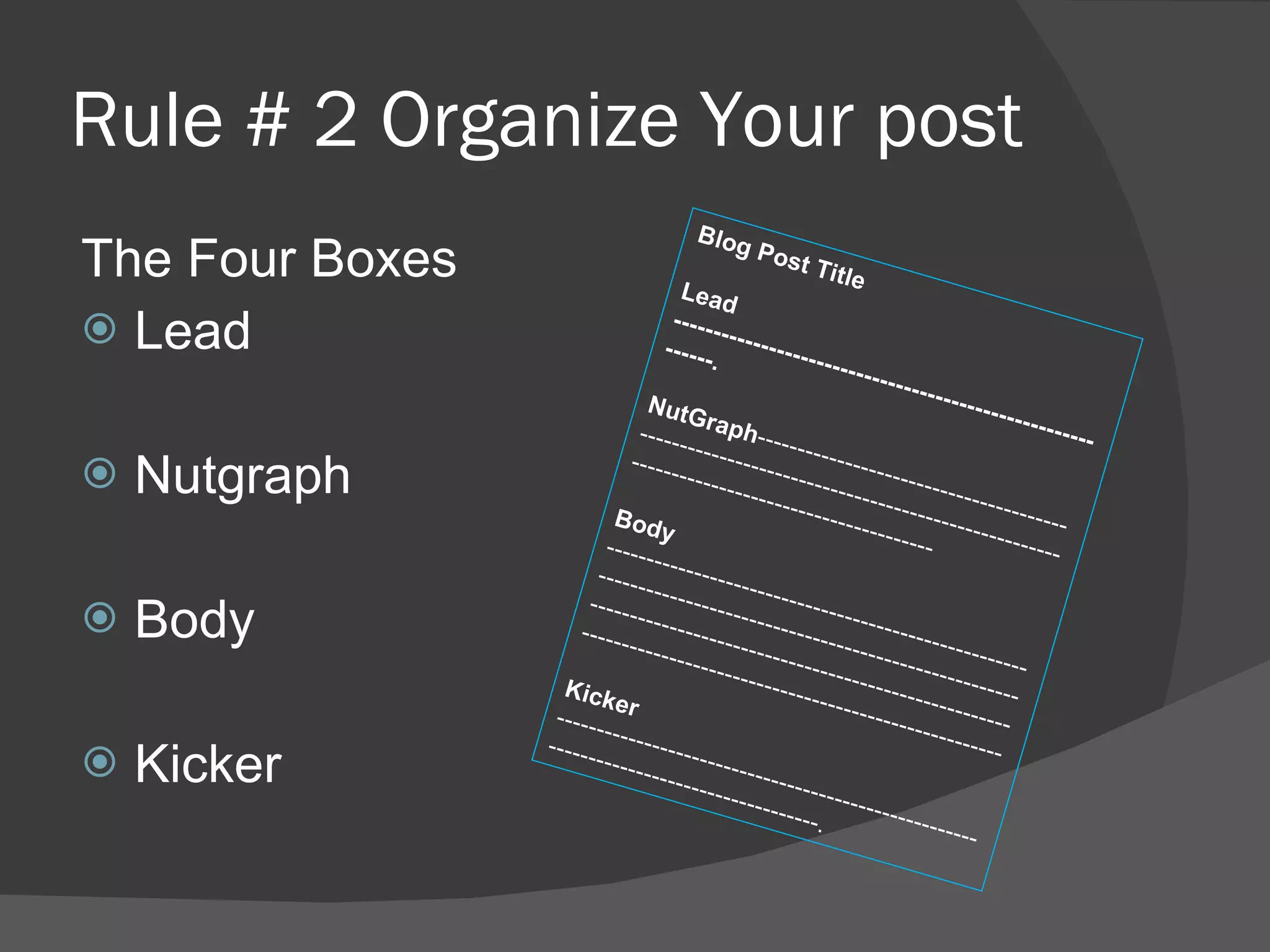
Blog Post Development Lead  - “No one cares what you think. They care whether you can make them think.” This is called a lead. Every single post should have one. Body  - contains the Lead, Nutgraph, kicker and the rest of the post except the title. Nutgraph – ( Nut shell Para graph ) a summary of what you will be talking about Kicker – brings the reader back to the nutgraph. It says, ‘see, I did what I said I was going to do’. Kickers can be funny, quotes, but it ties up. It’s the bow at the end.
Three Rules For Writing Great Blog Posts –  Elizabeth Souther Shorter is better Organize your post Write for your audience
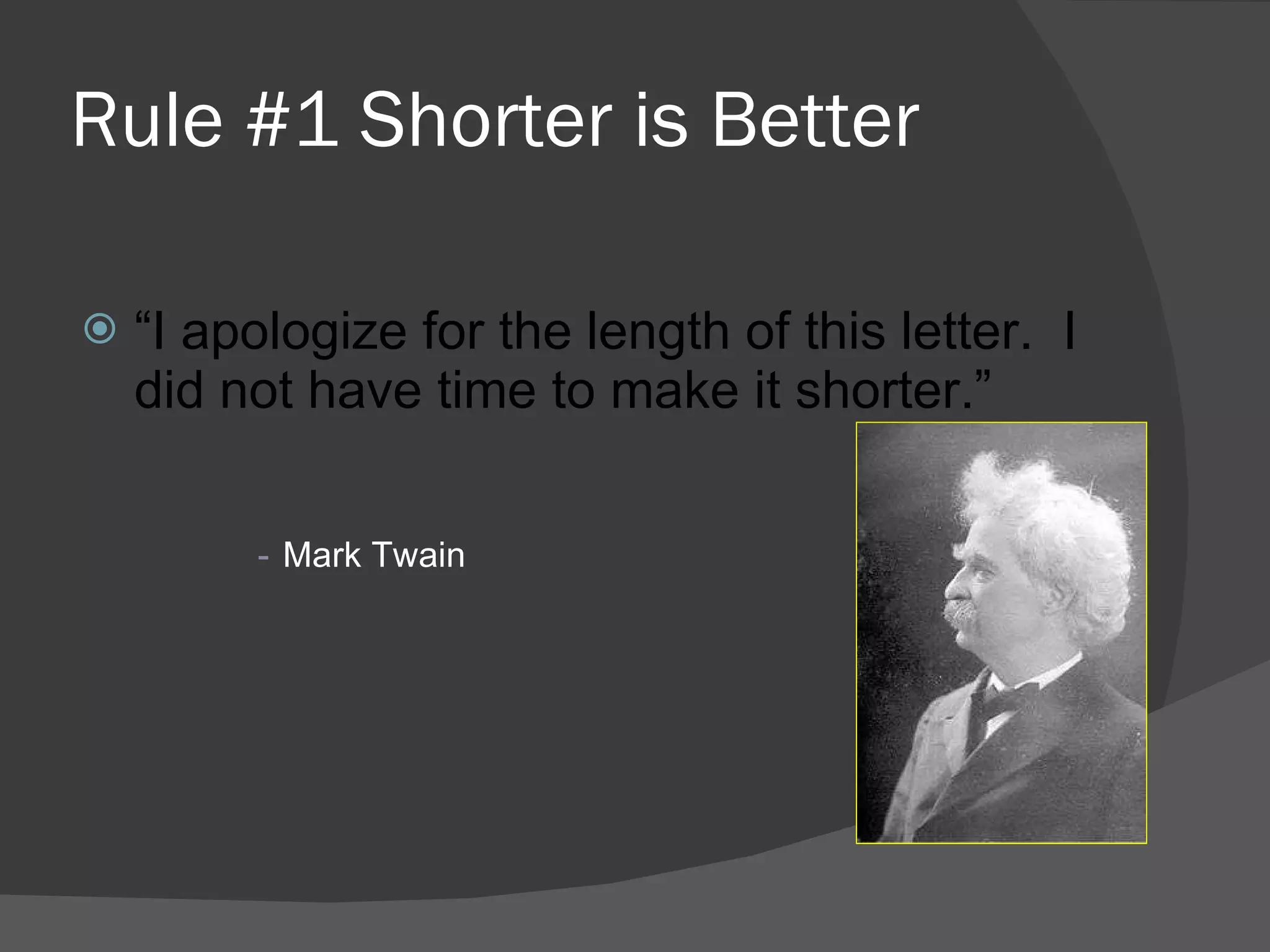
Rule #1 Shorter is Better “ I apologize for the length of this letter.  I did not have time to make it shorter.” Mark Twain
Rule #1 Shorter is Better Writing is the process of figuring out what you think.
Rule #1 Shorter is Better Play Word Elimination Look for echoes
Rule # 2 Organize Your post The Four Boxes Lead Nutgraph Body Kicker Blog Post Title Lead -----------------------------------------------------------. NutGraph ---------------------------------------------------------------------------------------------------------------------------------- Body  -------------------------------------------------------------------------------------------------------------------------------------------------------------------------------------------------------------------- Kicker  ---------------------------------------------------------------------------------------.
LEDE or LEAD The HOOK, does not have to impart information Goal is to grab the readers attention
NUTGRAPH Places your feet in the story, gives the reader notice as to what the piece will be about; Gives enough factual information that the story can now begin; Must address the familiar reader, whom you are forbidden to bore; the new reader, whom you are forbidden to confuse
BODY Tells the story ; Although it is the bulk of the post, it is not the entire post and must not take up too much space;
KICKER Brings the reader back to the NUTGRAPH – the promised point of the story; Answers the question,  ‘ Why was this worth the reader’s time;
Rule # 3 Write For Your Audience If you want people to read it, write it FOR them
Nobody cares what you think… But they care whether you can make them think.
Let It’s Go!
Types of Blog Contents http://www.readgeneration.com/blog-writing/types-of-blog-content

Blog content development version september 30 11

  • 1.
    Roy C Andrada,R.E.E., M.I.T.
  • 2.
    Where Are WeGoing ?
  • 3.
    This Lecture Presentation…Is about the shifts and trends in the (technological) environment How these trends affect education Is about Web 2.0 – the culminating event in the shift related to blogging Is about Types of BLOG CONTENTS Is about Blog Content Development
  • 4.
    Essential Questions Whatare the technological shifts and trends happening out there? In what ways do these changes affect education? How do I stay relevant in education today? Where does blogging fit in the picture?
  • 5.
  • 6.
    How would youlike to be voted as… TIME MAGAZINE’S Person of The Year?
  • 7.
  • 8.
    See December, 2006issue… it’s about you!!! You were voted as TIME Magazine’s Person of the Year
  • 9.
    A Challenge To“The Great Man Theory” Thomas Carlyle wrote that "the history of the world is but the biography of great men." He believed that it is the few, the powerful and the famous who shape our collective destiny as a species. This THEORY took a beating last 2006. There is a phenomenal shift in how history is being shaped today
  • 10.
    … Not byGREAT MEN but by YOU and ME … The Environment has shifted… While it is still true that GREAT MEN still influence the world’s trends, There is at the same time a global-scale COMMUNITY COLLABORATION going on. Mostly about the huge compendium of knowledge, “Wikipedia” , “Youtube”, “Facebook”, “MySpace”, etc., The transition is about wresting the power from the FEW, and “HELPING ONE ANOTHER FOR NOTHING”
  • 11.
    A Quick Surveyof the TRENDS... In Movies and Other Media… Superheroes have evolved now into more of becoming “LIKE ONE OF US”, hence showing more human-like weaknesses. REALITY shows have fluorished… “ Talentadong Pinoy”, American Idol, PGT, BGT… Survivors, Amazing Races, The Bachelors, Fear Factor, It Factor, “The X FACTOR” by Simon Cowell The Biggest Loser, Project Runway, etc Even News Reporting has those viewer collaboration today
  • 12.
    TWO MAJOR SUBGENRES First – the big COMPETITION- EVENT shows (Survivor, etc) Second – REAL WORLD VOYEURISM – real life settings – (The Real Housewives of D.C. , etc), also cooking shows, Source Reality TV at 10: How It's Changed Television — and Us By James Poniewozi TV shows have more participation from common people like YOU and ME.
  • 13.
    … inTECHNOLOGY From Mainframe Computers (big computers) To Desktop To Laptop To notebooks/netbooks Ipods Icloud What’s next? As to Function Organizational - Formal functions/Offices – Personal
  • 14.
  • 15.
  • 16.
  • 17.
    10 Global Trendsin ICT and Education (2010) By R o bert Hawkins - EduTech A World Bank Blog on ICT use in Education Mobile Learning Cloud computing One-to-One computing Ubiquitous learning Gaming Personalized learning Redefinition of learning spaces Teacher-generated open content Smart portfolio assessment Smart portfolio assessment
  • 18.
  • 19.
  • 20.
    Web 2.0 WhatIT IS NOT… Not a Technical Specification What IT IS… Cumulative changes in the ways software developers and end-users use the web Allows users to do more than just retrieve information (as in static websites), but provided the end-user with more user-interface, software and storage facilities all through their browsers – called “Network as a platform” computing.
  • 21.
    According to GlobalLanguage Monitor “ Web 2.0” is the English Word 1 MILLIONTH
  • 22.
    Characteristics of Web2.0 According to BEST Rich user experience User Participation Dynamic Content Metadata Web Standards and Scalability Further Characteristics Openness Freedom Collective Intelligence By Way Of User Participation (or collaboration)
  • 23.
    WEB 2.0 TechnologiesJust for the sake of coming up with a list but we will not talk about them here in this training… AJAX and Adobe Flash are the ones that stand out
  • 24.
    Web 2.0 Featuresand Techniques (SLATES) Search Finding information through keyword search. Links Connects information together into a meaningful information ecosystem using the model of the Web, and provides low-barrier social tools. Authoring The ability to create and update content leads to the collaborative work of many rather than just a few web authors. In wikis, users may extend, undo and redo each other's work. In blogs, posts and the comments of individuals build up over time. Tags Categorization of content by users adding "tags"—short, usually one-word descriptions—to facilitate searching, without dependence on pre-made categories. Collections of tags created by many users within a single system may be referred to as " folksonomies " (i.e., folk taxonomies ).
  • 25.
    SLATES – Search,Link, Authoring, Tagging, Extensions, Signals Extensions Software that makes the Web an application platform as well as a document server. These include software like Adobe Reader, Adobe Flash player, Microsoft Silverlight , ActiveX , Oracle Java, Quicktime , Windows Media, etc. Signals The use of syndication technology such as RSS to notify users of content changes.
  • 26.
    Web 2.0 WasChampioned By Bloggers “ It's a story about community and collaboration on a scale never seen before. It's about the cosmic compendium of knowledge Wikipedia and the million-channel people's network YouTube and the online metropolis MySpace . It's about the many wresting power from the few and helping one another for nothing and how that will not only change the world, but also change the way the world changes.” By Lev Grossman – TIME Magazine
  • 27.
    SHIFT in theWay People Communicate Podcasting Blogging Tagging Contributing to RSS Social bookmarking Social networking The popularity of the term Web 2.0, along with the increasing use of blogs, wikis, and social networking technologies, has led many in academia and business to coin a flurry of 2.0s, including: Library 2.0, Social Work 2.0, Enterprise 2.0, PR 2.0,Classroom 2.0, Publishing 2.0, Medicine 2.0, Telco 2.0, Travel 2.0, Government 2.0,
  • 28.
    Blogging, In theContext of Technological Development Blogging is one of the exemplary manifestations of Web 2.0 Blogs, wikis and RSS are often held up as exemplary manifestations of Web 2.0. A reader of a blog or a wiki is provided with tools to add a comment or even, in the case of the wiki, to edit the content. This is what we call the Read/Write web.
  • 29.
    Web 2.0 inEducation Web 2.0 technologies provide teachers with new ways to engage students in a meaningful way. "Children raised on new media technologies are less patient with filling out worksheets and listening to lectures” because students already participate on a global level. The lack of participation in a traditional classroom stems more from the fact that students receive better feedback online. Traditional classrooms have students do assignments and when they are completed, they are just that, finished. However, Web 2.0 shows students that education is a constantly evolving entity. Whether it is participating in a class discussion, or participating in a forum discussion, the technologies available to students in a Web 2.0 classroom does increase the amount they participate.
  • 30.
    Pros and Consof Using New Platforms (like blogging) in Education Disadvantages narcissism, gossip, wasted time, 'friending', hurt feelings, ruined reputations, and sometimes unsavory, even dangerous activities teachers may no longer be in control of the discussions (?) Advantages social networking sites promote conversations and interaction that is encouraged by educators. opportunity to learn for themselves and share that learning with their peers More student-centered environment
  • 31.
    Shift in EnvironmentCalls for Major Shifts in the Way Education is Provided to Students One of the biggest shifts is the fact that education must be not only socially, but collaboratively constructed Will Richardson - Blogs, Wikis, Podcasts, and Other Powerful Web Tools for Classrooms This means that students, in a Web 2.0 classroom, are expected to collaborate with their peers. Teachers create a more open atmosphere where students are expected to stay engaged and participate in the discussions and learning that is taking place around them. Through educational networking, educators are able to have a 24/7 online experience not unlike the rich connecting and sharing that have typically been reserved for special interest conferences.
  • 32.
    Looking At TheEducational Landscape From Another Perspective Students are already using these tools (Web 2.0, etc ) But they still are expected to go to a school where using these tools is frowned upon or even punished. How Will You Synthesize This Issue?
  • 33.
    Blog Content Development2 Areas Of Development TECHNOLOGY - HOW TO s Even this in Web 2.0 is easy. Instead of static websites, designers created templates , so that people can create their own web sites even without learning how to program. CONTENT – what to put in it, requires a mixture of different skills Technical, journalistic, artistic , etc.
  • 34.
    TYPES OF BLOGCONTENT Editorial Blog Posts Interview blog posts News Flash blog posts Video Blog Posts Audio Blog Posts Lists Informational graphs or images Videos or screencasts Collection of resources Something creative
  • 35.
    Content Development Contentcomes from ideas, hence the succeeding 1 hour will be about getting ideas, capturing them and forming them in order to come up with a great looking blog post.
  • 36.
    Reflections On apiece of paper or Microsoft Word Document … ponder on the following questions? Q1. SOURCES OF IDEAS Where do you get your ideas ? While driving, sitting on a jeepney station, doing house chores, from facebook?…
  • 37.
    Reflections Q2. REASON/S FOR BLOGGING Why do I blog? And what goals do I want to achieve with my blog?
  • 38.
    Reflections Q3. SuccessIndicator What does success in blogging look like for me? How will I know that I have arrived at my goal/s?
  • 39.
    Reflections Q4. AUDIENCEWho are my ideal readers? Get a photo of your ideal reader/s and paste it in front of you. If you don’t have any photo, just write their name/s while answering the question. If it is a group, jot names you can remember. Describe your reader/s
  • 40.
    Reflections Q5. PURPOSEWho needs you? This is reminding you of your purpose. SOMEBODY NEEDS YOUR HELP. Describe that person/s. When you look into the computer, imagine who is at the other end looking back, needing your help.
  • 41.
    Reflections Q6 TOPICSSo what topics would help you achieve your purpose and be of value to your ideal readers? List down the topics you can think of. Next, put a mark next to the topics you really like most.
  • 42.
    Summary of REFLECTIONQuestions Q1. SOURCES OF IDEAS Where do you get your ideas ? Q2. REASON/S FOR BLOGGING Why do I blog? Q3. SUCCESS INDICATOR What does success in blogging look like for me? Q4. AUDIENCE Who are my ideal readers? Q5. PURPOSE Who needs you? Q6 TOPICS So what topics would help you achieve your purpose and be of value to your ideal readers?
  • 43.
    Listening and SpeakingBlogging requires both skills in speaking (writing), and/or listening. Activity. Subdivide the class into groups of four. Each will discuss what they have written in the 6 questions, and one trainee per group will collectively report their answers. Trainees are to finalize activity by summarizing the lesson.
  • 44.
    Tips On HowTo Create a Post Activity Go to this blogsite: http://100wordblog.wordpress.com/ Or Read the blog post and notice its structure.
  • 45.
    Analysis of aBlog Post Questions: What is the thesis of the blog post? Who do you think would be the aimed readers for this post? What do you notice about the structure? Can you classify its parts? Does the post contain echoes? Do you think that the length is just right? Is the content consistent with the thesis? Is there any phrase words or paragraphs that may have been written better? Can this be used for teaching/learning? In what way/s?
  • 46.
    Blog Post DevelopmentLead - “No one cares what you think. They care whether you can make them think.” This is called a lead. Every single post should have one. Body - contains the Lead, Nutgraph, kicker and the rest of the post except the title. Nutgraph – ( Nut shell Para graph ) a summary of what you will be talking about Kicker – brings the reader back to the nutgraph. It says, ‘see, I did what I said I was going to do’. Kickers can be funny, quotes, but it ties up. It’s the bow at the end.
  • 47.
    Three Rules ForWriting Great Blog Posts – Elizabeth Souther Shorter is better Organize your post Write for your audience
  • 48.
    Rule #1 Shorteris Better “ I apologize for the length of this letter. I did not have time to make it shorter.” Mark Twain
  • 49.
    Rule #1 Shorteris Better Writing is the process of figuring out what you think.
  • 50.
    Rule #1 Shorteris Better Play Word Elimination Look for echoes
  • 51.
    Rule # 2Organize Your post The Four Boxes Lead Nutgraph Body Kicker Blog Post Title Lead -----------------------------------------------------------. NutGraph ---------------------------------------------------------------------------------------------------------------------------------- Body -------------------------------------------------------------------------------------------------------------------------------------------------------------------------------------------------------------------- Kicker ---------------------------------------------------------------------------------------.
  • 52.
    LEDE or LEADThe HOOK, does not have to impart information Goal is to grab the readers attention
  • 53.
    NUTGRAPH Places yourfeet in the story, gives the reader notice as to what the piece will be about; Gives enough factual information that the story can now begin; Must address the familiar reader, whom you are forbidden to bore; the new reader, whom you are forbidden to confuse
  • 54.
    BODY Tells thestory ; Although it is the bulk of the post, it is not the entire post and must not take up too much space;
  • 55.
    KICKER Brings thereader back to the NUTGRAPH – the promised point of the story; Answers the question, ‘ Why was this worth the reader’s time;
  • 56.
    Rule # 3Write For Your Audience If you want people to read it, write it FOR them
  • 57.
    Nobody cares whatyou think… But they care whether you can make them think.
  • 58.
  • 59.
    Types of BlogContents http://www.readgeneration.com/blog-writing/types-of-blog-content