SCENARIO PLANNING
LILIANE GEERLINGSEPTEMBER 24 TH 2013
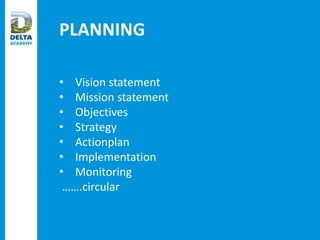
PLANNING
• Vision statement
• Mission statement
• Objectives
• Strategy
• Actionplan
• Implementation
• Monitoring
…….circular
23 SEPTEMBER 2013 3
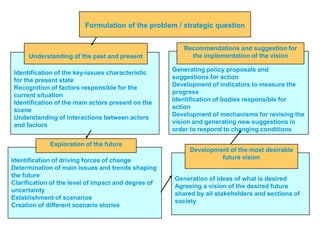
Identification of driving forces of change
Determination of main issues and trends shaping
the future
Clarification of the level of impact and degree of
uncertainty
Establishment of scenarios
Creation of different scenario stories
Exploration of the future
Formulation of the problem / strategic question
Identification of the key-issues characteristic
for the present state
Recognition of factors responsible for the
current situation
Identification of the main actors present on the
scene
Understanding of interactions between actors
and factors
Understanding of the past and present
Generating policy proposals and
suggestions for action
Development of indicators to measure the
progress
Identification of bodies responsible for
action
Development of mechanisms for revising the
vision and generating new suggestions in
order to respond to changing conditions
Recommendations and suggestion for
the implementation of the vision
Generation of ideas of what is desired
Agreeing a vision of the desired future
shared by all stakeholders and sections of
society
Development of the most desirable
future vision
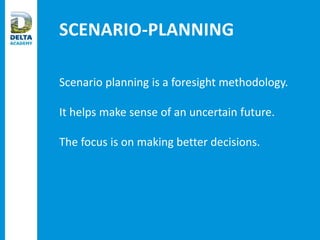
SCENARIO-PLANNING
Scenario planning is a foresight methodology.
It helps make sense of an uncertain future.
The focus is on making better decisions.
WHY DO IT?
The world is becoming more and more complex.
We are facing significant new challenges and
pressures.
Decisions taken today will have effects years into
the future, but in what sort of world?
It is increasingly difficult to discern trends and
realities, and to make well-informed decisions
today!
WHY DO IT?
The future is not pre-determined or predicable.
If it were, there would be no point in taking
action today, because it would have no effect on
the future.
Full information about the future is never
available.
It makes sense to look for ways to understand the
future to deal with uncertainty.
WHAT IS FORESIGHT?
All our knowledge is about the past, but all our
decisions are about the future.
We create our future by what we do or don’t do
today; it makes sense to try and understand as
best we can what that future might be like before
we act.
Foresight is not prediction! It is about getting an
idea about what plausible futures might look like.
We are good at learning from the past; we need
to learn from the future as well – we need to
develop a ‘history of the future’ as we do a
‘history of the past’.
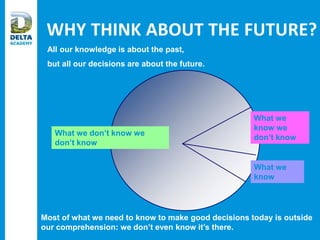
WHY THINK ABOUT THE FUTURE?
What we don’t know we
don’t know
What we
know we
don’t know
What we
know
Most of what we need to know to make good decisions today is outside
our comprehension: we don’t even know it’s there.
All our knowledge is about the past,
but all our decisions are about the future.
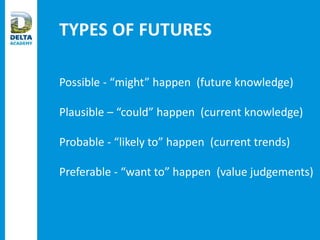
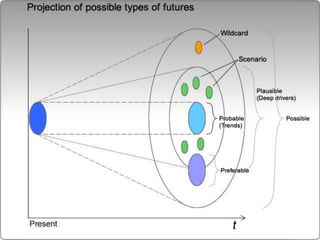
TYPES OF FUTURES
Possible - “might” happen (future knowledge)
Plausible – “could” happen (current knowledge)
Probable - “likely to” happen (current trends)
Preferable - “want to” happen (value judgements)
Time
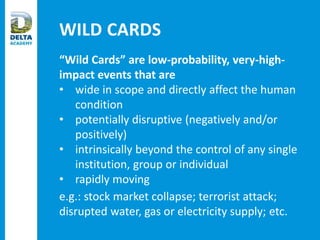
WILD CARDS
“Wild Cards” are low-probability, very-high-
impact events that are
• wide in scope and directly affect the human
condition
• potentially disruptive (negatively and/or
positively)
• intrinsically beyond the control of any single
institution, group or individual
• rapidly moving
e.g.: stock market collapse; terrorist attack;
disrupted water, gas or electricity supply; etc.
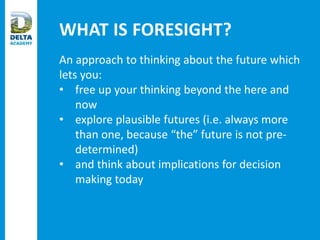
WHAT IS FORESIGHT?
An approach to thinking about the future which
lets you:
• free up your thinking beyond the here and
now
• explore plausible futures (i.e. always more
than one, because “the” future is not pre-
determined)
• and think about implications for decision
making today
WHAT IS FORESIGHT?
An attribute, competence or process that attempts
to broaden the boundaries of perception by:
– assessing the implications of present actions,
decisions etc.
– detecting and avoiding problems before they
occur (early warning indicators)
– considering the present implications of
possible future events (proactive strategy
formulation)
– envisioning aspects of desired futures
(scenarios)
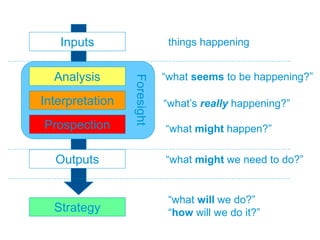
Inputs
Strategy
Outputs
Analysis
Interpretation
“what might we need to do?”
“what will we do?”
“how will we do it?”
“what’s really happening?”
“what seems to be happening?”
things happening
Foresight “what might happen?”Prospection
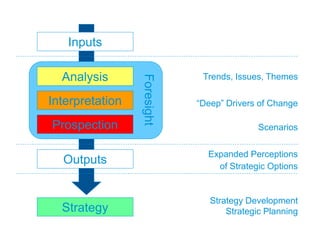
Inputs
Strategy
Outputs
Analysis
Interpretation
Prospection
Foresight
Expanded Perceptions
of Strategic Options
Strategy Development
Strategic Planning
Scenarios
“Deep” Drivers of Change
Trends, Issues, Themes
WHAT ARE SCENARIOS?
Scenarios are possible views of the world,
described in narrative form (stories) that provide
a context in which one can make decisions.
By seeing a range of possible worlds, decisions
will be better informed, and a strategy based on
this knowledge and insight will be more likely to
succeed.
Scenarios do not predict the future, but they do
illuminate the drivers of change: understanding
them can only help decision makers to take
greater control of their situation.
WHY SCENARIOS?
• Provides structured process for people to start
‘consciously’ thinking about the longer-term
future and possible implications for strategy
today.
• A creative and shared process that allows time
for reflection about a region and its future.
WHY SCENARIOS?
Scenarios strengthen a strategic management
tool box:
– traditional methods focus on the past
– scenario planning focuses on the future
Combining both the past and the future makes
thinking about strategy stronger and promotes:
– responsiveness
– flexibility
– competitive advantage
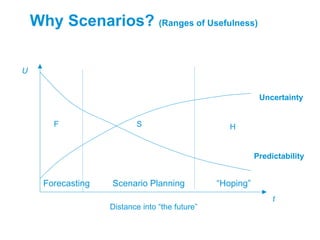
Distance into “the future”
Uncertainty
Predictability
F S H
Forecasting Scenario Planning “Hoping”
Why Scenarios? (Ranges of Usefulness)
t
U
THE SCENARIO PLANNING
PROCESS
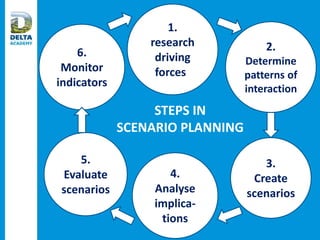
1. Research the driving forces
2. Determine patterns of interaction
3. Create scenarios
4. Analyse the implications
5. Evaluate scenarios
6. Monitor indicators
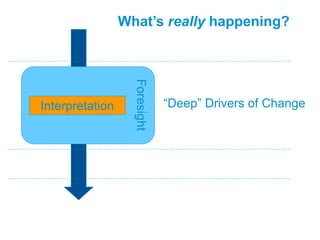
Interpretation
Foresight
“Deep” Drivers of Change
What’s really happening?
1 RESEARCH THE DRIVING
FORCES
Define the major sources of change that affect
the future, whether those forces are predictable
or not.
Some of the relatively predictable elements are
local demographics, trends in local land use,
levels of congestion, and mode split.
Less predictable are macro elements such as the
global economy, future availability of funding for
infrastructure, global environmental conditions,
and technological innovation.
THINGS CHANGE ...
“Inventions have long since reached their limit, and I see
no hope for future development”: Roman engineer
Sextus Julius Frontinus, 1st Century AD
“Heavier than air flying machines are not possible”: Lord
Kelvin, President of the Royal Society, 1895
“I think there is a world market for maybe 5 computers”:
Thomas Watson, Chairman of IBM, 1943
“Space flight is hokum”: Astronomer Royal, 1956
THINGS CHANGE ...
“We don’t like their sound, and guitar music is on the
way out”: Decca Recording Co. rejecting The Beatles, 1962
“640K [of RAM] ought to be enough for anybody”:
Bill Gates, 1981
“The fact that conflicts with other countries [producing
civilian casualties] have been conducted away from the
U.S. homeland can be considered one of the more
fortunate aspects of the American experience”:
Quadrennial Defense Review (QDR) for the US Dept of Defence, 2001
MAJOR DRIVERS OF CHANGE
• Social
• Technological
• Economic
• Environmental
• Political
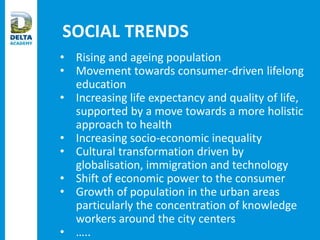
SOCIAL TRENDS
• Rising and ageing population
• Movement towards consumer-driven lifelong
education
• Increasing life expectancy and quality of life,
supported by a move towards a more holistic
approach to health
• Increasing socio-economic inequality
• Cultural transformation driven by
globalisation, immigration and technology
• Shift of economic power to the consumer
• Growth of population in the urban areas
particularly the concentration of knowledge
workers around the city centers
• …..
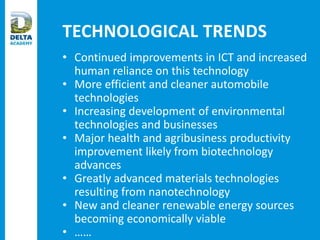
TECHNOLOGICAL TRENDS
• Continued improvements in ICT and increased
human reliance on this technology
• More efficient and cleaner automobile
technologies
• Increasing development of environmental
technologies and businesses
• Major health and agribusiness productivity
improvement likely from biotechnology
advances
• Greatly advanced materials technologies
resulting from nanotechnology
• New and cleaner renewable energy sources
becoming economically viable
• ……
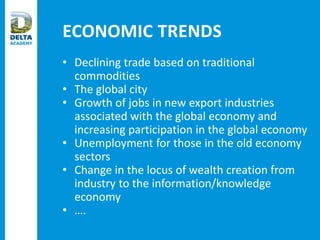
ECONOMIC TRENDS
• Declining trade based on traditional
commodities
• The global city
• Growth of jobs in new export industries
associated with the global economy and
increasing participation in the global economy
• Unemployment for those in the old economy
sectors
• Change in the locus of wealth creation from
industry to the information/knowledge
economy
• ….
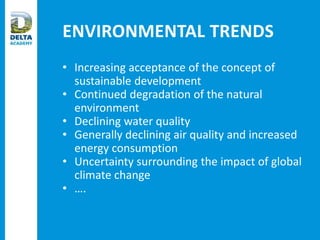
ENVIRONMENTAL TRENDS
• Increasing acceptance of the concept of
sustainable development
• Continued degradation of the natural
environment
• Declining water quality
• Generally declining air quality and increased
energy consumption
• Uncertainty surrounding the impact of global
climate change
• ….
POLITICAL TRENDS
• Rising influence of global government to the
detriment of national governments
• Rising influence of Transnational Corporations
and global capital
• Increasing influence of Non-Government
Organisations (NGO’s) on the global and local
scene
• Possibility of direct democracy and new
communities created by the internet
• New possibilities for global conflict, terrorism
and crime.
2: DETERMINE PATTERNS OF
INTERACTION
Consider how the driving forces could combine
to determine future conditions. To determine
these patterns of interaction between driving
forces, planners can develop a matrix that
identifies the driving forces as a pair of
opposites with a potential positive or negative
outcome.
BUILDING THE SCENARIO
MATRIX
For example, if the economy is a driving force, it
can be labeled as having either no growth or fast
growth. By determining the interaction of each
driving force, scenarios can be created.
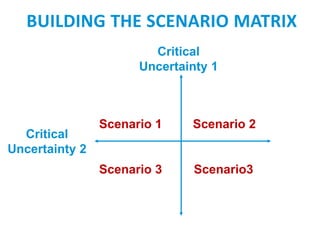
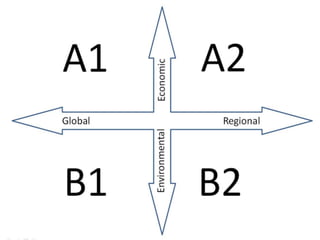
Choose two drivers that are most uncertain and
most critical in terms of impact on your plan.
Critical Uncertainty 1
Scenario 1 Scenario 2
Scenario 3 Scenario3
Critical
Uncertainty 1
Critical
Uncertainty 2
BUILDING THE SCENARIO MATRIX
DEVELOPING THE SCENARIOS
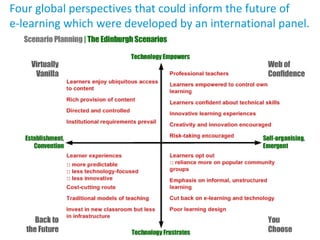
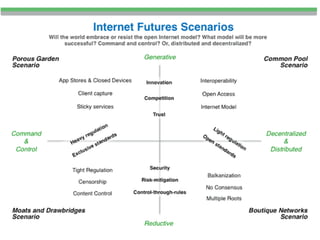
Four global perspectives that could inform the future of
e-learning which were developed by an international panel.
DEVELOPING THE SCENARIOS
3: CREATE SCENARIOS
When generating scenarios, planners should
think through the implications of different
strategies in different future environments.
The goal is to bring life to the scenarios so that
community stakeholders can easily recognize and
connect the various components.
4: ANALYSE THE IMPLICATIONS
Ultimately, scenario planning is a technique for
improving decision making. The scenarios enable
planners to explore the shape and nature of their
suggestions in a variety of circumstances.
The use of visual information to show the
interactions in each scenario can help the public
and decision makers understand the
consequences of potential actions and the
potential impacts of various scenarios.
5: EVALUATE SCENARIOS
Planners can measure the scenarios against one
another by comparing indicators relating to land
use, transportation, demographics, environment,
economics, technology, and other driving forces.
During large regional public meetings, graphic
simulations of alternative scenarios can stimulate
understanding and decisionmaking among
stakeholders.
Through this process, the community can
formulate reasoned responses and enhance its
ability to respond to change.
6: MONITOR INDICATORS
Scenario planning is an ongoing process.
As the future unfolds, planners need to assess
and compare real growth patterns to the selected
scenarios and devise new scenarios, make new
decisions, or create policies to address changing
conditions.
1.
research
driving
forcesh
2.
Determine
patterns of
interaction
3.
Create
scenarios
4.
Analyse
implica-
tions
6.
Monitor
indicators
5.
Evaluate
scenarios
STEPS IN
SCENARIO PLANNING

Lecture scenario planning

  • 1.
  • 2.
    PLANNING • Vision statement •Mission statement • Objectives • Strategy • Actionplan • Implementation • Monitoring …….circular
  • 3.
    23 SEPTEMBER 20133 Identification of driving forces of change Determination of main issues and trends shaping the future Clarification of the level of impact and degree of uncertainty Establishment of scenarios Creation of different scenario stories Exploration of the future Formulation of the problem / strategic question Identification of the key-issues characteristic for the present state Recognition of factors responsible for the current situation Identification of the main actors present on the scene Understanding of interactions between actors and factors Understanding of the past and present Generating policy proposals and suggestions for action Development of indicators to measure the progress Identification of bodies responsible for action Development of mechanisms for revising the vision and generating new suggestions in order to respond to changing conditions Recommendations and suggestion for the implementation of the vision Generation of ideas of what is desired Agreeing a vision of the desired future shared by all stakeholders and sections of society Development of the most desirable future vision
  • 4.
    SCENARIO-PLANNING Scenario planning isa foresight methodology. It helps make sense of an uncertain future. The focus is on making better decisions.
  • 5.
    WHY DO IT? Theworld is becoming more and more complex. We are facing significant new challenges and pressures. Decisions taken today will have effects years into the future, but in what sort of world? It is increasingly difficult to discern trends and realities, and to make well-informed decisions today!
  • 6.
    WHY DO IT? Thefuture is not pre-determined or predicable. If it were, there would be no point in taking action today, because it would have no effect on the future. Full information about the future is never available. It makes sense to look for ways to understand the future to deal with uncertainty.
  • 7.
    WHAT IS FORESIGHT? Allour knowledge is about the past, but all our decisions are about the future. We create our future by what we do or don’t do today; it makes sense to try and understand as best we can what that future might be like before we act. Foresight is not prediction! It is about getting an idea about what plausible futures might look like. We are good at learning from the past; we need to learn from the future as well – we need to develop a ‘history of the future’ as we do a ‘history of the past’.
  • 8.
    WHY THINK ABOUTTHE FUTURE? What we don’t know we don’t know What we know we don’t know What we know Most of what we need to know to make good decisions today is outside our comprehension: we don’t even know it’s there. All our knowledge is about the past, but all our decisions are about the future.
  • 9.
    TYPES OF FUTURES Possible- “might” happen (future knowledge) Plausible – “could” happen (current knowledge) Probable - “likely to” happen (current trends) Preferable - “want to” happen (value judgements)
  • 10.
  • 11.
    WILD CARDS “Wild Cards”are low-probability, very-high- impact events that are • wide in scope and directly affect the human condition • potentially disruptive (negatively and/or positively) • intrinsically beyond the control of any single institution, group or individual • rapidly moving e.g.: stock market collapse; terrorist attack; disrupted water, gas or electricity supply; etc.
  • 12.
    WHAT IS FORESIGHT? Anapproach to thinking about the future which lets you: • free up your thinking beyond the here and now • explore plausible futures (i.e. always more than one, because “the” future is not pre- determined) • and think about implications for decision making today
  • 13.
    WHAT IS FORESIGHT? Anattribute, competence or process that attempts to broaden the boundaries of perception by: – assessing the implications of present actions, decisions etc. – detecting and avoiding problems before they occur (early warning indicators) – considering the present implications of possible future events (proactive strategy formulation) – envisioning aspects of desired futures (scenarios)
  • 14.
    Inputs Strategy Outputs Analysis Interpretation “what might weneed to do?” “what will we do?” “how will we do it?” “what’s really happening?” “what seems to be happening?” things happening Foresight “what might happen?”Prospection
  • 15.
    Inputs Strategy Outputs Analysis Interpretation Prospection Foresight Expanded Perceptions of StrategicOptions Strategy Development Strategic Planning Scenarios “Deep” Drivers of Change Trends, Issues, Themes
  • 16.
    WHAT ARE SCENARIOS? Scenariosare possible views of the world, described in narrative form (stories) that provide a context in which one can make decisions. By seeing a range of possible worlds, decisions will be better informed, and a strategy based on this knowledge and insight will be more likely to succeed. Scenarios do not predict the future, but they do illuminate the drivers of change: understanding them can only help decision makers to take greater control of their situation.
  • 17.
    WHY SCENARIOS? • Providesstructured process for people to start ‘consciously’ thinking about the longer-term future and possible implications for strategy today. • A creative and shared process that allows time for reflection about a region and its future.
  • 18.
    WHY SCENARIOS? Scenarios strengthena strategic management tool box: – traditional methods focus on the past – scenario planning focuses on the future Combining both the past and the future makes thinking about strategy stronger and promotes: – responsiveness – flexibility – competitive advantage
  • 19.
    Distance into “thefuture” Uncertainty Predictability F S H Forecasting Scenario Planning “Hoping” Why Scenarios? (Ranges of Usefulness) t U
  • 20.
    THE SCENARIO PLANNING PROCESS 1.Research the driving forces 2. Determine patterns of interaction 3. Create scenarios 4. Analyse the implications 5. Evaluate scenarios 6. Monitor indicators
  • 21.
    Interpretation Foresight “Deep” Drivers ofChange What’s really happening?
  • 22.
    1 RESEARCH THEDRIVING FORCES Define the major sources of change that affect the future, whether those forces are predictable or not. Some of the relatively predictable elements are local demographics, trends in local land use, levels of congestion, and mode split. Less predictable are macro elements such as the global economy, future availability of funding for infrastructure, global environmental conditions, and technological innovation.
  • 23.
    THINGS CHANGE ... “Inventionshave long since reached their limit, and I see no hope for future development”: Roman engineer Sextus Julius Frontinus, 1st Century AD “Heavier than air flying machines are not possible”: Lord Kelvin, President of the Royal Society, 1895 “I think there is a world market for maybe 5 computers”: Thomas Watson, Chairman of IBM, 1943 “Space flight is hokum”: Astronomer Royal, 1956
  • 24.
    THINGS CHANGE ... “Wedon’t like their sound, and guitar music is on the way out”: Decca Recording Co. rejecting The Beatles, 1962 “640K [of RAM] ought to be enough for anybody”: Bill Gates, 1981 “The fact that conflicts with other countries [producing civilian casualties] have been conducted away from the U.S. homeland can be considered one of the more fortunate aspects of the American experience”: Quadrennial Defense Review (QDR) for the US Dept of Defence, 2001
  • 25.
    MAJOR DRIVERS OFCHANGE • Social • Technological • Economic • Environmental • Political
  • 26.
    SOCIAL TRENDS • Risingand ageing population • Movement towards consumer-driven lifelong education • Increasing life expectancy and quality of life, supported by a move towards a more holistic approach to health • Increasing socio-economic inequality • Cultural transformation driven by globalisation, immigration and technology • Shift of economic power to the consumer • Growth of population in the urban areas particularly the concentration of knowledge workers around the city centers • …..
  • 27.
    TECHNOLOGICAL TRENDS • Continuedimprovements in ICT and increased human reliance on this technology • More efficient and cleaner automobile technologies • Increasing development of environmental technologies and businesses • Major health and agribusiness productivity improvement likely from biotechnology advances • Greatly advanced materials technologies resulting from nanotechnology • New and cleaner renewable energy sources becoming economically viable • ……
  • 28.
    ECONOMIC TRENDS • Decliningtrade based on traditional commodities • The global city • Growth of jobs in new export industries associated with the global economy and increasing participation in the global economy • Unemployment for those in the old economy sectors • Change in the locus of wealth creation from industry to the information/knowledge economy • ….
  • 29.
    ENVIRONMENTAL TRENDS • Increasingacceptance of the concept of sustainable development • Continued degradation of the natural environment • Declining water quality • Generally declining air quality and increased energy consumption • Uncertainty surrounding the impact of global climate change • ….
  • 30.
    POLITICAL TRENDS • Risinginfluence of global government to the detriment of national governments • Rising influence of Transnational Corporations and global capital • Increasing influence of Non-Government Organisations (NGO’s) on the global and local scene • Possibility of direct democracy and new communities created by the internet • New possibilities for global conflict, terrorism and crime.
  • 31.
    2: DETERMINE PATTERNSOF INTERACTION Consider how the driving forces could combine to determine future conditions. To determine these patterns of interaction between driving forces, planners can develop a matrix that identifies the driving forces as a pair of opposites with a potential positive or negative outcome.
  • 32.
    BUILDING THE SCENARIO MATRIX Forexample, if the economy is a driving force, it can be labeled as having either no growth or fast growth. By determining the interaction of each driving force, scenarios can be created. Choose two drivers that are most uncertain and most critical in terms of impact on your plan. Critical Uncertainty 1
  • 33.
    Scenario 1 Scenario2 Scenario 3 Scenario3 Critical Uncertainty 1 Critical Uncertainty 2 BUILDING THE SCENARIO MATRIX
  • 34.
  • 35.
    DEVELOPING THE SCENARIOS Fourglobal perspectives that could inform the future of e-learning which were developed by an international panel.
  • 36.
  • 37.
    3: CREATE SCENARIOS Whengenerating scenarios, planners should think through the implications of different strategies in different future environments. The goal is to bring life to the scenarios so that community stakeholders can easily recognize and connect the various components.
  • 38.
    4: ANALYSE THEIMPLICATIONS Ultimately, scenario planning is a technique for improving decision making. The scenarios enable planners to explore the shape and nature of their suggestions in a variety of circumstances. The use of visual information to show the interactions in each scenario can help the public and decision makers understand the consequences of potential actions and the potential impacts of various scenarios.
  • 39.
    5: EVALUATE SCENARIOS Plannerscan measure the scenarios against one another by comparing indicators relating to land use, transportation, demographics, environment, economics, technology, and other driving forces. During large regional public meetings, graphic simulations of alternative scenarios can stimulate understanding and decisionmaking among stakeholders. Through this process, the community can formulate reasoned responses and enhance its ability to respond to change.
  • 40.
    6: MONITOR INDICATORS Scenarioplanning is an ongoing process. As the future unfolds, planners need to assess and compare real growth patterns to the selected scenarios and devise new scenarios, make new decisions, or create policies to address changing conditions.
  • 41.