
SCENARIO BUILDING BY BRIG ARUN SEHGAL SAGAR PUSHP EA09040
INTRODUCTION
This present moment Used to be The unimaginable future Stewart Brand (Strategist and Writer) Known for the Book : Whole Earth Catalog
PREVIEW Foresight What is Scenario Building? History Scenario Building Process Conduct of Scenario Analysis Conclusion
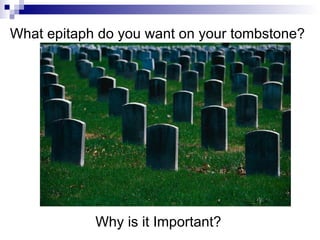
What epitaph do you want on your tombstone? Why is it Important?
And therefore, we need to have  FORESIGHT .
Foresight Everyone has an  innate  foresight capacity to think about the future. We do it everyday, but usually we don’t recognise it. To develop an individual foresight capacity, we first have to  recognise  that we have it, and that we need to  use  it.
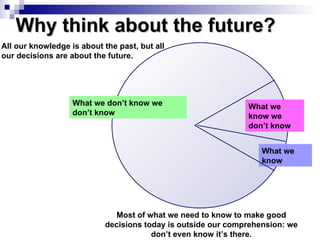
Why think about the future? What we don’t know we don’t know What we know we don’t know What we know Most of what we need to know to make good decisions today is outside our comprehension: we don’t even know it’s there. All our knowledge is about the past, but all our decisions are about the future.
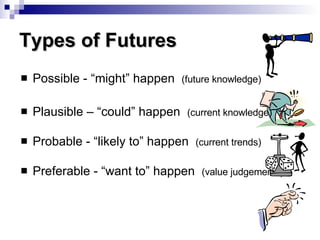
Possible - “might” happen  (future knowledge) Plausible – “could” happen  (current knowledge) Probable - “likely to” happen  (current trends) Preferable - “want to” happen  (value judgements) Types of Futures
Scenario Building Way of testing strategy in the  ‘planning stage’  to ensure that it is likely to work in different types of futures realistically expected to arise. ‘ Evolving’  and  ‘Continuous’  Process. Preparing for the  ‘Future’  not prediction of future. All we can predict is  ‘Change’. Scenarios do not predict the future, but they illuminate the  ‘drivers’  of change. Understanding them can only help managers to take  ‘greater control’  of their situation.
Quick assessment of the issue Which key questions need answering?   What's over the horizon?  What's really going on?  How might the future unfold?  What are others doing?  Where are we now?  How could we respond?  What shall we do?  How might we do it?  What do we do right now ?      Ask Simple Questions
History of Scenario Building Military war games in the 1960s. Initially a ‘predict and control’ approach. Post 1970s, the approach changed. Emphasis shifted to analyze ‘cause and effect’ relationship and prepare accordingly. Corporate incorporated this approach.
One of many foresight methodologies. Well developed and tested across government, business and education. Provides structured process for people to start ‘consciously’ thinking about the longer-term future and possible implications for strategy today (ie navigating the ‘chessboard’). A creative and  shared  process that allows time for reflection about the organisation and its future. Why Scenarios?
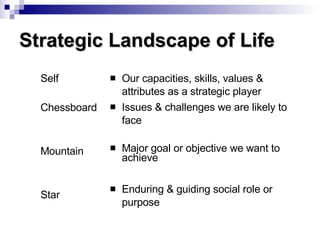
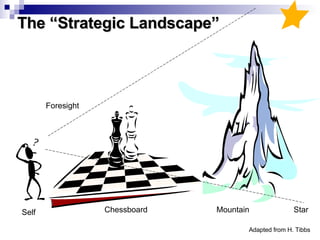
Strategic Landscape of Life Self Chessboard Mountain Star Our capacities, skills, values & attributes as a strategic player Issues & challenges we are likely to face Major goal or objective we want to achieve Enduring & guiding social role or purpose
The “Strategic Landscape” Foresight Adapted from H. Tibbs Self Mountain Star Chessboard
How do you build futures ready strategy? The Scenario Building Process
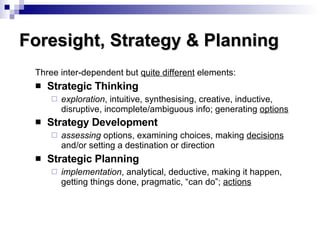
Three inter-dependent but  quite different  elements: Strategic Thinking exploration , intuitive, synthesising, creative, inductive, disruptive, incomplete/ambiguous info; generating  options Strategy Development assessing  options, examining choices, making  decisions  and/or setting a destination or direction Strategic Planning implementation , analytical, deductive, making it happen, getting things done, pragmatic, “can do”;  actions Foresight, Strategy & Planning
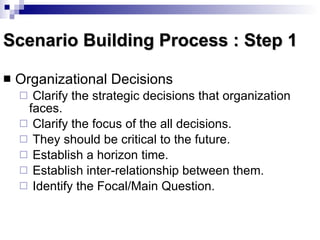
Scenario Building Process : Step 1 Organizational Decisions  Clarify the strategic decisions that organization faces. Clarify the focus of the all decisions. They should be critical to the future. Establish a horizon time. Establish inter-relationship between them. Identify the Focal/Main Question.
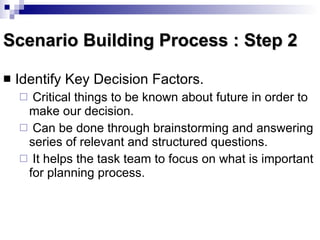
Scenario Building Process : Step 2 Identify Key Decision Factors.  Critical things to be known about future in order to make our decision. Can be done through brainstorming and answering series of relevant and structured questions. It helps the task team to focus on what is important for planning process.
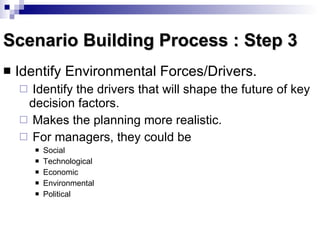
Scenario Building Process : Step 3 Identify Environmental Forces/Drivers.  Identify the drivers that will shape the future of key decision factors. Makes the planning more realistic. For managers, they could be Social Technological Economic Environmental  Political
Scenario Building Process : Step 4 Scenario Logics.  Heart of all process as it basically establishes the structure for scenario. Grouping the high impact/high uncertainty forces or drivers.
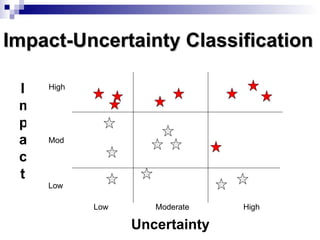
Impact-Uncertainty Classification Impact Uncertainty Low Moderate High Low Mod High
“ Low ” means we are reasonably certain that it will play out or continue in ways that are fairly well understood eg. population “ High ” means that we have no clear idea which of a number of plausible ways it might go eg. government legislation and policy “ Mod ” means “somewhere in between”   What is “Uncertainty”?
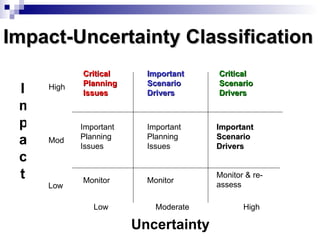
Impact-Uncertainty Classification Impact Uncertainty Critical Scenario Drivers Important Scenario Drivers Critical Planning Issues Important Planning Issues Important Planning Issues Important Scenario Drivers Monitor & re-assess Monitor  Monitor Low Moderate High Low Mod High
High Impact, Low Uncertainty = “ predetermined elements (or trends) ” should be present in  every  scenario High Impact, High Uncertainty = “ critical uncertainty ”  choose the two  most  uncertain of these to create the scenario matrix And the “ Non-significant   drivers ”? include in your scenarios  if you like , & if it makes sense to, particularly if you think that they will be significant in the future. Building the Scenario Matrix
WILD CARDS
“ Wild Cards” are low-probability, very-high-impact events that are wide in scope and directly affect the human condition potentially disruptive (negatively and/or positively) intrinsically beyond the control of any single institution, group or individual rapidly moving eg: asteroid impact; stock market collapse; terrorist attack; disrupted water, gas or electricity supply; etc Suddenly, the World Changes
If you don’t think about Wild Cards  before  they happen, then  all  of the value in thinking about them is lost (“horse has bolted / stable door”).   If we accept that there will be Wild Cards in the near future, then the only effective defence is to begin to systematically think about them  now , and examine their implications. Suddenly, the World Changes
CONDUCT OF SCENARIO ANALYSIS
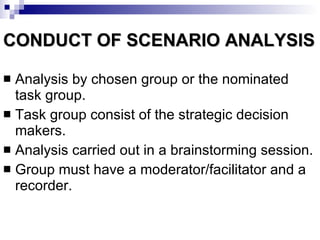
CONDUCT OF SCENARIO ANALYSIS Analysis by chosen group or the nominated task group. Task group consist of the strategic decision makers. Analysis carried out in a brainstorming session. Group must have a moderator/facilitator and a recorder.
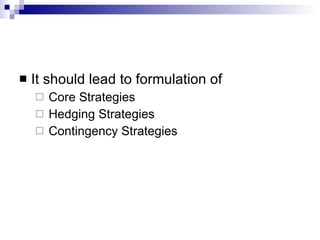
It should lead to formulation of Core Strategies Hedging Strategies Contingency Strategies
CONCLUSION
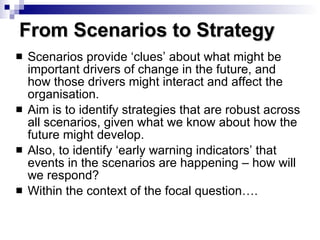
Scenarios provide ‘clues’ about what might be important drivers of change in the future, and how those drivers might interact and affect the organisation. Aim is to identify strategies that are robust across all scenarios, given what we know about how the future might develop. Also, to identify ‘early warning indicators’ that events in the scenarios are happening – how will we respond? Within the context of the focal question…. From Scenarios to Strategy
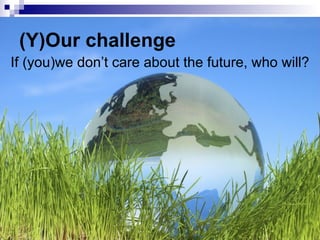
If (you)we don’t care about the future, who will? (Y)Our challenge

Scenario Building

  • 1.
    SCENARIO BUILDING BYBRIG ARUN SEHGAL SAGAR PUSHP EA09040
  • 2.
  • 3.
    This present momentUsed to be The unimaginable future Stewart Brand (Strategist and Writer) Known for the Book : Whole Earth Catalog
  • 4.
    PREVIEW Foresight Whatis Scenario Building? History Scenario Building Process Conduct of Scenario Analysis Conclusion
  • 5.
    What epitaph doyou want on your tombstone? Why is it Important?
  • 6.
    And therefore, weneed to have FORESIGHT .
  • 7.
    Foresight Everyone hasan innate foresight capacity to think about the future. We do it everyday, but usually we don’t recognise it. To develop an individual foresight capacity, we first have to recognise that we have it, and that we need to use it.
  • 8.
    Why think aboutthe future? What we don’t know we don’t know What we know we don’t know What we know Most of what we need to know to make good decisions today is outside our comprehension: we don’t even know it’s there. All our knowledge is about the past, but all our decisions are about the future.
  • 9.
    Possible - “might”happen (future knowledge) Plausible – “could” happen (current knowledge) Probable - “likely to” happen (current trends) Preferable - “want to” happen (value judgements) Types of Futures
  • 10.
    Scenario Building Wayof testing strategy in the ‘planning stage’ to ensure that it is likely to work in different types of futures realistically expected to arise. ‘ Evolving’ and ‘Continuous’ Process. Preparing for the ‘Future’ not prediction of future. All we can predict is ‘Change’. Scenarios do not predict the future, but they illuminate the ‘drivers’ of change. Understanding them can only help managers to take ‘greater control’ of their situation.
  • 11.
    Quick assessment of theissue Which key questions need answering? What's over the horizon? What's really going on? How might the future unfold? What are others doing? Where are we now? How could we respond? What shall we do? How might we do it? What do we do right now ?    Ask Simple Questions
  • 12.
    History of ScenarioBuilding Military war games in the 1960s. Initially a ‘predict and control’ approach. Post 1970s, the approach changed. Emphasis shifted to analyze ‘cause and effect’ relationship and prepare accordingly. Corporate incorporated this approach.
  • 13.
    One of manyforesight methodologies. Well developed and tested across government, business and education. Provides structured process for people to start ‘consciously’ thinking about the longer-term future and possible implications for strategy today (ie navigating the ‘chessboard’). A creative and shared process that allows time for reflection about the organisation and its future. Why Scenarios?
  • 14.
    Strategic Landscape ofLife Self Chessboard Mountain Star Our capacities, skills, values & attributes as a strategic player Issues & challenges we are likely to face Major goal or objective we want to achieve Enduring & guiding social role or purpose
  • 15.
    The “Strategic Landscape”Foresight Adapted from H. Tibbs Self Mountain Star Chessboard
  • 16.
    How do youbuild futures ready strategy? The Scenario Building Process
  • 17.
    Three inter-dependent but quite different elements: Strategic Thinking exploration , intuitive, synthesising, creative, inductive, disruptive, incomplete/ambiguous info; generating options Strategy Development assessing options, examining choices, making decisions and/or setting a destination or direction Strategic Planning implementation , analytical, deductive, making it happen, getting things done, pragmatic, “can do”; actions Foresight, Strategy & Planning
  • 18.
    Scenario Building Process: Step 1 Organizational Decisions Clarify the strategic decisions that organization faces. Clarify the focus of the all decisions. They should be critical to the future. Establish a horizon time. Establish inter-relationship between them. Identify the Focal/Main Question.
  • 19.
    Scenario Building Process: Step 2 Identify Key Decision Factors. Critical things to be known about future in order to make our decision. Can be done through brainstorming and answering series of relevant and structured questions. It helps the task team to focus on what is important for planning process.
  • 20.
    Scenario Building Process: Step 3 Identify Environmental Forces/Drivers. Identify the drivers that will shape the future of key decision factors. Makes the planning more realistic. For managers, they could be Social Technological Economic Environmental Political
  • 21.
    Scenario Building Process: Step 4 Scenario Logics. Heart of all process as it basically establishes the structure for scenario. Grouping the high impact/high uncertainty forces or drivers.
  • 22.
    Impact-Uncertainty Classification ImpactUncertainty Low Moderate High Low Mod High
  • 23.
    “ Low ”means we are reasonably certain that it will play out or continue in ways that are fairly well understood eg. population “ High ” means that we have no clear idea which of a number of plausible ways it might go eg. government legislation and policy “ Mod ” means “somewhere in between”  What is “Uncertainty”?
  • 24.
    Impact-Uncertainty Classification ImpactUncertainty Critical Scenario Drivers Important Scenario Drivers Critical Planning Issues Important Planning Issues Important Planning Issues Important Scenario Drivers Monitor & re-assess Monitor Monitor Low Moderate High Low Mod High
  • 25.
    High Impact, LowUncertainty = “ predetermined elements (or trends) ” should be present in every scenario High Impact, High Uncertainty = “ critical uncertainty ” choose the two most uncertain of these to create the scenario matrix And the “ Non-significant drivers ”? include in your scenarios if you like , & if it makes sense to, particularly if you think that they will be significant in the future. Building the Scenario Matrix
  • 26.
  • 27.
    “ Wild Cards”are low-probability, very-high-impact events that are wide in scope and directly affect the human condition potentially disruptive (negatively and/or positively) intrinsically beyond the control of any single institution, group or individual rapidly moving eg: asteroid impact; stock market collapse; terrorist attack; disrupted water, gas or electricity supply; etc Suddenly, the World Changes
  • 28.
    If you don’tthink about Wild Cards before they happen, then all of the value in thinking about them is lost (“horse has bolted / stable door”). If we accept that there will be Wild Cards in the near future, then the only effective defence is to begin to systematically think about them now , and examine their implications. Suddenly, the World Changes
  • 29.
  • 30.
    CONDUCT OF SCENARIOANALYSIS Analysis by chosen group or the nominated task group. Task group consist of the strategic decision makers. Analysis carried out in a brainstorming session. Group must have a moderator/facilitator and a recorder.
  • 31.
    It should leadto formulation of Core Strategies Hedging Strategies Contingency Strategies
  • 32.
  • 33.
    Scenarios provide ‘clues’about what might be important drivers of change in the future, and how those drivers might interact and affect the organisation. Aim is to identify strategies that are robust across all scenarios, given what we know about how the future might develop. Also, to identify ‘early warning indicators’ that events in the scenarios are happening – how will we respond? Within the context of the focal question…. From Scenarios to Strategy
  • 34.
    If (you)we don’tcare about the future, who will? (Y)Our challenge