


Strategic Foresight 101
November 12, 2019
Agenda
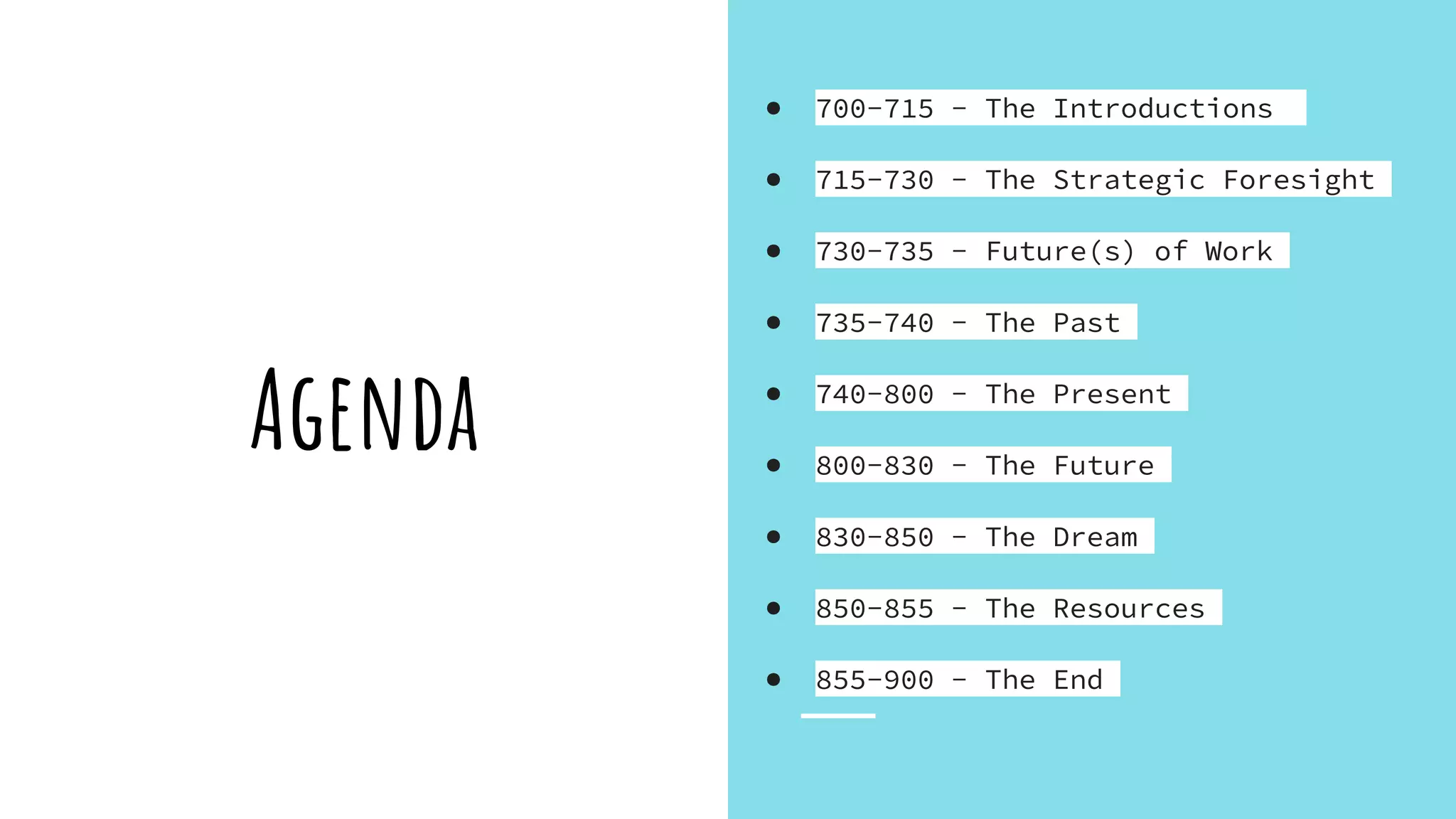
● 700-715 - The Introductions
● 715-730 - The Strategic Foresight
● 730-735 - Future(s) of Work
● 735-740 - The Past
● 740-800 - The Present
● 800-830 - The Future
● 830-850 - The Dream
● 850-855 - The Resources
● 855-900 - The End
The Introductions
1
Objective
● Learn what strategic foresight is.
● Learn about applications of strategic foresight and how
it can help you solve your problems (with a focus on
public policy).
● Learn some hands-on methods and tools to apply strategic
foresight.
● Leave you all with some resources to learn more.
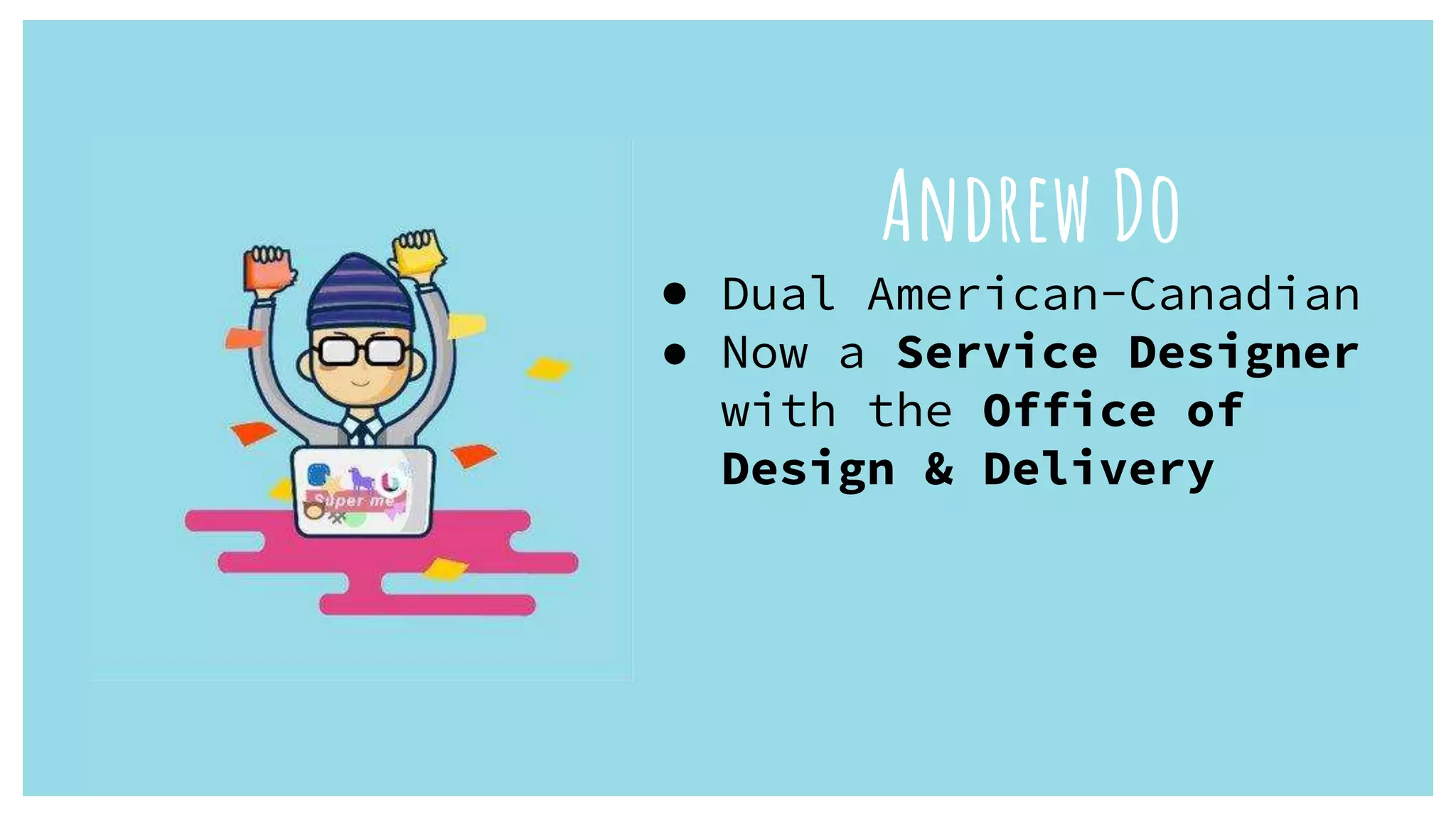
Andrew Do
● Dual American-Canadian
● Now a Service Designer
with the Office of
Design & Delivery
Speculative Futures - Austin Chapter
We’re part of a growing global community of
Speculative Futures Meetups organized by The
Design Futures Initiative, a 501c3 nonprofit
based in San Francisco, CA.
Speculative. Futures.
Speculative via Speculative Design and Critical
Design.
Futures via Futures Studies and Strategic
Foresight; how Futures methods and a futures-
oriented mindset can be applied to our design
praxis.
Design Futures Initiative (DFI) 1/3
Our mission is to bring people together to help the world imagine
a better place to live.
Design Futures Initiative (DFI) 2/3
Our mission is to bring people together to help the world imagine a better place to
live.
Our vision is to expand our global community and further the
discourse around Speculative Design and Foresight as strategies
for responsible, ethical, and mindful design futures.
Design Futures Initiative (DFI) 3/3
Our mission is to bring people together to help the world imagine a better place to
live.
Our vision is to expand our global community and further the discourse around
Speculative Design and Foresight as strategies for responsible, ethical, and mindful
design futures.
In service of answering the questions of what future(s) we want
and exploring the implications of the choices we make today.
(DFI) -> Speculative Futures Meetups
We do that by bringing together designers, strategists, artists,
scientists, futurists, and all of you to explore the ethical,
cultural, environmental, political and economic impacts of future
products and services.
The Strategic Foresight
2
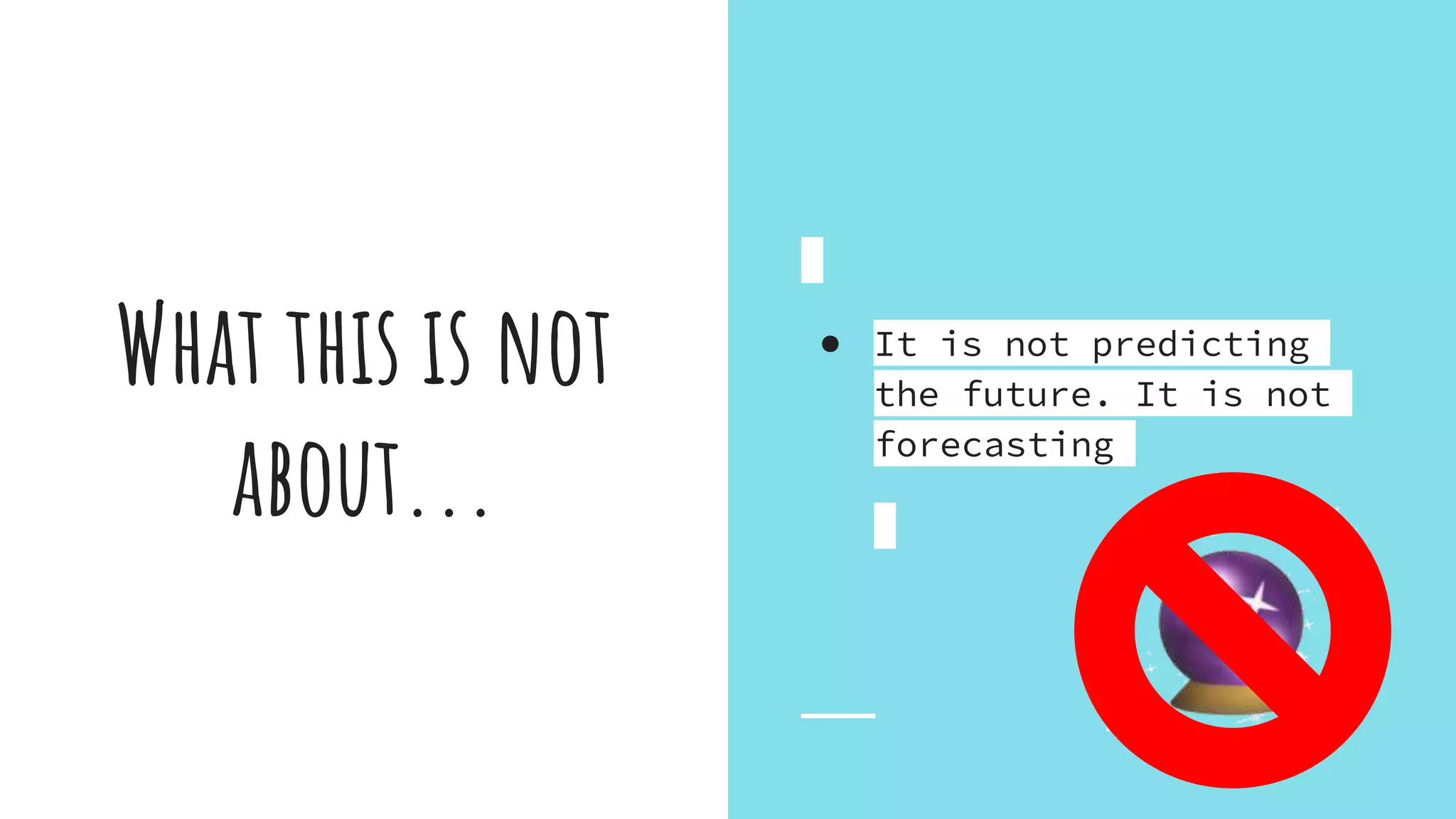
What this is not
about...
● It is not predicting
the future. It is not
forecasting
“It's tough to make
predictions,
especially about the
future.”
-Yogi Berra
So what is strategic foresight?
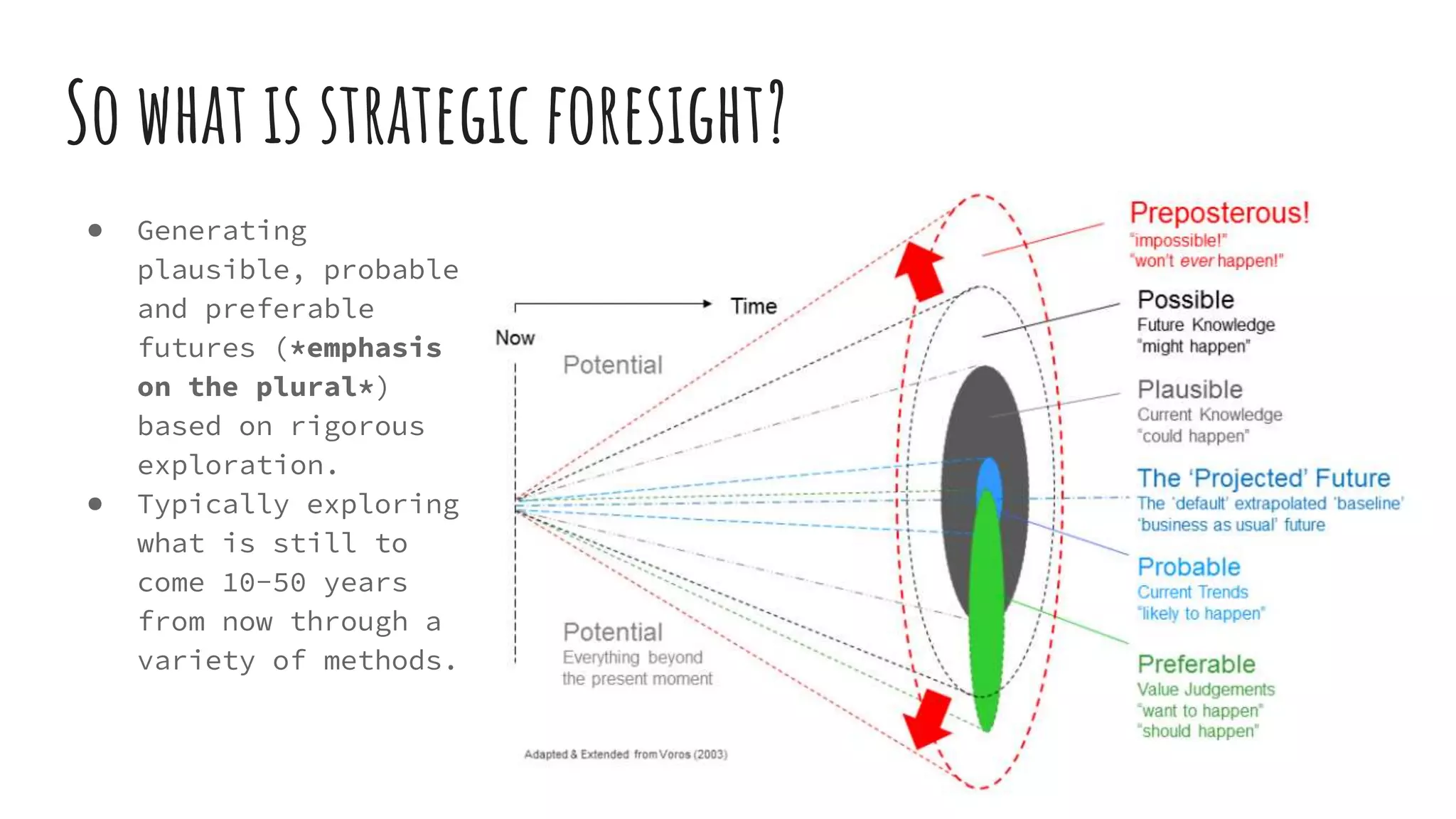
● Generating
plausible, probable
and preferable
futures (*emphasis
on the plural*)
based on rigorous
exploration.
● Typically exploring
what is still to
come 10-50 years
from now through a
variety of methods.
Everyone thinks about the future — they
just don’t do it very well.
-Jake Dunagan
“Strategic foresight is the ability to
create and maintain a high-quality,
coherent, and functional forward view and
to use the insights arising in
organizationally useful ways.”
-Richard Slaughter
“Futurism is an art of reperception. It
means recognizing that life will change,
must change, and has changed, and it
suggests how and why. It shows that old
perceptions have lost their validity, while
new ones are possible.”
-Bruce Sterling
“The futurist’s task is to create a space
of heightened insight, creativity and
strategic engagement.”
-Stuart Candy
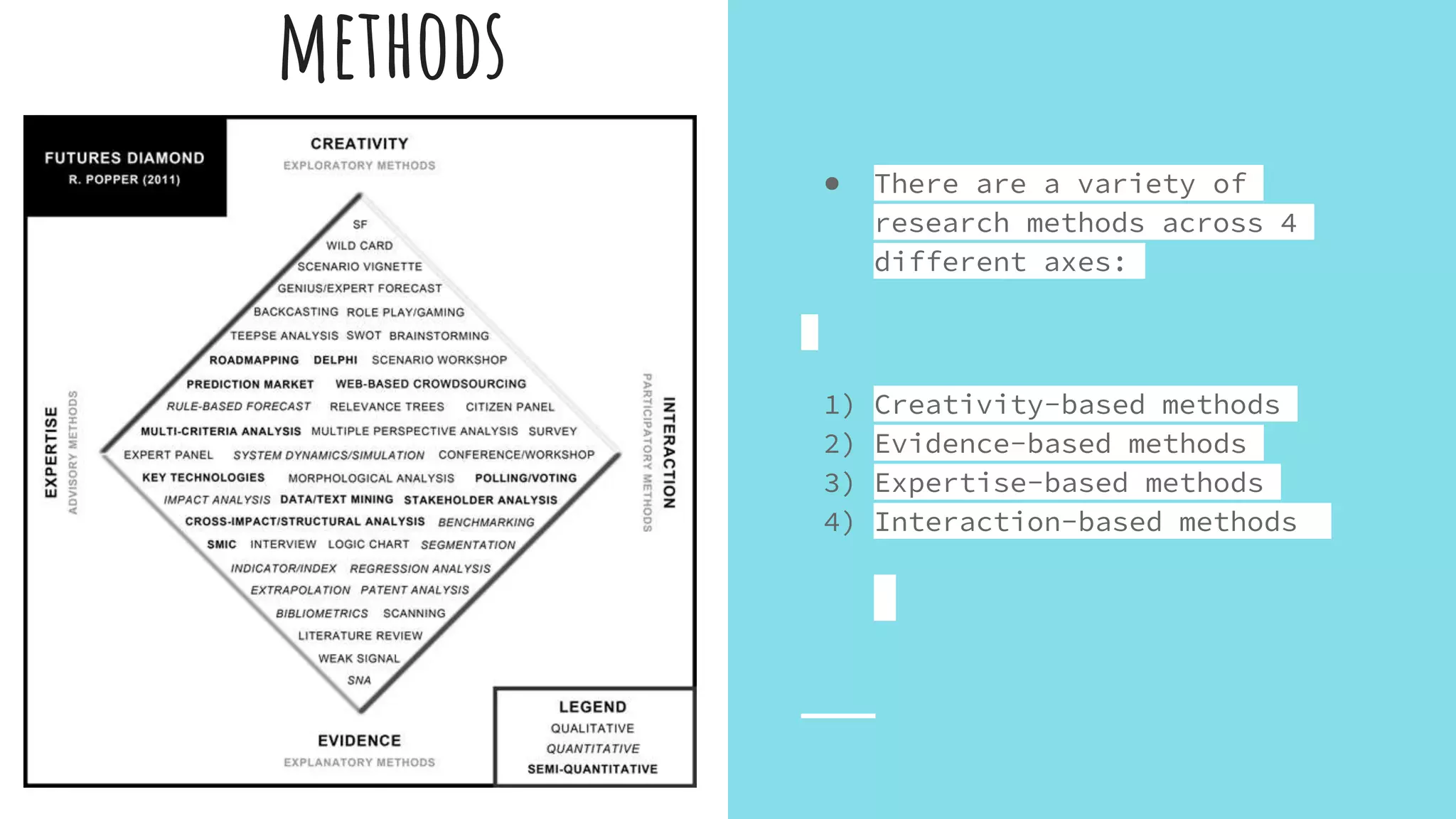
● There are a variety of
research methods across 4
different axes:
1) Creativity-based methods
2) Evidence-based methods
3) Expertise-based methods
4) Interaction-based methods
methods
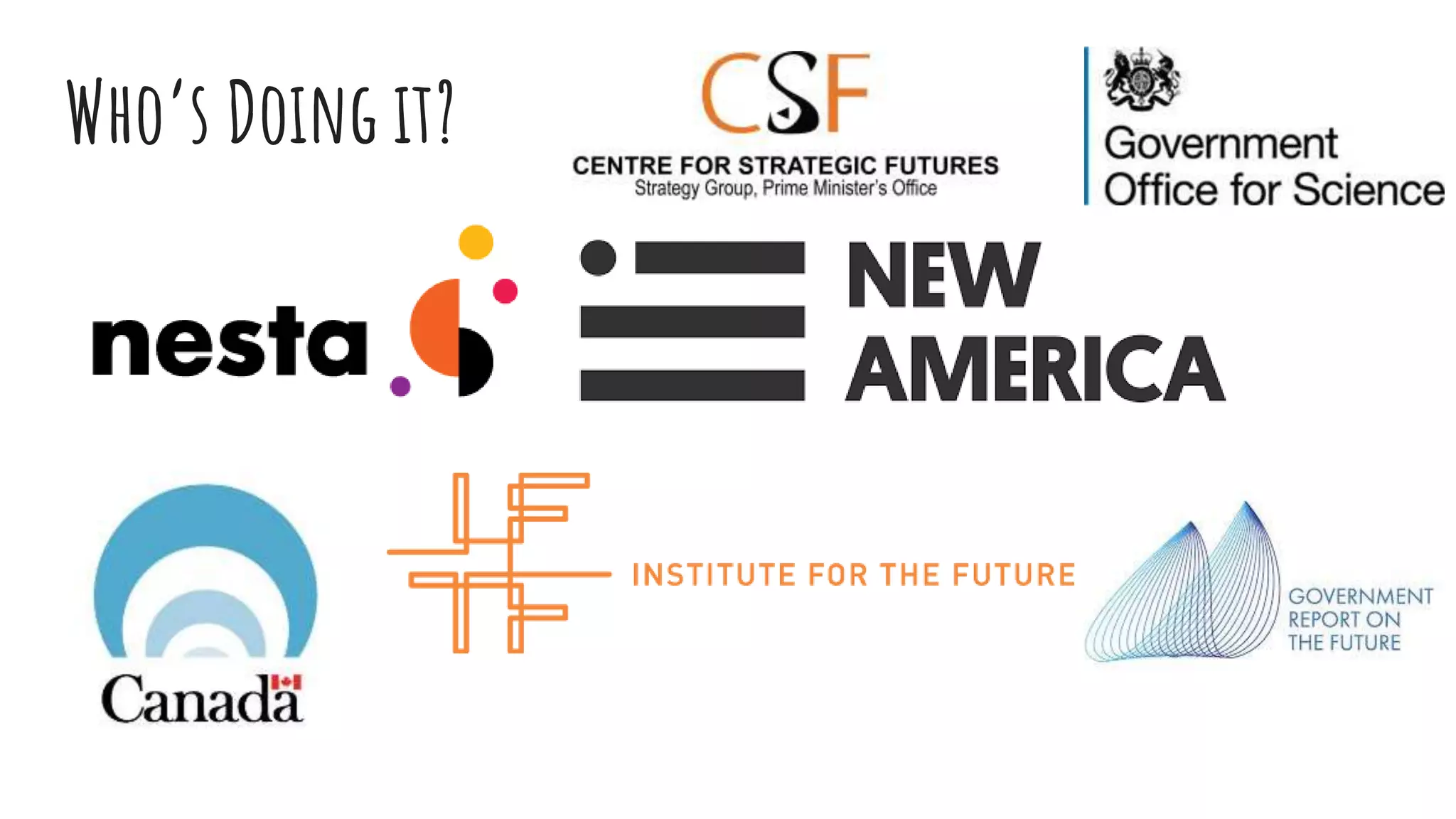
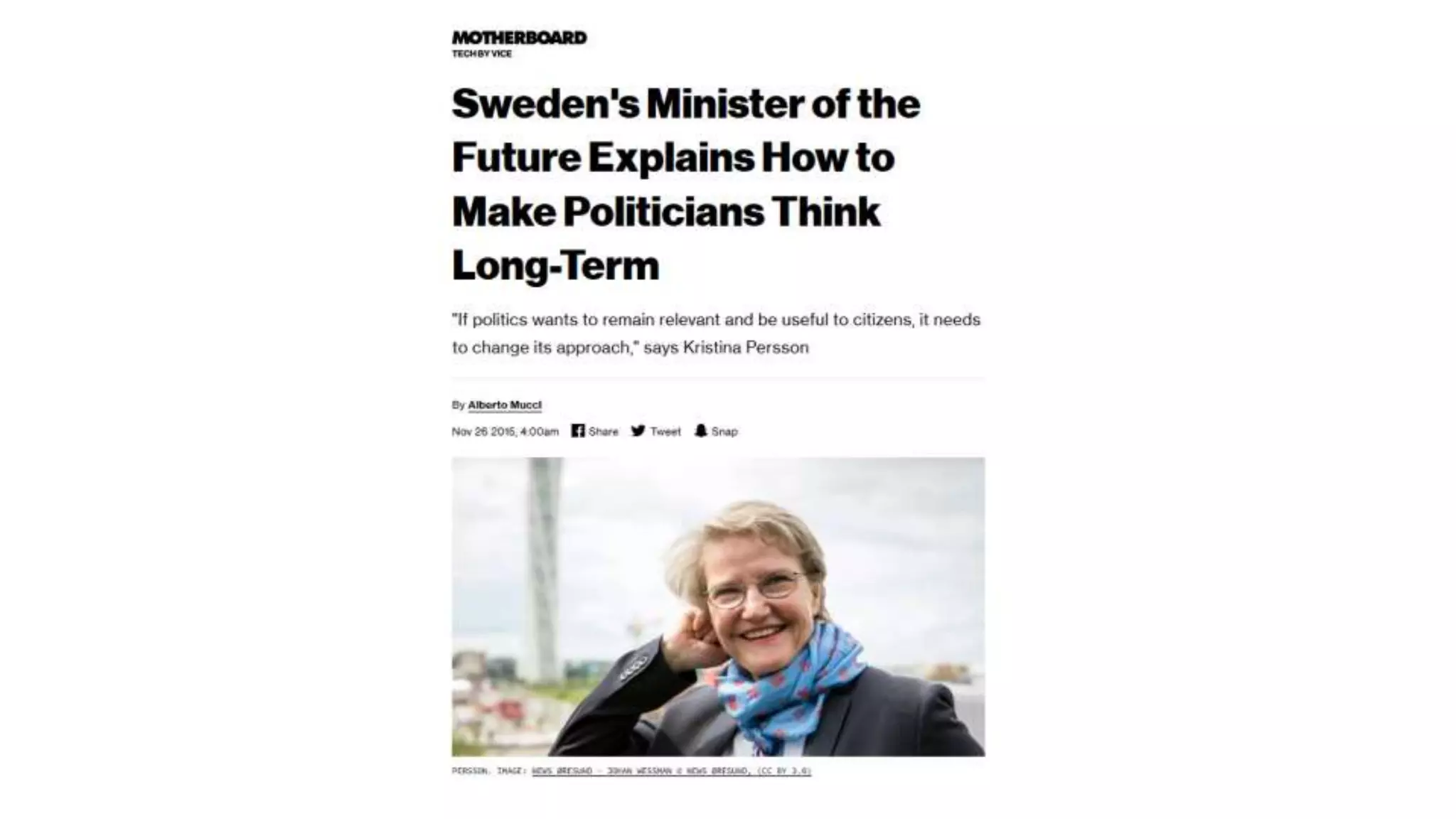
Who’s Doing it?
The OG...
Futures of work
3
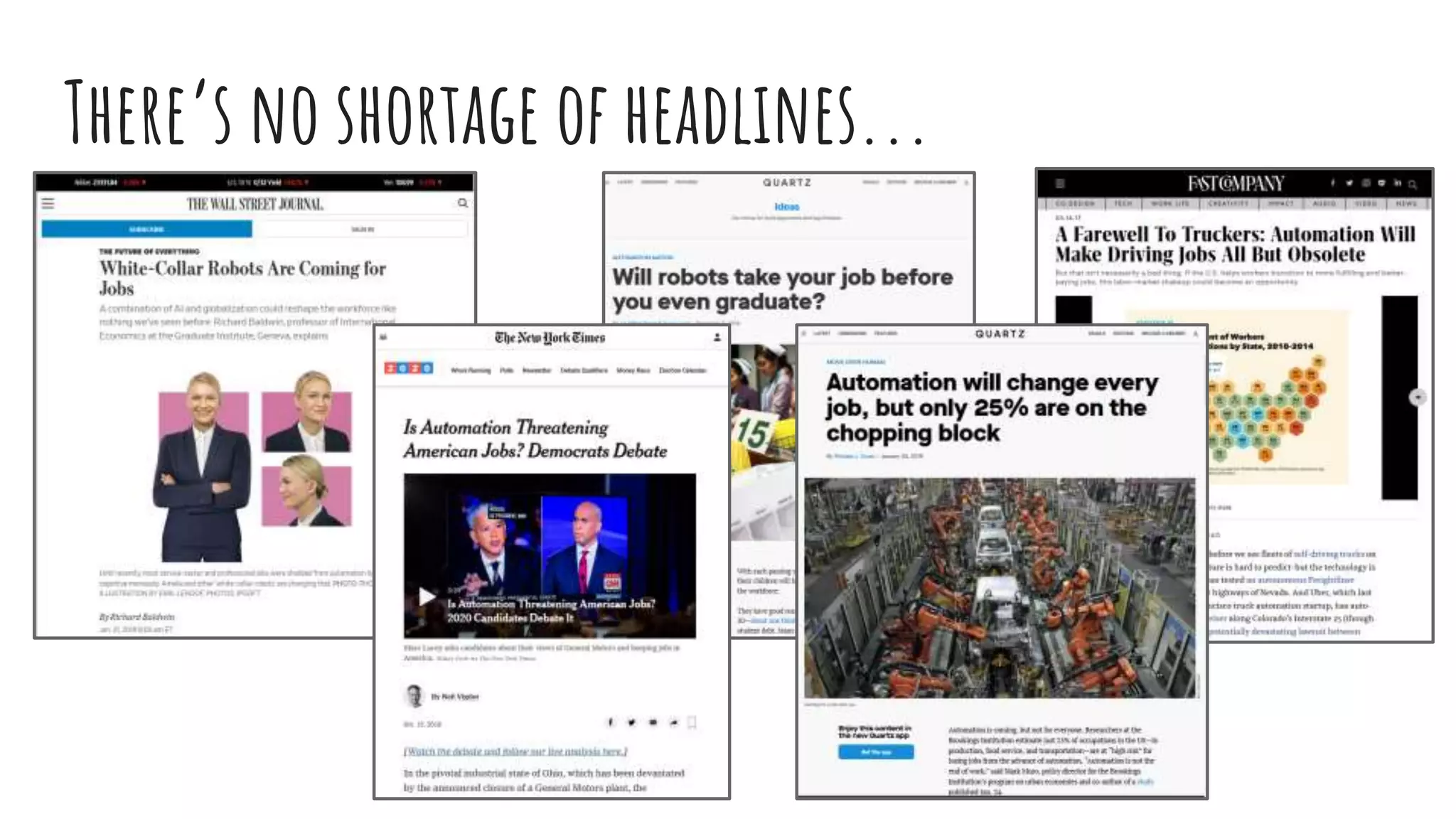
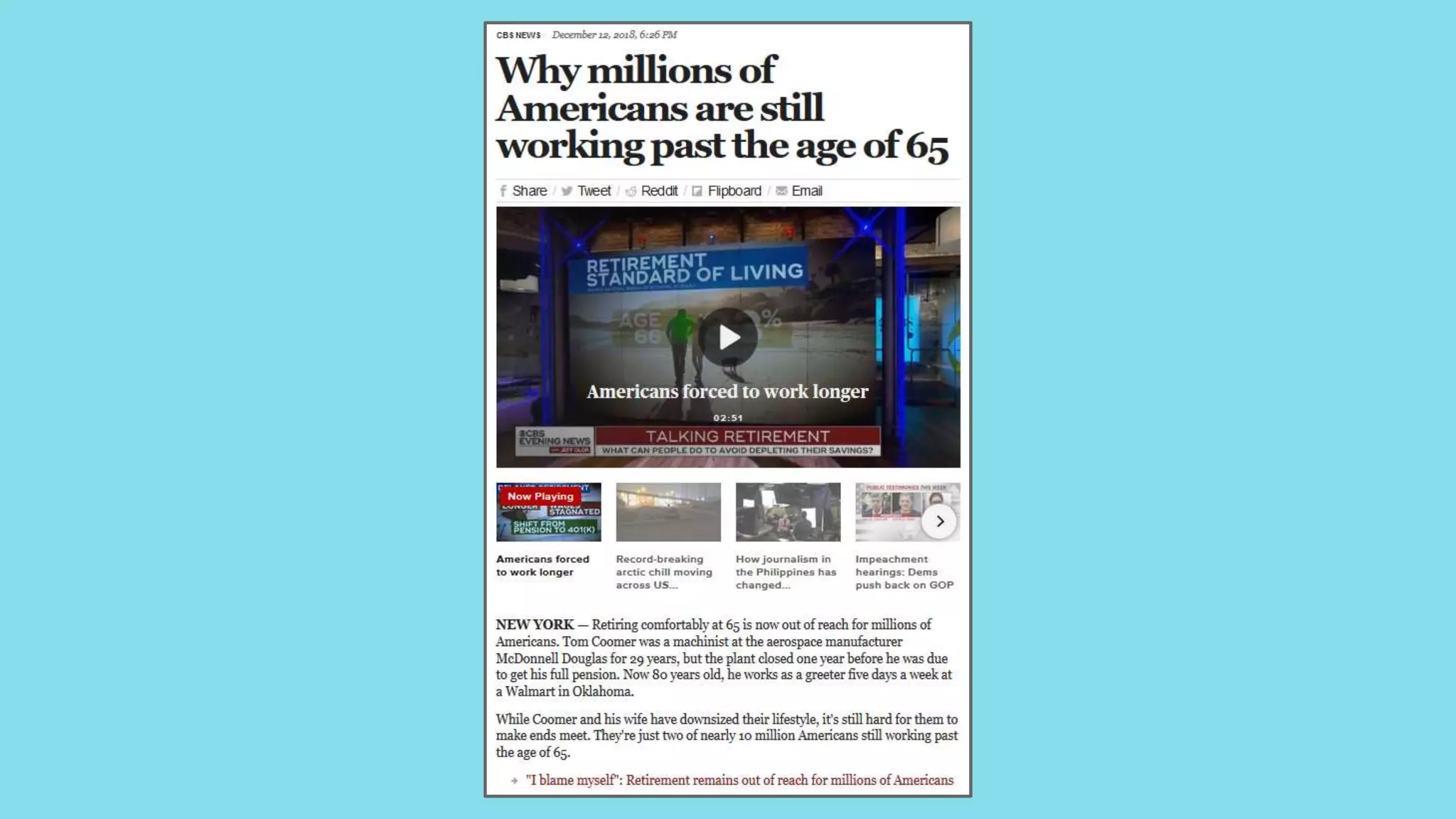
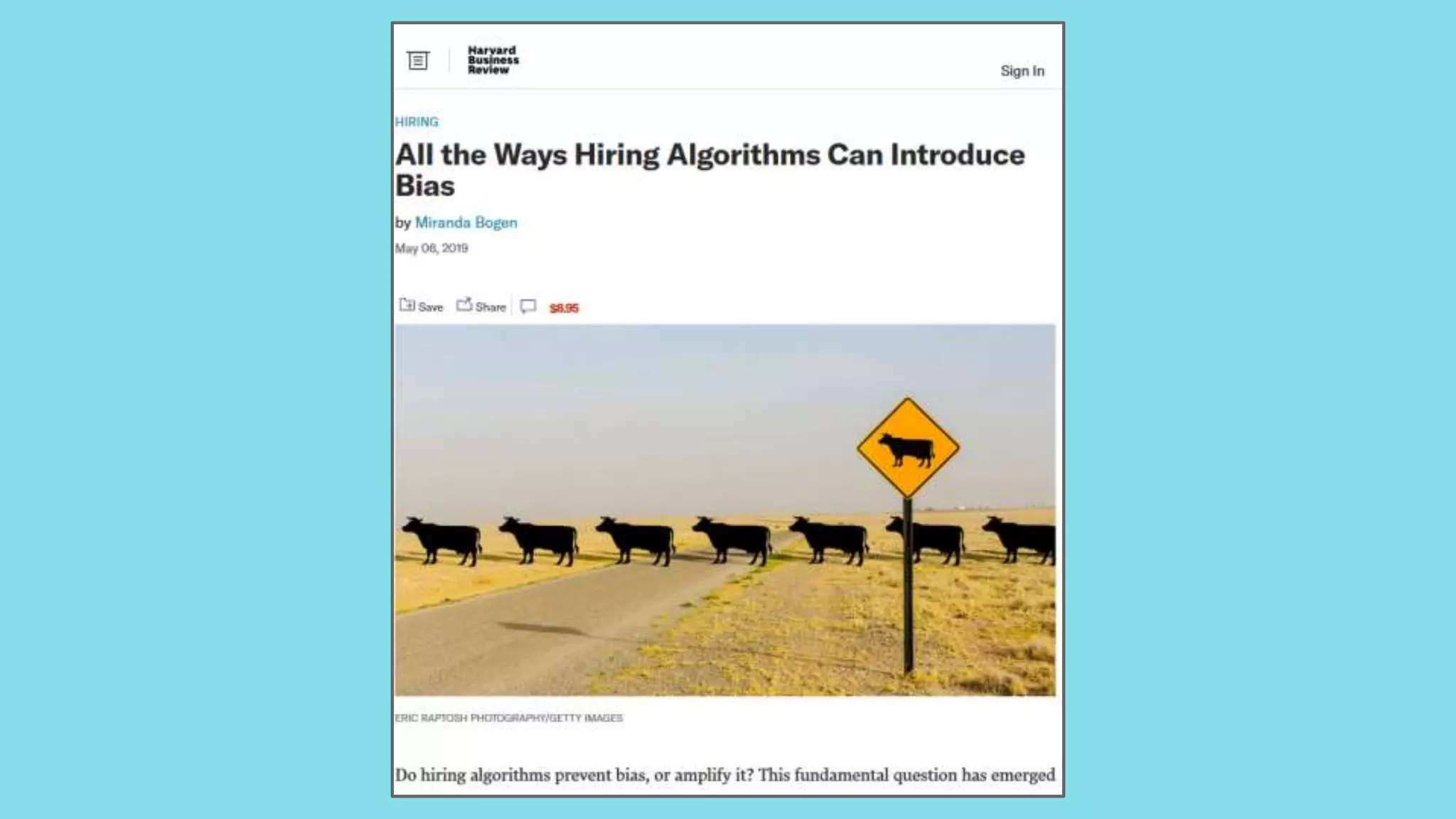
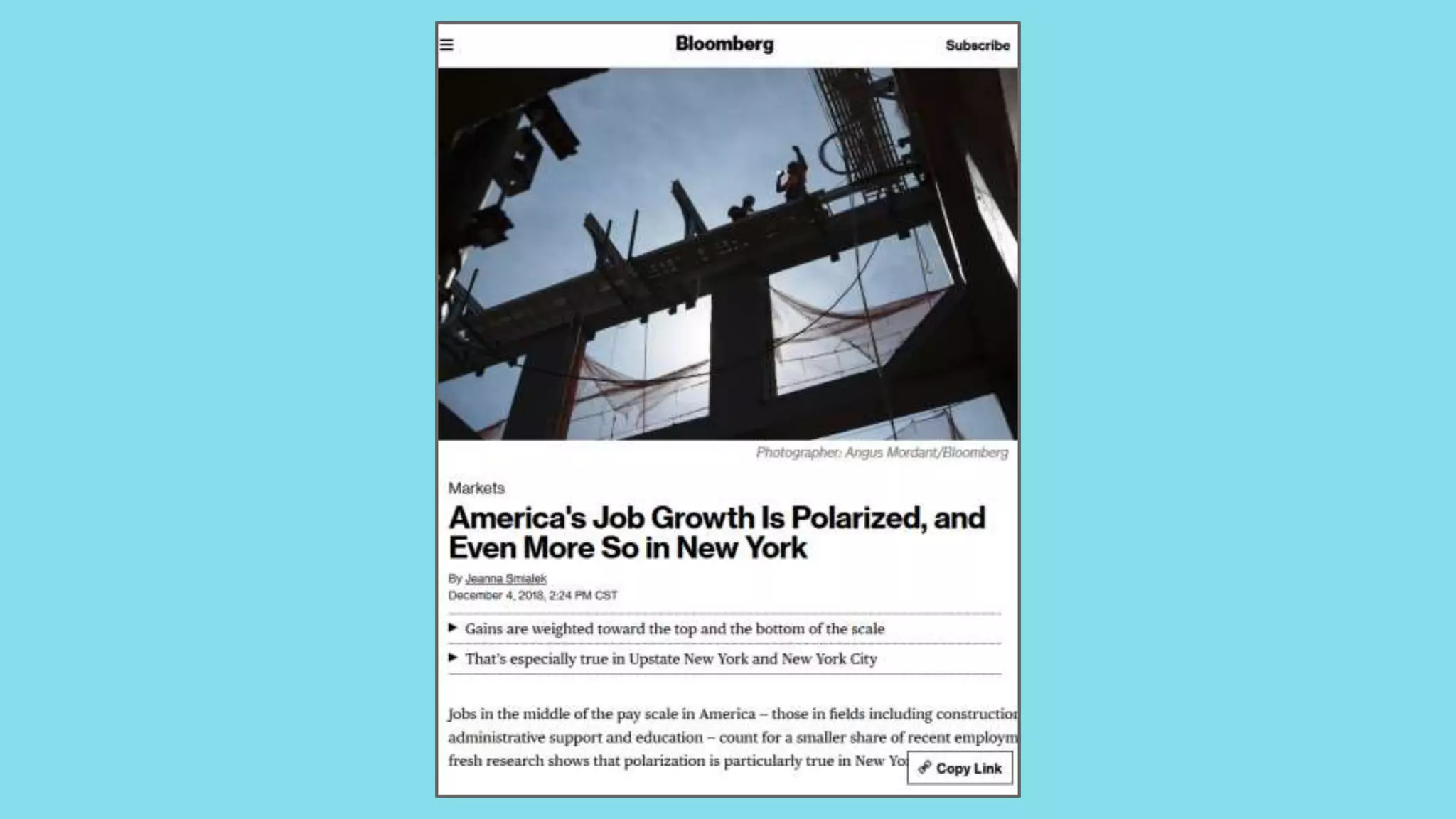
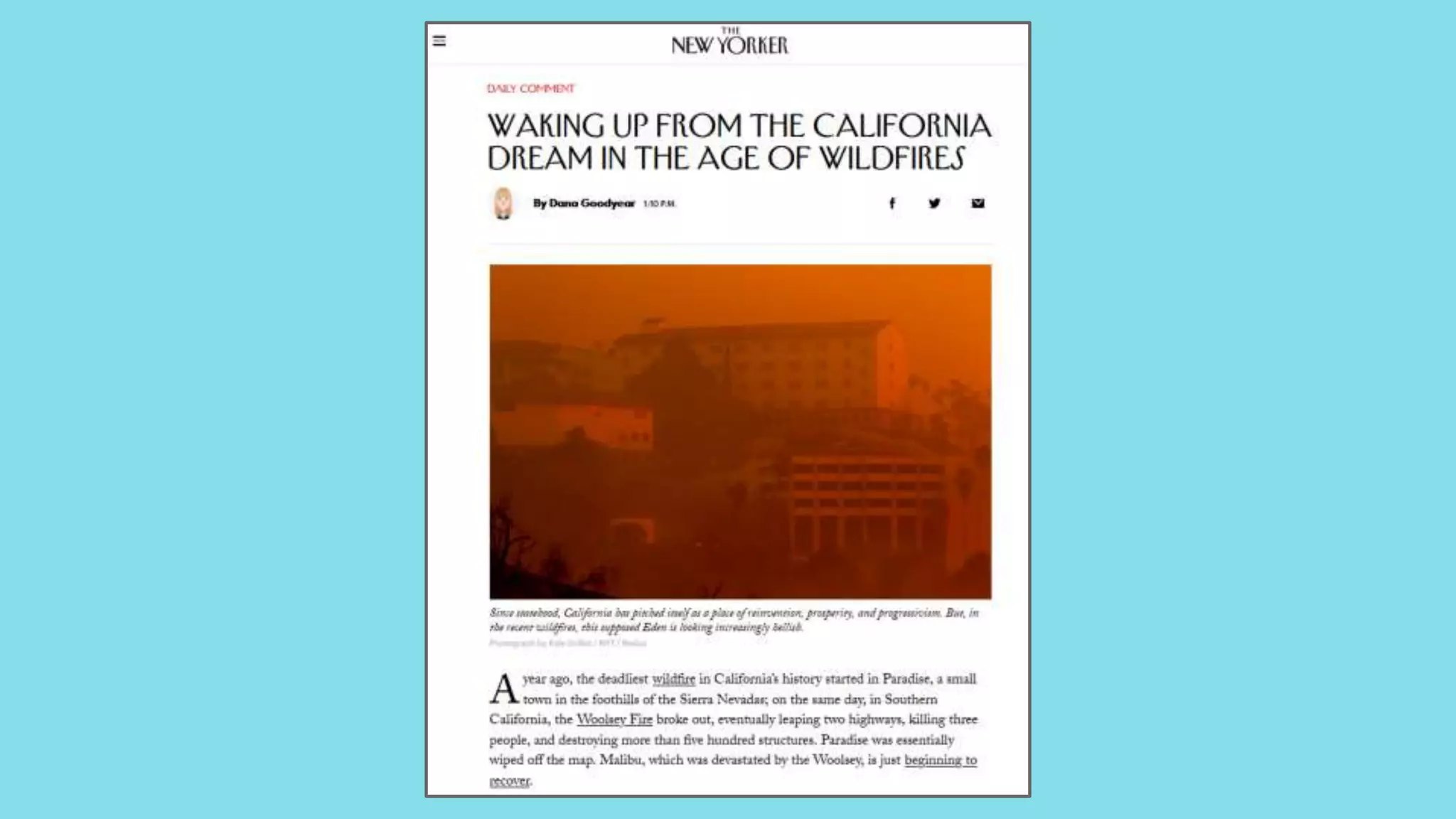
There’s no shortage of headlines...
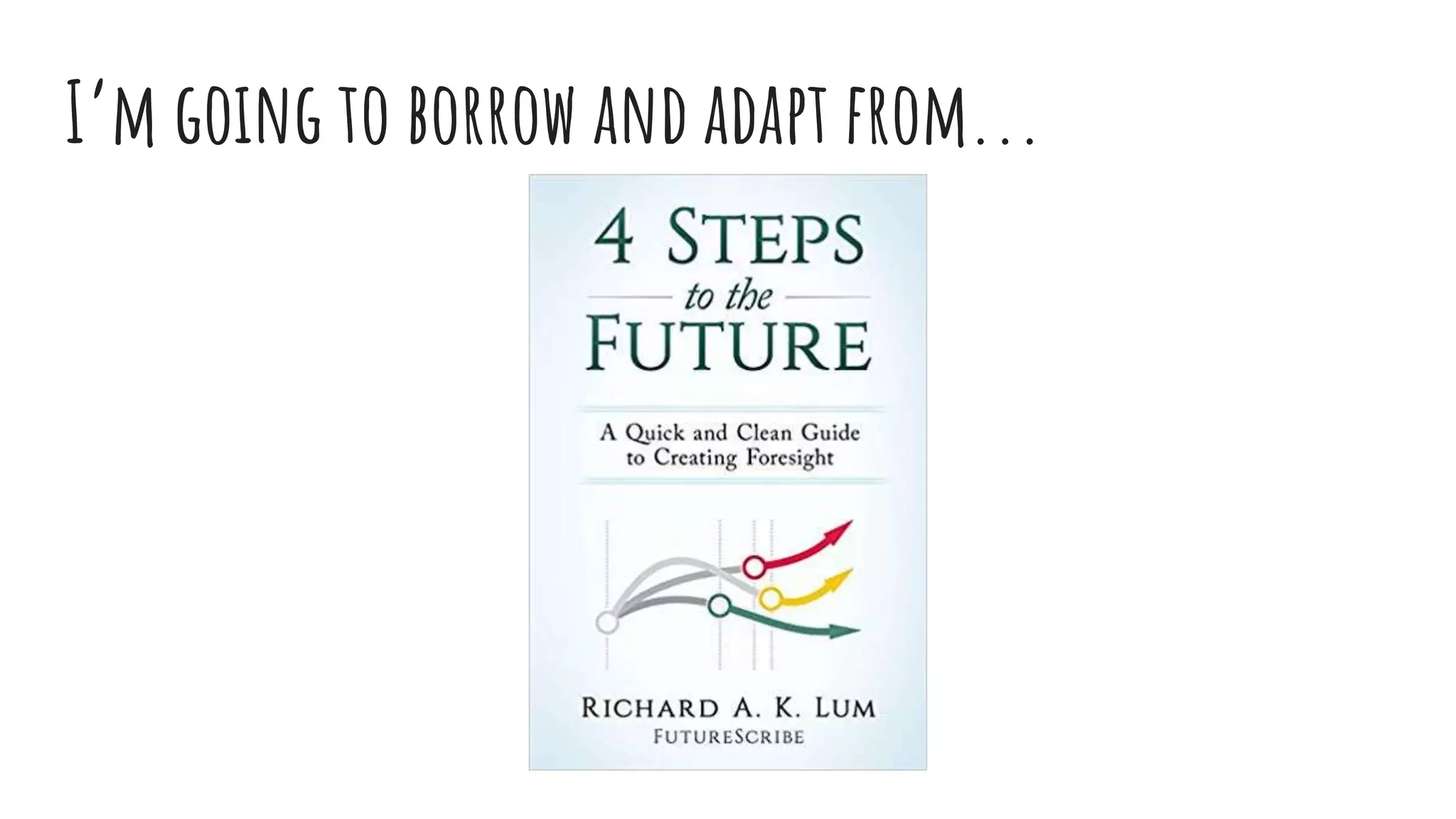
I’m going to borrow and adapt from...
The past
4
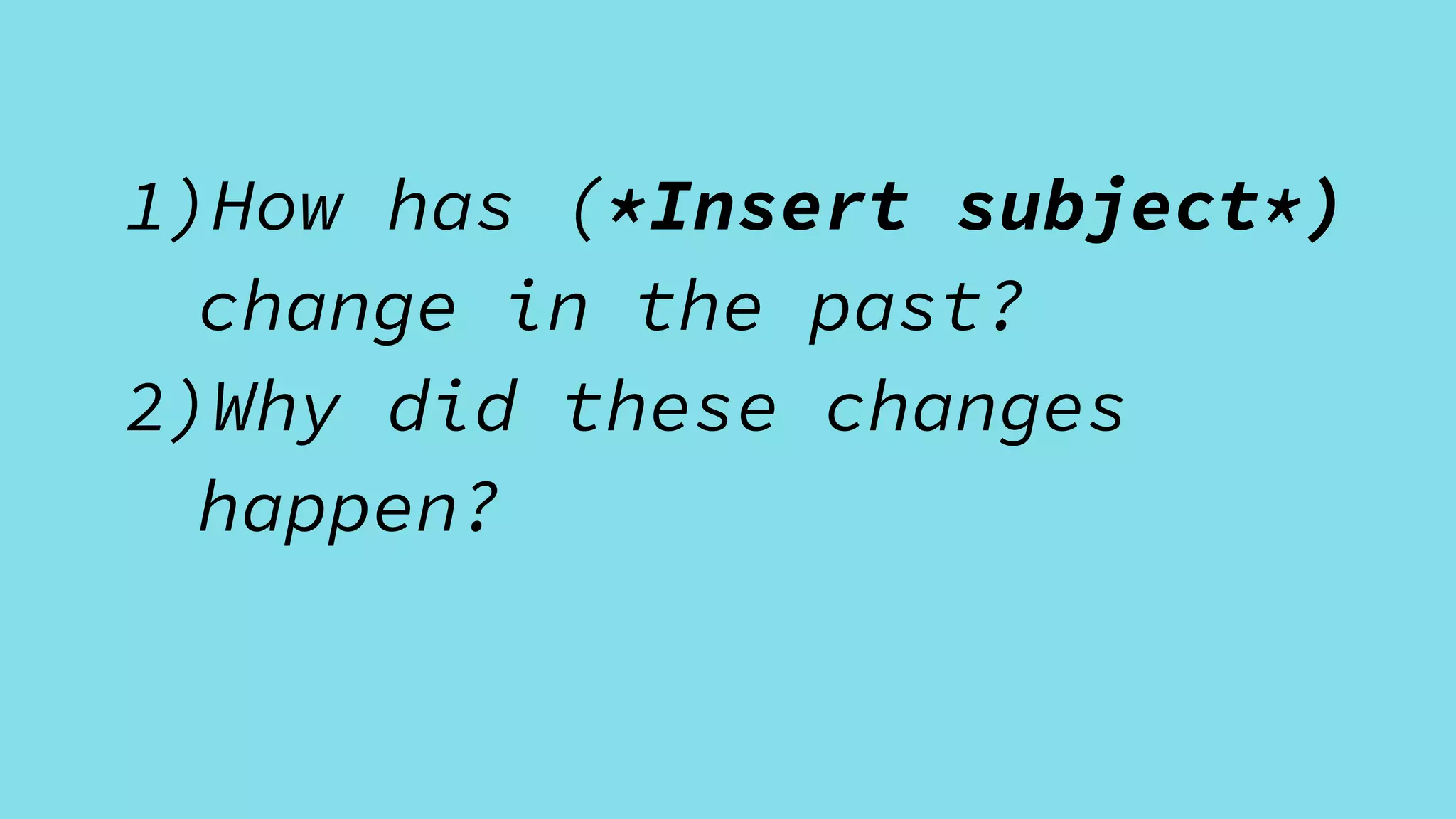
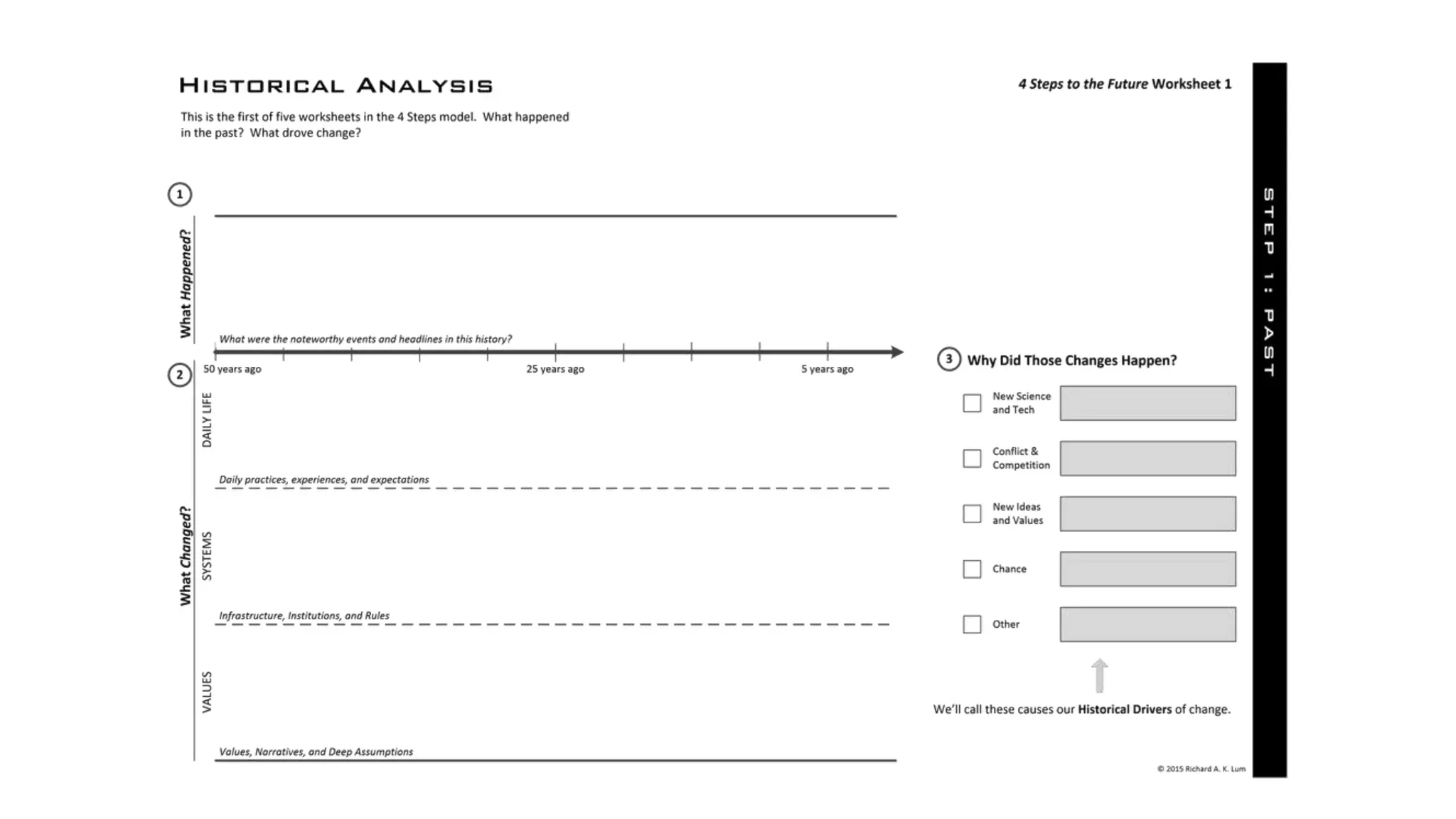
1)How has (*Insert subject*)
change in the past?
2)Why did these changes
happen?
Goal
Recognize patterns, cycles, and chance in
history.
● Technological advances
● Conflict or competition
● New ideas and/or values
● Chance
Reasons for Change
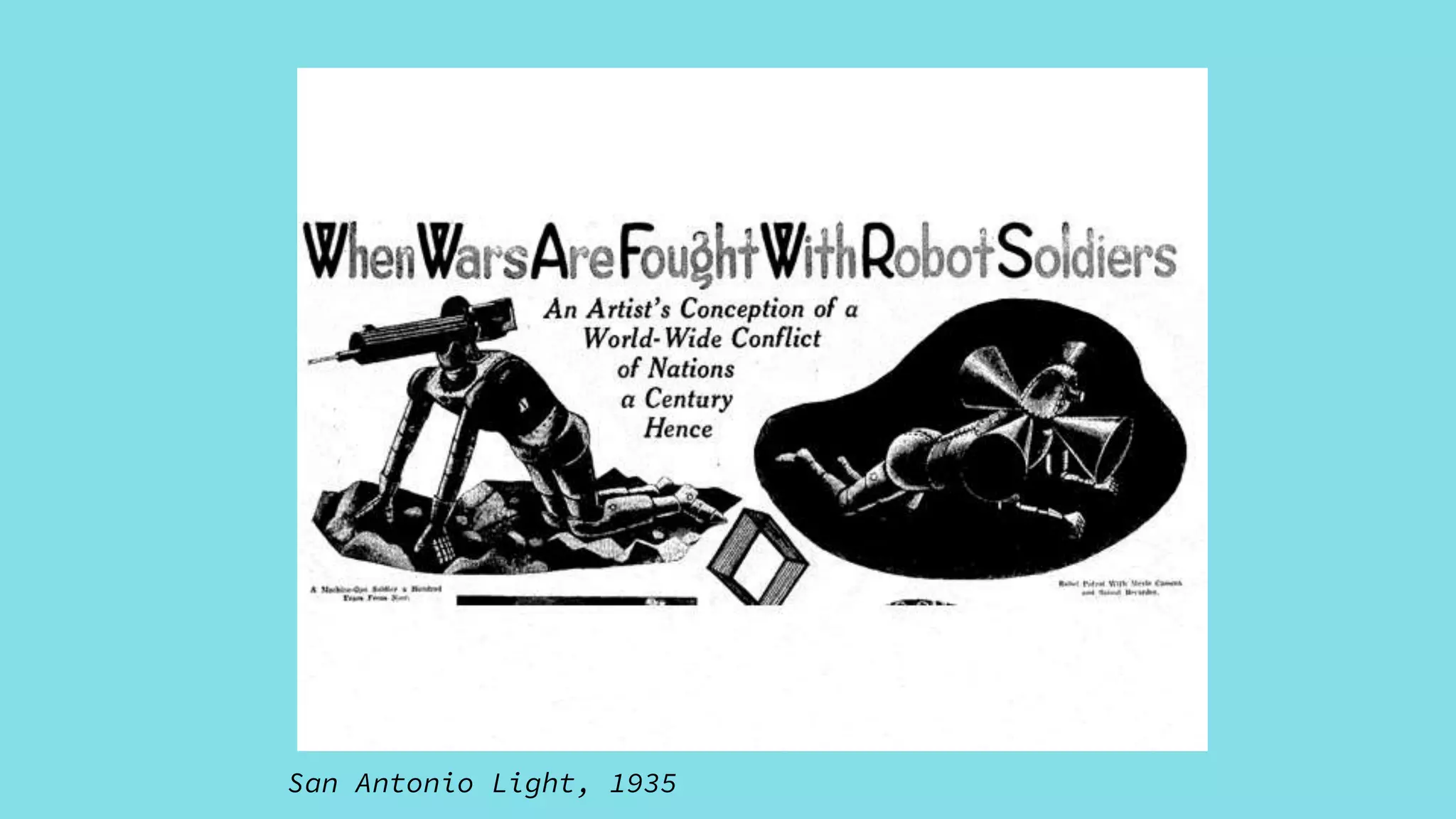
So what is the history of the “Future of
Work?”
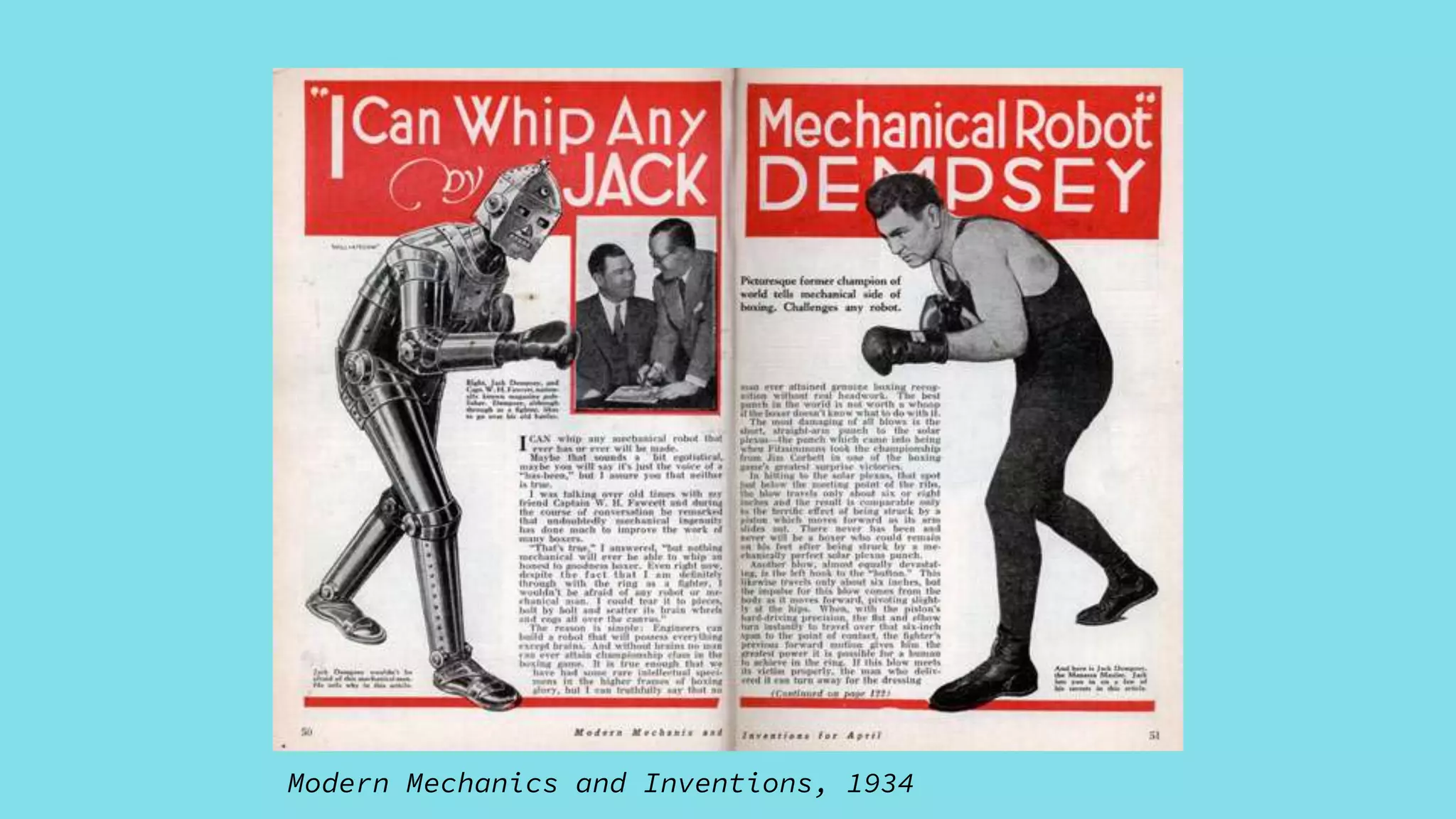
Modern Mechanics and Inventions, 1934
San Antonio Light, 1935
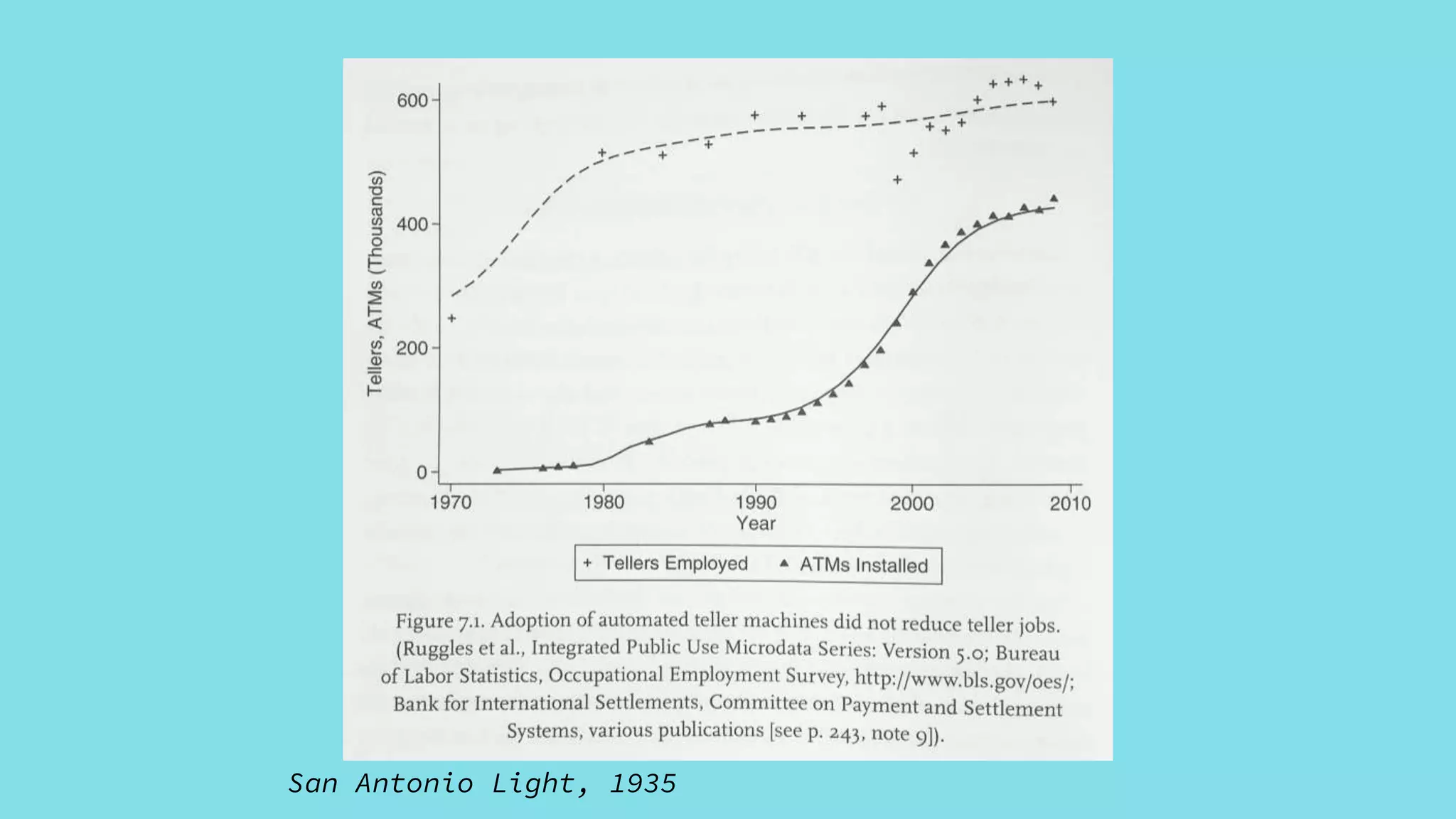
We heard it when people were
wondering how ATMs would take away
work from bank tellers...
San Antonio Light, 1935
In 1870, almost 50% of the U.S.
population was employed in
agriculture. As of 2008, less than
2% of the population is directly
employed in agriculture.
The Present
5
1)Which of these historical
drivers are at work again today?
2)What new sources of change do
you think are detecting?
3)What things might slow or even
prevent change today?
Goal
Looking for historical forces at work, new
changes and forces against change.
“The future is already here— It's just not
very evenly distributed.”
-William Gibson
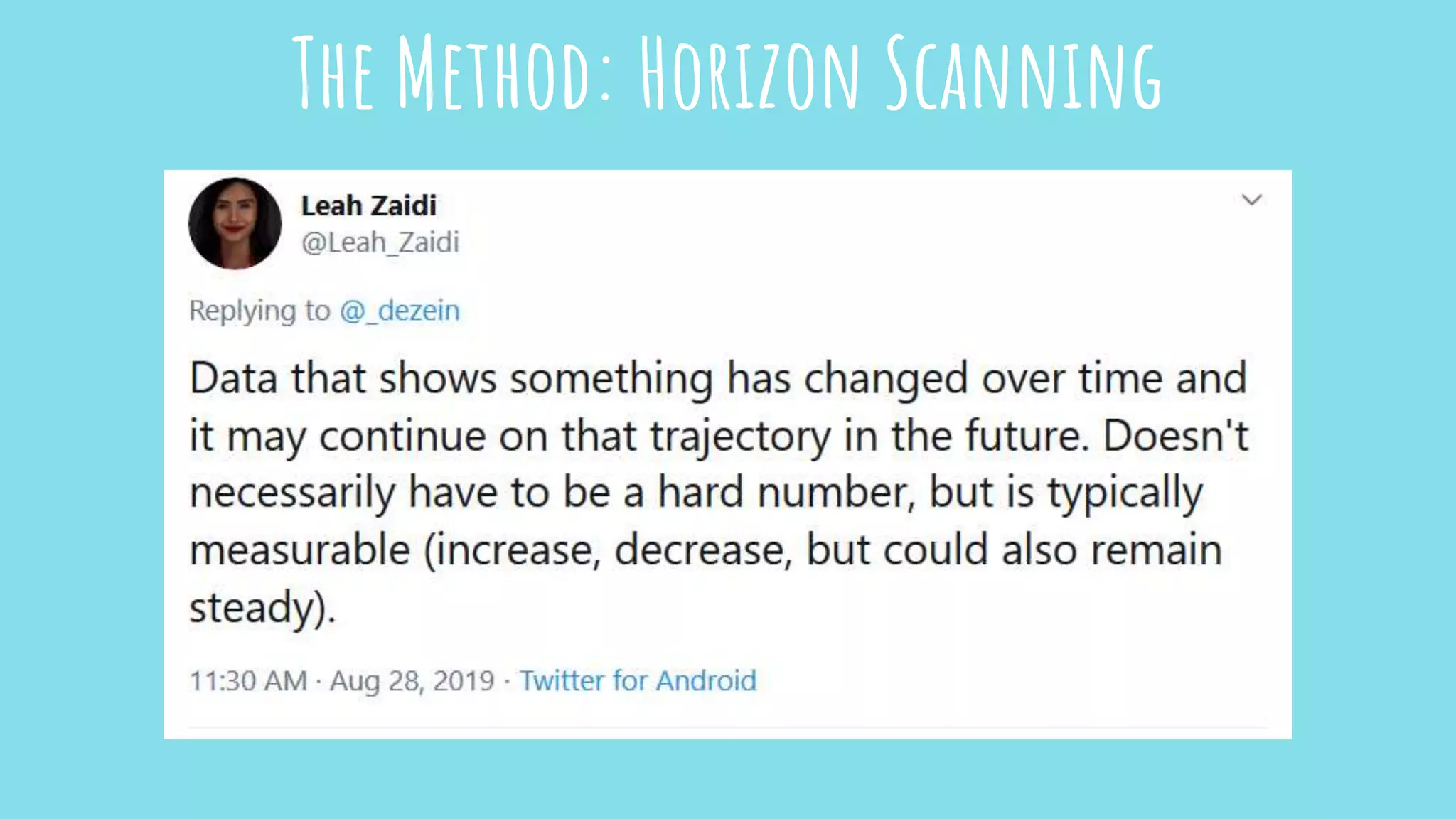
Looking to identify tangible, specific
evidence of change.
You should be exploring a variety of
sources — alternative press, art, journals,
statistics.
There is an understanding that these things
might impact the course of the future.
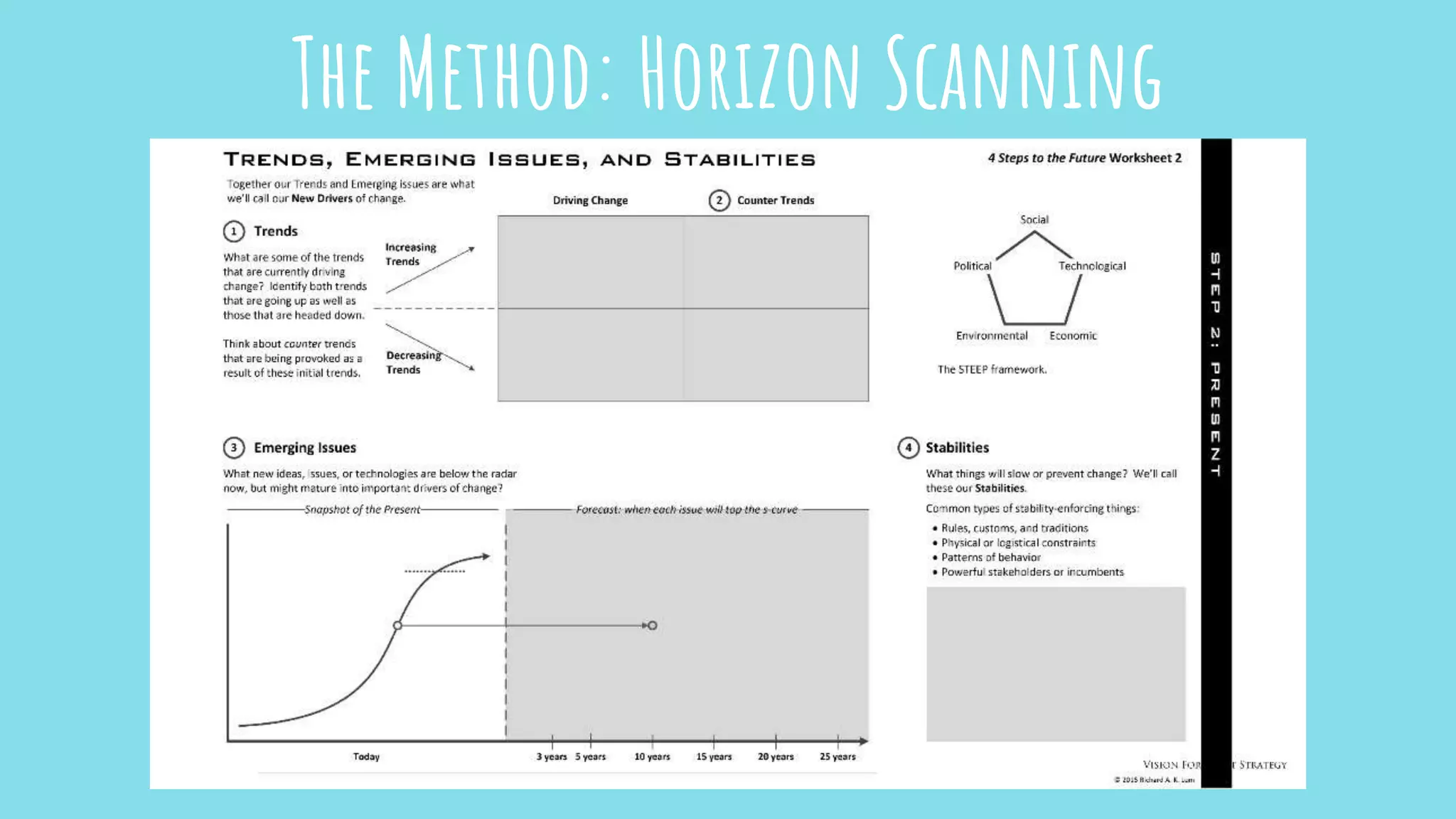
The Method: Horizon Scanning
Looking for:
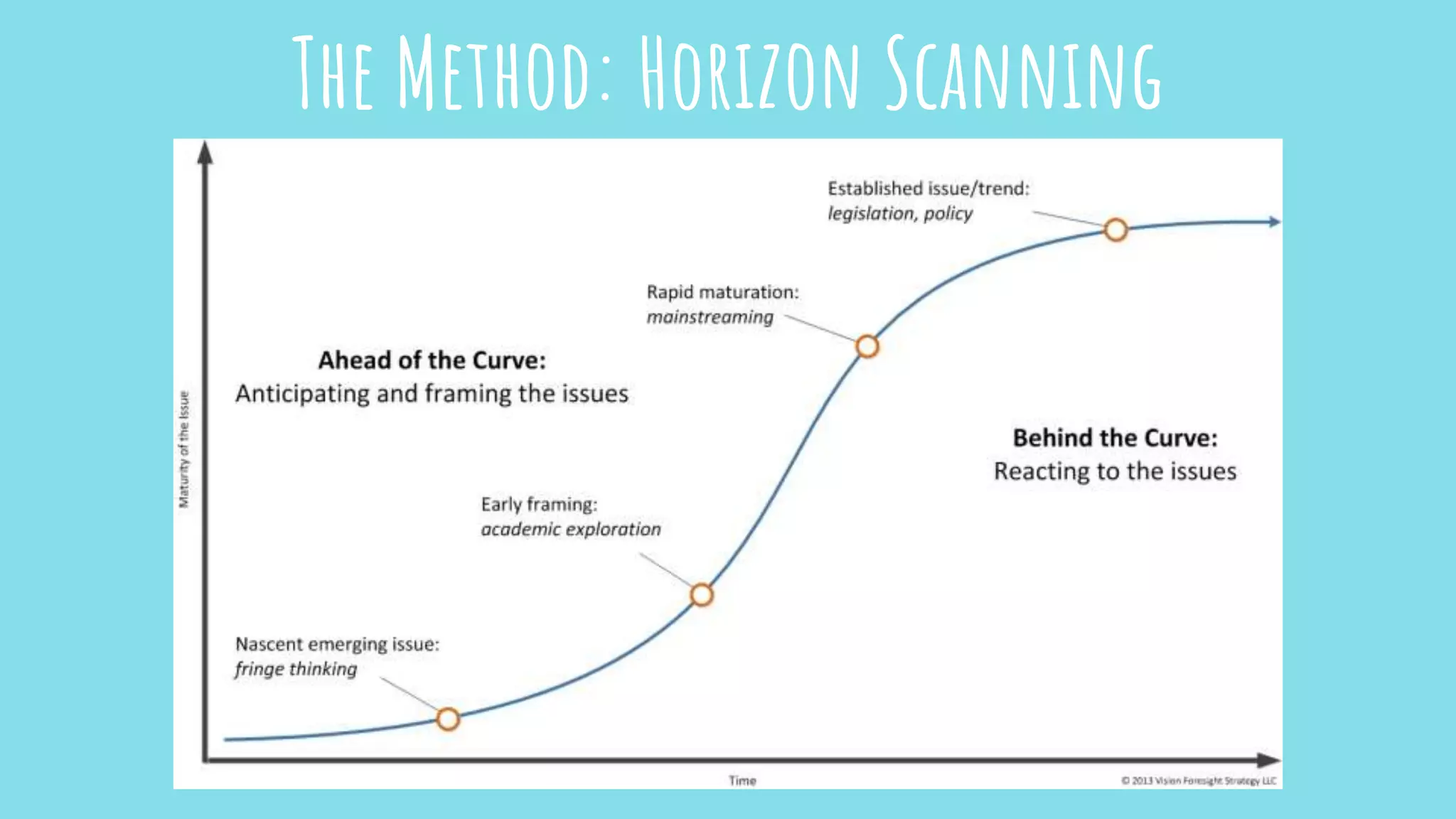
1)Weak Signals - small innovation that can
scale — an indicator of change
2)Emerging issues - some change
characterized by medium-level of
awareness.
3)Trends - a pattern of change that is
well known. It implies what the future
could look like if all else being equal.
The Method: Horizon Scanning
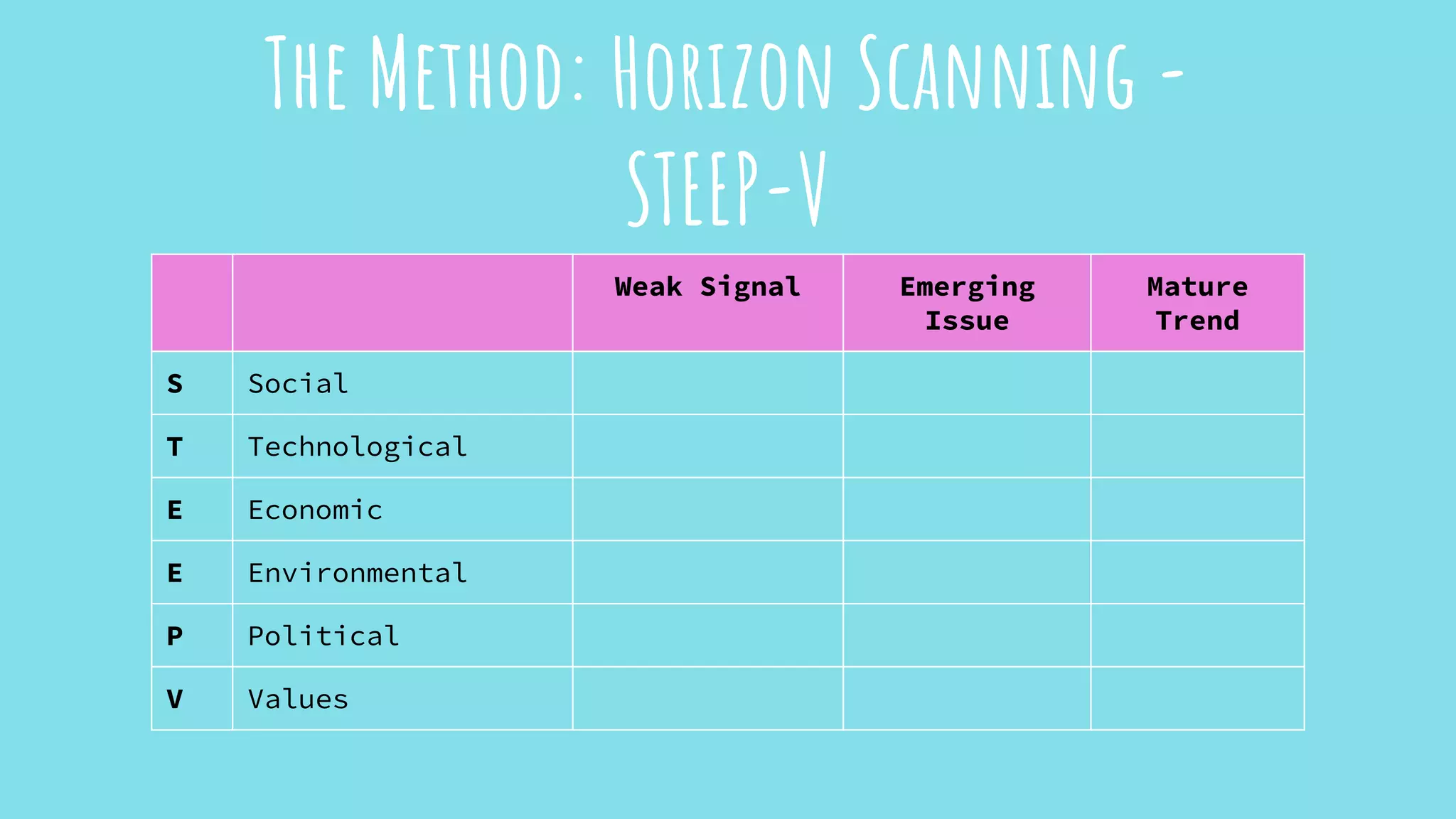
The Method: Horizon Scanning -
STEEP-V
Weak Signal Emerging
Issue
Mature
Trend
S Social
T Technological
E Economic
E Environmental
P Political
V Values
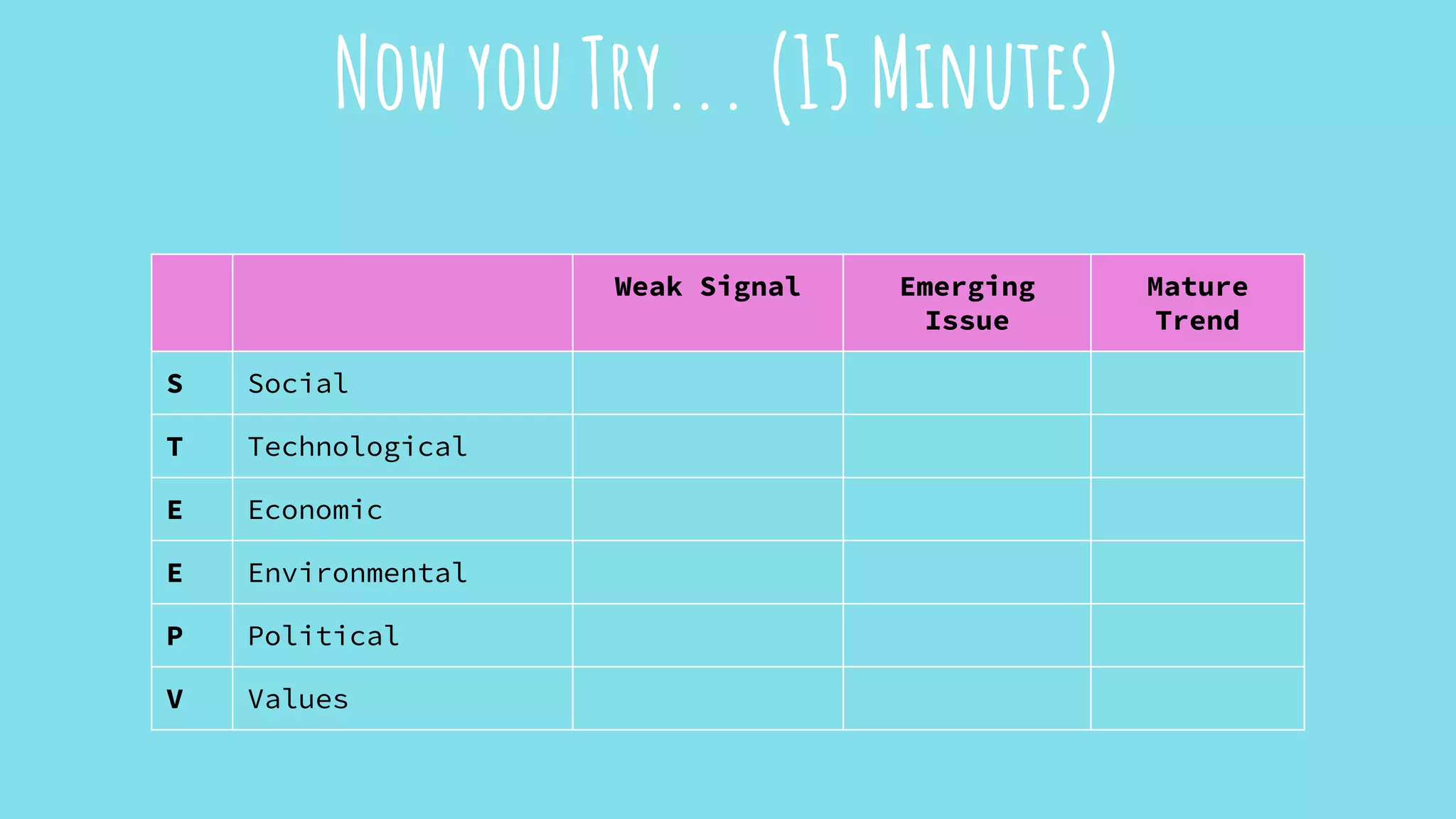
Now you Try... (15 Minutes)
Weak Signal Emerging
Issue
Mature
Trend
S Social
T Technological
E Economic
E Environmental
P Political
V Values
Now you try...
1)In groups of 5-6, think of
some trends that would impact
the future of work using
STEEP-V.
2)We’ll share at the end...
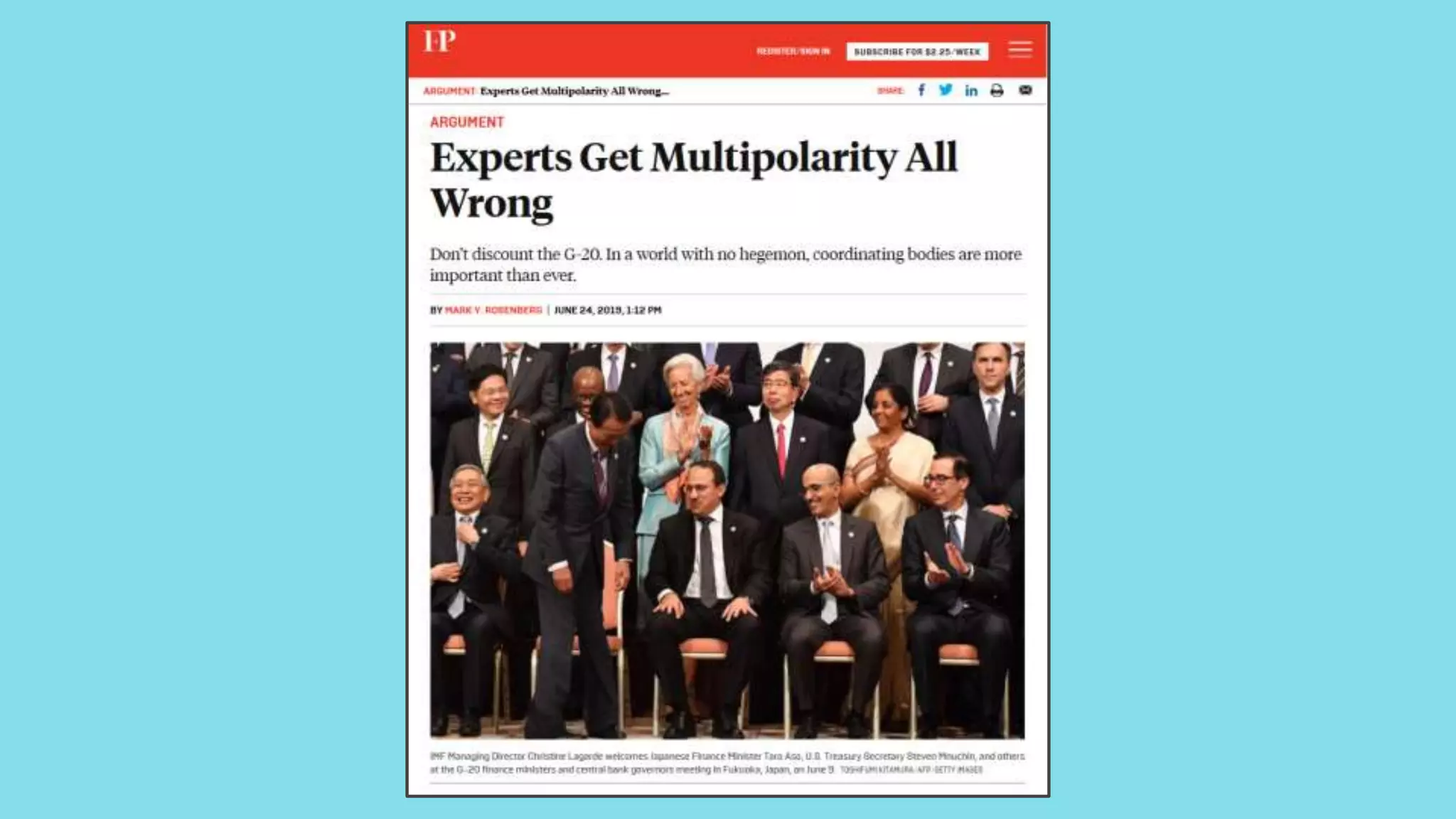
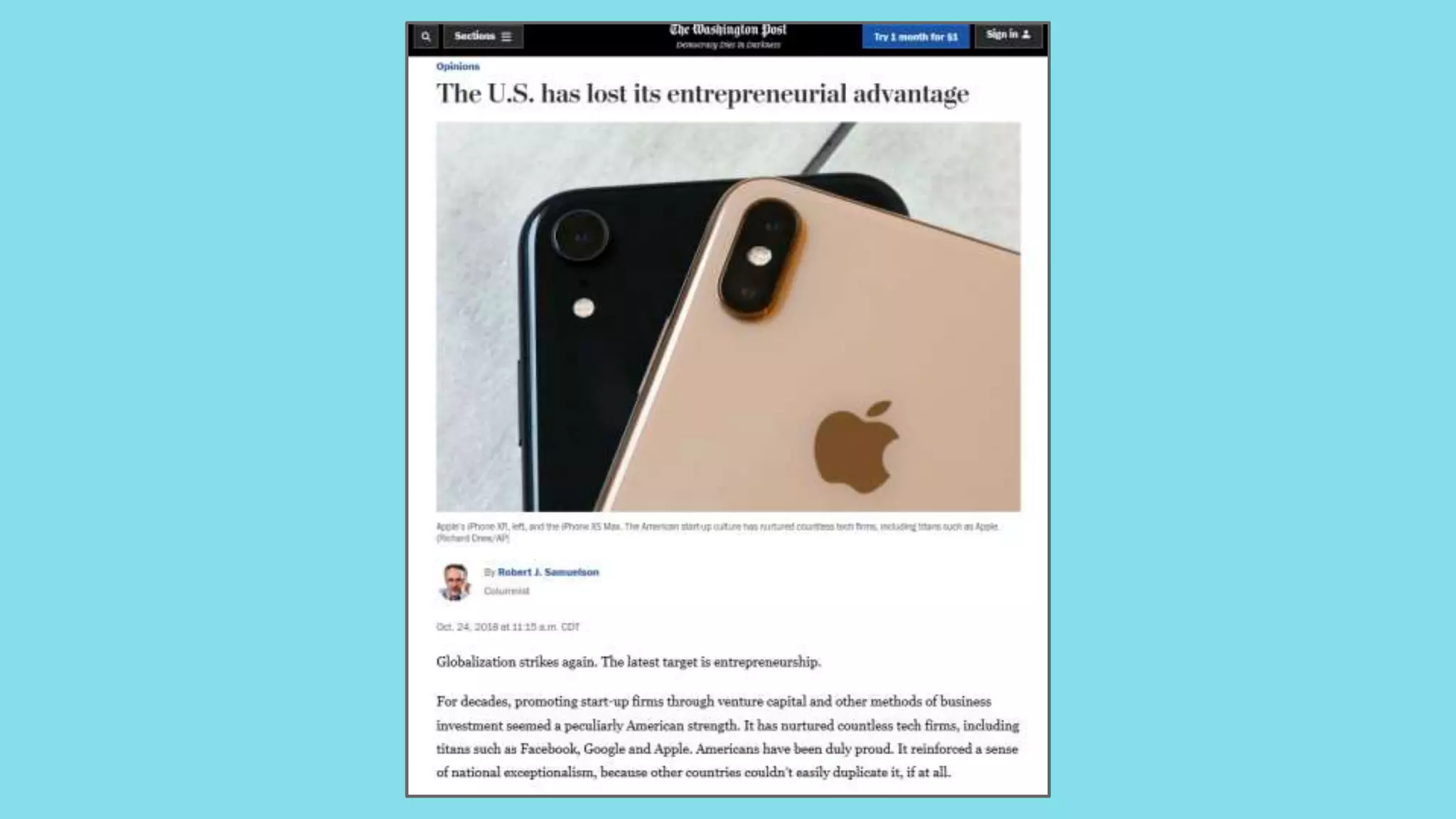
These are all uncertainties for the future.
The Future
6
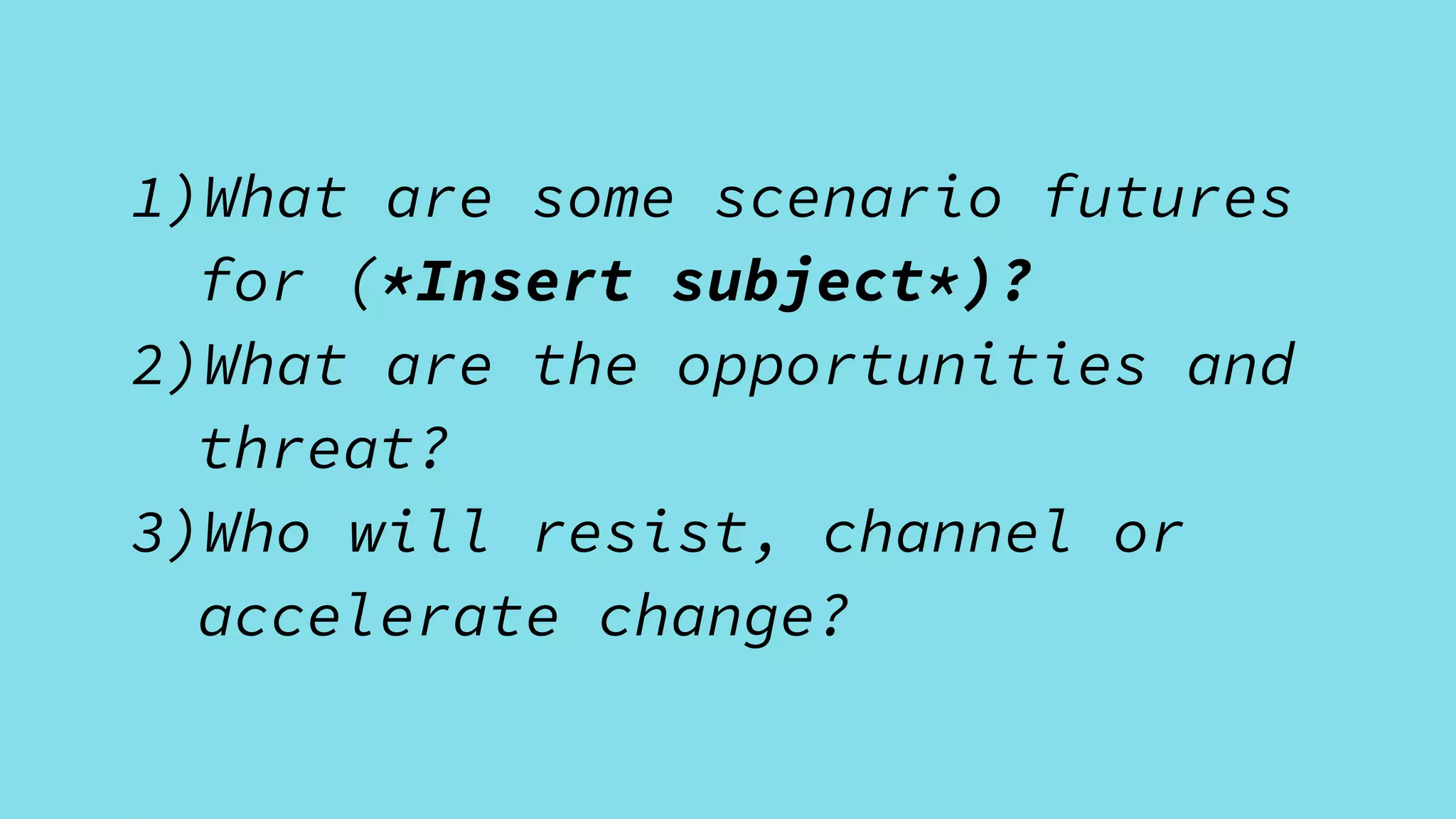
1)What are some scenario futures
for (*Insert subject*)?
2)What are the opportunities and
threat?
3)Who will resist, channel or
accelerate change?
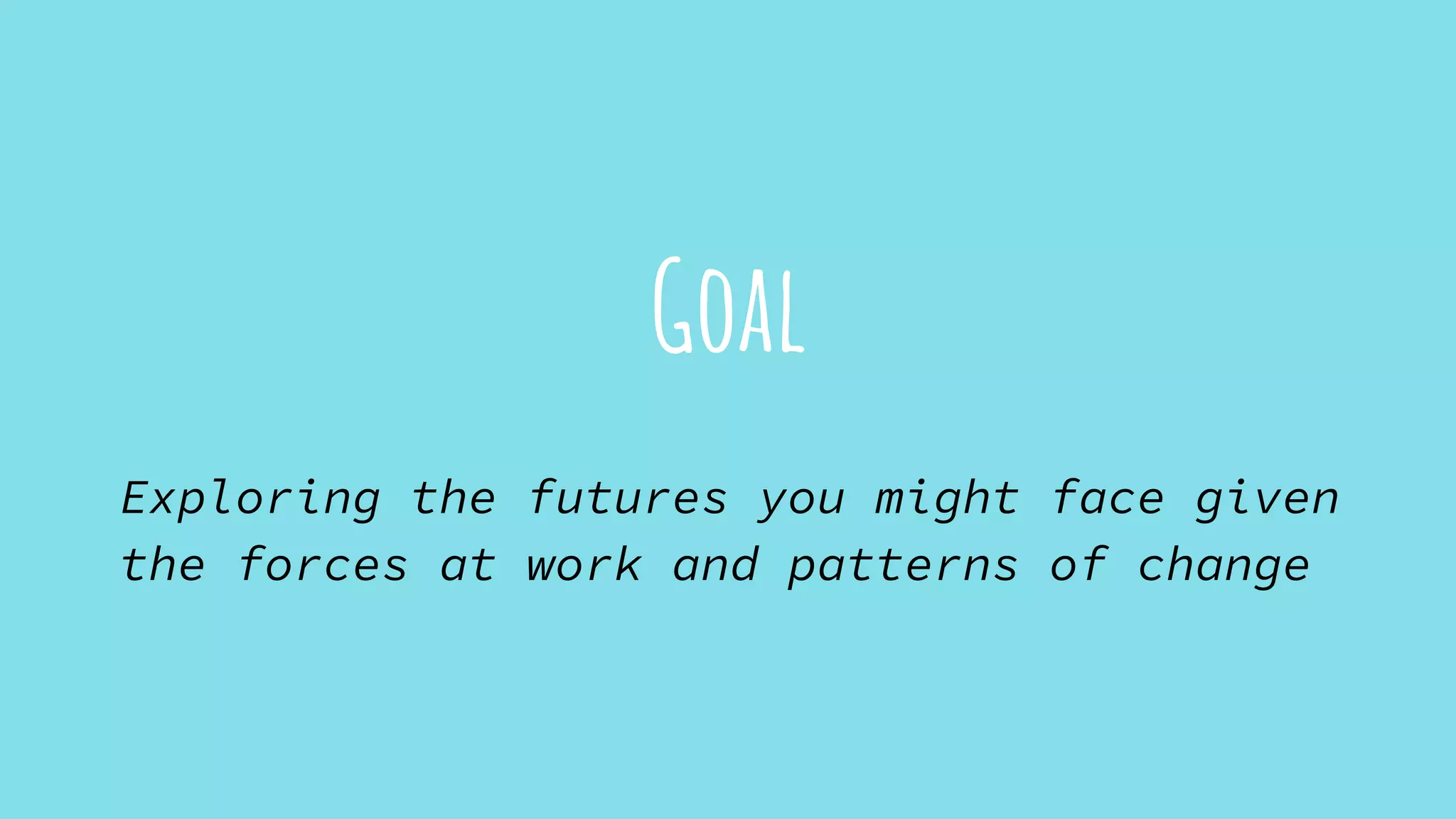
Goal
Exploring the futures you might face given
the forces at work and patterns of change
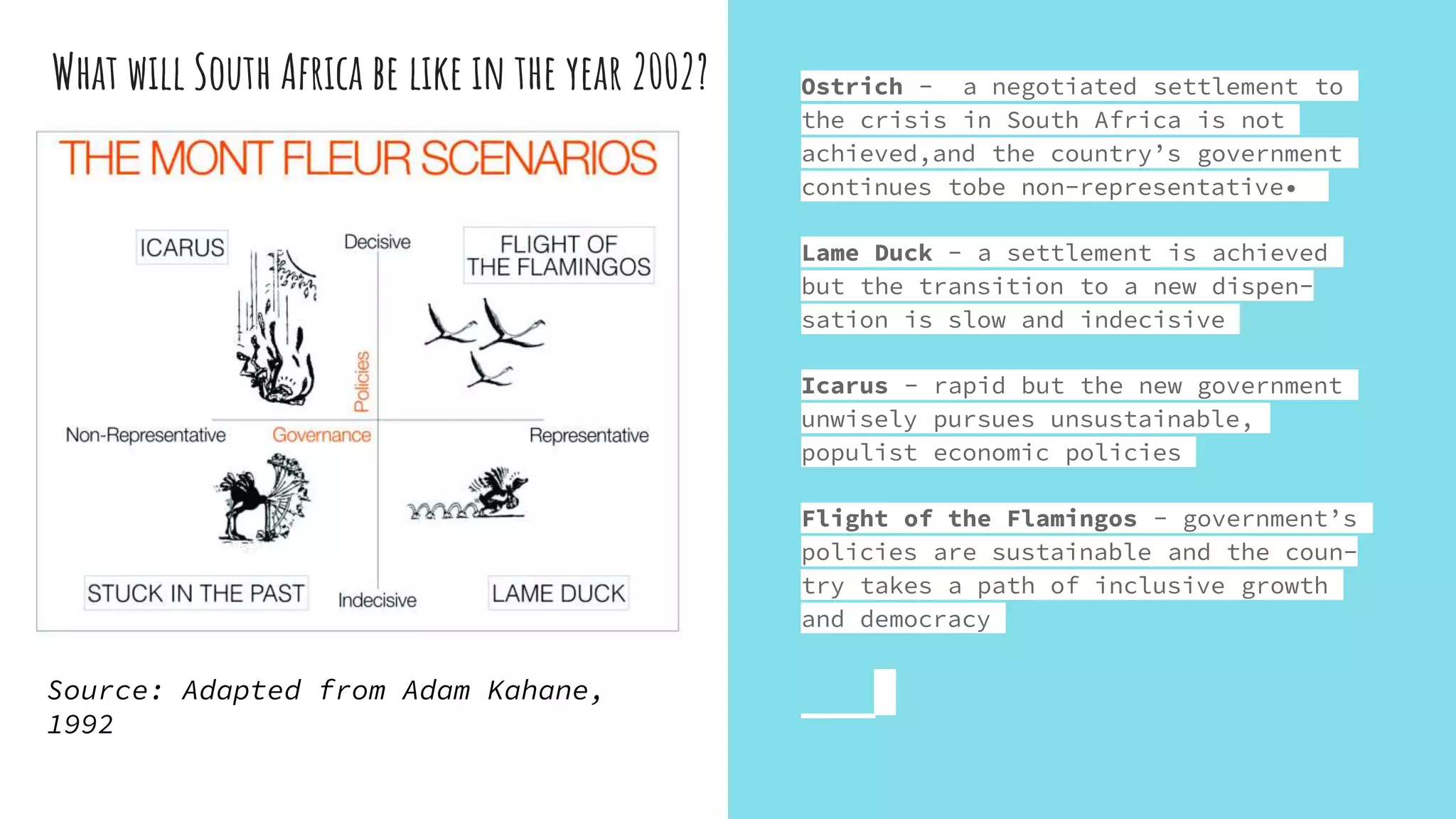
Ostrich - a negotiated settlement to
the crisis in South Africa is not
achieved,and the country’s government
continues tobe non-representative•
Lame Duck - a settlement is achieved
but the transition to a new dispen-
sation is slow and indecisive
Icarus - rapid but the new government
unwisely pursues unsustainable,
populist economic policies
Flight of the Flamingos - government’s
policies are sustainable and the coun-
try takes a path of inclusive growth
and democracy
What will South Africa be like in the year 2002?
Source: Adapted from Adam Kahane,
1992
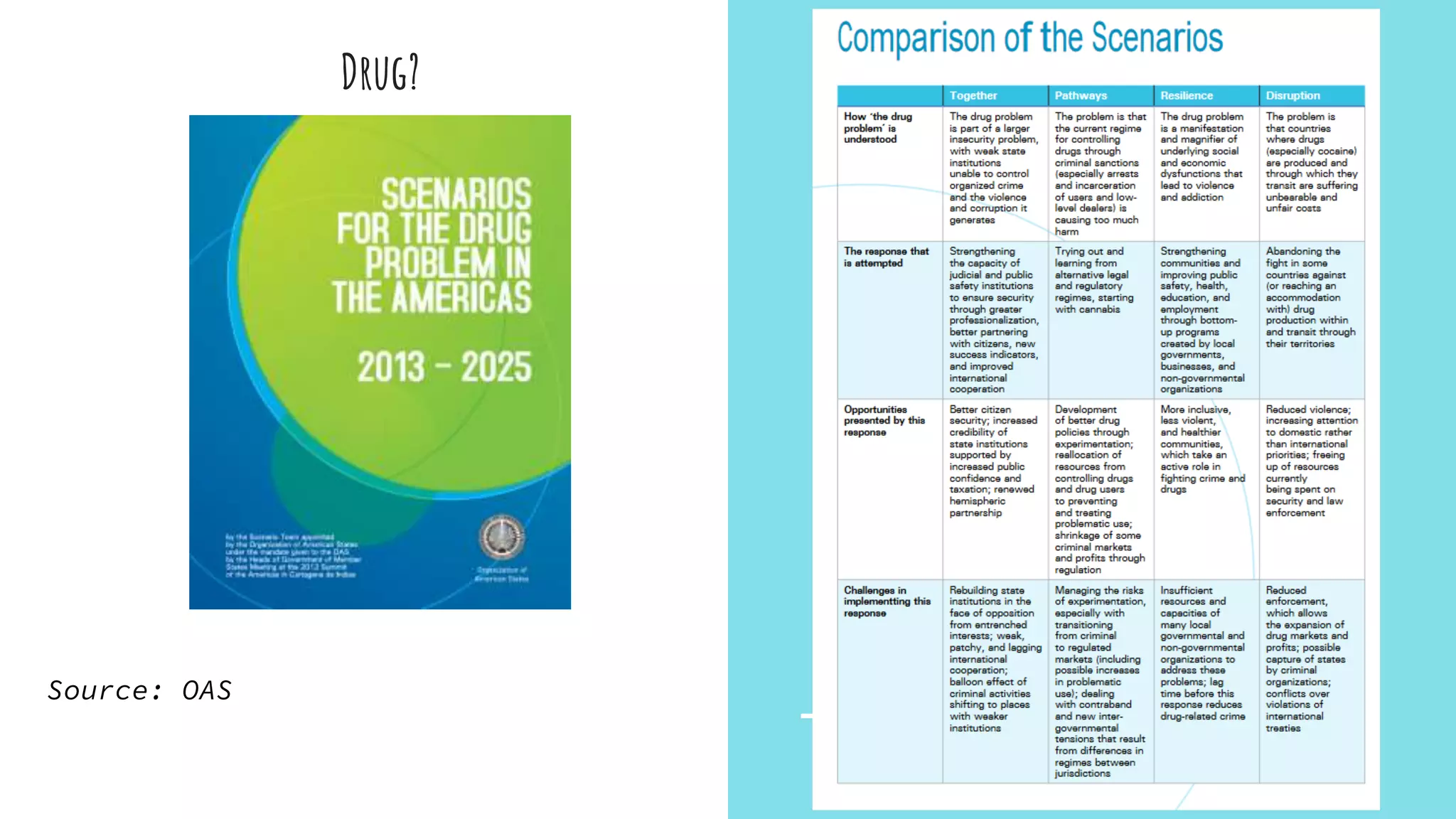
Drug?
Source: OAS
The Method: Scenarios
A method for exploring possible
futures and paint a story of
what could be based on the weak
signals, emerging issues and
trends we have.
This is a way to help us
navigate an uncertain future.
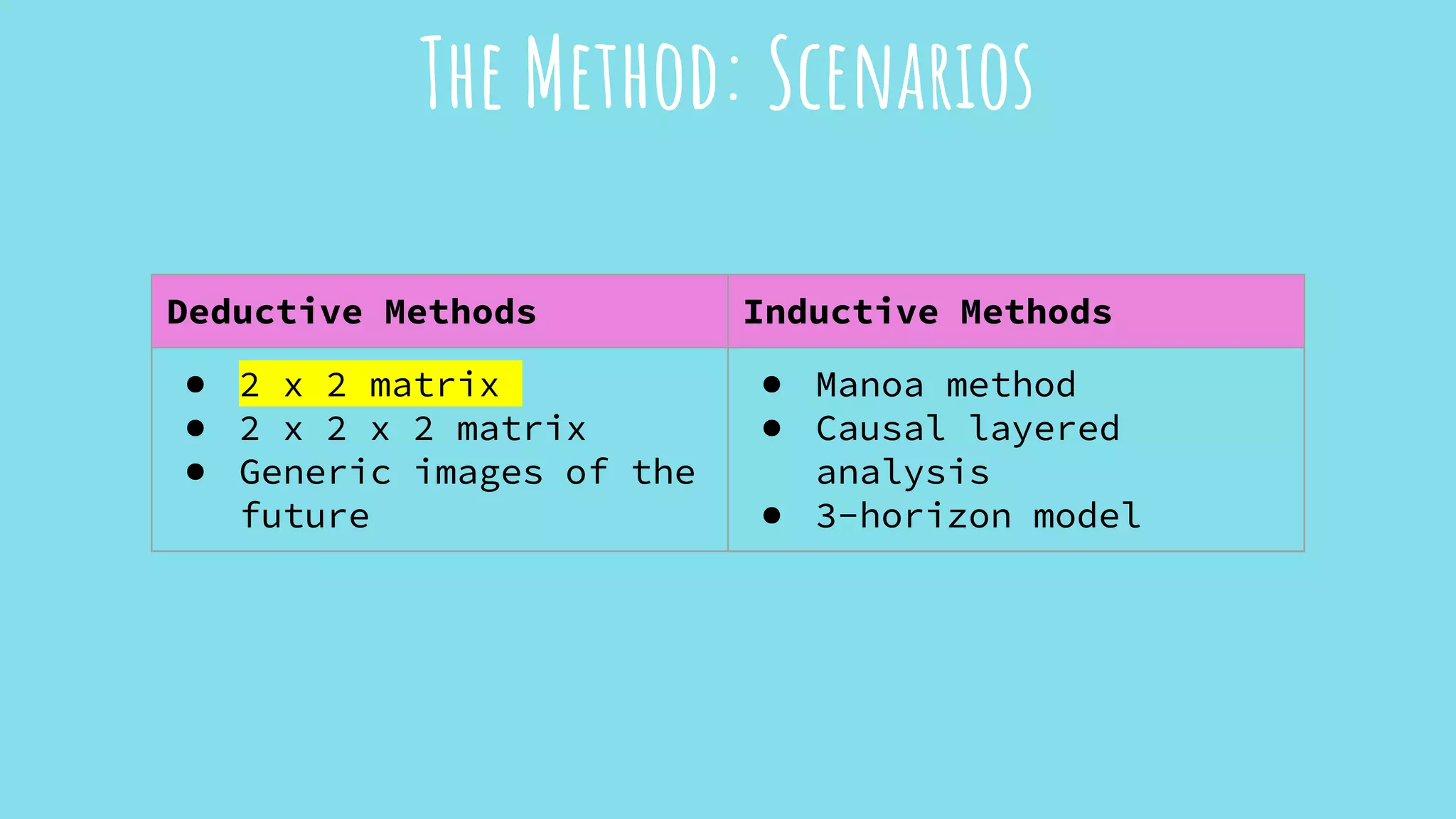
The Method: Scenarios
Deductive Methods Inductive Methods
● 2 x 2 matrix
● 2 x 2 x 2 matrix
● Generic images of the
future
● Manoa method
● Causal layered
analysis
● 3-horizon model
Deductive Methods Inductive Methods
● 2 x 2 matrix
● 2 x 2 x 2 matrix
● Generic images of the
future
● Manoa method
● Causal layered
analysis
● 3-horizon model
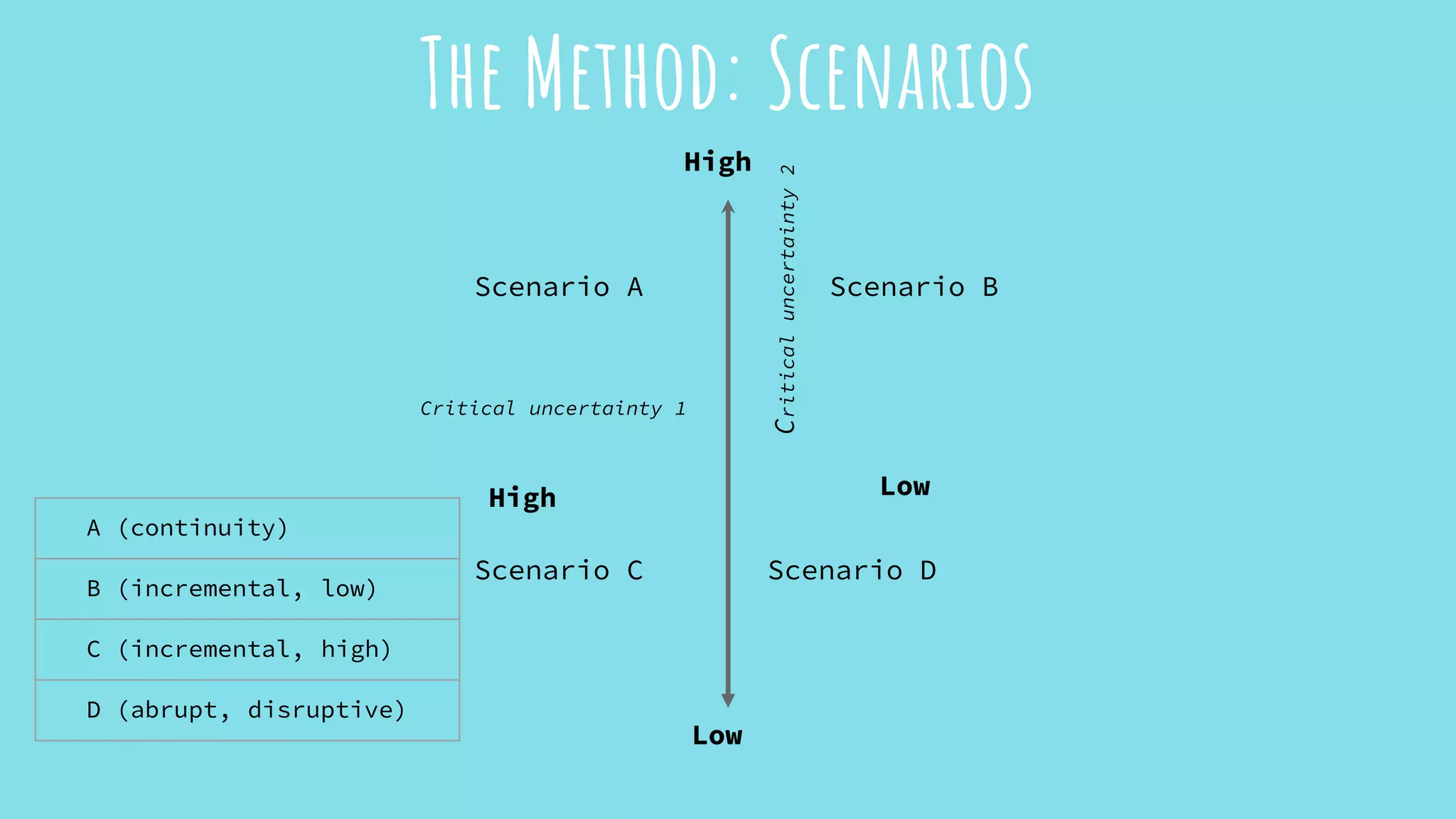
The Method: Scenarios
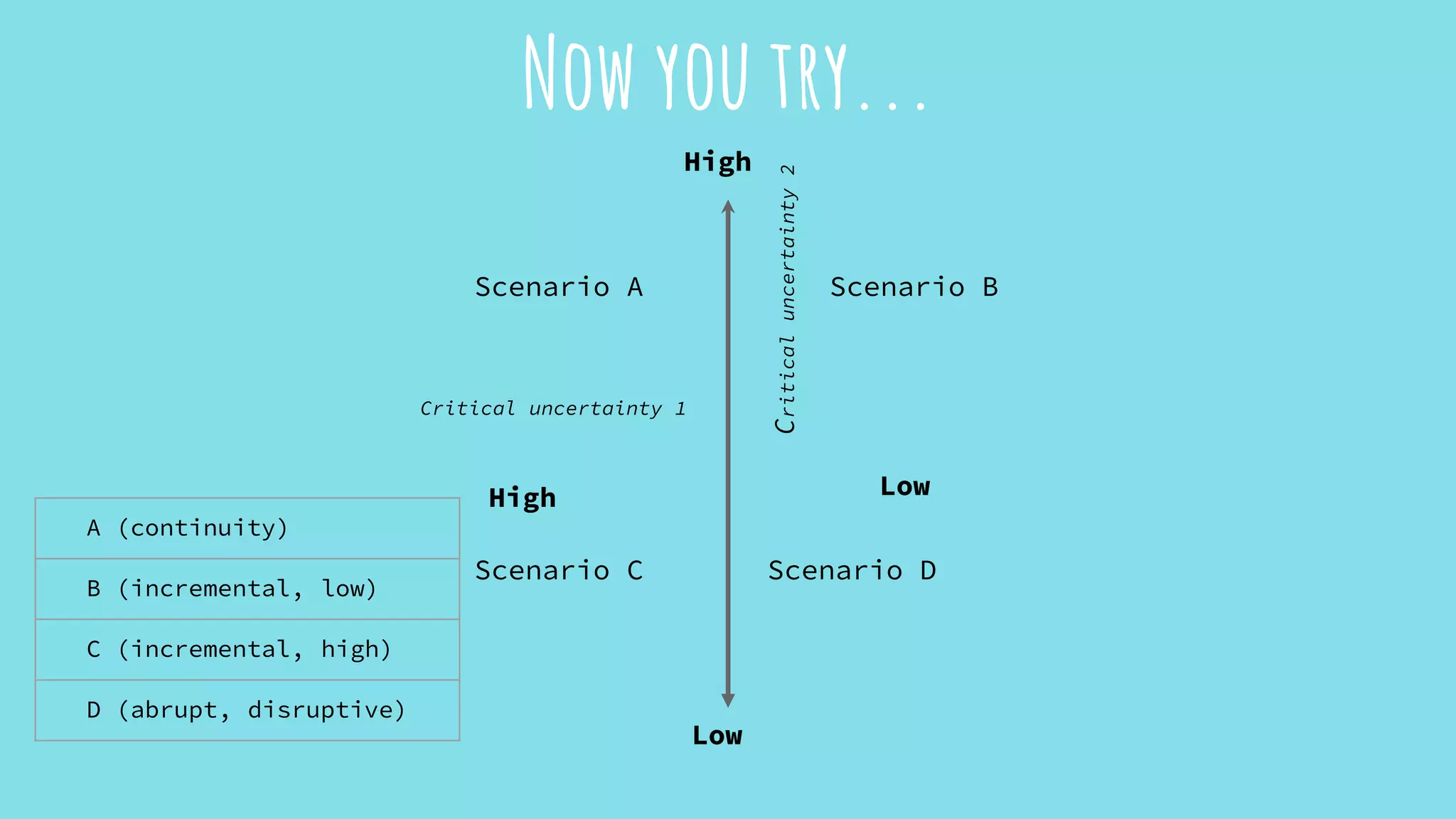
Critical uncertainty 1
High Low
Criticaluncertainty2
High
Low
Scenario A Scenario B
Scenario C Scenario D
A (continuity)
B (incremental, low)
C (incremental, high)
D (abrupt, disruptive)
Now you try...
1)Think of the (1) weak signals, (2)
emerging trends and (3) trends you
identified earlier.
1)Figure out two axes of uncertainties to
map out your scenarios.
1)Come up with short stories of the 4
scenarios you picked.
1)We will share as a group.
Now you try...
Critical uncertainty 1
High Low
Criticaluncertainty2
High
Low
Scenario A Scenario B
Scenario C Scenario D
A (continuity)
B (incremental, low)
C (incremental, high)
D (abrupt, disruptive)
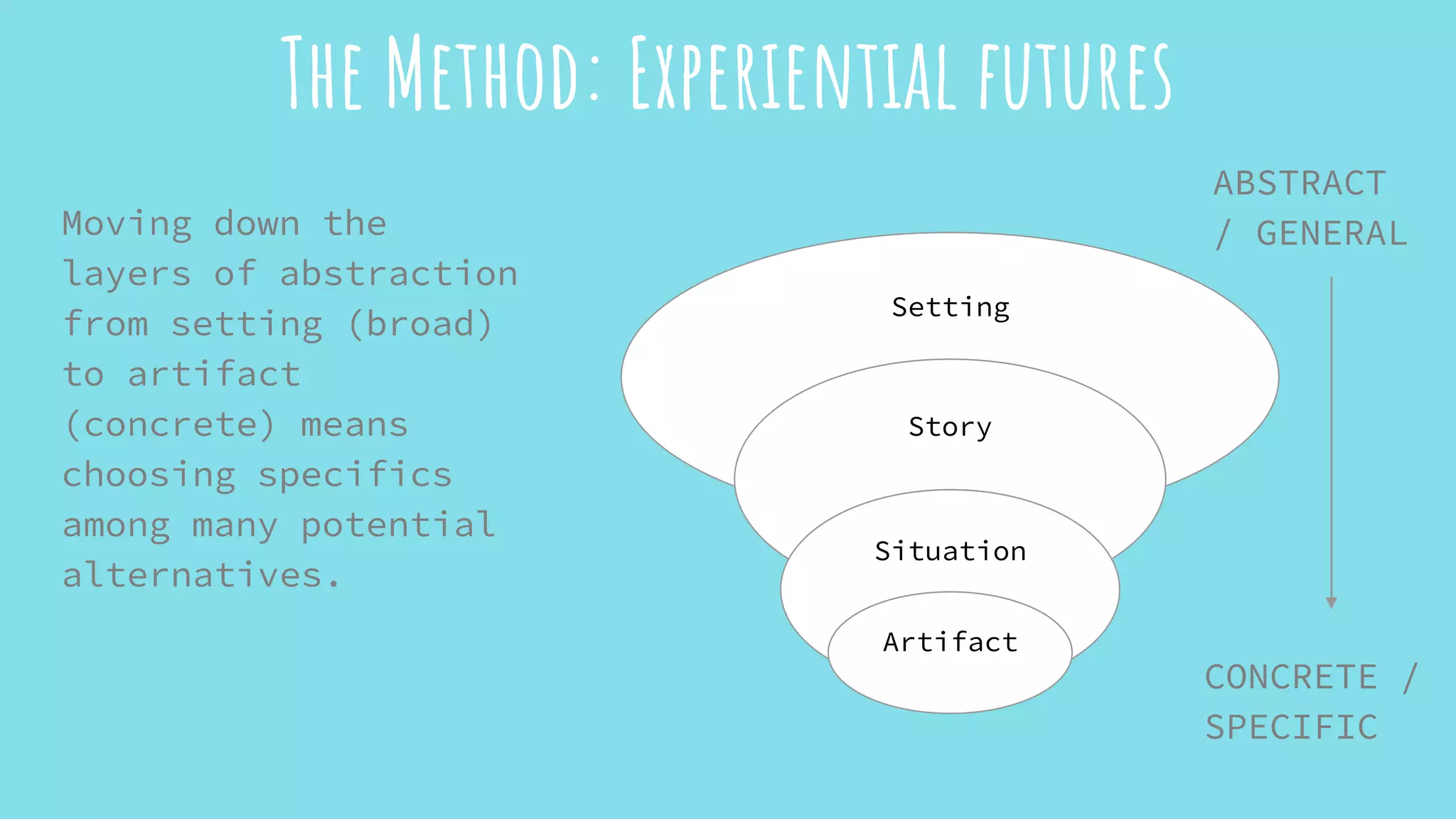
The Method: Experiential futures
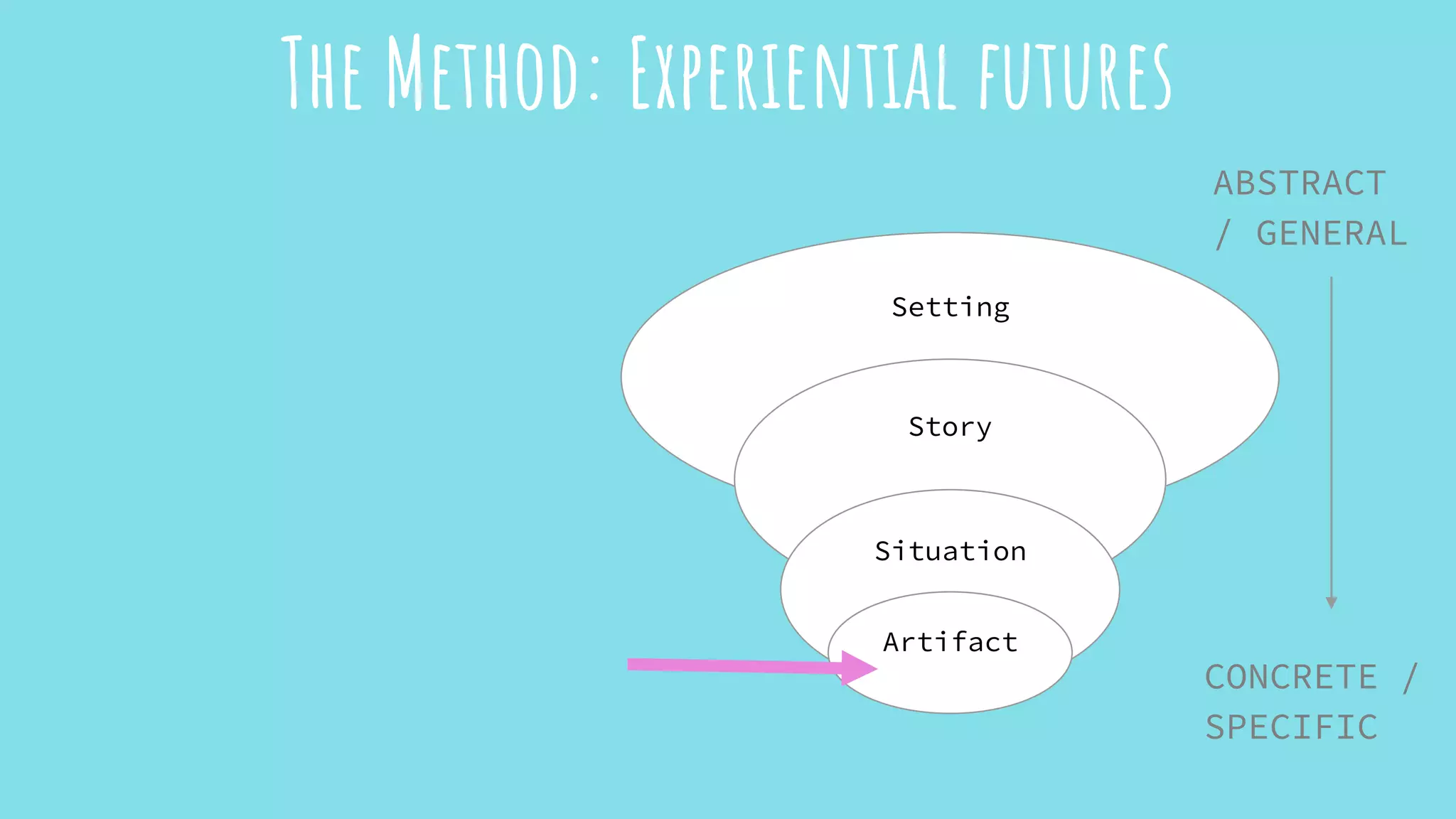
Moving down the
layers of abstraction
from setting (broad)
to artifact
(concrete) means
choosing specifics
among many potential
alternatives.
Setting
Story
Situation
Artifact
ABSTRACT
/ GENERAL
CONCRETE /
SPECIFIC
The Method: Experiential futures
Setting
Story
Situation
Artifact
ABSTRACT
/ GENERAL
CONCRETE /
SPECIFIC
The Dream
7
1)What are the goals we want
to achieve?
2)What is the dream?
3)How do we make the dream
real?
Goal
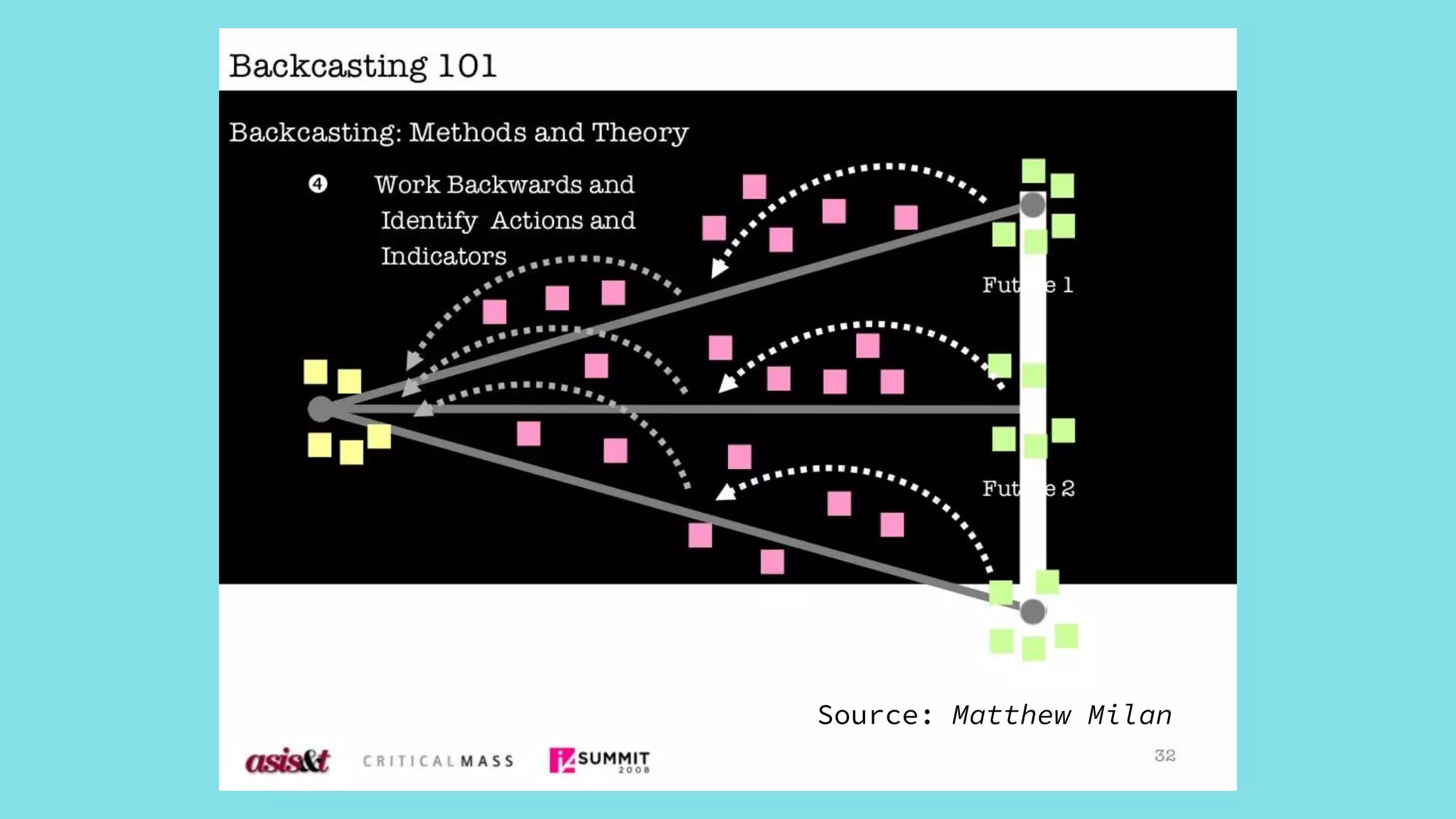
Drawing upon the values, and strengths and
foresight work to dream up the desirable
future you want to see along with a roadmap
to make the dream real.
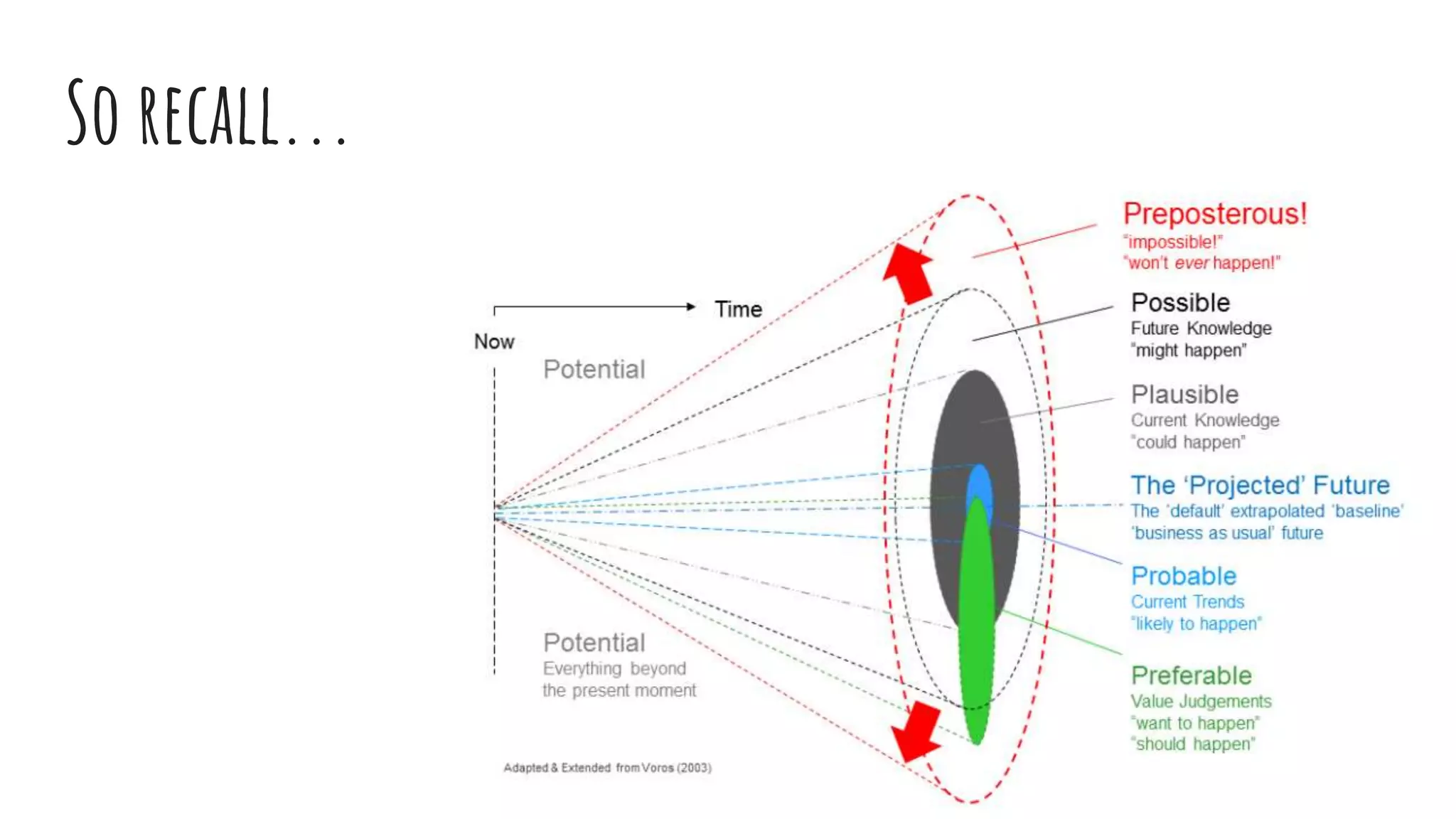
So recall...
Source: Matthew Milan
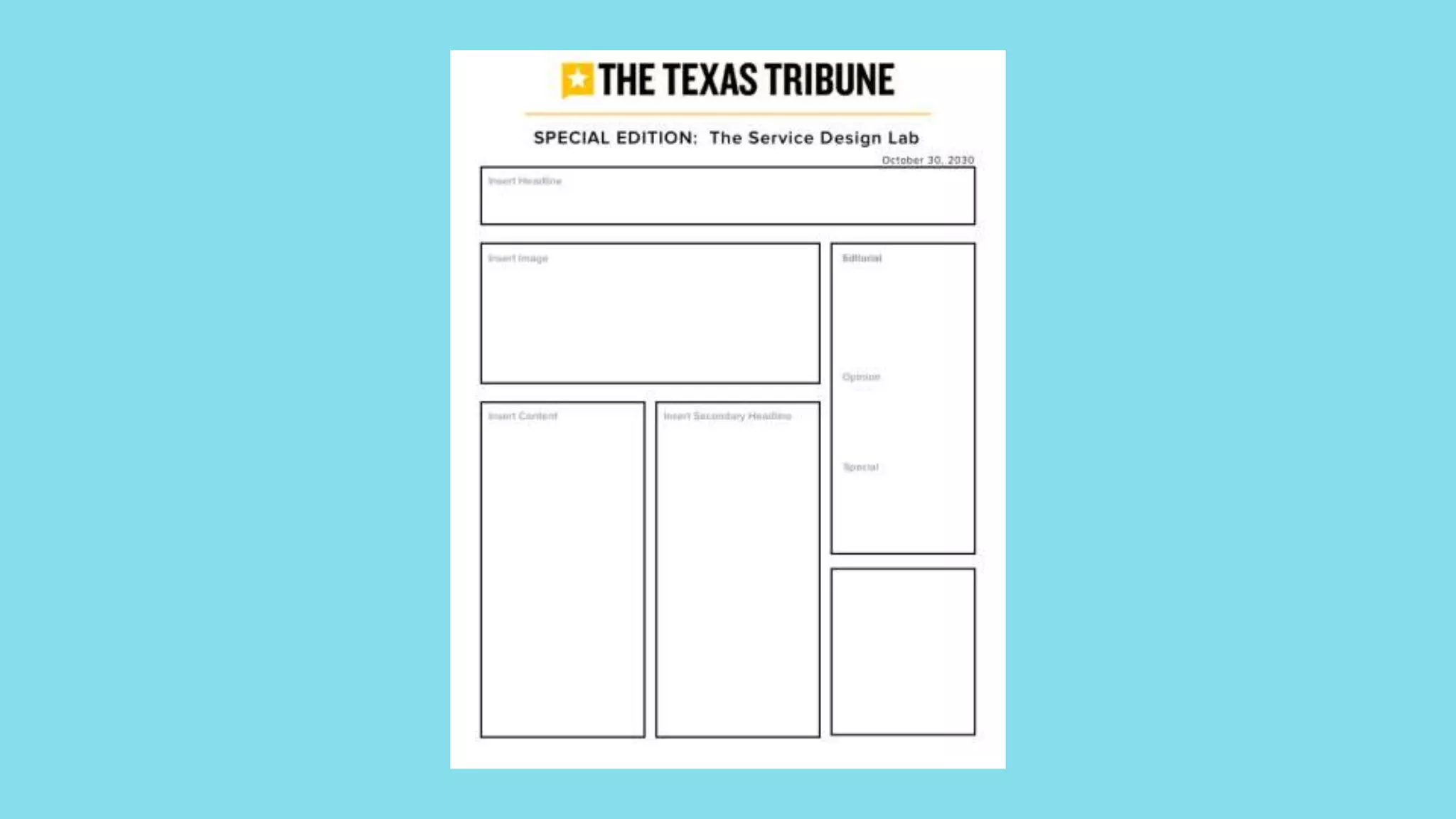
Now you try...
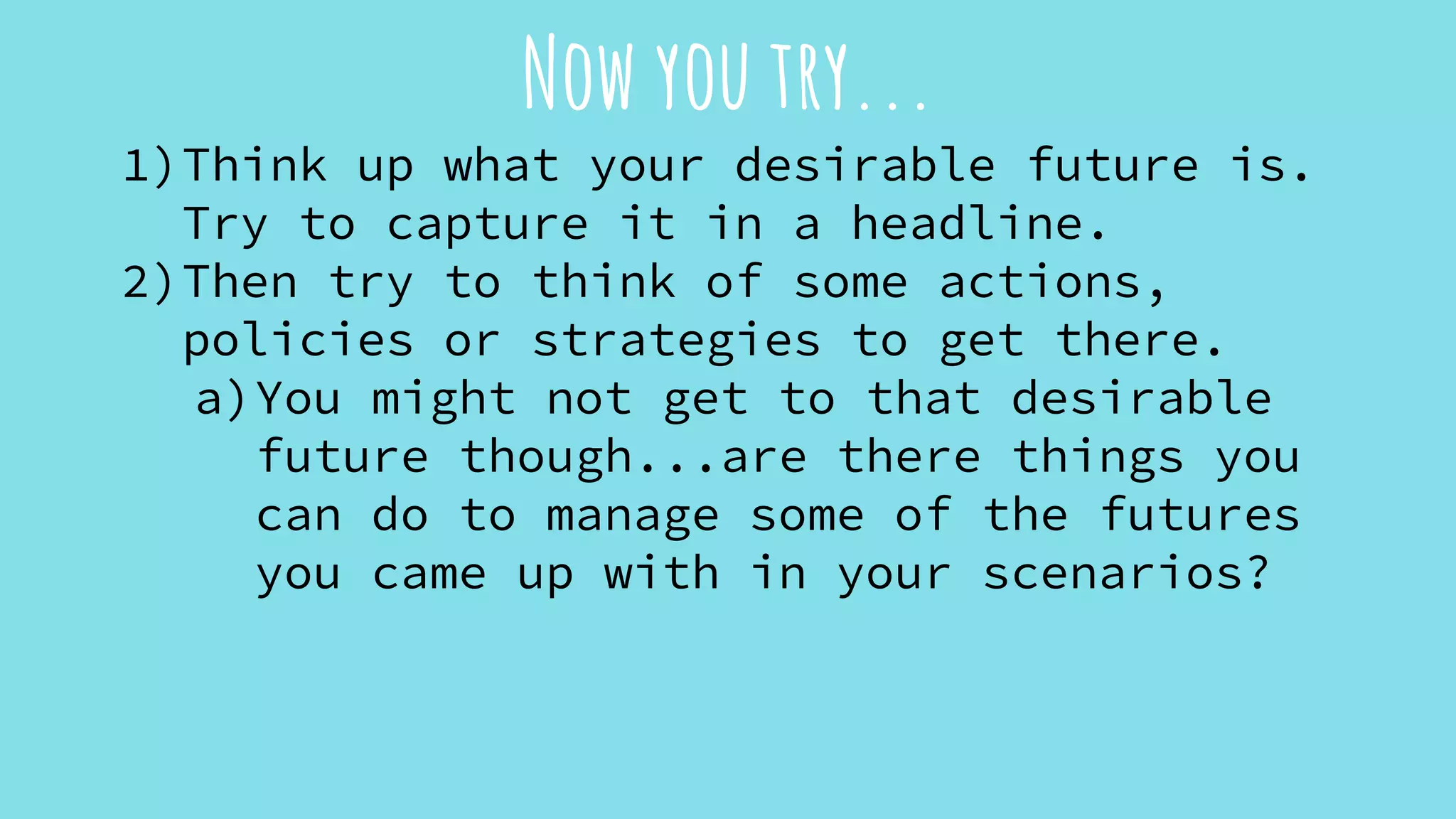
1)Think up what your desirable future is.
Try to capture it in a headline.
2)Then try to think of some actions,
policies or strategies to get there.
a)You might not get to that desirable
future though...are there things you
can do to manage some of the futures
you came up with in your scenarios?
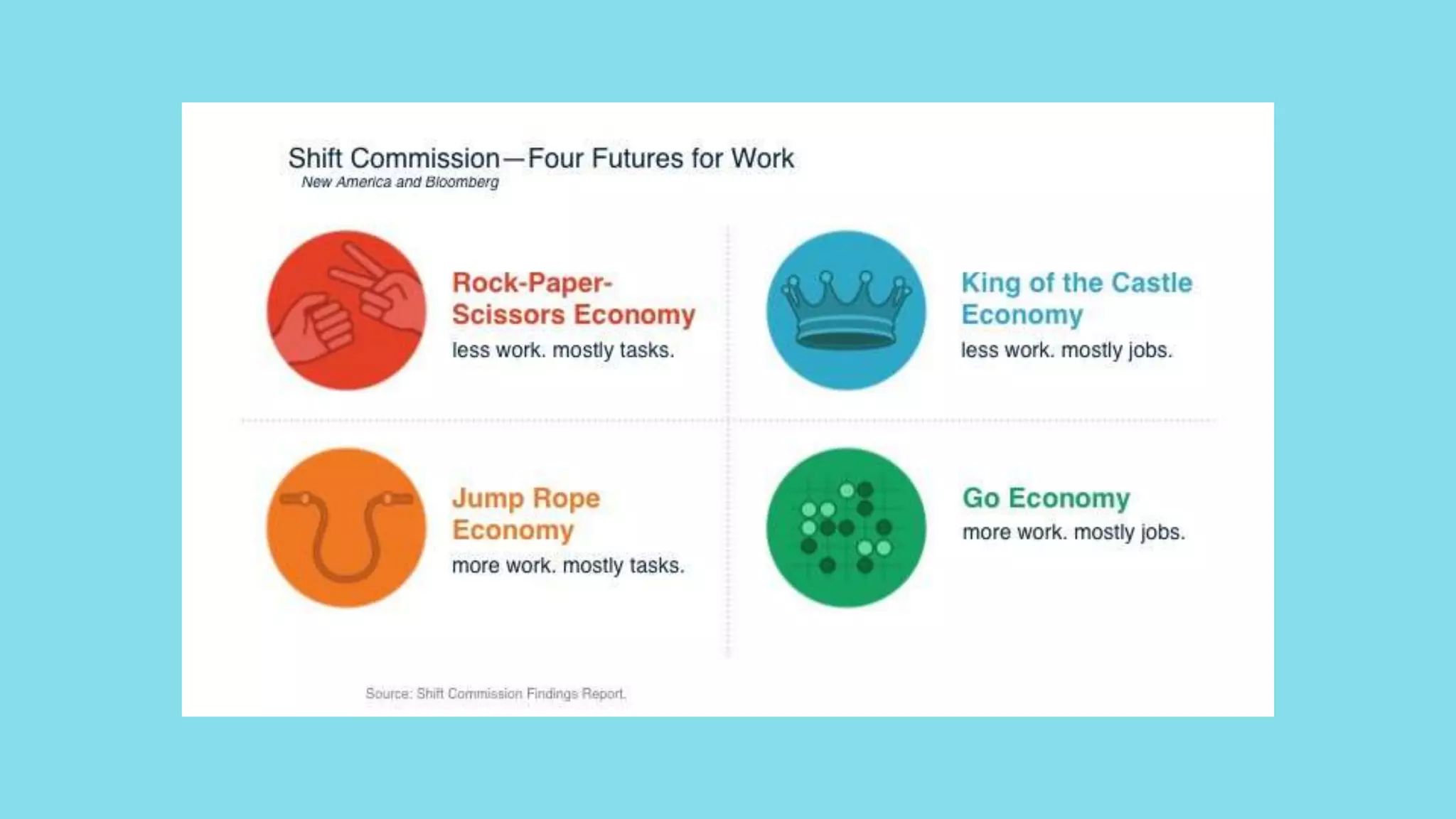
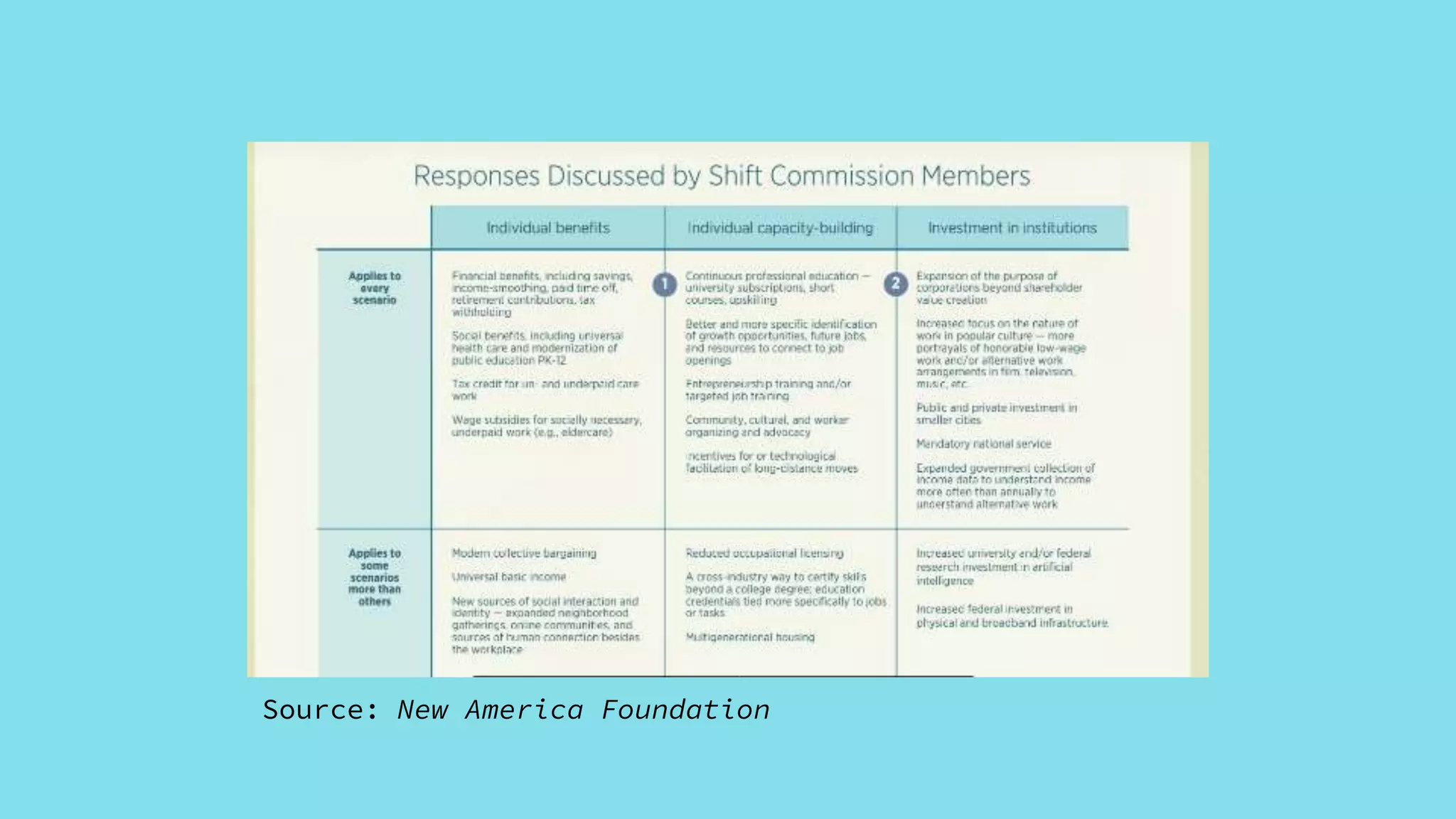
Source: New America Foundation
Resources
8
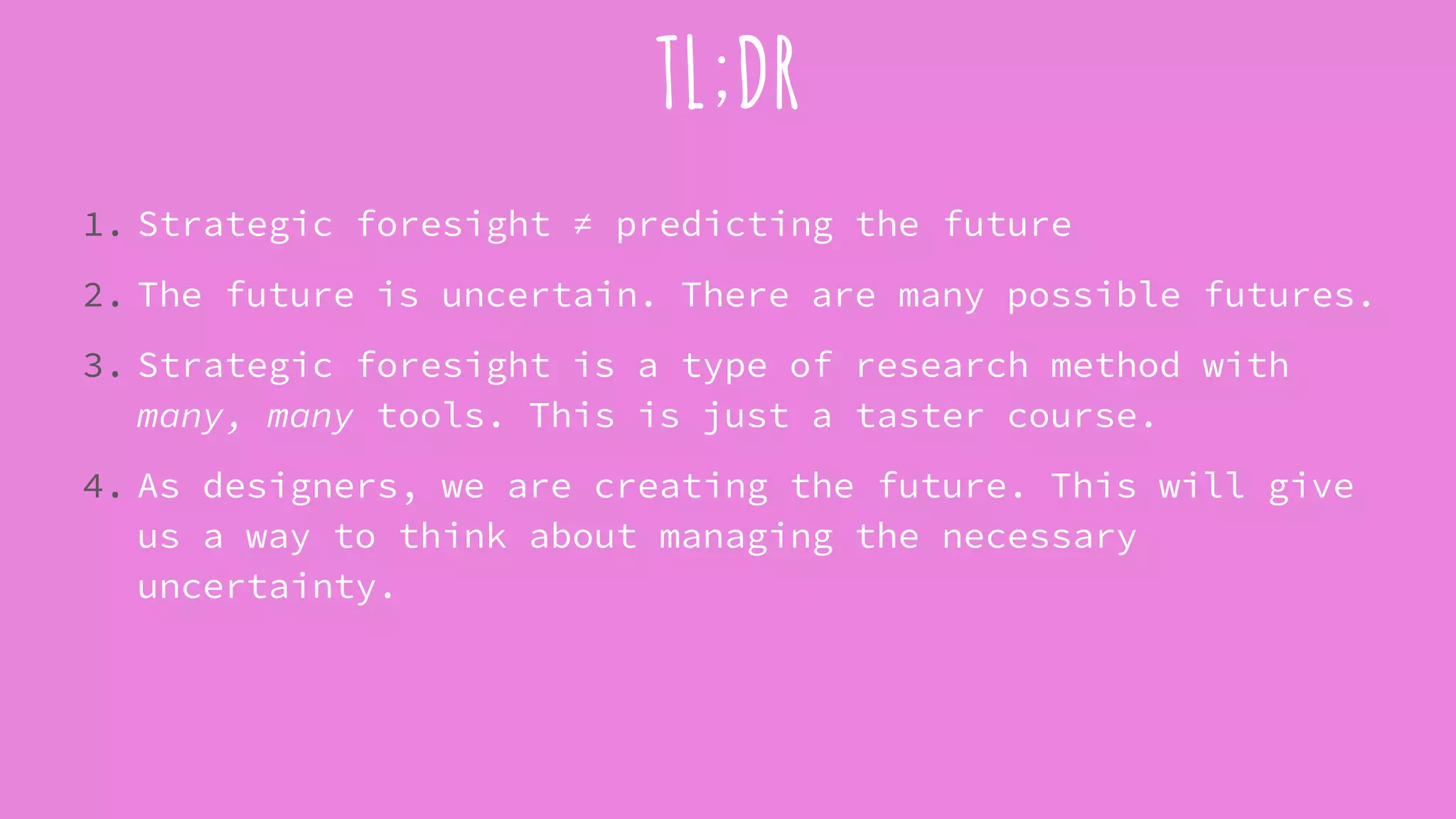
TL;DR
1. Strategic foresight ≠ predicting the future
2. The future is uncertain. There are many possible futures.
3. Strategic foresight is a type of research method with
many, many tools. This is just a taster course.
4. As designers, we are creating the future. This will give
us a way to think about managing the necessary
uncertainty.
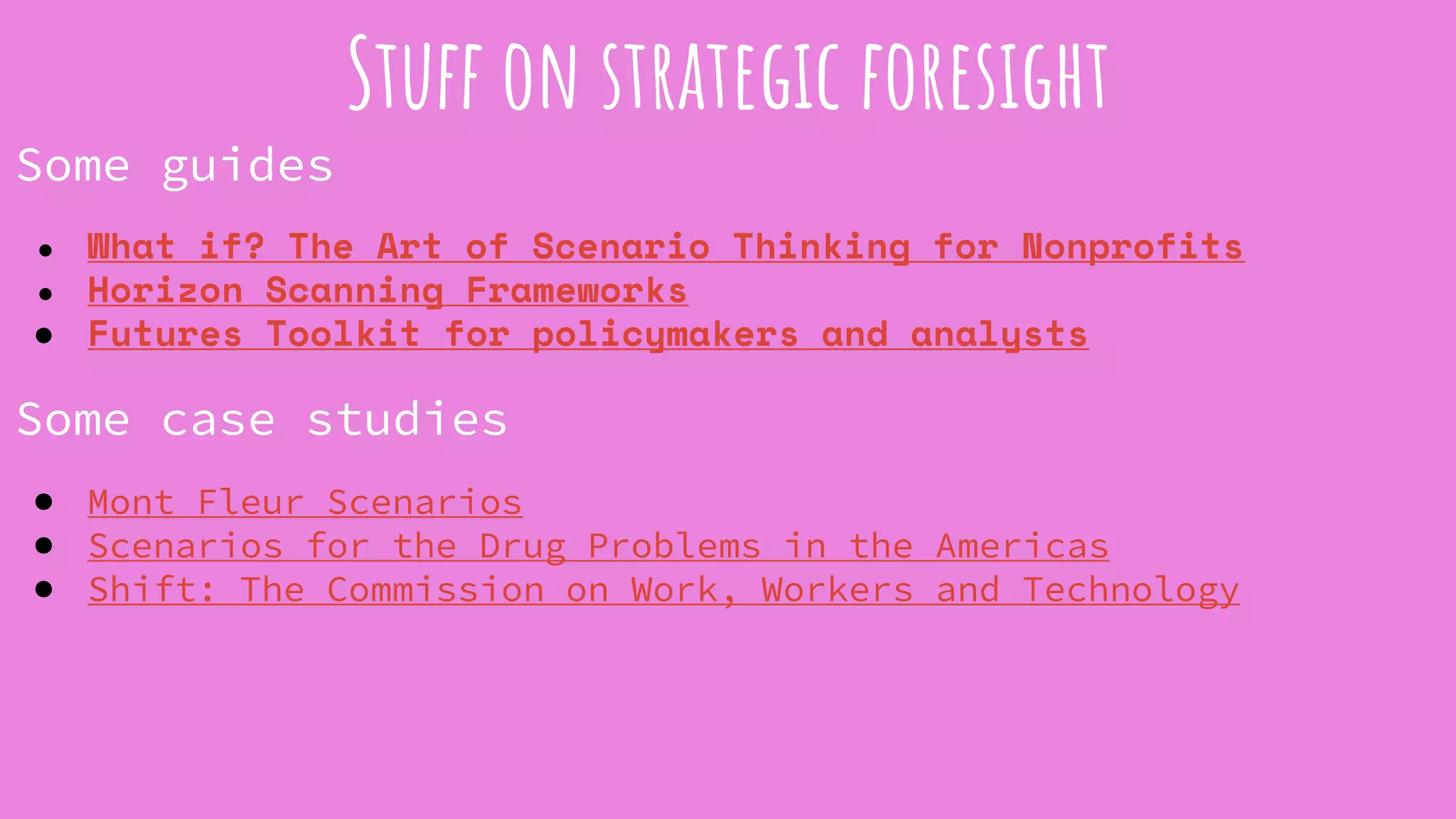
Some guides
● What if? The Art of Scenario Thinking for Nonprofits
● Horizon Scanning Frameworks
● Futures Toolkit for policymakers and analysts
Some case studies
● Mont Fleur Scenarios
● Scenarios for the Drug Problems in the Americas
● Shift: The Commission on Work, Workers and Technology
Stuff on strategic foresight
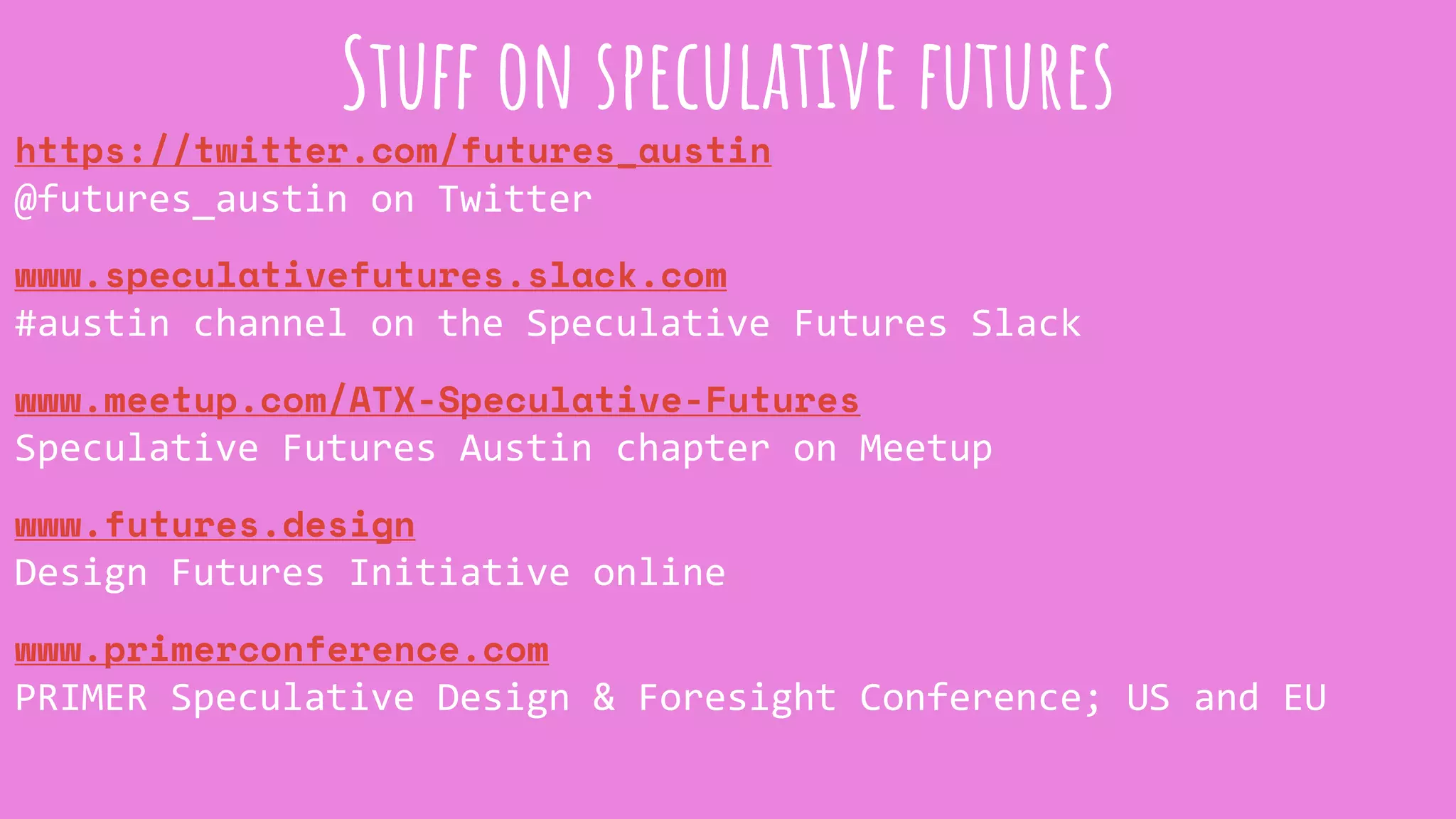
https://twitter.com/futures_austin
@futures_austin on Twitter
www.speculativefutures.slack.com
#austin channel on the Speculative Futures Slack
www.meetup.com/ATX-Speculative-Futures
Speculative Futures Austin chapter on Meetup
www.futures.design
Design Futures Initiative online
www.primerconference.com
PRIMER Speculative Design & Foresight Conference; US and EU
Stuff on speculative futures
The End
9

Speculative futures 11.12.2019 - strategic foresight 101

  • 1.
  • 2.
    Agenda ● 700-715 -The Introductions ● 715-730 - The Strategic Foresight ● 730-735 - Future(s) of Work ● 735-740 - The Past ● 740-800 - The Present ● 800-830 - The Future ● 830-850 - The Dream ● 850-855 - The Resources ● 855-900 - The End
  • 3.
  • 4.
    Objective ● Learn whatstrategic foresight is. ● Learn about applications of strategic foresight and how it can help you solve your problems (with a focus on public policy). ● Learn some hands-on methods and tools to apply strategic foresight. ● Leave you all with some resources to learn more.
  • 5.
    Andrew Do ● DualAmerican-Canadian ● Now a Service Designer with the Office of Design & Delivery
  • 6.
    Speculative Futures -Austin Chapter We’re part of a growing global community of Speculative Futures Meetups organized by The Design Futures Initiative, a 501c3 nonprofit based in San Francisco, CA.
  • 7.
    Speculative. Futures. Speculative viaSpeculative Design and Critical Design. Futures via Futures Studies and Strategic Foresight; how Futures methods and a futures- oriented mindset can be applied to our design praxis.
  • 8.
    Design Futures Initiative(DFI) 1/3 Our mission is to bring people together to help the world imagine a better place to live.
  • 9.
    Design Futures Initiative(DFI) 2/3 Our mission is to bring people together to help the world imagine a better place to live. Our vision is to expand our global community and further the discourse around Speculative Design and Foresight as strategies for responsible, ethical, and mindful design futures.
  • 10.
    Design Futures Initiative(DFI) 3/3 Our mission is to bring people together to help the world imagine a better place to live. Our vision is to expand our global community and further the discourse around Speculative Design and Foresight as strategies for responsible, ethical, and mindful design futures. In service of answering the questions of what future(s) we want and exploring the implications of the choices we make today.
  • 11.
    (DFI) -> SpeculativeFutures Meetups We do that by bringing together designers, strategists, artists, scientists, futurists, and all of you to explore the ethical, cultural, environmental, political and economic impacts of future products and services.
  • 12.
  • 13.
    What this isnot about... ● It is not predicting the future. It is not forecasting
  • 14.
    “It's tough tomake predictions, especially about the future.” -Yogi Berra
  • 15.
    So what isstrategic foresight? ● Generating plausible, probable and preferable futures (*emphasis on the plural*) based on rigorous exploration. ● Typically exploring what is still to come 10-50 years from now through a variety of methods.
  • 16.
    Everyone thinks aboutthe future — they just don’t do it very well. -Jake Dunagan
  • 17.
    “Strategic foresight isthe ability to create and maintain a high-quality, coherent, and functional forward view and to use the insights arising in organizationally useful ways.” -Richard Slaughter
  • 18.
    “Futurism is anart of reperception. It means recognizing that life will change, must change, and has changed, and it suggests how and why. It shows that old perceptions have lost their validity, while new ones are possible.” -Bruce Sterling
  • 19.
    “The futurist’s taskis to create a space of heightened insight, creativity and strategic engagement.” -Stuart Candy
  • 20.
    ● There area variety of research methods across 4 different axes: 1) Creativity-based methods 2) Evidence-based methods 3) Expertise-based methods 4) Interaction-based methods methods
  • 21.
  • 23.
  • 24.
  • 25.
    There’s no shortageof headlines...
  • 26.
    I’m going toborrow and adapt from...
  • 27.
  • 28.
    1)How has (*Insertsubject*) change in the past? 2)Why did these changes happen?
  • 29.
    Goal Recognize patterns, cycles,and chance in history.
  • 31.
    ● Technological advances ●Conflict or competition ● New ideas and/or values ● Chance Reasons for Change
  • 33.
    So what isthe history of the “Future of Work?”
  • 34.
    Modern Mechanics andInventions, 1934
  • 35.
  • 36.
    We heard itwhen people were wondering how ATMs would take away work from bank tellers...
  • 37.
  • 38.
    In 1870, almost50% of the U.S. population was employed in agriculture. As of 2008, less than 2% of the population is directly employed in agriculture.
  • 39.
  • 40.
    1)Which of thesehistorical drivers are at work again today? 2)What new sources of change do you think are detecting? 3)What things might slow or even prevent change today?
  • 41.
    Goal Looking for historicalforces at work, new changes and forces against change.
  • 42.
    “The future isalready here— It's just not very evenly distributed.” -William Gibson
  • 43.
    Looking to identifytangible, specific evidence of change. You should be exploring a variety of sources — alternative press, art, journals, statistics. There is an understanding that these things might impact the course of the future. The Method: Horizon Scanning
  • 44.
    Looking for: 1)Weak Signals- small innovation that can scale — an indicator of change 2)Emerging issues - some change characterized by medium-level of awareness. 3)Trends - a pattern of change that is well known. It implies what the future could look like if all else being equal. The Method: Horizon Scanning
  • 45.
  • 46.
  • 47.
  • 48.
    The Method: HorizonScanning - STEEP-V Weak Signal Emerging Issue Mature Trend S Social T Technological E Economic E Environmental P Political V Values
  • 49.
    Now you Try...(15 Minutes) Weak Signal Emerging Issue Mature Trend S Social T Technological E Economic E Environmental P Political V Values
  • 50.
    Now you try... 1)Ingroups of 5-6, think of some trends that would impact the future of work using STEEP-V. 2)We’ll share at the end...
  • 57.
    These are alluncertainties for the future.
  • 58.
  • 59.
    1)What are somescenario futures for (*Insert subject*)? 2)What are the opportunities and threat? 3)Who will resist, channel or accelerate change?
  • 60.
    Goal Exploring the futuresyou might face given the forces at work and patterns of change
  • 61.
    Ostrich - anegotiated settlement to the crisis in South Africa is not achieved,and the country’s government continues tobe non-representative• Lame Duck - a settlement is achieved but the transition to a new dispen- sation is slow and indecisive Icarus - rapid but the new government unwisely pursues unsustainable, populist economic policies Flight of the Flamingos - government’s policies are sustainable and the coun- try takes a path of inclusive growth and democracy What will South Africa be like in the year 2002? Source: Adapted from Adam Kahane, 1992
  • 62.
  • 64.
    The Method: Scenarios Amethod for exploring possible futures and paint a story of what could be based on the weak signals, emerging issues and trends we have. This is a way to help us navigate an uncertain future.
  • 65.
    The Method: Scenarios DeductiveMethods Inductive Methods ● 2 x 2 matrix ● 2 x 2 x 2 matrix ● Generic images of the future ● Manoa method ● Causal layered analysis ● 3-horizon model Deductive Methods Inductive Methods ● 2 x 2 matrix ● 2 x 2 x 2 matrix ● Generic images of the future ● Manoa method ● Causal layered analysis ● 3-horizon model
  • 66.
    The Method: Scenarios Criticaluncertainty 1 High Low Criticaluncertainty2 High Low Scenario A Scenario B Scenario C Scenario D A (continuity) B (incremental, low) C (incremental, high) D (abrupt, disruptive)
  • 67.
    Now you try... 1)Thinkof the (1) weak signals, (2) emerging trends and (3) trends you identified earlier. 1)Figure out two axes of uncertainties to map out your scenarios. 1)Come up with short stories of the 4 scenarios you picked. 1)We will share as a group.
  • 68.
    Now you try... Criticaluncertainty 1 High Low Criticaluncertainty2 High Low Scenario A Scenario B Scenario C Scenario D A (continuity) B (incremental, low) C (incremental, high) D (abrupt, disruptive)
  • 70.
    The Method: Experientialfutures Moving down the layers of abstraction from setting (broad) to artifact (concrete) means choosing specifics among many potential alternatives. Setting Story Situation Artifact ABSTRACT / GENERAL CONCRETE / SPECIFIC
  • 71.
    The Method: Experientialfutures Setting Story Situation Artifact ABSTRACT / GENERAL CONCRETE / SPECIFIC
  • 75.
  • 76.
    1)What are thegoals we want to achieve? 2)What is the dream? 3)How do we make the dream real?
  • 77.
    Goal Drawing upon thevalues, and strengths and foresight work to dream up the desirable future you want to see along with a roadmap to make the dream real.
  • 78.
  • 80.
  • 81.
    Now you try... 1)Thinkup what your desirable future is. Try to capture it in a headline. 2)Then try to think of some actions, policies or strategies to get there. a)You might not get to that desirable future though...are there things you can do to manage some of the futures you came up with in your scenarios?
  • 82.
  • 83.
  • 84.
    TL;DR 1. Strategic foresight≠ predicting the future 2. The future is uncertain. There are many possible futures. 3. Strategic foresight is a type of research method with many, many tools. This is just a taster course. 4. As designers, we are creating the future. This will give us a way to think about managing the necessary uncertainty.
  • 85.
    Some guides ● Whatif? The Art of Scenario Thinking for Nonprofits ● Horizon Scanning Frameworks ● Futures Toolkit for policymakers and analysts Some case studies ● Mont Fleur Scenarios ● Scenarios for the Drug Problems in the Americas ● Shift: The Commission on Work, Workers and Technology Stuff on strategic foresight
  • 86.
    https://twitter.com/futures_austin @futures_austin on Twitter www.speculativefutures.slack.com #austinchannel on the Speculative Futures Slack www.meetup.com/ATX-Speculative-Futures Speculative Futures Austin chapter on Meetup www.futures.design Design Futures Initiative online www.primerconference.com PRIMER Speculative Design & Foresight Conference; US and EU Stuff on speculative futures
  • 87.

Editor's Notes

  • #6 Discussion
  • #7 Personally, this Meetup offers me a venue for longer-term and larger-scale thinking than I typically engage in, which as a human is difficult to do and as a designer is not always supported by our vocations. Allows us a safe space to do this Allows a way to think deeper Allows a way to imagine what you want, and what you don’t Allows methods and tools to incorporate into your processes
  • #8 Personally, this Meetup offers me a venue for longer-term and larger-scale thinking than I typically engage in, which as a human is difficult to do and as a designer is not always supported by our vocations. Allows us a safe space to do this Allows a way to think deeper Allows a way to imagine what you want, and what you don’t Allows methods and tools to incorporate into your processes
  • #9 Personally, this Meetup offers me a venue for longer-term and larger-scale thinking than I typically engage in, which as a human is difficult to do and as a designer is not always supported by our vocations. Allows us a safe space to do this Allows a way to think deeper Allows a way to imagine what you want, and what you don’t Allows methods and tools to incorporate into your processes
  • #10 Personally, this Meetup offers me a venue for longer-term and larger-scale thinking than I typically engage in, which as a human is difficult to do and as a designer is not always supported by our vocations. Allows us a safe space to do this Allows a way to think deeper Allows a way to imagine what you want, and what you don’t Allows methods and tools to incorporate into your processes
  • #11 Personally, this Meetup offers me a venue for longer-term and larger-scale thinking than I typically engage in, which as a human is difficult to do and as a designer is not always supported by our vocations. Allows us a safe space to do this Allows a way to think deeper Allows a way to imagine what you want, and what you don’t Allows methods and tools to incorporate into your processes
  • #12 Personally, this Meetup offers me a venue for longer-term and larger-scale thinking than I typically engage in, which as a human is difficult to do and as a designer is not always supported by our vocations. Allows us a safe space to do this Allows a way to think deeper Allows a way to imagine what you want, and what you don’t Allows methods and tools to incorporate into your processes