Scenario Planning

Make better strategic decisions when faced
with uncertainty and change

Extracts from MBA dissertation - Colin Campbell
Change and Uncertainty
●

Business uncertainty has increased dramatically
–

●

Porter (1985)

Turbulent organisational environment means that traditional strategic
planning tools such as PEST are too simplistic- Burt el al. (2006)

●

Many business environments are no longer stable

●

Survival of long established businesses being questioned

●

History shows extreme challenges
–

British Motor Cycle Industry in the 1960's

–

IBM in the 1980's

–

Nokia and Blackberry in recent years
Scenarios can help
●

Scenarios present a range of longer term views of an organisation's external
environment based on
–
–

Industry structures

–

●

Competitive forces

–

●

Environmental factors

Trends

Each scenario attempts to tell a plausible story
Equips an organisation to take strategic decisions now which positions it well for the
range of possible futures
–

Cornelius et al. (2005)

●

Alters mental models

●

Changes assumptions about how the world works

●

Overcomes heuristics and biases in management decision making
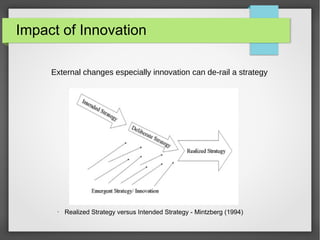
Impact of Innovation
External changes especially innovation can de-rail a strategy

•

Realized Strategy versus Intended Strategy - Mintzberg (1994)
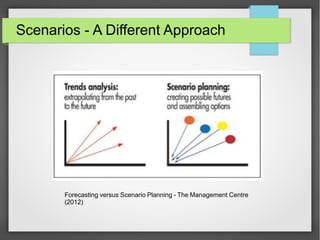
Scenarios - A Different Approach

Forecasting versus Scenario Planning - The Management Centre
(2012)
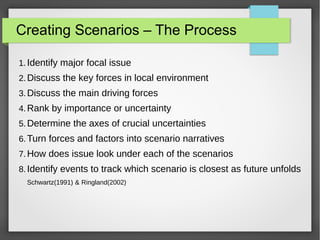
Creating Scenarios – The Process
1. Identify major focal issue
2. Discuss the key forces in local environment
3. Discuss the main driving forces
4. Rank by importance or uncertainty
5. Determine the axes of crucial uncertainties
6. Turn forces and factors into scenario narratives
7. How does issue look under each of the scenarios
8. Identify events to track which scenario is closest as future unfolds
Schwartz(1991) & Ringland(2002)
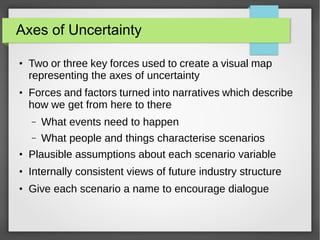
Axes of Uncertainty
●

●

Two or three key forces used to create a visual map
representing the axes of uncertainty
Forces and factors turned into narratives which describe
how we get from here to there
–

What events need to happen

–

What people and things characterise scenarios

●

Plausible assumptions about each scenario variable

●

Internally consistent views of future industry structure

●

Give each scenario a name to encourage dialogue
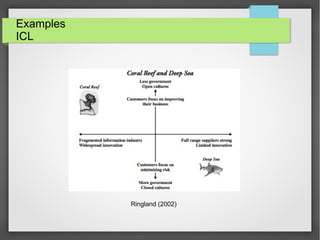
Examples
ICL

Ringland (2002)
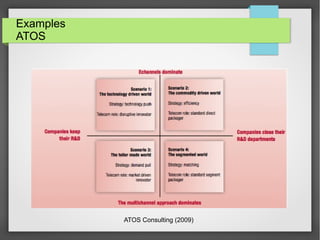
Examples
ATOS

ATOS Consulting (2009)
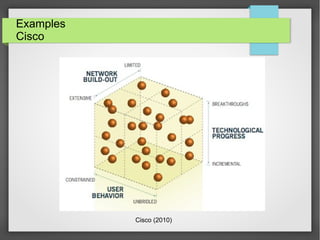
Examples
Cisco

Cisco (2010)
Building Strategies from Scenarios
●

Factoring Scenarios into the competitive strategy of the
organisation
–

Feed scenarios back to those consulted

–

Discuss strategic options

–

Agree the implementation plan

–

Publicise the scenarios
Ringland (2002)
Building Strategies from Scenarios
●

Robust Strategies
–

Options which work across the range of scenarios

–

Position organisation to exploit all future opportunities

–

Prepare for threats

–

Poised for opportunity

–

Probably requires extra cost to cover options
Building Strategies from Scenarios
●

Focussed Strategies
–

Pick a most probable or best case scenario

–

Can the organisation bring about a scenario?

–

Things to consider

–

First mover advantage
●
Initial competitive position
●
Attitude to risk
Numeric models for formalising strategy evaluation can be used

–

eg. Wright & Cairns (2011)
Potential to highlight best performing strategy

●

●
Building Strategies from Scenarios
●

Develop Early Warning Indicators
–

Keep options open until outcomes of external events and forces is more
clear

–

Conduct Horizon Scanning to spot change as it arises
Schultz (2006)
Trends and drivers can come from a wide and diverse set of sources
Spotting trends early has potential to deliver significant competitive
advantage when combined with Scenario Planning
●
●

–

Create change
Control circumstances
Conscious choices
Avoid being swept along by circumstances
●
●
●

–
Building Strategies from Scenarios
●

Strategic Conversations
–

Major decision making should remain a continual process.

–

Scenarios create language and structure for shared
interpretations of the world

–

Leads to joint action

–

Often best achieved through informal activities and
debate at all levels in an organisations

–

Promotes balanced viewpoint and avoids group-think
●

Van der Heijden et al. (2002)
Benefits of Scenario Planning
●

Improved Decision Making
–

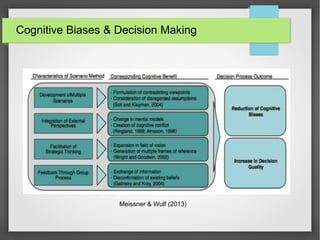
Human reasoning does not necessarily fit with optimal judgements
Lack of information, human emotional state
Mental shortcuts leading to systematic biases and bounded
rationality
– Eysenck & Keyne (2000), Kahneman & Tversky (1996)
Mental models drive people to be satisfied with limited
interpretation of situations
– Chermack (2004)
Scenarios can help overcome these pre-dispositions and change
mental models to improve decision quality
●
●

●

–
Cognitive Biases & Decision Making

Meissner & Wulf (2013)
Benefits of Scenario Planning
●

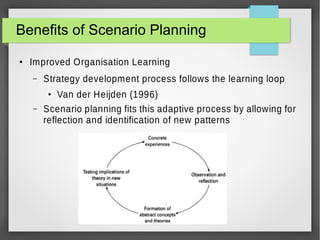
Improved Organisation Learning
–

Strategy development process follows the learning loop

–

Van der Heijden (1996)
Scenario planning fits this adaptive process by allowing for
reflection and identification of new patterns
●
Benefits of Scenario Planning
●

Scenario Planning delivers Organization Performance
and Change through
–

Dialogue, Conversation, Quality and Engagement

–

Learning

–

Decision Making

–

Mental Models

–

Leadership Support

Chermack (2011)
Three Month Market Study
●

Two internet surveys
–
–

●

●

Strategic Decision Making – 100 respondents
Scenario Planning – 61 respondents

Three companies with Scenario Planning experience
interviewed
Four Scenario Planning consultants interviewed
Companies Interviewed
●

UK Government's advisory body on natural environment

●

Leading International Law Company

●

Train Rolling Stock Leasing Company
Survey 1
Strategic Business Decision Making
●

●

●

●

Businesses typically look 2 to 5 years ahead when making
decisions around strategy (74% of respondents)
3 years is the most common time period (37%)
Brainstorming & SWOT are the favoured techniques for
decision making
Most important factors for effective long term decision making
were
–

Detailed understanding of current competitive forces

–

Strong direction from company leaders

–

Involve as many relevant stakeholders as possible
Survey 2
Scenario Planning
●

Scenario Planning timeframes
–

64% of respondents have used scenario planning to look
more than 15 years ahead

–

80% more than 5 years ahead

●

31% see an immediate impact from scenario planning

●

51% see an impact within 1 year

●

Most important key factors for a successful scenario planning
exercise were
–

Participants heavily involved
Detailed understanding of current business environment

–

Stakeholder involvement

–
Survey 2
Scenario Planning
●

Respondents believe Scenario Planning is most effective
at altering how people think

●

Most desirable outcome of a Scenario Planning exercise
–

Promotes regular discussion

–

Provides basis for review of current plans
Conclusions from Interviews
●

Scenario Planning is most effective at
–
–

●

●

Altering how people think
Adding to organisational knowledge

Wide stakeholder involvement is a key factor for better long term
decision making
Senior management involvement in Scenario Planning is key to
the success of the exercise
Principal Question Asked By Study
●

●

How can scenario planning help businesses make better decisions
when faced with uncertainty?
Conclusions
–

Involving a wide range of stakeholders broadens minds and
ensures wide range of opinions represented

–

Helps change how people think by diminishing many of the biases
involved in day to day decision making

–

Enhances learning by stimulating strategic conversations
throughout the organisation

–

Creates a framework and common language where organisations
can evaluate strategic options and maintain vigilence for signs of
change within decision making horizon
Contact
●

For more details on this study you can contact me at
–

colin@ mobilebeacon.com
Bibliography
Atos Consulting (2009) Telecom Companies in 2015: Trends and scenarios, Available at
http://www.be.atosconsulting.com/NR/rdonlyres/796D11B6-1214-43EE-88F8-120088703612/0/AtosConsulting_Whitepaper_Telecom_Companies_in_2015_uk.pdf [accessed at
1st June 2013]
Burt, G., Wright, G., Bradfield, R., Cairns, G., Van Der Heijden, K. (2006) The Role of Scenario Planning in Exploring the Environment in View of the Limitations of PEST and Its
Derivatives, International Studies of Management & Organization, vol. 36, no. 3, pp. 50-76

Chermack, T. J. (2004), Improving decision-making with scenario planning, Futures, 36
Chermack, T. J. (2011) Scenario Planning in Organizations, Berrett-Koehler
Cisco (2010) The Evolving Internet:A look ahead to 2025, Available at http://newsroom.cisco.com/dlls/2010/ekits/Evolving_Internet_GBN_Cisco_2010_Aug_rev2.pdf [accessed at
1st June 2013]
Cornelius, P., Van de Putte, A., Romani, M., (2005), Three Decades of Scenario Planning in Shell, California Management Review, Vol 48, No. 1
Eysenck, M.W. & Keane, M.T. (2000), Cognitive psychology: A students handbook, Psychology Press Ltd.
Kahneman D. & Tversky A. (1996) On the Reality of Cognitive Illusions, Psychological Review, Vol 103, No 3, pp583-591

Meissner, P. & Wulf, T. (2013) Cognitive benefits of scenario planning: Its impact on biases and decision quality, Technological Forecasting & Social Change, vol
80, pp. 801-814
Mintzberg, H. (1994) The rise and fall of strategic planning, Prentice Hall
Porter, M. (1985), Competitive Advantage: Creating and Sustaining Superior Performance, Free Press, New York
Ringland, G. (2002), Scenarios in Business, John Wiley & Sons.
Schwartz, P. (1991), The art of the long view, Currency Doubleday, New York
Schultz, W.L. (2006) The cultural contradictions of managing change: using horizon scanning in an evidence-based policy context, Foresight, vol 8, no. 4, pp 3-12
The Management Centre (2012) Scenario Planning, Available at http://www.managementcentre.co.uk/downloads/ScenarioPlanning.pdf [ accessed at 17th August 2012]

van der Heijden, K. (1996), The art of strategic conversation, John Wiley & Sons
van der Heijden, K. & Bradfield, R. & Burt, G. & Cairns, G. & Wright G. (2002), The sixth sense, John Wiley & Sons
Wright, G., Heijden K., Burt, G., Bradfield, R., Cairns, G., (2008), Scenario planning interventions in organizations: An analysis of the causes of success and failure, Futures, 40

Scenario planning - How it helps businesses make better decisions when faced with uncertainty

  • 1.
    Scenario Planning Make betterstrategic decisions when faced with uncertainty and change Extracts from MBA dissertation - Colin Campbell
  • 2.
    Change and Uncertainty ● Businessuncertainty has increased dramatically – ● Porter (1985) Turbulent organisational environment means that traditional strategic planning tools such as PEST are too simplistic- Burt el al. (2006) ● Many business environments are no longer stable ● Survival of long established businesses being questioned ● History shows extreme challenges – British Motor Cycle Industry in the 1960's – IBM in the 1980's – Nokia and Blackberry in recent years
  • 3.
    Scenarios can help ● Scenariospresent a range of longer term views of an organisation's external environment based on – – Industry structures – ● Competitive forces – ● Environmental factors Trends Each scenario attempts to tell a plausible story Equips an organisation to take strategic decisions now which positions it well for the range of possible futures – Cornelius et al. (2005) ● Alters mental models ● Changes assumptions about how the world works ● Overcomes heuristics and biases in management decision making
  • 4.
    Impact of Innovation Externalchanges especially innovation can de-rail a strategy • Realized Strategy versus Intended Strategy - Mintzberg (1994)
  • 5.
    Scenarios - ADifferent Approach Forecasting versus Scenario Planning - The Management Centre (2012)
  • 6.
    Creating Scenarios –The Process 1. Identify major focal issue 2. Discuss the key forces in local environment 3. Discuss the main driving forces 4. Rank by importance or uncertainty 5. Determine the axes of crucial uncertainties 6. Turn forces and factors into scenario narratives 7. How does issue look under each of the scenarios 8. Identify events to track which scenario is closest as future unfolds Schwartz(1991) & Ringland(2002)
  • 7.
    Axes of Uncertainty ● ● Twoor three key forces used to create a visual map representing the axes of uncertainty Forces and factors turned into narratives which describe how we get from here to there – What events need to happen – What people and things characterise scenarios ● Plausible assumptions about each scenario variable ● Internally consistent views of future industry structure ● Give each scenario a name to encourage dialogue
  • 8.
  • 9.
  • 10.
  • 11.
    Building Strategies fromScenarios ● Factoring Scenarios into the competitive strategy of the organisation – Feed scenarios back to those consulted – Discuss strategic options – Agree the implementation plan – Publicise the scenarios Ringland (2002)
  • 12.
    Building Strategies fromScenarios ● Robust Strategies – Options which work across the range of scenarios – Position organisation to exploit all future opportunities – Prepare for threats – Poised for opportunity – Probably requires extra cost to cover options
  • 13.
    Building Strategies fromScenarios ● Focussed Strategies – Pick a most probable or best case scenario – Can the organisation bring about a scenario? – Things to consider – First mover advantage ● Initial competitive position ● Attitude to risk Numeric models for formalising strategy evaluation can be used – eg. Wright & Cairns (2011) Potential to highlight best performing strategy ● ●
  • 14.
    Building Strategies fromScenarios ● Develop Early Warning Indicators – Keep options open until outcomes of external events and forces is more clear – Conduct Horizon Scanning to spot change as it arises Schultz (2006) Trends and drivers can come from a wide and diverse set of sources Spotting trends early has potential to deliver significant competitive advantage when combined with Scenario Planning ● ● – Create change Control circumstances Conscious choices Avoid being swept along by circumstances ● ● ● –
  • 15.
    Building Strategies fromScenarios ● Strategic Conversations – Major decision making should remain a continual process. – Scenarios create language and structure for shared interpretations of the world – Leads to joint action – Often best achieved through informal activities and debate at all levels in an organisations – Promotes balanced viewpoint and avoids group-think ● Van der Heijden et al. (2002)
  • 16.
    Benefits of ScenarioPlanning ● Improved Decision Making – Human reasoning does not necessarily fit with optimal judgements Lack of information, human emotional state Mental shortcuts leading to systematic biases and bounded rationality – Eysenck & Keyne (2000), Kahneman & Tversky (1996) Mental models drive people to be satisfied with limited interpretation of situations – Chermack (2004) Scenarios can help overcome these pre-dispositions and change mental models to improve decision quality ● ● ● –
  • 17.
    Cognitive Biases &Decision Making Meissner & Wulf (2013)
  • 18.
    Benefits of ScenarioPlanning ● Improved Organisation Learning – Strategy development process follows the learning loop – Van der Heijden (1996) Scenario planning fits this adaptive process by allowing for reflection and identification of new patterns ●
  • 19.
    Benefits of ScenarioPlanning ● Scenario Planning delivers Organization Performance and Change through – Dialogue, Conversation, Quality and Engagement – Learning – Decision Making – Mental Models – Leadership Support Chermack (2011)
  • 20.
    Three Month MarketStudy ● Two internet surveys – – ● ● Strategic Decision Making – 100 respondents Scenario Planning – 61 respondents Three companies with Scenario Planning experience interviewed Four Scenario Planning consultants interviewed
  • 21.
    Companies Interviewed ● UK Government'sadvisory body on natural environment ● Leading International Law Company ● Train Rolling Stock Leasing Company
  • 22.
    Survey 1 Strategic BusinessDecision Making ● ● ● ● Businesses typically look 2 to 5 years ahead when making decisions around strategy (74% of respondents) 3 years is the most common time period (37%) Brainstorming & SWOT are the favoured techniques for decision making Most important factors for effective long term decision making were – Detailed understanding of current competitive forces – Strong direction from company leaders – Involve as many relevant stakeholders as possible
  • 23.
    Survey 2 Scenario Planning ● ScenarioPlanning timeframes – 64% of respondents have used scenario planning to look more than 15 years ahead – 80% more than 5 years ahead ● 31% see an immediate impact from scenario planning ● 51% see an impact within 1 year ● Most important key factors for a successful scenario planning exercise were – Participants heavily involved Detailed understanding of current business environment – Stakeholder involvement –
  • 24.
    Survey 2 Scenario Planning ● Respondentsbelieve Scenario Planning is most effective at altering how people think ● Most desirable outcome of a Scenario Planning exercise – Promotes regular discussion – Provides basis for review of current plans
  • 25.
    Conclusions from Interviews ● ScenarioPlanning is most effective at – – ● ● Altering how people think Adding to organisational knowledge Wide stakeholder involvement is a key factor for better long term decision making Senior management involvement in Scenario Planning is key to the success of the exercise
  • 26.
    Principal Question AskedBy Study ● ● How can scenario planning help businesses make better decisions when faced with uncertainty? Conclusions – Involving a wide range of stakeholders broadens minds and ensures wide range of opinions represented – Helps change how people think by diminishing many of the biases involved in day to day decision making – Enhances learning by stimulating strategic conversations throughout the organisation – Creates a framework and common language where organisations can evaluate strategic options and maintain vigilence for signs of change within decision making horizon
  • 27.
    Contact ● For more detailson this study you can contact me at – colin@ mobilebeacon.com
  • 28.
    Bibliography Atos Consulting (2009)Telecom Companies in 2015: Trends and scenarios, Available at http://www.be.atosconsulting.com/NR/rdonlyres/796D11B6-1214-43EE-88F8-120088703612/0/AtosConsulting_Whitepaper_Telecom_Companies_in_2015_uk.pdf [accessed at 1st June 2013] Burt, G., Wright, G., Bradfield, R., Cairns, G., Van Der Heijden, K. (2006) The Role of Scenario Planning in Exploring the Environment in View of the Limitations of PEST and Its Derivatives, International Studies of Management & Organization, vol. 36, no. 3, pp. 50-76 Chermack, T. J. (2004), Improving decision-making with scenario planning, Futures, 36 Chermack, T. J. (2011) Scenario Planning in Organizations, Berrett-Koehler Cisco (2010) The Evolving Internet:A look ahead to 2025, Available at http://newsroom.cisco.com/dlls/2010/ekits/Evolving_Internet_GBN_Cisco_2010_Aug_rev2.pdf [accessed at 1st June 2013] Cornelius, P., Van de Putte, A., Romani, M., (2005), Three Decades of Scenario Planning in Shell, California Management Review, Vol 48, No. 1 Eysenck, M.W. & Keane, M.T. (2000), Cognitive psychology: A students handbook, Psychology Press Ltd. Kahneman D. & Tversky A. (1996) On the Reality of Cognitive Illusions, Psychological Review, Vol 103, No 3, pp583-591 Meissner, P. & Wulf, T. (2013) Cognitive benefits of scenario planning: Its impact on biases and decision quality, Technological Forecasting & Social Change, vol 80, pp. 801-814 Mintzberg, H. (1994) The rise and fall of strategic planning, Prentice Hall Porter, M. (1985), Competitive Advantage: Creating and Sustaining Superior Performance, Free Press, New York Ringland, G. (2002), Scenarios in Business, John Wiley & Sons. Schwartz, P. (1991), The art of the long view, Currency Doubleday, New York Schultz, W.L. (2006) The cultural contradictions of managing change: using horizon scanning in an evidence-based policy context, Foresight, vol 8, no. 4, pp 3-12 The Management Centre (2012) Scenario Planning, Available at http://www.managementcentre.co.uk/downloads/ScenarioPlanning.pdf [ accessed at 17th August 2012] van der Heijden, K. (1996), The art of strategic conversation, John Wiley & Sons van der Heijden, K. & Bradfield, R. & Burt, G. & Cairns, G. & Wright G. (2002), The sixth sense, John Wiley & Sons Wright, G., Heijden K., Burt, G., Bradfield, R., Cairns, G., (2008), Scenario planning interventions in organizations: An analysis of the causes of success and failure, Futures, 40