Strategic Planning
Workshop for Strategic Management Students
Association (SMSA)
Moi University, 17th November, 2015
Daniel Were, Sector Specialist,
Peniel Development Consult
What is Strategic Planning?
Why Strategic Planning?
What does strategic planning answer?
What is Organizational Inquiry
Defining the Strategic Framework
Strategic Planning Methodology
How to envision the future
Action Planning
CAT
Overview:
Strategic planning provides a bridge to the future
The strategic planning process clarifies mission, comes to grips with the
internal and external environments, identifies major issues that demand
response and directs energy and resources towards creative and
positive initiatives
The strategic planning process develops strategic thinking, a prerequisite
for progressive change and improvement
Strategic planning is all about choosing the best goals while
applying visionary leadership to determine the desired future
(Speed and efficiency are not assets when you are travelling down
the wrong road)
 Strategic leaders consistently ask questions about what new thing must
be done today in order to meet the challenges of tomorrow; what
should be done now to be ready for the opportunities that may
come our way next?
Some Facts:
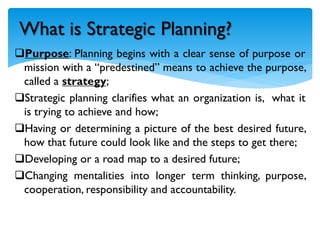
Purpose: Planning begins with a clear sense of purpose or
mission with a “predestined” means to achieve the purpose,
called a strategy;
Strategic planning clarifies what an organization is, what it
is trying to achieve and how;
Having or determining a picture of the best desired future,
how that future could look like and the steps to get there;
Developing or a road map to a desired future;
Changing mentalities into longer term thinking, purpose,
cooperation, responsibility and accountability.
What is Strategic Planning?
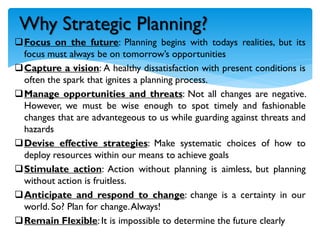
Focus on the future: Planning begins with todays realities, but its
focus must always be on tomorrow’s opportunities
Capture a vision: A healthy dissatisfaction with present conditions is
often the spark that ignites a planning process.
Manage opportunities and threats: Not all changes are negative.
However, we must be wise enough to spot timely and fashionable
changes that are advantegeous to us while guarding against threats and
hazards
Devise effective strategies: Make systematic choices of how to
deploy resources within our means to achieve goals
Stimulate action: Action without planning is aimless, but planning
without action is fruitless.
Anticipate and respond to change: change is a certainty in our
world. So? Plan for change.Always!
Remain Flexible: It is impossible to determine the future clearly
Why Strategic Planning?
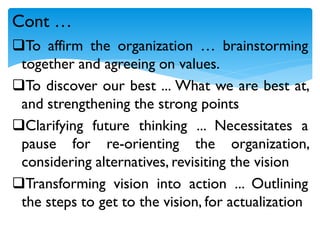
To affirm the organization … brainstorming
together and agreeing on values.
To discover our best ... What we are best at,
and strengthening the strong points
Clarifying future thinking ... Necessitates a
pause for re-orienting the organization,
considering alternatives, revisiting the vision
Transforming vision into action ... Outlining
the steps to get to the vision, for actualization
Cont …
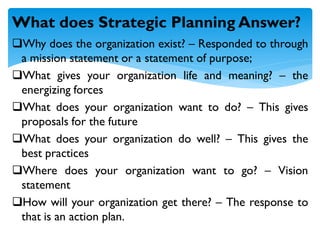
Why does the organization exist? – Responded to through
a mission statement or a statement of purpose;
What gives your organization life and meaning? – the
energizing forces
What does your organization want to do? – This gives
proposals for the future
What does your organization do well? – This gives the
best practices
Where does your organization want to go? – Vision
statement
How will your organization get there? – The response to
that is an action plan.
What does Strategic Planning Answer?
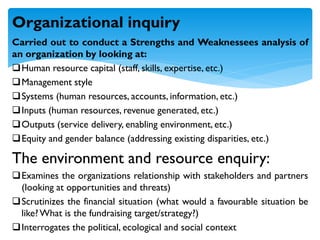
Carried out to conduct a Strengths and Weaknessees analysis of
an organization by looking at:
Human resource capital (staff, skills, expertise, etc.)
Management style
Systems (human resources, accounts, information, etc.)
Inputs (human resources, revenue generated, etc.)
Outputs (service delivery, enabling environment, etc.)
Equity and gender balance (addressing existing disparities, etc.)
The environment and resource enquiry:
Examines the organizations relationship with stakeholders and partners
(looking at opportunities and threats)
Scrutinizes the financial situation (what would a favourable situation be
like?What is the fundraising target/strategy?)
Interrogates the political, ecological and social context
Organizational inquiry
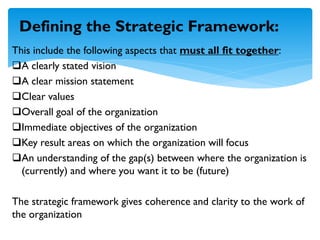
This include the following aspects that must all fit together:
A clearly stated vision
A clear mission statement
Clear values
Overall goal of the organization
Immediate objectives of the organization
Key result areas on which the organization will focus
An understanding of the gap(s) between where the organization is
(currently) and where you want it to be (future)
The strategic framework gives coherence and clarity to the work of
the organization
Defining the Strategic Framework:
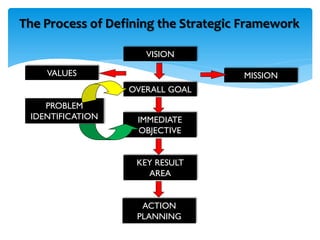
The Process of Defining the Strategic Framework
VISION
OVERALL GOAL
IMMEDIATE
OBJECTIVE
KEY RESULT
AREA
ACTION
PLANNING
MISSIONVALUES
PROBLEM
IDENTIFICATION
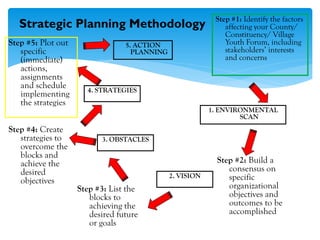
Strategic Planning Methodology Step #1: Identify the factors
affecting your County/
Constituency/ Village
Youth Forum, including
stakeholders’ interests
and concerns
Step #2: Build a
consensus on
specific
organizational
objectives and
outcomes to be
accomplished
Step #3: List the
blocks to
achieving the
desired future
or goals
Step #4: Create
strategies to
overcome the
blocks and
achieve the
desired
objectives
Step #5: Plot out
specific
(immediate)
actions,
assignments
and schedule
implementing
the strategies
1. ENVIRONMENTAL
SCAN
2. VISION
3. OBSTACLES
4. STRATEGIES
5. ACTION
PLANNING
1. Vision Statement – It is a concise expression of the
organization’s best future with the following desirable
characteristics:
Conveys what a people in the organization imagine possible
Must be shared
Is never impossed but is generated, understood, accepted
and lived by all
Broadly describes what the organization aspires to be and
the circumstances it intends to create
Communicates an organizations existance for external
relations
Strategic Orientation for the Organization
(Setting Strategic Goals)
Imagine in one or more years the following: (a)
What kind of organization will it be? (b) What will
the organization look like? (c) What will the
organization change?
Review the above questions and responses,
looking for common points.
Summarize all those possibilities presented into
one acceptable statement (that all those
involved can identify with ... And that describes
a state of being)
Drafting aVision Statement
Respond to the four questions listed in a previous
slide: why? Who? What? How? Where?
List the responses and take note of the ones that
best capture the purpose, target audience and the
business of the organization
Ensure the statements you create is consistent with
the vision statement
Seek consensus on the draft statement
Present it to other stakeholders and if agreeable,
adopt it as the most suitable organizations mission
statement
Drafting a Mission Statement
These are shared values or guiding principles
that underpin your work and relationship as an
organization
They are what individuals believe to be true
about themselves … eg.??
How one believes the world ought to be
There is need to clarify and reach consensus on
an organization’s values as it forms a basis for
making difficult decisions
OrganizationalValues
Step #1: Reflect on the vision statement then ask –
what are the values implicit in the vision that guide us as
we contribute towards it?
Step #2: List the values and value statements that come
up
Step #3:Agree in consensus what is shared and taken to
be the organization’s values
Drafting an Organization’sValues:
This is a broad response to “how the organization will get
there”
It outlines the practical and achievable action
Reviews the building blocks (inquiries into the organization
including the SWOT, vision, mission, etc)
Highlights of the gaps and strengths identified
Brainstorms and generates a range of specific actions that will
move the organization towards the desired future
From the list of actions we determine and consider: when they
will take place; who will be responsible; what forms of
technical assistance will be required (e.g. human and/or
financial resources, training, partnerships, equipment, etc)
It is presented, validated, endorsed and adopted
Developing the Action Plan
It is important to implement the strategic plan as soon
as it is endorsed
Carry out periodic monitoring and evaluation of the
strategic plan to ensure it is within the agreed
framework
Adjust the strategic plan according to the
organizations changing or emerging realities without
altering the vision, mission and goals
Inspire full participation of all parties and stakeholders
in the implementation of the proposed activities to
enhance transparency and accountability
Follow-up Action
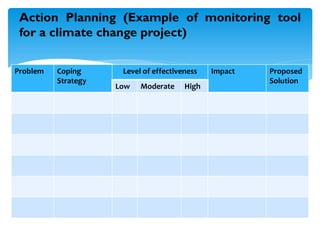
Problem Coping
Strategy
Level of effectiveness Impact Proposed
Solution
Low Moderate High
Action Planning (Example of monitoring tool
for a climate change project)
SP - Samples
“It is only when a mosquito lands
on your testicles that you realize
there is always a way to solve
problems without using violence”
- Chinese Proverb
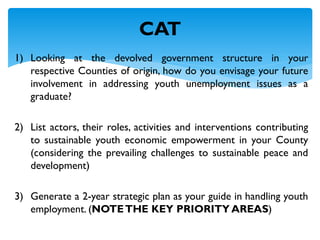
1) Looking at the devolved government structure in your
respective Counties of origin, how do you envisage your future
involvement in addressing youth unemployment issues as a
graduate?
2) List actors, their roles, activities and interventions contributing
to sustainable youth economic empowerment in your County
(considering the prevailing challenges to sustainable peace and
development)
3) Generate a 2-year strategic plan as your guide in handling youth
employment. (NOTETHE KEY PRIORITY AREAS)
CAT
Aii … Aii Mayi; Aii Aii …Mayi (x2)
OmwanaWanje
Aii Natembea Tira Omwana Natembea
The Small Frog and the Big Frog

Strategic Planning Workshop - Moi University SMSA

  • 1.
    Strategic Planning Workshop forStrategic Management Students Association (SMSA) Moi University, 17th November, 2015 Daniel Were, Sector Specialist, Peniel Development Consult
  • 2.
    What is StrategicPlanning? Why Strategic Planning? What does strategic planning answer? What is Organizational Inquiry Defining the Strategic Framework Strategic Planning Methodology How to envision the future Action Planning CAT Overview:
  • 3.
    Strategic planning providesa bridge to the future The strategic planning process clarifies mission, comes to grips with the internal and external environments, identifies major issues that demand response and directs energy and resources towards creative and positive initiatives The strategic planning process develops strategic thinking, a prerequisite for progressive change and improvement Strategic planning is all about choosing the best goals while applying visionary leadership to determine the desired future (Speed and efficiency are not assets when you are travelling down the wrong road)  Strategic leaders consistently ask questions about what new thing must be done today in order to meet the challenges of tomorrow; what should be done now to be ready for the opportunities that may come our way next? Some Facts:
  • 4.
    Purpose: Planning beginswith a clear sense of purpose or mission with a “predestined” means to achieve the purpose, called a strategy; Strategic planning clarifies what an organization is, what it is trying to achieve and how; Having or determining a picture of the best desired future, how that future could look like and the steps to get there; Developing or a road map to a desired future; Changing mentalities into longer term thinking, purpose, cooperation, responsibility and accountability. What is Strategic Planning?
  • 5.
    Focus on thefuture: Planning begins with todays realities, but its focus must always be on tomorrow’s opportunities Capture a vision: A healthy dissatisfaction with present conditions is often the spark that ignites a planning process. Manage opportunities and threats: Not all changes are negative. However, we must be wise enough to spot timely and fashionable changes that are advantegeous to us while guarding against threats and hazards Devise effective strategies: Make systematic choices of how to deploy resources within our means to achieve goals Stimulate action: Action without planning is aimless, but planning without action is fruitless. Anticipate and respond to change: change is a certainty in our world. So? Plan for change.Always! Remain Flexible: It is impossible to determine the future clearly Why Strategic Planning?
  • 6.
    To affirm theorganization … brainstorming together and agreeing on values. To discover our best ... What we are best at, and strengthening the strong points Clarifying future thinking ... Necessitates a pause for re-orienting the organization, considering alternatives, revisiting the vision Transforming vision into action ... Outlining the steps to get to the vision, for actualization Cont …
  • 7.
    Why does theorganization exist? – Responded to through a mission statement or a statement of purpose; What gives your organization life and meaning? – the energizing forces What does your organization want to do? – This gives proposals for the future What does your organization do well? – This gives the best practices Where does your organization want to go? – Vision statement How will your organization get there? – The response to that is an action plan. What does Strategic Planning Answer?
  • 8.
    Carried out toconduct a Strengths and Weaknessees analysis of an organization by looking at: Human resource capital (staff, skills, expertise, etc.) Management style Systems (human resources, accounts, information, etc.) Inputs (human resources, revenue generated, etc.) Outputs (service delivery, enabling environment, etc.) Equity and gender balance (addressing existing disparities, etc.) The environment and resource enquiry: Examines the organizations relationship with stakeholders and partners (looking at opportunities and threats) Scrutinizes the financial situation (what would a favourable situation be like?What is the fundraising target/strategy?) Interrogates the political, ecological and social context Organizational inquiry
  • 9.
    This include thefollowing aspects that must all fit together: A clearly stated vision A clear mission statement Clear values Overall goal of the organization Immediate objectives of the organization Key result areas on which the organization will focus An understanding of the gap(s) between where the organization is (currently) and where you want it to be (future) The strategic framework gives coherence and clarity to the work of the organization Defining the Strategic Framework:
  • 10.
    The Process ofDefining the Strategic Framework VISION OVERALL GOAL IMMEDIATE OBJECTIVE KEY RESULT AREA ACTION PLANNING MISSIONVALUES PROBLEM IDENTIFICATION
  • 11.
    Strategic Planning MethodologyStep #1: Identify the factors affecting your County/ Constituency/ Village Youth Forum, including stakeholders’ interests and concerns Step #2: Build a consensus on specific organizational objectives and outcomes to be accomplished Step #3: List the blocks to achieving the desired future or goals Step #4: Create strategies to overcome the blocks and achieve the desired objectives Step #5: Plot out specific (immediate) actions, assignments and schedule implementing the strategies 1. ENVIRONMENTAL SCAN 2. VISION 3. OBSTACLES 4. STRATEGIES 5. ACTION PLANNING
  • 13.
    1. Vision Statement– It is a concise expression of the organization’s best future with the following desirable characteristics: Conveys what a people in the organization imagine possible Must be shared Is never impossed but is generated, understood, accepted and lived by all Broadly describes what the organization aspires to be and the circumstances it intends to create Communicates an organizations existance for external relations Strategic Orientation for the Organization (Setting Strategic Goals)
  • 14.
    Imagine in oneor more years the following: (a) What kind of organization will it be? (b) What will the organization look like? (c) What will the organization change? Review the above questions and responses, looking for common points. Summarize all those possibilities presented into one acceptable statement (that all those involved can identify with ... And that describes a state of being) Drafting aVision Statement
  • 15.
    Respond to thefour questions listed in a previous slide: why? Who? What? How? Where? List the responses and take note of the ones that best capture the purpose, target audience and the business of the organization Ensure the statements you create is consistent with the vision statement Seek consensus on the draft statement Present it to other stakeholders and if agreeable, adopt it as the most suitable organizations mission statement Drafting a Mission Statement
  • 16.
    These are sharedvalues or guiding principles that underpin your work and relationship as an organization They are what individuals believe to be true about themselves … eg.?? How one believes the world ought to be There is need to clarify and reach consensus on an organization’s values as it forms a basis for making difficult decisions OrganizationalValues
  • 17.
    Step #1: Reflecton the vision statement then ask – what are the values implicit in the vision that guide us as we contribute towards it? Step #2: List the values and value statements that come up Step #3:Agree in consensus what is shared and taken to be the organization’s values Drafting an Organization’sValues:
  • 18.
    This is abroad response to “how the organization will get there” It outlines the practical and achievable action Reviews the building blocks (inquiries into the organization including the SWOT, vision, mission, etc) Highlights of the gaps and strengths identified Brainstorms and generates a range of specific actions that will move the organization towards the desired future From the list of actions we determine and consider: when they will take place; who will be responsible; what forms of technical assistance will be required (e.g. human and/or financial resources, training, partnerships, equipment, etc) It is presented, validated, endorsed and adopted Developing the Action Plan
  • 19.
    It is importantto implement the strategic plan as soon as it is endorsed Carry out periodic monitoring and evaluation of the strategic plan to ensure it is within the agreed framework Adjust the strategic plan according to the organizations changing or emerging realities without altering the vision, mission and goals Inspire full participation of all parties and stakeholders in the implementation of the proposed activities to enhance transparency and accountability Follow-up Action
  • 20.
    Problem Coping Strategy Level ofeffectiveness Impact Proposed Solution Low Moderate High Action Planning (Example of monitoring tool for a climate change project)
  • 21.
  • 22.
    “It is onlywhen a mosquito lands on your testicles that you realize there is always a way to solve problems without using violence” - Chinese Proverb
  • 23.
    1) Looking atthe devolved government structure in your respective Counties of origin, how do you envisage your future involvement in addressing youth unemployment issues as a graduate? 2) List actors, their roles, activities and interventions contributing to sustainable youth economic empowerment in your County (considering the prevailing challenges to sustainable peace and development) 3) Generate a 2-year strategic plan as your guide in handling youth employment. (NOTETHE KEY PRIORITY AREAS) CAT
  • 24.
    Aii … AiiMayi; Aii Aii …Mayi (x2) OmwanaWanje Aii Natembea Tira Omwana Natembea The Small Frog and the Big Frog