Scenario Planning   Drs. H. Dadang Solihin, MA Jakarta, January 29, 2007
Materi Apa itu Scenario Planning? Perbedaan antara Scenario, Forecast, dan Visions Dimensi Scenario Planning Perbandingan Karakteristik Traditional Planning dan Scenario Planning. Steps in Scenario Planning Tahapan Membuat Skenario Some Traps to Avoid Level of Strategic Thinking Level of Integration Models for Scenario Project Scenarios and Uncertainties Contoh: Daily Newspapers Contoh: Scenario Indonesia 2010 Contoh: China Scenarios to 2025 Contoh: India Scenarios to 2025 Contoh Pandangan dari Jawa Barat: Skenario Indonesia 2010
Apa itu  Scenario Planning? “ An internally consistent view of what the future might turn out to be” (Michael Porter, 1985). “ A tool [for] ordering one’s perceptions about alternative future environments in which one’s decision might be played out right” (Peter Schwartz, 1991). “ That part of strategic planning which relates to the tools and technologies for managing the uncertainties of the future” (Gill Ringland, 1998). “ A disciplined method for imaging possible futures in which organizational decisions may be played out” (Paul Shoemaker, 1995).
Apa itu  Scenario Planning? Scenario Planning is a model that can be used to explore and learn the future in which a corporate strategy is formed.  It works by describing a small number of scenarios, by creating stories how the future may unfold, and how this may affect an issue that confronts the corporation. Scenarios are carefully crafted stories about the future embodying a wide variety of ideas and integrating them in a way that is communicable and useful.  Scenarios help us to link uncertainties about the future to the decisions that we must make today (Royal Dutch Shell).
Apa itu  Scenario Planning? The scenario planning method works by understanding the nature and impact of the most uncertain and important driving forces affecting the future.  It is a group process which encourages knowledge exchange and development of mutual deeper understanding of central issues that are important to the future of your business.  The goal is to create and craft a number of diverging stories by extrapolating uncertain and heavily influencing driving forces.  The stories, plus the processes to create them, have a dual aim:  to increase the knowledge of the business environment and  to widen both the receiver's and participant's perception of possible future events.  The method is most widely used as a strategic management tool, but it is also used for enabling group discussion about a common future.
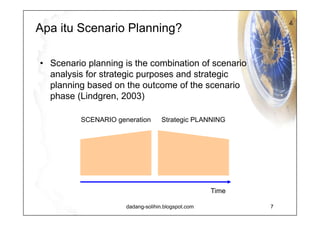
Apa itu  Scenario Planning? Scenario planning is the combination of scenario analysis for strategic purposes and strategic planning based on the outcome of the scenario phase (Lindgren, 2003) SCENARIO generation Strategic PLANNING Time
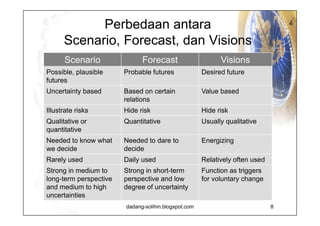
Perbedaan antara  Scenario, Forecast, dan  Visions Value based Based on certain relations Uncertainty based Desired future Probable futures Possible, plausible futures Usually qualitative Quantitative Qualitative or quantitative Hide risk Hide risk Illustrate risks Function as triggers  for voluntary change Strong in short-term perspective and low degree of uncertainty Strong in medium to long-term perspective and medium to high uncertainties Relatively often used Daily used Rarely used Energizing Needed to dare to decide Needed to know what we decide Visions Forecast Scenario
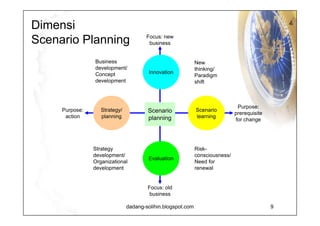
Dimensi  Scenario Planning Strategy/ planning Innovation Evaluation Scenario learning Scenario planning Risk-consciousness/ Need for renewal Focus: new business Purpose: prerequisite for change New thinking/ Paradigm shift Focus: old business Strategy development/ Organizational development Business development/ Concept development Purpose: action
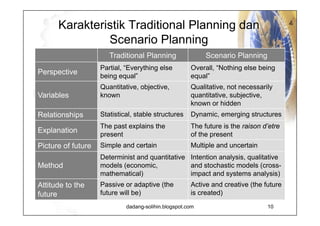
Karakteristik  Traditional Planning dan Scenario Planning Overall, “Nothing else being equal” Partial, “Everything else being equal” Perspective The future is the  raison d’etre  of the present The past explains the present Explanation Dynamic, emerging structures Statistical, stable structures Relationships Qualitative, not necessarily quantitative, subjective, known or hidden Quantitative, objective, known Variables Active and creative (the future is created) Passive or adaptive (the future will be) Attitude to the future Intention analysis, qualitative and stochastic models (cross-impact and systems analysis) Determinist and quantitative models (economic, mathematical) Method Multiple and uncertain Simple and certain Picture of future Scenario Planning Traditional Planning
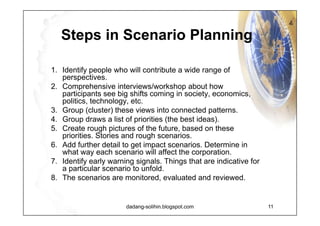
Steps in Scenario Planning Identify people who will contribute a wide range of perspectives. Comprehensive interviews/workshop about how participants see big shifts coming in society, economics, politics, technology, etc.  Group (cluster) these views into connected patterns. Group draws a list of priorities (the best ideas). Create rough pictures of the future, based on these priorities. Stories and rough scenarios. Add further detail to get impact scenarios. Determine in what way each scenario will affect the corporation. Identify early warning signals. Things that are indicative for a particular scenario to unfold. The scenarios are monitored, evaluated and reviewed.
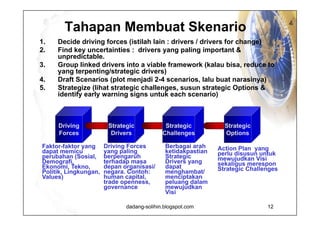
Tahapan Membuat Skenario Decide driving forces (istilah lain : drivers / drivers for change) Find key uncertainties :  drivers yang paling important & unpredictable.  Group linked drivers into a viable framework (kalau bisa, reduce to yang terpenting/strategic drivers) Draft Scenarios (plot menjadi 2-4 scenarios, lalu buat narasinya) Strategize (lihat strategic challenges, susun strategic Options & identify early warning signs untuk each scenario) Driving Forces Strategic Drivers Strategic Challenges Strategic Options Faktor-faktor yang dapat memicu perubahan (Sosial,  Demografi, Ekonomi, Tekno, Politik, Lingkungan, Values) Driving Forces yang paling berpengaruh terhadap masa depan organisasi/ negara. Contoh:  human capital, trade openness, governance Berbagai arah ketidakpastian  Strategic Drivers yang dapat menghambat/ menciptakan peluang dalam mewujudkan Visi Action Plan  yang perlu disusun untuk mewujudkan Visi sekaligus merespon  Strategic Challenges
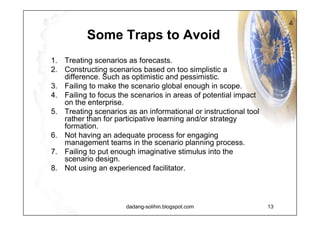
Some Traps to Avoid Treating scenarios as forecasts. Constructing scenarios based on too simplistic a difference. Such as optimistic and pessimistic. Failing to make the scenario global enough in scope. Failing to focus the scenarios in areas of potential impact on the enterprise. Treating scenarios as an informational or instructional tool rather than for participative learning and/or strategy formation. Not having an adequate process for engaging management teams in the scenario planning process. Failing to put enough imaginative stimulus into the scenario design. Not using an experienced facilitator.
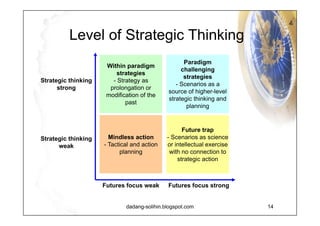
Level of Strategic Thinking Within paradigm strategies - Strategy as prolongation or modification of the past Paradigm challenging strategies - Scenarios as a source of higher-level strategic thinking and planning Mindless action - Tactical and action planning Future trap - Scenarios as science or intellectual exercise with no connection to strategic action Strategic thinking strong Strategic thinking weak Futures focus weak Futures focus strong
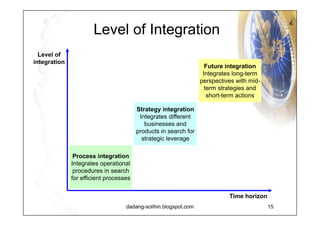
Level of Integration Process integration Integrates operational procedures in search for efficient processes Level of integration Time horizon Strategy integration Integrates different businesses and products in search for strategic leverage Future integration Integrates long-term perspectives with mid-term strategies and short-term actions
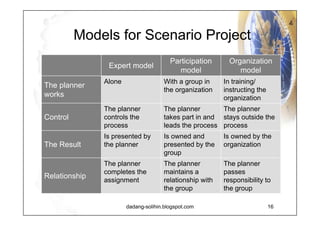
Models for Scenario Project In training/ instructing the organization With a group in the organization Alone The planner works The planner passes responsibility to the group The planner maintains a relationship with the group The planner completes the assignment Relationship Is owned by the organization Is owned and presented by the group Is presented by the planner The Result The planner stays outside the process The planner takes part in and leads the process The planner controls the process Control Organization model Participation model Expert model
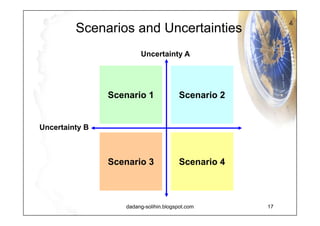
Scenarios and Uncertainties Scenario 1 Scenario 2 Scenario 3 Scenario 4 Uncertainty A Uncertainty B
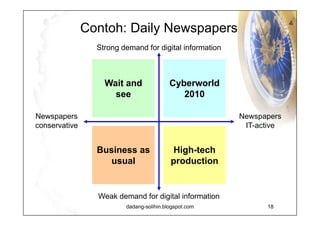
Contoh:  Daily Newspapers Wait and  see Cyberworld 2010 Business as usual High-tech production Strong demand for digital information Newspapers conservative Newspapers  IT-active Weak demand for digital information
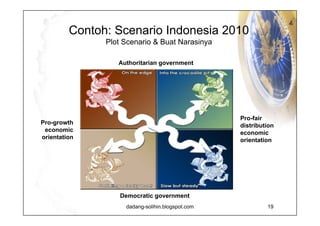
Contoh: Scenario Indonesia 2010  Plot Scenario & Buat Narasinya Pro-fair distribution economic orientation Pro-growth economic orientation Democratic government Authoritarian government
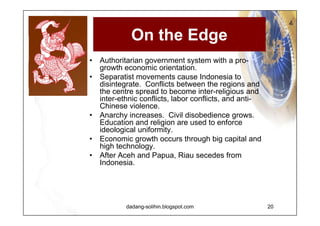
On the Edge Authoritarian government system with a pro-growth economic orientation. Separatist movements cause Indonesia to disintegrate.  Conflicts between the regions and the centre spread to become inter-religious and inter-ethnic conflicts, labor conflicts, and anti-Chinese violence.  Anarchy increases.  Civil disobedience grows.  Education and religion are used to enforce ideological uniformity. Economic growth occurs through big capital and high technology. After Aceh and Papua, Riau secedes from Indonesia.
Padding a Leaky Boat Combines a democratic government system with a pro-growth economic orientation. Indonesia become democratic, with a free press and the rule of law. Regional autonomy works.  Economic problems are overcome through growth, both through foreign investment and using domestic assets.
Into the Crocodile Pit Combines an authoritarian government with a pro-fair distribution economic orientation. Indonesia becomes more authoritarian due to economic isolation.  To keep up popular subsidies, the government over-exploits natural resources. Factories close, as resources grow scarce.  Forced agriculture is brought backs, as in colonial times. Dissidents are kept down by terror.  Nationalist soldiers join populist forces to launch a coup d’etat.
Slow but Steady Combines a democratic government with pro-fair distribution economic orientation. Successful regional autonomy and decentralization saves Indonesia from destruction Democracy survives the end of the New Order.  Foreign investors return, as does international credibility. Violence recedes.  Justice becomes the basis for resolving conflict. Economic growth is low profile, but fait distribution reaches the regions.
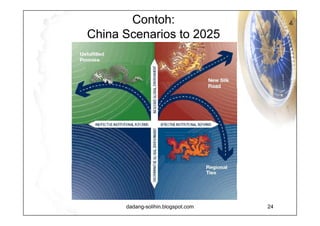
Contoh: China Scenarios to 2025
Regional Ties Regional Ties  describes how China continues on the path of reform despite an international environment that becomes increasingly difficult. Chinese leadership and vision facilitate the forging of regional ties that help overcome historical enmities and restore prosperity in Asia. The scenario is written as a Government White Paper, reflecting on 20 years of progress in China, a medium often used by the Chinese government to communicate to the public-at-large on a major issue, to lay out its policy or to reflect on the past.
Unfulfilled Promise Unfulfilled Promise  describes a China where the desire for economic development is not supported by the necessary structural reforms. The name reflects the general sentiment among the Chinese people that the promise made to them in terms of inclusive economic development has been largely unfulfilled. The story is told as an article in a Western online journal and reviews China’s development over the period 2006-2025.
New Silk Road New Silk Road   describes the flourishing economic and cultural rise of China, a feat achieved despite the presence of substantial internal obstacles. The scenario reflects China’s peaceful geopolitical integration and its sizeable role in the exchange of goods, services, investments and ideas. In this way it recreates the original Silk Road. The scenario is told using the Online Encyclopaedia of the World and provides a factual account of what China has achieved over a 20-year period.
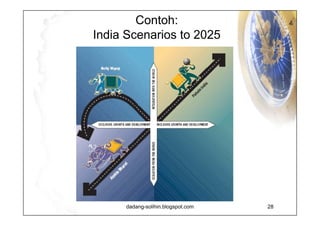
Contoh: India Scenarios to 2025
Bolly World “ Bollywood” is the name given to the highly successful Indian film industry, famous for its masala movies—melodramatic extravaganzas with spectacular song and dance numbers. The title “Bolly World” reflects a future in which India’s leaders are so dazzled by the immediate gains to be made in international markets that they fail to implement much needed domestic reforms. The scenario is told as a conversation overheard on a plane flying from Delhi to Dubai in 2025. A chartered accountant tells his traveling companion why he thinks India is no longer experiencing international success and is facing so many problems. As he puts it, the situation “is just like Bollywood itself—once you get behind all the glitter and the razzmatazz, you realize—the whole thing is just an illusion.”
Pahale India “ Pahale India” means “India First” and this is reflected in the scenario in at least three ways:  people from across India put the needs of their community and country first;  India emerges as a global economic leader; and  India’s dynamic internal developments make it a source of inspiration for the rest of the world. This story is told by a successful Indian business woman at the 40 th  India Economic Summit in 2025. Her keynote speech explores the reasons for India’s remarkable success.
Atakta Bharat “ Atakta Bharat”   des cribes an India “getting stuck without  direction” reflecting  the lack of unified action and absence  of effective   leaders hip that, in this scenario, create a  continuous and   cu mulative source of problems for India. The scenario is told as the transcript of a speech given at the monthly forum of the Hyderabad GM Crop Collective. The collective—a collaboration between the Hyderabad Farmers, Seed Developers and Rural Workers Cooperatives—is an example of one of the more positive responses made by some Indians to the multitude of troubles facing India. The speech itself also draws attention to the importance of self-organization and self-help. Entitled “India’s last 20 years: Why we must help ourselves”, it explores how initial well intentioned attempts at reform in India failed—because of corruption, inadequate planning and insufficient political will. The speaker raises a number of what he calls “if onlys” to describe how India’s future could have been very different.
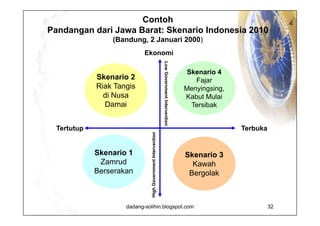
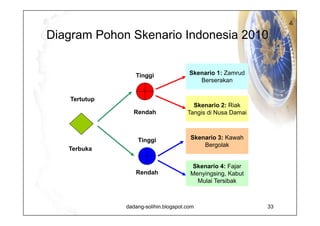
Contoh Pandangan dari Jawa Barat: Skenario Indonesia 2010  ( Bandung, 2 Januari 2000 ) Ekonomi Skenario 1   Zamrud Berserakan Skenario 3   Kawah Bergolak Skenario 2   Riak Tangis di Nusa Damai Skenario 4   Fajar Menyingsing, Kabut Mulai Tersibak Tertutup Tertutup Low Government Intervention High Government Intervention
Diagram Pohon Skenario Indonesia 2010 Skenario 1:  Zamrud Berserakan Skenario 2:  Riak Tangis di Nusa Damai Skenario 3:  Kawah Bergolak Skenario 4:  Fajar Menyingsing, Kabut Mulai Tersibak Tinggi Rendah Tinggi Rendah Tertutup Terbuka
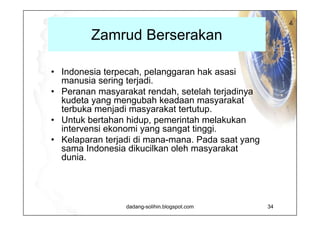
Zamrud Berserakan Indonesia terpecah, pelanggaran hak asasi manusia sering terjadi.  Peranan masyarakat rendah, setelah terjadinya kudeta yang mengubah keadaan masyarakat terbuka menjadi masyarakat tertutup.  Untuk bertahan hidup, pemerintah melakukan intervensi ekonomi yang sangat tinggi.  Kelaparan terjadi di mana-mana. Pada saat yang sama Indonesia dikucilkan oleh masyarakat dunia.
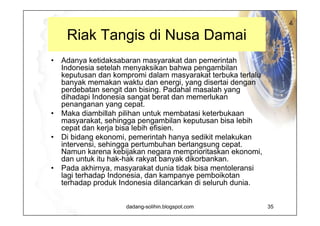
Riak Tangis di Nusa Damai Adanya  ketidaksabaran masyarakat dan pemerintah Indonesia setelah menyaksikan bahwa pengambilan keputusan dan kompromi dalam masyarakat terbuka terlalu banyak memakan waktu dan energi, yang disertai dengan perdebatan sengit dan bising. Padahal masalah yang dihadapi Indonesia sangat berat dan memerlukan penanganan yang cepat.  Maka diambillah pilihan untuk membatasi keterbukaan masyarakat, sehingga pengambilan keputusan bisa lebih cepat dan kerja bisa lebih efisien.  Di bidang ekonomi, pemerintah hanya sedikit melakukan intervensi, sehingga pertumbuhan berlangsung cepat. Namun karena kebijakan negara memprioritaskan ekonomi, dan untuk itu hak-hak rakyat banyak dikorbankan.  Pada akhirnya, masyarakat dunia tidak bisa mentoleransi lagi terhadap Indonesia, dan kampanye pemboikotan terhadap produk Indonesia dilancarkan di seluruh dunia.
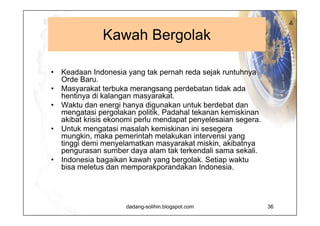
Kawah Bergolak K eadaan Indonesia yang tak pernah reda sejak runtuhnya Orde Baru.  Masyarakat terbuka merangsang perdebatan tidak ada hentinya di kalangan masyarakat.  Waktu dan energi hanya digunakan untuk berdebat dan mengatasi pergolakan politik. Padahal tekanan kemiskinan akibat krisis ekonomi perlu mendapat penyelesaian segera.  Untuk mengatasi masalah kemiskinan ini sesegera mungkin, maka pemerintah melakukan intervensi yang tinggi demi menyelamatkan masyarakat miskin, akibatnya pengurasan sumber daya alam tak terkendali sama sekali.  Indonesia bagaikan kawah yang bergolak. Setiap waktu bisa meletus dan memporakporandakan Indonesia.
Fajar Menyingsing, Kabut Mulai Tersibak M asyarakat dan pemerintah konsisten dan sabar untuk membangun masyarakat terbuka, yang mendorong makin kuatnya peranan masyarakat dan makin berkurangnya kekuasaan pemerintah.  Ketidaksabaran memang terus menggoda dan korban benar-benar berjatuhan. Berkali-kali masyarakat dan pemerintah tergoda untuk mengurangi keterbukaan masyarakat, tapi niat itu dikalahkan dengan ketakutan makin terancamnya kemanusiaan dan Indonesia.  Di bidang ekonomi, pemerintah mengurangi intervensinya, kecuali beras.  Konflik-konflik horisontal yang terjadi di awal pemerintahan Gus Dur membuat orang makin takut terhadap perpecahan. Jika Indonesia pecah, maka nusantara akan kembali seperti sebelum dijajah Belanda.  Perang antar negara baru tak akan terelakkan. Ketakutan perang antar negara -pecahan Indonesia- inilah yang menjadikan masyarakat tetap menjaga kesatuan Indonesia.
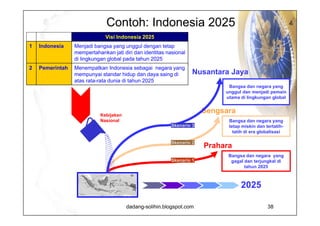
Contoh: Indonesia 2025 Prahara Sengsara Nusantara Jaya Bangsa dan negara  yang gagal dan terjungkal di tahun 2025 Bangsa dan negara yang tetap miskin dan tertatih-tatih di era globalisasi Bangsa dan negara yang unggul dan menjadi pemain utama di lingkungan global   2025 Skenario 1 Skenario 2 Skenario 3 Kebijakan Nasional Menempatkan Indonesia sebagai  negara yang mempunyai standar hidup dan daya saing di atas rata-rata dunia di tahun 2025  Pemerintah 2 Menjadi bangsa yang unggul dengan tetap mempertahankan jati diri dan identitas nasional di lingkungan global pada tahun 2025  Indonesia 1 Visi Indonesia 2025
Daftar Pustaka 'Eisy, Muhammad Ridlo (2000) Pertemuan Puncak - Dialog Regional Jawa Barat Menyusun Skenario Indonesia Masa Depan Pandangan dari Jawa Barat : Skenario Indonesia 2010, http://www.geocities.com/ind2010/serta.htm LINGREN, Mats and Hans Bandhold, 2003, “Scenario Planning, the Link between Future and Strategy”, New York: Palgrave MacMillan Hermana, Budi (2007)  “ Peran BI Menuju Indonesia 2025: Prahara, Sengsara, atau Nusantara Jaya? ” , Universitas Gunadarma RINGLAND, Gill, 2006.Scenario Planning, West Sussex: John Willey & Sons Ltd “ What is Scenario Planning?”, http://www.12manage.com/ methods_scenario_planning.html World Economic Forum (2006) World Scenario Series, China and the World: Scenarios to 2025, www.weforum.org  World Economic Forum (2006) World Scenario Series, India and the World: Scenarios to 2025, www.weforum.org
Terima Kasih
Dadang holds a MA degree (Economics), University of Colorado, USA. His previous post is Head, Center for Research Data and Information at DPD Secretariat General as well as Deputy Director for Information of Spatial Planning and Land Use Management at Indonesian National Development Planning Agency (Bappenas).  Beside working as Assistant Professor at Graduate School of Asia-Pacific Studies, Waseda University, Tokyo, Japan, he also active as Associate Professor at University of Darma Persada, Jakarta, Indonesia. He got various training around the globe, included Advanced International Training Programme of Information Technology Management, at Karlstad City, Sweden (2005); the Training Seminar on Land Use and Management, Taiwan (2004);  Developing Multimedia Applications for Managers, Kuala Lumpur, Malaysia (2003); Applied Policy Development Training, Vancouver, Canada (2002); Local Government Administration Training Course, Hiroshima, Japan (2001); and Regional Development and Planning Training Course, Sapporo, Japan (1999). He published more than five books regarding local autonomous.  You can reach Dadang Solihin by email at  dadangsol@yahoo.com  or by his mobile at +62812 932 2202 Dadang Solihin’s Profile

Scenario Planning

  • 1.
    Scenario Planning Drs. H. Dadang Solihin, MA Jakarta, January 29, 2007
  • 2.
    Materi Apa ituScenario Planning? Perbedaan antara Scenario, Forecast, dan Visions Dimensi Scenario Planning Perbandingan Karakteristik Traditional Planning dan Scenario Planning. Steps in Scenario Planning Tahapan Membuat Skenario Some Traps to Avoid Level of Strategic Thinking Level of Integration Models for Scenario Project Scenarios and Uncertainties Contoh: Daily Newspapers Contoh: Scenario Indonesia 2010 Contoh: China Scenarios to 2025 Contoh: India Scenarios to 2025 Contoh Pandangan dari Jawa Barat: Skenario Indonesia 2010
  • 3.
    Apa itu Scenario Planning? “ An internally consistent view of what the future might turn out to be” (Michael Porter, 1985). “ A tool [for] ordering one’s perceptions about alternative future environments in which one’s decision might be played out right” (Peter Schwartz, 1991). “ That part of strategic planning which relates to the tools and technologies for managing the uncertainties of the future” (Gill Ringland, 1998). “ A disciplined method for imaging possible futures in which organizational decisions may be played out” (Paul Shoemaker, 1995).
  • 4.
    Apa itu Scenario Planning? Scenario Planning is a model that can be used to explore and learn the future in which a corporate strategy is formed. It works by describing a small number of scenarios, by creating stories how the future may unfold, and how this may affect an issue that confronts the corporation. Scenarios are carefully crafted stories about the future embodying a wide variety of ideas and integrating them in a way that is communicable and useful. Scenarios help us to link uncertainties about the future to the decisions that we must make today (Royal Dutch Shell).
  • 5.
    Apa itu Scenario Planning? The scenario planning method works by understanding the nature and impact of the most uncertain and important driving forces affecting the future. It is a group process which encourages knowledge exchange and development of mutual deeper understanding of central issues that are important to the future of your business. The goal is to create and craft a number of diverging stories by extrapolating uncertain and heavily influencing driving forces. The stories, plus the processes to create them, have a dual aim: to increase the knowledge of the business environment and to widen both the receiver's and participant's perception of possible future events. The method is most widely used as a strategic management tool, but it is also used for enabling group discussion about a common future.
  • 6.
    Apa itu Scenario Planning? Scenario planning is the combination of scenario analysis for strategic purposes and strategic planning based on the outcome of the scenario phase (Lindgren, 2003) SCENARIO generation Strategic PLANNING Time
  • 7.
    Perbedaan antara Scenario, Forecast, dan Visions Value based Based on certain relations Uncertainty based Desired future Probable futures Possible, plausible futures Usually qualitative Quantitative Qualitative or quantitative Hide risk Hide risk Illustrate risks Function as triggers for voluntary change Strong in short-term perspective and low degree of uncertainty Strong in medium to long-term perspective and medium to high uncertainties Relatively often used Daily used Rarely used Energizing Needed to dare to decide Needed to know what we decide Visions Forecast Scenario
  • 8.
    Dimensi ScenarioPlanning Strategy/ planning Innovation Evaluation Scenario learning Scenario planning Risk-consciousness/ Need for renewal Focus: new business Purpose: prerequisite for change New thinking/ Paradigm shift Focus: old business Strategy development/ Organizational development Business development/ Concept development Purpose: action
  • 9.
    Karakteristik TraditionalPlanning dan Scenario Planning Overall, “Nothing else being equal” Partial, “Everything else being equal” Perspective The future is the raison d’etre of the present The past explains the present Explanation Dynamic, emerging structures Statistical, stable structures Relationships Qualitative, not necessarily quantitative, subjective, known or hidden Quantitative, objective, known Variables Active and creative (the future is created) Passive or adaptive (the future will be) Attitude to the future Intention analysis, qualitative and stochastic models (cross-impact and systems analysis) Determinist and quantitative models (economic, mathematical) Method Multiple and uncertain Simple and certain Picture of future Scenario Planning Traditional Planning
  • 10.
    Steps in ScenarioPlanning Identify people who will contribute a wide range of perspectives. Comprehensive interviews/workshop about how participants see big shifts coming in society, economics, politics, technology, etc. Group (cluster) these views into connected patterns. Group draws a list of priorities (the best ideas). Create rough pictures of the future, based on these priorities. Stories and rough scenarios. Add further detail to get impact scenarios. Determine in what way each scenario will affect the corporation. Identify early warning signals. Things that are indicative for a particular scenario to unfold. The scenarios are monitored, evaluated and reviewed.
  • 11.
    Tahapan Membuat SkenarioDecide driving forces (istilah lain : drivers / drivers for change) Find key uncertainties : drivers yang paling important & unpredictable. Group linked drivers into a viable framework (kalau bisa, reduce to yang terpenting/strategic drivers) Draft Scenarios (plot menjadi 2-4 scenarios, lalu buat narasinya) Strategize (lihat strategic challenges, susun strategic Options & identify early warning signs untuk each scenario) Driving Forces Strategic Drivers Strategic Challenges Strategic Options Faktor-faktor yang dapat memicu perubahan (Sosial, Demografi, Ekonomi, Tekno, Politik, Lingkungan, Values) Driving Forces yang paling berpengaruh terhadap masa depan organisasi/ negara. Contoh: human capital, trade openness, governance Berbagai arah ketidakpastian Strategic Drivers yang dapat menghambat/ menciptakan peluang dalam mewujudkan Visi Action Plan yang perlu disusun untuk mewujudkan Visi sekaligus merespon Strategic Challenges
  • 12.
    Some Traps toAvoid Treating scenarios as forecasts. Constructing scenarios based on too simplistic a difference. Such as optimistic and pessimistic. Failing to make the scenario global enough in scope. Failing to focus the scenarios in areas of potential impact on the enterprise. Treating scenarios as an informational or instructional tool rather than for participative learning and/or strategy formation. Not having an adequate process for engaging management teams in the scenario planning process. Failing to put enough imaginative stimulus into the scenario design. Not using an experienced facilitator.
  • 13.
    Level of StrategicThinking Within paradigm strategies - Strategy as prolongation or modification of the past Paradigm challenging strategies - Scenarios as a source of higher-level strategic thinking and planning Mindless action - Tactical and action planning Future trap - Scenarios as science or intellectual exercise with no connection to strategic action Strategic thinking strong Strategic thinking weak Futures focus weak Futures focus strong
  • 14.
    Level of IntegrationProcess integration Integrates operational procedures in search for efficient processes Level of integration Time horizon Strategy integration Integrates different businesses and products in search for strategic leverage Future integration Integrates long-term perspectives with mid-term strategies and short-term actions
  • 15.
    Models for ScenarioProject In training/ instructing the organization With a group in the organization Alone The planner works The planner passes responsibility to the group The planner maintains a relationship with the group The planner completes the assignment Relationship Is owned by the organization Is owned and presented by the group Is presented by the planner The Result The planner stays outside the process The planner takes part in and leads the process The planner controls the process Control Organization model Participation model Expert model
  • 16.
    Scenarios and UncertaintiesScenario 1 Scenario 2 Scenario 3 Scenario 4 Uncertainty A Uncertainty B
  • 17.
    Contoh: DailyNewspapers Wait and see Cyberworld 2010 Business as usual High-tech production Strong demand for digital information Newspapers conservative Newspapers IT-active Weak demand for digital information
  • 18.
    Contoh: Scenario Indonesia2010 Plot Scenario & Buat Narasinya Pro-fair distribution economic orientation Pro-growth economic orientation Democratic government Authoritarian government
  • 19.
    On the EdgeAuthoritarian government system with a pro-growth economic orientation. Separatist movements cause Indonesia to disintegrate. Conflicts between the regions and the centre spread to become inter-religious and inter-ethnic conflicts, labor conflicts, and anti-Chinese violence. Anarchy increases. Civil disobedience grows. Education and religion are used to enforce ideological uniformity. Economic growth occurs through big capital and high technology. After Aceh and Papua, Riau secedes from Indonesia.
  • 20.
    Padding a LeakyBoat Combines a democratic government system with a pro-growth economic orientation. Indonesia become democratic, with a free press and the rule of law. Regional autonomy works. Economic problems are overcome through growth, both through foreign investment and using domestic assets.
  • 21.
    Into the CrocodilePit Combines an authoritarian government with a pro-fair distribution economic orientation. Indonesia becomes more authoritarian due to economic isolation. To keep up popular subsidies, the government over-exploits natural resources. Factories close, as resources grow scarce. Forced agriculture is brought backs, as in colonial times. Dissidents are kept down by terror. Nationalist soldiers join populist forces to launch a coup d’etat.
  • 22.
    Slow but SteadyCombines a democratic government with pro-fair distribution economic orientation. Successful regional autonomy and decentralization saves Indonesia from destruction Democracy survives the end of the New Order. Foreign investors return, as does international credibility. Violence recedes. Justice becomes the basis for resolving conflict. Economic growth is low profile, but fait distribution reaches the regions.
  • 23.
  • 24.
    Regional Ties RegionalTies describes how China continues on the path of reform despite an international environment that becomes increasingly difficult. Chinese leadership and vision facilitate the forging of regional ties that help overcome historical enmities and restore prosperity in Asia. The scenario is written as a Government White Paper, reflecting on 20 years of progress in China, a medium often used by the Chinese government to communicate to the public-at-large on a major issue, to lay out its policy or to reflect on the past.
  • 25.
    Unfulfilled Promise UnfulfilledPromise describes a China where the desire for economic development is not supported by the necessary structural reforms. The name reflects the general sentiment among the Chinese people that the promise made to them in terms of inclusive economic development has been largely unfulfilled. The story is told as an article in a Western online journal and reviews China’s development over the period 2006-2025.
  • 26.
    New Silk RoadNew Silk Road describes the flourishing economic and cultural rise of China, a feat achieved despite the presence of substantial internal obstacles. The scenario reflects China’s peaceful geopolitical integration and its sizeable role in the exchange of goods, services, investments and ideas. In this way it recreates the original Silk Road. The scenario is told using the Online Encyclopaedia of the World and provides a factual account of what China has achieved over a 20-year period.
  • 27.
  • 28.
    Bolly World “Bollywood” is the name given to the highly successful Indian film industry, famous for its masala movies—melodramatic extravaganzas with spectacular song and dance numbers. The title “Bolly World” reflects a future in which India’s leaders are so dazzled by the immediate gains to be made in international markets that they fail to implement much needed domestic reforms. The scenario is told as a conversation overheard on a plane flying from Delhi to Dubai in 2025. A chartered accountant tells his traveling companion why he thinks India is no longer experiencing international success and is facing so many problems. As he puts it, the situation “is just like Bollywood itself—once you get behind all the glitter and the razzmatazz, you realize—the whole thing is just an illusion.”
  • 29.
    Pahale India “Pahale India” means “India First” and this is reflected in the scenario in at least three ways: people from across India put the needs of their community and country first; India emerges as a global economic leader; and India’s dynamic internal developments make it a source of inspiration for the rest of the world. This story is told by a successful Indian business woman at the 40 th India Economic Summit in 2025. Her keynote speech explores the reasons for India’s remarkable success.
  • 30.
    Atakta Bharat “Atakta Bharat” des cribes an India “getting stuck without direction” reflecting the lack of unified action and absence of effective leaders hip that, in this scenario, create a continuous and cu mulative source of problems for India. The scenario is told as the transcript of a speech given at the monthly forum of the Hyderabad GM Crop Collective. The collective—a collaboration between the Hyderabad Farmers, Seed Developers and Rural Workers Cooperatives—is an example of one of the more positive responses made by some Indians to the multitude of troubles facing India. The speech itself also draws attention to the importance of self-organization and self-help. Entitled “India’s last 20 years: Why we must help ourselves”, it explores how initial well intentioned attempts at reform in India failed—because of corruption, inadequate planning and insufficient political will. The speaker raises a number of what he calls “if onlys” to describe how India’s future could have been very different.
  • 31.
    Contoh Pandangan dariJawa Barat: Skenario Indonesia 2010 ( Bandung, 2 Januari 2000 ) Ekonomi Skenario 1 Zamrud Berserakan Skenario 3 Kawah Bergolak Skenario 2 Riak Tangis di Nusa Damai Skenario 4 Fajar Menyingsing, Kabut Mulai Tersibak Tertutup Tertutup Low Government Intervention High Government Intervention
  • 32.
    Diagram Pohon SkenarioIndonesia 2010 Skenario 1: Zamrud Berserakan Skenario 2: Riak Tangis di Nusa Damai Skenario 3: Kawah Bergolak Skenario 4: Fajar Menyingsing, Kabut Mulai Tersibak Tinggi Rendah Tinggi Rendah Tertutup Terbuka
  • 33.
    Zamrud Berserakan Indonesiaterpecah, pelanggaran hak asasi manusia sering terjadi. Peranan masyarakat rendah, setelah terjadinya kudeta yang mengubah keadaan masyarakat terbuka menjadi masyarakat tertutup. Untuk bertahan hidup, pemerintah melakukan intervensi ekonomi yang sangat tinggi. Kelaparan terjadi di mana-mana. Pada saat yang sama Indonesia dikucilkan oleh masyarakat dunia.
  • 34.
    Riak Tangis diNusa Damai Adanya ketidaksabaran masyarakat dan pemerintah Indonesia setelah menyaksikan bahwa pengambilan keputusan dan kompromi dalam masyarakat terbuka terlalu banyak memakan waktu dan energi, yang disertai dengan perdebatan sengit dan bising. Padahal masalah yang dihadapi Indonesia sangat berat dan memerlukan penanganan yang cepat. Maka diambillah pilihan untuk membatasi keterbukaan masyarakat, sehingga pengambilan keputusan bisa lebih cepat dan kerja bisa lebih efisien. Di bidang ekonomi, pemerintah hanya sedikit melakukan intervensi, sehingga pertumbuhan berlangsung cepat. Namun karena kebijakan negara memprioritaskan ekonomi, dan untuk itu hak-hak rakyat banyak dikorbankan. Pada akhirnya, masyarakat dunia tidak bisa mentoleransi lagi terhadap Indonesia, dan kampanye pemboikotan terhadap produk Indonesia dilancarkan di seluruh dunia.
  • 35.
    Kawah Bergolak Keadaan Indonesia yang tak pernah reda sejak runtuhnya Orde Baru. Masyarakat terbuka merangsang perdebatan tidak ada hentinya di kalangan masyarakat. Waktu dan energi hanya digunakan untuk berdebat dan mengatasi pergolakan politik. Padahal tekanan kemiskinan akibat krisis ekonomi perlu mendapat penyelesaian segera. Untuk mengatasi masalah kemiskinan ini sesegera mungkin, maka pemerintah melakukan intervensi yang tinggi demi menyelamatkan masyarakat miskin, akibatnya pengurasan sumber daya alam tak terkendali sama sekali. Indonesia bagaikan kawah yang bergolak. Setiap waktu bisa meletus dan memporakporandakan Indonesia.
  • 36.
    Fajar Menyingsing, KabutMulai Tersibak M asyarakat dan pemerintah konsisten dan sabar untuk membangun masyarakat terbuka, yang mendorong makin kuatnya peranan masyarakat dan makin berkurangnya kekuasaan pemerintah. Ketidaksabaran memang terus menggoda dan korban benar-benar berjatuhan. Berkali-kali masyarakat dan pemerintah tergoda untuk mengurangi keterbukaan masyarakat, tapi niat itu dikalahkan dengan ketakutan makin terancamnya kemanusiaan dan Indonesia. Di bidang ekonomi, pemerintah mengurangi intervensinya, kecuali beras. Konflik-konflik horisontal yang terjadi di awal pemerintahan Gus Dur membuat orang makin takut terhadap perpecahan. Jika Indonesia pecah, maka nusantara akan kembali seperti sebelum dijajah Belanda. Perang antar negara baru tak akan terelakkan. Ketakutan perang antar negara -pecahan Indonesia- inilah yang menjadikan masyarakat tetap menjaga kesatuan Indonesia.
  • 37.
    Contoh: Indonesia 2025Prahara Sengsara Nusantara Jaya Bangsa dan negara yang gagal dan terjungkal di tahun 2025 Bangsa dan negara yang tetap miskin dan tertatih-tatih di era globalisasi Bangsa dan negara yang unggul dan menjadi pemain utama di lingkungan global 2025 Skenario 1 Skenario 2 Skenario 3 Kebijakan Nasional Menempatkan Indonesia sebagai negara yang mempunyai standar hidup dan daya saing di atas rata-rata dunia di tahun 2025 Pemerintah 2 Menjadi bangsa yang unggul dengan tetap mempertahankan jati diri dan identitas nasional di lingkungan global pada tahun 2025 Indonesia 1 Visi Indonesia 2025
  • 38.
    Daftar Pustaka 'Eisy,Muhammad Ridlo (2000) Pertemuan Puncak - Dialog Regional Jawa Barat Menyusun Skenario Indonesia Masa Depan Pandangan dari Jawa Barat : Skenario Indonesia 2010, http://www.geocities.com/ind2010/serta.htm LINGREN, Mats and Hans Bandhold, 2003, “Scenario Planning, the Link between Future and Strategy”, New York: Palgrave MacMillan Hermana, Budi (2007) “ Peran BI Menuju Indonesia 2025: Prahara, Sengsara, atau Nusantara Jaya? ” , Universitas Gunadarma RINGLAND, Gill, 2006.Scenario Planning, West Sussex: John Willey & Sons Ltd “ What is Scenario Planning?”, http://www.12manage.com/ methods_scenario_planning.html World Economic Forum (2006) World Scenario Series, China and the World: Scenarios to 2025, www.weforum.org World Economic Forum (2006) World Scenario Series, India and the World: Scenarios to 2025, www.weforum.org
  • 39.
  • 40.
    Dadang holds aMA degree (Economics), University of Colorado, USA. His previous post is Head, Center for Research Data and Information at DPD Secretariat General as well as Deputy Director for Information of Spatial Planning and Land Use Management at Indonesian National Development Planning Agency (Bappenas). Beside working as Assistant Professor at Graduate School of Asia-Pacific Studies, Waseda University, Tokyo, Japan, he also active as Associate Professor at University of Darma Persada, Jakarta, Indonesia. He got various training around the globe, included Advanced International Training Programme of Information Technology Management, at Karlstad City, Sweden (2005); the Training Seminar on Land Use and Management, Taiwan (2004); Developing Multimedia Applications for Managers, Kuala Lumpur, Malaysia (2003); Applied Policy Development Training, Vancouver, Canada (2002); Local Government Administration Training Course, Hiroshima, Japan (2001); and Regional Development and Planning Training Course, Sapporo, Japan (1999). He published more than five books regarding local autonomous. You can reach Dadang Solihin by email at dadangsol@yahoo.com or by his mobile at +62812 932 2202 Dadang Solihin’s Profile