Driving and Delivering Foresight:   Why? How? What for? Ian Miles MIoIR, Manchester Business School, University of Manchester, UK [email_address]
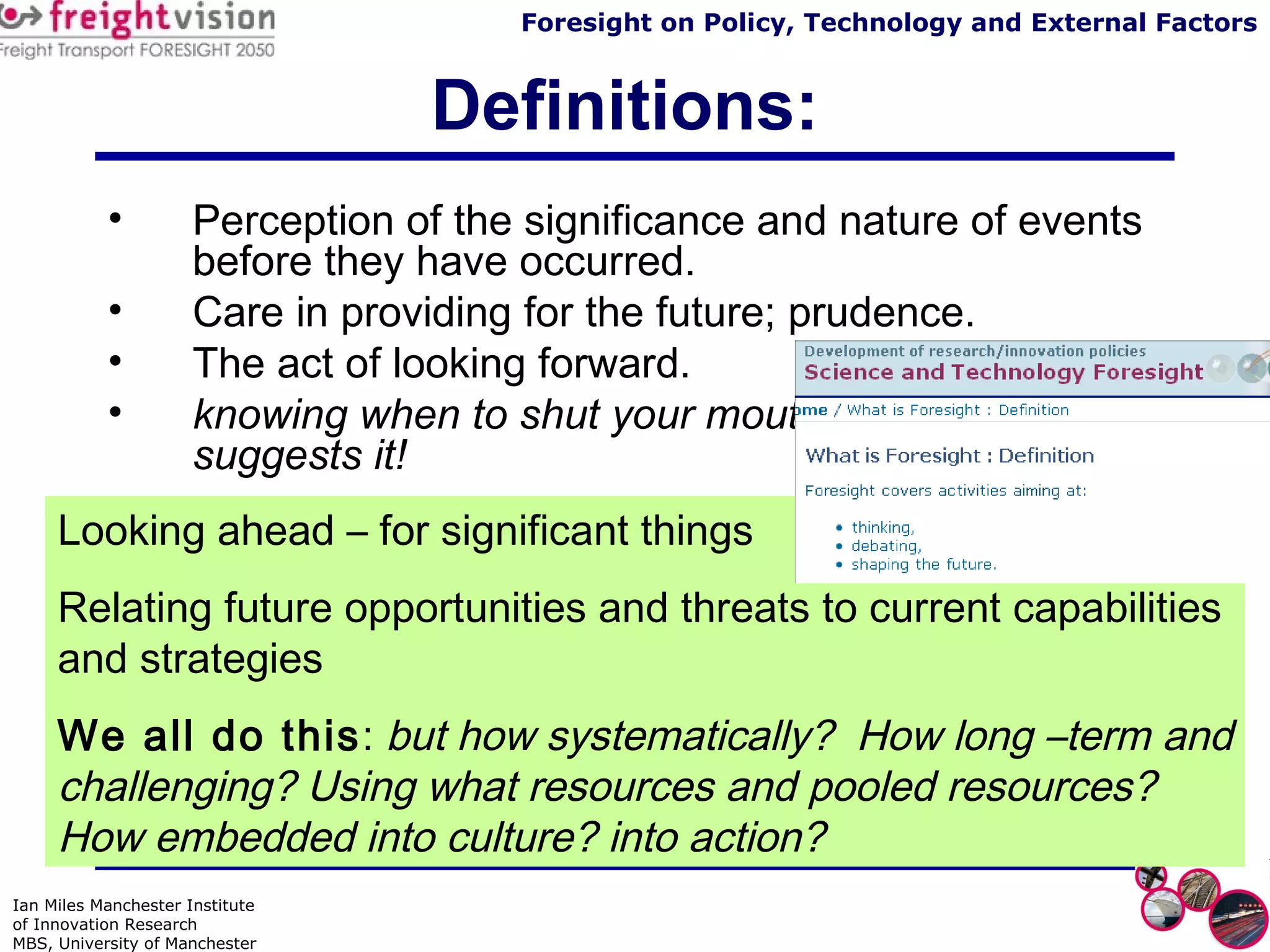
Definitions: Perception of the significance and nature of events before they have occurred. Care in providing for the future; prudence. The act of looking forward. knowing when to shut your mouth before someone suggests it! Looking ahead – for significant things Relating future opportunities and threats to current capabilities and strategies We all do this :  but how systematically?  How long –term and challenging? Using what resources and pooled resources?  How embedded into culture? into action?
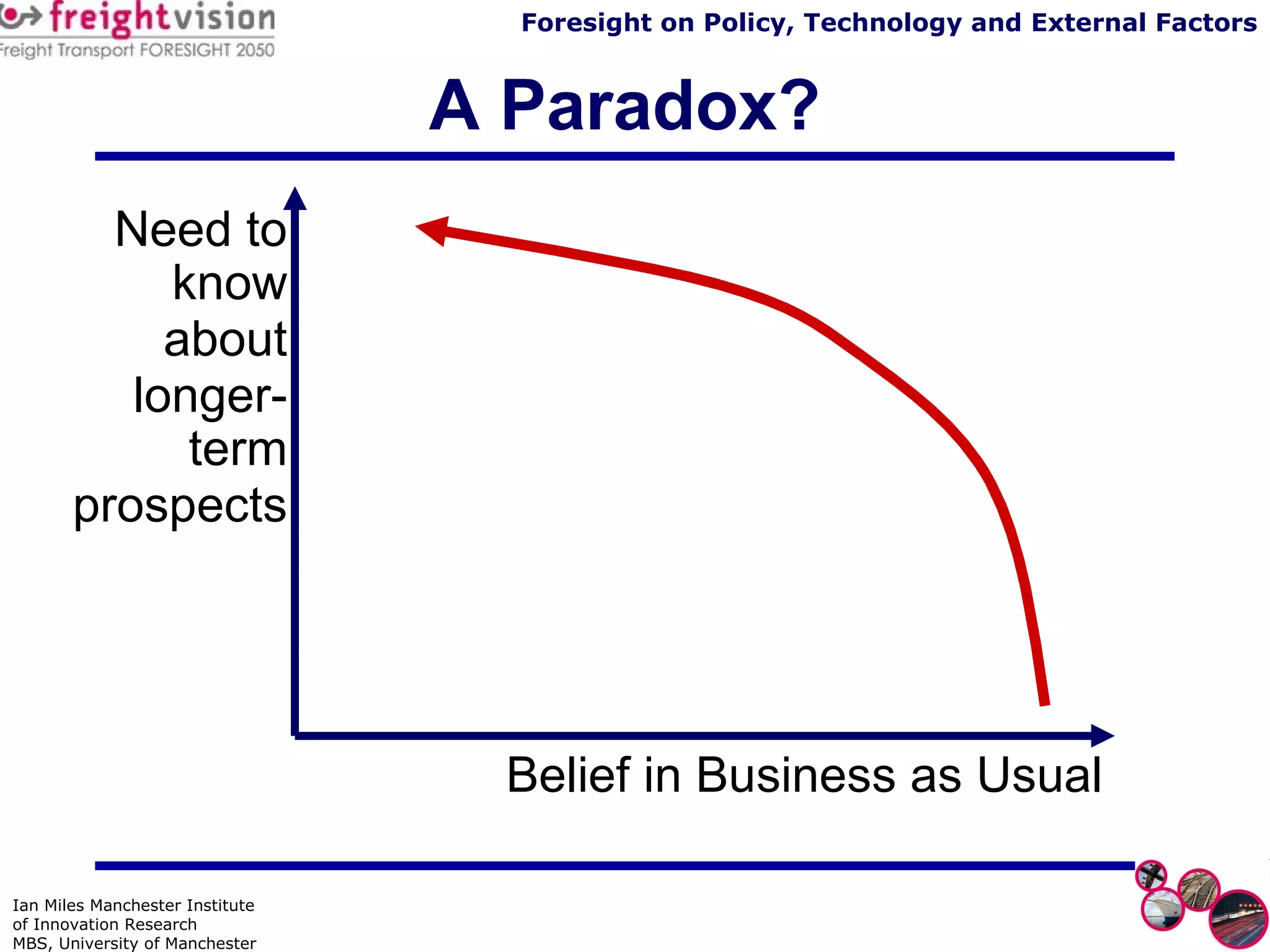
A Paradox? Need to know about longer-term prospects Belief in Business as Usual
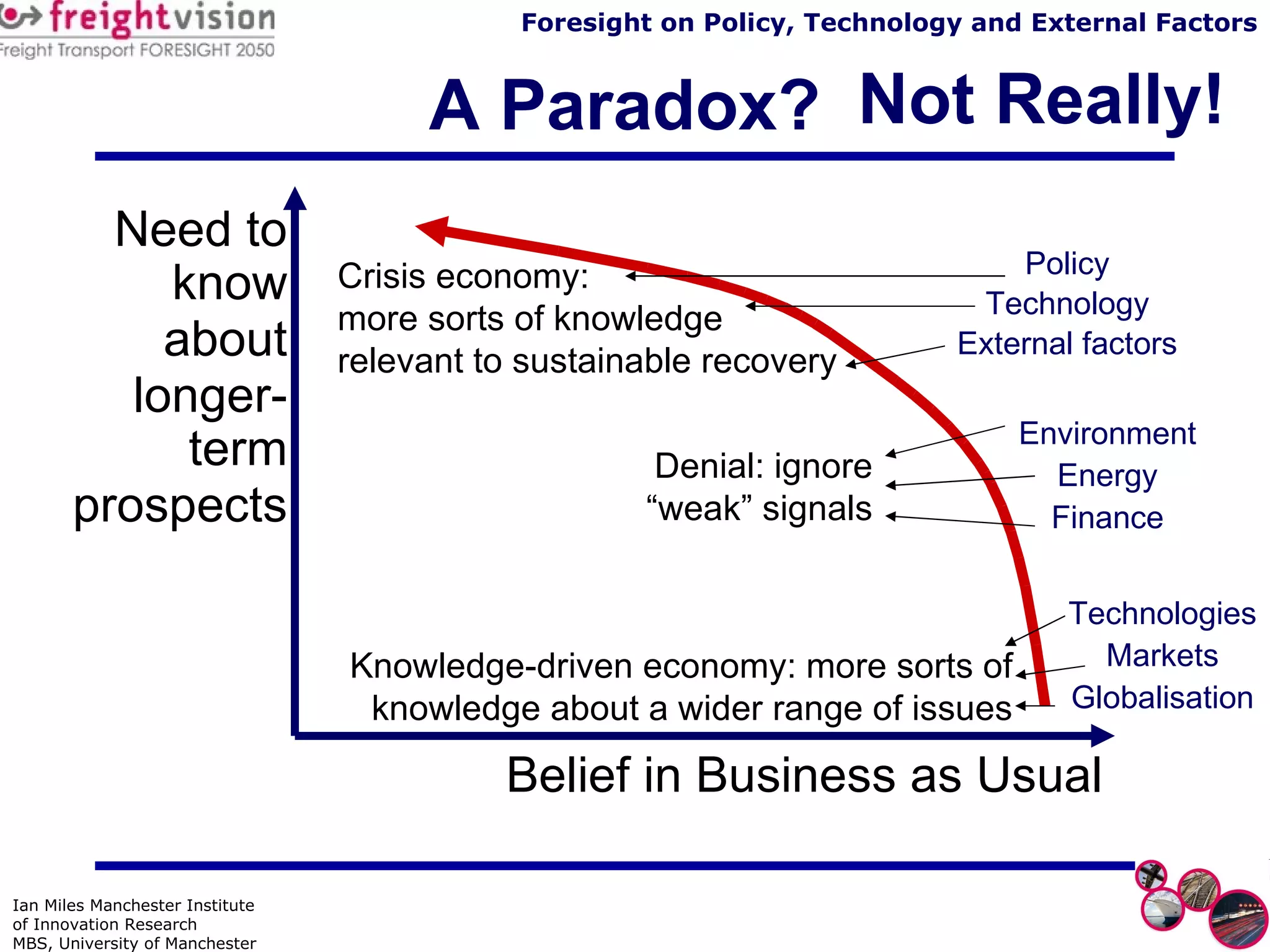
A Paradox? Belief in Business as Usual Need to know about longer-term prospects Not Really! Crisis economy:  more sorts of knowledge  relevant to sustainable recovery Policy Technology External factors Denial: ignore “weak” signals Environment Energy Finance Knowledge-driven economy: more sorts of knowledge about a wider range of issues Technologies Markets Globalisation
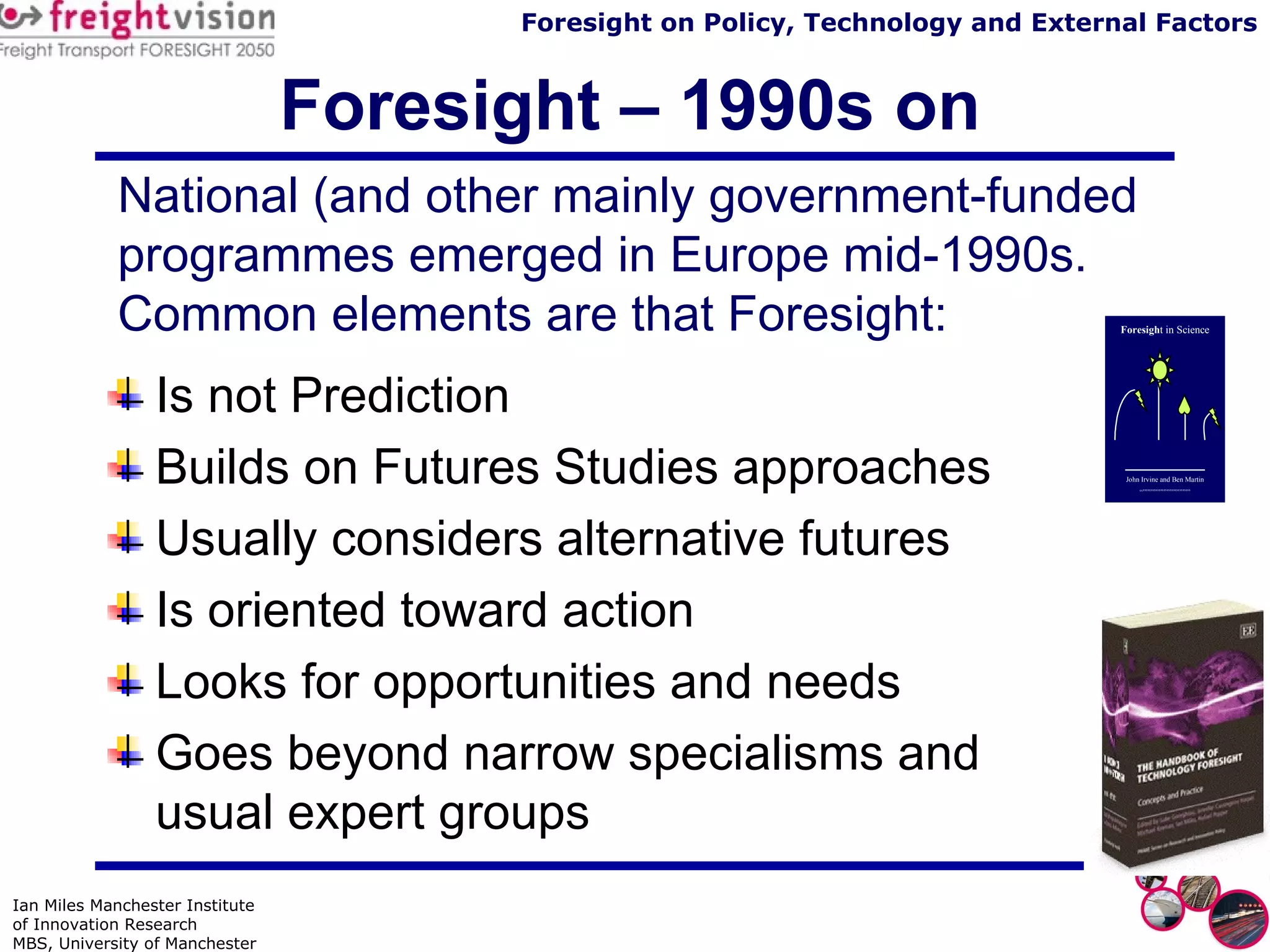
Foresight – 1990s on Is not Prediction Builds on Futures Studies approaches Usually considers alternative futures Is oriented toward action Looks for opportunities and needs Goes beyond narrow specialisms and  usual expert groups National (and other mainly government-funded programmes emerged in Europe mid-1990s. Common elements are that Foresight:  Foresigh t in Science John Irvine and Ben Martin “”””””””””””””””
Contemporary Foresight Programmes National (and other mainly government-funded programmes emerged in Europe mid-1990s; response to funding and legitimacy crises in STI policy and ongoing weaknesses in innovation systems. Initial European learning from Japanese approaches, which in turn had “borrowed” American  futures  tools in new contexts. Major national programmes conducted in most countries Evolution of focus, away from narrow technology foresight to include more socioeconomic dimensions Increasing number of “focused” exercises, alongside or instead of very wide-ranging programmes.  Embedded foresight in agencies. Meanwhile, European business use of futures approaches very much influenced directly by US corporate futures work.
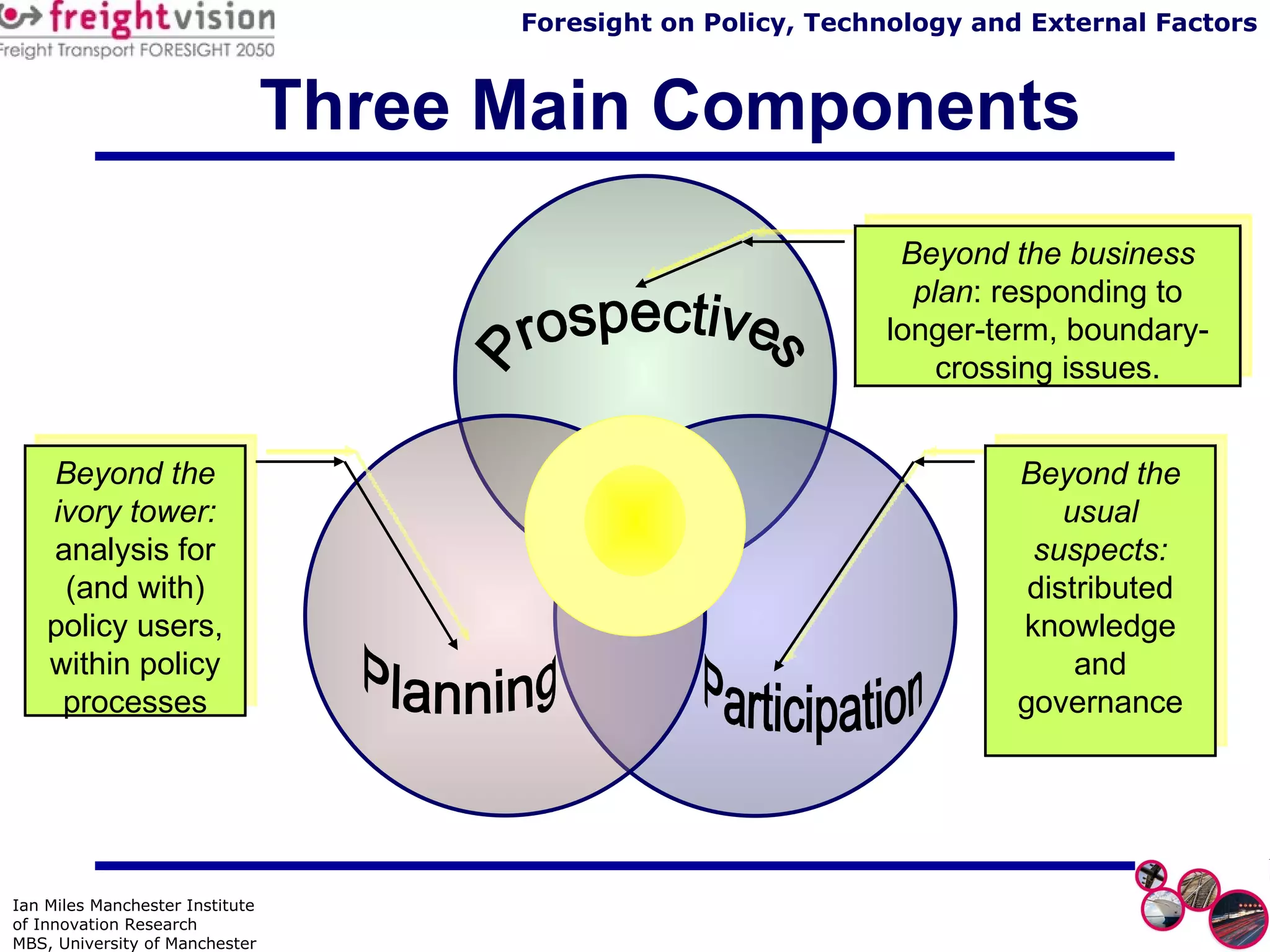
Three Main Components Beyond the usual suspects:  distributed knowledge and governance Beyond the ivory tower:  analysis for (and with) policy users, within policy processes Beyond the business plan : responding to longer-term, boundary-crossing issues. Prospectives Planning Participation
Why has Foresight taken off? Recognition of the centrality of technological innovation  for competitiveness - economic growth & social wellbeing Difficult decisions about R&D, as new technologies proliferate and converge, and as public budgets come under pressure - creating a drive to  concentrate available resources on more strategic options Awareness of weaknesses in the  innovation systems  linking scientific knowledge, technology commercialisation, standards-setting, etc.  Need for better understanding of social dimensions – markets, skills, entrepreneurship, regulatory governance…. Public perception of risk and ethical issues in some major innovations (and even in R&D), and in continued development trajectories Inability of any single organisation to marshal all relevant knowledge, and need to combine together insights from a wide range of fields
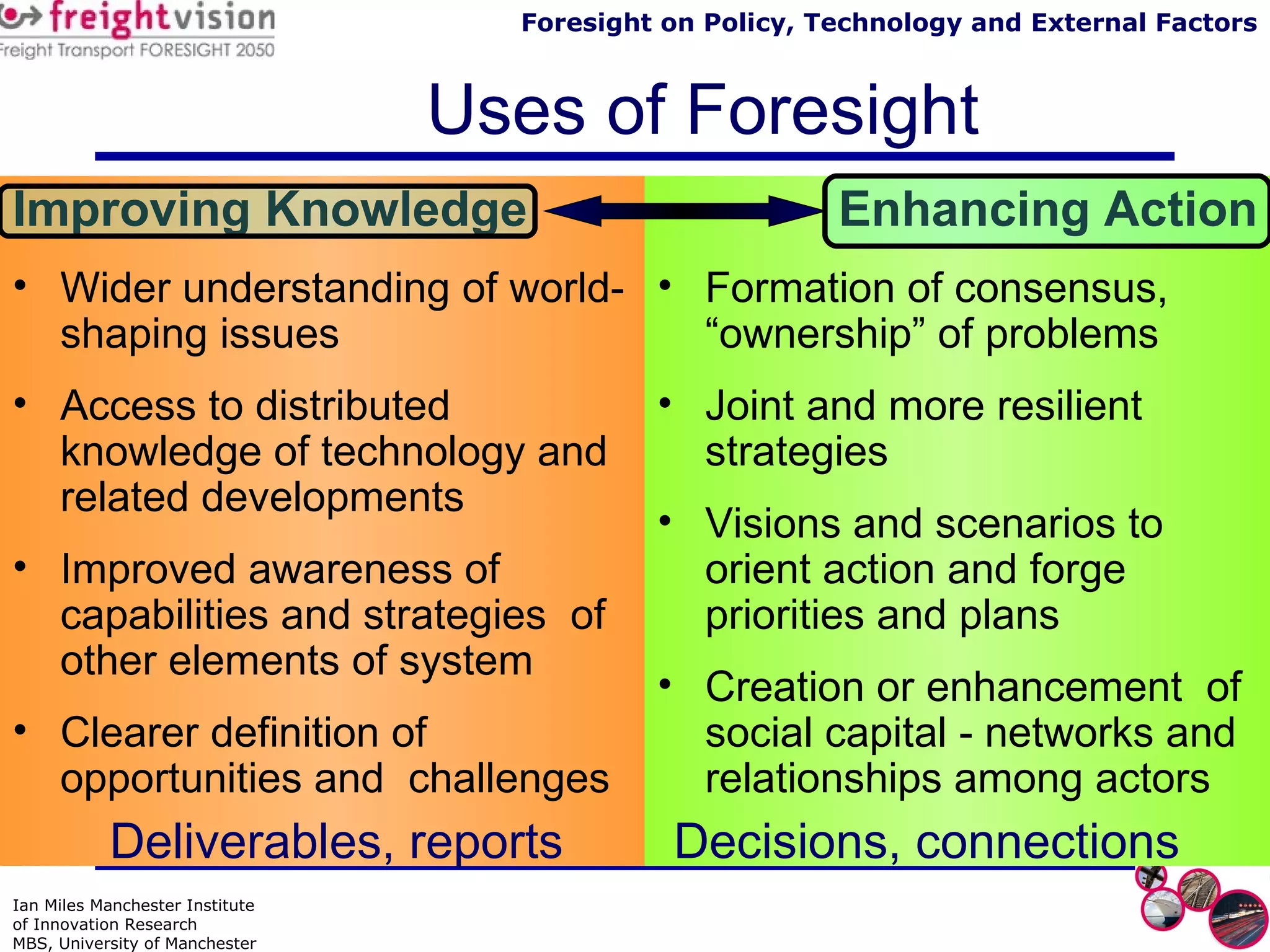
Uses of Foresight Improving Knowledge Wider understanding of world-shaping issues Access to distributed knowledge of technology and related developments Improved awareness of capabilities and strategies  of other elements of system Clearer definition of opportunities and  challenges Enhancing Action Formation of consensus, “ownership” of problems Joint and more resilient strategies Visions and scenarios to orient action and forge priorities and plans Creation or enhancement  of social capital - networks and relationships among actors Deliverables, reports  Decisions, connections
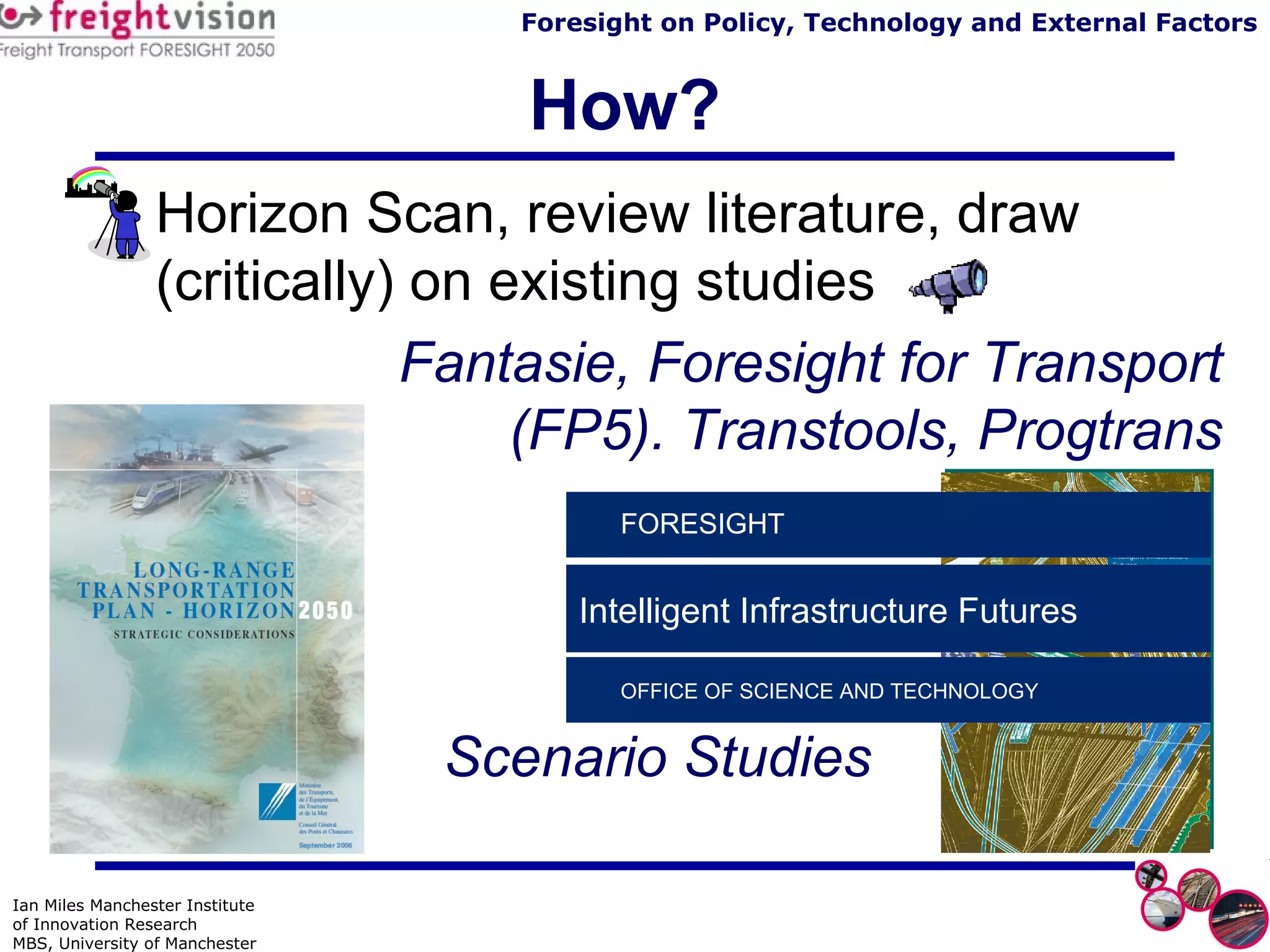
How? Horizon Scan, review literature, draw (critically) on existing studies Fantasie, Foresight for Transport (FP5). Transtools, Progtrans Scenario Studies   Intelligent Infrastructure Futures OFFICE OF SCIENCE AND TECHNOLOGY  FORESIGHT
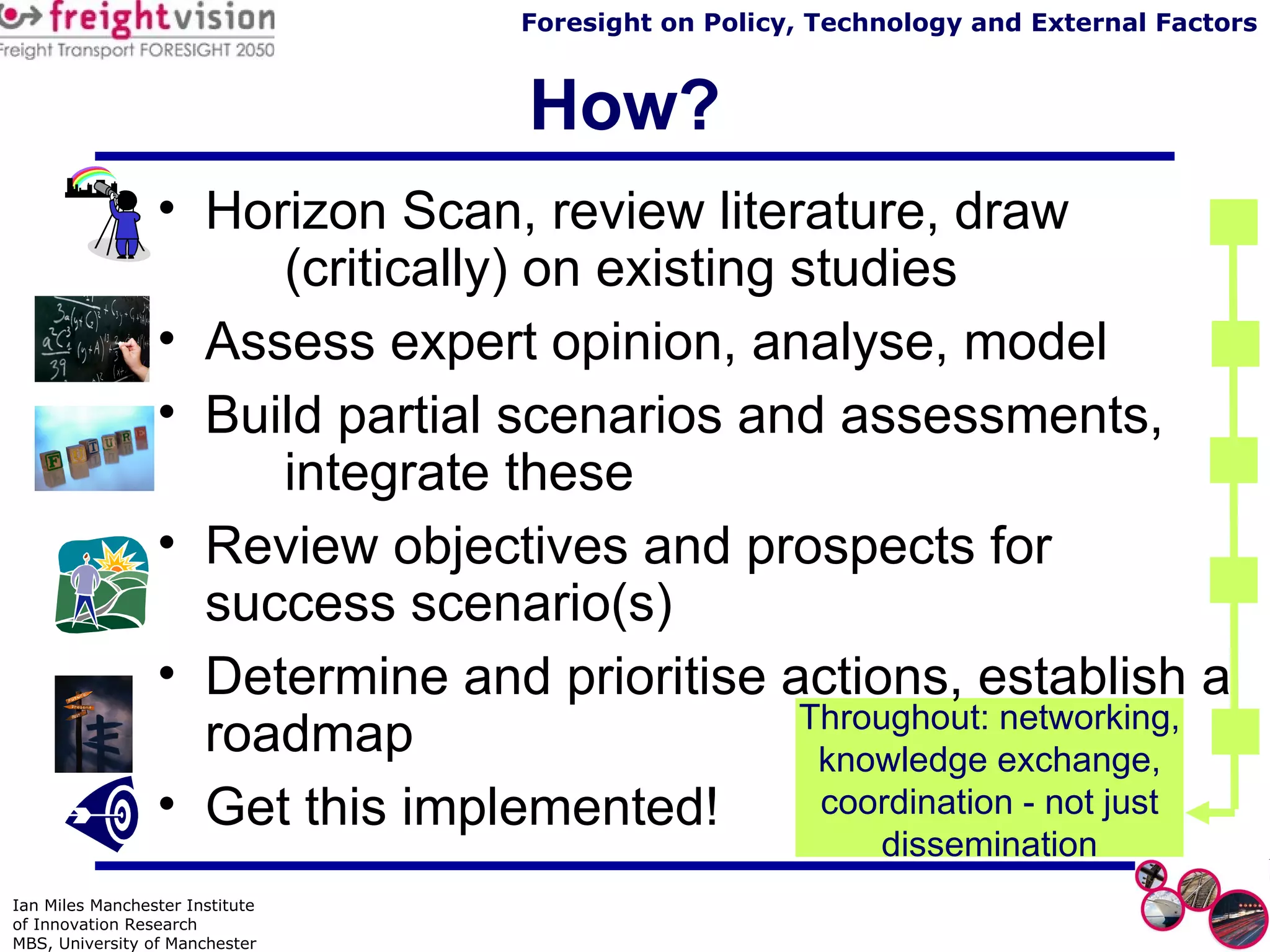
How? Horizon Scan, review literature, draw  (critically) on existing studies  Assess expert opinion, analyse, model  Build partial scenarios and assessments,  integrate these Review objectives and prospects for success scenario(s) Determine and prioritise actions, establish a roadmap Get this implemented! Throughout: networking, knowledge exchange, coordination - not just dissemination
What Foresight can and cannot Achieve It can open eyes to the longer term, and the need to prepare for this today. It can allow for resources and capabilities to be pooled to improve understanding and scope for collaborative and cooperative action It can help to “link up” innovation systems, allowing us to address complex problems and projects.  It is not a panacea It cannot substitute for leadership and wisdom. It cannot resolve all major political disagreements. Without better foresight, can there be better futures?
End of Presentation
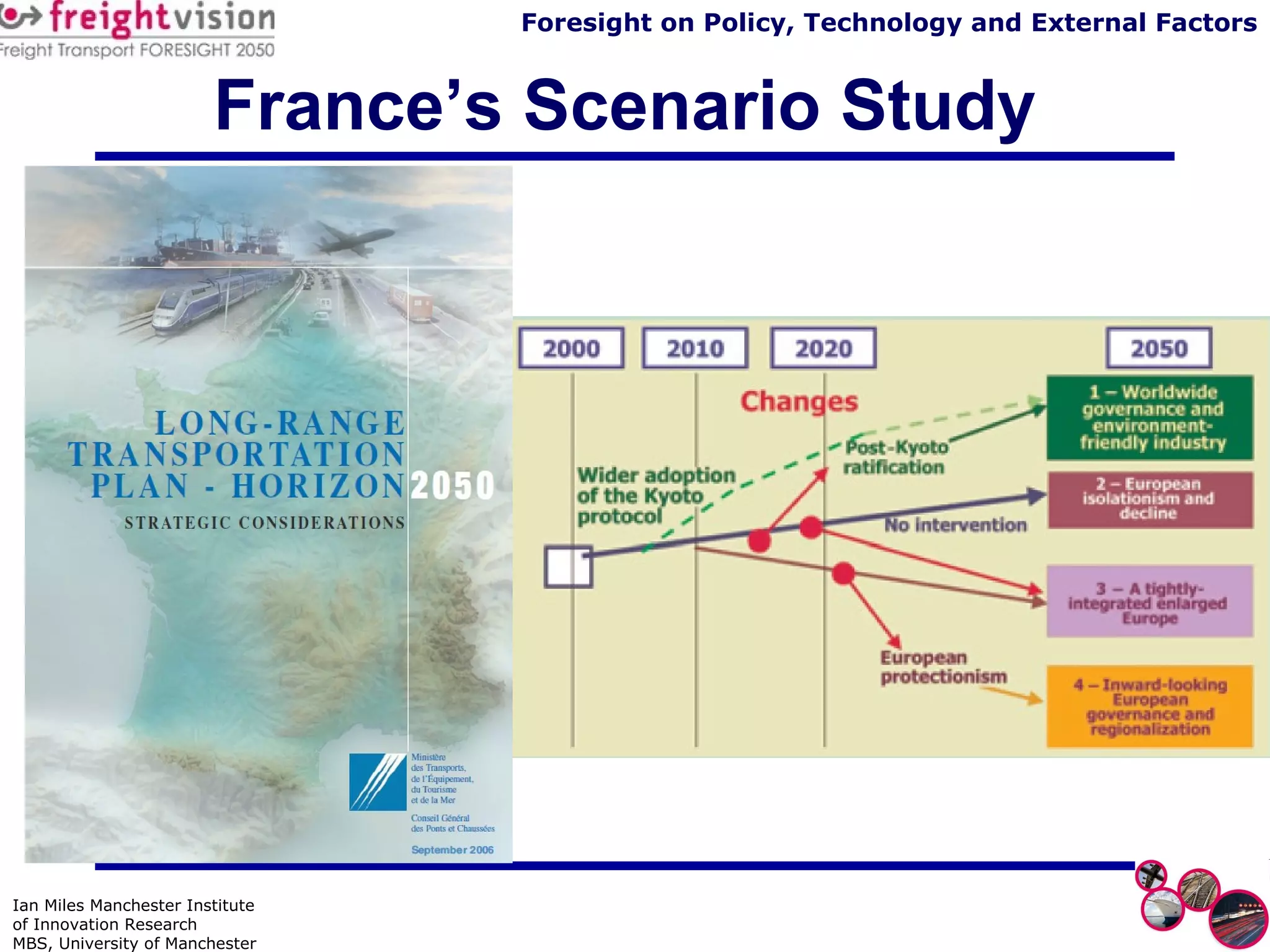
France’s Scenario Study
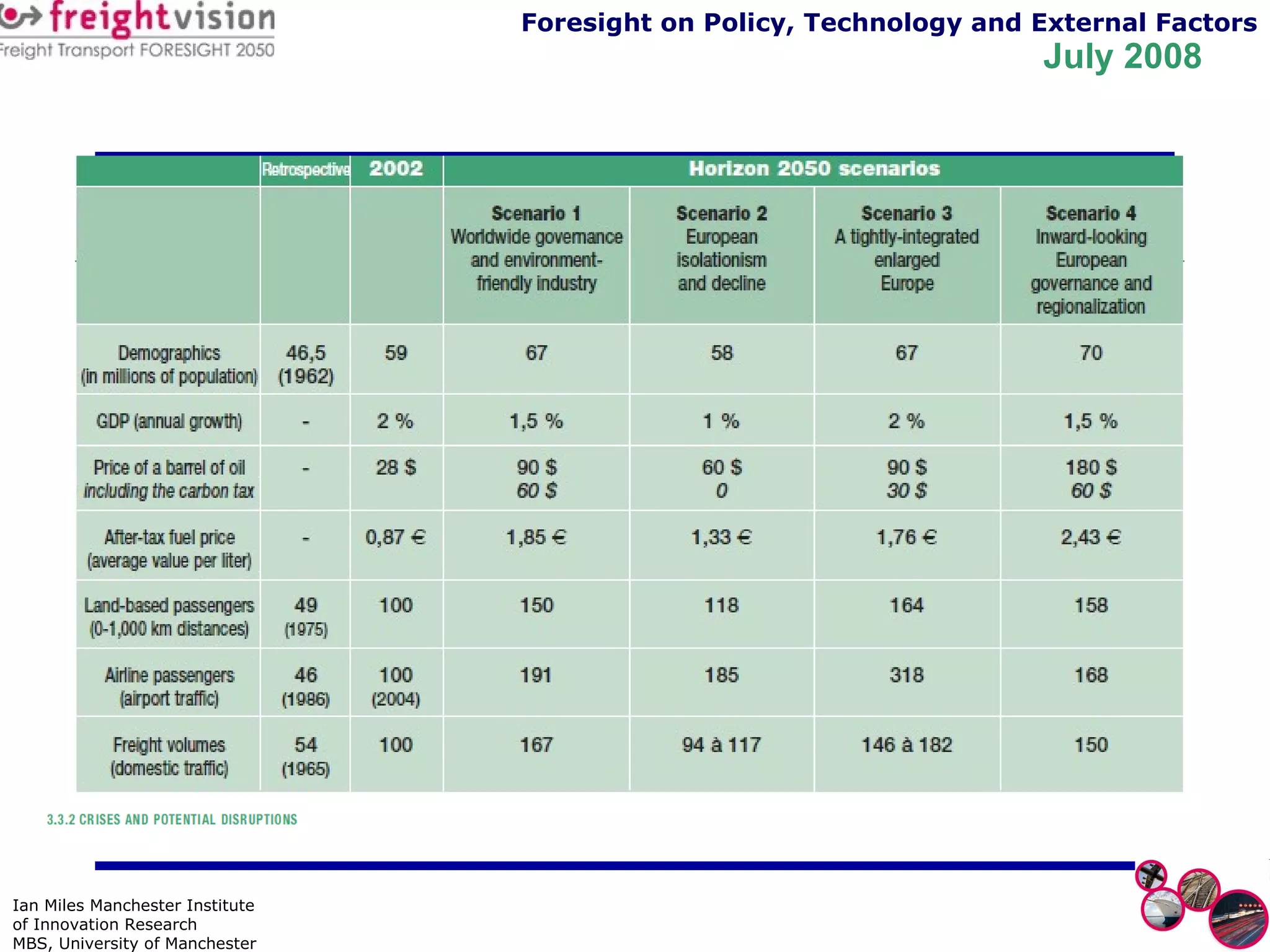
July 2008
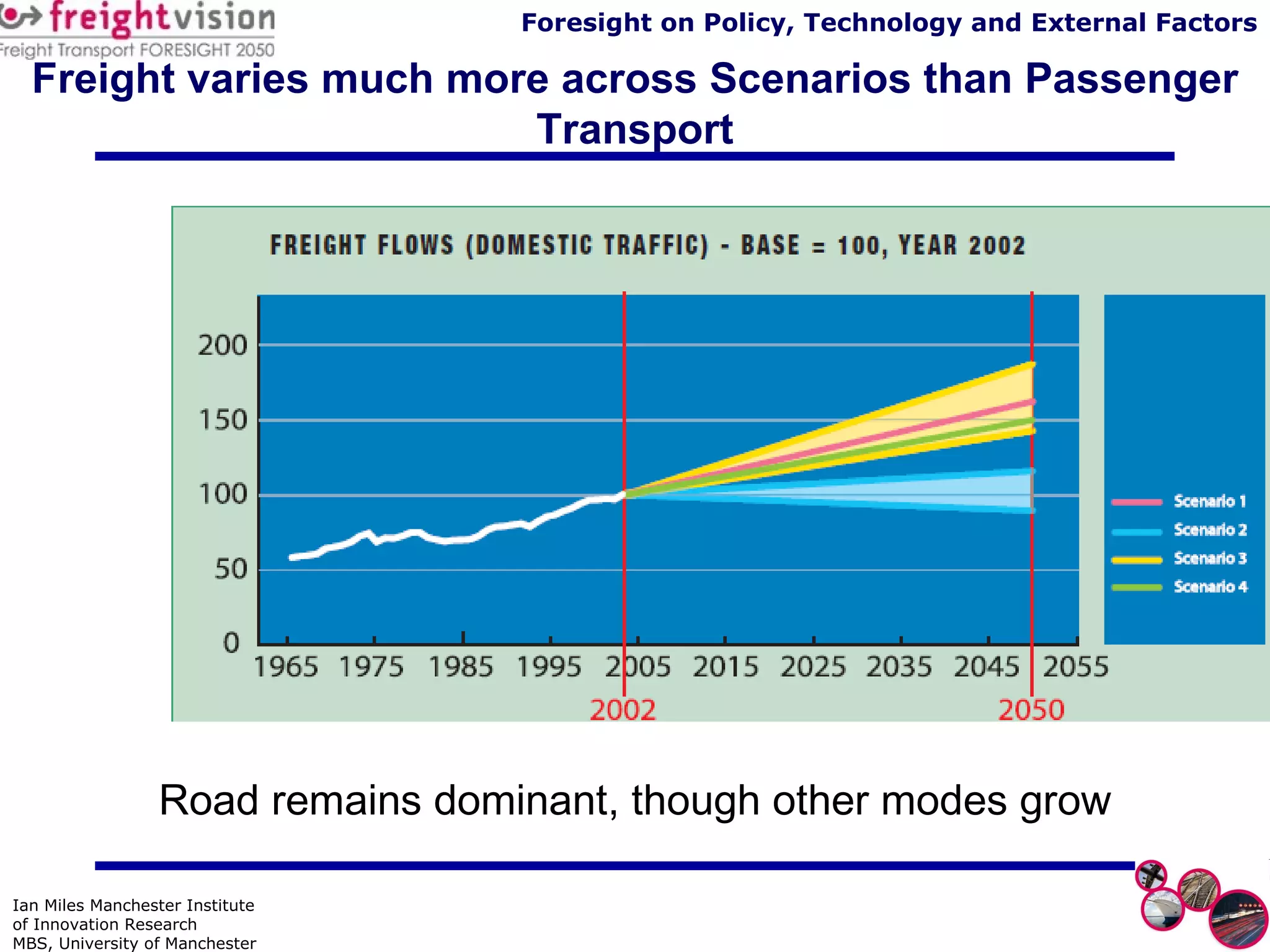
Freight varies much more across Scenarios than Passenger Transport Road remains dominant, though other modes grow
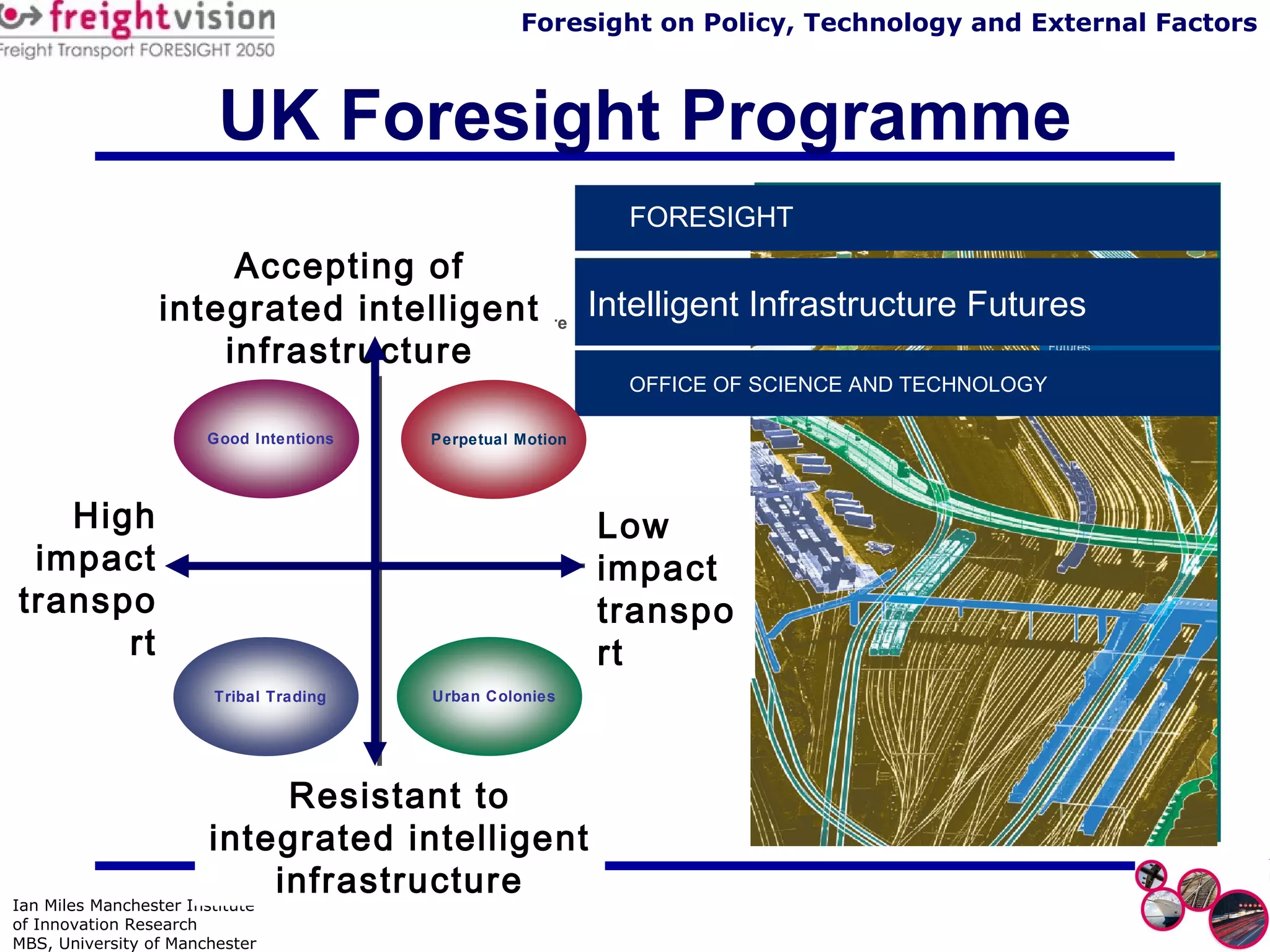
UK Foresight Programme Accepting of integrated intelligent infrastructure Low impact transport High impact transport Resistant to integrated intelligent infrastructure Intelligent Infrastructure Futures OFFICE OF SCIENCE AND TECHNOLOGY  FORESIGHT

2009 Freightvision Miles

  • 1.
    Driving and DeliveringForesight: Why? How? What for? Ian Miles MIoIR, Manchester Business School, University of Manchester, UK [email_address]
  • 2.
    Definitions: Perception ofthe significance and nature of events before they have occurred. Care in providing for the future; prudence. The act of looking forward. knowing when to shut your mouth before someone suggests it! Looking ahead – for significant things Relating future opportunities and threats to current capabilities and strategies We all do this : but how systematically? How long –term and challenging? Using what resources and pooled resources? How embedded into culture? into action?
  • 3.
    A Paradox? Needto know about longer-term prospects Belief in Business as Usual
  • 4.
    A Paradox? Beliefin Business as Usual Need to know about longer-term prospects Not Really! Crisis economy: more sorts of knowledge relevant to sustainable recovery Policy Technology External factors Denial: ignore “weak” signals Environment Energy Finance Knowledge-driven economy: more sorts of knowledge about a wider range of issues Technologies Markets Globalisation
  • 5.
    Foresight – 1990son Is not Prediction Builds on Futures Studies approaches Usually considers alternative futures Is oriented toward action Looks for opportunities and needs Goes beyond narrow specialisms and usual expert groups National (and other mainly government-funded programmes emerged in Europe mid-1990s. Common elements are that Foresight: Foresigh t in Science John Irvine and Ben Martin “”””””””””””””””
  • 6.
    Contemporary Foresight ProgrammesNational (and other mainly government-funded programmes emerged in Europe mid-1990s; response to funding and legitimacy crises in STI policy and ongoing weaknesses in innovation systems. Initial European learning from Japanese approaches, which in turn had “borrowed” American futures tools in new contexts. Major national programmes conducted in most countries Evolution of focus, away from narrow technology foresight to include more socioeconomic dimensions Increasing number of “focused” exercises, alongside or instead of very wide-ranging programmes. Embedded foresight in agencies. Meanwhile, European business use of futures approaches very much influenced directly by US corporate futures work.
  • 7.
    Three Main ComponentsBeyond the usual suspects: distributed knowledge and governance Beyond the ivory tower: analysis for (and with) policy users, within policy processes Beyond the business plan : responding to longer-term, boundary-crossing issues. Prospectives Planning Participation
  • 8.
    Why has Foresighttaken off? Recognition of the centrality of technological innovation for competitiveness - economic growth & social wellbeing Difficult decisions about R&D, as new technologies proliferate and converge, and as public budgets come under pressure - creating a drive to concentrate available resources on more strategic options Awareness of weaknesses in the innovation systems linking scientific knowledge, technology commercialisation, standards-setting, etc. Need for better understanding of social dimensions – markets, skills, entrepreneurship, regulatory governance…. Public perception of risk and ethical issues in some major innovations (and even in R&D), and in continued development trajectories Inability of any single organisation to marshal all relevant knowledge, and need to combine together insights from a wide range of fields
  • 9.
    Uses of ForesightImproving Knowledge Wider understanding of world-shaping issues Access to distributed knowledge of technology and related developments Improved awareness of capabilities and strategies of other elements of system Clearer definition of opportunities and challenges Enhancing Action Formation of consensus, “ownership” of problems Joint and more resilient strategies Visions and scenarios to orient action and forge priorities and plans Creation or enhancement of social capital - networks and relationships among actors Deliverables, reports Decisions, connections
  • 10.
    How? Horizon Scan,review literature, draw (critically) on existing studies Fantasie, Foresight for Transport (FP5). Transtools, Progtrans Scenario Studies Intelligent Infrastructure Futures OFFICE OF SCIENCE AND TECHNOLOGY FORESIGHT
  • 11.
    How? Horizon Scan,review literature, draw (critically) on existing studies Assess expert opinion, analyse, model Build partial scenarios and assessments, integrate these Review objectives and prospects for success scenario(s) Determine and prioritise actions, establish a roadmap Get this implemented! Throughout: networking, knowledge exchange, coordination - not just dissemination
  • 12.
    What Foresight canand cannot Achieve It can open eyes to the longer term, and the need to prepare for this today. It can allow for resources and capabilities to be pooled to improve understanding and scope for collaborative and cooperative action It can help to “link up” innovation systems, allowing us to address complex problems and projects. It is not a panacea It cannot substitute for leadership and wisdom. It cannot resolve all major political disagreements. Without better foresight, can there be better futures?
  • 13.
  • 14.
  • 15.
  • 16.
    Freight varies muchmore across Scenarios than Passenger Transport Road remains dominant, though other modes grow
  • 17.
    UK Foresight ProgrammeAccepting of integrated intelligent infrastructure Low impact transport High impact transport Resistant to integrated intelligent infrastructure Intelligent Infrastructure Futures OFFICE OF SCIENCE AND TECHNOLOGY FORESIGHT