STRATEGIC THINKING
 A presentation to Strategic Management PhD Students of
Kenyatta University -Kenya
Presented by
Omuse Frankline Oyese, BSc, MBA-Strat Mgt, (PhD-
Ongoing)- Author
D86/CTY/38195/2017
May, 2018
Scope
 Aim
 What is Strategic thinking?
 Liedtka Model of the Elements of Strategic Thinking
 Is Strategic Thinking compatible with Strategic Planning?
 Conclusion
 Q & A
 Dr Anne’s Guidance
Aim
 The purpose of the discussion paper was to clarify some
of the issues surrounding the concept of strategic thinking
 What is strategic thinking?
 How do we recognize it?
 Is strategic thinking different from strategic planning?
 If so, is it a replacement of strategic planning?
 Can both concepts be accommodated within strategic management
regime?
 ‘’ Without achieving the kind of detailed
understanding of Strategic thinking that we have
today of strategic planning, we risk introducing yet
another appealing concept to the strategy
lexicon…..’’ (Liedtka, 1998)
 ‘’ There is lack of understanding of what the concept
is, in turn leading to confusion in strat mgt
arena.Thus the need to clearly define it so that this
paradigm can be objectively embraced and
appropriately situated within the strategic mgt
context’’ ( Liedtka, 1998).
What is Strategic Thinking?
 Ian Wilson, (1994), suggested that strategic
thinking is merely thinking about strategy.
Improvement in strategic planning has
profoundly changed its character to strategic
management or strategic thinking.
This attempt to define it as improved strat
planning or strat mgt creates confusion and
waters down the full implications of strategic
thinking in its purest sense
 Henry Mintzbreg (1994), emphasizes that strategic
thinking is not merely ‘’alternative nomenclature for
everything falling under the umbrella of strategic
management’’. It is a particular way of thinking with
specific and clearly discernible/evident xtics.
 The diff: strat planning is systematic programming of
pre-determined strategies- action plan is developed.
Strategic thinking is a synthesizing process utilizing
intuition and creativity whose outcome is ‘’an
integrated perspective of the enterprise.’’
 Prahalad and Hamel (1989), describe taditional
approaches to planning as ‘’form filling.’’ They refer
strategic thinking as ‘’crafting strategic architecture’’
but emphasize Mintzberg’s themes of creativity,
exploration and understanding discontinuities.
 For Ralph Stacy (1992), strategic thinking is’’…using
analogies and qualitative similarities to develop
creative new ideas…(and) designing actions on the
basis of new learning. Strategic planning focuses on
following pre- programmed rules.
 In general then, it can be argued that
strategic thinking is acting within a
certain set of assumptions and potential
action alternatives as well as challenging
existing assumptions and action
alternatives, potentially leading to new
and more appropriate ones.
The Liedtka Model of Elements of
Strategic Thinking
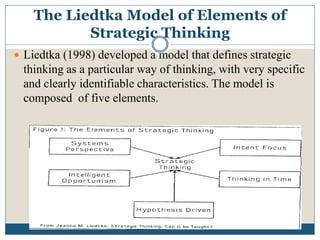
 Liedtka (1998) developed a model that defines strategic
thinking as a particular way of thinking, with very specific
and clearly identifiable characteristics. The model is
composed of five elements.
a. Systems perspective; A strategic thinker has a model of
the complete system of value creation from beginning to
end, and understands the interdependencies within the
chain. The mental model incorporates an understanding
of both the external and internal context of the
organization.
 Strategic thinkers must appreciate the inter-relationships among
the individual internal parts that, together, constitute the whole , as
well as the fact that the whole is greater than the sum of its parts.
 It addresses the fit btw corporate, business, functional and
individual level of strategy.
 Contd; According to Liedtka (1998), it is impossible to
optimize the outcome of the system for the end
customer, without such understanding.
 Thus , from a vertical perspective, strategic thinkers see the
linkages in the system from multiple perspectives and understand
the relationship among corporate, business and functional levels of
strategy to the external context.
 From a horizontal perspective, they also understand the
connections across departments and functions, and between
suppliers and buyers.
b. Intent – focused/driven; Hamel and Prahalad (1994):
Strategic intent implies a particular point of view about
the long-term competitive position that the firm intends to
build. It conveys a sense of direction, discovery, destiny.
Liedtka (1998): Strategic intent provides focus that allows
individuals to marshal and leverage their energy, to focus
attention, to resist destruction, and to concentrate for as
long as it takes to achieve the goal.
* Therefore, strategic thinking is fundamentally concerned
with, and driven with, the continuous shaping and re-
shaping of intent.
c. Intelligent opportunism; concerns openness to new
experience which allows taking advantage of alternative
strategies that may emerge as more relevant in a rapidly
changing business environment.
-It is important that organizations consider contribution
from lower level employees or more innovative
employees.
- According to Hamel (1997): If you want to create a point
of view about the future, if you want to create a
meaningful strategy, you have to create in your company a
hierarchy of imagination. It means disproportionate share
of voice to the young people.
d. Thinking in time; According to Hamel and Prahalad
(1994), strategy isn’t solely driven by the future, but by
the gap btw the current reality and the intent for the future.
Thus by connecting the past with present and linking this
to the future, strategic thinking is always ‘’thinking in
time.’’
-The big question is, ‘’ having seen the future that we want
to create, what must we keep from that past, lose from the
past, and create in our present to get there?’’
e. Hypothesis driven; It embraces hypothesis generation
and testing as core values.
- Hypothesis generation follows the creative question,
‘’what if…? and Hypothesis testing follows up with the
creative question, ‘’If…then.” and evaluates the data
relevant to the analysis.
- Liedtka (1998) states that, ‘’Taken together, the five
elements describe a strategic thinker with a broad field
view that sees the whole and the connections between its
pieces, both across the four vertical levels of strategy and
the horizontal elements of the end to end value system.
Is Strategic Thinking compatible with Strategic
Planning?
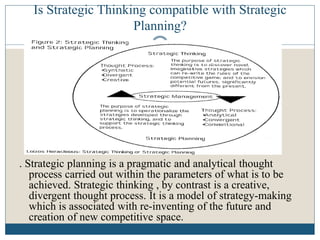
. Strategic planning is a pragmatic and analytical thought
process carried out within the parameters of what is to be
achieved. Strategic thinking , by contrast is a creative,
divergent thought process. It is a model of strategy-making
which is associated with re-inventing of the future and
creation of new competitive space.
Summary
 The sharp dichotomy frequently established btw strategic
planning and strategic thinking in literature gives the
impression that the two approaches are incompatible with
each other.
 However, both are required in any thoughtful strategy-
making process. Both are necessary and none is adequate
without the other in an effective strategy-making regime.
 The real challenge is how to transform today’s planning
process in a way that incorporates, rather than
undermines, strategy thinking.
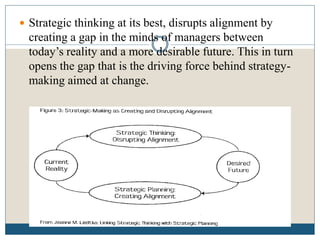
 Strategic thinking at its best, disrupts alignment by
creating a gap in the minds of managers between
today’s reality and a more desirable future. This in turn
opens the gap that is the driving force behind strategy-
making aimed at change.
Conclusion
 Strategic thinking has been gaining increasing
popularity in the literature on organizational planning.
However, the lack of clear articulation as to the nature
and implications of this concept has lead to considerable
confusion.
 Careful review of the emerging body of thought on this
subject, however, is that strategic thinking is not only
critical to the survival of the organization in these times
of rapid change, but more importantly, can be
effectively accommodated within a progressive strategy
making regime to support strategic planning.
Q & A
Guidance

Strategic thinking

  • 1.
    STRATEGIC THINKING  Apresentation to Strategic Management PhD Students of Kenyatta University -Kenya Presented by Omuse Frankline Oyese, BSc, MBA-Strat Mgt, (PhD- Ongoing)- Author D86/CTY/38195/2017 May, 2018
  • 2.
    Scope  Aim  Whatis Strategic thinking?  Liedtka Model of the Elements of Strategic Thinking  Is Strategic Thinking compatible with Strategic Planning?  Conclusion  Q & A  Dr Anne’s Guidance
  • 3.
    Aim  The purposeof the discussion paper was to clarify some of the issues surrounding the concept of strategic thinking  What is strategic thinking?  How do we recognize it?  Is strategic thinking different from strategic planning?  If so, is it a replacement of strategic planning?  Can both concepts be accommodated within strategic management regime?
  • 4.
     ‘’ Withoutachieving the kind of detailed understanding of Strategic thinking that we have today of strategic planning, we risk introducing yet another appealing concept to the strategy lexicon…..’’ (Liedtka, 1998)  ‘’ There is lack of understanding of what the concept is, in turn leading to confusion in strat mgt arena.Thus the need to clearly define it so that this paradigm can be objectively embraced and appropriately situated within the strategic mgt context’’ ( Liedtka, 1998).
  • 5.
    What is StrategicThinking?  Ian Wilson, (1994), suggested that strategic thinking is merely thinking about strategy. Improvement in strategic planning has profoundly changed its character to strategic management or strategic thinking. This attempt to define it as improved strat planning or strat mgt creates confusion and waters down the full implications of strategic thinking in its purest sense
  • 6.
     Henry Mintzbreg(1994), emphasizes that strategic thinking is not merely ‘’alternative nomenclature for everything falling under the umbrella of strategic management’’. It is a particular way of thinking with specific and clearly discernible/evident xtics.  The diff: strat planning is systematic programming of pre-determined strategies- action plan is developed. Strategic thinking is a synthesizing process utilizing intuition and creativity whose outcome is ‘’an integrated perspective of the enterprise.’’
  • 7.
     Prahalad andHamel (1989), describe taditional approaches to planning as ‘’form filling.’’ They refer strategic thinking as ‘’crafting strategic architecture’’ but emphasize Mintzberg’s themes of creativity, exploration and understanding discontinuities.  For Ralph Stacy (1992), strategic thinking is’’…using analogies and qualitative similarities to develop creative new ideas…(and) designing actions on the basis of new learning. Strategic planning focuses on following pre- programmed rules.
  • 8.
     In generalthen, it can be argued that strategic thinking is acting within a certain set of assumptions and potential action alternatives as well as challenging existing assumptions and action alternatives, potentially leading to new and more appropriate ones.
  • 9.
    The Liedtka Modelof Elements of Strategic Thinking  Liedtka (1998) developed a model that defines strategic thinking as a particular way of thinking, with very specific and clearly identifiable characteristics. The model is composed of five elements.
  • 10.
    a. Systems perspective;A strategic thinker has a model of the complete system of value creation from beginning to end, and understands the interdependencies within the chain. The mental model incorporates an understanding of both the external and internal context of the organization.  Strategic thinkers must appreciate the inter-relationships among the individual internal parts that, together, constitute the whole , as well as the fact that the whole is greater than the sum of its parts.  It addresses the fit btw corporate, business, functional and individual level of strategy.
  • 11.
     Contd; Accordingto Liedtka (1998), it is impossible to optimize the outcome of the system for the end customer, without such understanding.  Thus , from a vertical perspective, strategic thinkers see the linkages in the system from multiple perspectives and understand the relationship among corporate, business and functional levels of strategy to the external context.  From a horizontal perspective, they also understand the connections across departments and functions, and between suppliers and buyers.
  • 12.
    b. Intent –focused/driven; Hamel and Prahalad (1994): Strategic intent implies a particular point of view about the long-term competitive position that the firm intends to build. It conveys a sense of direction, discovery, destiny. Liedtka (1998): Strategic intent provides focus that allows individuals to marshal and leverage their energy, to focus attention, to resist destruction, and to concentrate for as long as it takes to achieve the goal. * Therefore, strategic thinking is fundamentally concerned with, and driven with, the continuous shaping and re- shaping of intent.
  • 13.
    c. Intelligent opportunism;concerns openness to new experience which allows taking advantage of alternative strategies that may emerge as more relevant in a rapidly changing business environment. -It is important that organizations consider contribution from lower level employees or more innovative employees. - According to Hamel (1997): If you want to create a point of view about the future, if you want to create a meaningful strategy, you have to create in your company a hierarchy of imagination. It means disproportionate share of voice to the young people.
  • 14.
    d. Thinking intime; According to Hamel and Prahalad (1994), strategy isn’t solely driven by the future, but by the gap btw the current reality and the intent for the future. Thus by connecting the past with present and linking this to the future, strategic thinking is always ‘’thinking in time.’’ -The big question is, ‘’ having seen the future that we want to create, what must we keep from that past, lose from the past, and create in our present to get there?’’
  • 15.
    e. Hypothesis driven;It embraces hypothesis generation and testing as core values. - Hypothesis generation follows the creative question, ‘’what if…? and Hypothesis testing follows up with the creative question, ‘’If…then.” and evaluates the data relevant to the analysis. - Liedtka (1998) states that, ‘’Taken together, the five elements describe a strategic thinker with a broad field view that sees the whole and the connections between its pieces, both across the four vertical levels of strategy and the horizontal elements of the end to end value system.
  • 16.
    Is Strategic Thinkingcompatible with Strategic Planning? . Strategic planning is a pragmatic and analytical thought process carried out within the parameters of what is to be achieved. Strategic thinking , by contrast is a creative, divergent thought process. It is a model of strategy-making which is associated with re-inventing of the future and creation of new competitive space.
  • 17.
    Summary  The sharpdichotomy frequently established btw strategic planning and strategic thinking in literature gives the impression that the two approaches are incompatible with each other.  However, both are required in any thoughtful strategy- making process. Both are necessary and none is adequate without the other in an effective strategy-making regime.  The real challenge is how to transform today’s planning process in a way that incorporates, rather than undermines, strategy thinking.
  • 18.
     Strategic thinkingat its best, disrupts alignment by creating a gap in the minds of managers between today’s reality and a more desirable future. This in turn opens the gap that is the driving force behind strategy- making aimed at change.
  • 19.
    Conclusion  Strategic thinkinghas been gaining increasing popularity in the literature on organizational planning. However, the lack of clear articulation as to the nature and implications of this concept has lead to considerable confusion.  Careful review of the emerging body of thought on this subject, however, is that strategic thinking is not only critical to the survival of the organization in these times of rapid change, but more importantly, can be effectively accommodated within a progressive strategy making regime to support strategic planning.
  • 20.