Urban Foresight As A Tool For Territorial Governance“Whither Strategic Foresight?”Professor John S RatcliffeBrusselsSeptember 2011
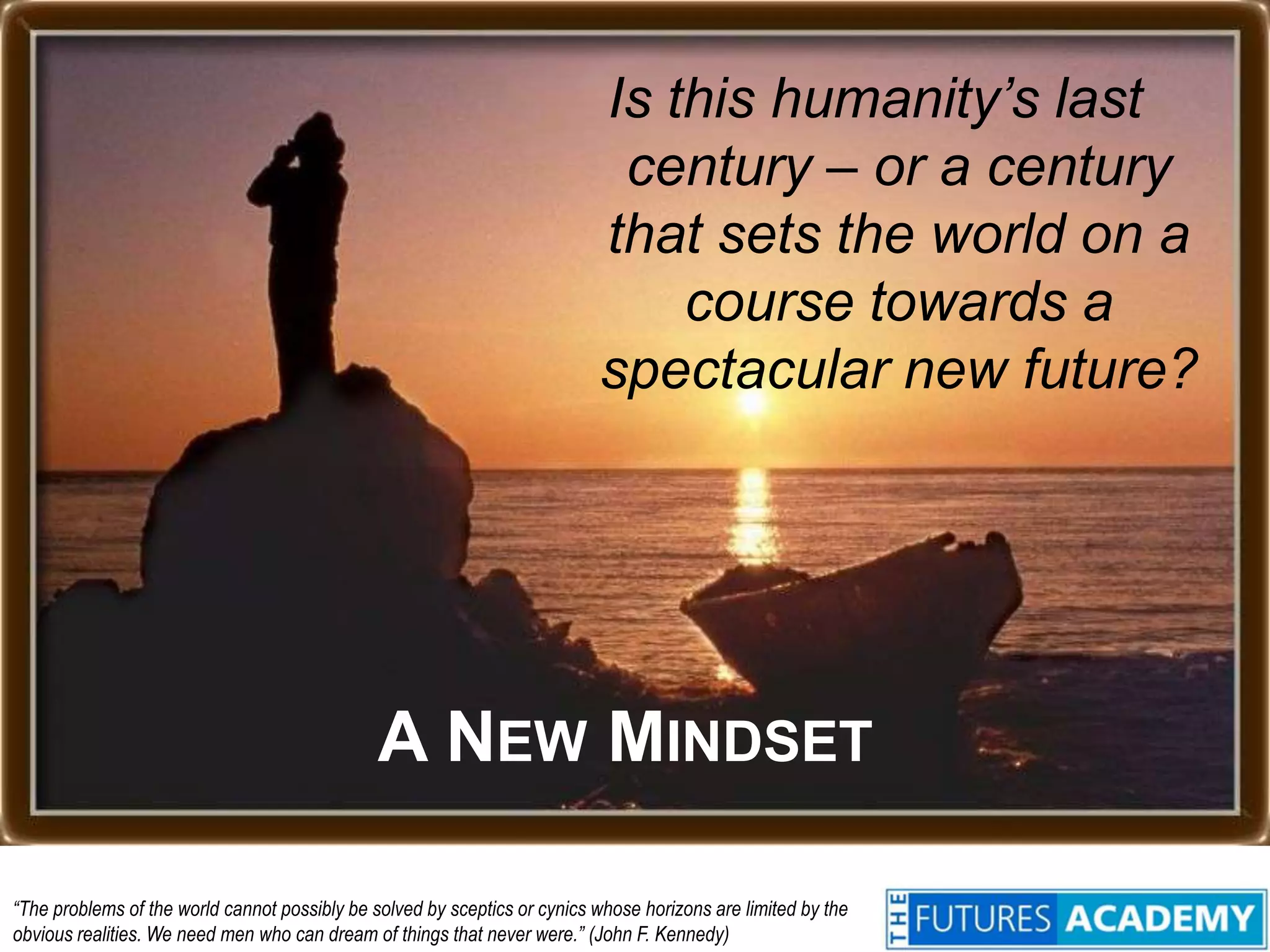
Is this humanity’s last century – or a century that sets the world on a course towards a spectacular new future?A NEW MINDSET“The problems of the world cannot possibly be solved by sceptics or cynics whose horizons are limited by the obvious realities. We need men who can dream of things that never were.” (John F. Kennedy)
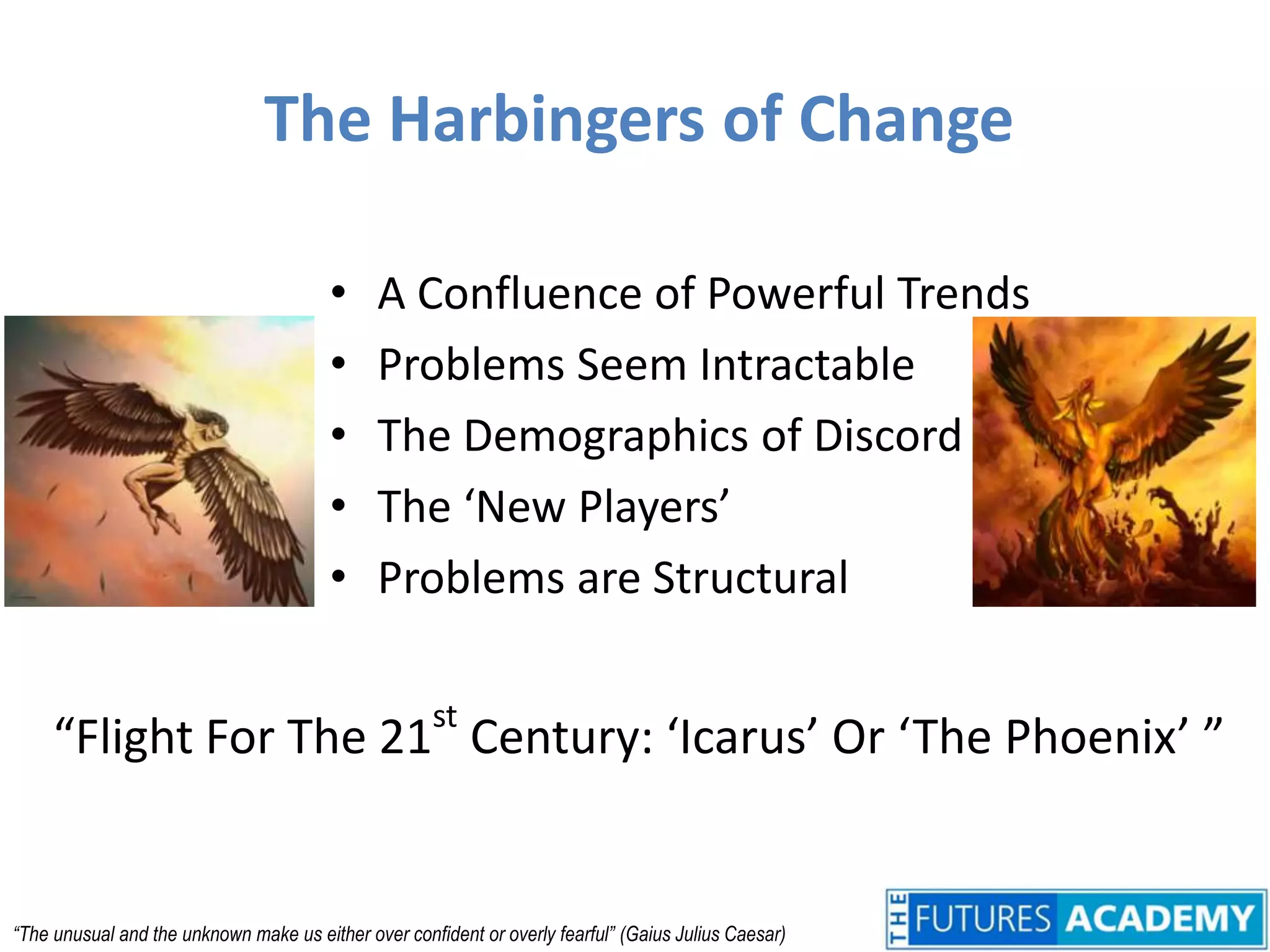
The Harbingers of ChangeA Confluence of Powerful TrendsProblems Seem IntractableThe Demographics of DiscordThe ‘New Players’Problems are Structural“Flight For The 21st Century: ‘Icarus’ Or ‘The Phoenix’ ”“The unusual and the unknown make us either over confident or overly fearful” 	(Gaius Julius Caesar)
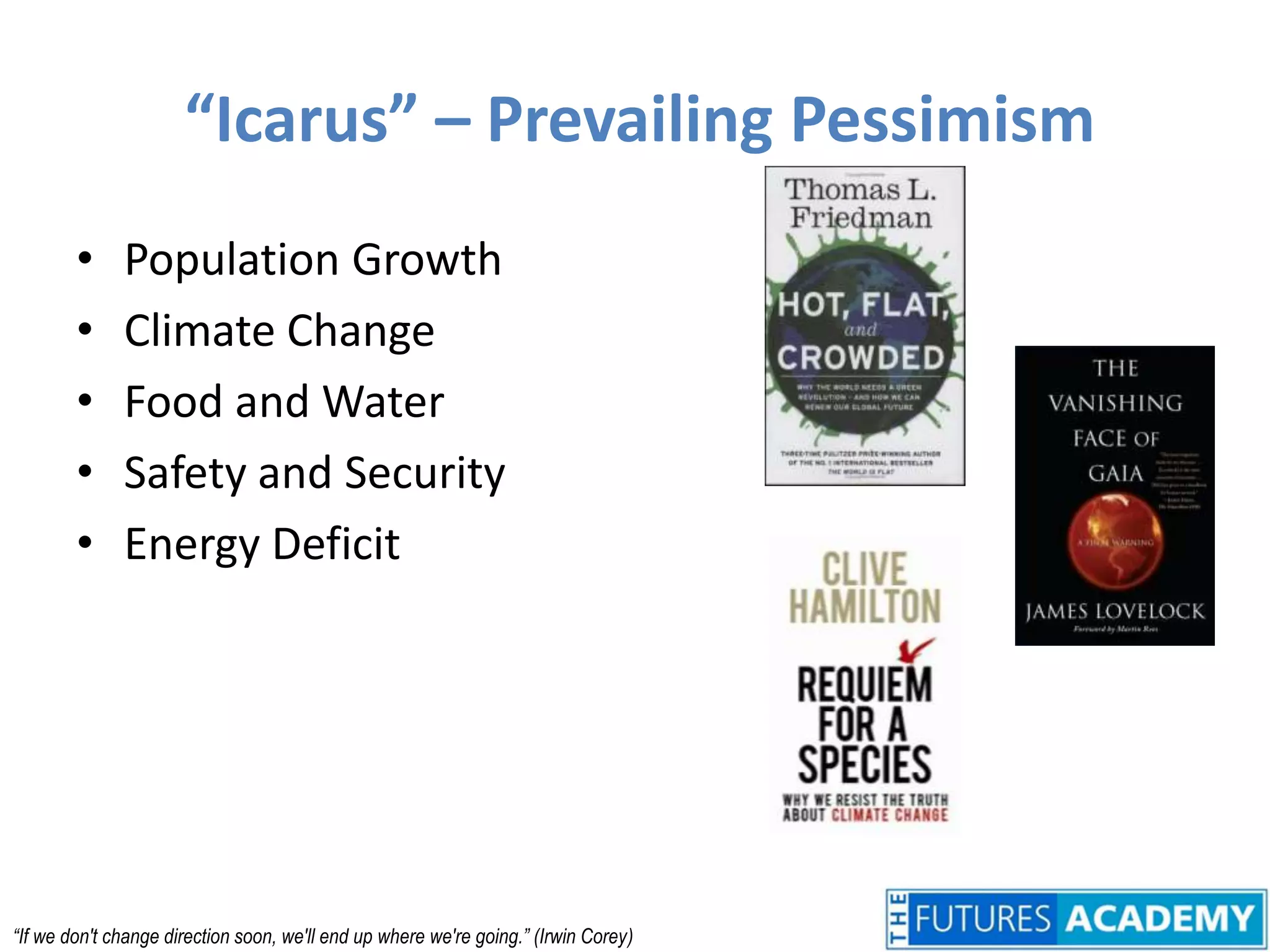
“Icarus” – Prevailing PessimismPopulation GrowthClimate ChangeFood and WaterSafety and SecurityEnergy Deficit“If we don't change direction soon, we'll end up where we're going.” (Irwin Corey)
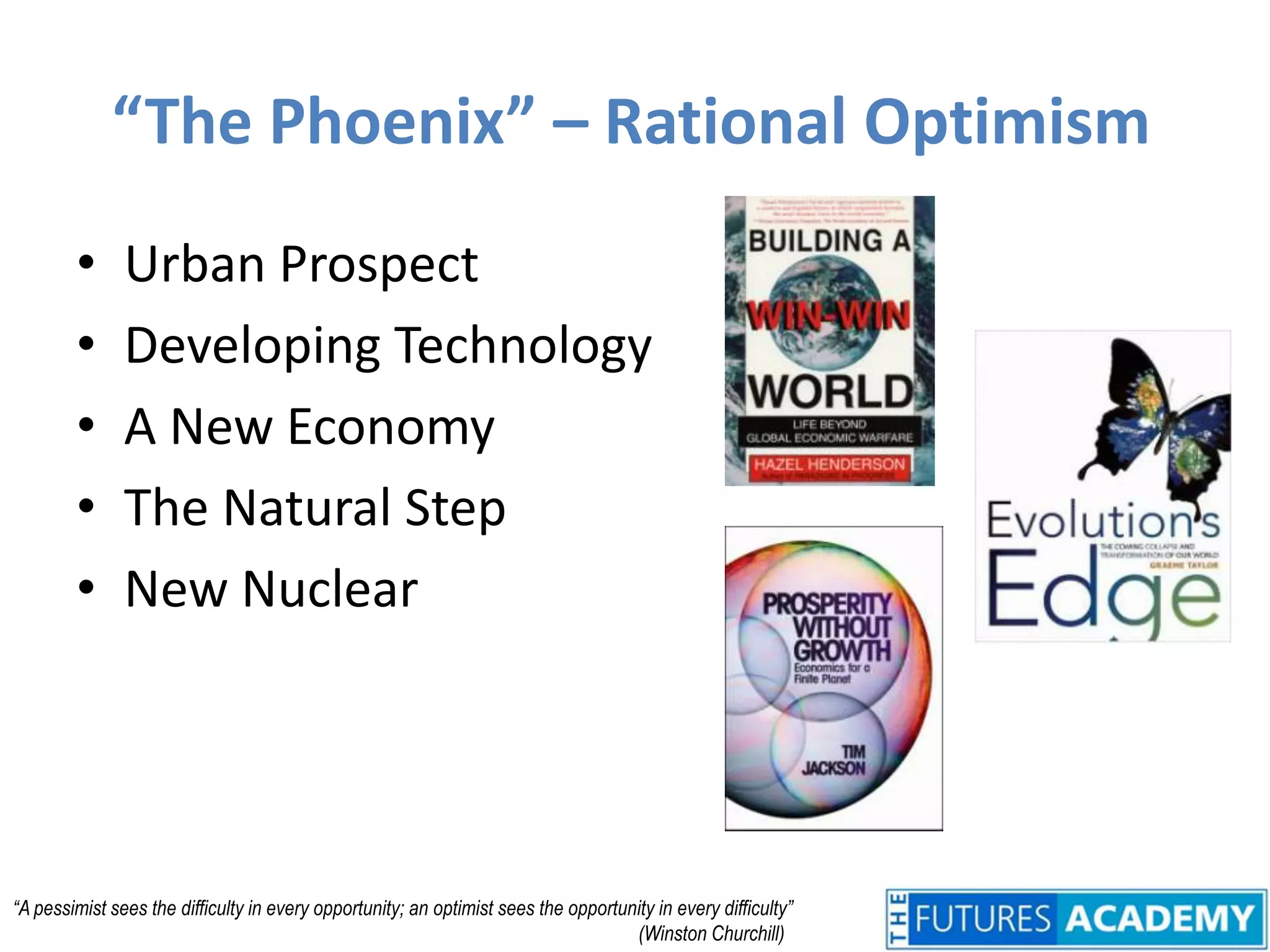
“The Phoenix” – Rational OptimismUrban ProspectDeveloping TechnologyA New EconomyThe Natural StepNew Nuclear“A pessimist sees the difficulty in every opportunity; an optimist sees the opportunity in every difficulty”	(Winston Churchill)
The Need for Vision“A vision without a task is but a dream  A task without a vision is drudgery  A vision with a task is the hope of the world”(Inscription in a church, Sussex, England, 1730)“No problem can be solved from the same level of consciousness that created it. We must learn to see the world anew” (Albert Einstein)
Present ProblemsChange, Complexity and Risk / UncertaintyLack of an Integrated ApproachShort-term OrientationObsolescence of ‘Predict and Provide’ ModelLimited Collaboration of Stakeholders“It’s not the strong that survive – but the most adaptable” (Charles Darwin)
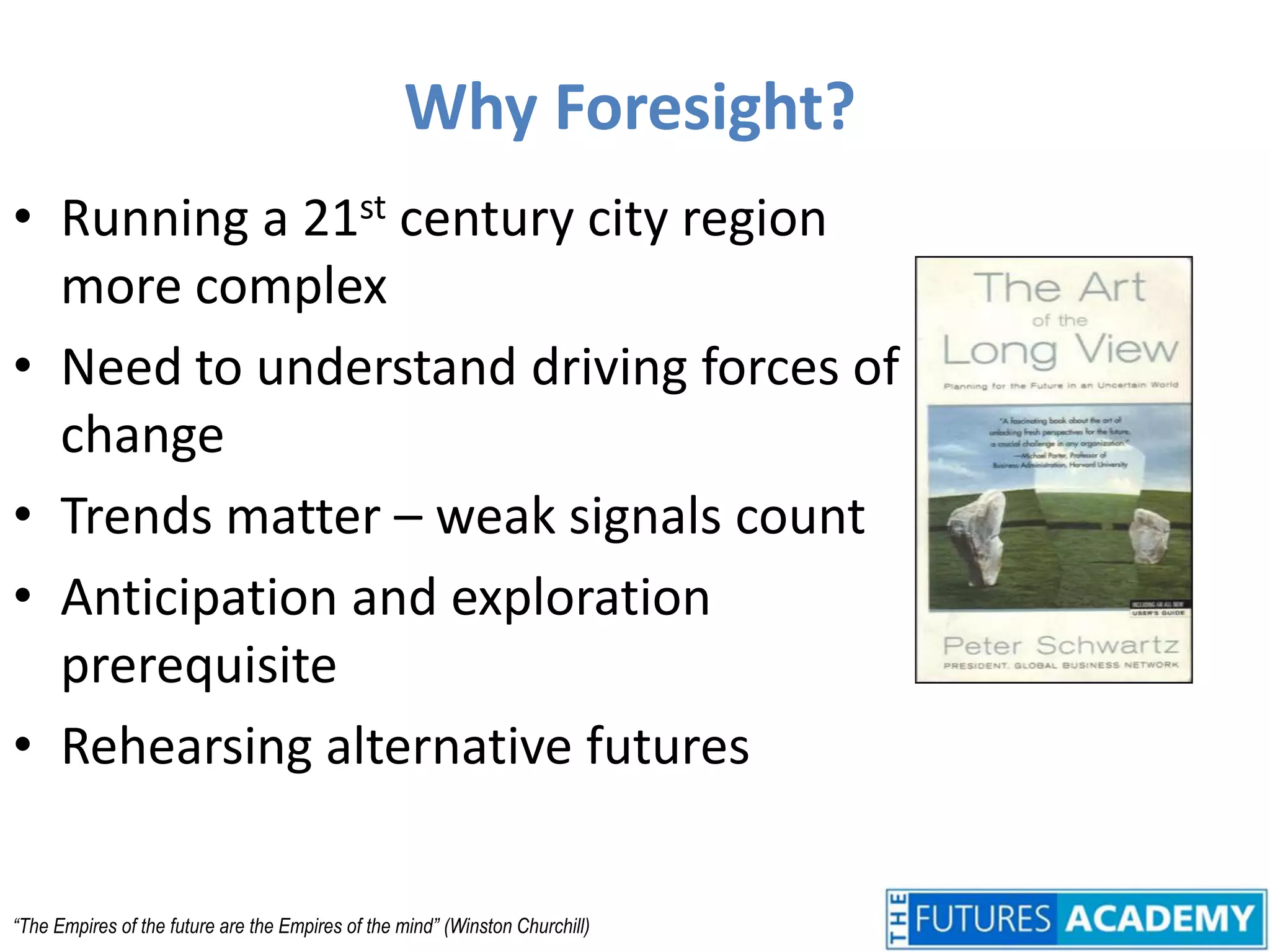
Why Foresight?Running a 21st century city region more complexNeed to understand driving forces of changeTrends matter – weak signals countAnticipation and exploration prerequisiteRehearsing alternative futures“The Empires of the future are the Empires of the mind” (Winston Churchill)
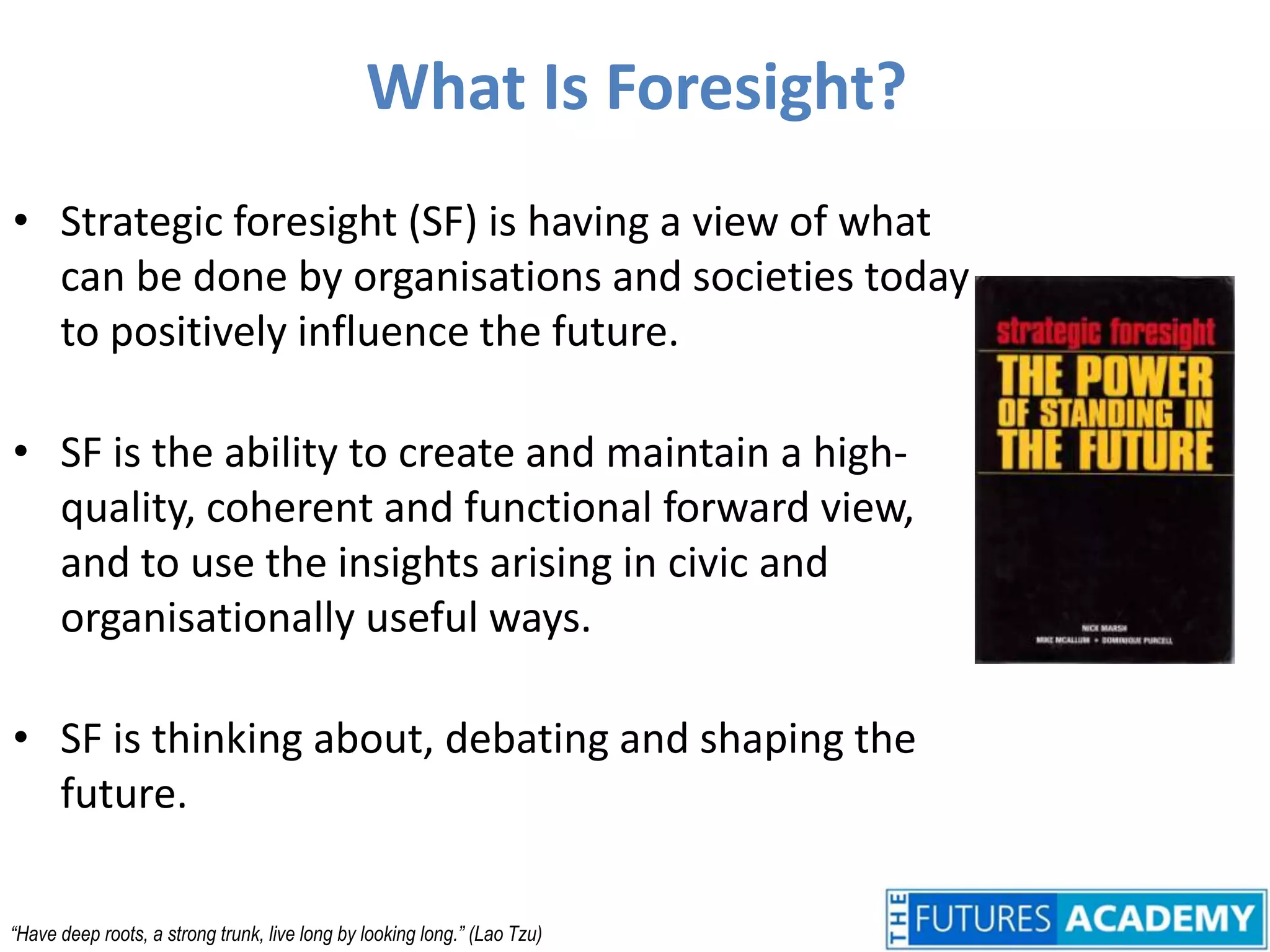
What Is Foresight?Strategic foresight (SF) is having a view of what can be done by organisations and societies today to positively influence the future.SF is the ability to create and maintain a high-quality, coherent and functional forward view, and to use the insights arising in civic and organisationally useful ways.SF is thinking about, debating and shaping the future.“Have deep roots, a strong trunk, live long by looking long.” (Lao Tzu)
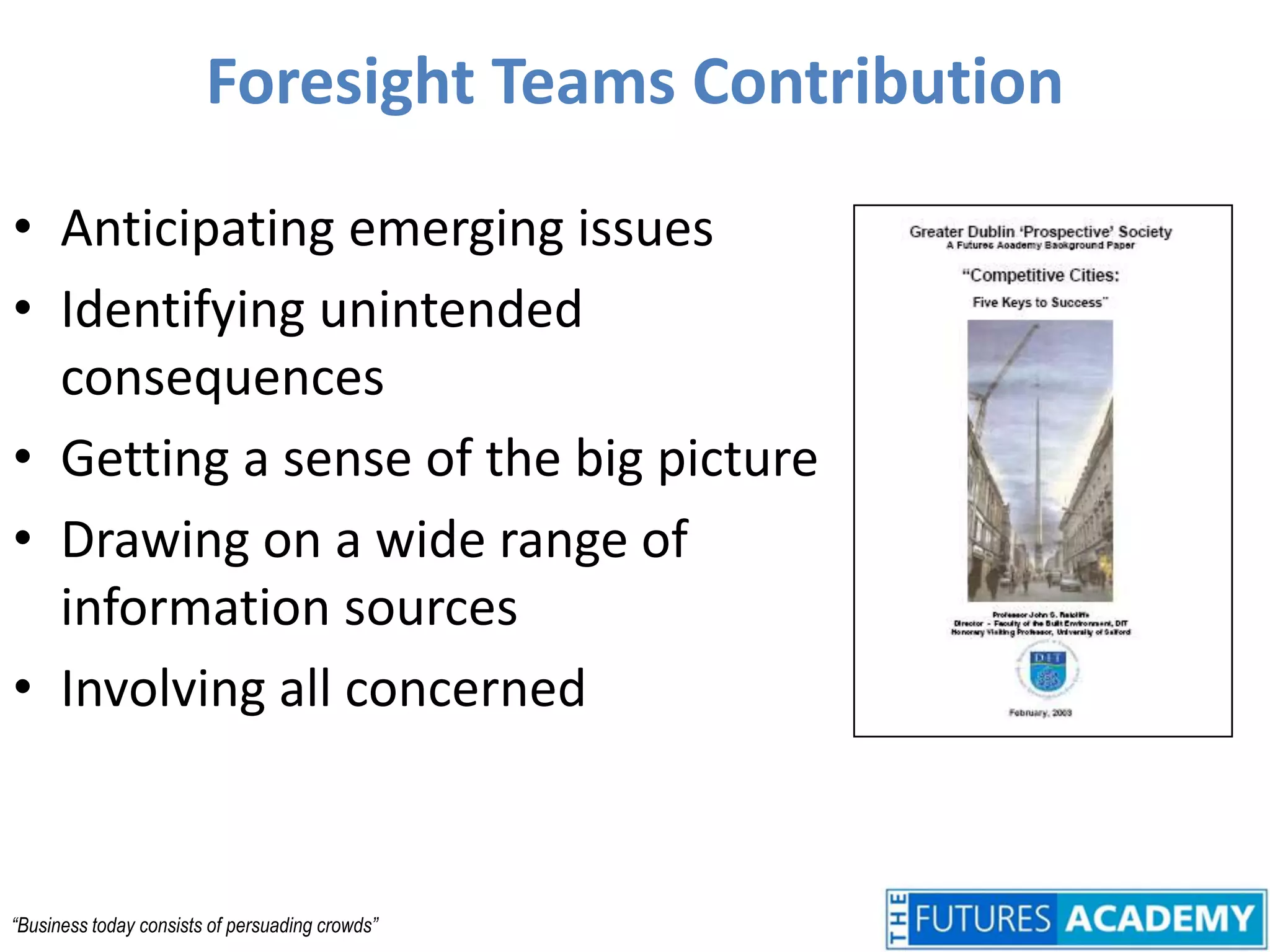
Foresight Teams ContributionAnticipating emerging issuesIdentifying unintended consequencesGetting a sense of the big pictureDrawing on a wide range of information sourcesInvolving all concerned“Business today consists of persuading crowds”
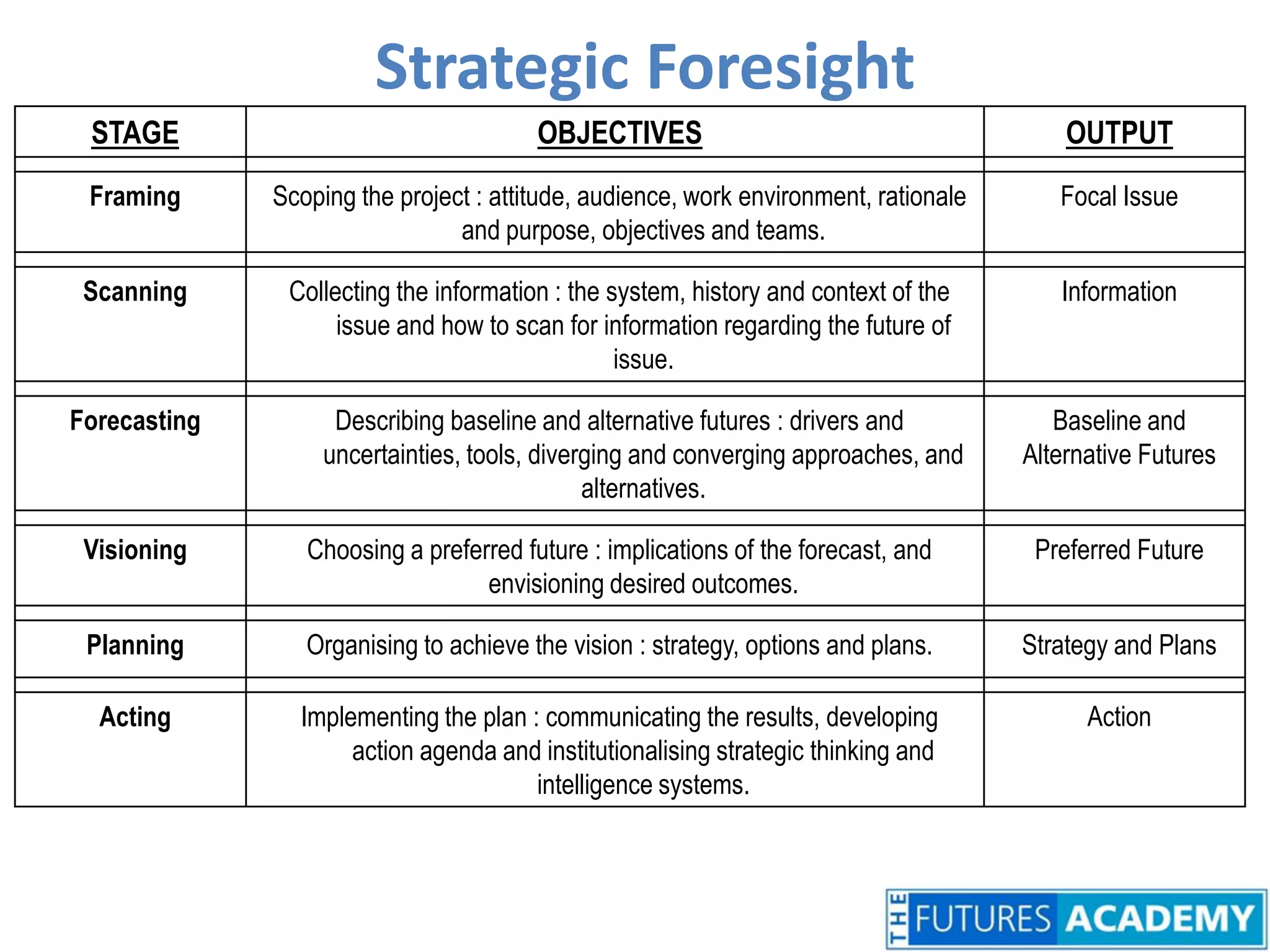
STAGEOBJECTIVESOUTPUTFramingScoping the project : attitude, audience, work environment, rationale and purpose, objectives and teams.Focal IssueScanningCollecting the information : the system, history and context of the issue and how to scan for information regarding the future of issue.InformationForecastingDescribing baseline and alternative futures : drivers and uncertainties, tools, diverging and converging approaches, and alternatives.Baseline andAlternative FuturesVisioningChoosing a preferred future : implications of the forecast, and envisioning desired outcomes.Preferred FuturePlanningOrganising to achieve the vision : strategy, options and plans.Strategy and PlansActingImplementing the plan : communicating the results, developing action agenda and institutionalising strategic thinking and intelligence systems.ActionStrategic Foresight
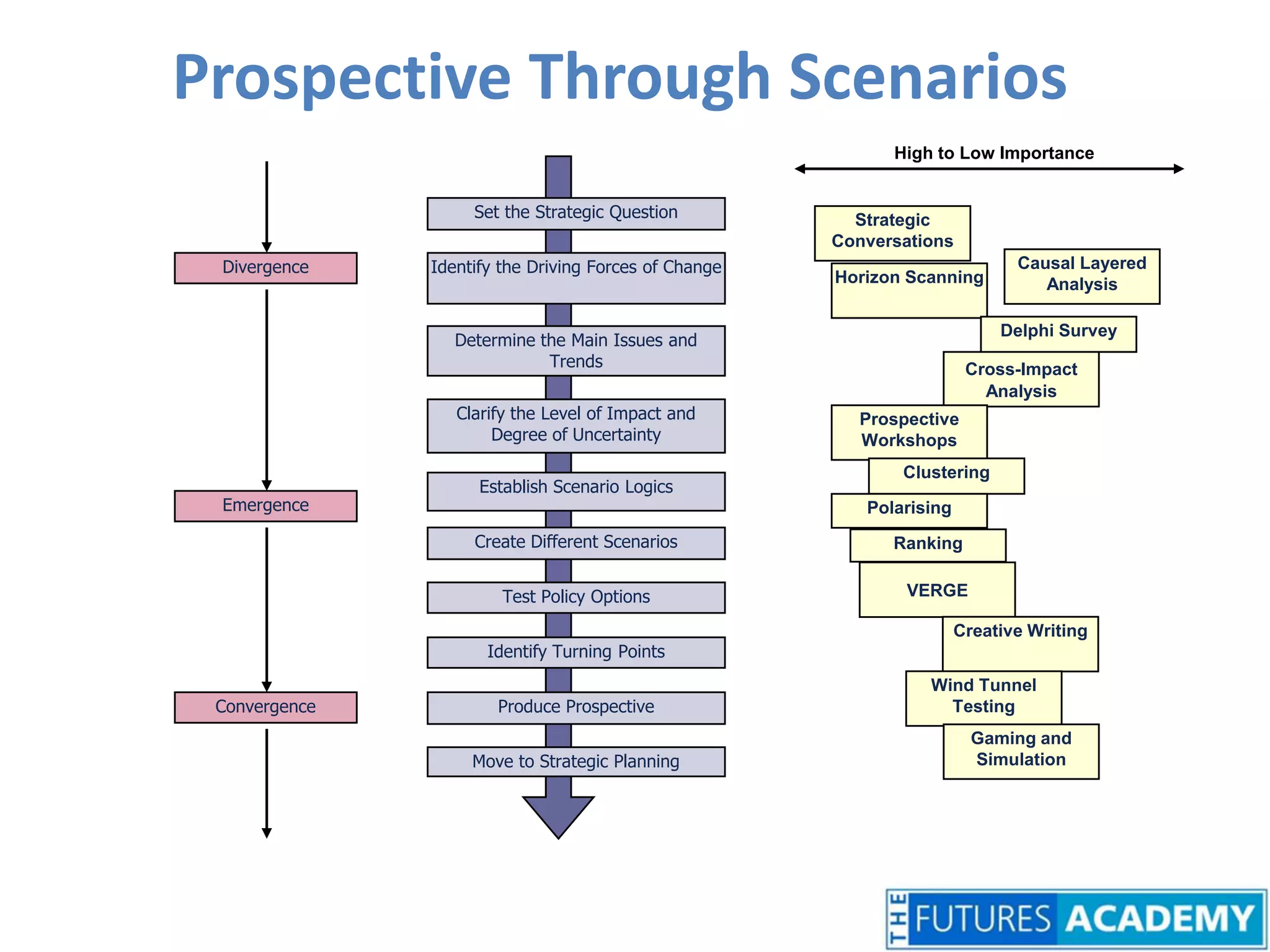
High to Low ImportanceSet the Strategic QuestionIdentify the Driving Forces of ChangeDivergenceDetermine the Main Issues and TrendsClarify the Level of Impact and Degree of UncertaintyEstablish Scenario LogicsEmergenceCreate Different ScenariosTest Policy OptionsIdentify Turning PointsProduce ProspectiveConvergenceMove to Strategic PlanningProspective Through ScenariosStrategic ConversationsCausal Layered AnalysisHorizon ScanningDelphi SurveyCross-ImpactAnalysisProspective WorkshopsClusteringPolarisingRankingVERGECreative WritingWind Tunnel TestingGaming and Simulation
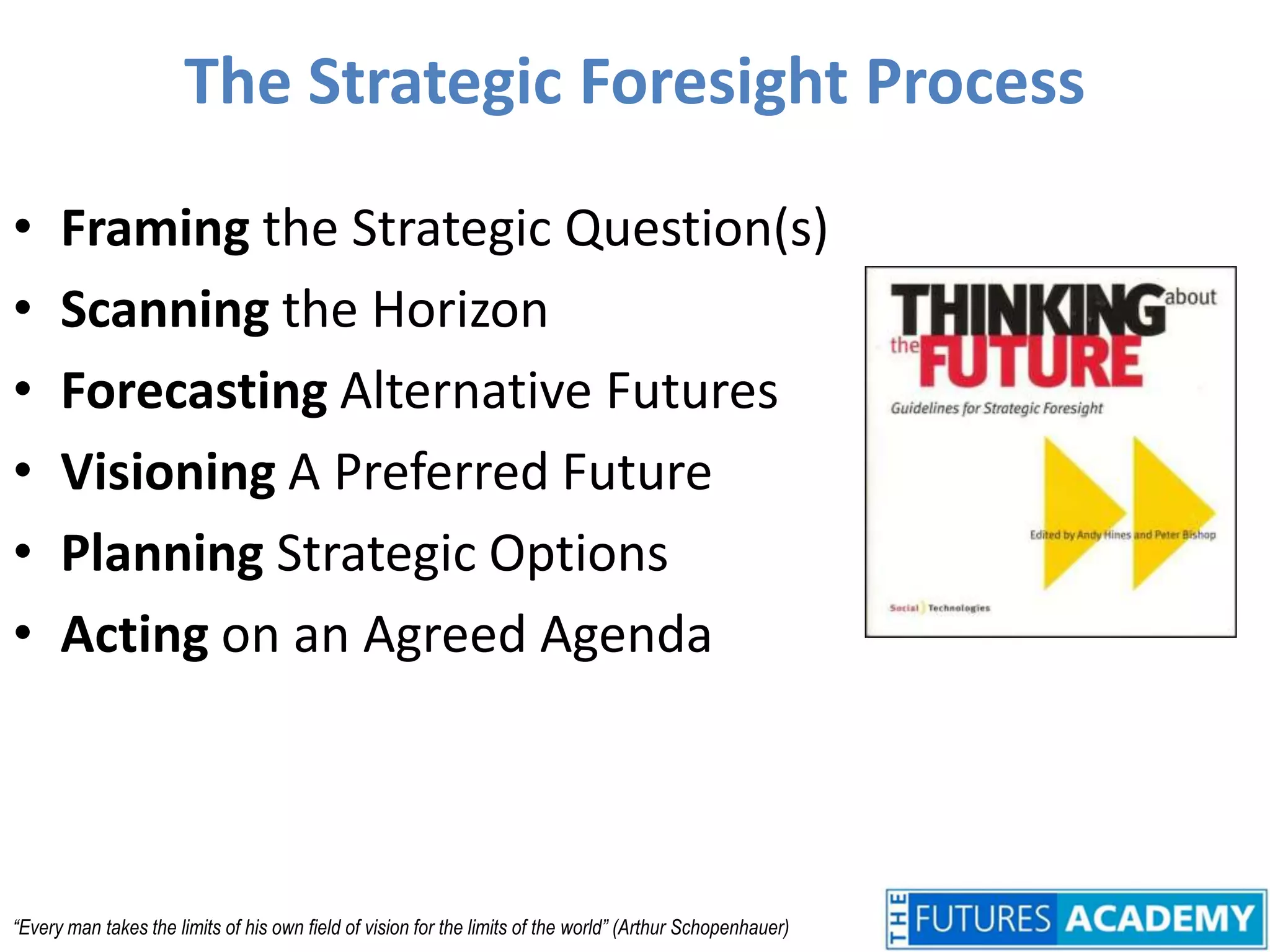
The Strategic Foresight ProcessFraming the Strategic Question(s)Scanning the HorizonForecasting Alternative FuturesVisioning A Preferred FuturePlanning Strategic OptionsActing on an Agreed Agenda“Every man takes the limits of his own field of vision for the limits of the world” (Arthur Schopenhauer)
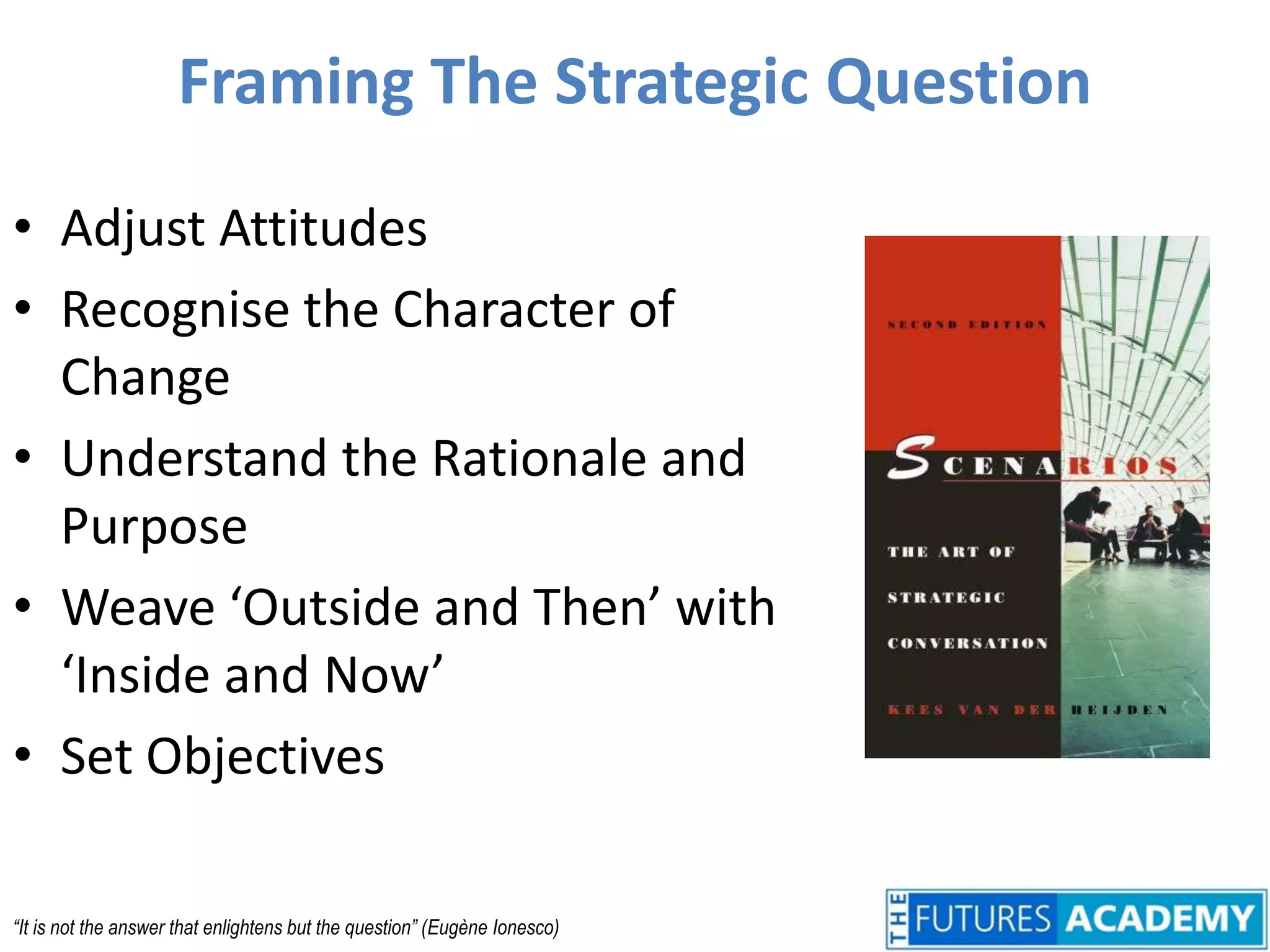
Framing The Strategic QuestionAdjust AttitudesRecognise the Character of ChangeUnderstand the Rationale and PurposeWeave ‘Outside and Then’ with ‘Inside and Now’Set Objectives“It is not the answer that enlightens but the question” (Eugène Ionesco)
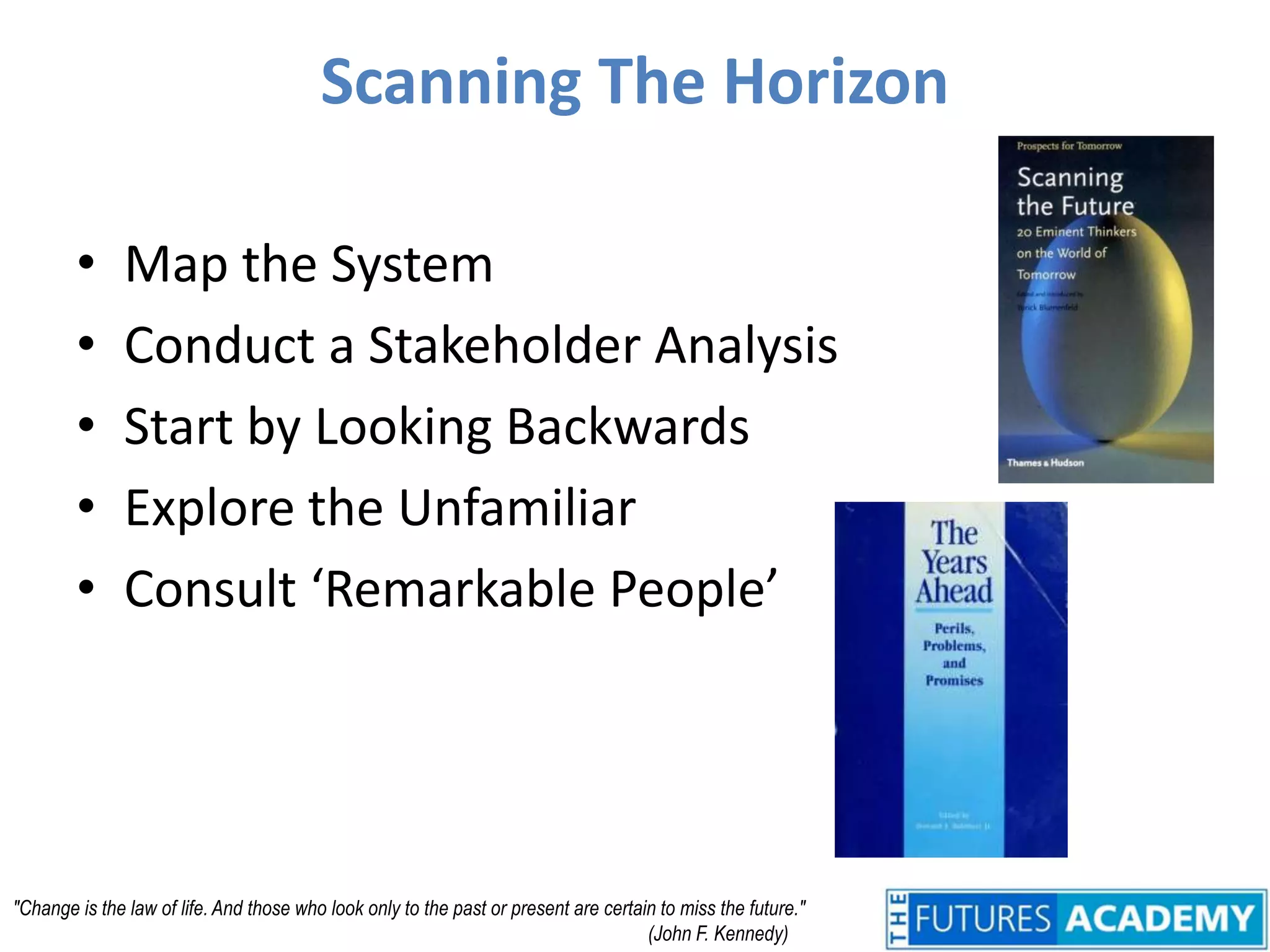
Scanning The HorizonMap the SystemConduct a Stakeholder AnalysisStart by Looking BackwardsExplore the UnfamiliarConsult ‘Remarkable People’"Change is the law of life. And those who look only to the past or present are certain to miss the future." 					(John F. Kennedy)
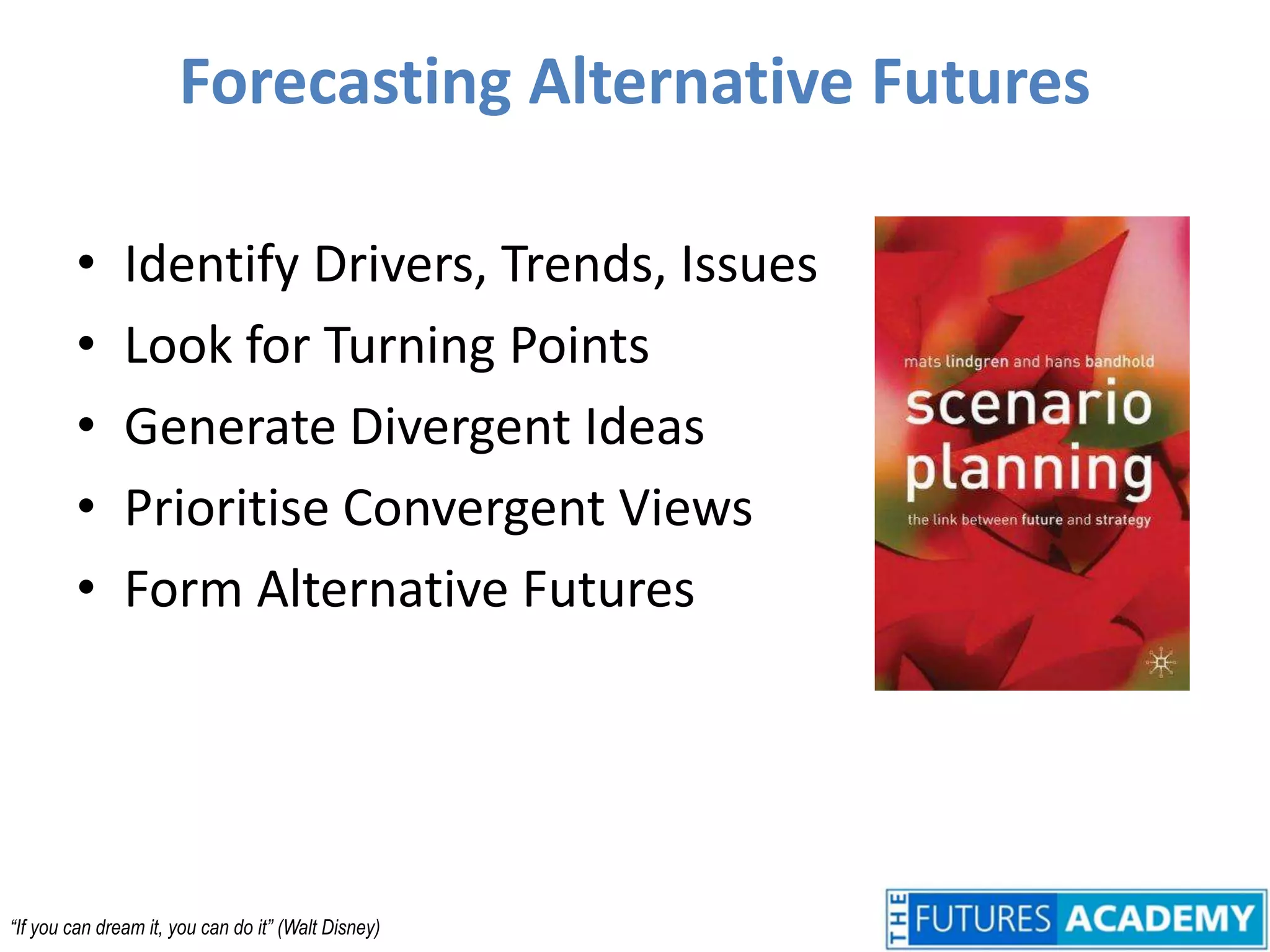
Forecasting Alternative FuturesIdentify Drivers, Trends, IssuesLook for Turning PointsGenerate Divergent IdeasPrioritise Convergent ViewsForm Alternative Futures“If you can dream it, you can do it” (Walt Disney)
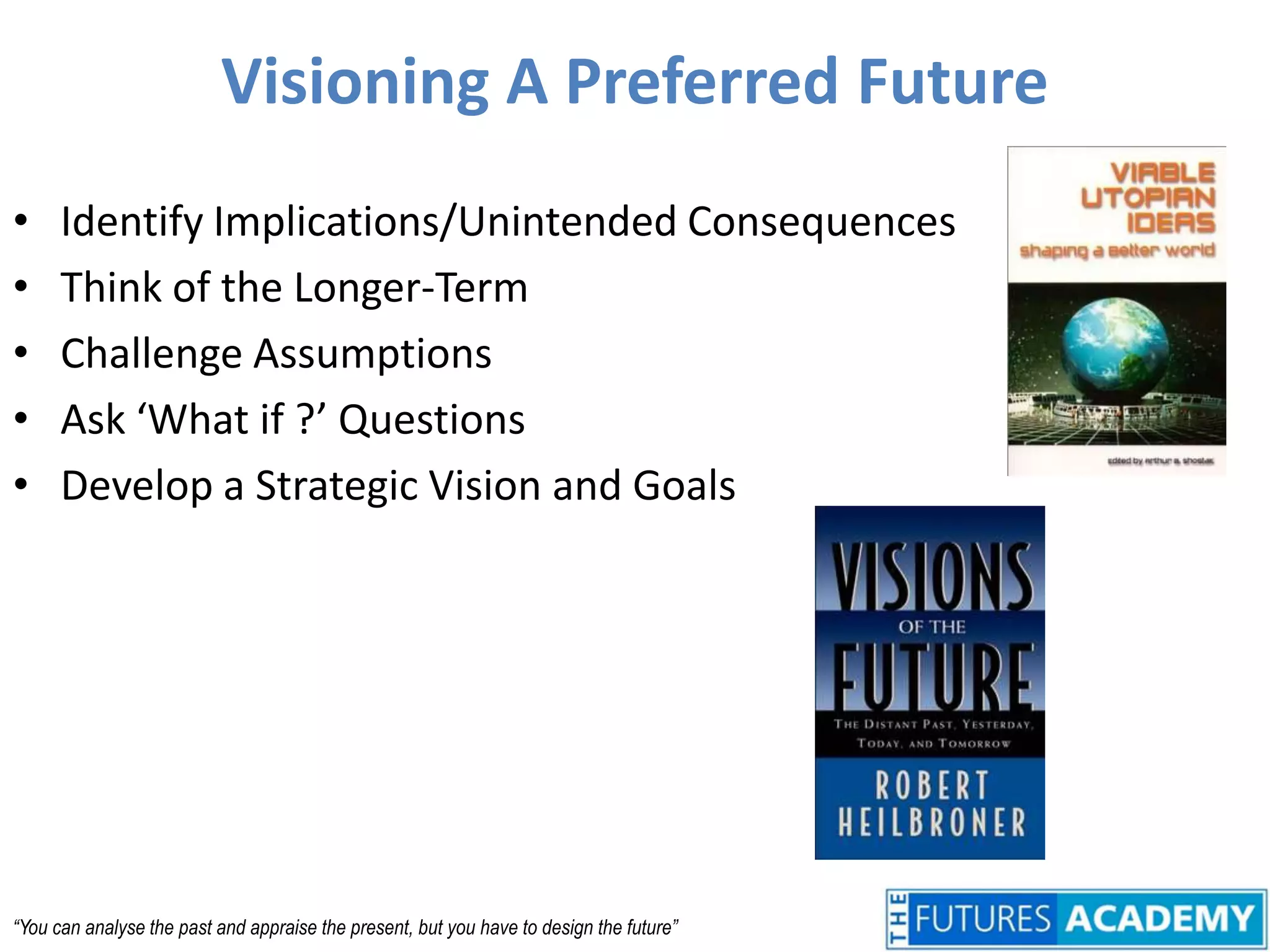
Visioning A Preferred FutureIdentify Implications/Unintended ConsequencesThink of the Longer-TermChallenge AssumptionsAsk ‘What if ?’ QuestionsDevelop a Strategic Vision and Goals“You can analyse the past and appraise the present, but you have to design the future”
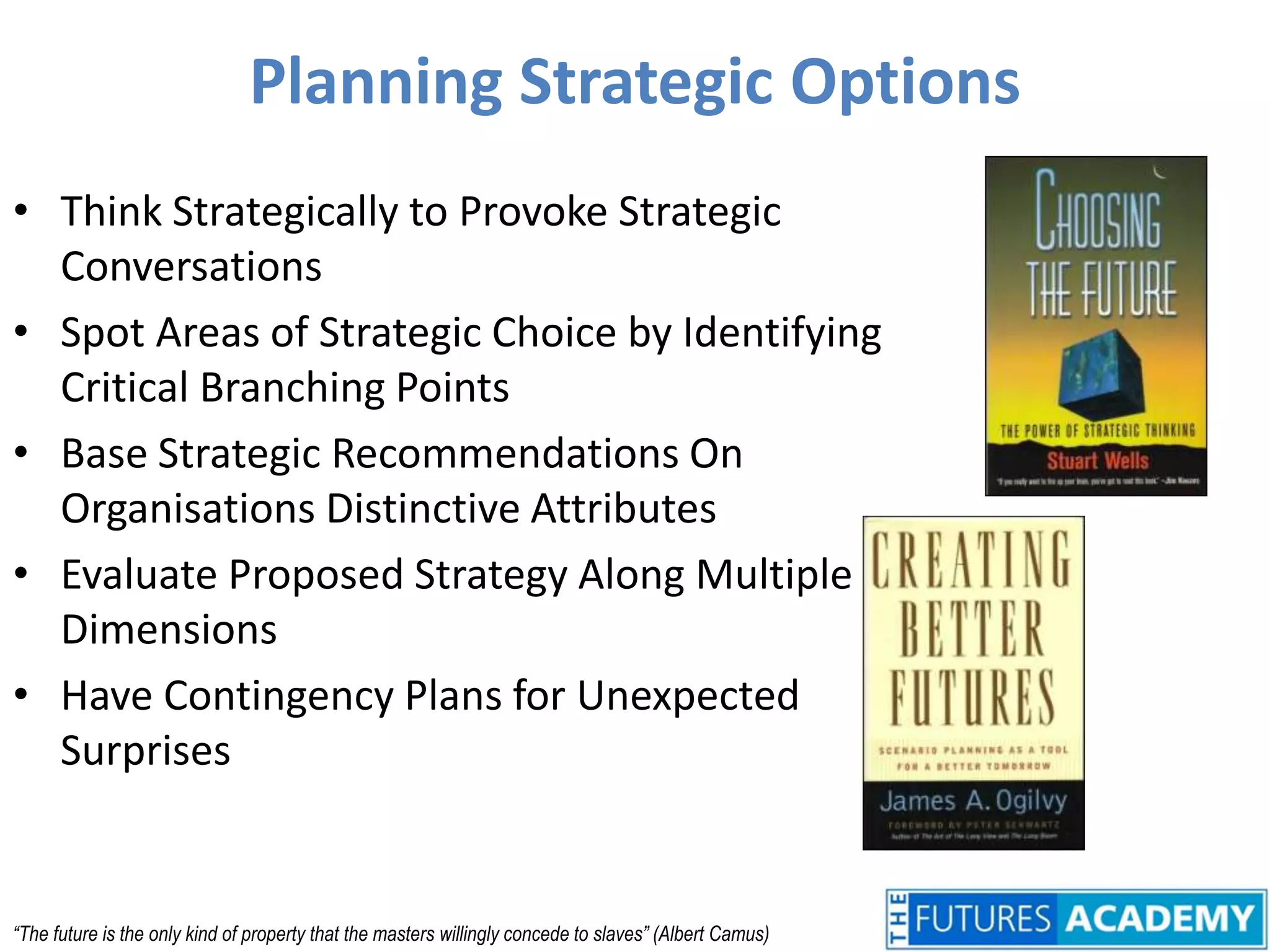
Planning Strategic OptionsThink Strategically to Provoke Strategic ConversationsSpot Areas of Strategic Choice by Identifying Critical Branching PointsBase Strategic Recommendations On Organisations Distinctive AttributesEvaluate Proposed Strategy Along Multiple DimensionsHave Contingency Plans for Unexpected Surprises“The future is the only kind of property that the masters willingly concede to slaves” (Albert Camus)
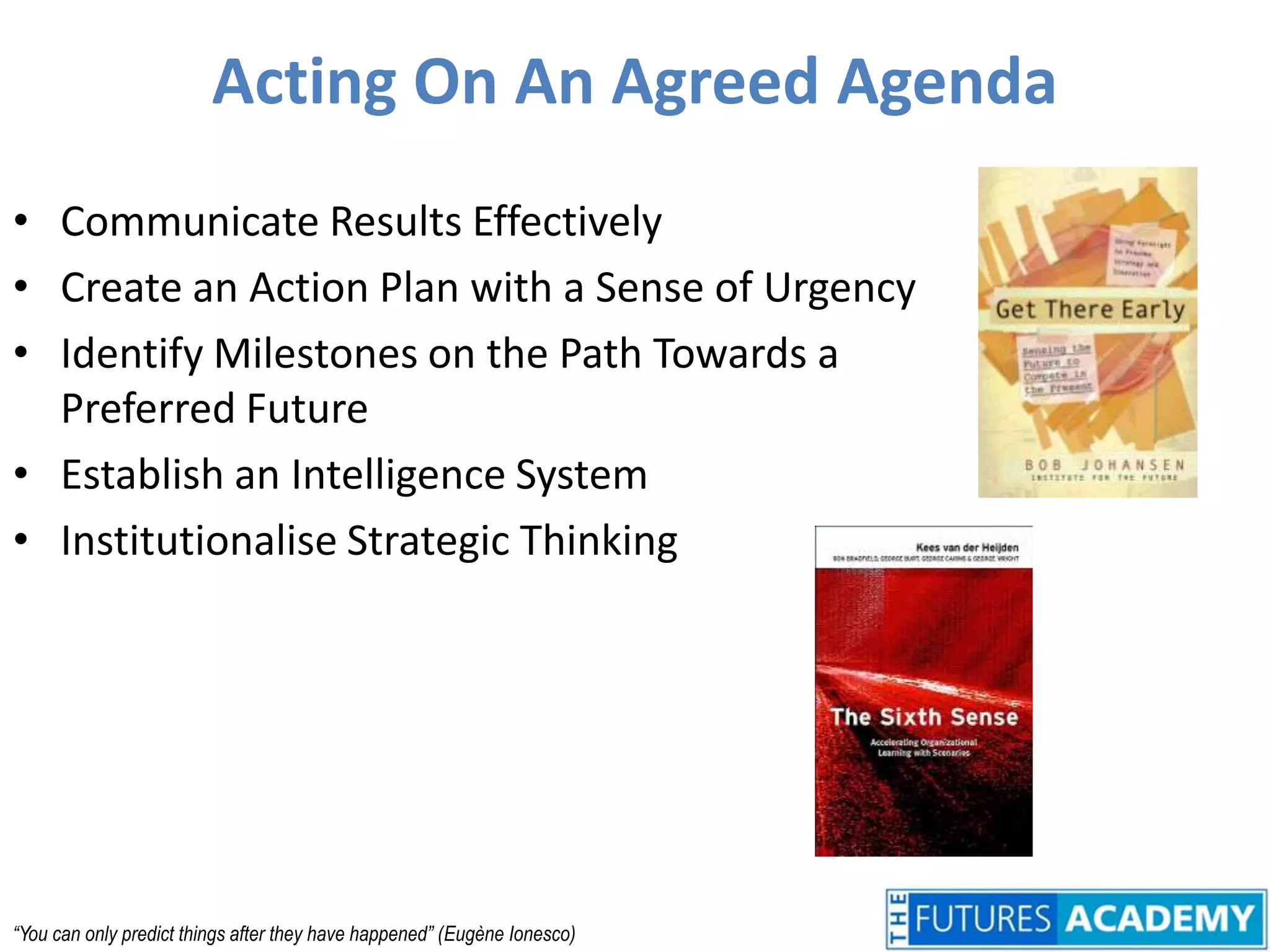
Acting On An Agreed AgendaCommunicate Results EffectivelyCreate an Action Plan with a Sense of UrgencyIdentify Milestones on the Path Towards a Preferred FutureEstablish an Intelligence SystemInstitutionalise Strategic Thinking“You can only predict things after they have happened” (Eugène Ionesco)
What Are The Prospects?“Can we go on like this?”Meta-forcesMacro-forcesMicro-forces“Reason is, and ought only to be the slave of the passions and can never pretend to any other office than to serve and obey them” (David Hume, 1783)
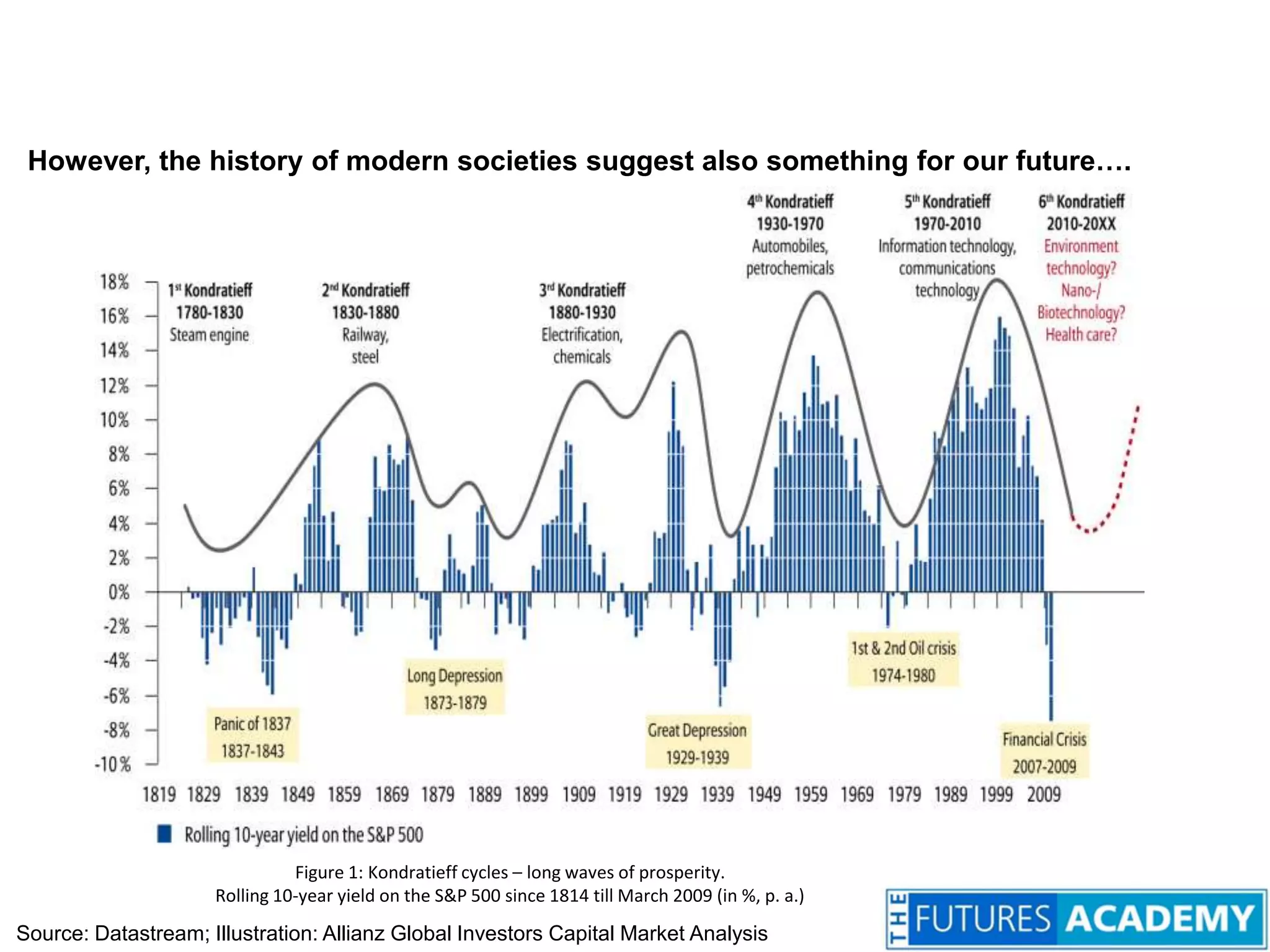
However, the history of modern societies suggest also something for our future….Figure 1: Kondratieff cycles – long waves of prosperity.Rolling 10-year yield on the S&P 500 since 1814 till March 2009 (in %, p. a.)Source: Datastream; Illustration: Allianz Global Investors Capital Market Analysis
Three Meta-forcesVALUESVISIONSVECTORS“Unless the investment in children is made, all of humanity's most fundamental long-term problems will remain fundamental long-term problems.”   (UNICEF) 
Values	The Transformation Towards	A Sustainable Responsible Civilization“All that is necessary for the triumph of evil is that good men do nothing.” (Edmund Burke)
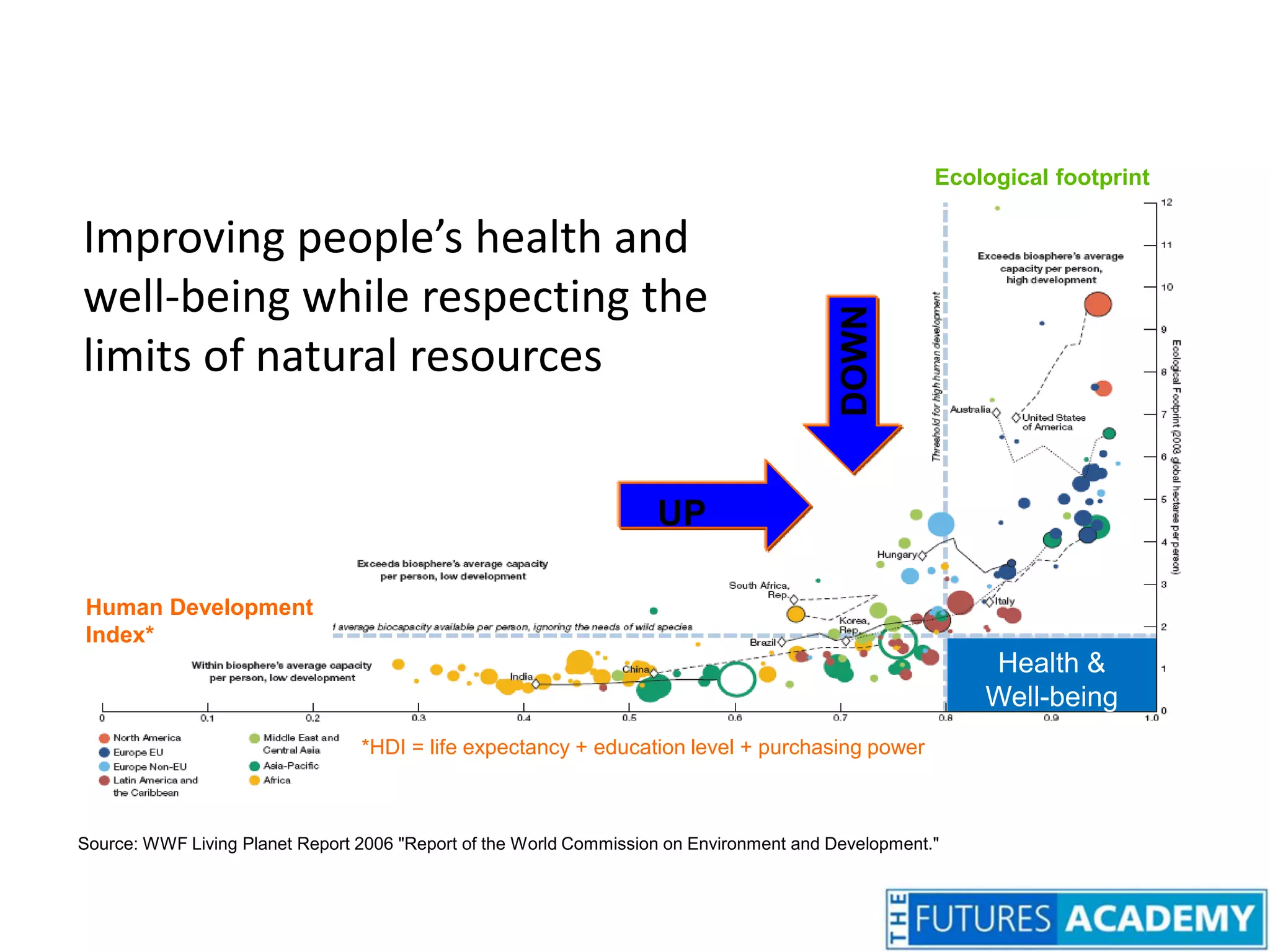
DOWNUPEcological footprintImproving people’s health and well-being while respecting the limits of natural resources *HDI = life expectancy + education level + purchasing powerHuman Development Index*Health & Well-beingSource: WWF Living Planet Report 2006 "Report of the World Commission on Environment and Development."
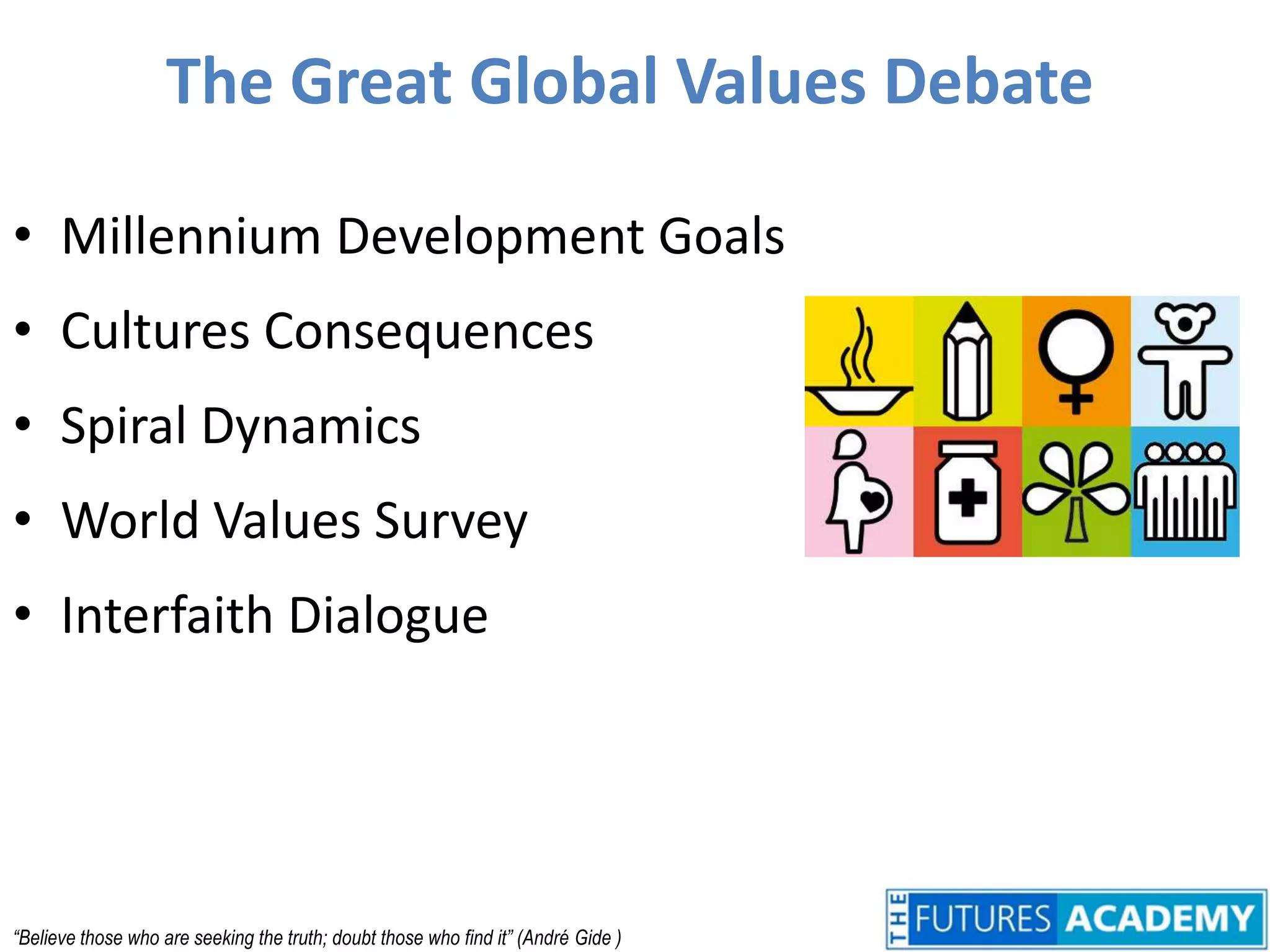
The Great Global Values DebateMillennium Development GoalsCultures ConsequencesSpiral DynamicsWorld Values SurveyInterfaith Dialogue“Believe those who are seeking the truth; doubt those who find it” (André Gide )
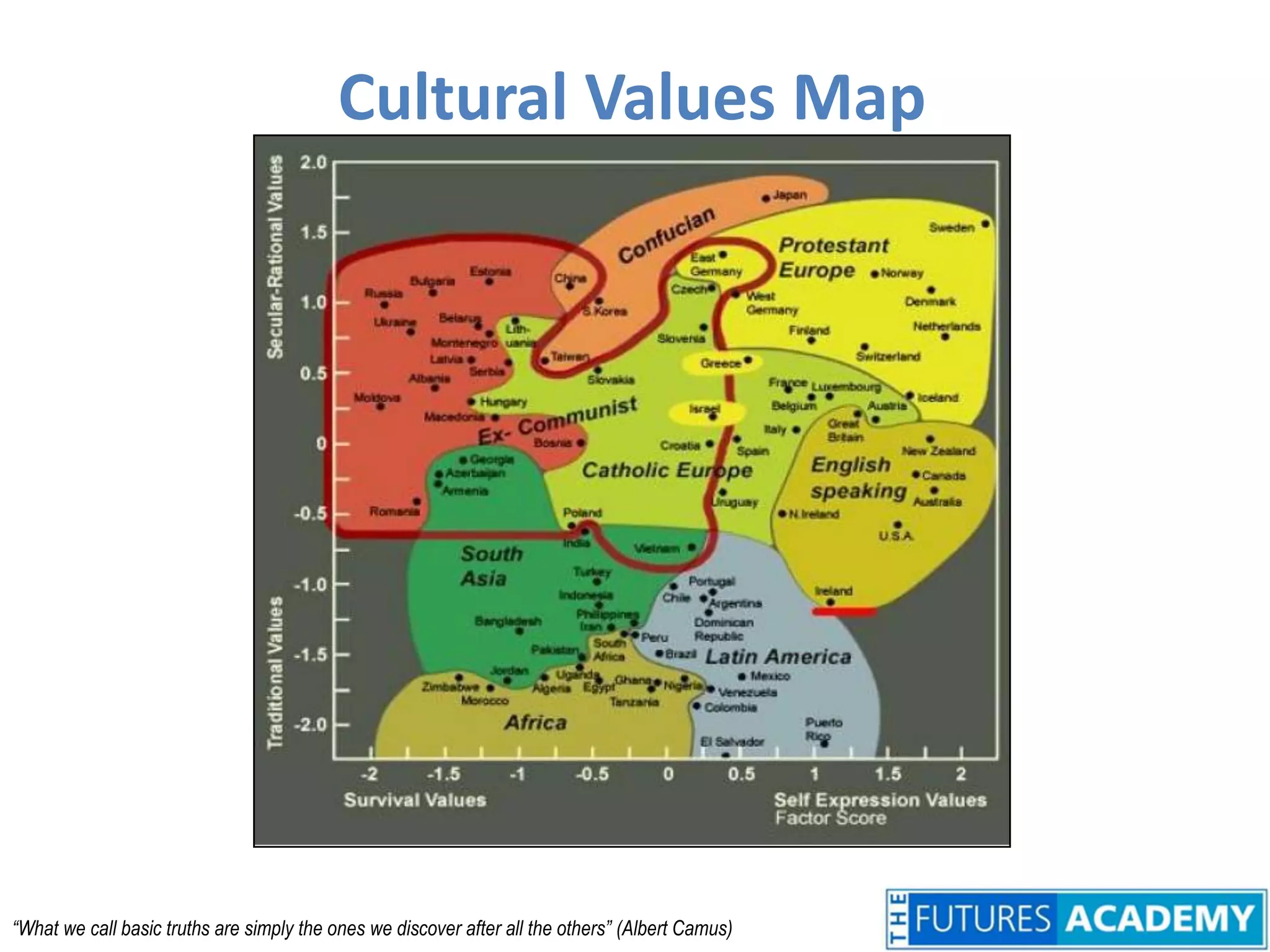
Cultural Values Map“What we call basic truths are simply the ones we discover after all the others” 	(Albert Camus)
Visions“Twenty-first Century Enlightenment”Self-Aware AutonomyEmpathetic UniversalismProgress and EthicsThe Social Aspiration GapSignposts to 21st C. Enlightenment“Government is a badge of lost innocence… For were the impulses of conscience clear, uniform and irresistibly obeyed, man would need no other lawgiver”  (Thomas Paine)
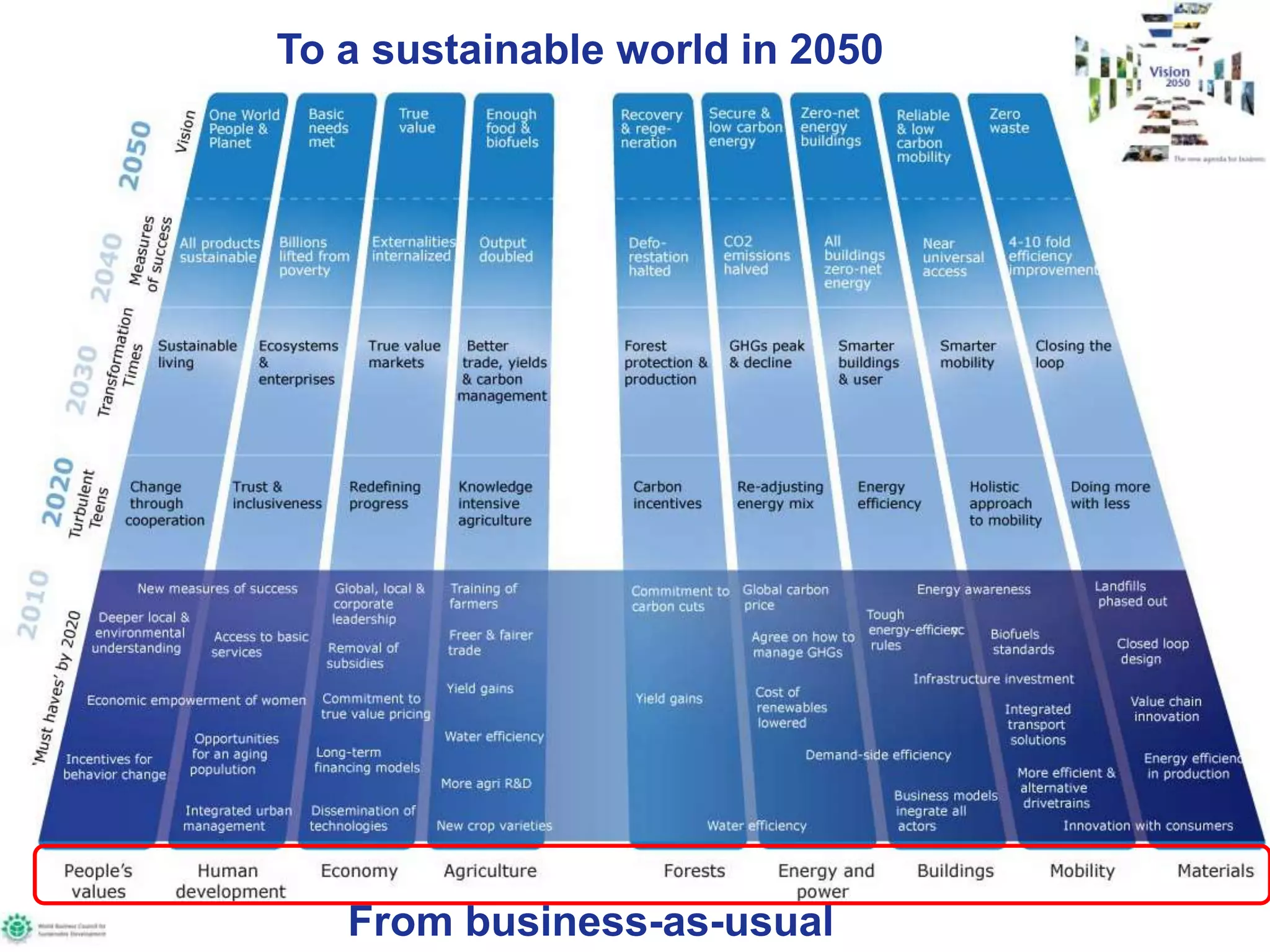
To a sustainable world in 2050From business-as-usual
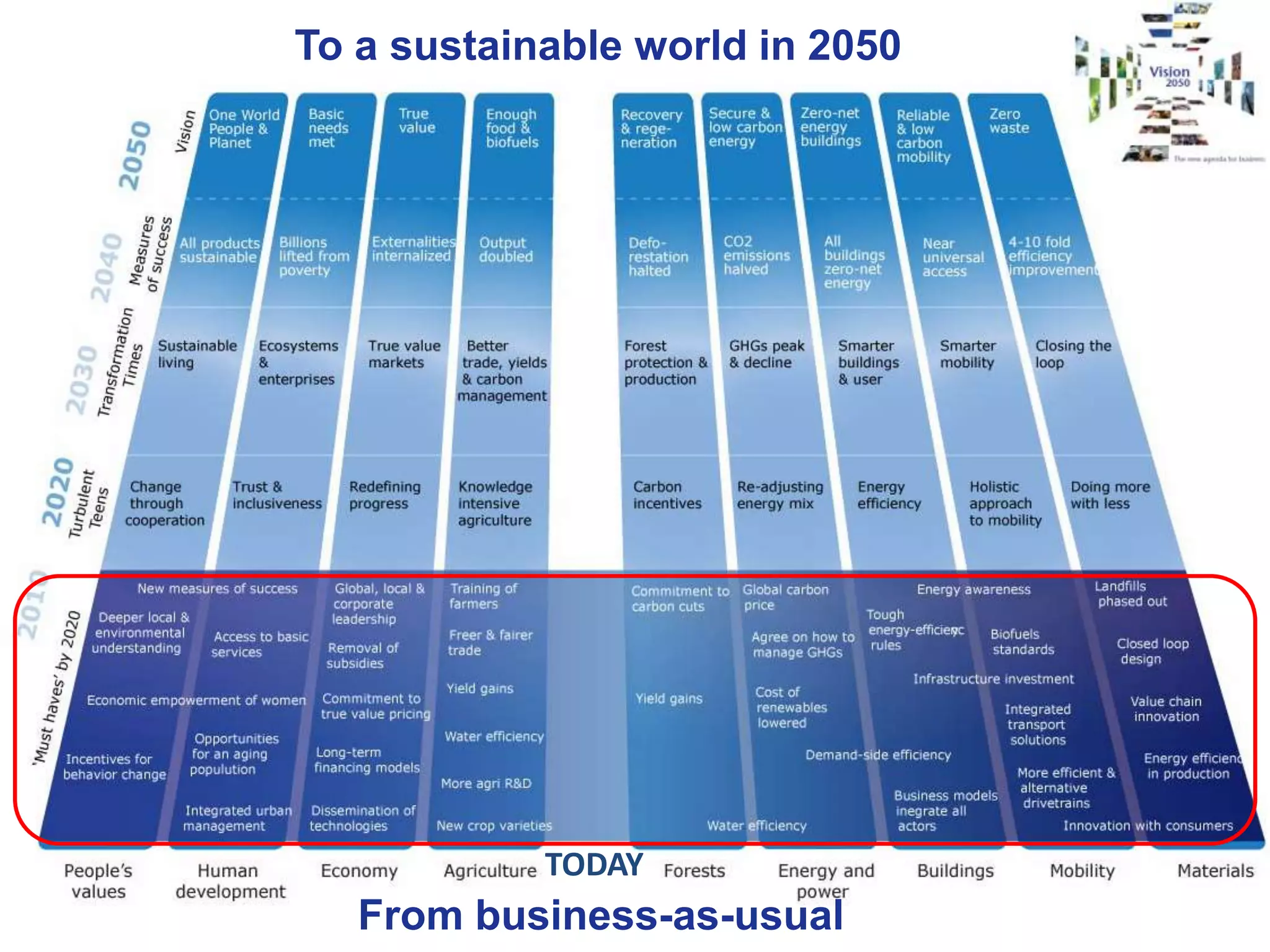
To a sustainable world in 2050TODAYFrom business-as-usual
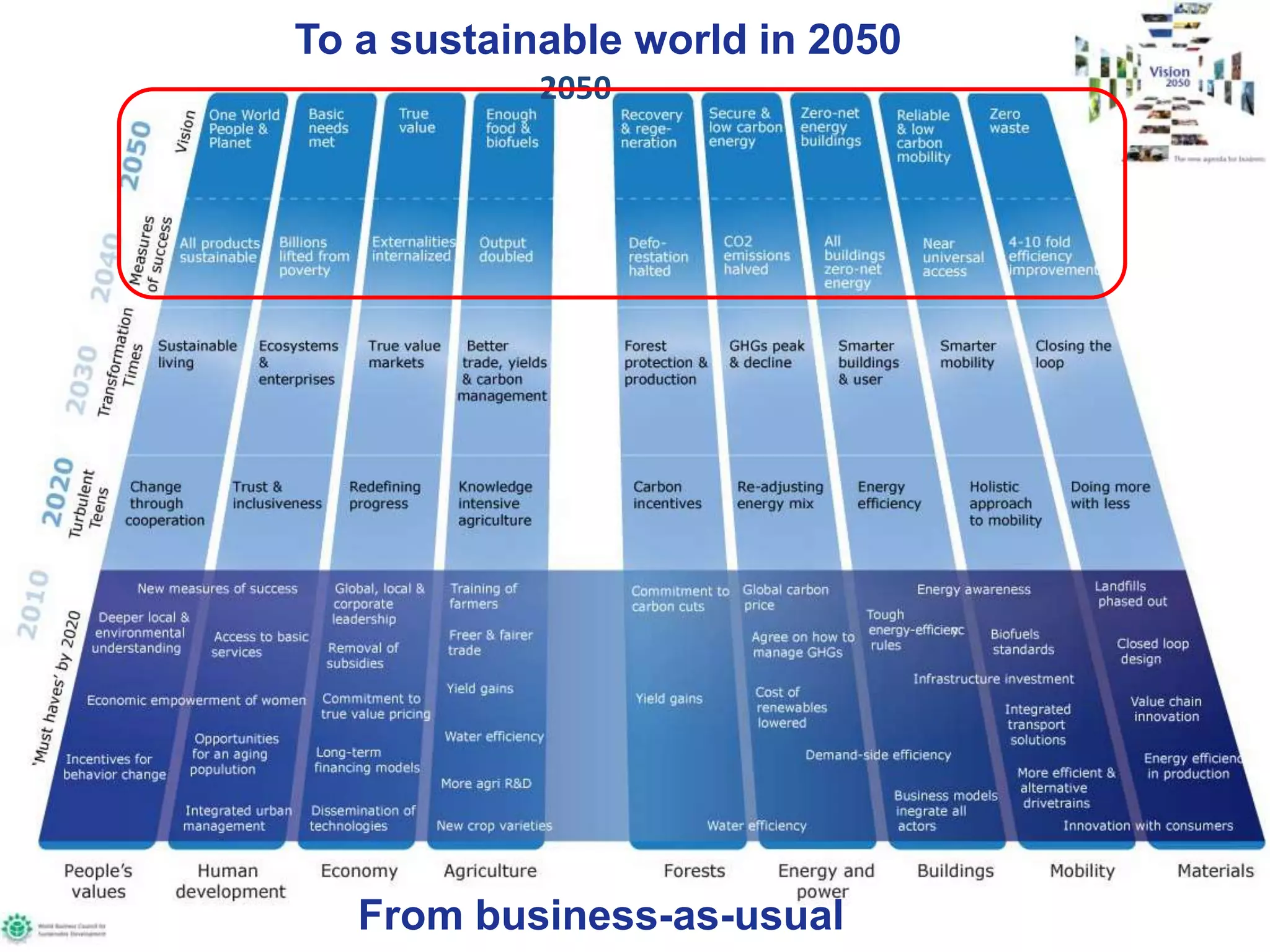
To a sustainable world in 20502050From business-as-usual
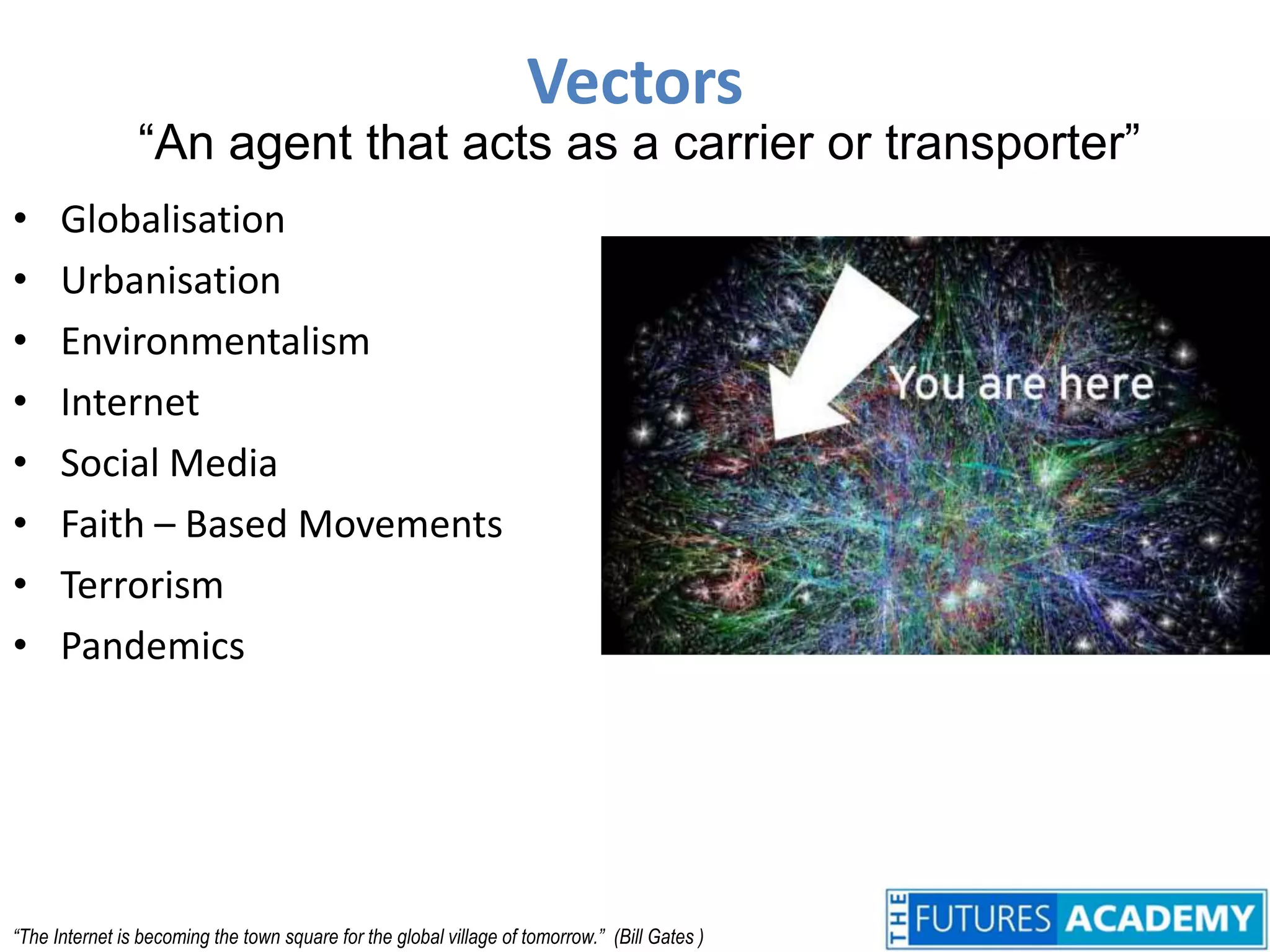
Vectors“An agent that acts as a carrier or transporter”GlobalisationUrbanisationEnvironmentalism InternetSocial MediaFaith – Based MovementsTerrorismPandemics“The Internet is becoming the town square for the global village of tomorrow.”  (Bill Gates )
proGective -- Fabienne GOUX-BAUDIMENT©
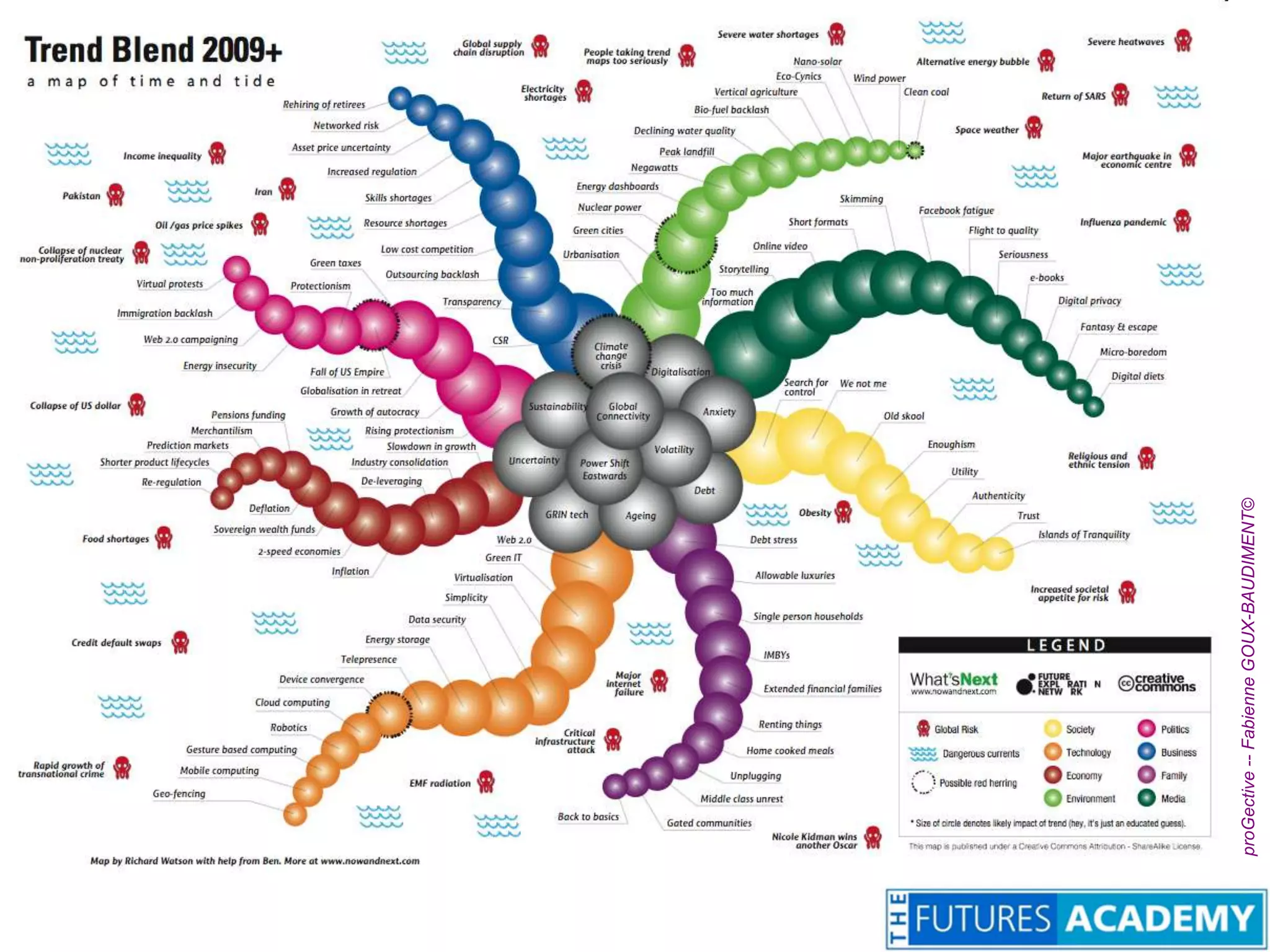
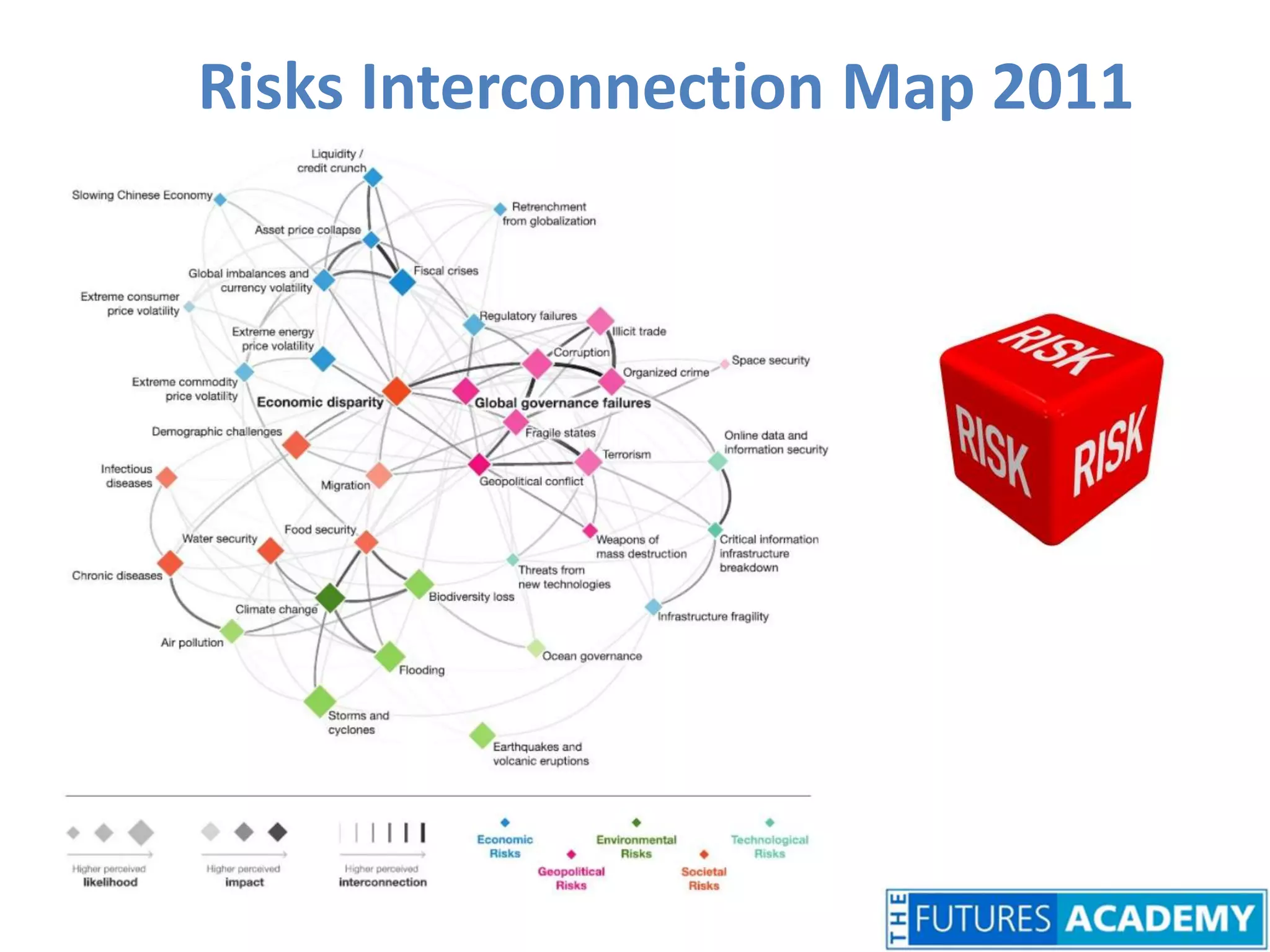
Risks Interconnection Map 2011
Imagineering the Built EnvironmentSTRATEGIC FORESIGHT 2030“Just Imagine!”Professor John S RatcliffeJuly 2011
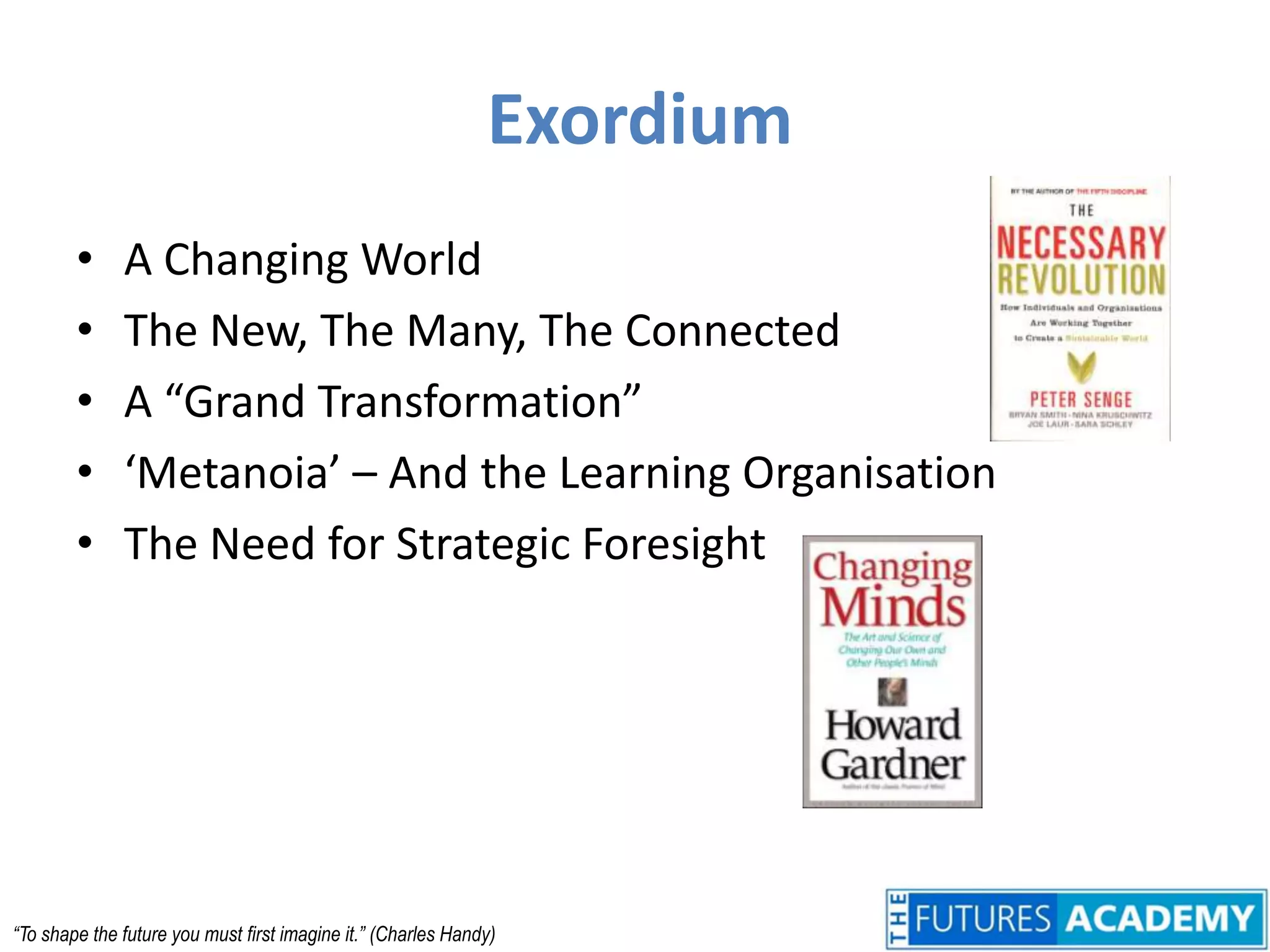
ExordiumA Changing WorldThe New, The Many, The ConnectedA “Grand Transformation”‘Metanoia’ – And the Learning OrganisationThe Need for Strategic Foresight“To shape the future you must first imagine it.” (Charles Handy)
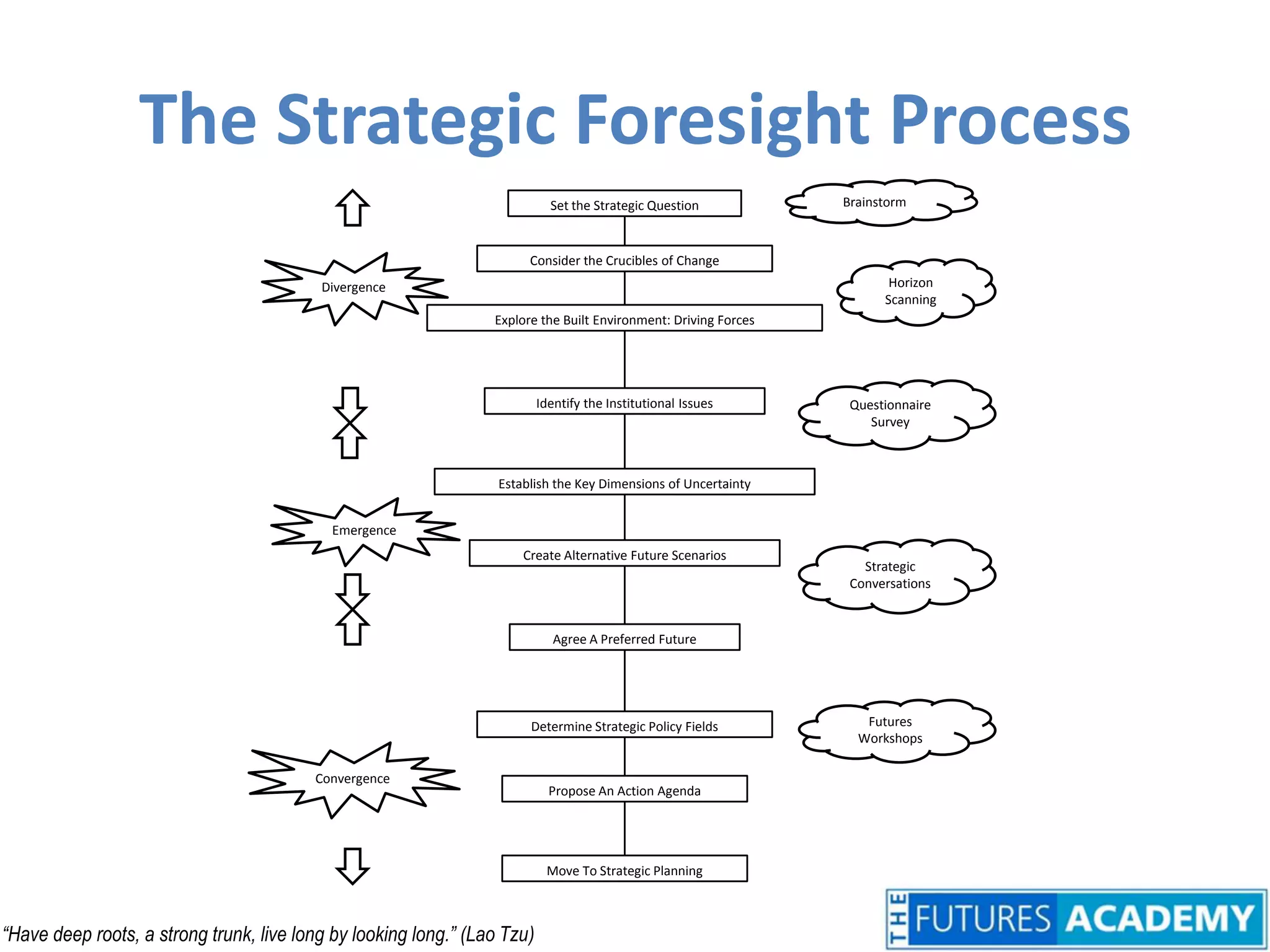
BrainstormSet the Strategic QuestionConsider the Crucibles of ChangeDivergenceHorizon ScanningExplore the Built Environment: Driving ForcesQuestionnaire Survey Identify the Institutional Issues Establish the Key Dimensions of UncertaintyEmergenceStrategic ConversationsCreate Alternative Future Scenarios  Agree A Preferred FutureFutures WorkshopsDetermine Strategic Policy FieldsConvergencePropose An Action Agenda“Have deep roots, a strong trunk, live long by looking long.” (Lao Tzu)Move To Strategic PlanningThe Strategic Foresight Process
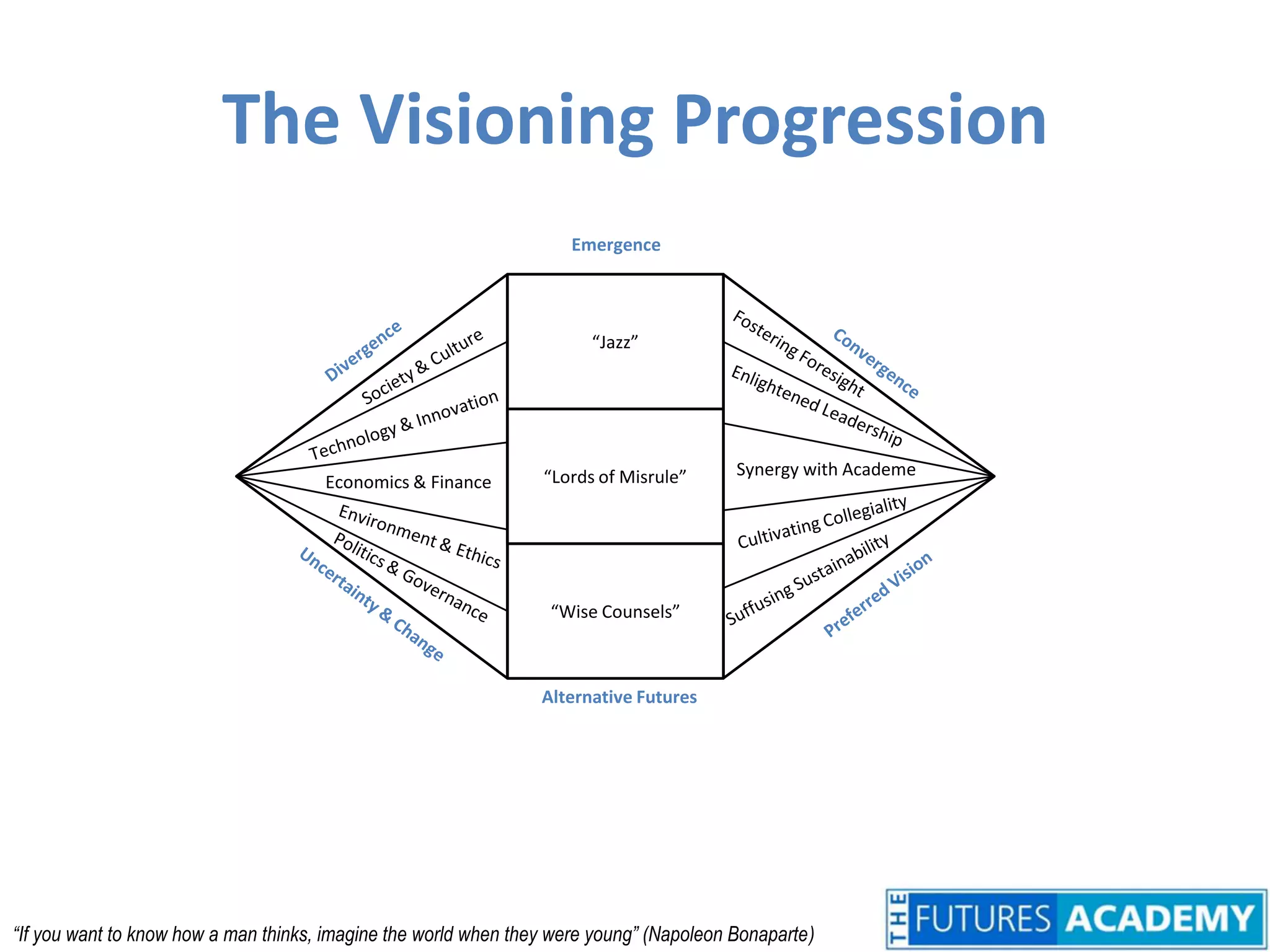
Emergence“Jazz”“Lords of Misrule”DivergenceFostering Foresight ConvergenceSociety & CultureEnlightened Leadership“Wise Counsels”Technology & InnovationSynergy with AcademeEconomics & FinanceAlternative FuturesCultivating CollegialityEnvironment & EthicsPolitics & GovernanceSuffusing SustainabilityPreferred VisionUncertainty & ChangeThe Visioning Progression“If you want to know how a man thinks, imagine the world when they were young” (Napoleon Bonaparte)
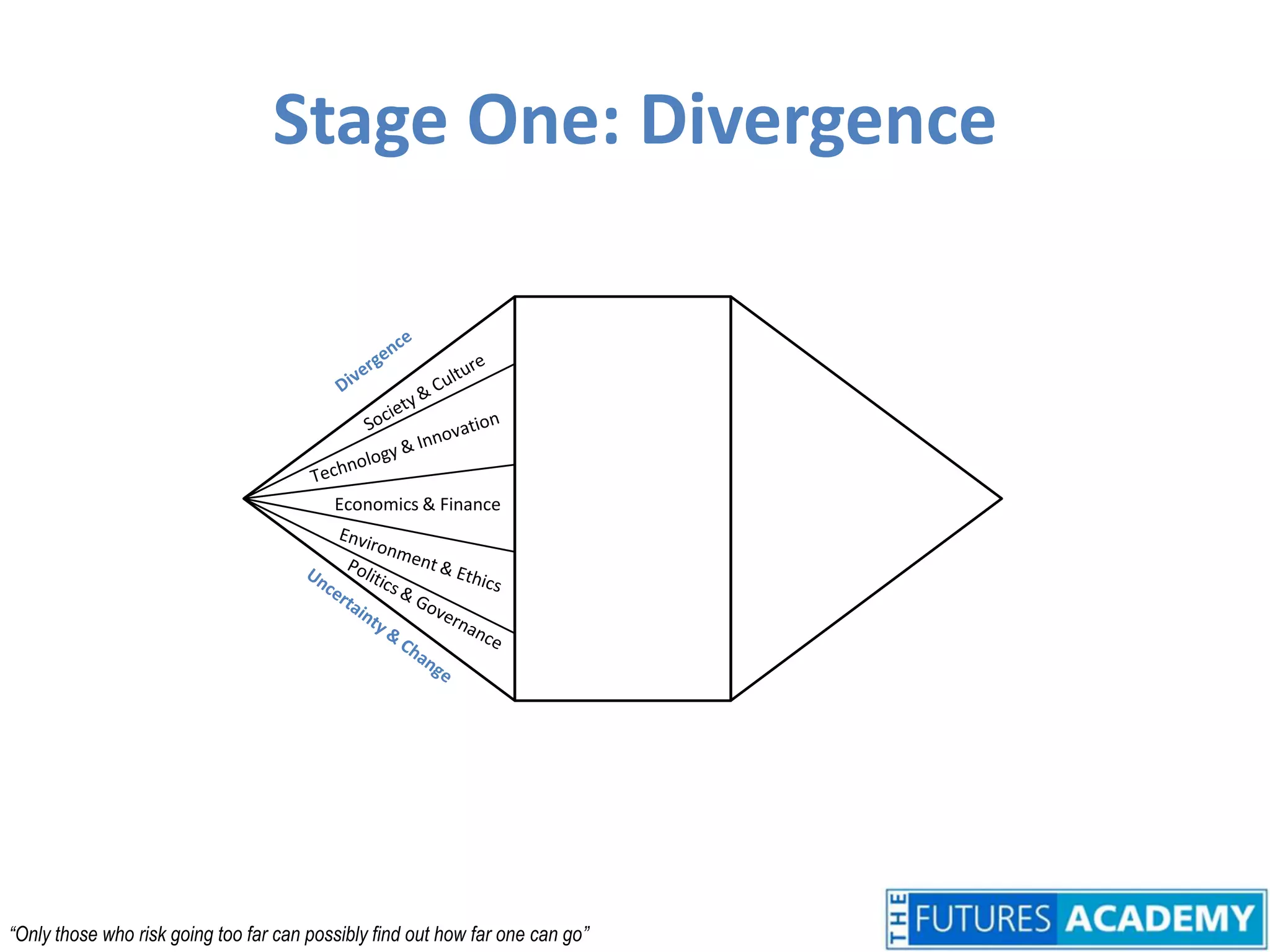
Stage One: DivergenceDivergence Society & Culture Technology & Innovation Economics & Finance  Environment & Ethics Politics & GovernanceUncertainty & Change“Only those who risk going too far can possibly find out how far one can go”
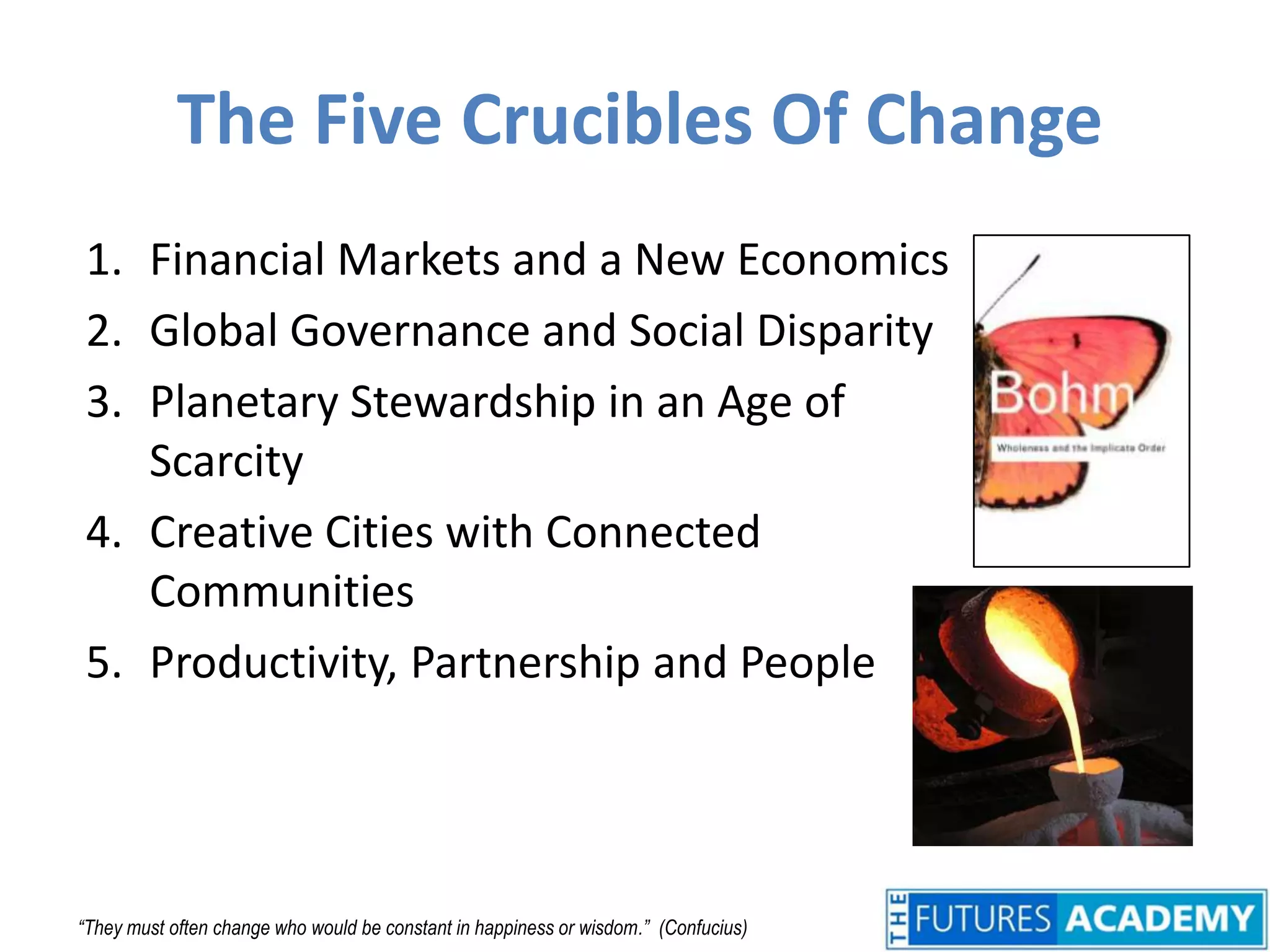
The Five Crucibles Of ChangeFinancial Markets and a New EconomicsGlobal Governance and Social DisparityPlanetary Stewardship in an Age of ScarcityCreative Cities with Connected CommunitiesProductivity, Partnership and People“They must often change who would be constant in happiness or wisdom.”  (Confucius)
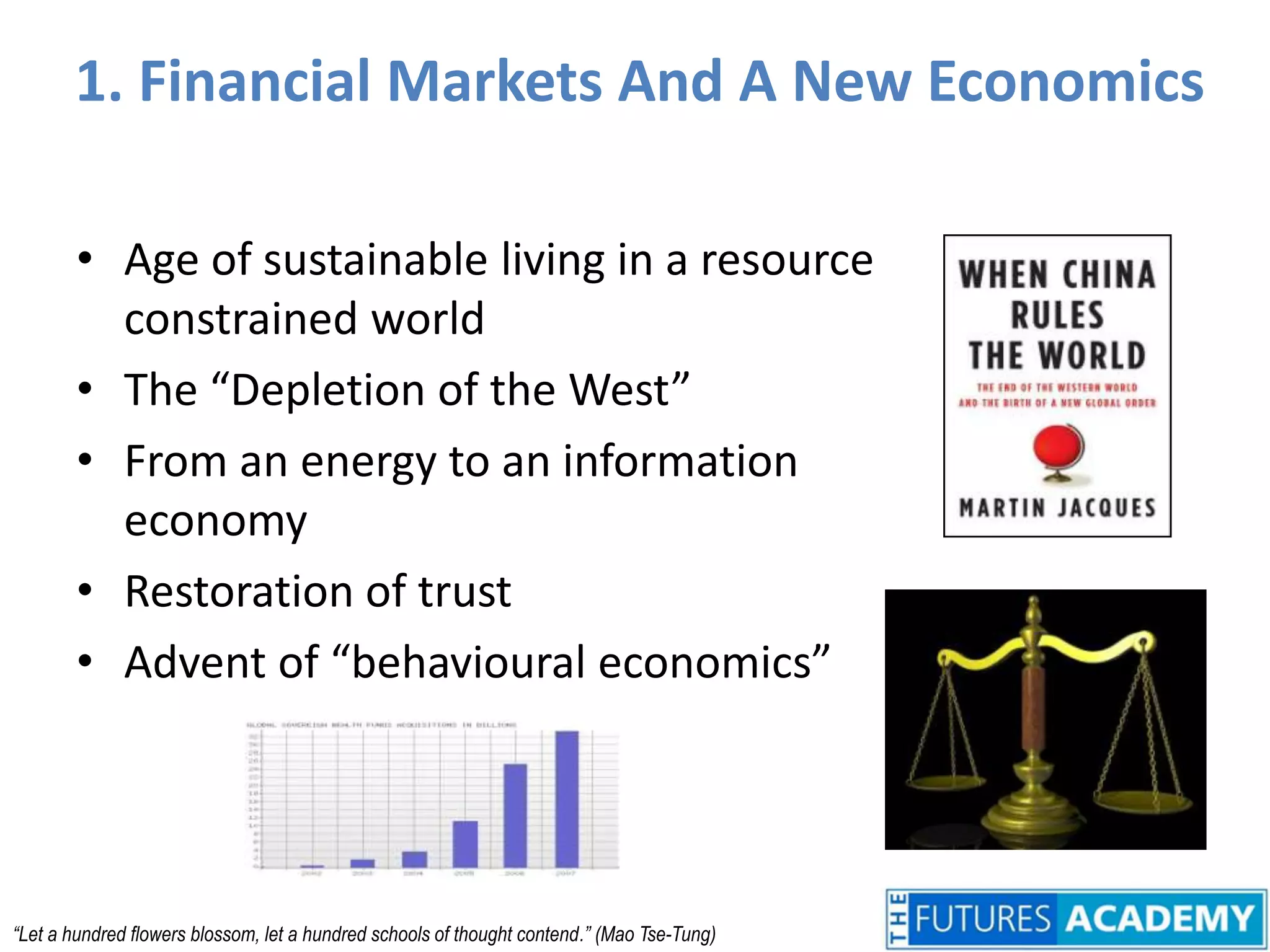
1. Financial Markets And A New EconomicsAge of sustainable living in a resource constrained worldThe “Depletion of the West”From an energy to an information economyRestoration of trustAdvent of “behavioural economics”“Let a hundred flowers blossom, let a hundred schools of thought contend.” (Mao Tse-Tung)
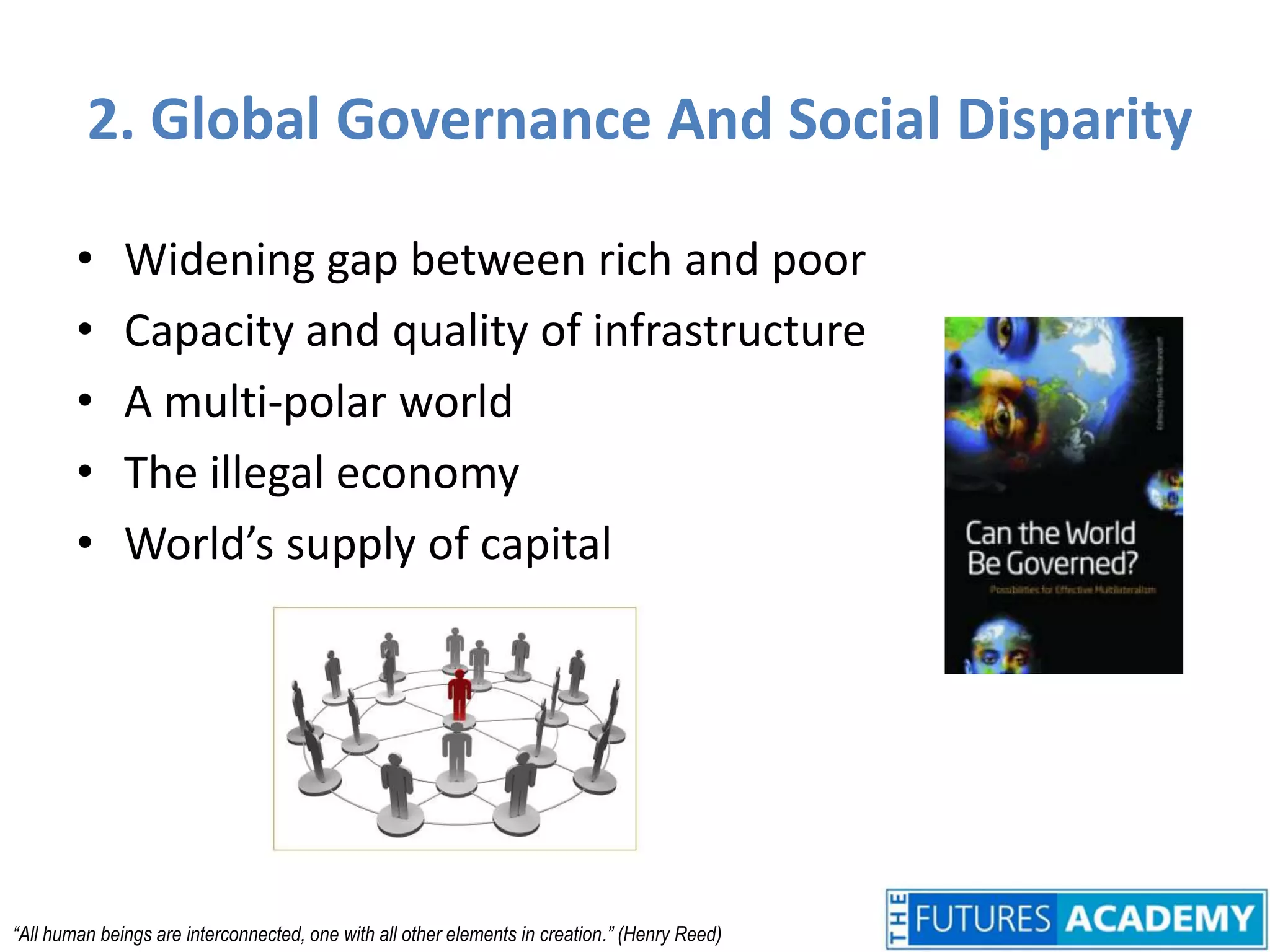
2. Global Governance And Social DisparityWidening gap between rich and poorCapacity and quality of infrastructureA multi-polar worldThe illegal economyWorld’s supply of capital“All human beings are interconnected, one with all other elements in creation.” (Henry Reed)
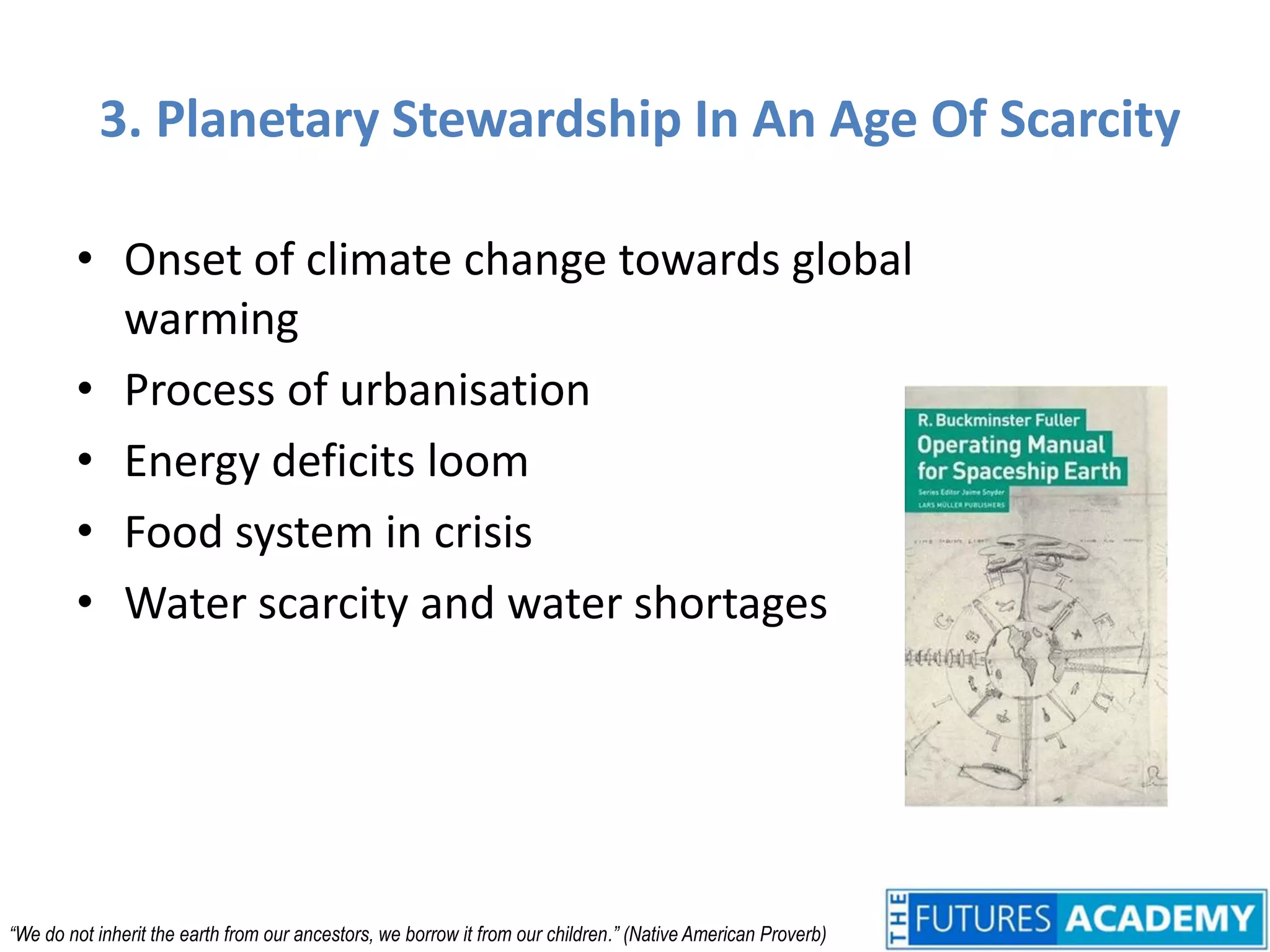
3. Planetary Stewardship In An Age Of ScarcityOnset of climate change towards global warmingProcess of urbanisationEnergy deficits loomFood system in crisisWater scarcity and water shortages“We do not inherit the earth from our ancestors, we borrow it from our children.” (Native American Proverb)
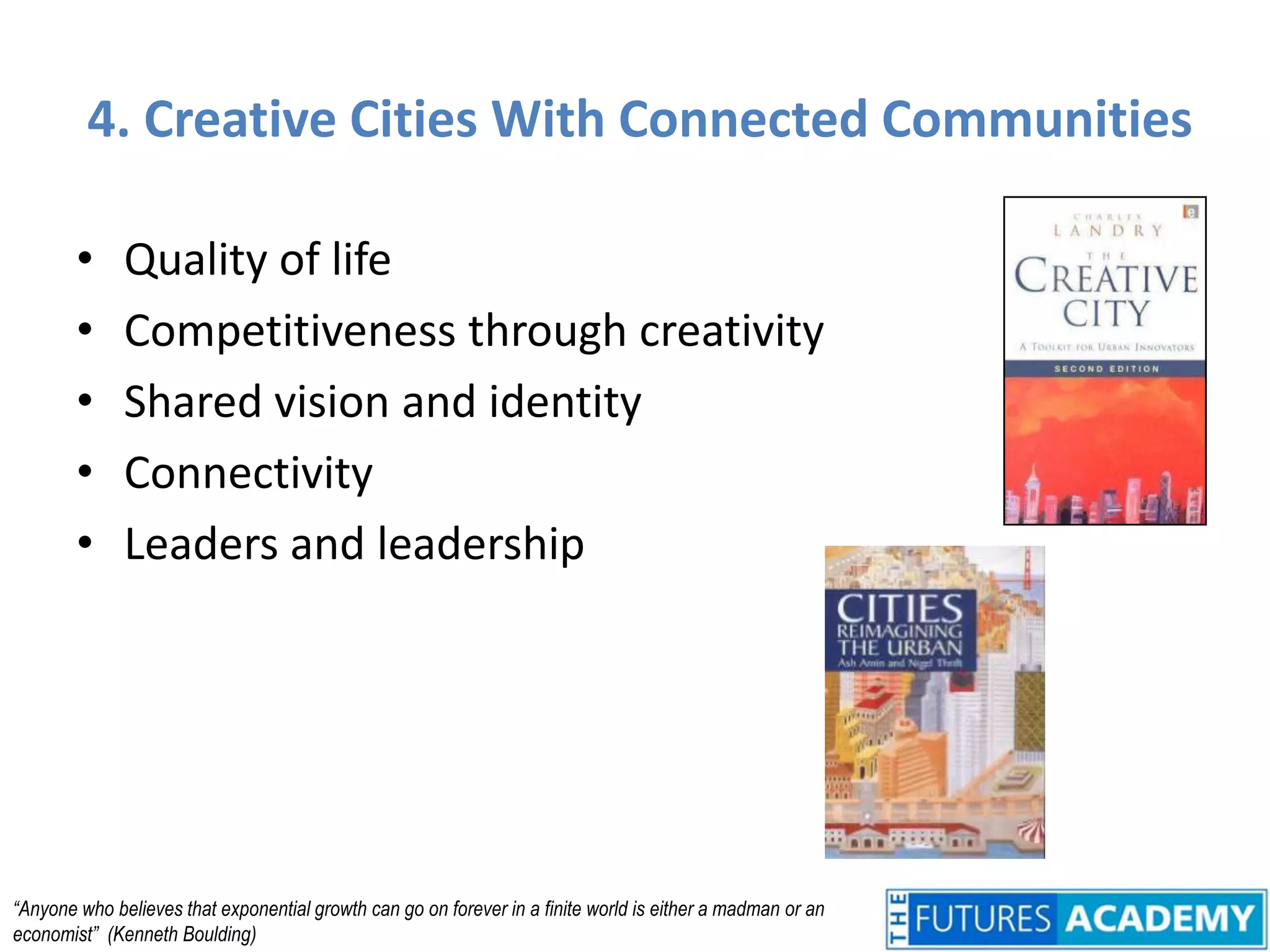
4. Creative Cities With Connected CommunitiesQuality of lifeCompetitiveness through creativityShared vision and identityConnectivityLeaders and leadership“Anyone who believes that exponential growth can go on forever in a finite world is either a madman or an economist”  (Kenneth Boulding)
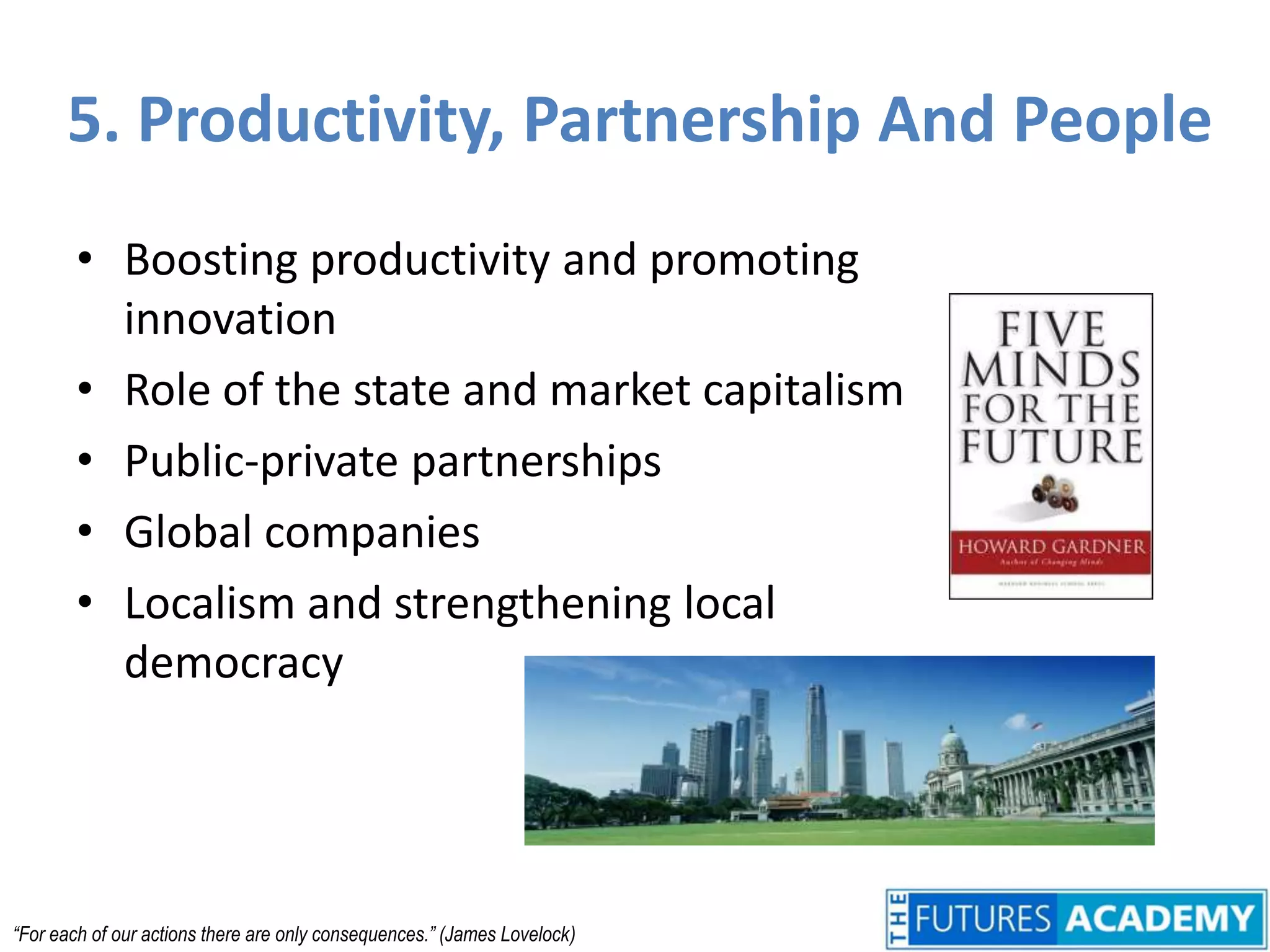
5. Productivity, Partnership And PeopleBoosting productivity and promoting innovationRole of the state and market capitalismPublic-private partnershipsGlobal companiesLocalism and strengthening local democracy“For each of our actions there are only consequences.” (James Lovelock)
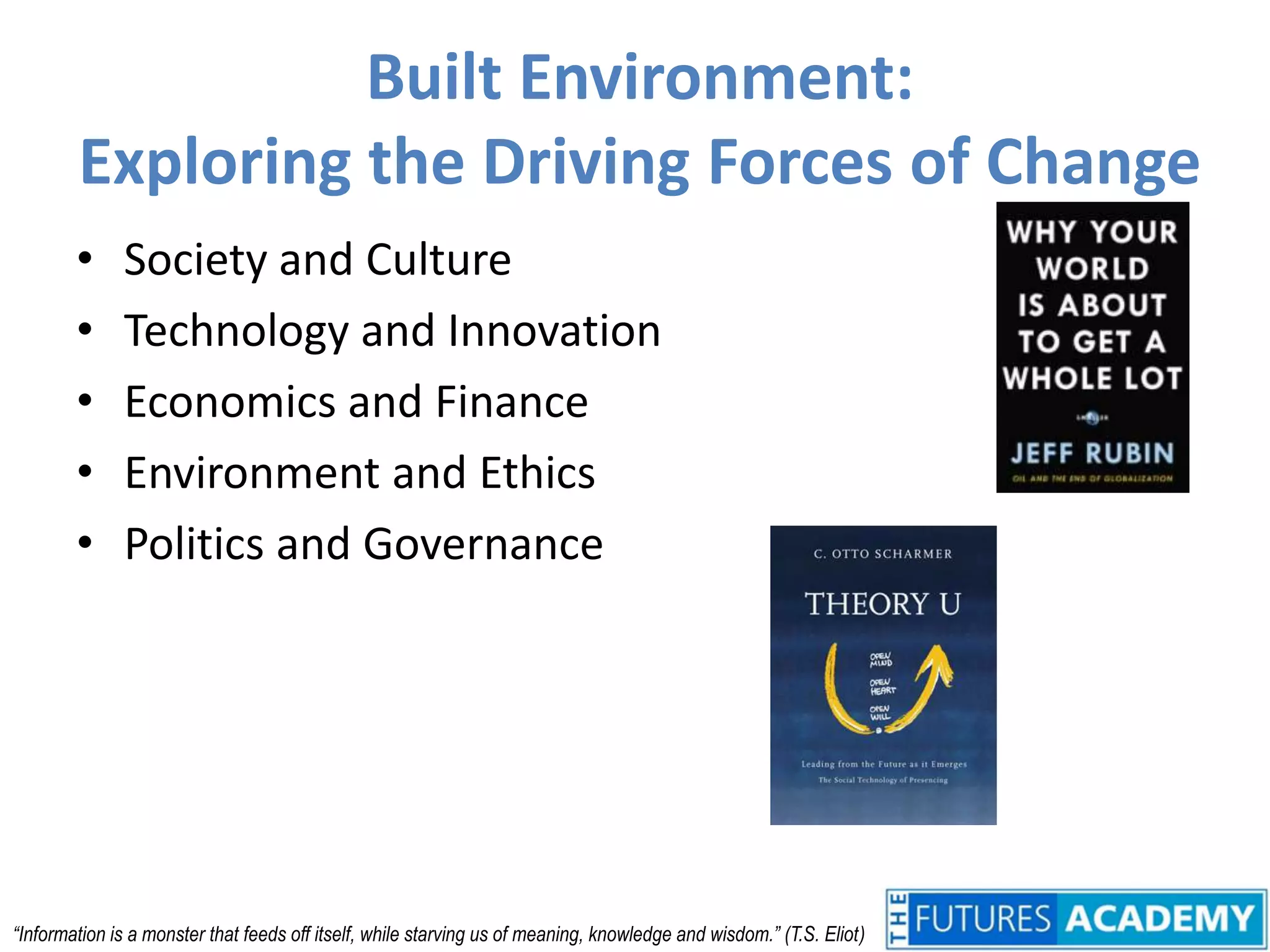
Built Environment: Exploring the Driving Forces of ChangeSociety and CultureTechnology and InnovationEconomics and FinanceEnvironment and EthicsPolitics and Governance“Information is a monster that feeds off itself, while starving us of meaning, knowledge and wisdom.” (T.S. Eliot)
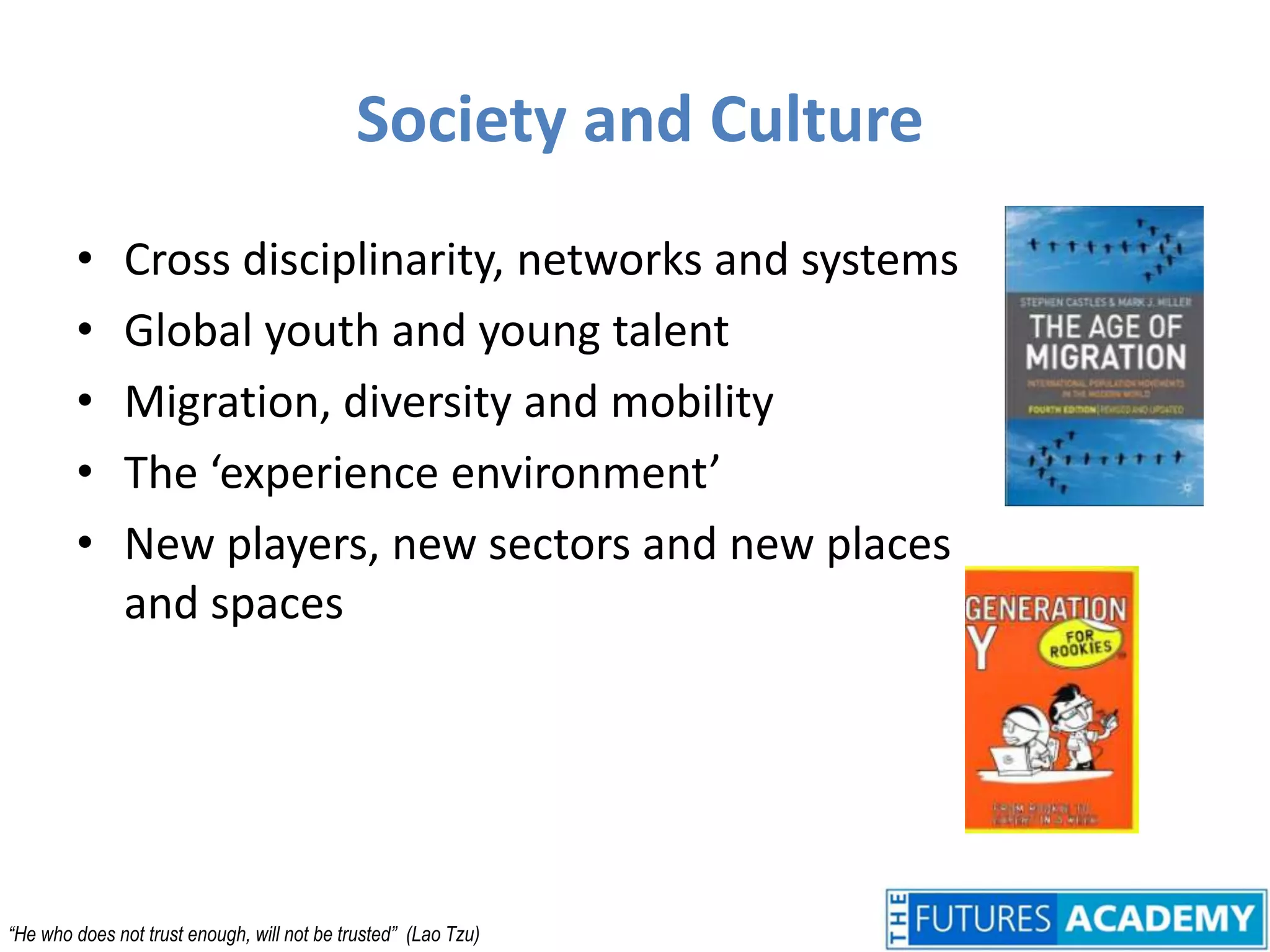
Society and CultureCross disciplinarity, networks and systemsGlobal youth and young talentMigration, diversity and mobilityThe ‘experience environment’New players, new sectors and new places and spaces“He who does not trust enough, will not be trusted”  (Lao Tzu)
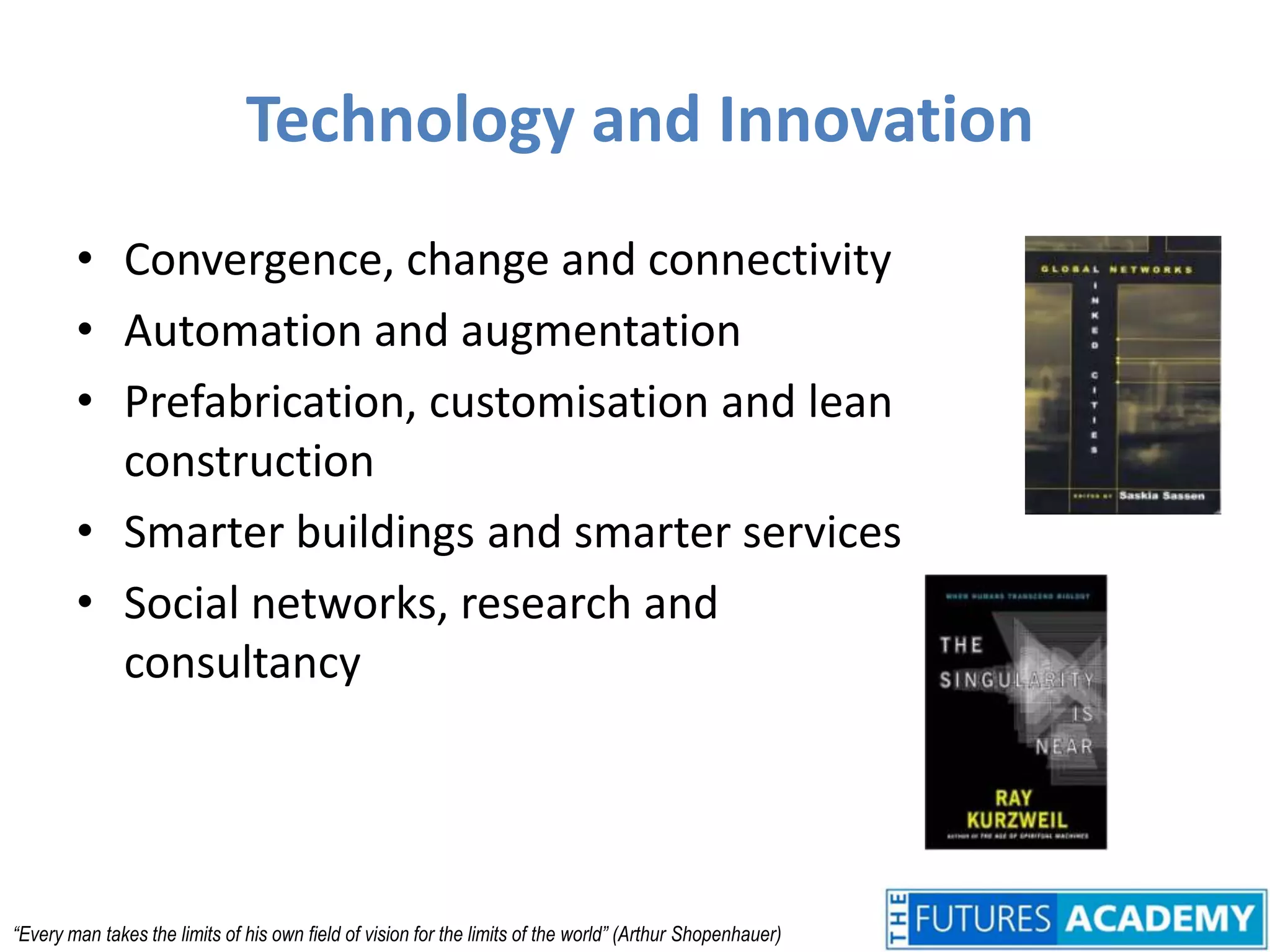
Technology and InnovationConvergence, change and connectivityAutomation and augmentationPrefabrication, customisation and lean constructionSmarter buildings and smarter servicesSocial networks, research and consultancy“Every man takes the limits of his own field of vision for the limits of the world” (Arthur Shopenhauer)
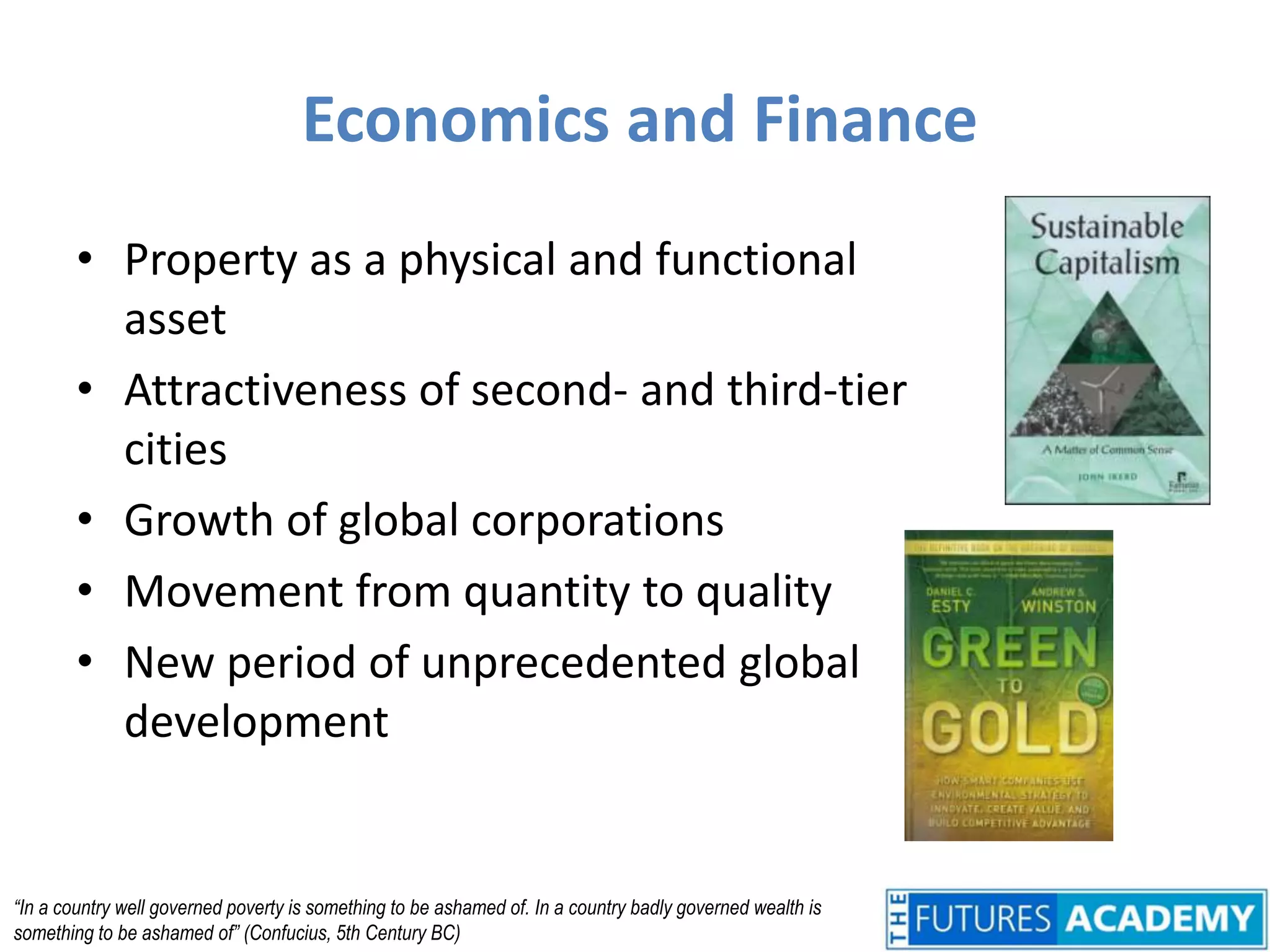
Economics and FinanceProperty as a physical and functional assetAttractiveness of second- and third-tier citiesGrowth of global corporationsMovement from quantity to qualityNew period of unprecedented global development“In a country well governed poverty is something to be ashamed of. In a country badly governed wealth is something to be ashamed of” (Confucius, 5th Century BC)
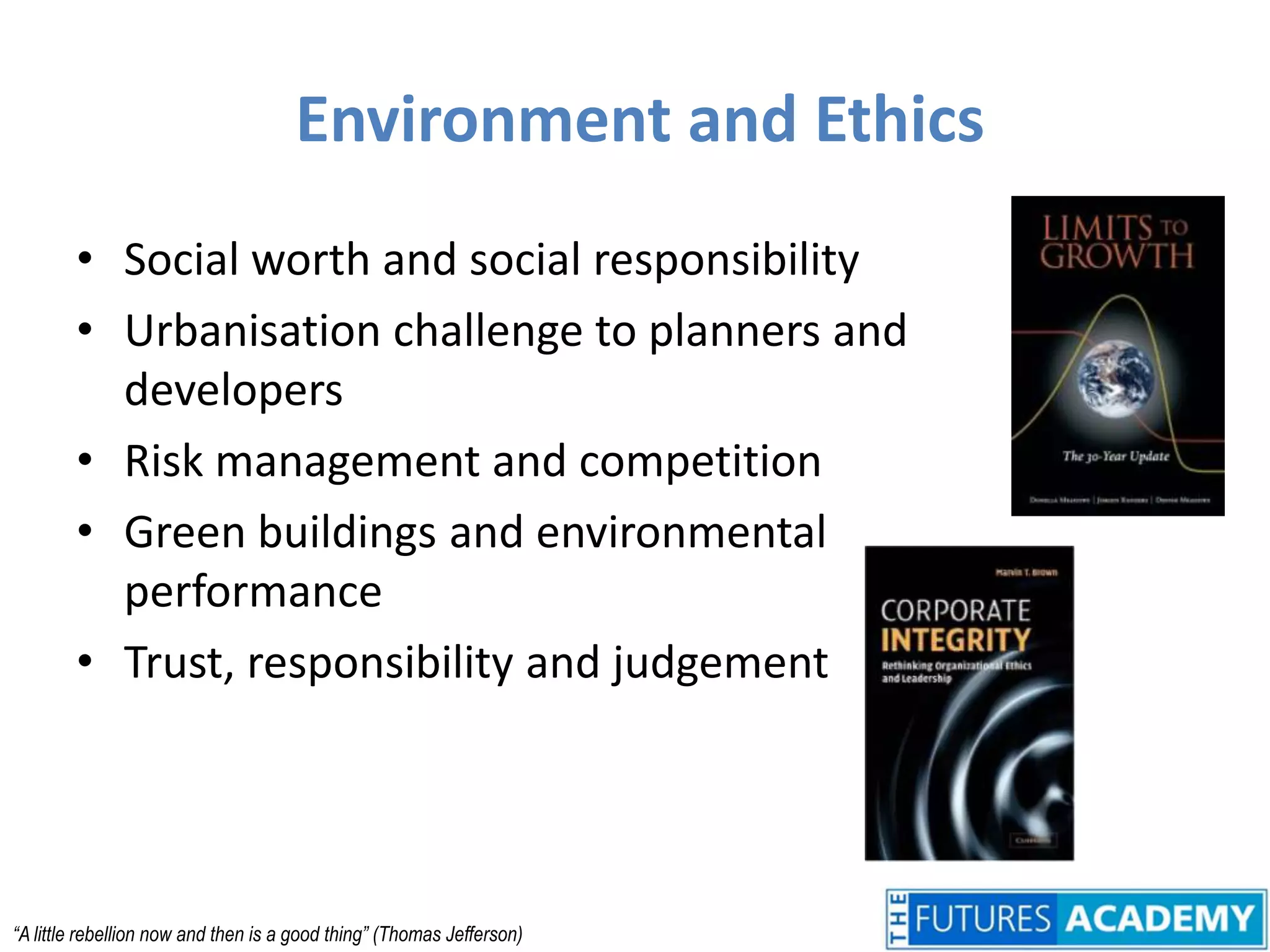
Environment and EthicsSocial worth and social responsibilityUrbanisation challenge to planners and developersRisk management and competitionGreen buildings and environmental performanceTrust, responsibility and judgement“A little rebellion now and then is a good thing” (Thomas Jefferson)
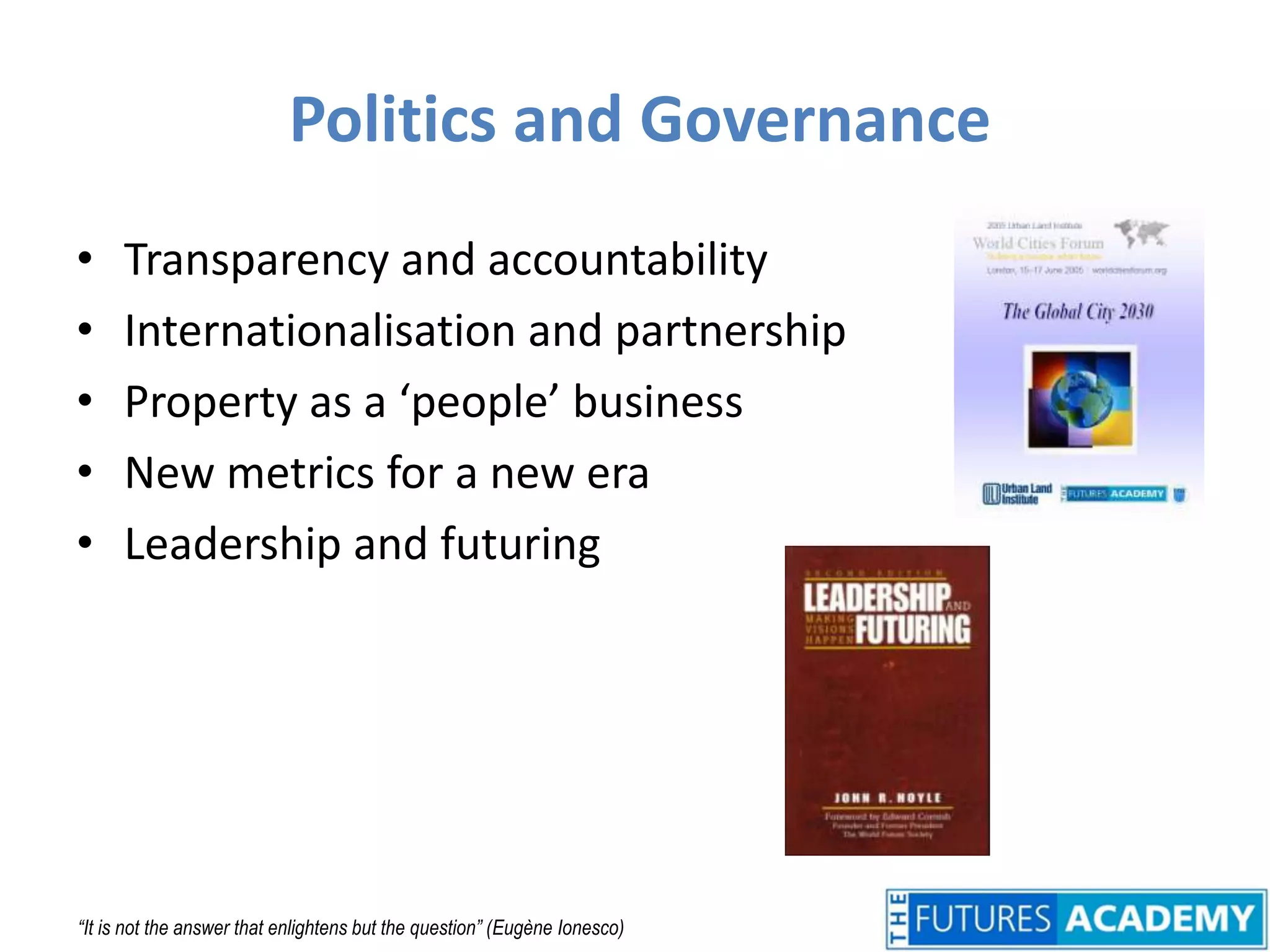
Politics and GovernanceTransparency and accountabilityInternationalisation and partnershipProperty as a ‘people’ businessNew metrics for a new eraLeadership and futuring“It is not the answer that enlightens but the question” (Eugène Ionesco)
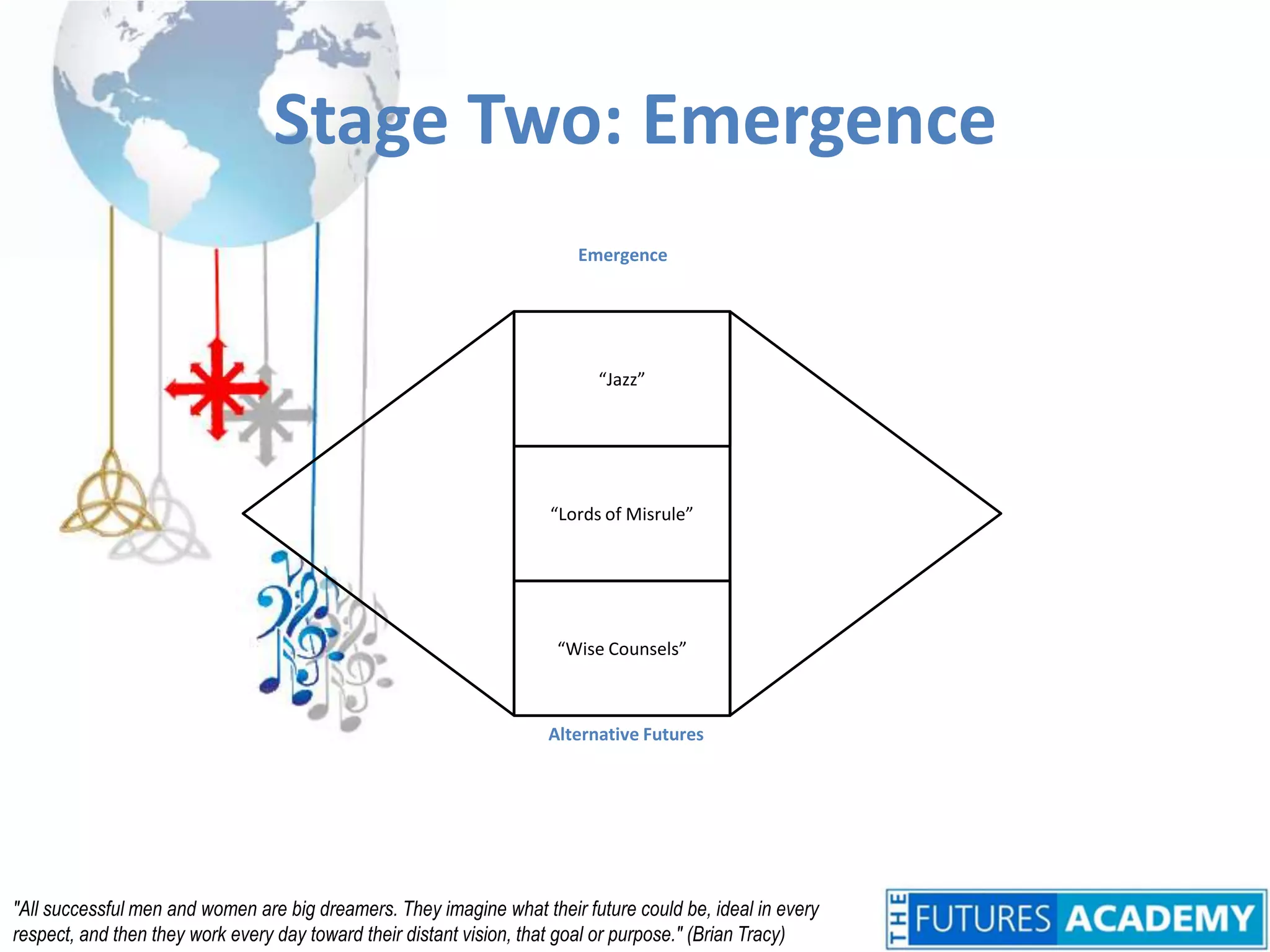
Stage Two: EmergenceEmergence“Jazz”“Lords of Misrule” “Wise Counsels”Alternative Futures"All successful men and women are big dreamers. They imagine what their future could be, ideal in every respect, and then they work every day toward their distant vision, that goal or purpose." (Brian Tracy)
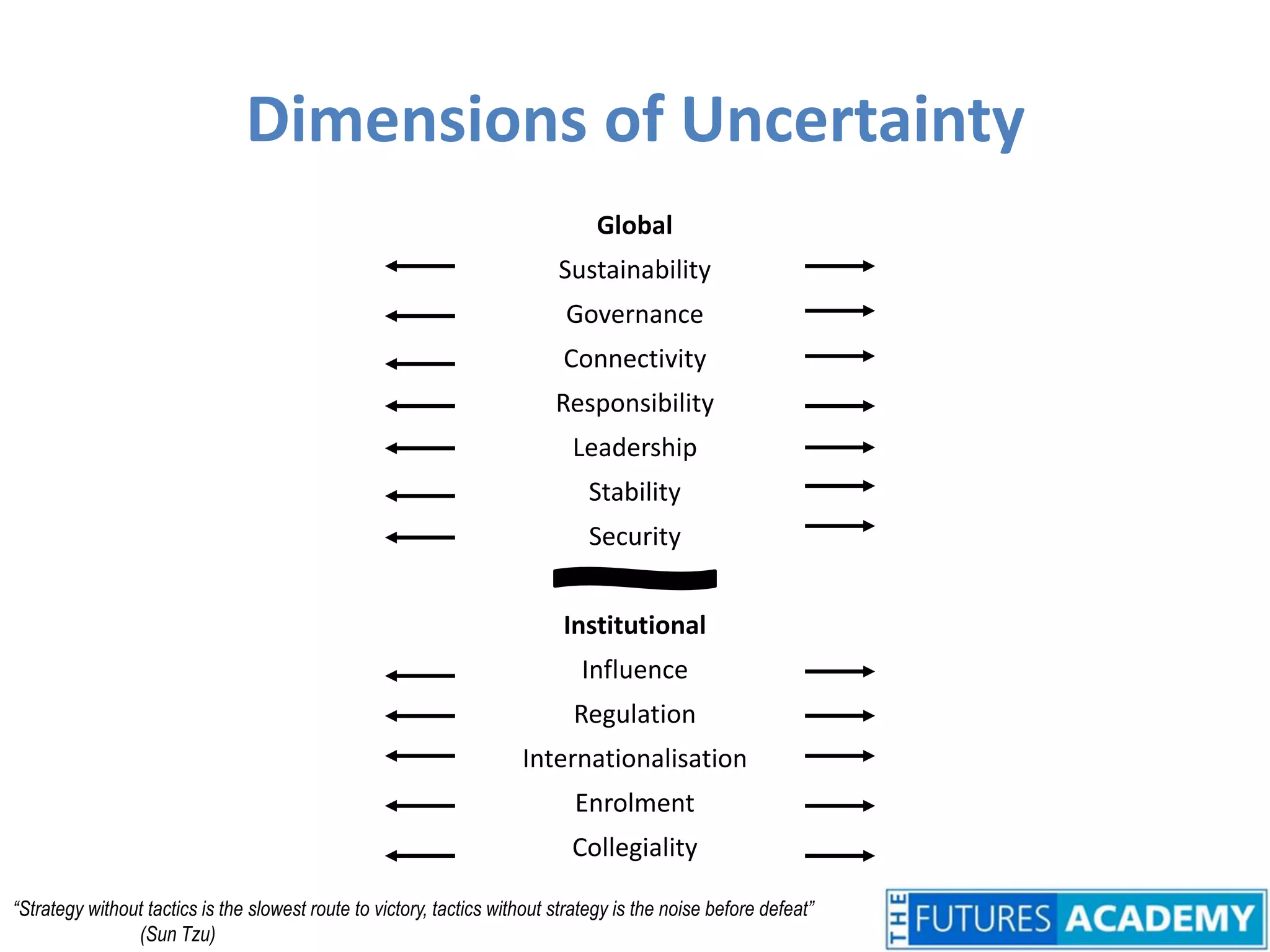
Dimensions of UncertaintyGlobalSustainabilityGovernanceConnectivityResponsibilityLeadershipStabilitySecurityInstitutionalInfluenceRegulationInternationalisationEnrolmentCollegiality“Strategy without tactics is the slowest route to victory, tactics without strategy is the noise before defeat” 	(Sun Tzu)
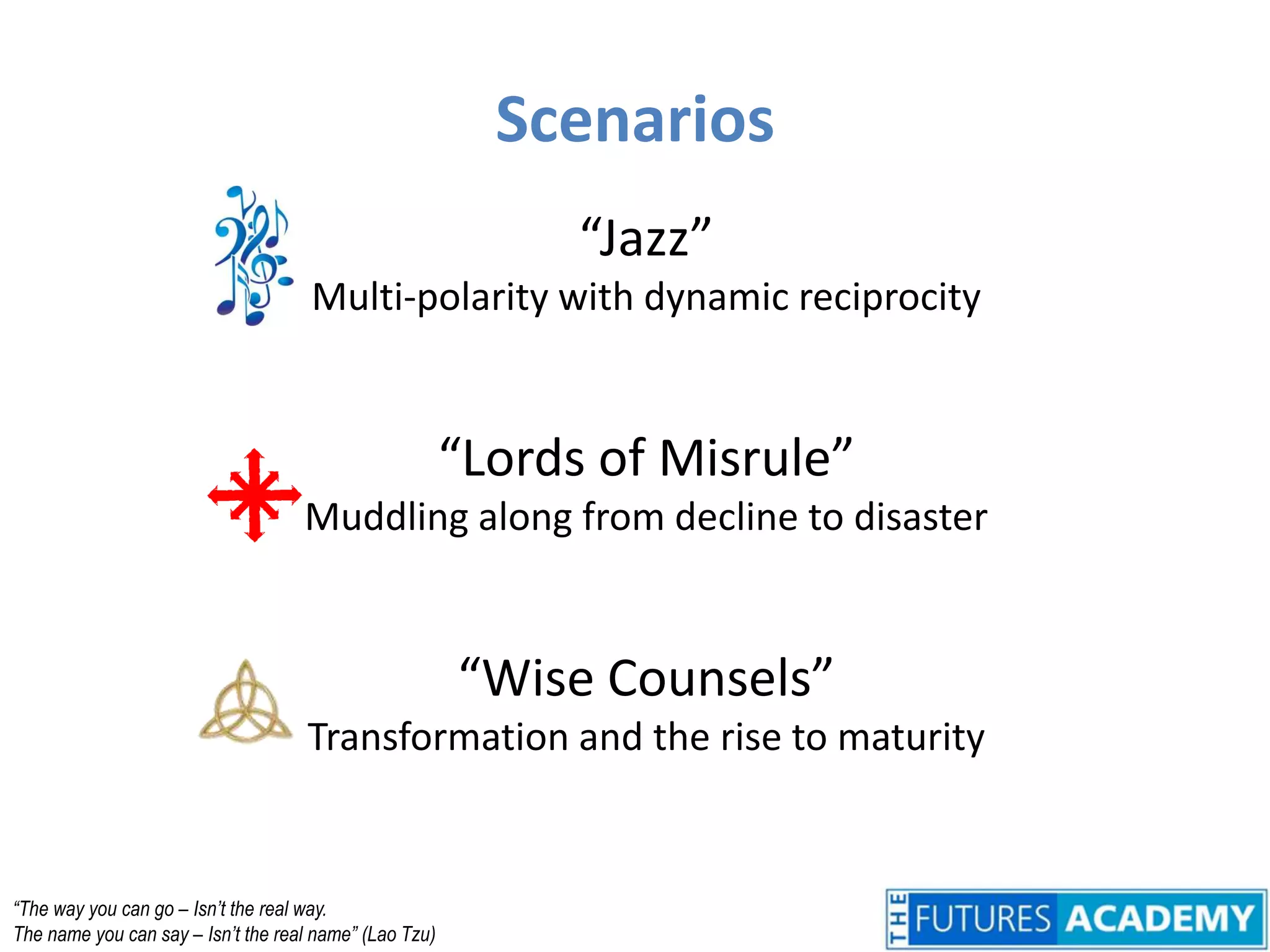
Scenarios“Jazz”Multi-polarity with dynamic reciprocity“Lords of Misrule”Muddling along from decline to disaster“Wise Counsels”Transformation and the rise to maturity“The way you can go – Isn’t the real way.The name you can say – Isn’t the real name” (Lao Tzu)
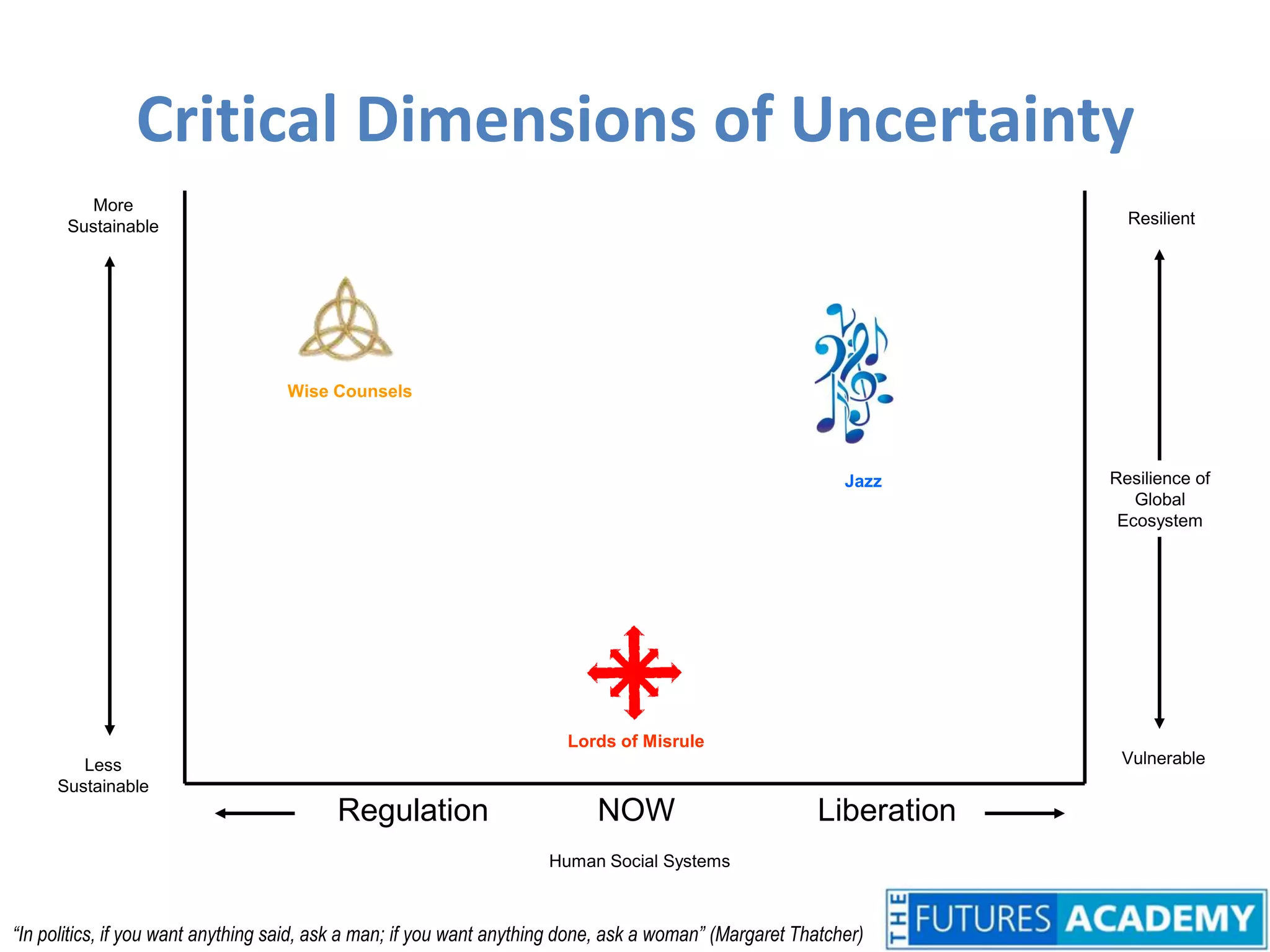
MoreSustainableResilientWise CounselsResilience of Global EcosystemJazzLords of MisruleVulnerableLessSustainableNOWRegulationLiberationHuman Social SystemsCritical Dimensions of Uncertainty“In politics, if you want anything said, ask a man; if you want anything done, ask a woman” (Margaret Thatcher)
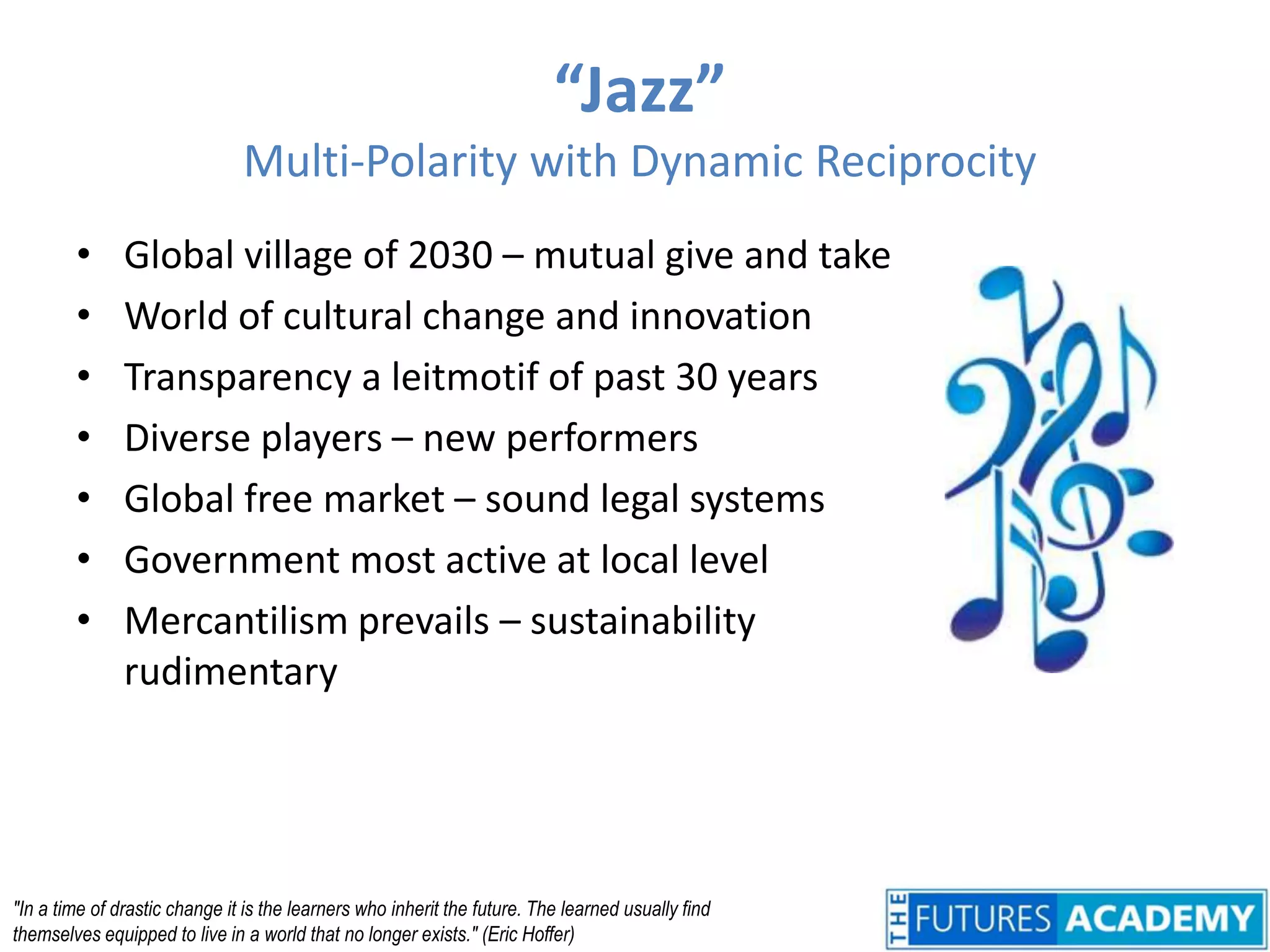
“Jazz”Multi-Polarity with Dynamic ReciprocityGlobal village of 2030 – mutual give and takeWorld of cultural change and innovationTransparency a leitmotif of past 30 yearsDiverse players – new performersGlobal free market – sound legal systemsGovernment most active at local levelMercantilism prevails – sustainability rudimentary"In a time of drastic change it is the learners who inherit the future. The learned usually find themselves equipped to live in a world that no longer exists." (Eric Hoffer)
“Lords of Misrule”Muddling Along From Decline to DisasterFamiliar world – but failingModest economic reforms onlyIgnorance about complexity of planets problems persistPolitical stalemates on strategic issuesToo many interests – no clear leadershipParochialism – partisanship – protectionismSustainability equals “First Raise Our Growth”“When there is a great cry that something should be done, you can depend on it that something remarkably silly will be done”
“Wise Counsels”Transformation And The Rise To MaturityAge of “new powers and new alliances”Radically different world order materializingNew leaders and new social institutionsStrengthening of government and governanceMillennium Goals met – if a little lateNew economics emerging – resource basedGlobal communications networks and progress“The future is always present, as a promise, a lure and a temptation” (Karl Popper)
ConvergenceFostering Foresight ConvergenceEnlightened LeadershipSynergy with AcademeCultivating CollegialitySuffusing SustainabilityPreferred Vision“The present system of global cooperation is not working sufficiently. [We need to] look at all issues on the global agenda in a systemic, integrated and strategic way.  We have to rethink our values; we are living together in a global society with many different cultures.  We have to redesign our processes; how do we deal with the issues and challenges on the global agenda?” (Klaus Schwab)
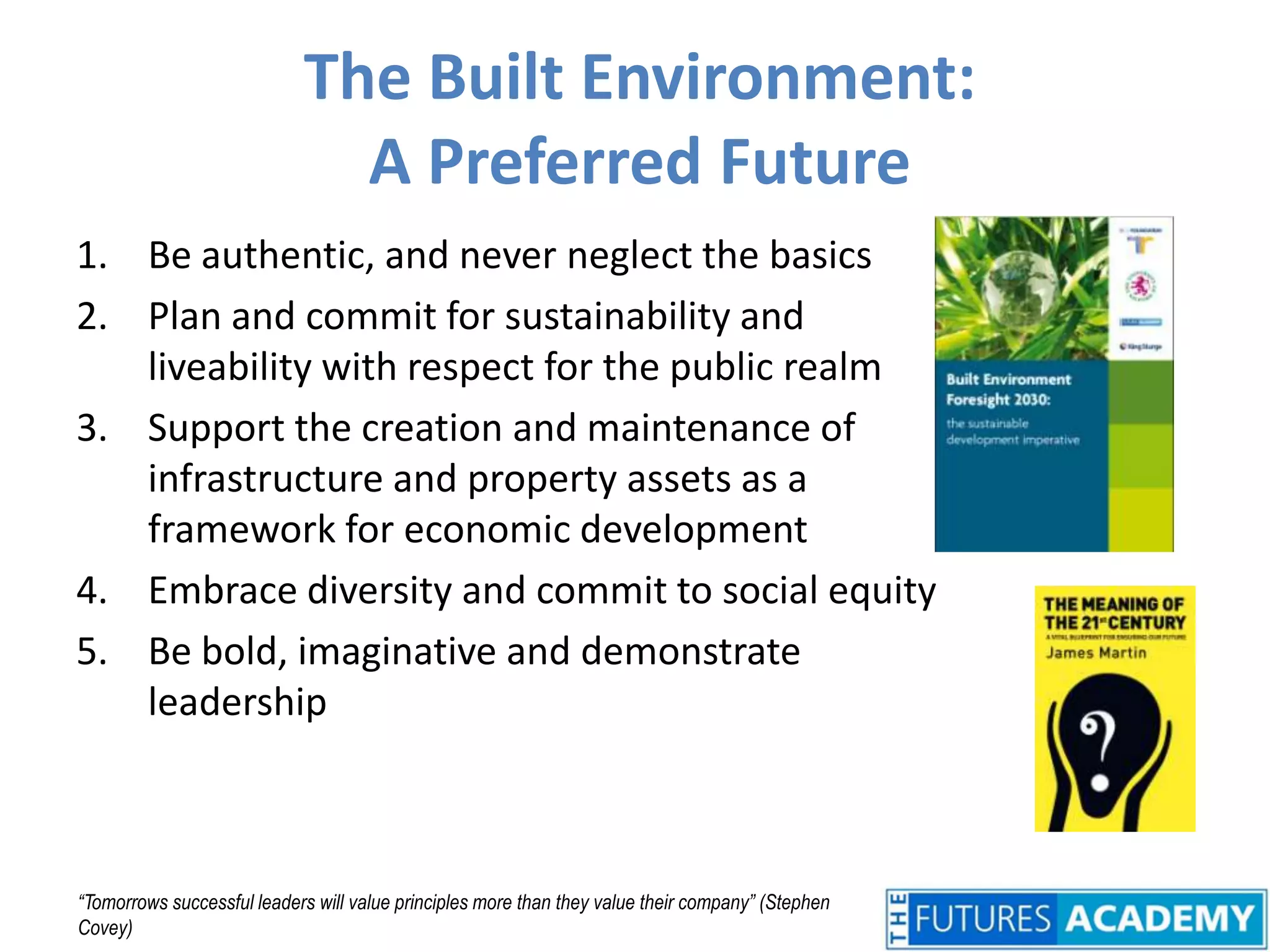
The Built Environment: A Preferred FutureBe authentic, and never neglect the basicsPlan and commit for sustainability and liveability with respect for the public realmSupport the creation and maintenance of infrastructure and property assets as a framework for economic developmentEmbrace diversity and commit to social equityBe bold, imaginative and demonstrate leadership“Tomorrows successful leaders will value principles more than they value their company” (Stephen Covey)
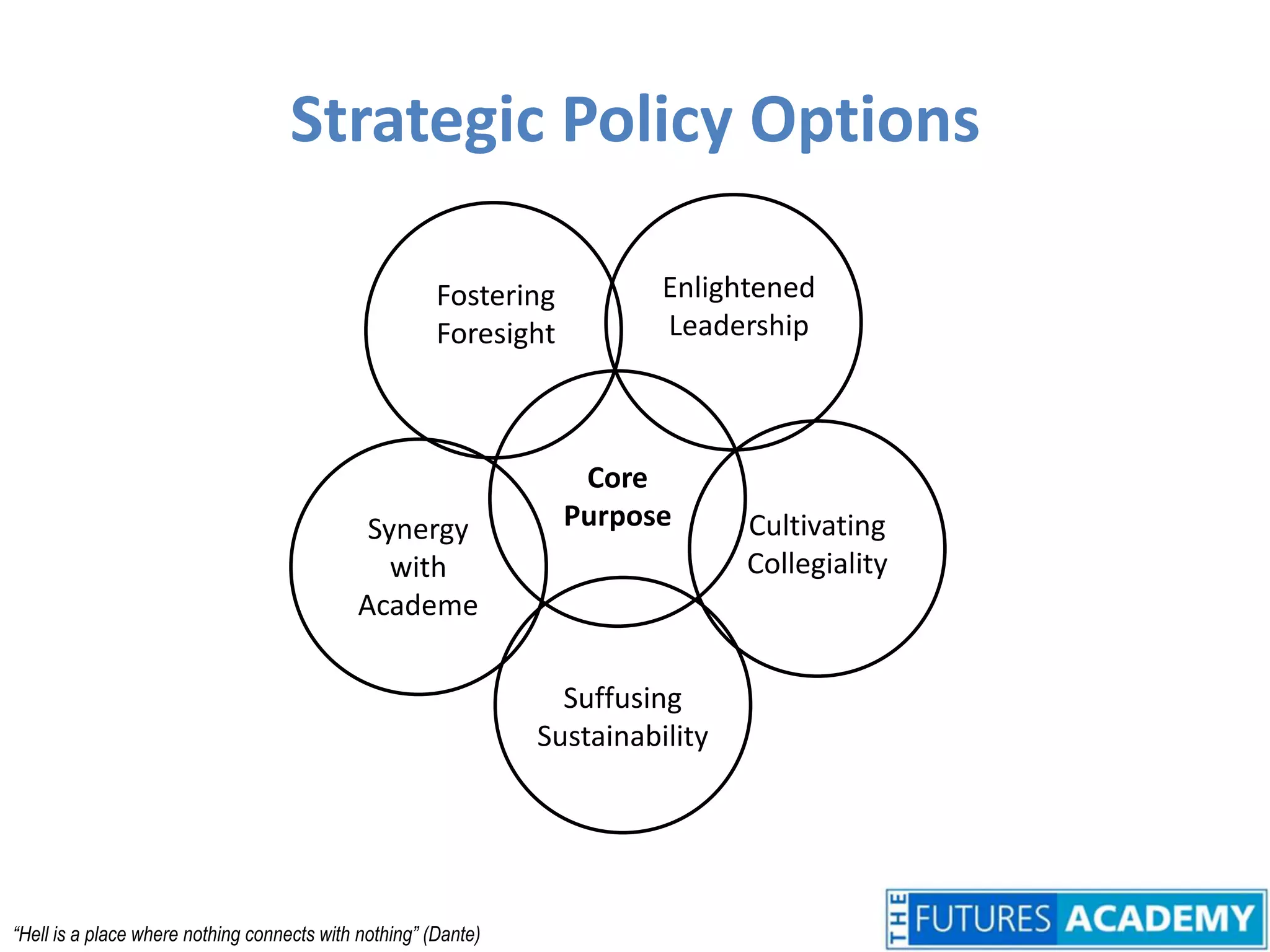
Strategic Policy OptionsFostering ForesightEnlightened LeadershipCore PurposeSynergy with AcademeCultivating CollegialitySuffusing Sustainability“Hell is a place where nothing connects with nothing” (Dante)
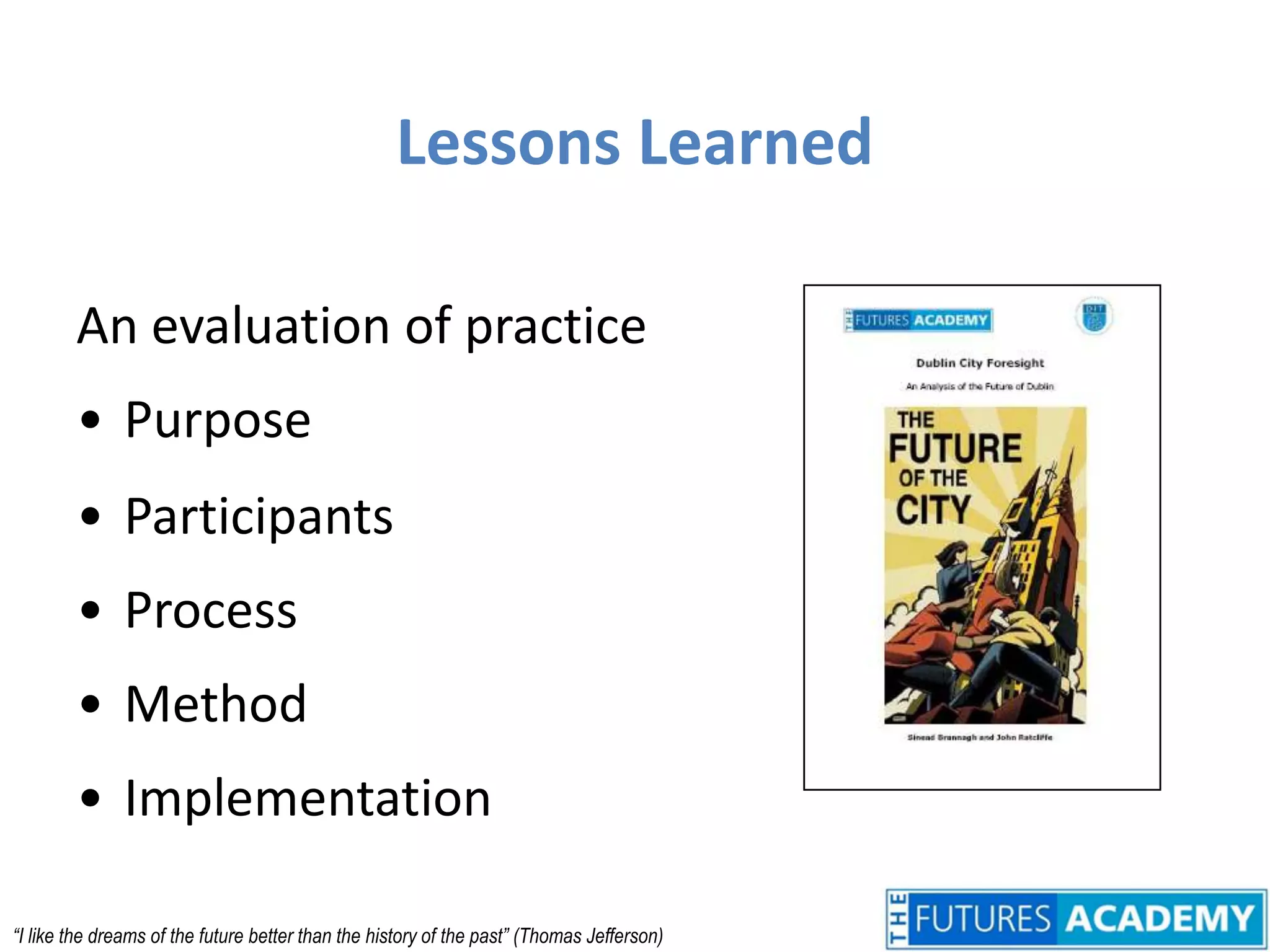
Lessons LearnedAn evaluation of practicePurpose
Participants
Process
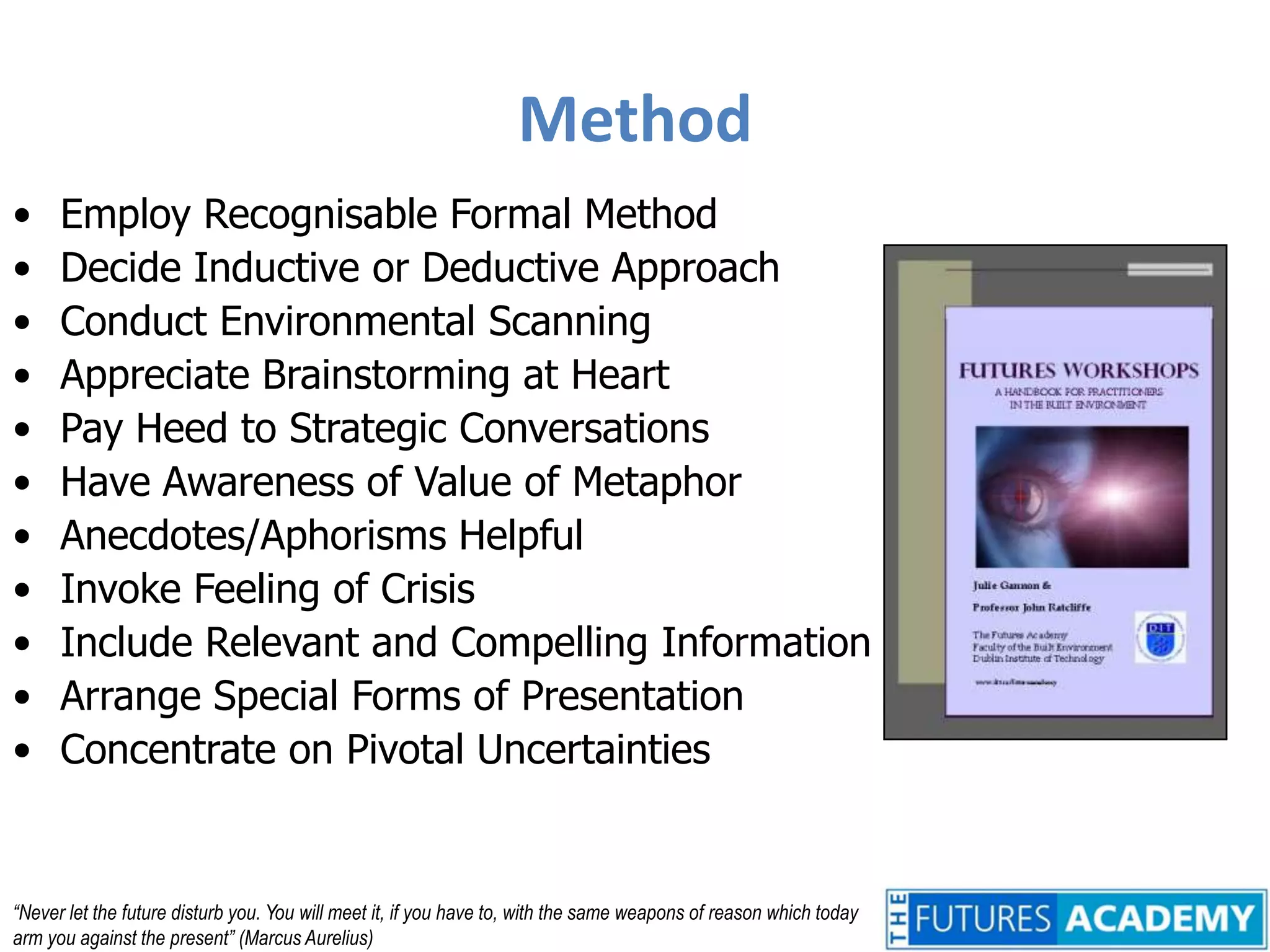
Method
Implementation“I like the dreams of the future better than the history of the past” (Thomas Jefferson)
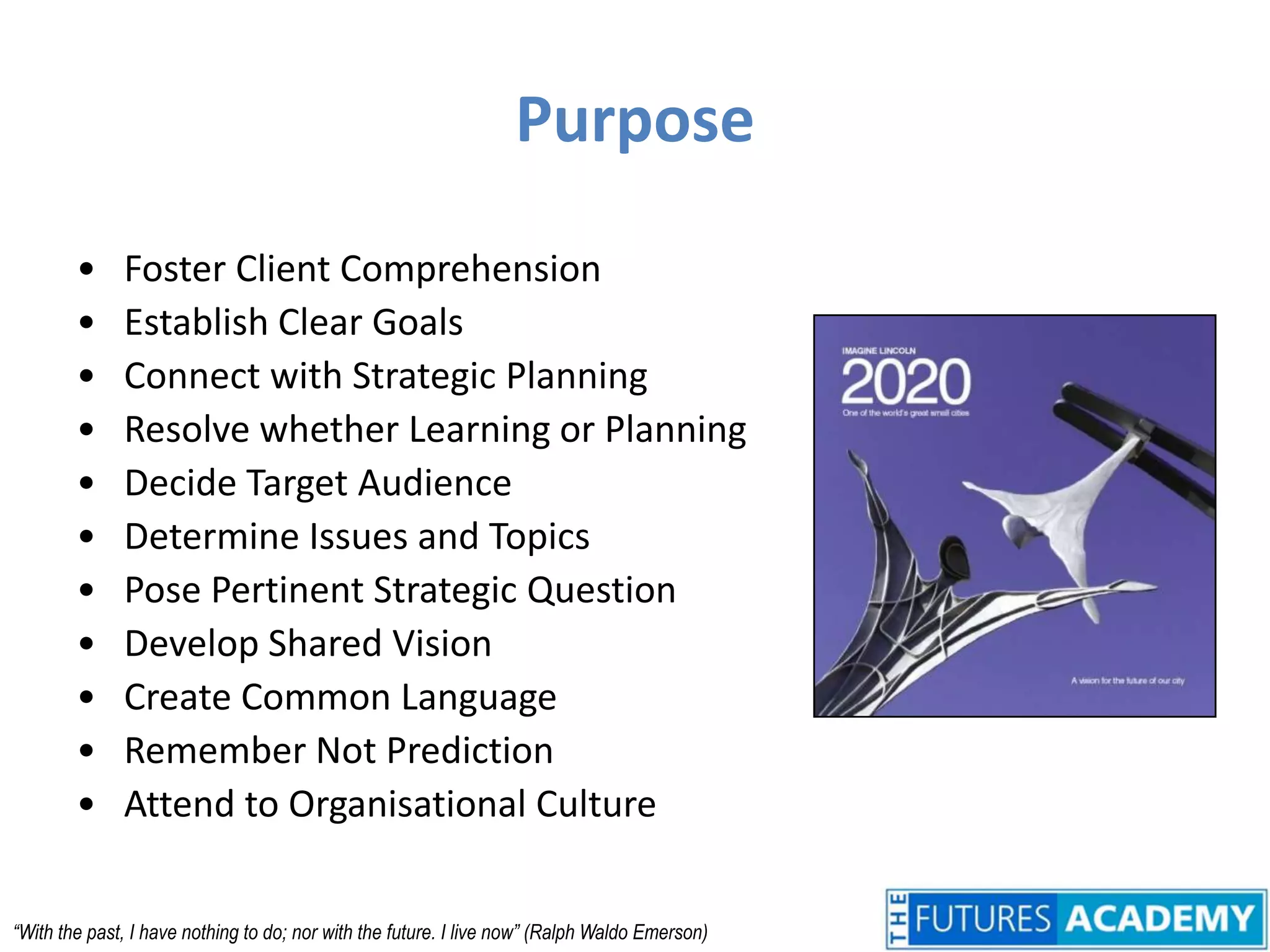
PurposeFoster Client Comprehension
Establish Clear Goals
Connect with Strategic Planning
Resolve whether Learning or Planning
Decide Target Audience
Determine Issues and Topics

"Whither Strategic Foresight?"

  • 1.
    Urban Foresight AsA Tool For Territorial Governance“Whither Strategic Foresight?”Professor John S RatcliffeBrusselsSeptember 2011
  • 2.
    Is this humanity’slast century – or a century that sets the world on a course towards a spectacular new future?A NEW MINDSET“The problems of the world cannot possibly be solved by sceptics or cynics whose horizons are limited by the obvious realities. We need men who can dream of things that never were.” (John F. Kennedy)
  • 3.
    The Harbingers ofChangeA Confluence of Powerful TrendsProblems Seem IntractableThe Demographics of DiscordThe ‘New Players’Problems are Structural“Flight For The 21st Century: ‘Icarus’ Or ‘The Phoenix’ ”“The unusual and the unknown make us either over confident or overly fearful” (Gaius Julius Caesar)
  • 4.
    “Icarus” – PrevailingPessimismPopulation GrowthClimate ChangeFood and WaterSafety and SecurityEnergy Deficit“If we don't change direction soon, we'll end up where we're going.” (Irwin Corey)
  • 5.
    “The Phoenix” –Rational OptimismUrban ProspectDeveloping TechnologyA New EconomyThe Natural StepNew Nuclear“A pessimist sees the difficulty in every opportunity; an optimist sees the opportunity in every difficulty” (Winston Churchill)
  • 6.
    The Need forVision“A vision without a task is but a dream A task without a vision is drudgery A vision with a task is the hope of the world”(Inscription in a church, Sussex, England, 1730)“No problem can be solved from the same level of consciousness that created it. We must learn to see the world anew” (Albert Einstein)
  • 7.
    Present ProblemsChange, Complexityand Risk / UncertaintyLack of an Integrated ApproachShort-term OrientationObsolescence of ‘Predict and Provide’ ModelLimited Collaboration of Stakeholders“It’s not the strong that survive – but the most adaptable” (Charles Darwin)
  • 8.
    Why Foresight?Running a21st century city region more complexNeed to understand driving forces of changeTrends matter – weak signals countAnticipation and exploration prerequisiteRehearsing alternative futures“The Empires of the future are the Empires of the mind” (Winston Churchill)
  • 9.
    What Is Foresight?Strategicforesight (SF) is having a view of what can be done by organisations and societies today to positively influence the future.SF is the ability to create and maintain a high-quality, coherent and functional forward view, and to use the insights arising in civic and organisationally useful ways.SF is thinking about, debating and shaping the future.“Have deep roots, a strong trunk, live long by looking long.” (Lao Tzu)
  • 10.
    Foresight Teams ContributionAnticipatingemerging issuesIdentifying unintended consequencesGetting a sense of the big pictureDrawing on a wide range of information sourcesInvolving all concerned“Business today consists of persuading crowds”
  • 11.
    STAGEOBJECTIVESOUTPUTFramingScoping the project: attitude, audience, work environment, rationale and purpose, objectives and teams.Focal IssueScanningCollecting the information : the system, history and context of the issue and how to scan for information regarding the future of issue.InformationForecastingDescribing baseline and alternative futures : drivers and uncertainties, tools, diverging and converging approaches, and alternatives.Baseline andAlternative FuturesVisioningChoosing a preferred future : implications of the forecast, and envisioning desired outcomes.Preferred FuturePlanningOrganising to achieve the vision : strategy, options and plans.Strategy and PlansActingImplementing the plan : communicating the results, developing action agenda and institutionalising strategic thinking and intelligence systems.ActionStrategic Foresight
  • 12.
    High to LowImportanceSet the Strategic QuestionIdentify the Driving Forces of ChangeDivergenceDetermine the Main Issues and TrendsClarify the Level of Impact and Degree of UncertaintyEstablish Scenario LogicsEmergenceCreate Different ScenariosTest Policy OptionsIdentify Turning PointsProduce ProspectiveConvergenceMove to Strategic PlanningProspective Through ScenariosStrategic ConversationsCausal Layered AnalysisHorizon ScanningDelphi SurveyCross-ImpactAnalysisProspective WorkshopsClusteringPolarisingRankingVERGECreative WritingWind Tunnel TestingGaming and Simulation
  • 14.
    The Strategic ForesightProcessFraming the Strategic Question(s)Scanning the HorizonForecasting Alternative FuturesVisioning A Preferred FuturePlanning Strategic OptionsActing on an Agreed Agenda“Every man takes the limits of his own field of vision for the limits of the world” (Arthur Schopenhauer)
  • 15.
    Framing The StrategicQuestionAdjust AttitudesRecognise the Character of ChangeUnderstand the Rationale and PurposeWeave ‘Outside and Then’ with ‘Inside and Now’Set Objectives“It is not the answer that enlightens but the question” (Eugène Ionesco)
  • 16.
    Scanning The HorizonMapthe SystemConduct a Stakeholder AnalysisStart by Looking BackwardsExplore the UnfamiliarConsult ‘Remarkable People’"Change is the law of life. And those who look only to the past or present are certain to miss the future." (John F. Kennedy)
  • 17.
    Forecasting Alternative FuturesIdentifyDrivers, Trends, IssuesLook for Turning PointsGenerate Divergent IdeasPrioritise Convergent ViewsForm Alternative Futures“If you can dream it, you can do it” (Walt Disney)
  • 18.
    Visioning A PreferredFutureIdentify Implications/Unintended ConsequencesThink of the Longer-TermChallenge AssumptionsAsk ‘What if ?’ QuestionsDevelop a Strategic Vision and Goals“You can analyse the past and appraise the present, but you have to design the future”
  • 19.
    Planning Strategic OptionsThinkStrategically to Provoke Strategic ConversationsSpot Areas of Strategic Choice by Identifying Critical Branching PointsBase Strategic Recommendations On Organisations Distinctive AttributesEvaluate Proposed Strategy Along Multiple DimensionsHave Contingency Plans for Unexpected Surprises“The future is the only kind of property that the masters willingly concede to slaves” (Albert Camus)
  • 20.
    Acting On AnAgreed AgendaCommunicate Results EffectivelyCreate an Action Plan with a Sense of UrgencyIdentify Milestones on the Path Towards a Preferred FutureEstablish an Intelligence SystemInstitutionalise Strategic Thinking“You can only predict things after they have happened” (Eugène Ionesco)
  • 21.
    What Are TheProspects?“Can we go on like this?”Meta-forcesMacro-forcesMicro-forces“Reason is, and ought only to be the slave of the passions and can never pretend to any other office than to serve and obey them” (David Hume, 1783)
  • 22.
    However, the historyof modern societies suggest also something for our future….Figure 1: Kondratieff cycles – long waves of prosperity.Rolling 10-year yield on the S&P 500 since 1814 till March 2009 (in %, p. a.)Source: Datastream; Illustration: Allianz Global Investors Capital Market Analysis
  • 23.
    Three Meta-forcesVALUESVISIONSVECTORS“Unless theinvestment in children is made, all of humanity's most fundamental long-term problems will remain fundamental long-term problems.”  (UNICEF) 
  • 24.
    Values The Transformation Towards ASustainable Responsible Civilization“All that is necessary for the triumph of evil is that good men do nothing.” (Edmund Burke)
  • 25.
    DOWNUPEcological footprintImproving people’shealth and well-being while respecting the limits of natural resources *HDI = life expectancy + education level + purchasing powerHuman Development Index*Health & Well-beingSource: WWF Living Planet Report 2006 "Report of the World Commission on Environment and Development."
  • 26.
    The Great GlobalValues DebateMillennium Development GoalsCultures ConsequencesSpiral DynamicsWorld Values SurveyInterfaith Dialogue“Believe those who are seeking the truth; doubt those who find it” (André Gide )
  • 27.
    Cultural Values Map“Whatwe call basic truths are simply the ones we discover after all the others” (Albert Camus)
  • 28.
    Visions“Twenty-first Century Enlightenment”Self-AwareAutonomyEmpathetic UniversalismProgress and EthicsThe Social Aspiration GapSignposts to 21st C. Enlightenment“Government is a badge of lost innocence… For were the impulses of conscience clear, uniform and irresistibly obeyed, man would need no other lawgiver” (Thomas Paine)
  • 29.
    To a sustainableworld in 2050From business-as-usual
  • 30.
    To a sustainableworld in 2050TODAYFrom business-as-usual
  • 31.
    To a sustainableworld in 20502050From business-as-usual
  • 32.
    Vectors“An agent thatacts as a carrier or transporter”GlobalisationUrbanisationEnvironmentalism InternetSocial MediaFaith – Based MovementsTerrorismPandemics“The Internet is becoming the town square for the global village of tomorrow.” (Bill Gates )
  • 33.
    proGective -- FabienneGOUX-BAUDIMENT©
  • 34.
  • 35.
    Imagineering the BuiltEnvironmentSTRATEGIC FORESIGHT 2030“Just Imagine!”Professor John S RatcliffeJuly 2011
  • 36.
    ExordiumA Changing WorldTheNew, The Many, The ConnectedA “Grand Transformation”‘Metanoia’ – And the Learning OrganisationThe Need for Strategic Foresight“To shape the future you must first imagine it.” (Charles Handy)
  • 37.
    BrainstormSet the StrategicQuestionConsider the Crucibles of ChangeDivergenceHorizon ScanningExplore the Built Environment: Driving ForcesQuestionnaire Survey Identify the Institutional Issues Establish the Key Dimensions of UncertaintyEmergenceStrategic ConversationsCreate Alternative Future Scenarios  Agree A Preferred FutureFutures WorkshopsDetermine Strategic Policy FieldsConvergencePropose An Action Agenda“Have deep roots, a strong trunk, live long by looking long.” (Lao Tzu)Move To Strategic PlanningThe Strategic Foresight Process
  • 38.
    Emergence“Jazz”“Lords of Misrule”DivergenceFosteringForesight ConvergenceSociety & CultureEnlightened Leadership“Wise Counsels”Technology & InnovationSynergy with AcademeEconomics & FinanceAlternative FuturesCultivating CollegialityEnvironment & EthicsPolitics & GovernanceSuffusing SustainabilityPreferred VisionUncertainty & ChangeThe Visioning Progression“If you want to know how a man thinks, imagine the world when they were young” (Napoleon Bonaparte)
  • 39.
    Stage One: DivergenceDivergence Society& Culture Technology & Innovation Economics & Finance  Environment & Ethics Politics & GovernanceUncertainty & Change“Only those who risk going too far can possibly find out how far one can go”
  • 40.
    The Five CruciblesOf ChangeFinancial Markets and a New EconomicsGlobal Governance and Social DisparityPlanetary Stewardship in an Age of ScarcityCreative Cities with Connected CommunitiesProductivity, Partnership and People“They must often change who would be constant in happiness or wisdom.” (Confucius)
  • 41.
    1. Financial MarketsAnd A New EconomicsAge of sustainable living in a resource constrained worldThe “Depletion of the West”From an energy to an information economyRestoration of trustAdvent of “behavioural economics”“Let a hundred flowers blossom, let a hundred schools of thought contend.” (Mao Tse-Tung)
  • 42.
    2. Global GovernanceAnd Social DisparityWidening gap between rich and poorCapacity and quality of infrastructureA multi-polar worldThe illegal economyWorld’s supply of capital“All human beings are interconnected, one with all other elements in creation.” (Henry Reed)
  • 43.
    3. Planetary StewardshipIn An Age Of ScarcityOnset of climate change towards global warmingProcess of urbanisationEnergy deficits loomFood system in crisisWater scarcity and water shortages“We do not inherit the earth from our ancestors, we borrow it from our children.” (Native American Proverb)
  • 44.
    4. Creative CitiesWith Connected CommunitiesQuality of lifeCompetitiveness through creativityShared vision and identityConnectivityLeaders and leadership“Anyone who believes that exponential growth can go on forever in a finite world is either a madman or an economist” (Kenneth Boulding)
  • 45.
    5. Productivity, PartnershipAnd PeopleBoosting productivity and promoting innovationRole of the state and market capitalismPublic-private partnershipsGlobal companiesLocalism and strengthening local democracy“For each of our actions there are only consequences.” (James Lovelock)
  • 46.
    Built Environment: Exploringthe Driving Forces of ChangeSociety and CultureTechnology and InnovationEconomics and FinanceEnvironment and EthicsPolitics and Governance“Information is a monster that feeds off itself, while starving us of meaning, knowledge and wisdom.” (T.S. Eliot)
  • 47.
    Society and CultureCrossdisciplinarity, networks and systemsGlobal youth and young talentMigration, diversity and mobilityThe ‘experience environment’New players, new sectors and new places and spaces“He who does not trust enough, will not be trusted” (Lao Tzu)
  • 48.
    Technology and InnovationConvergence,change and connectivityAutomation and augmentationPrefabrication, customisation and lean constructionSmarter buildings and smarter servicesSocial networks, research and consultancy“Every man takes the limits of his own field of vision for the limits of the world” (Arthur Shopenhauer)
  • 49.
    Economics and FinancePropertyas a physical and functional assetAttractiveness of second- and third-tier citiesGrowth of global corporationsMovement from quantity to qualityNew period of unprecedented global development“In a country well governed poverty is something to be ashamed of. In a country badly governed wealth is something to be ashamed of” (Confucius, 5th Century BC)
  • 50.
    Environment and EthicsSocialworth and social responsibilityUrbanisation challenge to planners and developersRisk management and competitionGreen buildings and environmental performanceTrust, responsibility and judgement“A little rebellion now and then is a good thing” (Thomas Jefferson)
  • 51.
    Politics and GovernanceTransparencyand accountabilityInternationalisation and partnershipProperty as a ‘people’ businessNew metrics for a new eraLeadership and futuring“It is not the answer that enlightens but the question” (Eugène Ionesco)
  • 52.
    Stage Two: EmergenceEmergence“Jazz”“Lordsof Misrule” “Wise Counsels”Alternative Futures"All successful men and women are big dreamers. They imagine what their future could be, ideal in every respect, and then they work every day toward their distant vision, that goal or purpose." (Brian Tracy)
  • 53.
  • 54.
    Scenarios“Jazz”Multi-polarity with dynamicreciprocity“Lords of Misrule”Muddling along from decline to disaster“Wise Counsels”Transformation and the rise to maturity“The way you can go – Isn’t the real way.The name you can say – Isn’t the real name” (Lao Tzu)
  • 55.
    MoreSustainableResilientWise CounselsResilience ofGlobal EcosystemJazzLords of MisruleVulnerableLessSustainableNOWRegulationLiberationHuman Social SystemsCritical Dimensions of Uncertainty“In politics, if you want anything said, ask a man; if you want anything done, ask a woman” (Margaret Thatcher)
  • 56.
    “Jazz”Multi-Polarity with DynamicReciprocityGlobal village of 2030 – mutual give and takeWorld of cultural change and innovationTransparency a leitmotif of past 30 yearsDiverse players – new performersGlobal free market – sound legal systemsGovernment most active at local levelMercantilism prevails – sustainability rudimentary"In a time of drastic change it is the learners who inherit the future. The learned usually find themselves equipped to live in a world that no longer exists." (Eric Hoffer)
  • 57.
    “Lords of Misrule”MuddlingAlong From Decline to DisasterFamiliar world – but failingModest economic reforms onlyIgnorance about complexity of planets problems persistPolitical stalemates on strategic issuesToo many interests – no clear leadershipParochialism – partisanship – protectionismSustainability equals “First Raise Our Growth”“When there is a great cry that something should be done, you can depend on it that something remarkably silly will be done”
  • 58.
    “Wise Counsels”Transformation AndThe Rise To MaturityAge of “new powers and new alliances”Radically different world order materializingNew leaders and new social institutionsStrengthening of government and governanceMillennium Goals met – if a little lateNew economics emerging – resource basedGlobal communications networks and progress“The future is always present, as a promise, a lure and a temptation” (Karl Popper)
  • 59.
    ConvergenceFostering Foresight ConvergenceEnlightened LeadershipSynergywith AcademeCultivating CollegialitySuffusing SustainabilityPreferred Vision“The present system of global cooperation is not working sufficiently. [We need to] look at all issues on the global agenda in a systemic, integrated and strategic way. We have to rethink our values; we are living together in a global society with many different cultures. We have to redesign our processes; how do we deal with the issues and challenges on the global agenda?” (Klaus Schwab)
  • 60.
    The Built Environment:A Preferred FutureBe authentic, and never neglect the basicsPlan and commit for sustainability and liveability with respect for the public realmSupport the creation and maintenance of infrastructure and property assets as a framework for economic developmentEmbrace diversity and commit to social equityBe bold, imaginative and demonstrate leadership“Tomorrows successful leaders will value principles more than they value their company” (Stephen Covey)
  • 61.
    Strategic Policy OptionsFosteringForesightEnlightened LeadershipCore PurposeSynergy with AcademeCultivating CollegialitySuffusing Sustainability“Hell is a place where nothing connects with nothing” (Dante)
  • 62.
  • 63.
  • 64.
  • 65.
  • 66.
    Implementation“I like thedreams of the future better than the history of the past” (Thomas Jefferson)
  • 67.
  • 68.
  • 69.
  • 70.
  • 71.
  • 72.
  • 73.
  • 74.
  • 75.
  • 76.
  • 77.
    Attend to OrganisationalCulture“With the past, I have nothing to do; nor with the future. I live now” (Ralph Waldo Emerson)
  • 78.
  • 79.
  • 80.
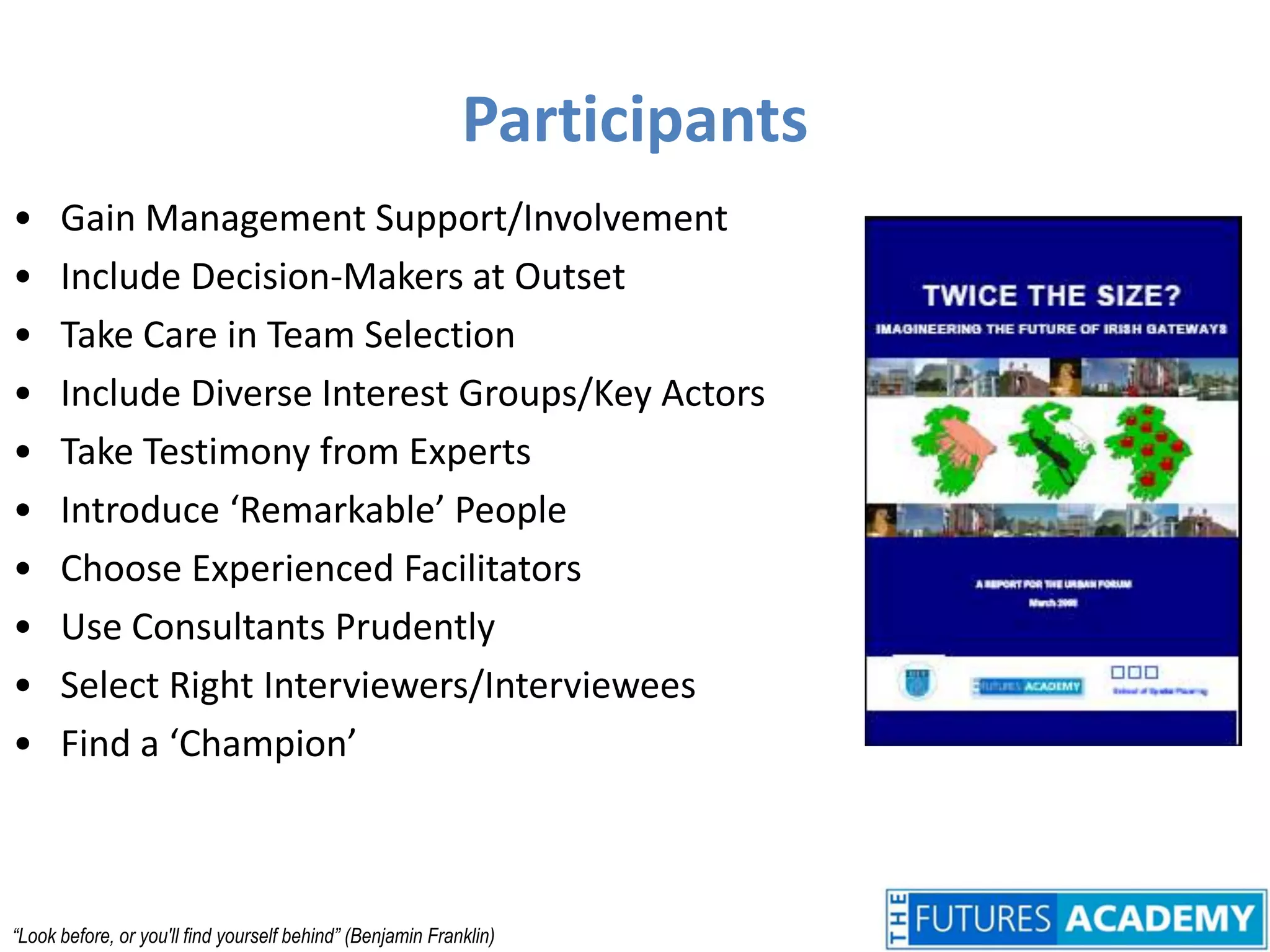
    Take Care inTeam Selection
  • 81.
    Include Diverse InterestGroups/Key Actors
  • 82.
  • 83.
  • 84.
  • 85.
  • 86.
  • 87.
    Find a ‘Champion’“Lookbefore, or you'll find yourself behind” (Benjamin Franklin)
  • 88.
  • 89.
    Do Not LimitScope of Exercise
  • 90.
    Time and TimingAll Important
  • 91.
  • 92.
  • 93.
    Have Breadth andDepth in Foresighting
  • 94.
  • 95.
  • 96.
    Process Should beContinuous and Cumulative
  • 97.
    Do Not UnderestimateAmount of Work
  • 98.
    Foster Executive Process“Thefuture is a convenient place for dreams” (Anatole France)
  • 99.
  • 100.
  • 101.
  • 102.
    Appreciate Value ofOther Informal Results
  • 103.
  • 104.
    Devise Set ofIndicators
  • 105.
    Be Innovative inPresentation
  • 106.
  • 107.
    Be Aware Successis Hard to Pinpoint
  • 108.
    Recognise Learning isan Iterative Process
  • 109.
    Gain Support“Tomorrow willgive us something to think about” (Marcus Tullius Cicero)
  • 110.
  • 111.
    Decide Inductive orDeductive Approach
  • 112.
  • 113.
  • 114.
    Pay Heed toStrategic Conversations
  • 115.
    Have Awareness ofValue of Metaphor
  • 116.
  • 117.
  • 118.
    Include Relevant andCompelling Information
  • 119.
    Arrange Special Formsof Presentation
  • 120.
    Concentrate on PivotalUncertainties“Never let the future disturb you. You will meet it, if you have to, with the same weapons of reason which today arm you against the present” (Marcus Aurelius)
  • 121.
    Embedding Futures ThinkingFiveMost Important IngredientsContinuous Environmental Scanning
  • 122.
    Link to Strategyand Outcomes
  • 123.
  • 124.
  • 125.
    Delivering Competitive Advantage“Hewho controls the present, controls the past. He who controls the past, controls the future” (George Orwell)
  • 126.
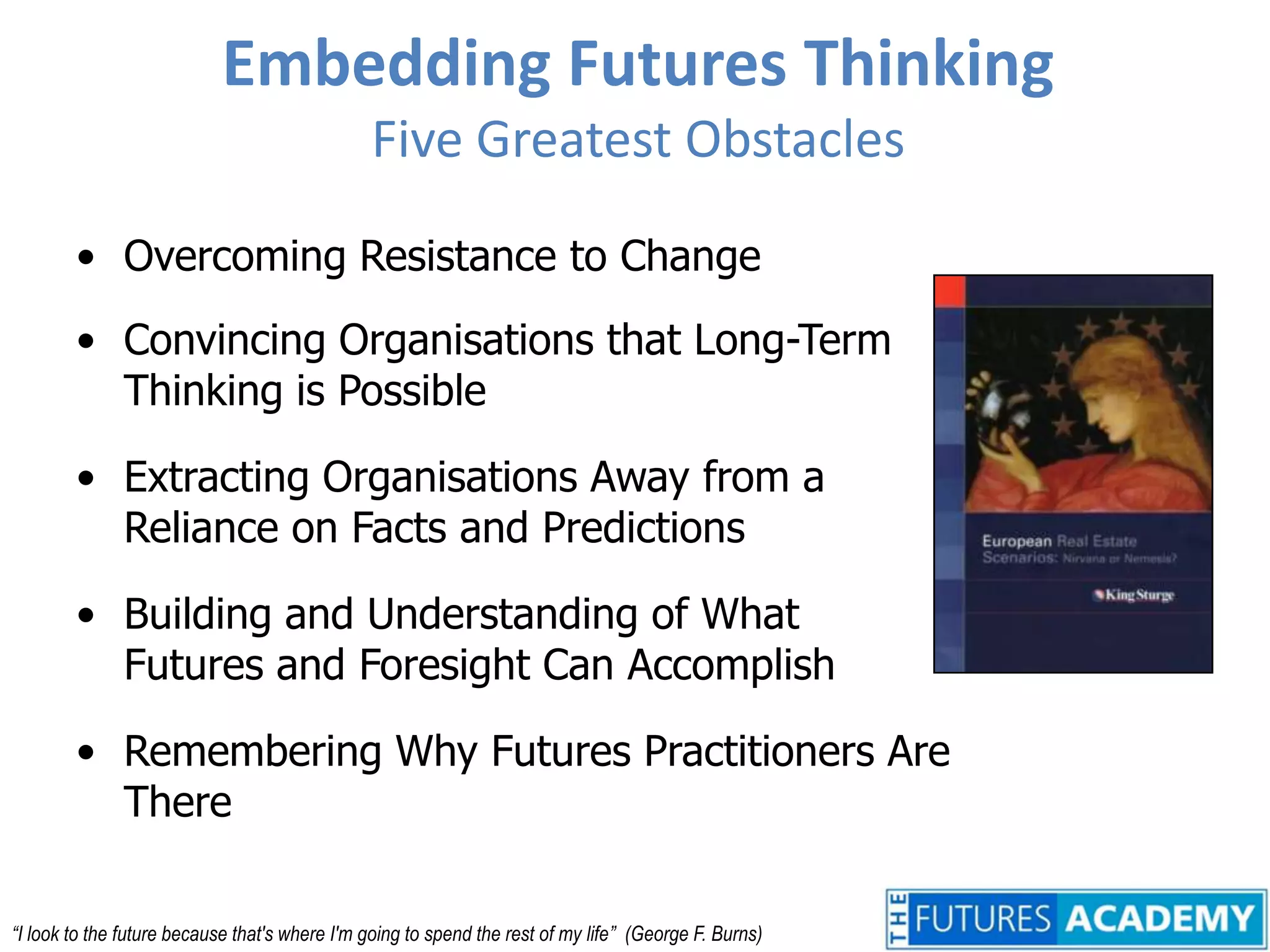
    Embedding Futures ThinkingFiveGreatest ObstaclesOvercoming Resistance to Change
  • 127.
    Convincing Organisations thatLong-Term Thinking is Possible
  • 128.
    Extracting Organisations Awayfrom a Reliance on Facts and Predictions
  • 129.
    Building and Understandingof What Futures and Foresight Can Accomplish
  • 130.
    Remembering Why FuturesPractitioners Are There“I look to the future because that's where I'm going to spend the rest of my life” (George F. Burns)
  • 131.
    “Therefore hold tothe things which are reliable Look to simplicity; embrace purity Lessen the self: diminish desire” (Tao TeChing)
  • 132.
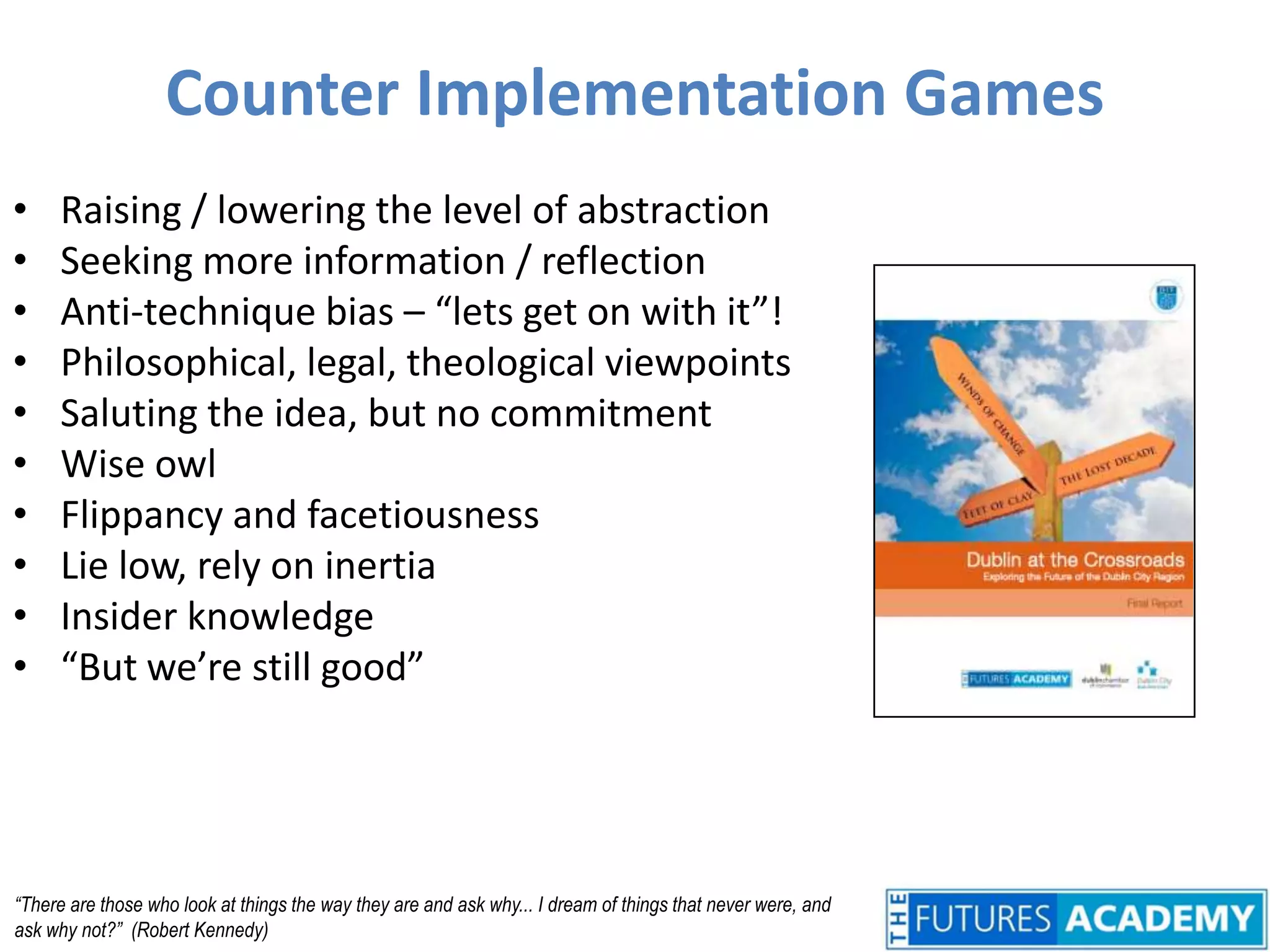
    Counter Implementation GamesRaising/ lowering the level of abstractionSeeking more information / reflectionAnti-technique bias – “lets get on with it”!Philosophical, legal, theological viewpointsSaluting the idea, but no commitmentWise owlFlippancy and facetiousnessLie low, rely on inertiaInsider knowledge“But we’re still good”“There are those who look at things the way they are and ask why... I dream of things that never were, and ask why not?” (Robert Kennedy)
  • 133.
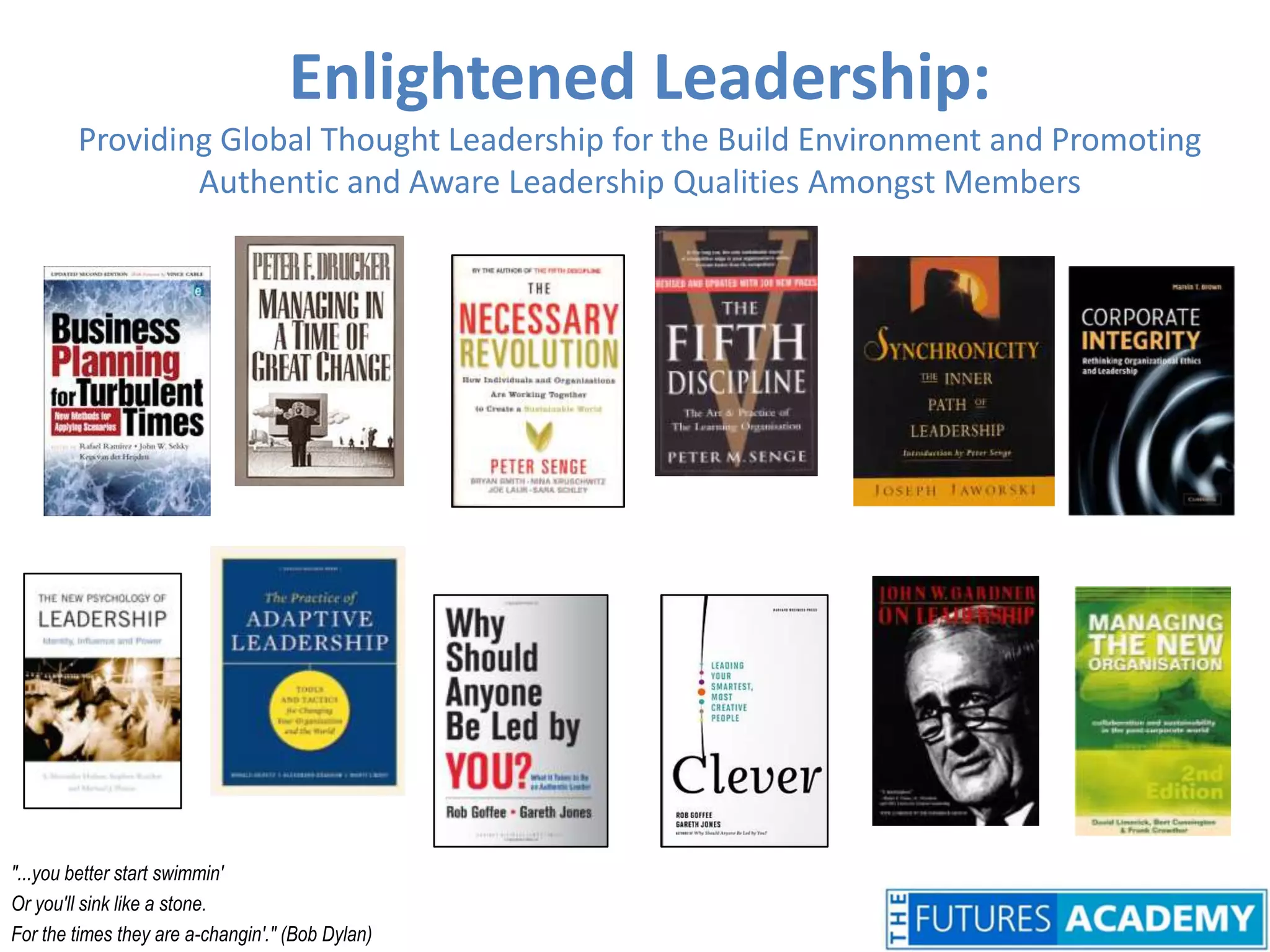
    Enlightened Leadership:Providing GlobalThought Leadership for the Build Environment and Promoting Authentic and Aware Leadership Qualities Amongst Members"...you better start swimmin'Or you'll sink like a stone.For the times they are a-changin'." (Bob Dylan)
Editor's Notes
  • #30 The World Business Council for Sustainable Development (WBCSD) is a CEO-led, global association of some 200 companies dealing exclusively with business and sustainable development. – The WBCSD was founded on the eve of the 1992 Rio Earth Summit to involve business in sustainability issues and give it a voice in the forum. The WBCSD was the brainchild of the Swiss industrialist, Stephan Schmidheiny, 29 member companies contributed to a document called Vision 2050The nine elements, or critical areas in which actions need to be taken over the next four decades are values and behaviors, human development, economy, agriculture, forests, energy and power, buildings, mobility and materials. Do more with less; create value; prosper and to advance the human conditionJust 40 years from now, some 30% more people will be living on this planet. Business view – we can sell more stuff! Bad news – shreinking resources and changing climates
  • #31 As part of these Turbulent Teens, we have identified several “must-haves”, things that need to happen to achieve our vision. These must-haves are specific to each element but they all talk about innovation, policies, financing or a deeper understanding of what is going on.
  • #32 We have detailed our vision for 2050 in each of the nine elements with a clear measure of success for each of them. For example, for the energy and power element, our vision is that a secure and low carbon energy is widely available and used efficiently. Here, the measure of success is that CO2 emissions will have been halved.