Ar Hena Tiwari
Jan-July 2016, GCAD Sonipat
Late Modernism
Ar. Hena Tiwari,
GCAD, Jan-July 2016
LECTURE V
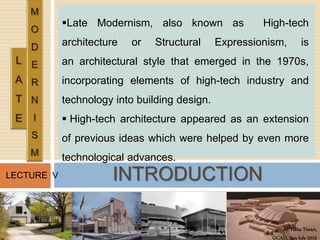
Late Modernism, also known as High-tech
architecture or Structural Expressionism, is
an architectural style that emerged in the 1970s,
incorporating elements of high-tech industry and
technology into building design.
 High-tech architecture appeared as an extension
of previous ideas which were helped by even more
technological advances.
INTRODUCTION
Ar. Hena Tiwari,
GCAD, Jan-July 2016
LECTURE V
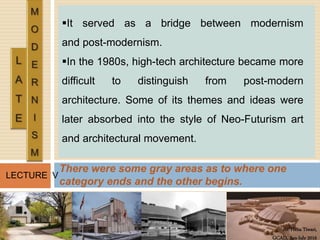
It served as a bridge between modernism
and post-modernism.
In the 1980s, high-tech architecture became more
difficult to distinguish from post-modern
architecture. Some of its themes and ideas were
later absorbed into the style of Neo-Futurism art
and architectural movement.
There were some gray areas as to where one
category ends and the other begins.
Ar. Hena Tiwari,
GCAD, Jan-July 2016
LECTURE V
Like Brutalism, Late Modernism buildings revealed
their structure on the outside as well as the inside,
but with visual emphasis placed on the internal
steel and concrete skeleton structure as opposed
to exterior concrete walls.
Ar. Hena Tiwari,
GCAD, Jan-July 2016
LECTURE V
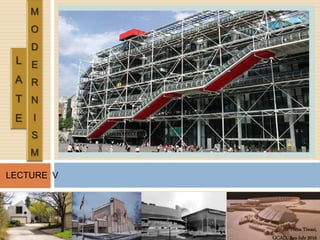
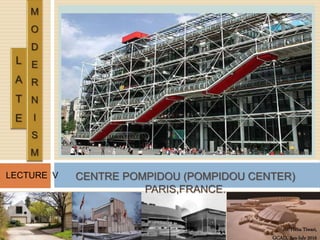
For eg. in buildings such as the Pompidou
Centre, this idea of revealed structure is taken to
the extreme, with apparently structural
components serving little or no structural role.
 In this case, the use of "structural" steel is a
stylistic or aesthetic matter.
Ar. Hena Tiwari,
GCAD, Jan-July 2016
LECTURE V
The style's premier practitioners included:
Colombian architect Bruce Graham and Bangladeshi
architect Fazlur Rahman Khan for the John Hancock
Centre, Willis Tower and Onterie Center.
British architects Sir Norman Foster, Sir Richard
Rogers
Italian architect Renzo Piano.
Spanish architect Santiago Calatrava, known for his
organic, skeleton-like designs.
ARCHITECTS
Ar. Hena Tiwari,
GCAD, Jan-July 2016
LECTURE V
It evolved from inadequacy of Modernism.
Desperately to come out of the constraints of
Modernism.
The public was once again acknowledged as a
participant of architecture, whose voice cannot be
ignored.
Was determined not to be boring like modernism
and made a conscious effort to be interesting
always.
EVOLUTION
Ar. Hena Tiwari,
GCAD, Jan-July 2016
LECTURE V
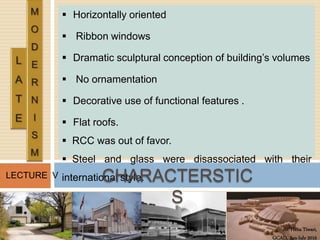
 Horizontally oriented
 Ribbon windows
 Dramatic sculptural conception of building’s volumes
 No ornamentation
 Decorative use of functional features .
 Flat roofs.
 RCC was out of favor.
 Steel and glass were disassociated with their
international style.CHARACTERSTIC
S
Ar. Hena Tiwari,
GCAD, Jan-July 2016
LECTURE V
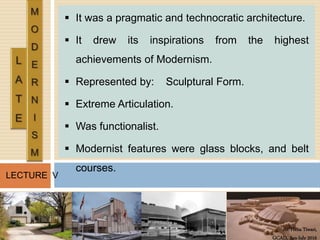
 It was a pragmatic and technocratic architecture.
 It drew its inspirations from the highest
achievements of Modernism.
 Represented by: Sculptural Form.
 Extreme Articulation.
 Was functionalist.
 Modernist features were glass blocks, and belt
courses.
Ar. Hena Tiwari,
GCAD, Jan-July 2016
LECTURE V
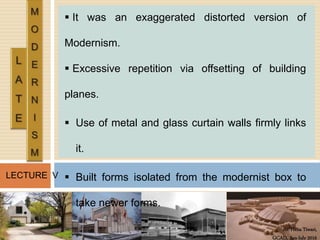
 It was an exaggerated distorted version of
Modernism.
 Excessive repetition via offsetting of building
planes.
 Use of metal and glass curtain walls firmly links
it.
 Built forms isolated from the modernist box to
take newer forms.
EXAMPLES
Ar. Hena Tiwari,
GCAD, Jan-July 2016
LECTURE V
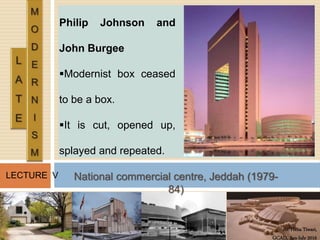
Philip Johnson and
John Burgee
Modernist box ceased
to be a box.
It is cut, opened up,
splayed and repeated.
National commercial centre, Jeddah (1979-
84)
Ar. Hena Tiwari,
GCAD, Jan-July 2016
LECTURE V
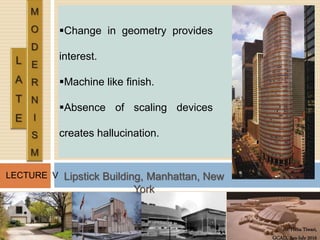
Change in geometry provides
interest.
Machine like finish.
Absence of scaling devices
creates hallucination.
Lipstick Building, Manhattan, New
York
Ar. Hena Tiwari,
GCAD, Jan-July 2016
LECTURE V
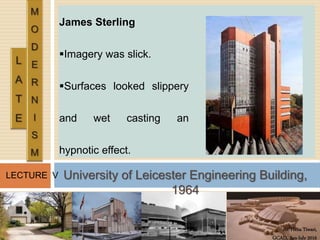
James Sterling
Imagery was slick.
Surfaces looked slippery
and wet casting an
hypnotic effect.
University of Leicester Engineering Building,
1964
Ar. Hena Tiwari,
GCAD, Jan-July 2016
LECTURE V
 Nature is architecture’s best teacher.
 “The Innermost Being of Architecture”.
 Additive Architecture.
 Modest to monumental.
 Nordic Sensibility.
 Influenced by the architecture of the ancient
Mayan civilisation, as well as the Islamic world,
China and Japan.
Jorn Utzon
Ar. Hena Tiwari,
GCAD, Jan-July 2016
LECTURE V
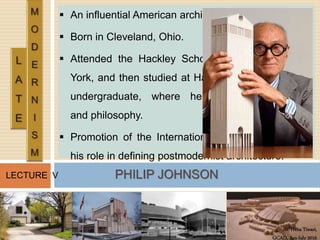
 An influential American architect.
 Born in Cleveland, Ohio.
 Attended the Hackley School, in Tarrytown, New
York, and then studied at Harvard University as an
undergraduate, where he focused on history
and philosophy.
 Promotion of the International style and, later, for
his role in defining postmodernist architecture.
PHILIP JOHNSON
Ar. Hena Tiwari,
GCAD, Jan-July 2016
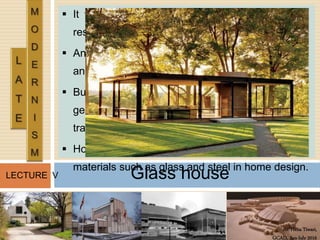
LECTURE V Glass house
 It was designed by Philip Johnson as his own
residence.
 An important and influential project for Johnson
and for modern architecture.
 Building is an essay in minimal structure,
geometry, proportion, and the effects of
transparency and reflection.
 House is an example of early use of industrial
materials such as glass and steel in home design.
Ar. Hena Tiwari,
GCAD, Jan-July 2016
LECTURE V
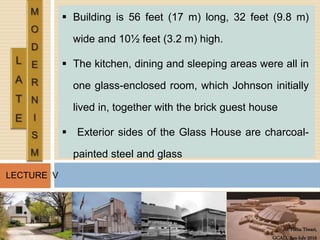
 Building is 56 feet (17 m) long, 32 feet (9.8 m)
wide and 10½ feet (3.2 m) high.
 The kitchen, dining and sleeping areas were all in
one glass-enclosed room, which Johnson initially
lived in, together with the brick guest house
 Exterior sides of the Glass House are charcoal-
painted steel and glass
Ar. Hena Tiwari,
GCAD, Jan-July 2016
LECTURE V
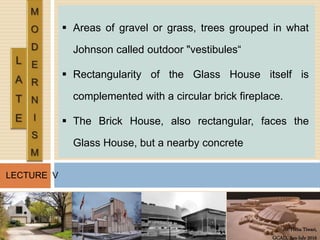
 Areas of gravel or grass, trees grouped in what
Johnson called outdoor "vestibules“
 Rectangularity of the Glass House itself is
complemented with a circular brick fireplace.
 The Brick House, also rectangular, faces the
Glass House, but a nearby concrete
Ar. Hena Tiwari,
GCAD, Jan-July 2016
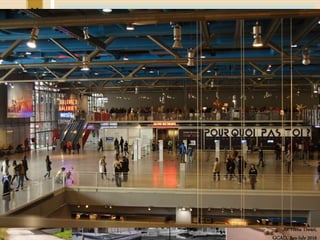
LECTURE V CENTRE POMPIDOU (POMPIDOU CENTER)
PARIS,FRANCE.
Ar. Hena Tiwari,
GCAD, Jan-July 2016
LECTURE V
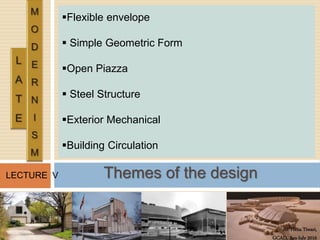
Flexible envelope
 Simple Geometric Form
Open Piazza
 Steel Structure
Exterior Mechanical
Building Circulation
Themes of the design
Ar. Hena Tiwari,
GCAD, Jan-July 2016
LECTURE V
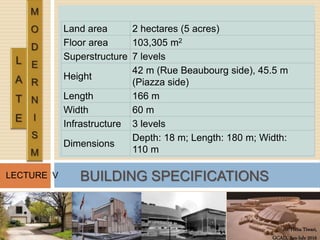
Land area 2 hectares (5 acres)
Floor area 103,305 m2
Superstructure 7 levels
Height
42 m (Rue Beaubourg side), 45.5 m
(Piazza side)
Length 166 m
Width 60 m
Infrastructure 3 levels
Dimensions
Depth: 18 m; Length: 180 m; Width:
110 m
BUILDING SPECIFICATIONS
Ar. Hena Tiwari,
GCAD, Jan-July 2016
LECTURE V
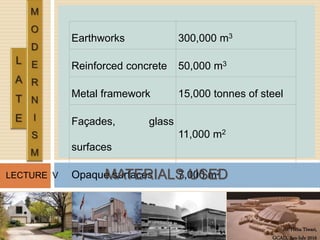
Earthworks 300,000 m3
Reinforced concrete 50,000 m3
Metal framework 15,000 tonnes of steel
Façades, glass
surfaces
11,000 m2
Opaque surfaces 7,000 m2
MATERIALS USED
Ar. Hena Tiwari,
GCAD, Jan-July 2016
LECTURE V
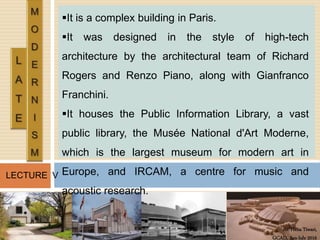
It is a complex building in Paris.
It was designed in the style of high-tech
architecture by the architectural team of Richard
Rogers and Renzo Piano, along with Gianfranco
Franchini.
It houses the Public Information Library, a vast
public library, the Musée National d'Art Moderne,
which is the largest museum for modern art in
Europe, and IRCAM, a centre for music and
acoustic research.
Ar. Hena Tiwari,
GCAD, Jan-July 2016
LECTURE V
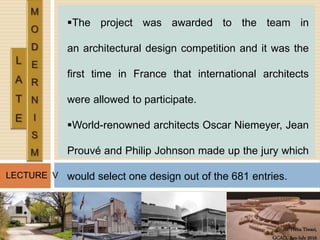
The project was awarded to the team in
an architectural design competition and it was the
first time in France that international architects
were allowed to participate.
World-renowned architects Oscar Niemeyer, Jean
Prouvé and Philip Johnson made up the jury which
would select one design out of the 681 entries.
Ar. Hena Tiwari,
GCAD, Jan-July 2016
LECTURE V
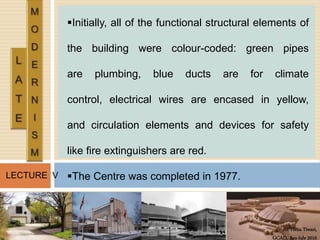
Initially, all of the functional structural elements of
the building were colour-coded: green pipes
are plumbing, blue ducts are for climate
control, electrical wires are encased in yellow,
and circulation elements and devices for safety
like fire extinguishers are red.
The Centre was completed in 1977.
Ar. Hena Tiwari,
GCAD, Jan-July 2016
LECTURE V

Lecture iv late modernism

  • 1.
    Ar Hena Tiwari Jan-July2016, GCAD Sonipat Late Modernism
  • 2.
    Ar. Hena Tiwari, GCAD,Jan-July 2016 LECTURE V Late Modernism, also known as High-tech architecture or Structural Expressionism, is an architectural style that emerged in the 1970s, incorporating elements of high-tech industry and technology into building design.  High-tech architecture appeared as an extension of previous ideas which were helped by even more technological advances. INTRODUCTION
  • 3.
    Ar. Hena Tiwari, GCAD,Jan-July 2016 LECTURE V It served as a bridge between modernism and post-modernism. In the 1980s, high-tech architecture became more difficult to distinguish from post-modern architecture. Some of its themes and ideas were later absorbed into the style of Neo-Futurism art and architectural movement. There were some gray areas as to where one category ends and the other begins.
  • 4.
    Ar. Hena Tiwari, GCAD,Jan-July 2016 LECTURE V Like Brutalism, Late Modernism buildings revealed their structure on the outside as well as the inside, but with visual emphasis placed on the internal steel and concrete skeleton structure as opposed to exterior concrete walls.
  • 5.
    Ar. Hena Tiwari, GCAD,Jan-July 2016 LECTURE V For eg. in buildings such as the Pompidou Centre, this idea of revealed structure is taken to the extreme, with apparently structural components serving little or no structural role.  In this case, the use of "structural" steel is a stylistic or aesthetic matter.
  • 6.
    Ar. Hena Tiwari, GCAD,Jan-July 2016 LECTURE V The style's premier practitioners included: Colombian architect Bruce Graham and Bangladeshi architect Fazlur Rahman Khan for the John Hancock Centre, Willis Tower and Onterie Center. British architects Sir Norman Foster, Sir Richard Rogers Italian architect Renzo Piano. Spanish architect Santiago Calatrava, known for his organic, skeleton-like designs. ARCHITECTS
  • 7.
    Ar. Hena Tiwari, GCAD,Jan-July 2016 LECTURE V It evolved from inadequacy of Modernism. Desperately to come out of the constraints of Modernism. The public was once again acknowledged as a participant of architecture, whose voice cannot be ignored. Was determined not to be boring like modernism and made a conscious effort to be interesting always. EVOLUTION
  • 8.
    Ar. Hena Tiwari, GCAD,Jan-July 2016 LECTURE V  Horizontally oriented  Ribbon windows  Dramatic sculptural conception of building’s volumes  No ornamentation  Decorative use of functional features .  Flat roofs.  RCC was out of favor.  Steel and glass were disassociated with their international style.CHARACTERSTIC S
  • 9.
    Ar. Hena Tiwari, GCAD,Jan-July 2016 LECTURE V  It was a pragmatic and technocratic architecture.  It drew its inspirations from the highest achievements of Modernism.  Represented by: Sculptural Form.  Extreme Articulation.  Was functionalist.  Modernist features were glass blocks, and belt courses.
  • 10.
    Ar. Hena Tiwari, GCAD,Jan-July 2016 LECTURE V  It was an exaggerated distorted version of Modernism.  Excessive repetition via offsetting of building planes.  Use of metal and glass curtain walls firmly links it.  Built forms isolated from the modernist box to take newer forms.
  • 11.
  • 12.
    Ar. Hena Tiwari, GCAD,Jan-July 2016 LECTURE V Philip Johnson and John Burgee Modernist box ceased to be a box. It is cut, opened up, splayed and repeated. National commercial centre, Jeddah (1979- 84)
  • 13.
    Ar. Hena Tiwari, GCAD,Jan-July 2016 LECTURE V Change in geometry provides interest. Machine like finish. Absence of scaling devices creates hallucination. Lipstick Building, Manhattan, New York
  • 14.
    Ar. Hena Tiwari, GCAD,Jan-July 2016 LECTURE V James Sterling Imagery was slick. Surfaces looked slippery and wet casting an hypnotic effect. University of Leicester Engineering Building, 1964
  • 15.
    Ar. Hena Tiwari, GCAD,Jan-July 2016 LECTURE V  Nature is architecture’s best teacher.  “The Innermost Being of Architecture”.  Additive Architecture.  Modest to monumental.  Nordic Sensibility.  Influenced by the architecture of the ancient Mayan civilisation, as well as the Islamic world, China and Japan. Jorn Utzon
  • 16.
    Ar. Hena Tiwari, GCAD,Jan-July 2016 LECTURE V  An influential American architect.  Born in Cleveland, Ohio.  Attended the Hackley School, in Tarrytown, New York, and then studied at Harvard University as an undergraduate, where he focused on history and philosophy.  Promotion of the International style and, later, for his role in defining postmodernist architecture. PHILIP JOHNSON
  • 17.
    Ar. Hena Tiwari, GCAD,Jan-July 2016 LECTURE V Glass house  It was designed by Philip Johnson as his own residence.  An important and influential project for Johnson and for modern architecture.  Building is an essay in minimal structure, geometry, proportion, and the effects of transparency and reflection.  House is an example of early use of industrial materials such as glass and steel in home design.
  • 18.
    Ar. Hena Tiwari, GCAD,Jan-July 2016 LECTURE V  Building is 56 feet (17 m) long, 32 feet (9.8 m) wide and 10½ feet (3.2 m) high.  The kitchen, dining and sleeping areas were all in one glass-enclosed room, which Johnson initially lived in, together with the brick guest house  Exterior sides of the Glass House are charcoal- painted steel and glass
  • 19.
    Ar. Hena Tiwari, GCAD,Jan-July 2016 LECTURE V  Areas of gravel or grass, trees grouped in what Johnson called outdoor "vestibules“  Rectangularity of the Glass House itself is complemented with a circular brick fireplace.  The Brick House, also rectangular, faces the Glass House, but a nearby concrete
  • 20.
    Ar. Hena Tiwari, GCAD,Jan-July 2016 LECTURE V CENTRE POMPIDOU (POMPIDOU CENTER) PARIS,FRANCE.
  • 21.
    Ar. Hena Tiwari, GCAD,Jan-July 2016 LECTURE V Flexible envelope  Simple Geometric Form Open Piazza  Steel Structure Exterior Mechanical Building Circulation Themes of the design
  • 22.
    Ar. Hena Tiwari, GCAD,Jan-July 2016 LECTURE V Land area 2 hectares (5 acres) Floor area 103,305 m2 Superstructure 7 levels Height 42 m (Rue Beaubourg side), 45.5 m (Piazza side) Length 166 m Width 60 m Infrastructure 3 levels Dimensions Depth: 18 m; Length: 180 m; Width: 110 m BUILDING SPECIFICATIONS
  • 23.
    Ar. Hena Tiwari, GCAD,Jan-July 2016 LECTURE V Earthworks 300,000 m3 Reinforced concrete 50,000 m3 Metal framework 15,000 tonnes of steel Façades, glass surfaces 11,000 m2 Opaque surfaces 7,000 m2 MATERIALS USED
  • 24.
    Ar. Hena Tiwari, GCAD,Jan-July 2016 LECTURE V It is a complex building in Paris. It was designed in the style of high-tech architecture by the architectural team of Richard Rogers and Renzo Piano, along with Gianfranco Franchini. It houses the Public Information Library, a vast public library, the Musée National d'Art Moderne, which is the largest museum for modern art in Europe, and IRCAM, a centre for music and acoustic research.
  • 25.
    Ar. Hena Tiwari, GCAD,Jan-July 2016 LECTURE V The project was awarded to the team in an architectural design competition and it was the first time in France that international architects were allowed to participate. World-renowned architects Oscar Niemeyer, Jean Prouvé and Philip Johnson made up the jury which would select one design out of the 681 entries.
  • 26.
    Ar. Hena Tiwari, GCAD,Jan-July 2016 LECTURE V Initially, all of the functional structural elements of the building were colour-coded: green pipes are plumbing, blue ducts are for climate control, electrical wires are encased in yellow, and circulation elements and devices for safety like fire extinguishers are red. The Centre was completed in 1977.
  • 27.
    Ar. Hena Tiwari, GCAD,Jan-July 2016 LECTURE V

Editor's Notes

  • #16 *He believed that buildings were like seeds of the same plant which have the same potential for growth and development, but depending on various factors such as the environment, the seedlings would develop differently. *from the understated monumentality of the Bagsværd Church with its poetic cloud-like undulating ceiling. *that is site specific and poetic, informed by a profound appreciation of nature and diversity of human cultures. *Utzon displays a Nordic sensibility to nature and integrity of design that strives for the attainment of quality in architecture and design, through the simple, honest yet noble synthesis of form, material and function, motivated by social values. To this essentially regional response, Utzon combines a fascination for the architectural legacies of foreign cultures. These influences include the architecture of the ancient Mayan civilisation, as well as the Islamic world, China and Japan.