JAGANNATH UNIVERSITY
        FACUTLY OF
        ARCHITECTURE


        PRESENTATION
        ON LE CORBUSIER
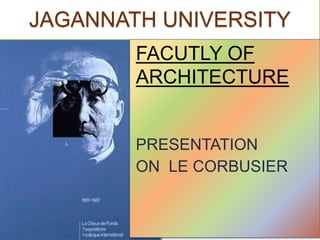
Le Corbusier
 Charles-Edouard Jeanneret, better
  known as Le Corbusier.

 He was born in Switzerland and became
 a French citizen in 1930.                October 6, 1887 –
                                          August 27, 1965)
 He was architect ,designer urbanist
  and writer.

 His career spanned five decades, with
 his buildings constructed throughout
 Europe, India and America.
EARLY LIFE AND CARRER(1914-
1930)
Le Corbusier taught at his old school in La-
 chaux-de-Fond during World War I.

 Until the end of the first world war he
  worked in switzerland.

 Were he worked on theoretical
  architectural studies using modern
  techniques.

 Among these was his project for the
  Domino House (1914–1915)
 In 1908, He studied architecture
 in Vienna with Josef Hoffmann.

 Between October 1910 and March 1911, he
 worked near Berlin for the renowned
 architect Peter Behrens.

 Soon he would begin his own architectural
 practice with his cousin, Pierre Jeanneret (1896–
 1967), a partnership that would last until the
 1950s.

In 1918, Le Corbusier met the Cubist
 painter Amédée Ozenfant.
 After World War II, Le Corbusier attempted to realize his
  urban planning schemes on a small scale by constructing a
  series of "unités" (the housing block unit of the Radiant City)
  around France.

 The most famous of these was the Unité d'Habitation of
  Marseilles (1946–1952).

 In the 1950s, a unique opportunity to translate the Radiant
  City on a grand scale presented itself in the construction of
  the Union Territory Chandigarh.

 The new capital of Indian states of Punjab
  and Haryana and the first planned city in
  India.

                                     Unité d'Habitation France Le
                                     corbusier Marseille or Cité Radieuse .
LE CORBUSIER – THE MODULAR

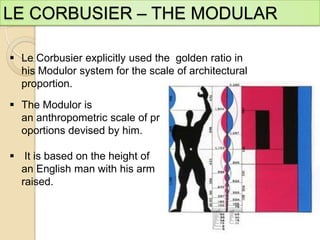
 Le Corbusier explicitly used the golden ratio in
  his Modulor system for the scale of architectural
  proportion.
 The Modulor is
  an anthropometric scale of pr
  oportions devised by him.

 It is based on the height of
  an English man with his arm
  raised.
INFLUENCES

 He saw this system as a
  continuation of the long tradition
  of Vitruvius, Leonardo da
  Vinci's and , the work of Leon
  Battista Alberti.

 They used the proportions of the
  human body to improve the
  appearance and function
  of architecture.

 Le Corbusier described it as a
 "range of harmonious
 measurements to suit the human
 scale, universally applicable to
BUILDING WITH MODULAR
SYSTEM
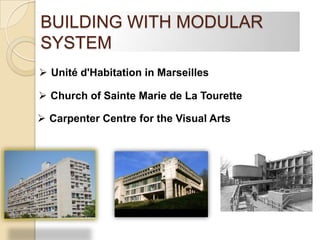
 Unité d'Habitation in Marseilles

 Church of Sainte Marie de La Tourette

 Carpenter Centre for the Visual Arts
CHANDIGARH PLANNING

 Historical Background
 Selection of site
 Planning
  To select a suitable
  site, the Govt. of
  Punjab appointed a
  Committee in 1948
  under the
  Chairmanship of P.L
  Verma, Chief Engineer
  to assess and evaluate
  the existing towns in
  the State for setting up
  the proposed capital of
 The present site was selected in 1948 taking into account various
  attributes such as its Central location in the state, proximity to the national
  capital & availability of sufficient water supply, fertile of soil, gradient of
  land for natural drainage.

 An American Firm, M/s. Mayer, Whittlessay and Glass was commissioned
  in 1950 to prepare the Master Plan for the new City


 Albert Mayer and Mathew Novicki evolved a fan shaped Master Plan and
  worked out conceptual sketches of the super block.

 The super block was designed as a self –sufficient neighborhood units
  placed along the curvilinear roads and comprised of cluster type
  housing, markets and centrally located open spaces.
Le Corbusier's Master Plan

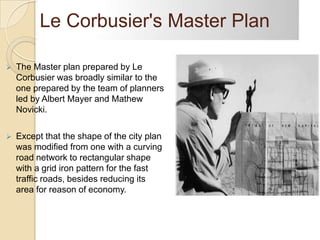
   The Master plan prepared by Le
    Corbusier was broadly similar to the
    one prepared by the team of planners
    led by Albert Mayer and Mathew
    Novicki.

   Except that the shape of the city plan
    was modified from one with a curving
    road network to rectangular shape
    with a grid iron pattern for the fast
    traffic roads, besides reducing its
    area for reason of economy.
 Due to economic constraints, the master plan was to be
  realized in two phases, catering to a total population of half a
  million.

 . Phase-I consisting of 30 low density sector spread over an
  area of 9000 acres (Sector 1 to 30) for 1,50,000 people .

 Phase-II consisting of 17 considerably high density Sectors (
  Sectors 31 to 47) spread over an area of 6000 acres for a
  population of 3,50,000.
 The primary module of city‟s design is a Sector, a neighborhood unit of
  size 800 meters x 1200 meters. It is a self-sufficient unit having shops,
  school, health centers and places of recreations and worship.

 The population of a sector varies between 3000 and 20000 depending
  upon the sizes of plots and the topography of the area.
The open hand
 The Open Hand (La Main Ouverte) is a
  recurring motif in Le Corbusier's
  architecture.

 This is a sign of relief and reconciliation.

 It is open to give and open to receive.

 The largest of the many Open Hand
 sculptures that Le Corbusier created is a
                                                 The Open Hand Monument in
 28 meter high version in Chandigarh,             Chandigarh
 India.                                          , India
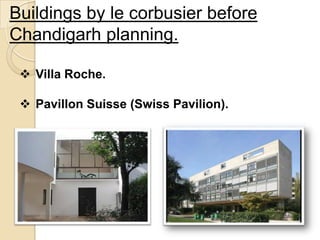
Buildings by le corbusier before
Chandigarh planning.

  Villa Roche.

  Pavillon Suisse (Swiss Pavilion).
location    Paris
                          function
VILLA ROCHE                           private
                                      house, museum, gallery


Project Year: 1923-1925
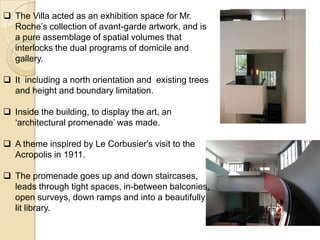
 The Villa La Roche is a perfect showcase for Le
  Corbusier's new architecture.

 The house would serve as a private gallery to display La
 Roche's extensive art collection.
 The Villa acted as an exhibition space for Mr.
  Roche‟s collection of avant-garde artwork, and is
  a pure assemblage of spatial volumes that
  interlocks the dual programs of domicile and
  gallery.

 It including a north orientation and existing trees
  and height and boundary limitation.

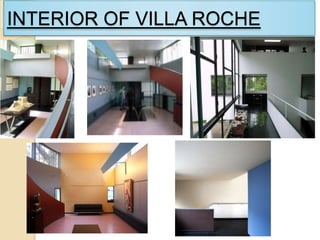
 Inside the building, to display the art, an
  „architectural promenade‟ was made.

 A theme inspired by Le Corbusier's visit to the
  Acropolis in 1911.

 The promenade goes up and down staircases,
  leads through tight spaces, in-between balconies,
  open surveys, down ramps and into a beautifully
  lit library.
INTERIOR OF VILLA ROCHE
BUILDING FEATURES OF
    VILLA ROCHE.
 The Villa was imagined as a “spatial
  experience” and consists of a specifically
  deliberate path which guides the inhabitant
  and unveils the artwork as an itinerary through
  history.
 The promenade lead us into a succession of
  wonderfully illuminated spaces which were
  perceptibly designed to be experiential and
  viewed from a single, fixed point.
 Precisely placed wall openings, stairs, ramps,
  and balconies divide the space into three
  dimensional grid-like layers which are
  permeable to stunning illumination.
 In contrast to the entirely white façade, the
  vivid internal color palate harmonizes the
  otherwise asymmetrical arrangement of the
  Villa.
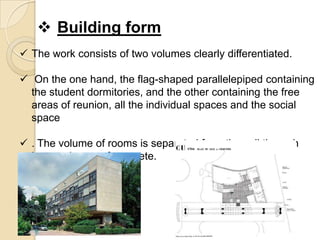
Pavillon Suisse (Swiss Pavilion)


Pavillon Suisse (Swiss Pavilion)
7 boulevard Jourdan
75014 Paris
France
 Citi university was founded in 1921 to provide accommodation and support
  for foreign students in Paris.
BUILDING DETAILS
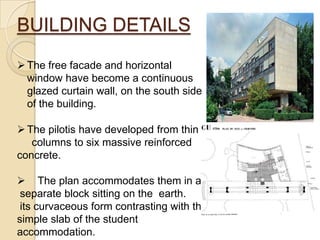
 The free facade and horizontal
  window have become a continuous
  glazed curtain wall, on the south side
  of the building.

 The pilotis have developed from thin
   columns to six massive reinforced
concrete.

 The plan accommodates them in a
 separate block sitting on the earth.
 its curvaceous form contrasting with the
simple slab of the student
accommodation.
 Building form
 The work consists of two volumes clearly differentiated.

 On the one hand, the flag-shaped parallelepiped containing
  the student dormitories, and the other containing the free
  areas of reunion, all the individual spaces and the social
  space

 . The volume of rooms is separated from the soil through
  large columns of concrete.
 Structure
System of beams and
columns of reinforced
concrete.
 Materials
 Concrete, stone and glass.
MILL OWNERS' ASSOCIATION BUILDING


                                        location Ahmedabad
                                        function auditorium, meeting room,
                                        office


 A ceremonial ramp makes for a grand approach into a triple-
  height entrance hall.

 Arrival is on the first floor, where (as per the original design)
  the executives‟ offices and boardroom are located
Building characteristic
 The ground floor houses the work
  spaces of the clerks and a
  separate, single-storey canteen at the
  rear.

 On the third floor is a high, top-lit
  auditorium with a roof canopy and a
  curved, enclosing wall, in addition to a
  generous lobby.

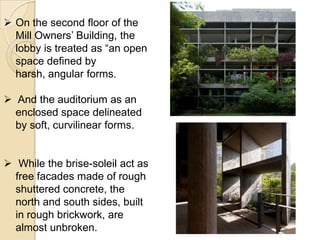
 The east and west façades are in the
  form of sun breakers , one of Corbusier‟s
  many formal inventions.

 while avoiding harsh sun, permit visual
  connection and air movement.
 On the second floor of the
  Mill Owners‟ Building, the
  lobby is treated as “an open
  space defined by
  harsh, angular forms.

 And the auditorium as an
  enclosed space delineated
  by soft, curvilinear forms.


 While the brise-soleil act as
  free facades made of rough
  shuttered concrete, the
  north and south sides, built
  in rough brickwork, are
  almost unbroken.
SECRETARIAT BUILDING


               location      Chandigarh
               function      government

 The Secretariat building is a long, horizontal concrete slab
  form, 254 meters long and 42 meters high
 The building is composed of block divided by expansion joints
  and measures over 800 feet long, bookended by two sculptural
  ramps providing vertical circulation throughout the facilities‟
  levels.
 The massive, horizontal
  complex is comprised of 8
  stories of rough-cast
  concrete.

 The building has notable
  similarities with Corbusier‟s
  Marseille block and had an
  equally lofty goal: to
  revolutionize the modern
  office building.
 The whole structure is constructed in „beton brut‟ (rough-
  cast concrete) with Corbusier‟s signature „brise-soleils‟
  facade.

 Over 800 feet long, the
  extensive facade of the
  building gives a sculptural
  aesthetic with exposed
  concrete ramps, punctured
  with small square windows
  dictating the front and rear
  views

 The cafeteria rests atop the
  terrace, where one can have
  a spectacular view of the
  city.
 Similarly, the roof garden and its promenade set
  against the surrounding landscape, which constantly
  changes as the observer‟s angle of vision changes..

 To maximize natural lighting
  and increase cross-
  ventilation, a long and narrow
  plan was implemented.

 The Secretariat is a simpler
  and more conventional form
  where variations of structure
  and internal distribution do
  not interrupt its compact
  volume.
FAMOUS QUOTES BY
LE CORBUSIER

 “To create architecture is to put in order. Put
  what in order? Function and objects.”

 Space and light and order. Those are the
  things that men need just as much as they
  need bread or a place to sleep.”

 A house is a machine for living in.”
Thank you

le corbusier principles

  • 1.
    JAGANNATH UNIVERSITY FACUTLY OF ARCHITECTURE PRESENTATION ON LE CORBUSIER
  • 2.
    Le Corbusier  Charles-EdouardJeanneret, better known as Le Corbusier.  He was born in Switzerland and became a French citizen in 1930. October 6, 1887 – August 27, 1965)  He was architect ,designer urbanist and writer.  His career spanned five decades, with his buildings constructed throughout Europe, India and America.
  • 3.
    EARLY LIFE ANDCARRER(1914- 1930) Le Corbusier taught at his old school in La- chaux-de-Fond during World War I.  Until the end of the first world war he worked in switzerland.  Were he worked on theoretical architectural studies using modern techniques.  Among these was his project for the Domino House (1914–1915)
  • 4.
     In 1908,He studied architecture in Vienna with Josef Hoffmann.  Between October 1910 and March 1911, he worked near Berlin for the renowned architect Peter Behrens.  Soon he would begin his own architectural practice with his cousin, Pierre Jeanneret (1896– 1967), a partnership that would last until the 1950s. In 1918, Le Corbusier met the Cubist painter Amédée Ozenfant.
  • 5.
     After WorldWar II, Le Corbusier attempted to realize his urban planning schemes on a small scale by constructing a series of "unités" (the housing block unit of the Radiant City) around France.  The most famous of these was the Unité d'Habitation of Marseilles (1946–1952).  In the 1950s, a unique opportunity to translate the Radiant City on a grand scale presented itself in the construction of the Union Territory Chandigarh.  The new capital of Indian states of Punjab and Haryana and the first planned city in India. Unité d'Habitation France Le corbusier Marseille or Cité Radieuse .
  • 6.
    LE CORBUSIER –THE MODULAR  Le Corbusier explicitly used the golden ratio in his Modulor system for the scale of architectural proportion.  The Modulor is an anthropometric scale of pr oportions devised by him.  It is based on the height of an English man with his arm raised.
  • 7.
    INFLUENCES  He sawthis system as a continuation of the long tradition of Vitruvius, Leonardo da Vinci's and , the work of Leon Battista Alberti.  They used the proportions of the human body to improve the appearance and function of architecture.  Le Corbusier described it as a "range of harmonious measurements to suit the human scale, universally applicable to
  • 8.
    BUILDING WITH MODULAR SYSTEM Unité d'Habitation in Marseilles  Church of Sainte Marie de La Tourette  Carpenter Centre for the Visual Arts
  • 9.
    CHANDIGARH PLANNING  HistoricalBackground  Selection of site  Planning To select a suitable site, the Govt. of Punjab appointed a Committee in 1948 under the Chairmanship of P.L Verma, Chief Engineer to assess and evaluate the existing towns in the State for setting up the proposed capital of
  • 10.
     The presentsite was selected in 1948 taking into account various attributes such as its Central location in the state, proximity to the national capital & availability of sufficient water supply, fertile of soil, gradient of land for natural drainage.  An American Firm, M/s. Mayer, Whittlessay and Glass was commissioned in 1950 to prepare the Master Plan for the new City  Albert Mayer and Mathew Novicki evolved a fan shaped Master Plan and worked out conceptual sketches of the super block.  The super block was designed as a self –sufficient neighborhood units placed along the curvilinear roads and comprised of cluster type housing, markets and centrally located open spaces.
  • 11.
    Le Corbusier's MasterPlan  The Master plan prepared by Le Corbusier was broadly similar to the one prepared by the team of planners led by Albert Mayer and Mathew Novicki.  Except that the shape of the city plan was modified from one with a curving road network to rectangular shape with a grid iron pattern for the fast traffic roads, besides reducing its area for reason of economy.
  • 12.
     Due toeconomic constraints, the master plan was to be realized in two phases, catering to a total population of half a million.  . Phase-I consisting of 30 low density sector spread over an area of 9000 acres (Sector 1 to 30) for 1,50,000 people .  Phase-II consisting of 17 considerably high density Sectors ( Sectors 31 to 47) spread over an area of 6000 acres for a population of 3,50,000.
  • 13.
     The primarymodule of city‟s design is a Sector, a neighborhood unit of size 800 meters x 1200 meters. It is a self-sufficient unit having shops, school, health centers and places of recreations and worship.  The population of a sector varies between 3000 and 20000 depending upon the sizes of plots and the topography of the area.
  • 17.
    The open hand The Open Hand (La Main Ouverte) is a recurring motif in Le Corbusier's architecture.  This is a sign of relief and reconciliation.  It is open to give and open to receive.  The largest of the many Open Hand sculptures that Le Corbusier created is a The Open Hand Monument in 28 meter high version in Chandigarh, Chandigarh India. , India
  • 18.
    Buildings by lecorbusier before Chandigarh planning.  Villa Roche.  Pavillon Suisse (Swiss Pavilion).
  • 19.
    location Paris function VILLA ROCHE private house, museum, gallery Project Year: 1923-1925  The Villa La Roche is a perfect showcase for Le Corbusier's new architecture.  The house would serve as a private gallery to display La Roche's extensive art collection.
  • 20.
     The Villaacted as an exhibition space for Mr. Roche‟s collection of avant-garde artwork, and is a pure assemblage of spatial volumes that interlocks the dual programs of domicile and gallery.  It including a north orientation and existing trees and height and boundary limitation.  Inside the building, to display the art, an „architectural promenade‟ was made.  A theme inspired by Le Corbusier's visit to the Acropolis in 1911.  The promenade goes up and down staircases, leads through tight spaces, in-between balconies, open surveys, down ramps and into a beautifully lit library.
  • 21.
  • 22.
    BUILDING FEATURES OF VILLA ROCHE.  The Villa was imagined as a “spatial experience” and consists of a specifically deliberate path which guides the inhabitant and unveils the artwork as an itinerary through history.  The promenade lead us into a succession of wonderfully illuminated spaces which were perceptibly designed to be experiential and viewed from a single, fixed point.  Precisely placed wall openings, stairs, ramps, and balconies divide the space into three dimensional grid-like layers which are permeable to stunning illumination.  In contrast to the entirely white façade, the vivid internal color palate harmonizes the otherwise asymmetrical arrangement of the Villa.
  • 23.
    Pavillon Suisse (SwissPavilion) Pavillon Suisse (Swiss Pavilion) 7 boulevard Jourdan 75014 Paris France  Citi university was founded in 1921 to provide accommodation and support for foreign students in Paris.
  • 24.
    BUILDING DETAILS  Thefree facade and horizontal window have become a continuous glazed curtain wall, on the south side of the building.  The pilotis have developed from thin columns to six massive reinforced concrete.  The plan accommodates them in a separate block sitting on the earth. its curvaceous form contrasting with the simple slab of the student accommodation.
  • 25.
     Building form The work consists of two volumes clearly differentiated.  On the one hand, the flag-shaped parallelepiped containing the student dormitories, and the other containing the free areas of reunion, all the individual spaces and the social space  . The volume of rooms is separated from the soil through large columns of concrete.
  • 26.
     Structure System ofbeams and columns of reinforced concrete.  Materials Concrete, stone and glass.
  • 27.
    MILL OWNERS' ASSOCIATIONBUILDING location Ahmedabad function auditorium, meeting room, office  A ceremonial ramp makes for a grand approach into a triple- height entrance hall.  Arrival is on the first floor, where (as per the original design) the executives‟ offices and boardroom are located
  • 28.
    Building characteristic  Theground floor houses the work spaces of the clerks and a separate, single-storey canteen at the rear.  On the third floor is a high, top-lit auditorium with a roof canopy and a curved, enclosing wall, in addition to a generous lobby.  The east and west façades are in the form of sun breakers , one of Corbusier‟s many formal inventions.  while avoiding harsh sun, permit visual connection and air movement.
  • 29.
     On thesecond floor of the Mill Owners‟ Building, the lobby is treated as “an open space defined by harsh, angular forms.  And the auditorium as an enclosed space delineated by soft, curvilinear forms.  While the brise-soleil act as free facades made of rough shuttered concrete, the north and south sides, built in rough brickwork, are almost unbroken.
  • 30.
    SECRETARIAT BUILDING location Chandigarh function government  The Secretariat building is a long, horizontal concrete slab form, 254 meters long and 42 meters high
  • 31.
     The buildingis composed of block divided by expansion joints and measures over 800 feet long, bookended by two sculptural ramps providing vertical circulation throughout the facilities‟ levels.  The massive, horizontal complex is comprised of 8 stories of rough-cast concrete.  The building has notable similarities with Corbusier‟s Marseille block and had an equally lofty goal: to revolutionize the modern office building.
  • 32.
     The wholestructure is constructed in „beton brut‟ (rough- cast concrete) with Corbusier‟s signature „brise-soleils‟ facade.  Over 800 feet long, the extensive facade of the building gives a sculptural aesthetic with exposed concrete ramps, punctured with small square windows dictating the front and rear views  The cafeteria rests atop the terrace, where one can have a spectacular view of the city.
  • 33.
     Similarly, theroof garden and its promenade set against the surrounding landscape, which constantly changes as the observer‟s angle of vision changes..  To maximize natural lighting and increase cross- ventilation, a long and narrow plan was implemented.  The Secretariat is a simpler and more conventional form where variations of structure and internal distribution do not interrupt its compact volume.
  • 34.
    FAMOUS QUOTES BY LECORBUSIER  “To create architecture is to put in order. Put what in order? Function and objects.”  Space and light and order. Those are the things that men need just as much as they need bread or a place to sleep.”  A house is a machine for living in.”
  • 35.