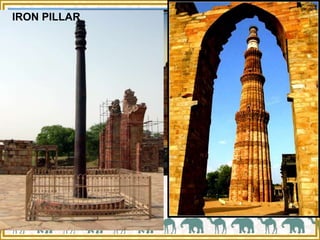

Tomb of BalbanSultan Ghari
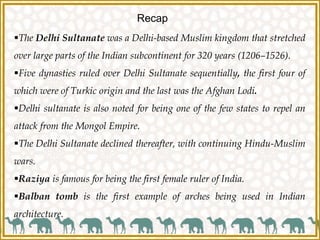
Qutub Minar
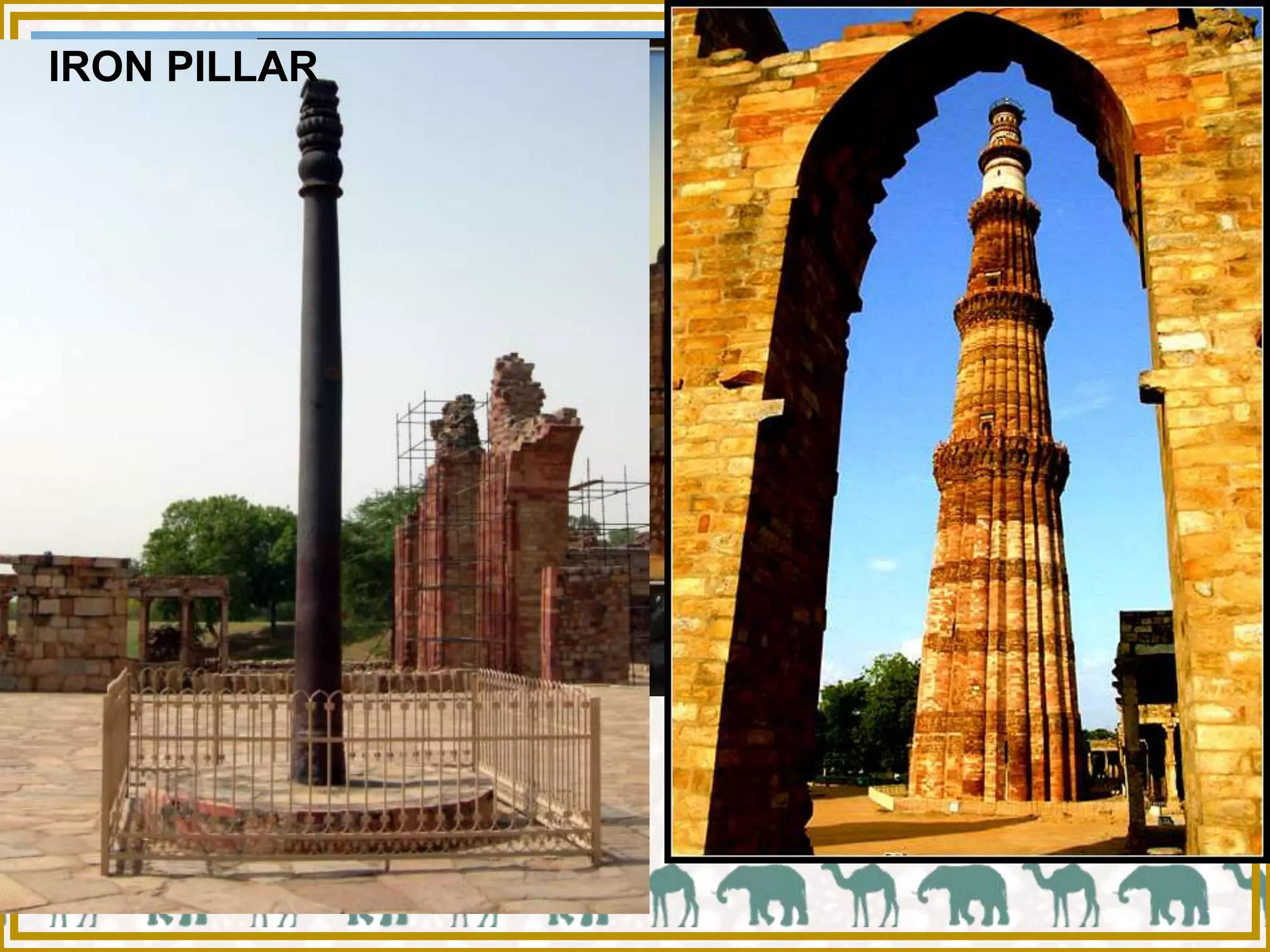
IRON PILLAR
Recap
The Delhi Sultanate was a Delhi-based Muslim kingdom that stretched
over large parts of the Indian subcontinent for 320 years (1206–1526).
Five dynasties ruled over Delhi Sultanate sequentially, the first four of
which were of Turkic origin and the last was the Afghan Lodi.
Delhi sultanate is also noted for being one of the few states to repel an
attack from the Mongol Empire.
The Delhi Sultanate declined thereafter, with continuing Hindu-Muslim
wars.
Raziya is famous for being the first female ruler of India.
Balban tomb is the first example of arches being used in Indian
architecture.
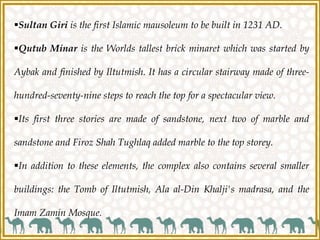
Sultan Giri is the first Islamic mausoleum to be built in 1231 AD.
Qutub Minar is the Worlds tallest brick minaret which was started by
Aybak and finished by Iltutmish. It has a circular stairway made of three-
hundred-seventy-nine steps to reach the top for a spectacular view.
Its first three stories are made of sandstone, next two of marble and
sandstone and Firoz Shah Tughlaq added marble to the top storey.
In addition to these elements, the complex also contains several smaller
buildings: the Tomb of Iltutmish, Ala al-Din Khalji's madrasa, and the
Imam Zamin Mosque.
Ar. Hena Tiwari
Assistant Professor
GCAD,Sonipat
Lecture-III
Architecture of Sultan in Delhi Region
(cont.)
The Khiljis
The Khilji Sultanate was a dynasty of Turkic origin who ruled
large parts of South Asia from 1290 - 1320.
They were the second dynasty to rule the Delhi Sultanate.
Led by their powerful ruler, Ala-ud-din Khilji, they are historically
notable for repeatedly defending India from Mongols attacks.
Alauddin Khalji, murdered his uncle Jalaluddin Firoze to gain
the throne.
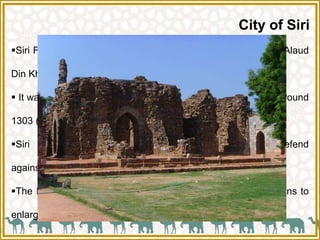
City of Siri
Siri Fort, in the city of New Delhi, was built during the rule of Alaud
Din Khalji to defend the city from the onslaught of the Mongols.
 It was the second of the seven cities of medieval Delhi built around
1303 (stated to be the first entirely constructed by Muslims).
Siri was created between 1297 and 1307 to defend
against Mongol invasions of India and Delhi.
The Fort served as the seat of his power during his campaigns to
enlarge his territory.
Extension to Qutab Complex
Alaudin Khilji extended Qutub complex to further to where Iltumish
left it.
Alaud-din enlarged the size of Quwwat-ul-Islam mosque by more
than six times.
This was achieved by throwing yet another asymmetrically
arranged cloister around the existing one.
In the centre courtyard of the extension on the northern side, he
laid the foundation of the Alai Minar.
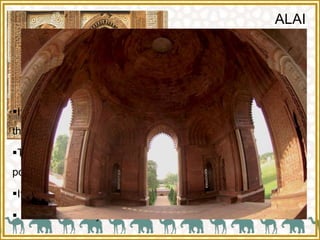
ALAI
DARWAZAIt is the southern gateway of the mosque, and is a gem of
Islamic architecture in India.
It was built by Alla-ud-din Khilji in 1311.
JALI WORK IN THE WINDOWS
It is 17.2m square and pierced by ached openings that echo
the contours of the covering dome.
The arch to the north is semicircular while the others are of
pointed horse shoe shape.
It has intricate carvings in red sandstone and marble.
 It has red stone jalli screens.
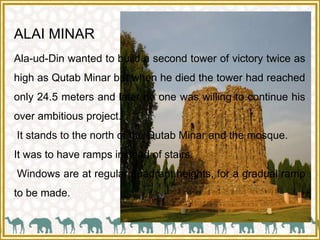
ALAI MINAR
Ala-ud-Din wanted to build a second tower of victory twice as
high as Qutab Minar but when he died the tower had reached
only 24.5 meters and later no one was willing to continue his
over ambitious project.
It stands to the north of the Qutab Minar and the mosque.
It was to have ramps instead of stairs.
Windows are at regular quadrant heights, for a gradual ramp
to be made.
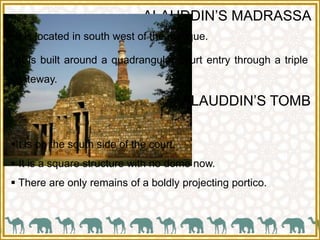
ALAUDDIN’S MADRASSA
It is on the south side of the court.
 It is a square structure with no dome now.
 There are only remains of a boldly projecting portico.
 It is located in south west of the mosque.
 It is built around a quadrangular court entry through a triple
gateway.
ALAUDDIN’S TOMB
Topic-III
Tughluq dynasty
Tughlaq Dynasty
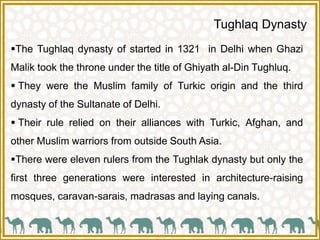
The Tughlaq dynasty of started in 1321 in Delhi when Ghazi
Malik took the throne under the title of Ghiyath al-Din Tughluq.
 They were the Muslim family of Turkic origin and the third
dynasty of the Sultanate of Delhi.
 Their rule relied on their alliances with Turkic, Afghan, and
other Muslim warriors from outside South Asia.
There were eleven rulers from the Tughlak dynasty but only the
first three generations were interested in architecture-raising
mosques, caravan-sarais, madrasas and laying canals.
Tughlaqabad
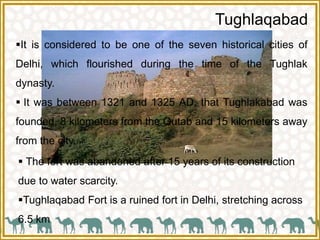
It is considered to be one of the seven historical cities of
Delhi, which flourished during the time of the Tughlak
dynasty.
 It was between 1321 and 1325 AD, that Tughlakabad was
founded, 8 kilometers from the Qutab and 15 kilometers away
from the city.
 The fort was abandoned after 15 years of its construction
due to water scarcity.
Tughlaqabad Fort is a ruined fort in Delhi, stretching across
6.5 km
TUGHLAQABAD FORT
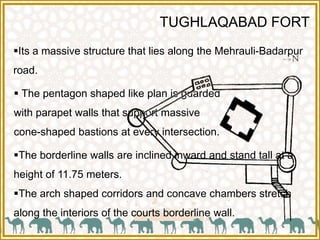
Its a massive structure that lies along the Mehrauli-Badarpur
road.
 The pentagon shaped like plan is guarded
with parapet walls that support massive
cone-shaped bastions at every intersection.
The borderline walls are inclined inward and stand tall at a
height of 11.75 meters.
The arch shaped corridors and concave chambers stretch
along the interiors of the courts borderline wall.
The fort served the dual purpose of a defensive structure as
well as the imperial capital of Ghiyas-ud-din Tughlaq, the
founder of the Tughlaq dynasty.
There are a number of monuments within the precincts of this
massive fort.
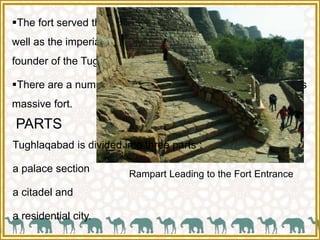
Rampart Leading to the Fort Entrance
PARTS
Tughlaqabad is divided into three parts :
a palace section
a citadel and
a residential city.
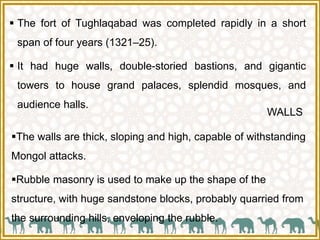
 The fort of Tughlaqabad was completed rapidly in a short
span of four years (1321–25).
 It had huge walls, double-storied bastions, and gigantic
towers to house grand palaces, splendid mosques, and
audience halls.
WALLS
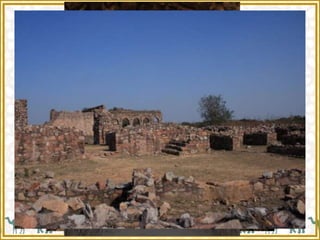
The walls are thick, sloping and high, capable of withstanding
Mongol attacks.
Rubble masonry is used to make up the shape of the
structure, with huge sandstone blocks, probably quarried from
the surrounding hills, enveloping the rubble.
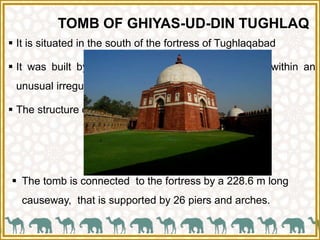
TOMB OF GHIYAS-UD-DIN TUGHLAQ
 It is situated in the south of the fortress of Tughlaqabad
 It was built by Ghiyas-ud-din Tughlaq in AD 1325 within an
unusual irregular pentagonal fortified enclosure.
 The structure of this building is simple but elegant.
 The tomb is connected to the fortress by a 228.6 m long
causeway, that is supported by 26 piers and arches.
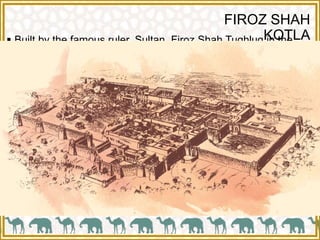
FIROZ SHAH
KOTLA Built by the famous ruler, Sultan Firoz Shah Tughluq in the
year 1354, it is a typical structure of that era.
 It was the grand royal citadel of the city.
 The walls of the citadel are as high as 15 meters and have
a slight slope on the outside.
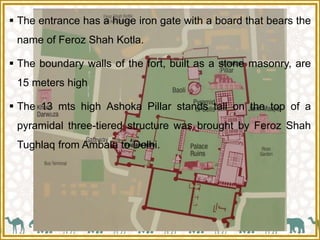
 The entrance has a huge iron gate with a board that bears the
name of Feroz Shah Kotla.
 The boundary walls of the fort, built as a stone masonry, are
15 meters high
 The 13 mts high Ashoka Pillar stands tall on the top of a
pyramidal three-tiered structure was brought by Feroz Shah
Tughlaq from Ambala to Delhi.
PYRAMIDAL STRUCTURE
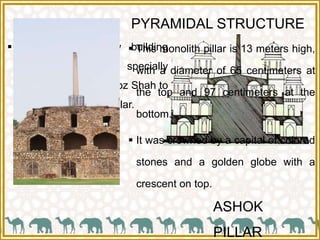
 It is a three-storey building
which was specially
commissioned by Feroz Shah to
support the Ashoka pillar.
ASHOK
PILLAR
 This monolith pillar is 13 meters high,
with a diameter of 65 centimeters at
the top and 97 centimeters at the
bottom.
 It was crowned by a capital of colored
stones and a golden globe with a
crescent on top.
JAMI MASJID
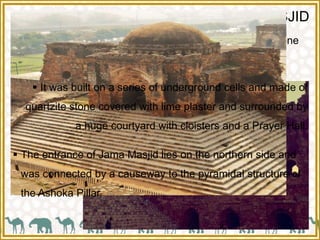
 Built inside Feroz Shah’s Kotla, Jami Masjid used to be one
of the largest mosques of the Tughlaq period.
 It was built on a series of underground cells and made of
quartzite stone covered with lime plaster and surrounded by
a huge courtyard with cloisters and a Prayer Hall.
 The entrance of Jama Masjid lies on the northern side and
was connected by a causeway to the pyramidal structure of
the Ashoka Pillar.
BAOLI
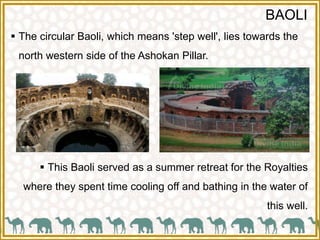
 The circular Baoli, which means 'step well', lies towards the
north western side of the Ashokan Pillar.
 This Baoli served as a summer retreat for the Royalties
where they spent time cooling off and bathing in the water of
this well.
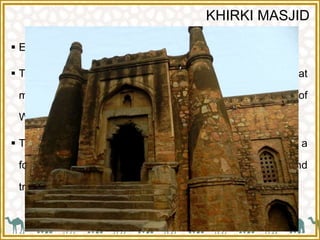
KHIRKI MASJID
 Entrance of khirki masjid is from south.
 The word 'Khirki' prefixed to masjid is an Urdu word that
means "window" and hence is also called "The Masjid of
Windows"
 The Masjid, which is in a quadrangular shape, was built as a
fortress with an unusual fusion of Islamic and
traditional Hindu architecture.
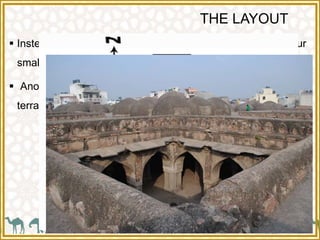
THE LAYOUT
 Instead of one big open courtyard, the mosque has four
smaller square courtyards measuring 30 Ft x 30 Ft.
 Another interesting aspect of this mosque is its design of the
terrace.
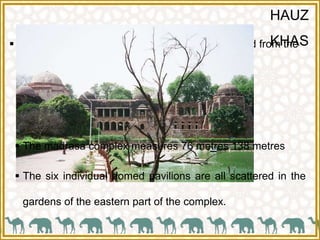
HAUZ
KHAS The name Hauz Khas in Urdu language is derived from the
words -
 ‘Hauz’: “water tank” (or lake) and
 ‘Khas’:“royal”- the “Royal tank”
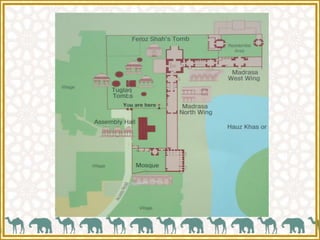
 The madrasa complex measures 76 metres 138 metres
 The six individual domed pavilions are all scattered in the
gardens of the eastern part of the complex.
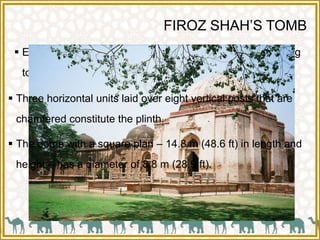
FIROZ SHAH’S TOMB
 Entry to the tomb is through a passage in the south leading
to the doorway.
 Three horizontal units laid over eight vertical posts that are
chamfered constitute the plinth.
 The dome with a square plan – 14.8 m (48.6 ft) in length and
height – has a diameter of 8.8 m (28.9 ft).
Conclusion
The Delhi Sultanate was a Muslim kingdom that stretched over large
parts of the Indian subcontinent for 320 years (1206–1526).
Five dynasties ruled over Delhi Sultanate sequentially, the first four of
which were of Turkic origin and the last was the Afghan Lodi.
Qutub Minar is the Worlds tallest brick minaret.
Alaud-din enlarged the size of Quwwat-ul-Islam mosque by more than
six times.
Ala-ud-Din wanted to build a second tower of victory twice as high as
Qutab Minar but when he died the tower had reached only 24.5 meters
and later no one was willing to continue his over ambitious project. (Alai
Minar)
Tuglagabad fort has pentagon shaped like plan is guarded with parapet
walls that support massive cone-shaped bastions at every intersection.
The walls are thick, sloping and high, capable of withstanding Mongol
attacks.
The entrance to Feroz Shah Kotla has a huge iron gate with a board that
bears the name of Feroz Shah Kotla.
The boundary walls of the fort, built as a stone masonry, are 15 meters
high
The 13 mts high Ashoka Pillar stands tall on the top of a pyramidal
three-tiered structure was brought by Feroz Shah Tughlaq from Ambala
to Delhi.
“History never really says goodbye.
History says, 'See you later.'
Eduardo Galeano
Assignment
1. Describe in detail with appropriate sketches the layout of
Tughlaqabad Fort.
2. Explain in brief with sketches:
 City of Siri
 Feroz Shah Kotla
 Baoli

Lecture iii delhi sultanet

  • 1.
    Tomb of BalbanSultanGhari Qutub Minar IRON PILLAR
  • 2.
    Recap The Delhi Sultanatewas a Delhi-based Muslim kingdom that stretched over large parts of the Indian subcontinent for 320 years (1206–1526). Five dynasties ruled over Delhi Sultanate sequentially, the first four of which were of Turkic origin and the last was the Afghan Lodi. Delhi sultanate is also noted for being one of the few states to repel an attack from the Mongol Empire. The Delhi Sultanate declined thereafter, with continuing Hindu-Muslim wars. Raziya is famous for being the first female ruler of India. Balban tomb is the first example of arches being used in Indian architecture.
  • 3.
    Sultan Giri isthe first Islamic mausoleum to be built in 1231 AD. Qutub Minar is the Worlds tallest brick minaret which was started by Aybak and finished by Iltutmish. It has a circular stairway made of three- hundred-seventy-nine steps to reach the top for a spectacular view. Its first three stories are made of sandstone, next two of marble and sandstone and Firoz Shah Tughlaq added marble to the top storey. In addition to these elements, the complex also contains several smaller buildings: the Tomb of Iltutmish, Ala al-Din Khalji's madrasa, and the Imam Zamin Mosque.
  • 4.
    Ar. Hena Tiwari AssistantProfessor GCAD,Sonipat Lecture-III Architecture of Sultan in Delhi Region (cont.)
  • 5.
    The Khiljis The KhiljiSultanate was a dynasty of Turkic origin who ruled large parts of South Asia from 1290 - 1320. They were the second dynasty to rule the Delhi Sultanate. Led by their powerful ruler, Ala-ud-din Khilji, they are historically notable for repeatedly defending India from Mongols attacks. Alauddin Khalji, murdered his uncle Jalaluddin Firoze to gain the throne.
  • 6.
    City of Siri SiriFort, in the city of New Delhi, was built during the rule of Alaud Din Khalji to defend the city from the onslaught of the Mongols.  It was the second of the seven cities of medieval Delhi built around 1303 (stated to be the first entirely constructed by Muslims). Siri was created between 1297 and 1307 to defend against Mongol invasions of India and Delhi. The Fort served as the seat of his power during his campaigns to enlarge his territory.
  • 7.
    Extension to QutabComplex Alaudin Khilji extended Qutub complex to further to where Iltumish left it. Alaud-din enlarged the size of Quwwat-ul-Islam mosque by more than six times. This was achieved by throwing yet another asymmetrically arranged cloister around the existing one. In the centre courtyard of the extension on the northern side, he laid the foundation of the Alai Minar.
  • 8.
    ALAI DARWAZAIt is thesouthern gateway of the mosque, and is a gem of Islamic architecture in India. It was built by Alla-ud-din Khilji in 1311. JALI WORK IN THE WINDOWS It is 17.2m square and pierced by ached openings that echo the contours of the covering dome. The arch to the north is semicircular while the others are of pointed horse shoe shape. It has intricate carvings in red sandstone and marble.  It has red stone jalli screens.
  • 9.
    ALAI MINAR Ala-ud-Din wantedto build a second tower of victory twice as high as Qutab Minar but when he died the tower had reached only 24.5 meters and later no one was willing to continue his over ambitious project. It stands to the north of the Qutab Minar and the mosque. It was to have ramps instead of stairs. Windows are at regular quadrant heights, for a gradual ramp to be made.
  • 10.
    ALAUDDIN’S MADRASSA It ison the south side of the court.  It is a square structure with no dome now.  There are only remains of a boldly projecting portico.  It is located in south west of the mosque.  It is built around a quadrangular court entry through a triple gateway. ALAUDDIN’S TOMB
  • 11.
  • 12.
    Tughlaq Dynasty The Tughlaqdynasty of started in 1321 in Delhi when Ghazi Malik took the throne under the title of Ghiyath al-Din Tughluq.  They were the Muslim family of Turkic origin and the third dynasty of the Sultanate of Delhi.  Their rule relied on their alliances with Turkic, Afghan, and other Muslim warriors from outside South Asia. There were eleven rulers from the Tughlak dynasty but only the first three generations were interested in architecture-raising mosques, caravan-sarais, madrasas and laying canals.
  • 13.
    Tughlaqabad It is consideredto be one of the seven historical cities of Delhi, which flourished during the time of the Tughlak dynasty.  It was between 1321 and 1325 AD, that Tughlakabad was founded, 8 kilometers from the Qutab and 15 kilometers away from the city.  The fort was abandoned after 15 years of its construction due to water scarcity. Tughlaqabad Fort is a ruined fort in Delhi, stretching across 6.5 km
  • 14.
    TUGHLAQABAD FORT Its amassive structure that lies along the Mehrauli-Badarpur road.  The pentagon shaped like plan is guarded with parapet walls that support massive cone-shaped bastions at every intersection. The borderline walls are inclined inward and stand tall at a height of 11.75 meters. The arch shaped corridors and concave chambers stretch along the interiors of the courts borderline wall.
  • 15.
    The fort servedthe dual purpose of a defensive structure as well as the imperial capital of Ghiyas-ud-din Tughlaq, the founder of the Tughlaq dynasty. There are a number of monuments within the precincts of this massive fort. Rampart Leading to the Fort Entrance PARTS Tughlaqabad is divided into three parts : a palace section a citadel and a residential city.
  • 16.
     The fortof Tughlaqabad was completed rapidly in a short span of four years (1321–25).  It had huge walls, double-storied bastions, and gigantic towers to house grand palaces, splendid mosques, and audience halls. WALLS The walls are thick, sloping and high, capable of withstanding Mongol attacks. Rubble masonry is used to make up the shape of the structure, with huge sandstone blocks, probably quarried from the surrounding hills, enveloping the rubble.
  • 18.
    TOMB OF GHIYAS-UD-DINTUGHLAQ  It is situated in the south of the fortress of Tughlaqabad  It was built by Ghiyas-ud-din Tughlaq in AD 1325 within an unusual irregular pentagonal fortified enclosure.  The structure of this building is simple but elegant.  The tomb is connected to the fortress by a 228.6 m long causeway, that is supported by 26 piers and arches.
  • 19.
    FIROZ SHAH KOTLA Builtby the famous ruler, Sultan Firoz Shah Tughluq in the year 1354, it is a typical structure of that era.  It was the grand royal citadel of the city.  The walls of the citadel are as high as 15 meters and have a slight slope on the outside.
  • 20.
     The entrancehas a huge iron gate with a board that bears the name of Feroz Shah Kotla.  The boundary walls of the fort, built as a stone masonry, are 15 meters high  The 13 mts high Ashoka Pillar stands tall on the top of a pyramidal three-tiered structure was brought by Feroz Shah Tughlaq from Ambala to Delhi.
  • 21.
    PYRAMIDAL STRUCTURE  Itis a three-storey building which was specially commissioned by Feroz Shah to support the Ashoka pillar. ASHOK PILLAR  This monolith pillar is 13 meters high, with a diameter of 65 centimeters at the top and 97 centimeters at the bottom.  It was crowned by a capital of colored stones and a golden globe with a crescent on top.
  • 22.
    JAMI MASJID  Builtinside Feroz Shah’s Kotla, Jami Masjid used to be one of the largest mosques of the Tughlaq period.  It was built on a series of underground cells and made of quartzite stone covered with lime plaster and surrounded by a huge courtyard with cloisters and a Prayer Hall.  The entrance of Jama Masjid lies on the northern side and was connected by a causeway to the pyramidal structure of the Ashoka Pillar.
  • 23.
    BAOLI  The circularBaoli, which means 'step well', lies towards the north western side of the Ashokan Pillar.  This Baoli served as a summer retreat for the Royalties where they spent time cooling off and bathing in the water of this well.
  • 24.
    KHIRKI MASJID  Entranceof khirki masjid is from south.  The word 'Khirki' prefixed to masjid is an Urdu word that means "window" and hence is also called "The Masjid of Windows"  The Masjid, which is in a quadrangular shape, was built as a fortress with an unusual fusion of Islamic and traditional Hindu architecture.
  • 25.
    THE LAYOUT  Insteadof one big open courtyard, the mosque has four smaller square courtyards measuring 30 Ft x 30 Ft.  Another interesting aspect of this mosque is its design of the terrace.
  • 26.
    HAUZ KHAS The nameHauz Khas in Urdu language is derived from the words -  ‘Hauz’: “water tank” (or lake) and  ‘Khas’:“royal”- the “Royal tank”  The madrasa complex measures 76 metres 138 metres  The six individual domed pavilions are all scattered in the gardens of the eastern part of the complex.
  • 28.
    FIROZ SHAH’S TOMB Entry to the tomb is through a passage in the south leading to the doorway.  Three horizontal units laid over eight vertical posts that are chamfered constitute the plinth.  The dome with a square plan – 14.8 m (48.6 ft) in length and height – has a diameter of 8.8 m (28.9 ft).
  • 29.
    Conclusion The Delhi Sultanatewas a Muslim kingdom that stretched over large parts of the Indian subcontinent for 320 years (1206–1526). Five dynasties ruled over Delhi Sultanate sequentially, the first four of which were of Turkic origin and the last was the Afghan Lodi. Qutub Minar is the Worlds tallest brick minaret. Alaud-din enlarged the size of Quwwat-ul-Islam mosque by more than six times. Ala-ud-Din wanted to build a second tower of victory twice as high as Qutab Minar but when he died the tower had reached only 24.5 meters and later no one was willing to continue his over ambitious project. (Alai Minar)
  • 30.
    Tuglagabad fort haspentagon shaped like plan is guarded with parapet walls that support massive cone-shaped bastions at every intersection. The walls are thick, sloping and high, capable of withstanding Mongol attacks. The entrance to Feroz Shah Kotla has a huge iron gate with a board that bears the name of Feroz Shah Kotla. The boundary walls of the fort, built as a stone masonry, are 15 meters high The 13 mts high Ashoka Pillar stands tall on the top of a pyramidal three-tiered structure was brought by Feroz Shah Tughlaq from Ambala to Delhi.
  • 31.
    “History never reallysays goodbye. History says, 'See you later.' Eduardo Galeano
  • 32.
    Assignment 1. Describe indetail with appropriate sketches the layout of Tughlaqabad Fort. 2. Explain in brief with sketches:  City of Siri  Feroz Shah Kotla  Baoli

Editor's Notes

  • #13 The lowest point for the dynasty however came in 1398, when Turco-Mongol invader, Timur defeated four armies of the Sultanate on December 15, 1398. Subsequently the Sultan Mahmud Khan fled before Timur entered Delhi on December 18. For eight days Delhi was plundered, its population massacred and over 100,000 war prisoners were killed as well.
  • #14 According to certain legends, Tughlakabad was devastated due to the curse of a religious leader named Nijamuddin. 
  • #26 For terrace :Partitioned into 25 squares of equal size, each square has 9 domes on each side, measuring 81 in all & these square blocks are alternated by 12 flat roofs, giving a very distinct shadow upon the interiors.
  • #27 The notable structures built by Firuz Shah on the eastern and northern side of the reservoir consisted of the Madrasa ,the small Mosque, the Main tomb for himself and six domed pavilions in its precincts, which were all built between 1352 and 1354 A.D.