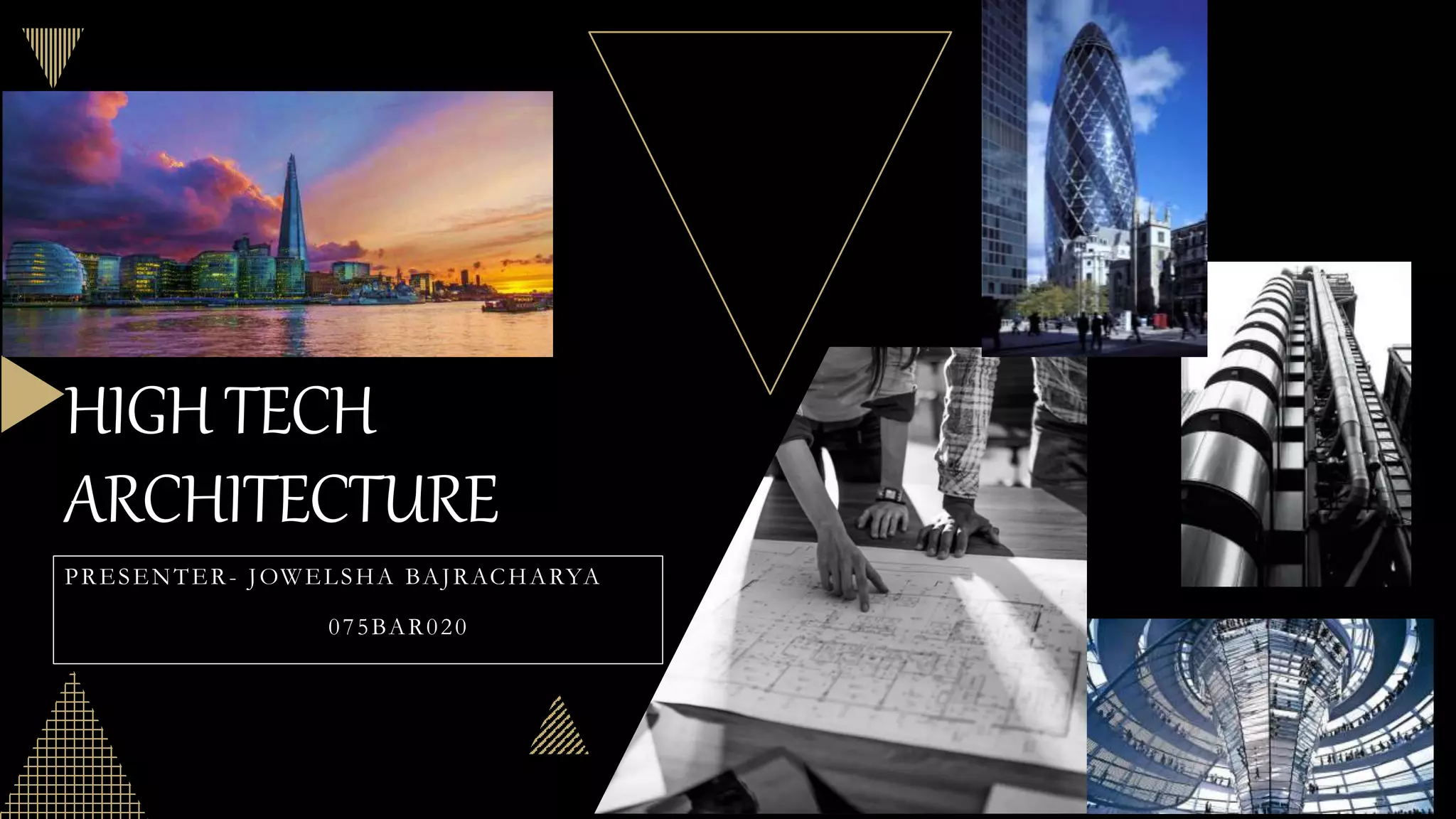
HIGH TECH
ARCHITECTURE
PRESENTER- JOWELSHA BAJRACHARYA
075BAR020
INTRODUCTION
o Also known as Late Modernism or
Structural Expressionism, it is an
architectural style that emerged in the
1970s,
o It incorporates elements of high-tech
industry and technology into building
designs
o Influenced by engineering and
new technology, High Tech is a style
that accentuates a building's
construction.
o It was a concept of design, based on
engineering, construction and other
aspects, such as the manipulation of
space.
o Many of its themes and ideas were
absorbed into the language of the post-
modern architectural schools.
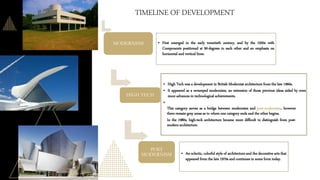
TIMELINE OF DEVELOPMENT
MODERNISM • First emerged in the early twentieth century, and by the 1920s with
Components positioned at 90-degrees to each other and an emphasis on
horizontal and vertical lines.
HIGH TECH
• High Tech was a development in British Modernist architecture from the late 1960s.
• It appeared as a revamped modernism, an extension of those previous ideas aided by even
more advances in technological achievements.
•
POST
MODERNISM • An eclectic, colorful style of architecture and the decorative arts that
appeared from the late 1970s and continues in some form today.
This category serves as a bridge between modernism and post-modernism, however
there remain gray areas as to where one category ends and the other begins.
In the 1980s, high-tech architecture became more difficult to distinguish from post-
modern architecture.
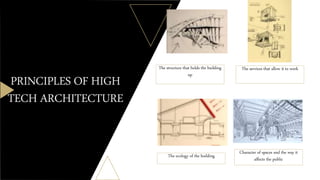
The structure that holds the building
up
The services that allow it to work
The ecology of the building
Character of spaces and the way it
affects the public
PRINCIPLES OF HIGH
TECH ARCHITECTURE
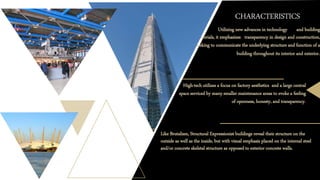
CHARACTERISTICS
o Utilizing new advances in technology and building
materials, it emphasizes transparency in design and construction,
seeking to communicate the underlying structure and function of a
building throughout its interior and exterior.
High-tech utilizes a focus on factory aesthetics and a large central
space serviced by many smaller maintenance areas to evoke a feeling
of openness, honesty, and transparency.
Like Brutalism, Structural Expressionist buildings reveal their structure on the
outside as well as the inside, but with visual emphasis placed on the internal steel
and/or concrete skeletal structure as opposed to exterior concrete walls.
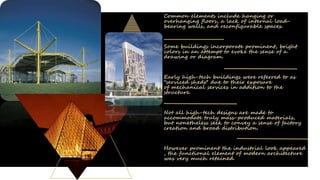
Common elements include hanging or
overhanging floors, a lack of internal load-
bearing walls, and reconfigurable spaces.
Some buildings incorporate prominent, bright
colors in an attempt to evoke the sense of a
drawing or diagram.
Early high-tech buildings were referred to as
"serviced sheds" due to their exposure
of mechanical services in addition to the
structure.
Not all high-tech designs are made to
accommodate truly mass-produced materials,
but nonetheless seek to convey a sense of factory
creation and broad distribution.
However prominent the industrial look appeared
, the functional element of modern architecture
was very much retained.
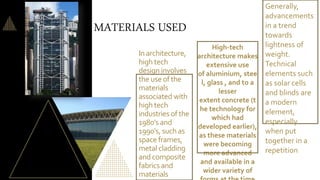
In architecture,
high tech
design involves
the use of the
materials
associated with
high tech
industries of the
1980's and
1990's, suchas
space frames,
metal cladding
and composite
fabrics and
materials
High-tech
architecture makes
extensive use
of aluminium, stee
l, glass , and to a
lesser
extent concrete (t
he technology for
which had
developed earlier),
as these materials
were becoming
more advanced
and available in a
wider variety of
Generally,
advancements
in a trend
towards
lightness of
weight.
Technical
elements such
as solar cells
and blinds are
a modern
element,
especially
when put
together in a
repetition
MATERIALS USED
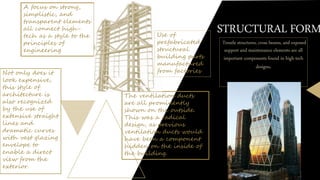
STRUCTURAL FORM
Tensile structures, cross beams, and exposed
support and maintenance elements are all
important components found in high-tech
designs.
A focus on strong,
simplistic, and
transparent elements
all connect high-
tech as a style to the
principles of
engineering
The ventilation ducts
are all prominently
shown on the outside.
This was a radical
design, as previous
ventilation ducts would
have been a component
hidden on the inside of
the building.
Not only does it
look expensive,
this style of
architecture is
also recognized
by the use of
extensive straight
lines and
dramatic curves
with vast glazing
envelope to
enable a direct
view from the
exterior.
Use of
prefabricated
structural
building parts
manufactured
from factories
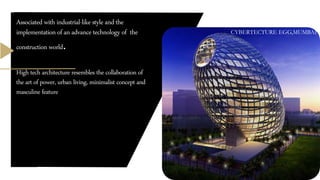
Associated with industrial-like style and the
implementation of an advance technology of the
construction world.
High tech architecture resembles the collaboration of
the art of power, urban living, minimalist concept and
masculine feature
CYBERTECTURE EGG,MUMBAI
PIONEERS OF HIGH TECH
ARCHITECTURE
o NORMAN FOSTER
o RICHARD ROGERS
o RENZO PIANO
o SANTIAGO CALATRAVA
o NICHOLAS GRIMSHAW
o I.M PEI
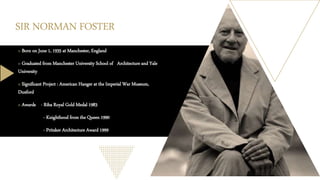
SIR NORMAN FOSTER
o Born on June 1, 1935 at Manchester, England
o Graduated from Manchester University School of Architecture and Yale
University
o Significant Project : American Hanger at the Imperial War Museum,
Duxford
o Awards - Riba Royal Gold Medal 1983
- Knighthood from the Queen 1990
- Pritzker Architecture Award 1999
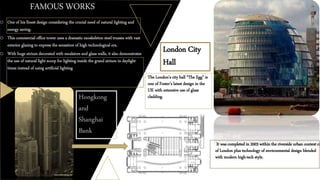
FAMOUS WORKS
o One of his finest design considering the crucial need of natural lighting and
energy saving.
o This commercial office tower uses a dramatic exoskeleton steel trusses with vast
exterior glazing to express the sensation of high technological era.
o With huge atrium decorated with escalators and glass walls, it also demonstrates
the use of natural light scoop for lighting inside the grand atrium in daylight
times instead of using artificial lighting
Hongkong
and
Shanghai
Bank
London City
Hall
The London's city hall “The Egg” is
one of Foster’s latest design in the
UK with extensive use of glass
cladding.
o It was completed in 2003 within the riverside urban context ci
of London plus technology of environmental design blended
with modern high-tech style.
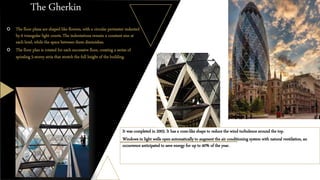
The Gherkin
It was completed in 2003. It has a cone-like shape to reduce the wind turbulence around the top.
Windows in light wells open automatically to augment the air conditioning system with natural ventilation, an
occurrence anticipated to save energy for up to 40% of the year.
o The floor plans are shaped like flowers, with a circular perimeter indented
by 6 triangular light courts. The indentations remain a constant size at
each level, while the space between them diminishes.
o The floor plan is rotated for each successive floor, creating a series of
spiraling 5-storey atria that stretch the full height of the building.
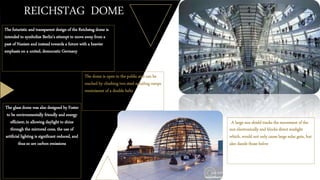
REICHSTAG DOME
The futuristic and transparent design of the Reichstag dome is
intended to symbolize Berlin's attempt to move away from a
past of Nazism and instead towards a future with a heavier
emphasis on a united, democratic Germany
The dome is open to the public and can be
reached by climbing two steel spiraling ramps
reminiscent of a double helix
The glass dome was also designed by Foster
to be environmentally friendly and energy
efficient; in allowing daylight to shine
through the mirrored cone, the use of
artificial lighting is significant reduced, and
thus so are carbon emissions
A large sun shield tracks the movement of the
sun electronically and blocks direct sunlight
which, would not only cause large solar gain, but
also dazzle those below
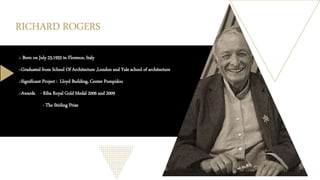
RICHARD ROGERS
o Born on July 23,1933 in Florence, Italy
oGraduated from School Of Architecture ,London and Yale school of architecture
oSignificant Project : Lloyd Building, Center Pompidou
oAwards - Riba Royal Gold Medal 2006 and 2009
- The Stirling Prize
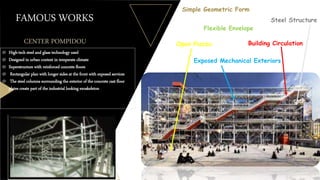
FAMOUS WORKS
o High-tech steel and glass technology used
o Designed in urban context in temperate climate
o Superstructure with reinforced concrete floors
o Rectangular plan with longer sides at the front with exposed services
o The steel columns surrounding the exterior of the concrete cast floor
plates create part of the industrial looking exoskeleton
Flexible Envelope
Steel Structure
Simple Geometric Form
Exposed Mechanical Exteriors
Building Circulation
Open Piazza
CENTER POMPIDOU
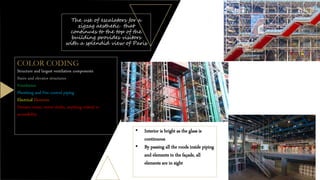
The use of escalators for a
zigzag aesthetic that
continues to the top of the
building provides visitors
with a splendid view of Paris
COLOR CODING
Structure and largest ventilation components
Stairs and elevator structures
Ventilation
Plumbing and Fire control piping
Electrical Elements
Elevator room, motor shafts, anything related to
accessibility
• Interior is bright as the glass is
continuous
• By passing all the roods inside piping
and elements in the façade, all
elements are in sight
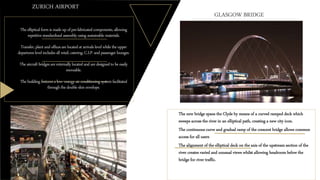
Theellipticalformis madeupofpre-fabricatedcomponents,allowing
repetitivestandardized assembly using sustainable materials.
Transfer,plant andofficesarelocatedat arrivalslevelwhiletheupper
departureslevelincludesall retail,catering,C.I.P.and passenger lounges.
Theaircraftbridgesareexternallylocatedand aredesignedtobeeasily
moveable.
Thebuildingfeaturesalow- energyair conditioningsystemfacilitated
throughthedoubleskinenvelope.
ZURICH AIRPORT
o The new bridge spans the Clyde by means of a curved ramped deck which
sweeps across the river in an elliptical path, creating a new city icon.
o The continuous curve and gradual ramp of the crescent bridge allows common
access for all users
o The alignment of the elliptical deck on the axis of the upstream section of the
river creates varied and unusual views whilst allowing headroom below the
bridge for river traffic.
GLASGOW BRIDGE
RENZO PIANO
o Born on September 14, 1937 , Pegli, Italy
oGraduated from Milan Polytechnic University
oSignificant Project : The Shard, Center Pompidou
oAwards --Pritzker Architecture Prize
- RIBA Gold Medal
- Sonning Prize
- AIA Gold Medal
- Kyoto Prize
FAMOUS WORKS
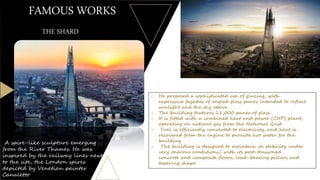
A spire-like sculpture emerging
from the River Thames. He was
inspired by the railway lines next
to the site, the London spires
depicted by Venetian painter
Canaletto
THE SHARD
o He proposed a sophisticated use of glazing, with
expressive façades of angled glass panes intended to reflect
sunlight and the sky above
o The building features 11,000 panes of glass
o It is fitted with a combined heat and power (CHP) plant,
operating on natural gas from the National Grid
o Fuel is efficiently converted to electricity, and heat is
recovered from the engine to provide hot water for the
building
o The building is designed to maintain its stability under
very onerous conditions,[ with its post-tensioned
concrete and composite floors, load-bearing pillars and
tapering shape
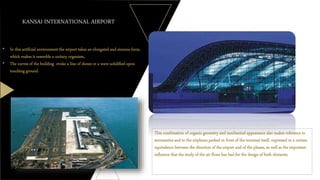
• In this artificial environment the airport takes an elongated and sinuous form,
which makes it resemble a unitary organism,
• The curves of the building evoke a line of dunes or a wave solidified upon
touching ground.
This combination of organic geometry and mechanical appearance also makes reference to
aeronautics and to the airplanes parked in front of the terminal itself, expressed in a certain
equivalence between the direction of the airport and of the planes, as well as the important
influence that the study of the air flows has had for the design of both elements.
KANSAI INTERNATIONAL AIRPORT
SANTIAGO CALATRAVA
o Born on 28 July 1951 ,Benimàmet, Valencia, Spain
o Graduated from Polytechnic University of Valencia ,
Swiss Federal Institute of Technology
o Significant Project :Athens Olympic Sports Complex, Auditorio de Tenerife, Alamillo bridge,
Chords Bridge
o Awards --European Prize for Architecture
-AIA Gold Medal
-IStructEGold Medal
-Eugene McDermott Award
-Prince of Asturias Award
-Auguste Perret Prize
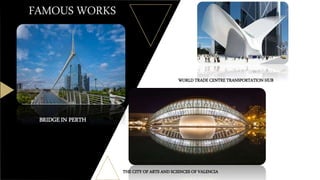
FAMOUS WORKS
BRIDGE IN PERTH
THE CITY OF ARTS AND SCIENCES OF VALENCIA
WORLD TRADE CENTRE TRANSPORTATION HUB
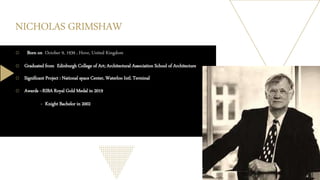
NICHOLAS GRIMSHAW
o Born on October 9, 1939 , Hove, United Kingdom
o Graduated from Edinburgh College of Art; Architectural Association School of Architecture
o Significant Project : National space Center, Waterloo Intl. Terminal
o Awards --RIBA Royal Gold Medal in 2019
- Knight Bachelor in 2002
FAMOUS WORKS
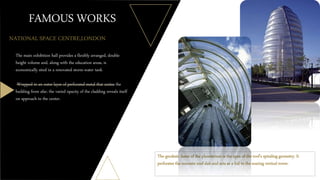
The main exhibition hall provides a flexibly arranged, double-
height volume and, along with the education areas, is
economically sited in a renovated storm-water tank
Wrapped in an outer layer of perforated metal that unites the
building from afar, the varied opacity of the cladding reveals itself
on approach to the center.
The geodesic dome of the planetarium is the apex of the roof’s spiraling geometry. It
perforates the concrete roof slab and acts as a foil to the soaring vertical tower.
NATIONAL SPACE CENTRE,LONDON
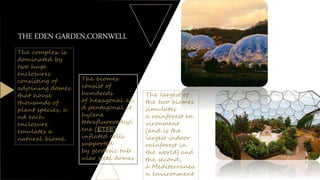
THE EDEN GARDEN,CORNWELL
The largest of
the two biomes
simulates
a rainforest en
vironment
(and is the
largest indoor
rainforest in
the world) and
the second,
a Mediterranea
n environment.
The complex is
dominated by
two huge
enclosures
consisting of
adjoining domes
that house
thousands of
plant species, a
nd each
enclosure
emulates a
natural biome.
The biomes
consist of
hundreds
of hexagonal an
d pentagonal et
hylene
tetrafluoroethyl
ene (ETFE)
inflated cells
supported
by geodesic tub
ular steel domes
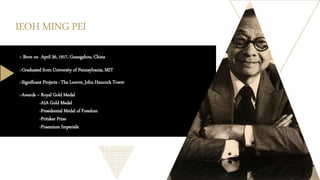
IEOH MING PEI
o Born on April 26, 1917, Guangzhou, China
oGraduated from University of Pennsylvania, MIT
oSignificant Projects : The Louvre, John Hancock Tower
oAwards -- Royal Gold Medal
-AIA Gold Medal
-Presidential Medal of Freedom
-Pritzker Prize
-Praemium Imperiale
FAMOUS WORKS
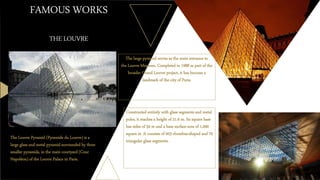
THE LOUVRE
The large pyramid serves as the main entrance to
the Louvre Museum. Completed in 1988 as part of the
broader Grand Louvre project, it has become a
landmark of the city of Paris.
The Louvre Pyramid (Pyramide du Louvre) is a
large glass and metal pyramid surrounded by three
smaller pyramids, in the main courtyard (Cour
Napoléon) of the Louvre Palace in Paris.
Constructed entirely with glass segments and metal
poles, it reaches a height of 21.6 m. Its square base
has sides of 34 m and a base surface area of 1,000
square m .It consists of 603 rhombus-shaped and 70
triangular glass segments.
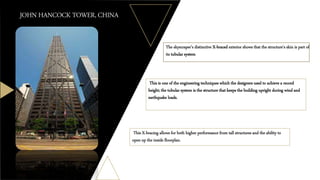
JOHN HANCOCK TOWER, CHINA
This is one of the engineering techniques which the designers used to achieve a record
height; the tubular system is the structure that keeps the building upright during wind and
earthquake loads.
The skyscraper's distinctive X-braced exterior shows that the structure's skin is part of
its tubular system
This X-bracing allows for both higher performance from tall structures and the ability to
open up the inside floorplan.
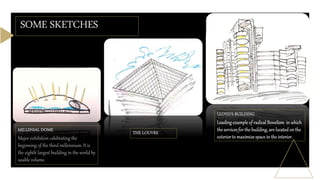
SOME SKETCHES
MILLENIAL DOME
Major exhibition celebrating the
beginning of the third millennium. It is
the eighth largest building in the world by
usable volume.
THE LOUVRE
LLOYD’S BUILDING
Leading example of radicalBowelism in which
the servicesfor thebuilding,are locatedon the
exterior to maximizespace in the interior.
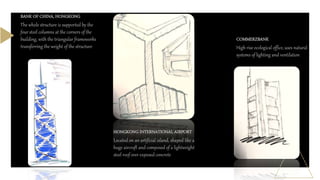
BANK OF CHINA, HONGKONG
The whole structure is supported by the
four steel columns at the corners of the
building, with the triangular frameworks
transferring the weight of the structure
HONGKONG INTERNATIONAL AIRPORT
Located on an artificial island, shaped like a
huge aircraft and composed of a lightweight
steel roof over exposed concrete
COMMERZBANK
High rise ecological office, uses natural
systems of lighting and ventilation
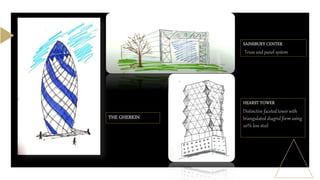
THE GHERKIN
SAINSBURY CENTER
Truss and panel system
HEARST TOWER
Distinctive faceted tower with
triangulated diagrid form using
20% less steel
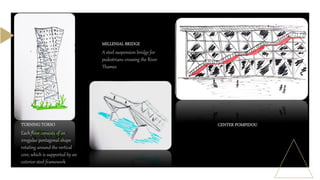
TURNING TORSO
Each floor consists of an
irregular pentagonal shape
rotating around the vertical
core, which is supported by an
exterior steel framework
MILLENIAL BRIDGE
A steel suspension bridge for
pedestrians crossing the River
Thames
CENTER POMPIDOU
High tech architecture

High tech architecture

  • 1.
  • 2.
    INTRODUCTION o Also knownas Late Modernism or Structural Expressionism, it is an architectural style that emerged in the 1970s, o It incorporates elements of high-tech industry and technology into building designs o Influenced by engineering and new technology, High Tech is a style that accentuates a building's construction. o It was a concept of design, based on engineering, construction and other aspects, such as the manipulation of space. o Many of its themes and ideas were absorbed into the language of the post- modern architectural schools.
  • 3.
    TIMELINE OF DEVELOPMENT MODERNISM• First emerged in the early twentieth century, and by the 1920s with Components positioned at 90-degrees to each other and an emphasis on horizontal and vertical lines. HIGH TECH • High Tech was a development in British Modernist architecture from the late 1960s. • It appeared as a revamped modernism, an extension of those previous ideas aided by even more advances in technological achievements. • POST MODERNISM • An eclectic, colorful style of architecture and the decorative arts that appeared from the late 1970s and continues in some form today. This category serves as a bridge between modernism and post-modernism, however there remain gray areas as to where one category ends and the other begins. In the 1980s, high-tech architecture became more difficult to distinguish from post- modern architecture.
  • 4.
    The structure thatholds the building up The services that allow it to work The ecology of the building Character of spaces and the way it affects the public PRINCIPLES OF HIGH TECH ARCHITECTURE
  • 5.
    CHARACTERISTICS o Utilizing newadvances in technology and building materials, it emphasizes transparency in design and construction, seeking to communicate the underlying structure and function of a building throughout its interior and exterior. High-tech utilizes a focus on factory aesthetics and a large central space serviced by many smaller maintenance areas to evoke a feeling of openness, honesty, and transparency. Like Brutalism, Structural Expressionist buildings reveal their structure on the outside as well as the inside, but with visual emphasis placed on the internal steel and/or concrete skeletal structure as opposed to exterior concrete walls.
  • 6.
    Common elements includehanging or overhanging floors, a lack of internal load- bearing walls, and reconfigurable spaces. Some buildings incorporate prominent, bright colors in an attempt to evoke the sense of a drawing or diagram. Early high-tech buildings were referred to as "serviced sheds" due to their exposure of mechanical services in addition to the structure. Not all high-tech designs are made to accommodate truly mass-produced materials, but nonetheless seek to convey a sense of factory creation and broad distribution. However prominent the industrial look appeared , the functional element of modern architecture was very much retained.
  • 7.
    In architecture, high tech designinvolves the use of the materials associated with high tech industries of the 1980's and 1990's, suchas space frames, metal cladding and composite fabrics and materials High-tech architecture makes extensive use of aluminium, stee l, glass , and to a lesser extent concrete (t he technology for which had developed earlier), as these materials were becoming more advanced and available in a wider variety of Generally, advancements in a trend towards lightness of weight. Technical elements such as solar cells and blinds are a modern element, especially when put together in a repetition MATERIALS USED
  • 8.
    STRUCTURAL FORM Tensile structures,cross beams, and exposed support and maintenance elements are all important components found in high-tech designs. A focus on strong, simplistic, and transparent elements all connect high- tech as a style to the principles of engineering The ventilation ducts are all prominently shown on the outside. This was a radical design, as previous ventilation ducts would have been a component hidden on the inside of the building. Not only does it look expensive, this style of architecture is also recognized by the use of extensive straight lines and dramatic curves with vast glazing envelope to enable a direct view from the exterior. Use of prefabricated structural building parts manufactured from factories
  • 9.
    Associated with industrial-likestyle and the implementation of an advance technology of the construction world. High tech architecture resembles the collaboration of the art of power, urban living, minimalist concept and masculine feature CYBERTECTURE EGG,MUMBAI
  • 10.
    PIONEERS OF HIGHTECH ARCHITECTURE o NORMAN FOSTER o RICHARD ROGERS o RENZO PIANO o SANTIAGO CALATRAVA o NICHOLAS GRIMSHAW o I.M PEI
  • 11.
    SIR NORMAN FOSTER oBorn on June 1, 1935 at Manchester, England o Graduated from Manchester University School of Architecture and Yale University o Significant Project : American Hanger at the Imperial War Museum, Duxford o Awards - Riba Royal Gold Medal 1983 - Knighthood from the Queen 1990 - Pritzker Architecture Award 1999
  • 12.
    FAMOUS WORKS o Oneof his finest design considering the crucial need of natural lighting and energy saving. o This commercial office tower uses a dramatic exoskeleton steel trusses with vast exterior glazing to express the sensation of high technological era. o With huge atrium decorated with escalators and glass walls, it also demonstrates the use of natural light scoop for lighting inside the grand atrium in daylight times instead of using artificial lighting Hongkong and Shanghai Bank London City Hall The London's city hall “The Egg” is one of Foster’s latest design in the UK with extensive use of glass cladding. o It was completed in 2003 within the riverside urban context ci of London plus technology of environmental design blended with modern high-tech style.
  • 13.
    The Gherkin It wascompleted in 2003. It has a cone-like shape to reduce the wind turbulence around the top. Windows in light wells open automatically to augment the air conditioning system with natural ventilation, an occurrence anticipated to save energy for up to 40% of the year. o The floor plans are shaped like flowers, with a circular perimeter indented by 6 triangular light courts. The indentations remain a constant size at each level, while the space between them diminishes. o The floor plan is rotated for each successive floor, creating a series of spiraling 5-storey atria that stretch the full height of the building.
  • 14.
    REICHSTAG DOME The futuristicand transparent design of the Reichstag dome is intended to symbolize Berlin's attempt to move away from a past of Nazism and instead towards a future with a heavier emphasis on a united, democratic Germany The dome is open to the public and can be reached by climbing two steel spiraling ramps reminiscent of a double helix The glass dome was also designed by Foster to be environmentally friendly and energy efficient; in allowing daylight to shine through the mirrored cone, the use of artificial lighting is significant reduced, and thus so are carbon emissions A large sun shield tracks the movement of the sun electronically and blocks direct sunlight which, would not only cause large solar gain, but also dazzle those below
  • 15.
    RICHARD ROGERS o Bornon July 23,1933 in Florence, Italy oGraduated from School Of Architecture ,London and Yale school of architecture oSignificant Project : Lloyd Building, Center Pompidou oAwards - Riba Royal Gold Medal 2006 and 2009 - The Stirling Prize
  • 16.
    FAMOUS WORKS o High-techsteel and glass technology used o Designed in urban context in temperate climate o Superstructure with reinforced concrete floors o Rectangular plan with longer sides at the front with exposed services o The steel columns surrounding the exterior of the concrete cast floor plates create part of the industrial looking exoskeleton Flexible Envelope Steel Structure Simple Geometric Form Exposed Mechanical Exteriors Building Circulation Open Piazza CENTER POMPIDOU
  • 17.
    The use ofescalators for a zigzag aesthetic that continues to the top of the building provides visitors with a splendid view of Paris COLOR CODING Structure and largest ventilation components Stairs and elevator structures Ventilation Plumbing and Fire control piping Electrical Elements Elevator room, motor shafts, anything related to accessibility • Interior is bright as the glass is continuous • By passing all the roods inside piping and elements in the façade, all elements are in sight
  • 18.
    Theellipticalformis madeupofpre-fabricatedcomponents,allowing repetitivestandardized assemblyusing sustainable materials. Transfer,plant andofficesarelocatedat arrivalslevelwhiletheupper departureslevelincludesall retail,catering,C.I.P.and passenger lounges. Theaircraftbridgesareexternallylocatedand aredesignedtobeeasily moveable. Thebuildingfeaturesalow- energyair conditioningsystemfacilitated throughthedoubleskinenvelope. ZURICH AIRPORT o The new bridge spans the Clyde by means of a curved ramped deck which sweeps across the river in an elliptical path, creating a new city icon. o The continuous curve and gradual ramp of the crescent bridge allows common access for all users o The alignment of the elliptical deck on the axis of the upstream section of the river creates varied and unusual views whilst allowing headroom below the bridge for river traffic. GLASGOW BRIDGE
  • 19.
    RENZO PIANO o Bornon September 14, 1937 , Pegli, Italy oGraduated from Milan Polytechnic University oSignificant Project : The Shard, Center Pompidou oAwards --Pritzker Architecture Prize - RIBA Gold Medal - Sonning Prize - AIA Gold Medal - Kyoto Prize
  • 20.
    FAMOUS WORKS A spire-likesculpture emerging from the River Thames. He was inspired by the railway lines next to the site, the London spires depicted by Venetian painter Canaletto THE SHARD o He proposed a sophisticated use of glazing, with expressive façades of angled glass panes intended to reflect sunlight and the sky above o The building features 11,000 panes of glass o It is fitted with a combined heat and power (CHP) plant, operating on natural gas from the National Grid o Fuel is efficiently converted to electricity, and heat is recovered from the engine to provide hot water for the building o The building is designed to maintain its stability under very onerous conditions,[ with its post-tensioned concrete and composite floors, load-bearing pillars and tapering shape
  • 21.
    • In thisartificial environment the airport takes an elongated and sinuous form, which makes it resemble a unitary organism, • The curves of the building evoke a line of dunes or a wave solidified upon touching ground. This combination of organic geometry and mechanical appearance also makes reference to aeronautics and to the airplanes parked in front of the terminal itself, expressed in a certain equivalence between the direction of the airport and of the planes, as well as the important influence that the study of the air flows has had for the design of both elements. KANSAI INTERNATIONAL AIRPORT
  • 22.
    SANTIAGO CALATRAVA o Bornon 28 July 1951 ,Benimàmet, Valencia, Spain o Graduated from Polytechnic University of Valencia , Swiss Federal Institute of Technology o Significant Project :Athens Olympic Sports Complex, Auditorio de Tenerife, Alamillo bridge, Chords Bridge o Awards --European Prize for Architecture -AIA Gold Medal -IStructEGold Medal -Eugene McDermott Award -Prince of Asturias Award -Auguste Perret Prize
  • 23.
    FAMOUS WORKS BRIDGE INPERTH THE CITY OF ARTS AND SCIENCES OF VALENCIA WORLD TRADE CENTRE TRANSPORTATION HUB
  • 24.
    NICHOLAS GRIMSHAW o Bornon October 9, 1939 , Hove, United Kingdom o Graduated from Edinburgh College of Art; Architectural Association School of Architecture o Significant Project : National space Center, Waterloo Intl. Terminal o Awards --RIBA Royal Gold Medal in 2019 - Knight Bachelor in 2002
  • 25.
    FAMOUS WORKS The mainexhibition hall provides a flexibly arranged, double- height volume and, along with the education areas, is economically sited in a renovated storm-water tank Wrapped in an outer layer of perforated metal that unites the building from afar, the varied opacity of the cladding reveals itself on approach to the center. The geodesic dome of the planetarium is the apex of the roof’s spiraling geometry. It perforates the concrete roof slab and acts as a foil to the soaring vertical tower. NATIONAL SPACE CENTRE,LONDON
  • 26.
    THE EDEN GARDEN,CORNWELL Thelargest of the two biomes simulates a rainforest en vironment (and is the largest indoor rainforest in the world) and the second, a Mediterranea n environment. The complex is dominated by two huge enclosures consisting of adjoining domes that house thousands of plant species, a nd each enclosure emulates a natural biome. The biomes consist of hundreds of hexagonal an d pentagonal et hylene tetrafluoroethyl ene (ETFE) inflated cells supported by geodesic tub ular steel domes
  • 27.
    IEOH MING PEI oBorn on April 26, 1917, Guangzhou, China oGraduated from University of Pennsylvania, MIT oSignificant Projects : The Louvre, John Hancock Tower oAwards -- Royal Gold Medal -AIA Gold Medal -Presidential Medal of Freedom -Pritzker Prize -Praemium Imperiale
  • 28.
    FAMOUS WORKS THE LOUVRE Thelarge pyramid serves as the main entrance to the Louvre Museum. Completed in 1988 as part of the broader Grand Louvre project, it has become a landmark of the city of Paris. The Louvre Pyramid (Pyramide du Louvre) is a large glass and metal pyramid surrounded by three smaller pyramids, in the main courtyard (Cour Napoléon) of the Louvre Palace in Paris. Constructed entirely with glass segments and metal poles, it reaches a height of 21.6 m. Its square base has sides of 34 m and a base surface area of 1,000 square m .It consists of 603 rhombus-shaped and 70 triangular glass segments.
  • 29.
    JOHN HANCOCK TOWER,CHINA This is one of the engineering techniques which the designers used to achieve a record height; the tubular system is the structure that keeps the building upright during wind and earthquake loads. The skyscraper's distinctive X-braced exterior shows that the structure's skin is part of its tubular system This X-bracing allows for both higher performance from tall structures and the ability to open up the inside floorplan.
  • 30.
    SOME SKETCHES MILLENIAL DOME Majorexhibition celebrating the beginning of the third millennium. It is the eighth largest building in the world by usable volume. THE LOUVRE LLOYD’S BUILDING Leading example of radicalBowelism in which the servicesfor thebuilding,are locatedon the exterior to maximizespace in the interior.
  • 31.
    BANK OF CHINA,HONGKONG The whole structure is supported by the four steel columns at the corners of the building, with the triangular frameworks transferring the weight of the structure HONGKONG INTERNATIONAL AIRPORT Located on an artificial island, shaped like a huge aircraft and composed of a lightweight steel roof over exposed concrete COMMERZBANK High rise ecological office, uses natural systems of lighting and ventilation
  • 32.
    THE GHERKIN SAINSBURY CENTER Trussand panel system HEARST TOWER Distinctive faceted tower with triangulated diagrid form using 20% less steel
  • 33.
    TURNING TORSO Each floorconsists of an irregular pentagonal shape rotating around the vertical core, which is supported by an exterior steel framework MILLENIAL BRIDGE A steel suspension bridge for pedestrians crossing the River Thames CENTER POMPIDOU