CONTEMPORARY ARCHITECTURAL TRENDS AND THEORIES
DEEPIKA VERMA
M. Arch. (1ST Sem)
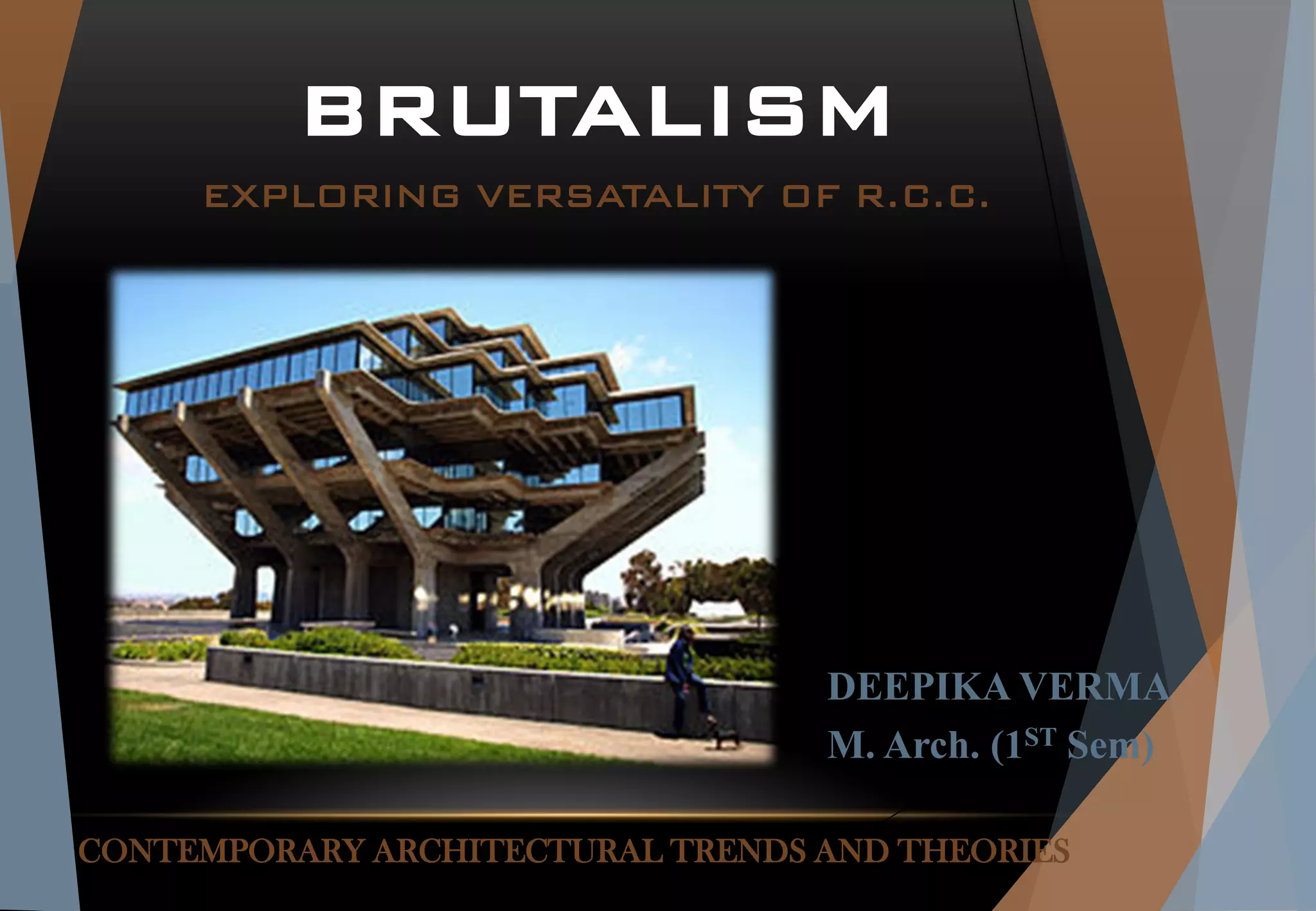
BRUTALISM
EXPLORING VERSATALITY OF R.C.C.
CONTEMPORARY ARCHITECTURAL TRENDS AND THEORIES
BRUTALISM
THECELEBRATIONOFCONCRETE
DEEPIKA VERMA
Introduction
 The term originates from the French béton brut, or
"raw concrete".
 Brutalism is an architectural style that spawned
from the Modernist architectural movement and
which flourished from the 1950s to the1970s.
 The early style was largely inspired by the work of
Swiss architect, Le Corbusier(in particular his Unite
de habitation building) and of Mies Van der Rohe.
 Le Corbusier use the term brutalism to describe his
own work, though it was originally COINED BY the
British architects Alison and Peter Smithson.
 The term eventually became part of the common
architectural lexicon when Reyner Banham used it in
his book, “New Brutalism”
CONTEMPORARY ARCHITECTURAL TRENDS AND THEORIES
BRUTALISM
THECELEBRATIONOFCONCRETE
DEEPIKA VERMA
Introduction
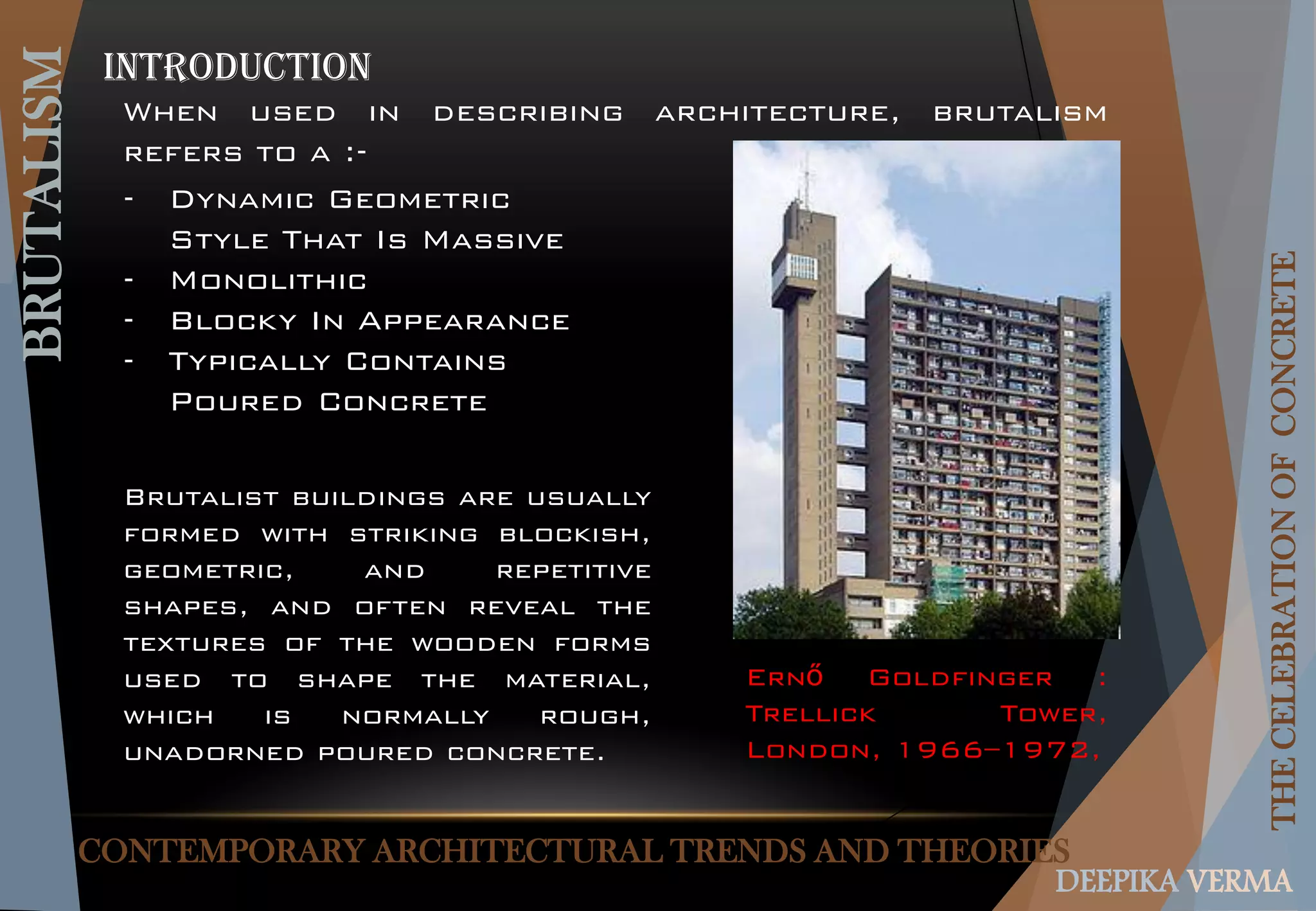
When used in describing architecture, brutalism
refers to a :-
Brutalist buildings are usually
formed with striking blockish,
geometric, and repetitive
shapes, and often reveal the
textures of the wooden forms
used to shape the material,
which is normally rough,
unadorned poured concrete.
- Dynamic Geometric
Style That Is Massive
- Monolithic
- Blocky In Appearance
- Typically Contains
Poured Concrete
Ernő Goldfinger :
Trellick Tower,
London, 1966–1972,
CONTEMPORARY ARCHITECTURAL TRENDS AND THEORIES
BRUTALISM
THECELEBRATIONOFCONCRETE
DEEPIKA VERMA
 STRONG BOLD SHAPES.
 REINFORCED CONCRETE STRUCTURES.
 LARGENESS OF SCALE , STRONG.
 OFF FORM CONCRETE CONSTRUCTION.
 LARGE AREAS OF BLANK WALL.
 DIAGONAL , SLOPING OR STRONG CURVED
ELEMENTS CONTRASTING WITH HORIZONTAL AND
VERTICAL MEMBERS.
 BRUTALIST BUILDING MATERIALS ALSO INCLUDE
BRICK, GLASS, STEEL.
 THE EXPOSURE OF THE BUILDING'S FUNCTIONS —
RANGING FROM THEIR STRUCTURE AND SERVICES
TO THEIR HUMAN USE—IN THE EXTERIOR OF THE
BUILDING.
CHARACTERISTICS
CONTEMPORARY ARCHITECTURAL TRENDS AND THEORIES
BRUTALISM
THECELEBRATIONOFCONCRETE
DEEPIKA VERMA
Leading Brutalists
Architects associated with the brutalist style
include-
 Le-Corbusier with his works across the world,
 Paul Rudolph one of the masters in Brutalism,
 Japanise architect Kenzo Tange,Erno goldfinger,
 Husband-wife Peter and Alison Smithsor, members
of Team X.
 Outside Britain Louis Kahn with government
buildings in Asia,
 Charles Correa with residential buildings,
 More recent Modernists such as I.M Pie and Tadao
Ando have also designed notable Brutalist works.
CONTEMPORARY ARCHITECTURAL TRENDS AND THEORIES
BRUTALISM
THECELEBRATIONOFCONCRETE
DEEPIKA VERMA
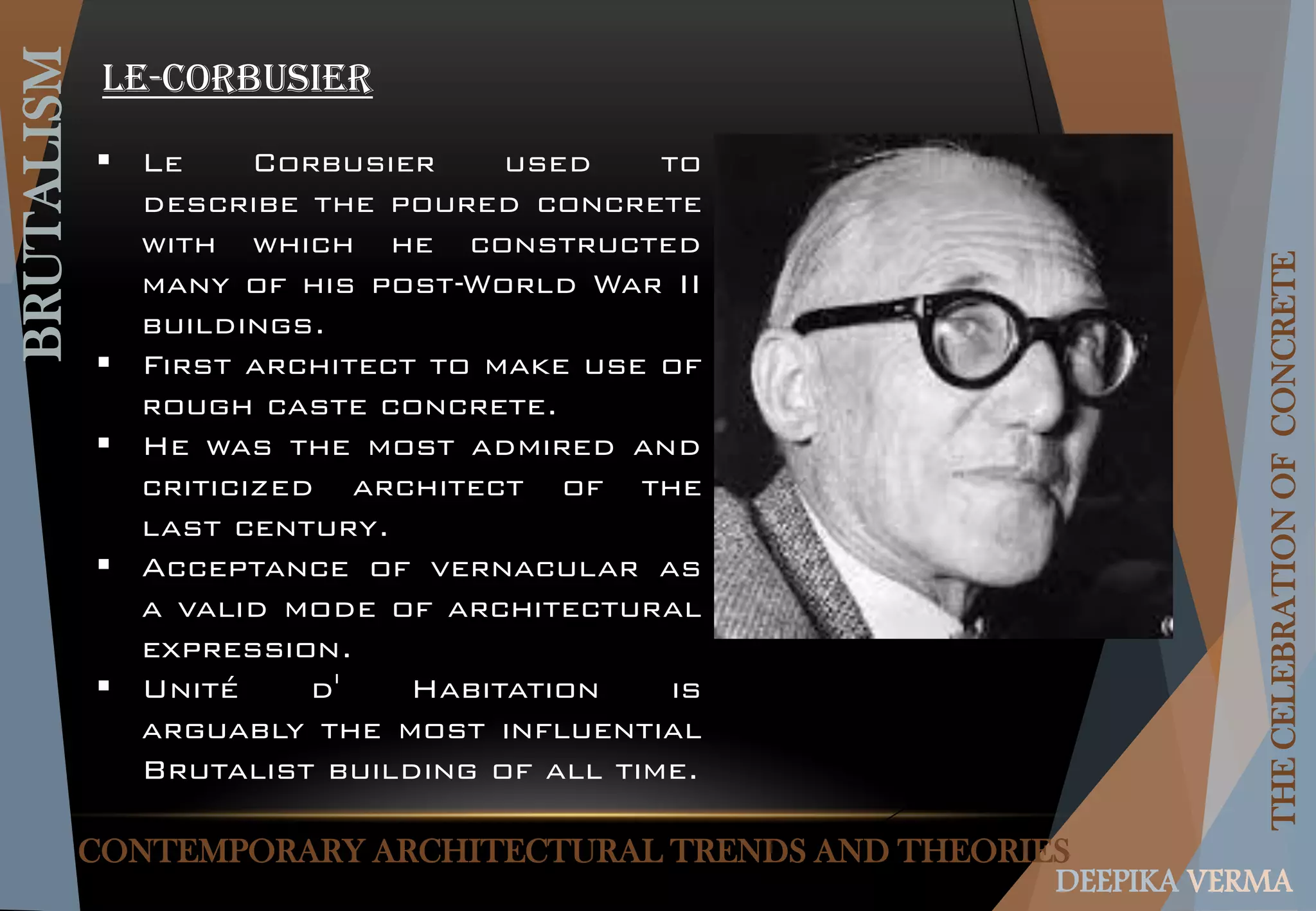
Le-corbusier
 Le Corbusier used to
describe the poured concrete
with which he constructed
many of his post-World War II
buildings.
 First architect to make use of
rough caste concrete.
 He was the most admired and
criticized architect of the
last century.
 Acceptance of vernacular as
a valid mode of architectural
expression.
 Unité d' Habitation is
arguably the most influential
Brutalist building of all time.
CONTEMPORARY ARCHITECTURAL TRENDS AND THEORIES
BRUTALISM
THECELEBRATIONOFCONCRETE
DEEPIKA VERMA
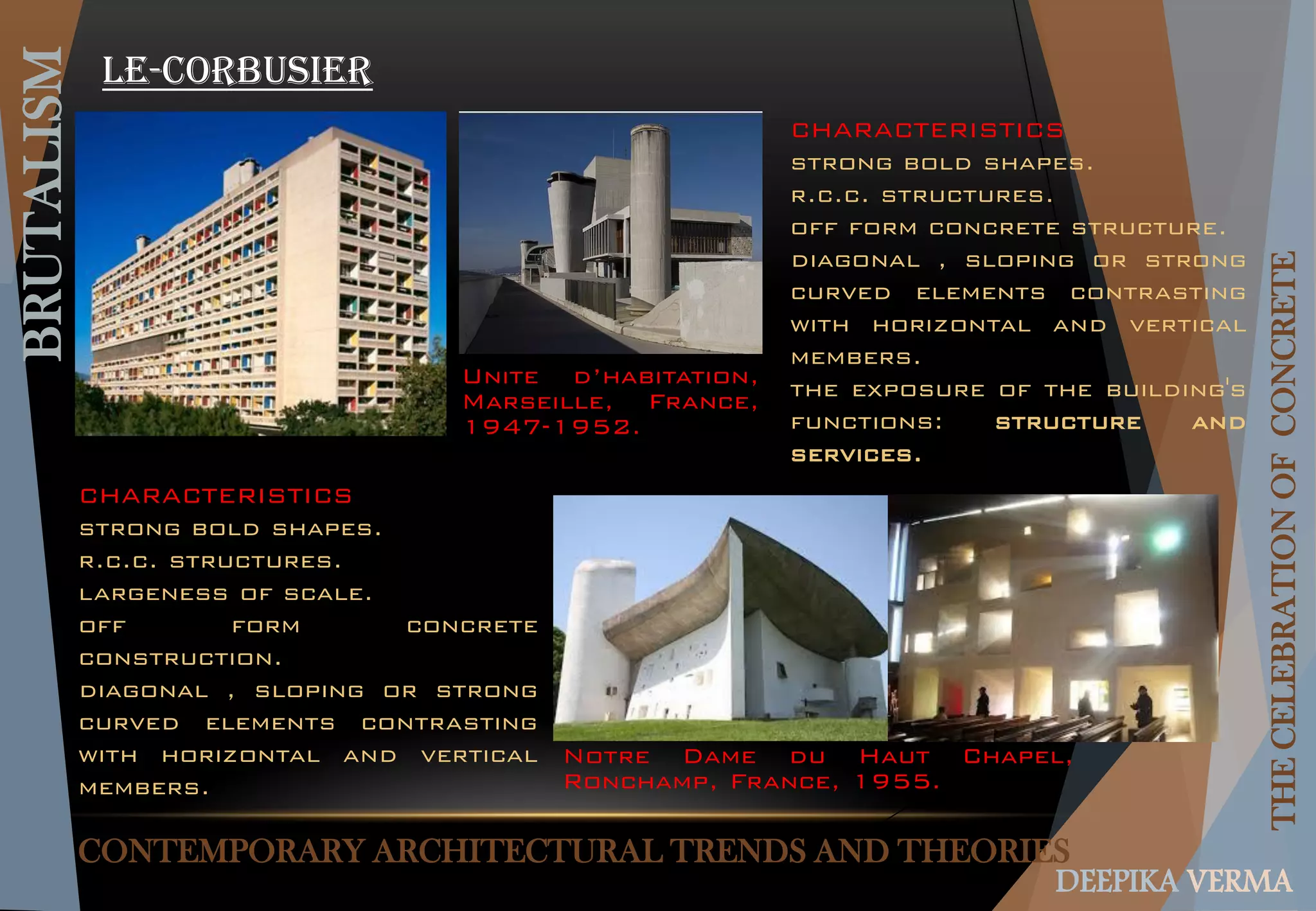
Le-corbusier
Unite d’habitation,
Marseille, France,
1947-1952.
Notre Dame du Haut Chapel,
Ronchamp, France, 1955.
CHARACTERISTICS
strong bold shapes.
r.c.c. structures.
off form concrete structure.
diagonal , sloping or strong
curved elements contrasting
with horizontal and vertical
members.
the exposure of the building's
functions: structure and
services.
CHARACTERISTICS
strong bold shapes.
r.c.c. structures.
largeness of scale.
off form concrete
construction.
diagonal , sloping or strong
curved elements contrasting
with horizontal and vertical
members.
CONTEMPORARY ARCHITECTURAL TRENDS AND THEORIES
BRUTALISM
THECELEBRATIONOFCONCRETE
DEEPIKA VERMA
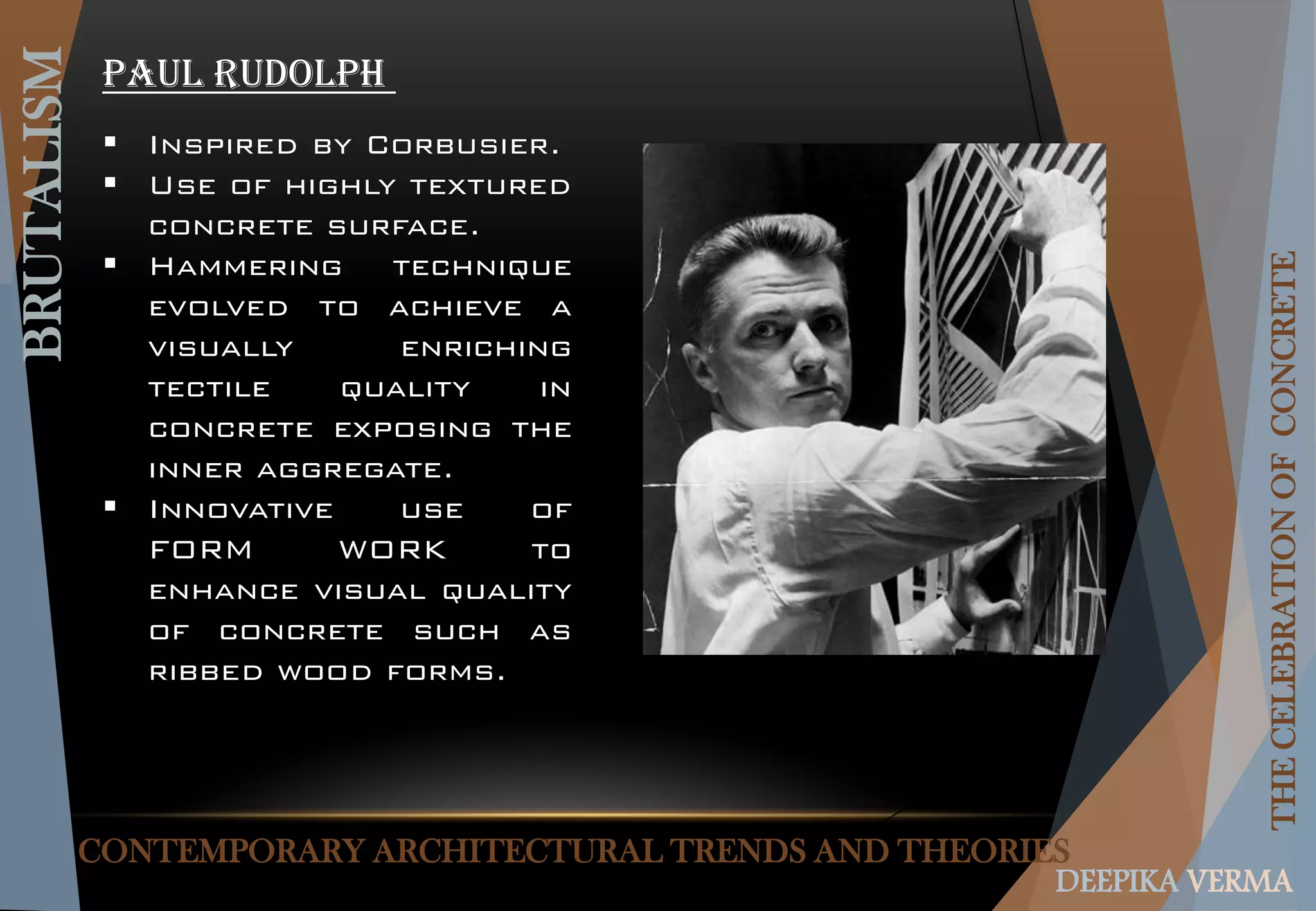
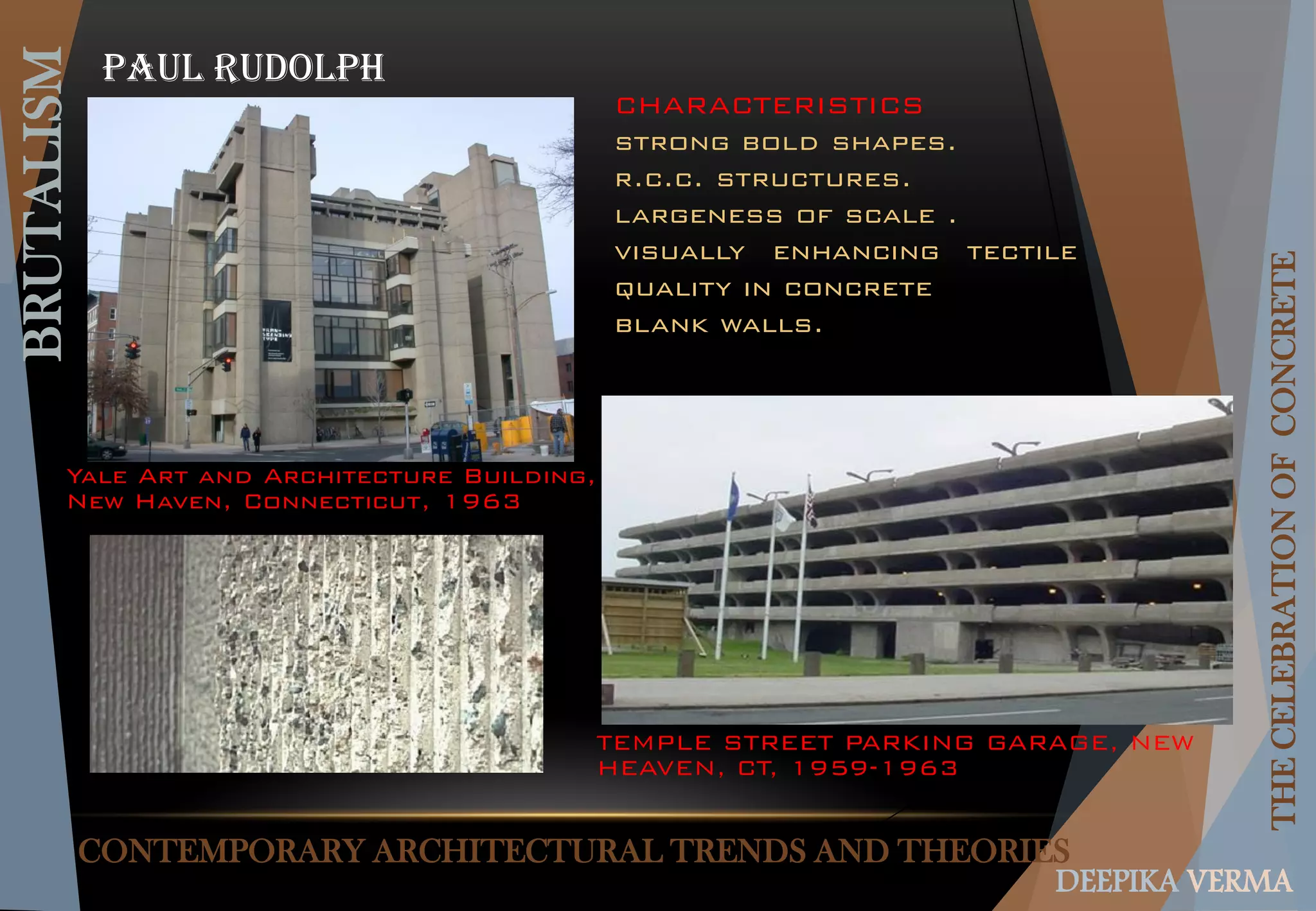
PAUL RUDOLPH
 Inspired by Corbusier.
 Use of highly textured
concrete surface.
 Hammering technique
evolved to achieve a
visually enriching
tectile quality in
concrete exposing the
inner aggregate.
 Innovative use of
FORM WORK to
enhance visual quality
of concrete such as
ribbed wood forms.
CONTEMPORARY ARCHITECTURAL TRENDS AND THEORIES
BRUTALISM
THECELEBRATIONOFCONCRETE
DEEPIKA VERMA
PAUL RUDOLPH
Yale Art and Architecture Building,
New Haven, Connecticut, 1963
TEMPLE STREET PARKING GARAGE, NEW
HEAVEN, CT, 1959-1963
CHARACTERISTICS
strong bold shapes.
r.c.c. structures.
largeness of scale .
visually enhancing tectile
quality in concrete
blank walls.
CONTEMPORARY ARCHITECTURAL TRENDS AND THEORIES
BRUTALISM
THECELEBRATIONOFCONCRETE
DEEPIKA VERMA
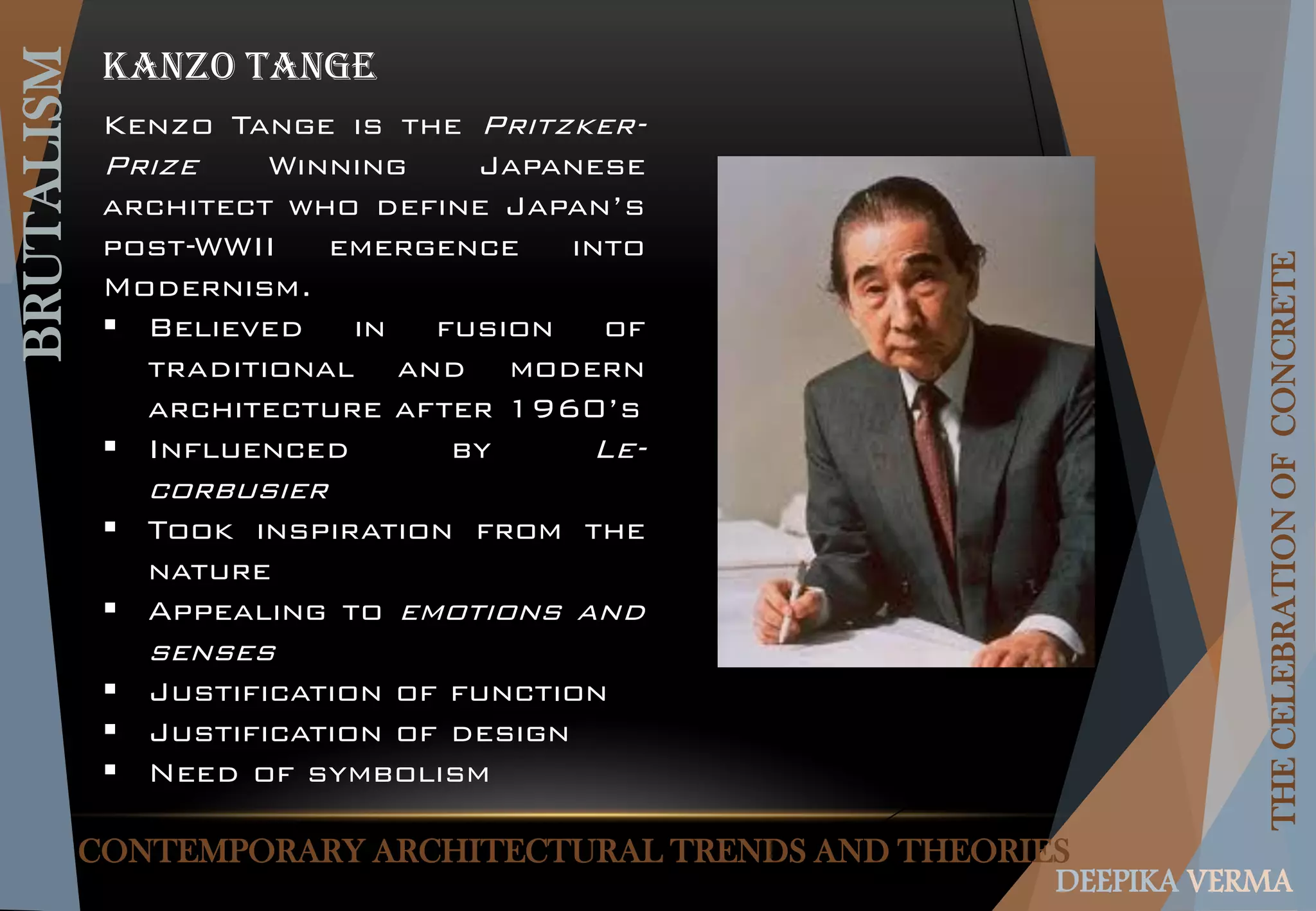
KANZO TANGE
Kenzo Tange is the Pritzker-
Prize Winning Japanese
architect who define Japan’s
post-WWII emergence into
Modernism.
 Believed in fusion of
traditional and modern
architecture after 1960’s
 Influenced by Le-
corbusier
 Took inspiration from the
nature
 Appealing to emotions and
senses
 Justification of function
 Justification of design
 Need of symbolism
CONTEMPORARY ARCHITECTURAL TRENDS AND THEORIES
BRUTALISM
THECELEBRATIONOFCONCRETE
DEEPIKA VERMA
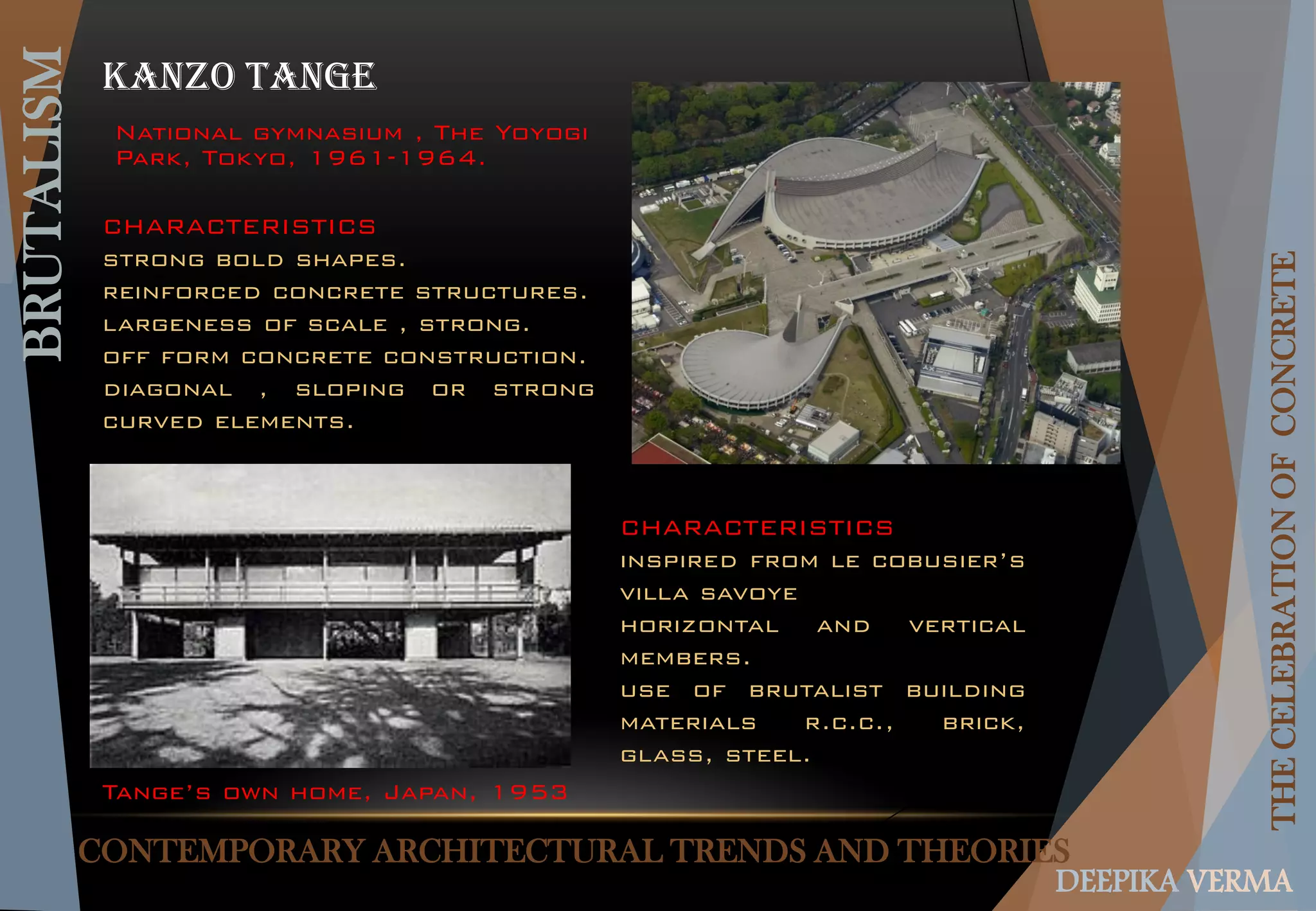
KANZO TANGE
Tange’s own home, Japan, 1953
National gymnasium , The Yoyogi
Park, Tokyo, 1961-1964.
CHARACTERISTICS
strong bold shapes.
reinforced concrete structures.
largeness of scale , strong.
off form concrete construction.
diagonal , sloping or strong
curved elements.
CHARACTERISTICS
inspired from le cobusier’s
villa savoye
horizontal and vertical
members.
use of brutalist building
materials r.c.c., brick,
glass, steel.
CONTEMPORARY ARCHITECTURAL TRENDS AND THEORIES
BRUTALISM
THECELEBRATIONOFCONCRETE
DEEPIKA VERMA
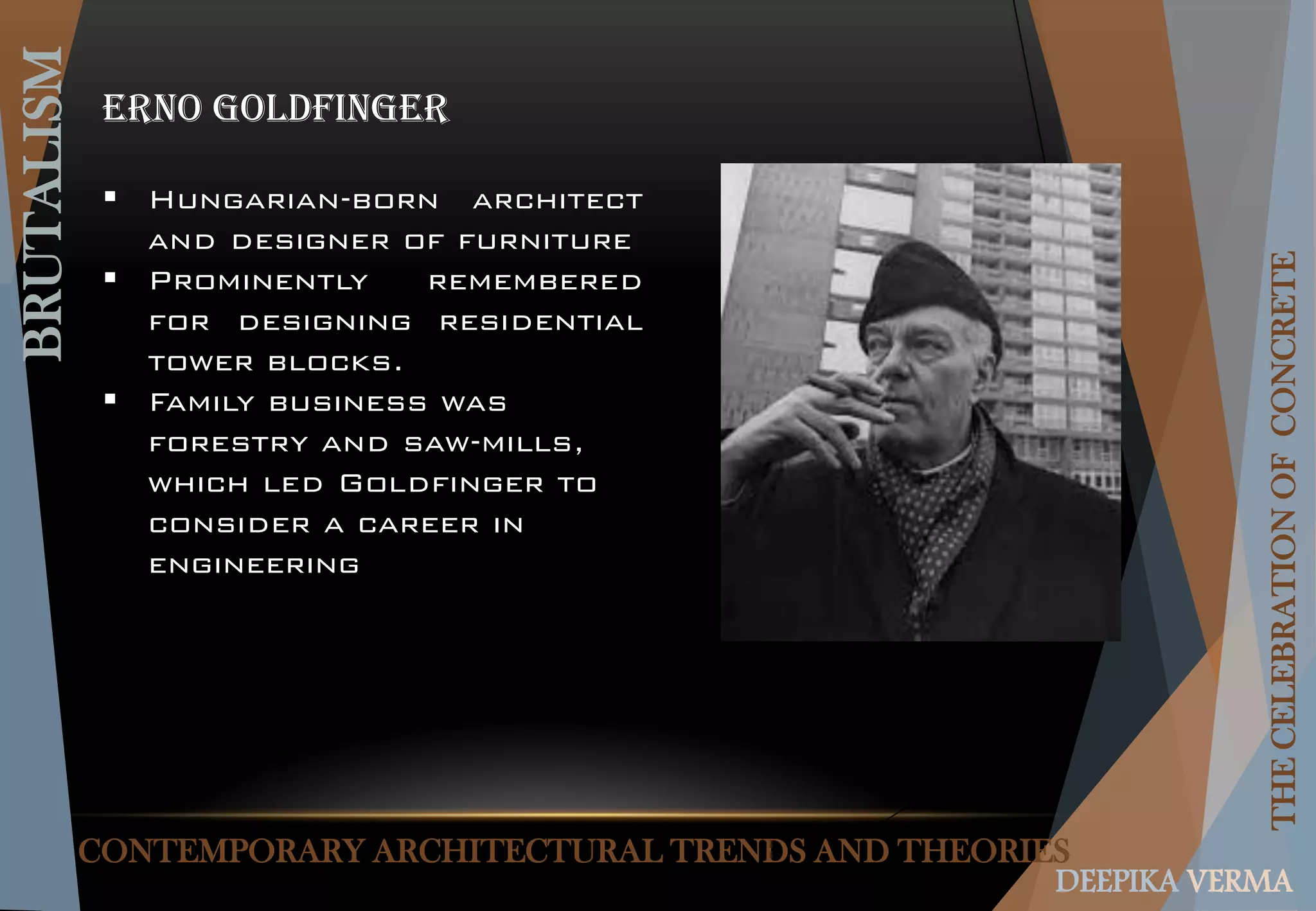
Erno goldfinger
 Hungarian-born architect
and designer of furniture
 Prominently remembered
for designing residential
tower blocks.
 Family business was
forestry and saw-mills,
which led Goldfinger to
consider a career in
engineering
CONTEMPORARY ARCHITECTURAL TRENDS AND THEORIES
BRUTALISM
THECELEBRATIONOFCONCRETE
DEEPIKA VERMA
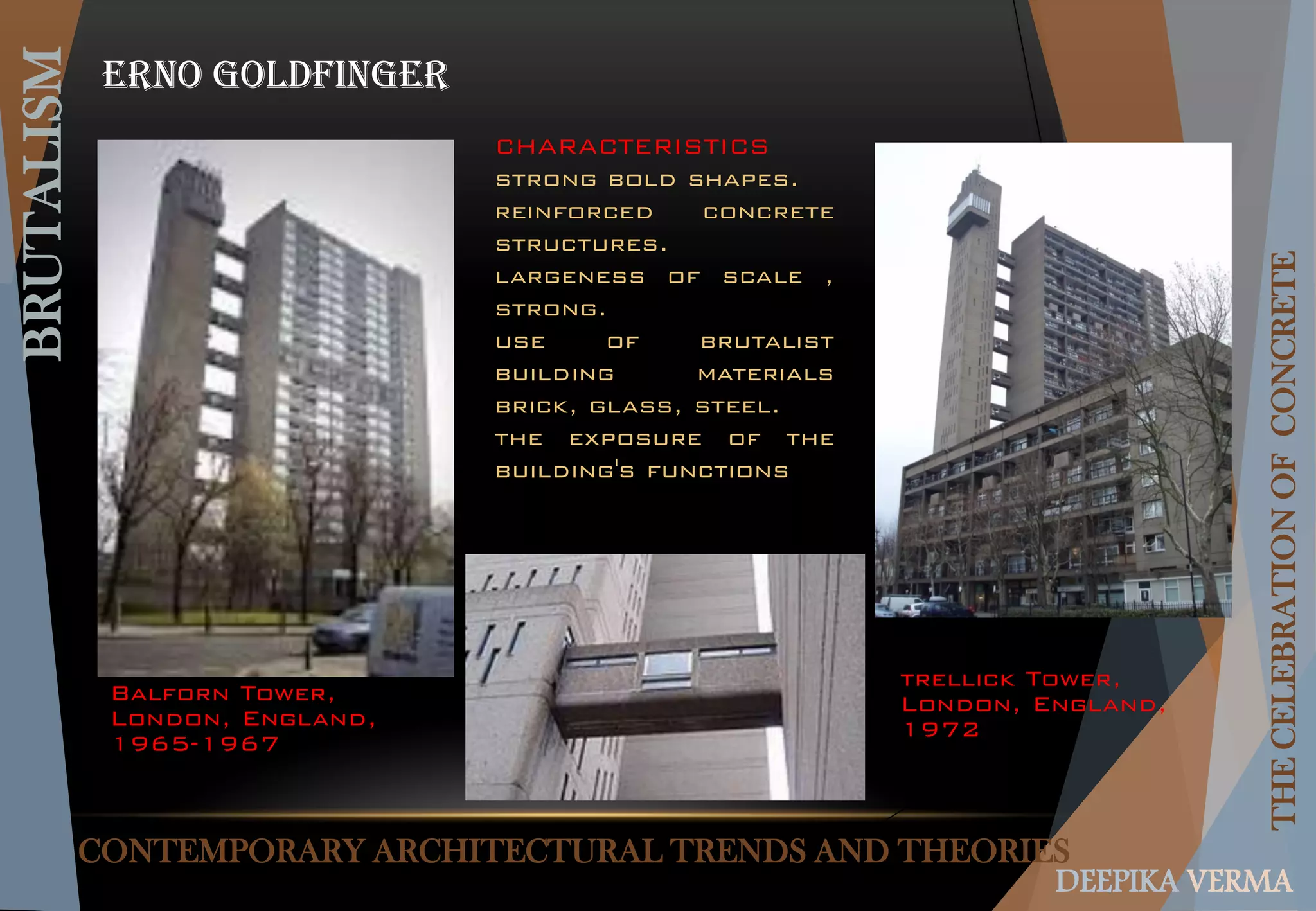
Erno goldfinger
Balforn Tower,
London, England,
1965-1967
trellick Tower,
London, England,
1972
CHARACTERISTICS
strong bold shapes.
reinforced concrete
structures.
largeness of scale ,
strong.
use of brutalist
building materials
brick, glass, steel.
the exposure of the
building's functions
CONTEMPORARY ARCHITECTURAL TRENDS AND THEORIES
BRUTALISM
THECELEBRATIONOFCONCRETE
DEEPIKA VERMA
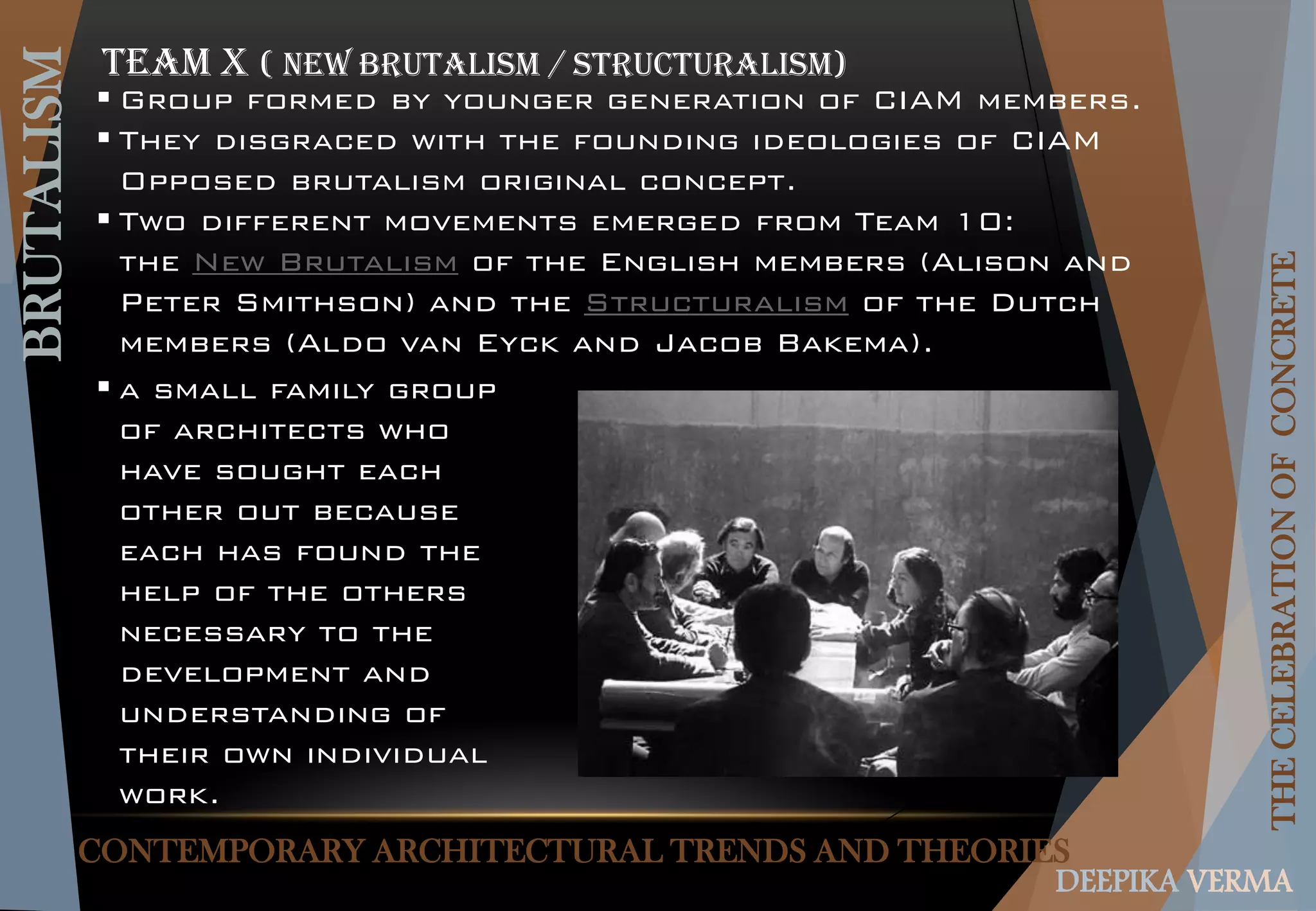
Team x ( New Brutalism / Structuralism)
 Group formed by younger generation of CIAM members.
 They disgraced with the founding ideologies of CIAM
Opposed brutalism original concept.
 Two different movements emerged from Team 10:
the New Brutalism of the English members (Alison and
Peter Smithson) and the Structuralism of the Dutch
members (Aldo van Eyck and Jacob Bakema).
 a small family group
of architects who
have sought each
other out because
each has found the
help of the others
necessary to the
development and
understanding of
their own individual
work.
CONTEMPORARY ARCHITECTURAL TRENDS AND THEORIES
BRUTALISM
THECELEBRATIONOFCONCRETE
DEEPIKA VERMA
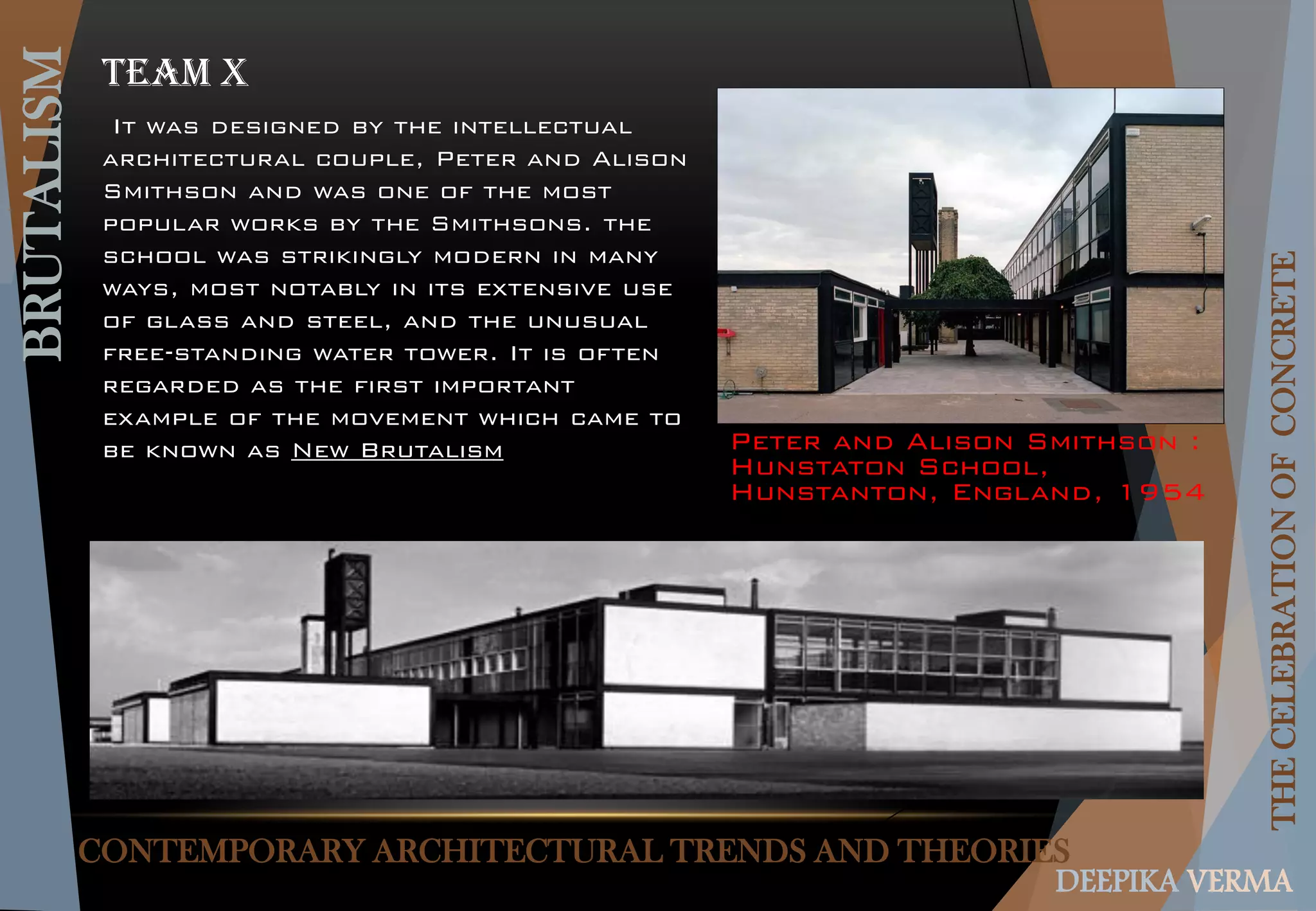
Team x
Peter and Alison Smithson :
Hunstaton School,
Hunstanton, England, 1954
It was designed by the intellectual
architectural couple, Peter and Alison
Smithson and was one of the most
popular works by the Smithsons. the
school was strikingly modern in many
ways, most notably in its extensive use
of glass and steel, and the unusual
free-standing water tower. It is often
regarded as the first important
example of the movement which came to
be known as New Brutalism
CONTEMPORARY ARCHITECTURAL TRENDS AND THEORIES
BRUTALISM
THECELEBRATIONOFCONCRETE
DEEPIKA VERMA
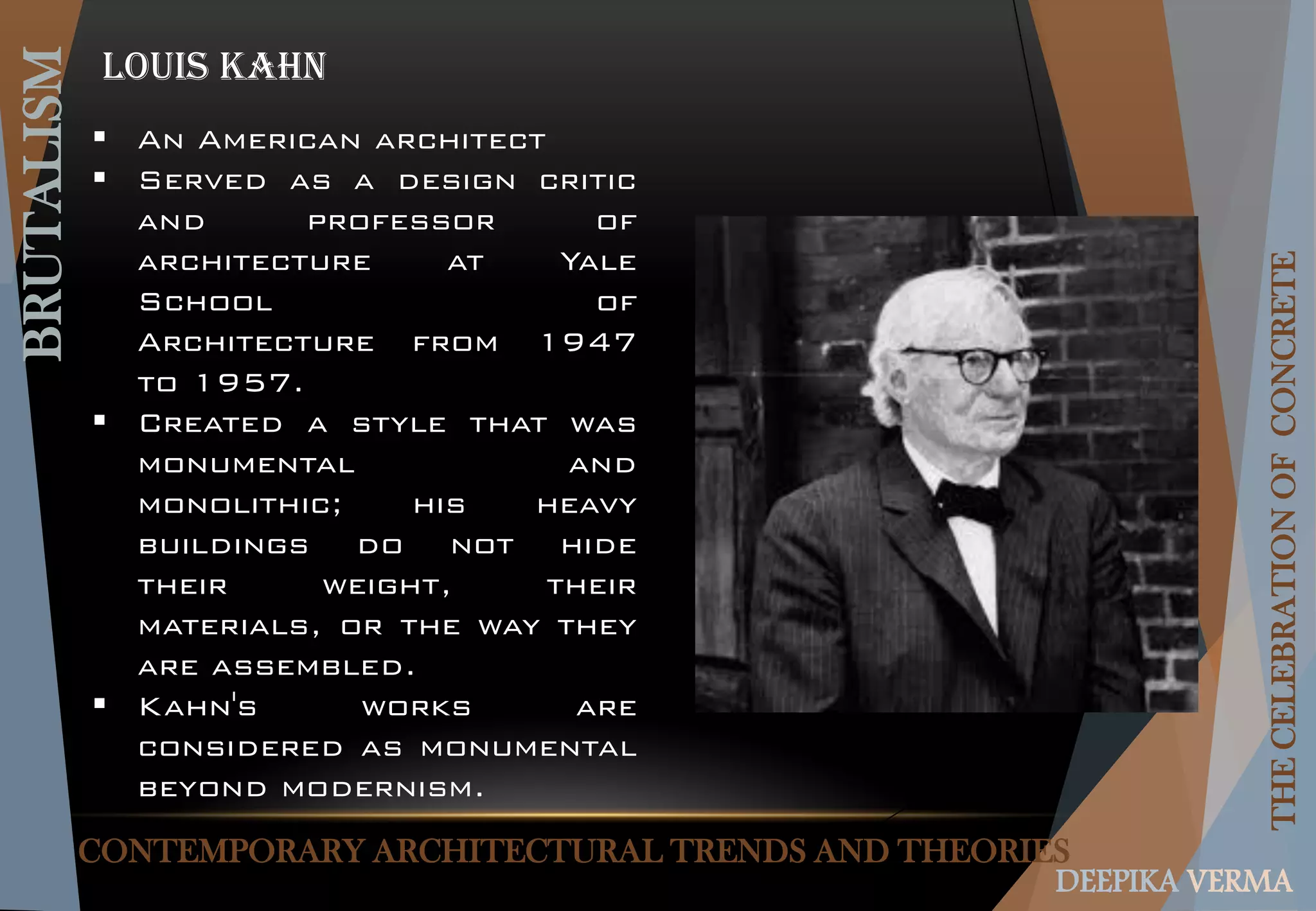
Louis Kahn
 An American architect
 Served as a design critic
and professor of
architecture at Yale
School of
Architecture from 1947
to 1957.
 Created a style that was
monumental and
monolithic; his heavy
buildings do not hide
their weight, their
materials, or the way they
are assembled.
 Kahn's works are
considered as monumental
beyond modernism.
CONTEMPORARY ARCHITECTURAL TRENDS AND THEORIES
BRUTALISM
THECELEBRATIONOFCONCRETE
DEEPIKA VERMA
Louis Kahn
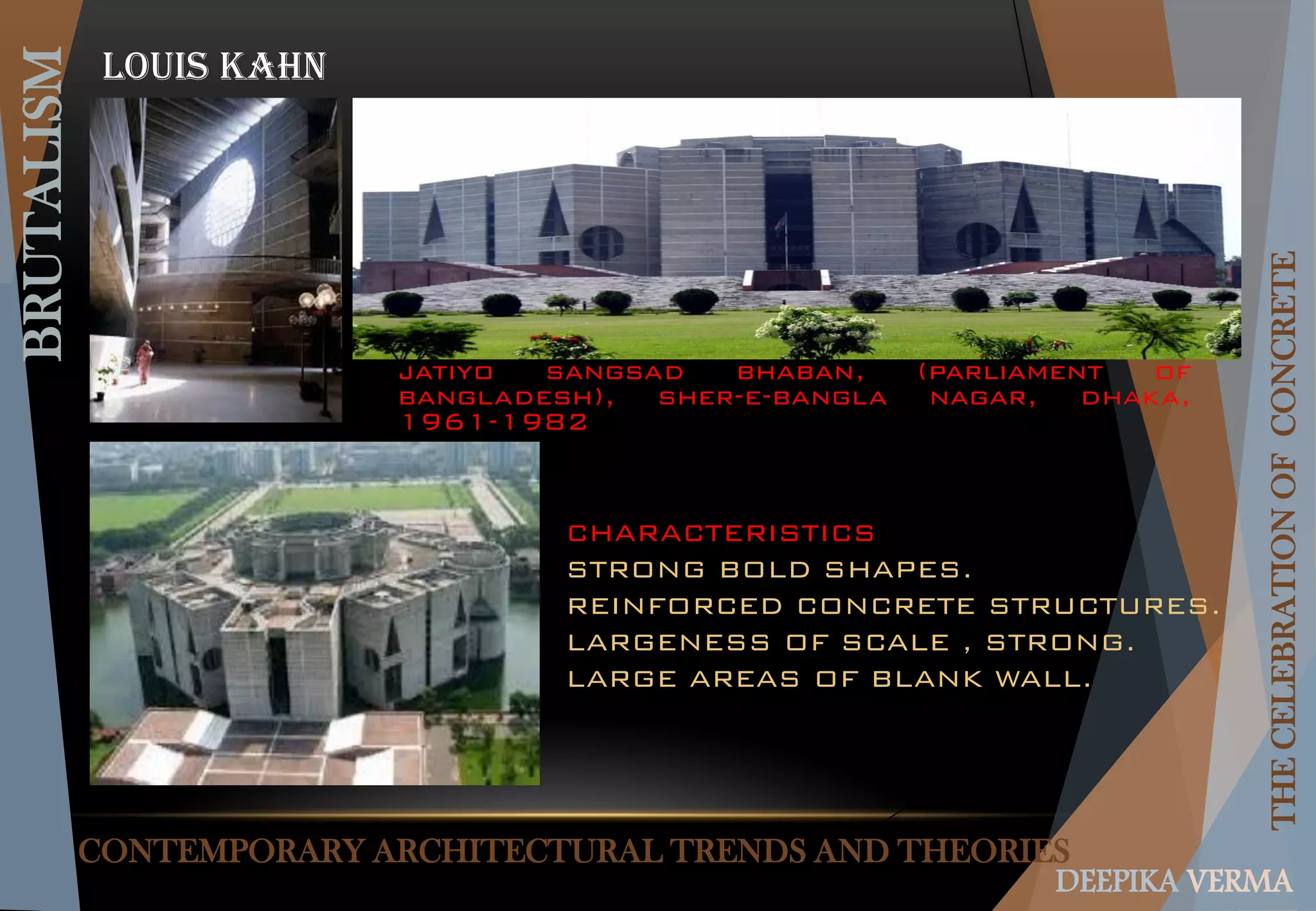
jatiyo sangsad bhaban, (parliament of
bangladesh), sher-e-bangla nagar, dhaka,
1961-1982
CHARACTERISTICS
STRONG BOLD SHAPES.
REINFORCED CONCRETE STRUCTURES.
LARGENESS OF SCALE , STRONG.
LARGE AREAS OF BLANK WALL.
CONTEMPORARY ARCHITECTURAL TRENDS AND THEORIES
BRUTALISM
THECELEBRATIONOFCONCRETE
DEEPIKA VERMA
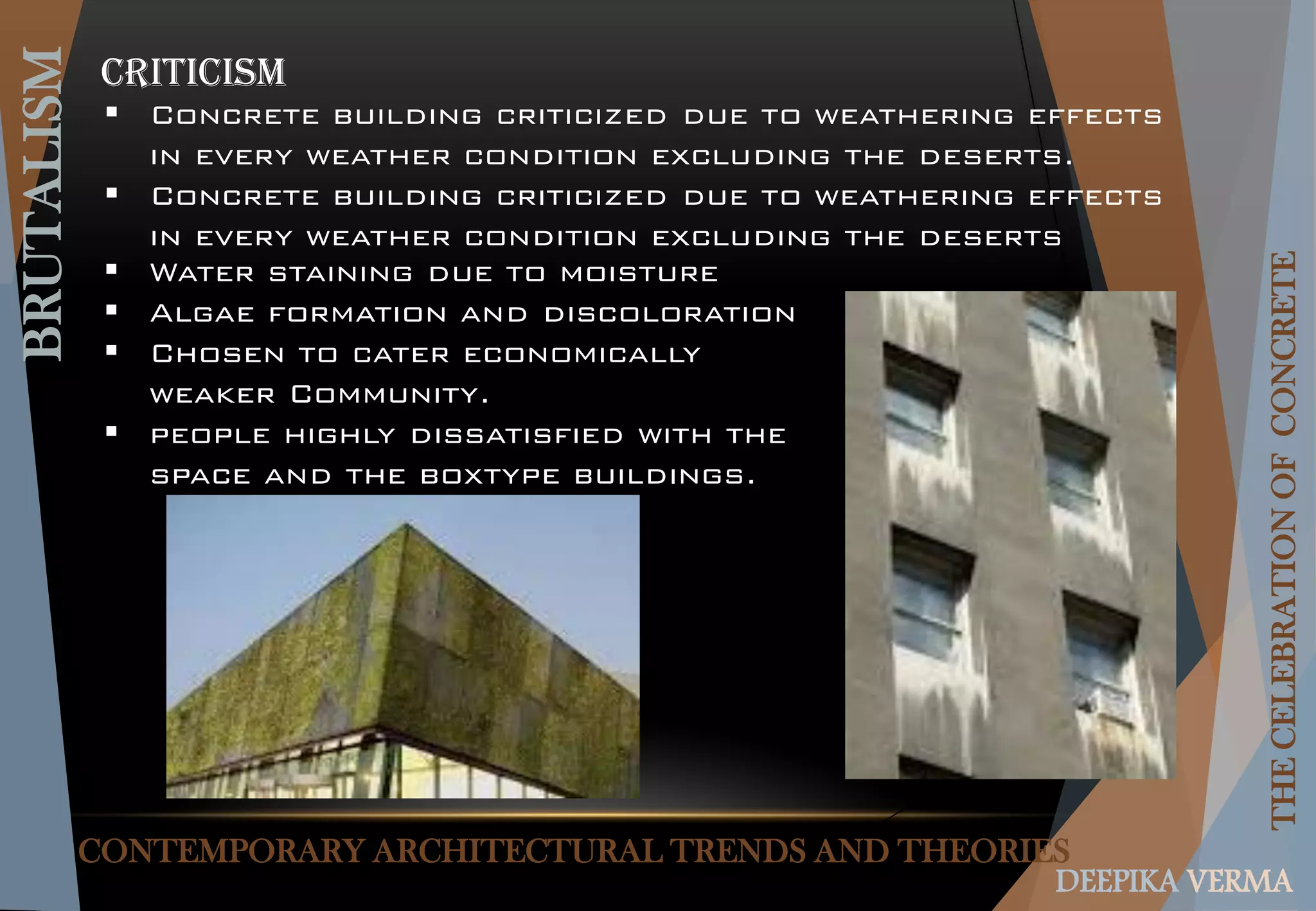
 Concrete building criticized due to weathering effects
in every weather condition excluding the deserts.
 Concrete building criticized due to weathering effects
in every weather condition excluding the deserts
CRITICISM
 Water staining due to moisture
 Algae formation and discoloration
 Chosen to cater economically
weaker Community.
 people highly dissatisfied with the
space and the boxtype buildings.
CONTEMPORARY ARCHITECTURAL TRENDS AND THEORIES
BRUTALISM
THECELEBRATIONOFCONCRETE
DEEPIKA VERMA
CONCLUSION
 War-ravaged Britain wanted a solution that looked
modern and forward-thinking and that fitted with the
excitement that followed the initial post-war
depression.
 The New Brutalism pioneered in France by Le
Corbusier.
 An undeniably honest approach to architecture that
demanded form follow function and avoided
unnecessary flourishes.
 The Brutalist approach was all about showing off the
materials from which the building was made, about
sharp angles, rough surfacing and exposed services.
 Brutalist architecture was a relatively short-lived
fashion but due to the large number of building
projects going on at the time of its peak leaves a
lasting legacy.
CONTEMPORARY ARCHITECTURAL TRENDS AND THEORIES
BRUTALISM
THECELEBRATIONOFCONCRETE
DEEPIKA VERMA
THANK YOU


Brutalism Architecture (EXPLORING VERSATALITY OF R.C.C.)

  • 1.
    CONTEMPORARY ARCHITECTURAL TRENDSAND THEORIES DEEPIKA VERMA M. Arch. (1ST Sem) BRUTALISM EXPLORING VERSATALITY OF R.C.C.
  • 2.
    CONTEMPORARY ARCHITECTURAL TRENDSAND THEORIES BRUTALISM THECELEBRATIONOFCONCRETE DEEPIKA VERMA Introduction  The term originates from the French béton brut, or "raw concrete".  Brutalism is an architectural style that spawned from the Modernist architectural movement and which flourished from the 1950s to the1970s.  The early style was largely inspired by the work of Swiss architect, Le Corbusier(in particular his Unite de habitation building) and of Mies Van der Rohe.  Le Corbusier use the term brutalism to describe his own work, though it was originally COINED BY the British architects Alison and Peter Smithson.  The term eventually became part of the common architectural lexicon when Reyner Banham used it in his book, “New Brutalism”
  • 3.
    CONTEMPORARY ARCHITECTURAL TRENDSAND THEORIES BRUTALISM THECELEBRATIONOFCONCRETE DEEPIKA VERMA Introduction When used in describing architecture, brutalism refers to a :- Brutalist buildings are usually formed with striking blockish, geometric, and repetitive shapes, and often reveal the textures of the wooden forms used to shape the material, which is normally rough, unadorned poured concrete. - Dynamic Geometric Style That Is Massive - Monolithic - Blocky In Appearance - Typically Contains Poured Concrete Ernő Goldfinger : Trellick Tower, London, 1966–1972,
  • 4.
    CONTEMPORARY ARCHITECTURAL TRENDSAND THEORIES BRUTALISM THECELEBRATIONOFCONCRETE DEEPIKA VERMA  STRONG BOLD SHAPES.  REINFORCED CONCRETE STRUCTURES.  LARGENESS OF SCALE , STRONG.  OFF FORM CONCRETE CONSTRUCTION.  LARGE AREAS OF BLANK WALL.  DIAGONAL , SLOPING OR STRONG CURVED ELEMENTS CONTRASTING WITH HORIZONTAL AND VERTICAL MEMBERS.  BRUTALIST BUILDING MATERIALS ALSO INCLUDE BRICK, GLASS, STEEL.  THE EXPOSURE OF THE BUILDING'S FUNCTIONS — RANGING FROM THEIR STRUCTURE AND SERVICES TO THEIR HUMAN USE—IN THE EXTERIOR OF THE BUILDING. CHARACTERISTICS
  • 5.
    CONTEMPORARY ARCHITECTURAL TRENDSAND THEORIES BRUTALISM THECELEBRATIONOFCONCRETE DEEPIKA VERMA Leading Brutalists Architects associated with the brutalist style include-  Le-Corbusier with his works across the world,  Paul Rudolph one of the masters in Brutalism,  Japanise architect Kenzo Tange,Erno goldfinger,  Husband-wife Peter and Alison Smithsor, members of Team X.  Outside Britain Louis Kahn with government buildings in Asia,  Charles Correa with residential buildings,  More recent Modernists such as I.M Pie and Tadao Ando have also designed notable Brutalist works.
  • 6.
    CONTEMPORARY ARCHITECTURAL TRENDSAND THEORIES BRUTALISM THECELEBRATIONOFCONCRETE DEEPIKA VERMA Le-corbusier  Le Corbusier used to describe the poured concrete with which he constructed many of his post-World War II buildings.  First architect to make use of rough caste concrete.  He was the most admired and criticized architect of the last century.  Acceptance of vernacular as a valid mode of architectural expression.  Unité d' Habitation is arguably the most influential Brutalist building of all time.
  • 7.
    CONTEMPORARY ARCHITECTURAL TRENDSAND THEORIES BRUTALISM THECELEBRATIONOFCONCRETE DEEPIKA VERMA Le-corbusier Unite d’habitation, Marseille, France, 1947-1952. Notre Dame du Haut Chapel, Ronchamp, France, 1955. CHARACTERISTICS strong bold shapes. r.c.c. structures. off form concrete structure. diagonal , sloping or strong curved elements contrasting with horizontal and vertical members. the exposure of the building's functions: structure and services. CHARACTERISTICS strong bold shapes. r.c.c. structures. largeness of scale. off form concrete construction. diagonal , sloping or strong curved elements contrasting with horizontal and vertical members.
  • 8.
    CONTEMPORARY ARCHITECTURAL TRENDSAND THEORIES BRUTALISM THECELEBRATIONOFCONCRETE DEEPIKA VERMA PAUL RUDOLPH  Inspired by Corbusier.  Use of highly textured concrete surface.  Hammering technique evolved to achieve a visually enriching tectile quality in concrete exposing the inner aggregate.  Innovative use of FORM WORK to enhance visual quality of concrete such as ribbed wood forms.
  • 9.
    CONTEMPORARY ARCHITECTURAL TRENDSAND THEORIES BRUTALISM THECELEBRATIONOFCONCRETE DEEPIKA VERMA PAUL RUDOLPH Yale Art and Architecture Building, New Haven, Connecticut, 1963 TEMPLE STREET PARKING GARAGE, NEW HEAVEN, CT, 1959-1963 CHARACTERISTICS strong bold shapes. r.c.c. structures. largeness of scale . visually enhancing tectile quality in concrete blank walls.
  • 10.
    CONTEMPORARY ARCHITECTURAL TRENDSAND THEORIES BRUTALISM THECELEBRATIONOFCONCRETE DEEPIKA VERMA KANZO TANGE Kenzo Tange is the Pritzker- Prize Winning Japanese architect who define Japan’s post-WWII emergence into Modernism.  Believed in fusion of traditional and modern architecture after 1960’s  Influenced by Le- corbusier  Took inspiration from the nature  Appealing to emotions and senses  Justification of function  Justification of design  Need of symbolism
  • 11.
    CONTEMPORARY ARCHITECTURAL TRENDSAND THEORIES BRUTALISM THECELEBRATIONOFCONCRETE DEEPIKA VERMA KANZO TANGE Tange’s own home, Japan, 1953 National gymnasium , The Yoyogi Park, Tokyo, 1961-1964. CHARACTERISTICS strong bold shapes. reinforced concrete structures. largeness of scale , strong. off form concrete construction. diagonal , sloping or strong curved elements. CHARACTERISTICS inspired from le cobusier’s villa savoye horizontal and vertical members. use of brutalist building materials r.c.c., brick, glass, steel.
  • 12.
    CONTEMPORARY ARCHITECTURAL TRENDSAND THEORIES BRUTALISM THECELEBRATIONOFCONCRETE DEEPIKA VERMA Erno goldfinger  Hungarian-born architect and designer of furniture  Prominently remembered for designing residential tower blocks.  Family business was forestry and saw-mills, which led Goldfinger to consider a career in engineering
  • 13.
    CONTEMPORARY ARCHITECTURAL TRENDSAND THEORIES BRUTALISM THECELEBRATIONOFCONCRETE DEEPIKA VERMA Erno goldfinger Balforn Tower, London, England, 1965-1967 trellick Tower, London, England, 1972 CHARACTERISTICS strong bold shapes. reinforced concrete structures. largeness of scale , strong. use of brutalist building materials brick, glass, steel. the exposure of the building's functions
  • 14.
    CONTEMPORARY ARCHITECTURAL TRENDSAND THEORIES BRUTALISM THECELEBRATIONOFCONCRETE DEEPIKA VERMA Team x ( New Brutalism / Structuralism)  Group formed by younger generation of CIAM members.  They disgraced with the founding ideologies of CIAM Opposed brutalism original concept.  Two different movements emerged from Team 10: the New Brutalism of the English members (Alison and Peter Smithson) and the Structuralism of the Dutch members (Aldo van Eyck and Jacob Bakema).  a small family group of architects who have sought each other out because each has found the help of the others necessary to the development and understanding of their own individual work.
  • 15.
    CONTEMPORARY ARCHITECTURAL TRENDSAND THEORIES BRUTALISM THECELEBRATIONOFCONCRETE DEEPIKA VERMA Team x Peter and Alison Smithson : Hunstaton School, Hunstanton, England, 1954 It was designed by the intellectual architectural couple, Peter and Alison Smithson and was one of the most popular works by the Smithsons. the school was strikingly modern in many ways, most notably in its extensive use of glass and steel, and the unusual free-standing water tower. It is often regarded as the first important example of the movement which came to be known as New Brutalism
  • 16.
    CONTEMPORARY ARCHITECTURAL TRENDSAND THEORIES BRUTALISM THECELEBRATIONOFCONCRETE DEEPIKA VERMA Louis Kahn  An American architect  Served as a design critic and professor of architecture at Yale School of Architecture from 1947 to 1957.  Created a style that was monumental and monolithic; his heavy buildings do not hide their weight, their materials, or the way they are assembled.  Kahn's works are considered as monumental beyond modernism.
  • 17.
    CONTEMPORARY ARCHITECTURAL TRENDSAND THEORIES BRUTALISM THECELEBRATIONOFCONCRETE DEEPIKA VERMA Louis Kahn jatiyo sangsad bhaban, (parliament of bangladesh), sher-e-bangla nagar, dhaka, 1961-1982 CHARACTERISTICS STRONG BOLD SHAPES. REINFORCED CONCRETE STRUCTURES. LARGENESS OF SCALE , STRONG. LARGE AREAS OF BLANK WALL.
  • 18.
    CONTEMPORARY ARCHITECTURAL TRENDSAND THEORIES BRUTALISM THECELEBRATIONOFCONCRETE DEEPIKA VERMA  Concrete building criticized due to weathering effects in every weather condition excluding the deserts.  Concrete building criticized due to weathering effects in every weather condition excluding the deserts CRITICISM  Water staining due to moisture  Algae formation and discoloration  Chosen to cater economically weaker Community.  people highly dissatisfied with the space and the boxtype buildings.
  • 19.
    CONTEMPORARY ARCHITECTURAL TRENDSAND THEORIES BRUTALISM THECELEBRATIONOFCONCRETE DEEPIKA VERMA CONCLUSION  War-ravaged Britain wanted a solution that looked modern and forward-thinking and that fitted with the excitement that followed the initial post-war depression.  The New Brutalism pioneered in France by Le Corbusier.  An undeniably honest approach to architecture that demanded form follow function and avoided unnecessary flourishes.  The Brutalist approach was all about showing off the materials from which the building was made, about sharp angles, rough surfacing and exposed services.  Brutalist architecture was a relatively short-lived fashion but due to the large number of building projects going on at the time of its peak leaves a lasting legacy.
  • 20.
    CONTEMPORARY ARCHITECTURAL TRENDSAND THEORIES BRUTALISM THECELEBRATIONOFCONCRETE DEEPIKA VERMA THANK YOU 