CHARLES
CORREA
BIOGRAPHY:
Born: 1sep 1930, middle class catholic family secunderabad
Death:16th jan 2015,Mumbai
Education : 1946 -1948 inter –science. St. xavier’s college, university of bomboy
1949-1953 b.arch., university of Michigan.
1953-1955 m.arch., Massachusetts institute of technology.
Career:
Arch style: sustainable architecture
Professional experience :
1955-1958 partner with g.m.bhuta associates
1964-1965 prepares master plan proposing twin city across the harbor from
bombey .
1971-1975 chief architect to CIDCO
1975-1976 consultant to UN secretory-general for habitat
1975-1983 chairman housing urban renewal and ecology board
1985 chairman dharavi planning commission
• 1961 prize for low income housing
• 1972 padmashri by the president of india
• 1980 awarded an honorary doctorate by the university of Michigan
• 1984 gold medal royal institute of british architects
• 1985 prize for the improvement in the quality of human settlements
from the international union of architects.
• 1986 chicago architecture award .
• 1987 gold medal – indian institute of architects.
• 1990 gold medal (international union of architects)
• 1994 the premium imperial from japan society of art.
• 1999 Aga khan award for vidhan sabha, Bhopal
AWARDS:
PRINCIPLES:
Few cardinal principles in his vast body of work –
• Incrementality
• Identity
• Pluralism
• Income generation
• Equity
• Open-to-sky space
• Disaggregation
o Correa’s work in India shows a careful development,
understanding and adaption of modernism to a non-western
culture. Correa’s early works attempt to explore a local
vernacular within a modern environment.
WORKS:
• In Dadar – Our lady of Salvation church
• In Bombay – Kanchenjunga apartments
• In Goa – kala academy
• In Ahmedabad- Gandhi smarak sangrahalaya
• In Delhi – the LIC centre ; british council building
• In Kerala – The Leela, kovalam beach resort hotel
• In Andaman – bay island hotel in port blair
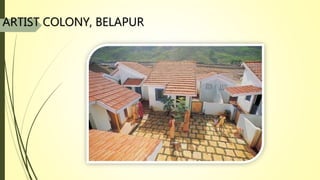
• In Belapur – artist colony
• In Canada – Ismail centre
• In MP – Vidhan Bhavan building
• In rajasthan – Jawahar kala kendra
• In Pune – IUCCA centre
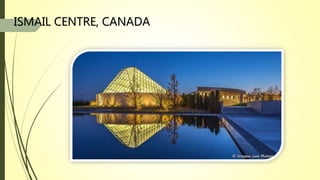
ISMAIL CENTRE, CANADA
ABOUT STRCTURE:
Location : Toranto, Canada,2014
Construction period : April 2010-2014
The site : the Ismail centre Toronto share a site with the Aga Khan museum the two building
are united by a 6.8 hectare park.
Architect : Charles Correa and associates ( india )
Site statistics : over 550 new trees .
Trees include serviceberry maple trembling aspen ,dawn redwood magnolia .
765 parking spaces on site .
Functional spaces : Institutional offices of the ismaili community , social hall
prayer hall , library , classroom , atrium lounge , activities room .
Material :
exterior :– limestone cladding ,granite pavers ,concrete ,glass wood.
Interior:- patterned glass ,maple paneling ,white oak and stone mosaic floors white onyx.
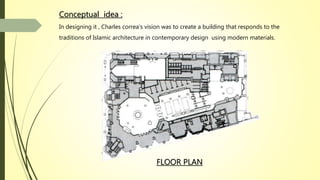
FLOOR PLAN
Conceptual idea :
In designing it , Charles correa’s vision was to create a building that responds to the
traditions of Islamic architecture in contemporary design using modern materials.
Architecture:
• The complex is a symbolic marker at the permanent
presence of the Ismaili community
in Canada.
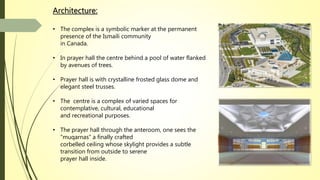
• In prayer hall the centre behind a pool of water flanked
by avenues of trees.
• Prayer hall is with crystalline frosted glass dome and
elegant steel trusses.
• The centre is a complex of varied spaces for
contemplative, cultural, educational
and recreational purposes.
• The prayer hall through the anteroom, one sees the
“muqarnas“ a finally crafted
corbelled ceiling whose skylight provides a subtle
transition from outside to serene
prayer hall inside.
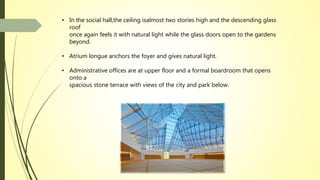
• In the social hall,the ceiling isalmost two stories high and the descending glass
roof
once again feels it with natural light while the glass doors open to the gardens
beyond.
• Atrium longue anchors the foyer and gives natural light.
• Administrative offices are at upper floor and a formal boardroom that opens
onto a
spacious stone terrace with views of the city and park below.
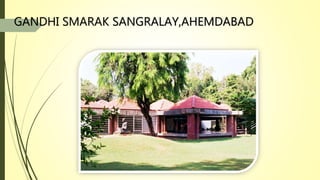
GANDHI SMARAK SANGRALAY,AHEMDABAD
ABOUT STRCTURE:
Location : kochrab area, Ahmedabad
Construction period : 1958 to 1963
Also known as: Harijan ashram
Building type: culture and entertainment memorial museum.
Architect : Charles correa and associates ( india )
Site spaces:
• In the ashram where the Mahatma live from 1917 to 1930.
• Originally it was called the Satyagraha Ashram.
• The ashram now has a museum also, having photography and painting section, books
section (library), meeting room, office and letter section
Material :
Brick piers ,stone floors and tiled roofs to find a contemporary expression for the spirit of
swadeshi.
Light and ventilation by openable wooden louvers.
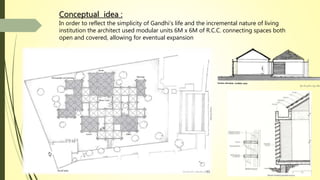
Conceptual idea :
In order to reflect the simplicity of Gandhi’s life and the incremental nature of living
institution the architect used modular units 6M x 6M of R.C.C. connecting spaces both
open and covered, allowing for eventual expansion
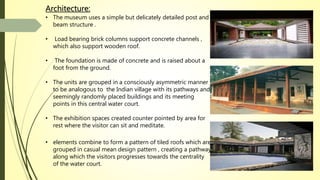
Architecture:
• The museum uses a simple but delicately detailed post and
beam structure .
• Load bearing brick columns support concrete channels ,
which also support wooden roof.
• The foundation is made of concrete and is raised about a
foot from the ground.
• The units are grouped in a consciously asymmetric manner
to be analogous to the Indian village with its pathways and
seemingly randomly placed buildings and its meeting
points in this central water court.
• The exhibition spaces created counter pointed by area for
rest where the visitor can sit and meditate.
• elements combine to form a pattern of tiled roofs which are
grouped in casual mean design pattern , creating a pathway
along which the visitors progresses towards the centrality
of the water court.
IUCCA CENTRE, PUNE
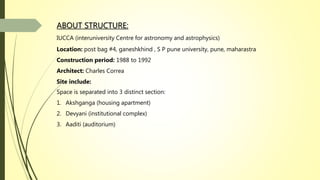
ABOUT STRUCTURE:
IUCCA (interuniversity Centre for astronomy and astrophysics)
Location: post bag #4, ganeshkhind , S P pune university, pune, maharastra
Construction period: 1988 to 1992
Architect: Charles Correa
Site include:
Space is separated into 3 distinct section:
1. Akshganga (housing apartment)
2. Devyani (institutional complex)
3. Aaditi (auditorium)
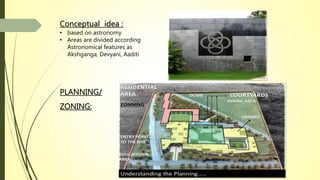
Conceptual idea :
• based on astronomy
• Areas are divided according
Astronomical features as
Akshganga, Devyani, Aaditi
PLANNING/
ZONING:
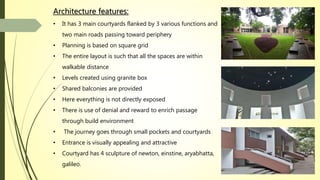
Architecture features:
• It has 3 main courtyards flanked by 3 various functions and
two main roads passing toward periphery
• Planning is based on square grid
• The entire layout is such that all the spaces are within
walkable distance
• Levels created using granite box
• Shared balconies are provided
• Here everything is not directly exposed
• There is use of denial and reward to enrich passage
through build environment
• The journey goes through small pockets and courtyards
• Entrance is visually appealing and attractive
• Courtyard has 4 sculpture of newton, einstine, aryabhatta,
galileo.
Construction details and materials:
• Structural system of RCC column, beam, slab, grid of 5-6m is use
• The roof of library and lecture halls have been constructed using
hollow concrete blocks and in-situ beams.
• External curved walls- khadki stone masonry, grey slate/sahabad
stone, black granite
• Courtyard facing walls- cement plaster of smooth type with
pastel shades of acrylic distemper
• External passages- unpolished/polished sahabad, marble,
cement blocks
• Internal walls- POP with colour distemper
• Internal floors- marble, granite, IPS
• External ground cover- doob grass, crab grass, stone paving
with grass joints.
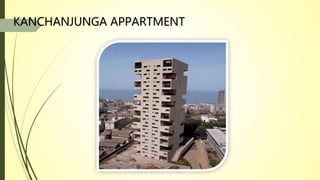
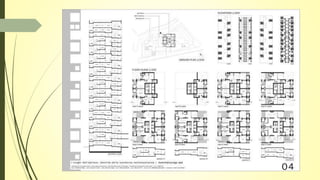
KANCHANJUNGA APPARTMENT
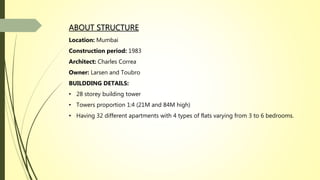
ABOUT STRUCTURE
Location: Mumbai
Construction period: 1983
Architect: Charles Correa
Owner: Larsen and Toubro
BUILDDING DETAILS:
• 28 storey building tower
• Towers proportion 1:4 (21M and 84M high)
• Having 32 different apartments with 4 types of flats varying from 3 to 6 bedrooms.
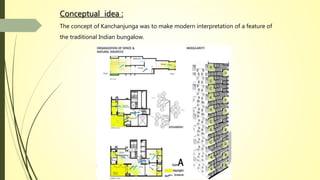
Conceptual idea :
The concept of Kanchanjunga was to make modern interpretation of a feature of
the traditional Indian bungalow.
Architectural features:
• Having 32 different appartments with 4 types of
flats varying from 3 to 6 bedrooms.
• Interlocking of these variations expressed
externally by shear end walls that hold up the
cantilevers.
• Garden terraces are depiction of traditional
indian bunglows i.e.The Verandah.
• Each apartment provided with a deep 2 storey
high garden terrace i.e. oriented away from the
sun so as to protect it from the harsh sunlight.
• Small displacements of levels effectively shield
these high rise units from the effect of both the
sun and monsoon rain.
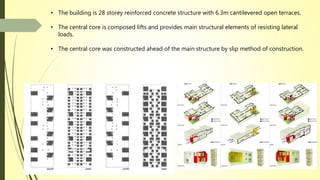
• The building is 28 storey reinforced concrete structure with 6.3m cantilevered open terraces.
• The central core is composed lifts and provides main structural elements of resisting lateral
loads.
• The central core was constructed ahead of the main structure by slip method of construction.
OUR LADY OF SALVATION CHURCH, DADAR
ABOUT STRUCTURE
Location: Dadar, Mumbai
Construction period:1596-1977
Originally build in 1596, rebuild in 1659 & again in 1914
Restoration done in 1935 (parochial hall was build)
In 1940 presbytery was build
Architect: Charles Correa
Site include:
1. Church
2. Office building
3. Residence
4. Grave yard
5. Landscape area
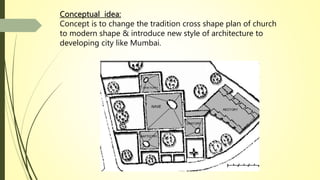
Conceptual idea:
Concept is to change the tradition cross shape plan of church
to modern shape & introduce new style of architecture to
developing city like Mumbai.
Architectural features:
• The sanctuary and oratory are interconnected so
accommodation of the Church is well over 1000
persons.
• All areas open out to gardens and courtyards
• The entrains courtyard serves the transition from
Street.
• The confessional and baptismal font are located
on the left of the courtyard in baptistry.
• The pulpit & lectern, area of enlightenment &
instruction is in center, beyond this the area of
sacrifice, meeting with God
• The oratory is to the right of the courtyard and
connected to the main congregational space
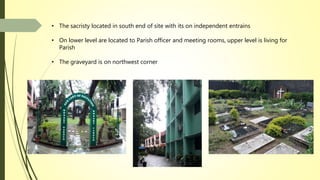
• The sacristy located in south end of site with its on independent entrains
• On lower level are located to Parish officer and meeting rooms, upper level is living for
Parish
• The graveyard is on northwest corner
ARTIST COLONY, BELAPUR
ABOUT STRUCTURE
Location: The Belapur Incremental Housing is located in Sector 8, Belapur, Navi
Mumbai, Maharashtra
Architect: Charles Correa
BUILDDING DETAILS:
•Belapur incremental housing project - a proposal for mass affordable housing in New
Bombay (Navi Mumbai), which demonstrated how high densities could be achieved
with low-rise courtyard homes, built with simple materials at a human scale.
•Based on clusters of between seven and 12 pairs of houses arranged around
communal courtyards, the buildings did not share party walls – allowing each
family to extend and adapt their own house independently.
•550 families were planned for in a 5.4-hectare area limitation.
MATERIALS AND CONSTRUCTION:
brick walls, roof- wooden shingles outdoor stone pavings, simple floor
plans and building methods
CONCEPT:
Making housing is like a bird building nest. You start with basic house, but you have to
let people change it to their own needs.
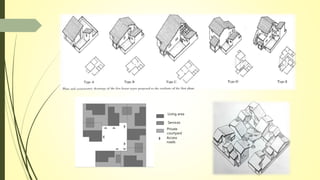
SITE PLANS
PRINCIPLES:
•Incrementality
•identity
•pluralism
•income generation
Living area
Services
Private
courtyard
Access
roads
ARCHITECTURE FEATURES:
• Project demonstrates how high density housing (500 people
per hectare) can be achieved in a low-rise typology, while
including (open to sky spaces) and services, like schools, that
the community requires
• Overriding principle is to give each unit its own site to allow
for expansion (Incrementality)
• The footprint of each plan varies little in size (from 45 sq. m
to 70 sq. m), maintaining equity (fairness) in the community
• Scheme caters wide range from the lowest budgets of Rs
20000, Middle income groups Rs 30000-50000 and Upper
income Rs 180000.
• common space between the houses, katta used as a
seating
• two wheeler and four wheeler parking
• The village was produced with the idea that the residents
were going to alter it in many ways, making it truly their own,
therefore homes are freestanding, so residents can add
to them as their families grow; and differently priced plans
appeal to a wide variety of income levels.
• A common garden divided the entries of both the
condominiums and a well serving both.
• Both the condominiums are separated and differentiated by
gates. The entry gates are about 4.8m wide. These opened
from the common parking space that was about 16mx16m.
• There was a common entrance space to both condominiums.
However condominium 4 being a gated and secured one, all
the vehicles belonging to the residents were parked in the
common open space not harming any tree or green spaces
JAWAHAR KALA KENDRA, JAIPUR
ABOUT STRUCTURE
Location: Gandhi Nagar,Jaipur,Rajasthan
Architect: Charles Correa
Construction Period: 1986-1991
Building details:
Site area: 9.5 acre
Build up area: 8100 sq.m.
Materials:
Spanning between beams: wooden bamboo
Cladding of walls and steps in Courtyard: red sandstone
Huts in shilpgram:
Walls: bricks and mud
Roof: MS circular pipe, fiber sheet,
Skylights: fiber
Details in canteen: Kota and granite
Landscaping: African grass ushers
Conceptual idea :
• The center is an analogue of the original city plan of Jaipur drawn up by the
Maharaja Jai Singh-II .
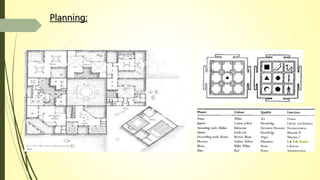
• Correa’s plan for the center invokes directly the original navagraha or nine
house mandala.
• One of the square is provided to recall the original city plan and also to create
the entrance.
• Each square was linked to the planet as per the characteristics of the particular
planet and it’s astrological values and the functionality of the square.
• The landscaping was also done as per planets astrological values.
• The canteen was designed with the concept of moon.
Planning:
ABOUT STRUCTURE
Divisions of Jawahar Kala Kendra :
Theatre:
Theatre is a reflection of society and refines and reforms
the society. Jawahar Kala Kendra has been able to live
up to its expectations and provides an ideal platform for
scholars, students and artists to blend their creativity
and learn in turn from each other.
Madhyavarti:
This is an open air theatre that has been designed
creatively to reflect the look of a traditional step well
that are common in rural locations of Rajasthan.
Rangayan:
All modern plays are screened in this regular closed
theatre which has been appropriately named Rangayan.
Krishanayan:
All intimate performances are done in Krishnayan making
Jawahar Kala Kendra unique in the sense that this is the
only theatre in the region which has dedicated theatres
distinct kind of performances.
Kala Galleries :
Sudarshan , Sukriti , Surekh and Chaturdik I and II : In
these galleries numerous exhibition are held throughout
the year.
Museum :
Alankar museum is home to carved wooden doors,
furniture, items, posts and terracotta artefacts.
Shilpgram:
Here all fares, hut bazars and festivals get organized.
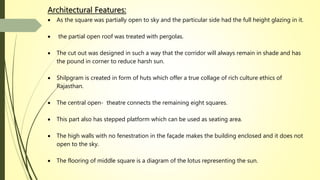
Architectural Features:
 As the square was partially open to sky and the particular side had the full height glazing in it.
 the partial open roof was treated with pergolas.
 The cut out was designed in such a way that the corridor will always remain in shade and has
the pound in corner to reduce harsh sun.
 Shilpgram is created in form of huts which offer a true collage of rich culture ethics of
Rajasthan.
 The central open- theatre connects the remaining eight squares.
 This part also has stepped platform which can be used as seating area.
 The high walls with no fenestration in the façade makes the building enclosed and it does not
open to the sky.
 The flooring of middle square is a diagram of the lotus representing the sun.
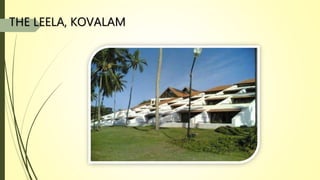
THE LEELA, KOVALAM
ABOUT STRUCTURE
Location: kovalam, kerela
Construction: 1969-1974
Site: The structure is spread over 44acres
Construction material:
Construction is in traditional vernacular of Kerala- Plaster walls with red tiled
roofs
Other pavilion consists of little Bamboo chhatries with coir matins on the floor
and local Kerala handicrafts.
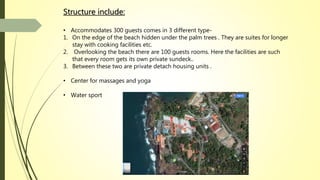
Structure include:
• Accommodates 300 guests comes in 3 different type-
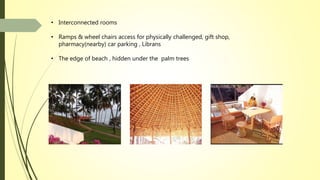
1. On the edge of the beach hidden under the palm trees . They are suites for longer
stay with cooking facilities etc.
2. Overlooking the beach there are 100 guests rooms. Here the facilities are such
that every room gets its own private sundeck..
3. Between these two are private detach housing units .
• Center for massages and yoga
• Water sport
Conceptual idea:
• to initiate one of the Indians most spectacular beaches as a major beach resort area
• The master plan does not concentrate all the facilities in one area, but generate a large
number of potential growth points, thus allowing a more flexible response to future
demands .
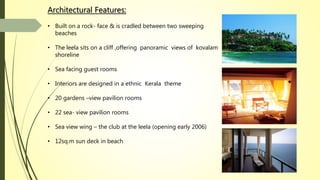
Architectural Features:
• Built on a rock- face & is cradled between two sweeping
beaches
• The leela sits on a cliff ,offering panoramic views of kovalam
shoreline
• Sea facing guest rooms
• Interiors are designed in a ethnic Kerala theme
• 20 gardens –view pavilion rooms
• 22 sea- view pavilion rooms
• Sea view wing – the club at the leela (opening early 2006)
• 12sq.m sun deck in beach
• Interconnected rooms
• Ramps & wheel chairs access for physically challenged, gift shop,
pharmacy(nearby) car parking , Librans
• The edge of beach , hidden under the palm trees
KALA ACADEMY, GOA
ABOUT STRUCTURE
Location: Camplal, Panaji
Construction: 1969
Architect: Charles Correa
Site Area : 6.3acres
Structure is:
•It is the venue of international film festival of India.
•The kala academy established in 1969 for promotion of art and culture in Goa.
•It is a vibrant representation of the culture and art of the people of Goa
•Variety of cultural programs held in its premises.
Layout:
•There are four entries to the site.
•Boat jetty provided on the river side.
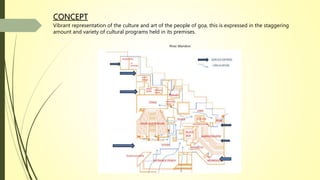
•The coverage is about 40% the pedestrian and vehicular systems are well defined.
• The active area includes the cafeteria, the garden and the amphitheatre.
•The site is divided into main building service building, Muktangan, parking area, the
exhibition space.
River Mandovi
CONCEPT
Vibrant representation of the culture and art of the people of goa, this is expressed in the staggering
amount and variety of cultural programs held in its premises.
Building construction:
• Importance to the process of moving through the spaces in a building.
• Built form has been kept low ranging from one to three floors.
• This is further enhanced by the use of parapet walls from upper floors, which
emphasize horizontally.
• Pergola above the entrance.
• Extensive use at specially designed seating.
• Building is divided into three zones public, administration, academic.
• Art Gallery
• D.M Kalamandir
• OAT (open amphitheater)
• Mini OAT
• Black box
• Rehearsal Room
• Kitchen
• Administration
• Reception
• Lounge
• Green Room
• Meeting Room
• Guest Room
• Preview Theater
• Café
• Library
• Class Room
Site include:
Art Gallery
• Running wall space for display – 51m
• Carpet area – 165 sq.m
• 3 mobile display panels to be used on
• both sides – each having a space of 4*1.5m
Mini Open air auditorium
• it is an open stage without roof/ceiling.
• Programs, Conference, meeting and drama.
• Seating Capacity without chairs – 300.
• Seating capacity with chairs – 210.
Library
• Reading Desk for 11 peoples only
• 12 major shelves
• 32 major shelves
• 4 cassette shelves
ABOUT STRUCTURE:
Dinanath Mangeshkar Kala Mandir
• Drama, khel tiatr, magic shows, professional drama, western
music, concerts, gathering, orchestra, beat show, dance
fashion show, lectures and meetings.
• Seating capacity – 954 seats
• Proscenium stage opening – 81cm to 96 cm
• Proscenium height – 39cm
• Orchestra pit – 60cm*18cm
• No of green rooms – 3
Black box
• The black box is used for experimental productions
• Its designed for music, concerts, meetings, and
performances.
• Can be used as a recording studio.
• Seating capacity without chair – 250
• Seating capacity with chair – 170
• Carpet area – 184.80 sq.m
• Stage – 10m*1.5m
CONCLUSION:
• This study is all about different structures of Ar. Charles Correa which inspire us to
design according to end user’s comfort.
• He use to design according to climatic conditions of particular region.
• He gave special attention toward open spaces and connectivity like courtyard,
pergolas.
• In most of his structures we can see that spaces are divided into different zones
according to public need such as kanchanjunga,artist colony and The Leela hotel.
• He taught us that Functionality of design is more important than the shape of
building.
THANK
YOU
SUBMITTED
BY:
• Sayali
chinchore
• Vrushali
mhaskar
• kaushal
dohale
• pankaj khade
• ashish
tambitkar

Charles correa

  • 1.
  • 2.
    BIOGRAPHY: Born: 1sep 1930,middle class catholic family secunderabad Death:16th jan 2015,Mumbai Education : 1946 -1948 inter –science. St. xavier’s college, university of bomboy 1949-1953 b.arch., university of Michigan. 1953-1955 m.arch., Massachusetts institute of technology. Career: Arch style: sustainable architecture Professional experience : 1955-1958 partner with g.m.bhuta associates 1964-1965 prepares master plan proposing twin city across the harbor from bombey . 1971-1975 chief architect to CIDCO 1975-1976 consultant to UN secretory-general for habitat 1975-1983 chairman housing urban renewal and ecology board 1985 chairman dharavi planning commission
  • 3.
    • 1961 prizefor low income housing • 1972 padmashri by the president of india • 1980 awarded an honorary doctorate by the university of Michigan • 1984 gold medal royal institute of british architects • 1985 prize for the improvement in the quality of human settlements from the international union of architects. • 1986 chicago architecture award . • 1987 gold medal – indian institute of architects. • 1990 gold medal (international union of architects) • 1994 the premium imperial from japan society of art. • 1999 Aga khan award for vidhan sabha, Bhopal AWARDS:
  • 4.
    PRINCIPLES: Few cardinal principlesin his vast body of work – • Incrementality • Identity • Pluralism • Income generation • Equity • Open-to-sky space • Disaggregation o Correa’s work in India shows a careful development, understanding and adaption of modernism to a non-western culture. Correa’s early works attempt to explore a local vernacular within a modern environment.
  • 5.
    WORKS: • In Dadar– Our lady of Salvation church • In Bombay – Kanchenjunga apartments • In Goa – kala academy • In Ahmedabad- Gandhi smarak sangrahalaya • In Delhi – the LIC centre ; british council building • In Kerala – The Leela, kovalam beach resort hotel • In Andaman – bay island hotel in port blair • In Belapur – artist colony • In Canada – Ismail centre • In MP – Vidhan Bhavan building • In rajasthan – Jawahar kala kendra • In Pune – IUCCA centre
  • 6.
  • 7.
    ABOUT STRCTURE: Location :Toranto, Canada,2014 Construction period : April 2010-2014 The site : the Ismail centre Toronto share a site with the Aga Khan museum the two building are united by a 6.8 hectare park. Architect : Charles Correa and associates ( india ) Site statistics : over 550 new trees . Trees include serviceberry maple trembling aspen ,dawn redwood magnolia . 765 parking spaces on site . Functional spaces : Institutional offices of the ismaili community , social hall prayer hall , library , classroom , atrium lounge , activities room . Material : exterior :– limestone cladding ,granite pavers ,concrete ,glass wood. Interior:- patterned glass ,maple paneling ,white oak and stone mosaic floors white onyx.
  • 8.
    FLOOR PLAN Conceptual idea: In designing it , Charles correa’s vision was to create a building that responds to the traditions of Islamic architecture in contemporary design using modern materials.
  • 9.
    Architecture: • The complexis a symbolic marker at the permanent presence of the Ismaili community in Canada. • In prayer hall the centre behind a pool of water flanked by avenues of trees. • Prayer hall is with crystalline frosted glass dome and elegant steel trusses. • The centre is a complex of varied spaces for contemplative, cultural, educational and recreational purposes. • The prayer hall through the anteroom, one sees the “muqarnas“ a finally crafted corbelled ceiling whose skylight provides a subtle transition from outside to serene prayer hall inside.
  • 10.
    • In thesocial hall,the ceiling isalmost two stories high and the descending glass roof once again feels it with natural light while the glass doors open to the gardens beyond. • Atrium longue anchors the foyer and gives natural light. • Administrative offices are at upper floor and a formal boardroom that opens onto a spacious stone terrace with views of the city and park below.
  • 11.
  • 12.
    ABOUT STRCTURE: Location :kochrab area, Ahmedabad Construction period : 1958 to 1963 Also known as: Harijan ashram Building type: culture and entertainment memorial museum. Architect : Charles correa and associates ( india ) Site spaces: • In the ashram where the Mahatma live from 1917 to 1930. • Originally it was called the Satyagraha Ashram. • The ashram now has a museum also, having photography and painting section, books section (library), meeting room, office and letter section Material : Brick piers ,stone floors and tiled roofs to find a contemporary expression for the spirit of swadeshi. Light and ventilation by openable wooden louvers.
  • 13.
    Conceptual idea : Inorder to reflect the simplicity of Gandhi’s life and the incremental nature of living institution the architect used modular units 6M x 6M of R.C.C. connecting spaces both open and covered, allowing for eventual expansion
  • 14.
    Architecture: • The museumuses a simple but delicately detailed post and beam structure . • Load bearing brick columns support concrete channels , which also support wooden roof. • The foundation is made of concrete and is raised about a foot from the ground. • The units are grouped in a consciously asymmetric manner to be analogous to the Indian village with its pathways and seemingly randomly placed buildings and its meeting points in this central water court. • The exhibition spaces created counter pointed by area for rest where the visitor can sit and meditate. • elements combine to form a pattern of tiled roofs which are grouped in casual mean design pattern , creating a pathway along which the visitors progresses towards the centrality of the water court.
  • 15.
  • 16.
    ABOUT STRUCTURE: IUCCA (interuniversityCentre for astronomy and astrophysics) Location: post bag #4, ganeshkhind , S P pune university, pune, maharastra Construction period: 1988 to 1992 Architect: Charles Correa Site include: Space is separated into 3 distinct section: 1. Akshganga (housing apartment) 2. Devyani (institutional complex) 3. Aaditi (auditorium)
  • 17.
    Conceptual idea : •based on astronomy • Areas are divided according Astronomical features as Akshganga, Devyani, Aaditi PLANNING/ ZONING:
  • 18.
    Architecture features: • Ithas 3 main courtyards flanked by 3 various functions and two main roads passing toward periphery • Planning is based on square grid • The entire layout is such that all the spaces are within walkable distance • Levels created using granite box • Shared balconies are provided • Here everything is not directly exposed • There is use of denial and reward to enrich passage through build environment • The journey goes through small pockets and courtyards • Entrance is visually appealing and attractive • Courtyard has 4 sculpture of newton, einstine, aryabhatta, galileo.
  • 19.
    Construction details andmaterials: • Structural system of RCC column, beam, slab, grid of 5-6m is use • The roof of library and lecture halls have been constructed using hollow concrete blocks and in-situ beams. • External curved walls- khadki stone masonry, grey slate/sahabad stone, black granite • Courtyard facing walls- cement plaster of smooth type with pastel shades of acrylic distemper • External passages- unpolished/polished sahabad, marble, cement blocks • Internal walls- POP with colour distemper • Internal floors- marble, granite, IPS • External ground cover- doob grass, crab grass, stone paving with grass joints.
  • 20.
  • 21.
    ABOUT STRUCTURE Location: Mumbai Constructionperiod: 1983 Architect: Charles Correa Owner: Larsen and Toubro BUILDDING DETAILS: • 28 storey building tower • Towers proportion 1:4 (21M and 84M high) • Having 32 different apartments with 4 types of flats varying from 3 to 6 bedrooms.
  • 22.
    Conceptual idea : Theconcept of Kanchanjunga was to make modern interpretation of a feature of the traditional Indian bungalow.
  • 24.
    Architectural features: • Having32 different appartments with 4 types of flats varying from 3 to 6 bedrooms. • Interlocking of these variations expressed externally by shear end walls that hold up the cantilevers. • Garden terraces are depiction of traditional indian bunglows i.e.The Verandah. • Each apartment provided with a deep 2 storey high garden terrace i.e. oriented away from the sun so as to protect it from the harsh sunlight. • Small displacements of levels effectively shield these high rise units from the effect of both the sun and monsoon rain.
  • 25.
    • The buildingis 28 storey reinforced concrete structure with 6.3m cantilevered open terraces. • The central core is composed lifts and provides main structural elements of resisting lateral loads. • The central core was constructed ahead of the main structure by slip method of construction.
  • 26.
    OUR LADY OFSALVATION CHURCH, DADAR
  • 27.
    ABOUT STRUCTURE Location: Dadar,Mumbai Construction period:1596-1977 Originally build in 1596, rebuild in 1659 & again in 1914 Restoration done in 1935 (parochial hall was build) In 1940 presbytery was build Architect: Charles Correa Site include: 1. Church 2. Office building 3. Residence 4. Grave yard 5. Landscape area
  • 28.
    Conceptual idea: Concept isto change the tradition cross shape plan of church to modern shape & introduce new style of architecture to developing city like Mumbai.
  • 29.
    Architectural features: • Thesanctuary and oratory are interconnected so accommodation of the Church is well over 1000 persons. • All areas open out to gardens and courtyards • The entrains courtyard serves the transition from Street. • The confessional and baptismal font are located on the left of the courtyard in baptistry. • The pulpit & lectern, area of enlightenment & instruction is in center, beyond this the area of sacrifice, meeting with God • The oratory is to the right of the courtyard and connected to the main congregational space
  • 30.
    • The sacristylocated in south end of site with its on independent entrains • On lower level are located to Parish officer and meeting rooms, upper level is living for Parish • The graveyard is on northwest corner
  • 31.
  • 32.
    ABOUT STRUCTURE Location: TheBelapur Incremental Housing is located in Sector 8, Belapur, Navi Mumbai, Maharashtra Architect: Charles Correa BUILDDING DETAILS: •Belapur incremental housing project - a proposal for mass affordable housing in New Bombay (Navi Mumbai), which demonstrated how high densities could be achieved with low-rise courtyard homes, built with simple materials at a human scale. •Based on clusters of between seven and 12 pairs of houses arranged around communal courtyards, the buildings did not share party walls – allowing each family to extend and adapt their own house independently. •550 families were planned for in a 5.4-hectare area limitation. MATERIALS AND CONSTRUCTION: brick walls, roof- wooden shingles outdoor stone pavings, simple floor plans and building methods
  • 33.
    CONCEPT: Making housing islike a bird building nest. You start with basic house, but you have to let people change it to their own needs. SITE PLANS PRINCIPLES: •Incrementality •identity •pluralism •income generation
  • 34.
  • 35.
    ARCHITECTURE FEATURES: • Projectdemonstrates how high density housing (500 people per hectare) can be achieved in a low-rise typology, while including (open to sky spaces) and services, like schools, that the community requires • Overriding principle is to give each unit its own site to allow for expansion (Incrementality) • The footprint of each plan varies little in size (from 45 sq. m to 70 sq. m), maintaining equity (fairness) in the community • Scheme caters wide range from the lowest budgets of Rs 20000, Middle income groups Rs 30000-50000 and Upper income Rs 180000. • common space between the houses, katta used as a seating • two wheeler and four wheeler parking
  • 36.
    • The villagewas produced with the idea that the residents were going to alter it in many ways, making it truly their own, therefore homes are freestanding, so residents can add to them as their families grow; and differently priced plans appeal to a wide variety of income levels. • A common garden divided the entries of both the condominiums and a well serving both. • Both the condominiums are separated and differentiated by gates. The entry gates are about 4.8m wide. These opened from the common parking space that was about 16mx16m. • There was a common entrance space to both condominiums. However condominium 4 being a gated and secured one, all the vehicles belonging to the residents were parked in the common open space not harming any tree or green spaces
  • 37.
  • 38.
    ABOUT STRUCTURE Location: GandhiNagar,Jaipur,Rajasthan Architect: Charles Correa Construction Period: 1986-1991 Building details: Site area: 9.5 acre Build up area: 8100 sq.m. Materials: Spanning between beams: wooden bamboo Cladding of walls and steps in Courtyard: red sandstone Huts in shilpgram: Walls: bricks and mud Roof: MS circular pipe, fiber sheet, Skylights: fiber Details in canteen: Kota and granite Landscaping: African grass ushers
  • 39.
    Conceptual idea : •The center is an analogue of the original city plan of Jaipur drawn up by the Maharaja Jai Singh-II . • Correa’s plan for the center invokes directly the original navagraha or nine house mandala. • One of the square is provided to recall the original city plan and also to create the entrance. • Each square was linked to the planet as per the characteristics of the particular planet and it’s astrological values and the functionality of the square. • The landscaping was also done as per planets astrological values. • The canteen was designed with the concept of moon.
  • 40.
  • 41.
    ABOUT STRUCTURE Divisions ofJawahar Kala Kendra : Theatre: Theatre is a reflection of society and refines and reforms the society. Jawahar Kala Kendra has been able to live up to its expectations and provides an ideal platform for scholars, students and artists to blend their creativity and learn in turn from each other. Madhyavarti: This is an open air theatre that has been designed creatively to reflect the look of a traditional step well that are common in rural locations of Rajasthan. Rangayan: All modern plays are screened in this regular closed theatre which has been appropriately named Rangayan.
  • 42.
    Krishanayan: All intimate performancesare done in Krishnayan making Jawahar Kala Kendra unique in the sense that this is the only theatre in the region which has dedicated theatres distinct kind of performances. Kala Galleries : Sudarshan , Sukriti , Surekh and Chaturdik I and II : In these galleries numerous exhibition are held throughout the year. Museum : Alankar museum is home to carved wooden doors, furniture, items, posts and terracotta artefacts. Shilpgram: Here all fares, hut bazars and festivals get organized.
  • 43.
    Architectural Features:  Asthe square was partially open to sky and the particular side had the full height glazing in it.  the partial open roof was treated with pergolas.  The cut out was designed in such a way that the corridor will always remain in shade and has the pound in corner to reduce harsh sun.  Shilpgram is created in form of huts which offer a true collage of rich culture ethics of Rajasthan.  The central open- theatre connects the remaining eight squares.  This part also has stepped platform which can be used as seating area.  The high walls with no fenestration in the façade makes the building enclosed and it does not open to the sky.  The flooring of middle square is a diagram of the lotus representing the sun.
  • 44.
  • 45.
    ABOUT STRUCTURE Location: kovalam,kerela Construction: 1969-1974 Site: The structure is spread over 44acres Construction material: Construction is in traditional vernacular of Kerala- Plaster walls with red tiled roofs Other pavilion consists of little Bamboo chhatries with coir matins on the floor and local Kerala handicrafts.
  • 46.
    Structure include: • Accommodates300 guests comes in 3 different type- 1. On the edge of the beach hidden under the palm trees . They are suites for longer stay with cooking facilities etc. 2. Overlooking the beach there are 100 guests rooms. Here the facilities are such that every room gets its own private sundeck.. 3. Between these two are private detach housing units . • Center for massages and yoga • Water sport
  • 47.
    Conceptual idea: • toinitiate one of the Indians most spectacular beaches as a major beach resort area • The master plan does not concentrate all the facilities in one area, but generate a large number of potential growth points, thus allowing a more flexible response to future demands .
  • 48.
    Architectural Features: • Builton a rock- face & is cradled between two sweeping beaches • The leela sits on a cliff ,offering panoramic views of kovalam shoreline • Sea facing guest rooms • Interiors are designed in a ethnic Kerala theme • 20 gardens –view pavilion rooms • 22 sea- view pavilion rooms • Sea view wing – the club at the leela (opening early 2006) • 12sq.m sun deck in beach
  • 49.
    • Interconnected rooms •Ramps & wheel chairs access for physically challenged, gift shop, pharmacy(nearby) car parking , Librans • The edge of beach , hidden under the palm trees
  • 50.
  • 51.
    ABOUT STRUCTURE Location: Camplal,Panaji Construction: 1969 Architect: Charles Correa Site Area : 6.3acres Structure is: •It is the venue of international film festival of India. •The kala academy established in 1969 for promotion of art and culture in Goa. •It is a vibrant representation of the culture and art of the people of Goa •Variety of cultural programs held in its premises. Layout: •There are four entries to the site. •Boat jetty provided on the river side. •The coverage is about 40% the pedestrian and vehicular systems are well defined. • The active area includes the cafeteria, the garden and the amphitheatre. •The site is divided into main building service building, Muktangan, parking area, the exhibition space.
  • 52.
    River Mandovi CONCEPT Vibrant representationof the culture and art of the people of goa, this is expressed in the staggering amount and variety of cultural programs held in its premises.
  • 53.
    Building construction: • Importanceto the process of moving through the spaces in a building. • Built form has been kept low ranging from one to three floors. • This is further enhanced by the use of parapet walls from upper floors, which emphasize horizontally. • Pergola above the entrance. • Extensive use at specially designed seating. • Building is divided into three zones public, administration, academic. • Art Gallery • D.M Kalamandir • OAT (open amphitheater) • Mini OAT • Black box • Rehearsal Room • Kitchen • Administration • Reception • Lounge • Green Room • Meeting Room • Guest Room • Preview Theater • Café • Library • Class Room Site include:
  • 54.
    Art Gallery • Runningwall space for display – 51m • Carpet area – 165 sq.m • 3 mobile display panels to be used on • both sides – each having a space of 4*1.5m Mini Open air auditorium • it is an open stage without roof/ceiling. • Programs, Conference, meeting and drama. • Seating Capacity without chairs – 300. • Seating capacity with chairs – 210. Library • Reading Desk for 11 peoples only • 12 major shelves • 32 major shelves • 4 cassette shelves ABOUT STRUCTURE:
  • 55.
    Dinanath Mangeshkar KalaMandir • Drama, khel tiatr, magic shows, professional drama, western music, concerts, gathering, orchestra, beat show, dance fashion show, lectures and meetings. • Seating capacity – 954 seats • Proscenium stage opening – 81cm to 96 cm • Proscenium height – 39cm • Orchestra pit – 60cm*18cm • No of green rooms – 3 Black box • The black box is used for experimental productions • Its designed for music, concerts, meetings, and performances. • Can be used as a recording studio. • Seating capacity without chair – 250 • Seating capacity with chair – 170 • Carpet area – 184.80 sq.m • Stage – 10m*1.5m
  • 56.
    CONCLUSION: • This studyis all about different structures of Ar. Charles Correa which inspire us to design according to end user’s comfort. • He use to design according to climatic conditions of particular region. • He gave special attention toward open spaces and connectivity like courtyard, pergolas. • In most of his structures we can see that spaces are divided into different zones according to public need such as kanchanjunga,artist colony and The Leela hotel. • He taught us that Functionality of design is more important than the shape of building.
  • 57.
    THANK YOU SUBMITTED BY: • Sayali chinchore • Vrushali mhaskar •kaushal dohale • pankaj khade • ashish tambitkar