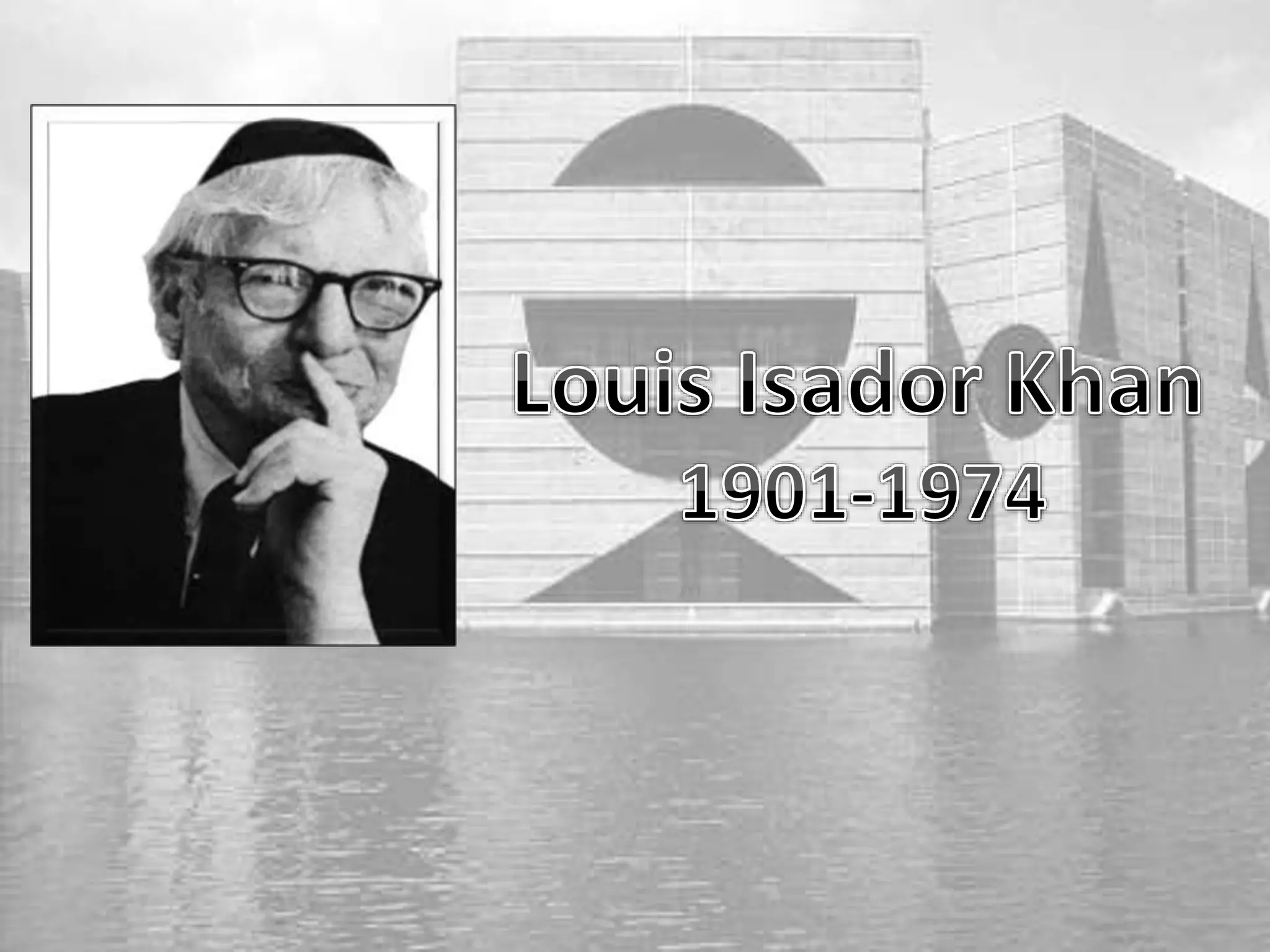
• Louis Isadore Kahn was born in
1901 on the Baltic island of Osel,
Estonia.
• His given name at birth was Itze-
Leib Schmuilowsky but was changed
upon arrival in the US.
• Kahn attended public schools and supplemented
his education with art classes at the local
industrial Art school
Early life
• Completed his bachelor’s degree from
Pennsylvania University in 1924.
•After college, worked as a
senior draftsman in the office
of Philadelphia City Architect John
Molitor.
•To find his inspiration, he traveled
through Europe visiting castles
and medieval strongholds in 1928,
only 4 years after graduating.
•He finally started his own
firm in 1935.
Elements of Design
re-examination of structure
form Space light
•His earlier work abstained from the international
style modernism. Inspired from
greek,roman,egyptian.
•“Louis Kahn described his quest for
meaningful form as a search for
"beginnings,“ a spiritual resource
from which modern man could
draw inspiration”.
Design philosophy
Louis Kahn is credited in re-defining modern architecture in
more than one ways. Forexample:
•Kahn was known to appreciate the appearance and feel of
different materials that he used in his work. He used brick
and concrete extensively .
•Kahn realised the importance of sunlight and was highly
impressed by its usage in Egyptians and Greek works.
•Use extensive geometric shapes and hence we find many
of his buildings taking shape of squares, circles or
triangles.
Louis Kahn's vision on how an architect can make
difference to his design can be seen from the master's
own words :
"A building is like a human, an architect has the
opportunity of creating life. The way the knuckles
and joints come together make each hand
interesting and beautiful. In a building these
details should not be put in a mitten and hidden.
Space is architectural when the evidence of how it
is made is seen and comprehended."
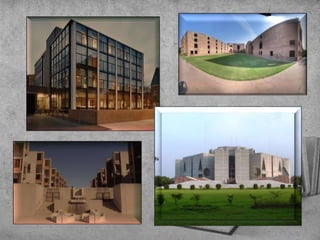
•Yale University Art Gallery, New Haven, Connecticut,(1951–
1953),
•The Salk Institute, La Jolla, California, (1959–1965),
•Jatiyo Sangshad Bhaban (National Assembly Building)
in Dhaka, Bangladesh (1962–1974)
•Indian Institute of Management ,in Ahmedabad,
India (1962).
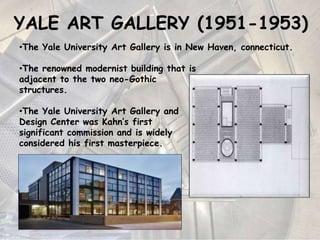
YALE ART GALLERY (1951-1953)
•The Yale University Art Gallery is in New Haven, connecticut.
•The renowned modernist building that is
adjacent to the two neo-Gothic
structures.
•The Yale University Art Gallery and
Design Center was Kahn’s first
significant commission and is widely
considered his first masterpiece.
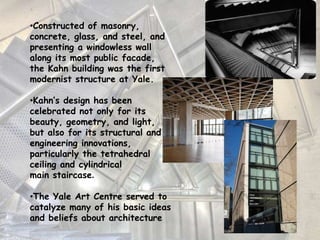
•Constructed of masonry,
concrete, glass, and steel, and
presenting a windowless wall
along its most public facade,
the Kahn building was the first
modernist structure at Yale.
•Kahn’s design has been
celebrated not only for its
beauty, geometry, and light,
but also for its structural and
engineering innovations,
particularly the tetrahedral
ceiling and cylindrical
main staircase.
•The Yale Art Centre served to
catalyze many of his basic ideas
and beliefs about architecture
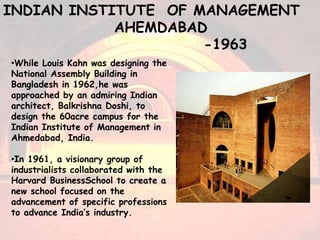
•While Louis Kahn was designing the
National Assembly Building in
Bangladesh in 1962,he was
approached by an admiring Indian
architect, Balkrishna Doshi, to
design the 60acre campus for the
Indian Institute of Management in
Ahmedabad, India.
•In 1961, a visionary group of
industrialists collaborated with the
Harvard BusinessSchool to create a
new school focused on the
advancement of specific professions
to advance India’s industry.
INDIAN INSTITUTE OF MANAGEMENT
AHEMDABAD
-1963
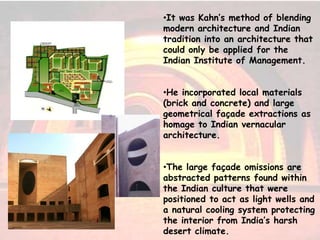
•It was Kahn’s method of blending
modern architecture and Indian
tradition into an architecture that
could only be applied for the
Indian Institute of Management.
•He incorporated local materials
(brick and concrete) and large
geometrical façade extractions as
homage to Indian vernacular
architecture.
•The large façade omissions are
abstracted patterns found within
the Indian culture that were
positioned to act as light wells and
a natural cooling system protecting
the interior from India’s harsh
desert climate.
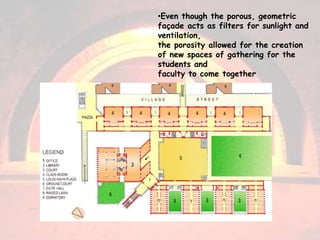
•Even though the porous, geometric
façade acts as filters for sunlight and
ventilation,
the porosity allowed for the creation
of new spaces of gathering for the
students and
faculty to come together
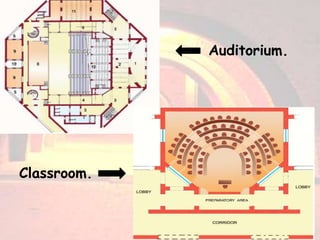
Auditorium.
Classroom.
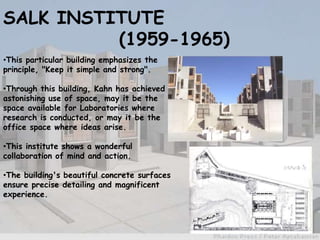
SALK INSTITUTE
(1959-1965)
•This particular building emphasizes the
principle, "Keep it simple and strong".
•Through this building, Kahn has achieved
astonishing use of space, may it be the
space available for Laboratories where
research is conducted, or may it be the
office space where ideas arise.
•This institute shows a wonderful
collaboration of mind and action.
•The building's beautiful concrete surfaces
ensure precise detailing and magnificent
experience.
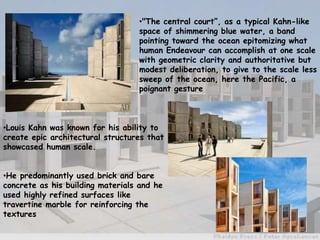
•Louis Kahn was known for his ability to
create epic architectural structures that
showcased human scale.
•He predominantly used brick and bare
concrete as his building materials and he
used highly refined surfaces like
travertine marble for reinforcing the
textures
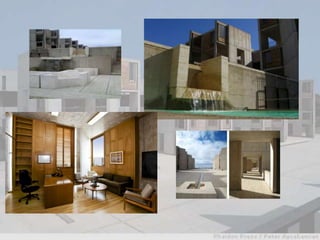
•"The central court”, as a typical Kahn-like
space of shimmering blue water, a band
pointing toward the ocean epitomizing what
human Endeavour can accomplish at one scale
with geometric clarity and authoritative but
modest deliberation, to give to the scale less
sweep of the ocean, here the Pacific, a
poignant gesture
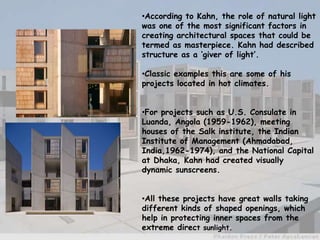
•According to Kahn, the role of natural light
was one of the most significant factors in
creating architectural spaces that could be
termed as masterpiece. Kahn had described
structure as a ‘giver of light’.
•Classic examples this are some of his
projects located in hot climates.
•For projects such as U.S. Consulate in
Luanda, Angola (1959-1962), meeting
houses of the Salk institute, the Indian
Institute of Management (Ahmadabad,
India,1962-1974), and the National Capital
at Dhaka, Kahn had created visually
dynamic sunscreens.
•All these projects have great walls taking
different kinds of shaped openings, which
help in protecting inner spaces from the
extreme direct sunlight.
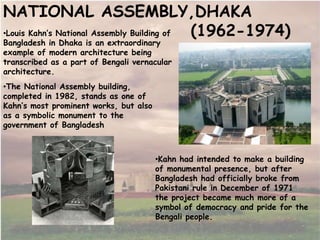
•Louis Kahn’s National Assembly Building of
Bangladesh in Dhaka is an extraordinary
example of modern architecture being
transcribed as a part of Bengali vernacular
architecture.
NATIONAL ASSEMBLY,DHAKA
(1962-1974)
•Kahn had intended to make a building
of monumental presence, but after
Bangladesh had officially broke from
Pakistani rule in December of 1971
the project became much more of a
symbol of democracy and pride for the
Bengali people.
•The National Assembly building,
completed in 1982, stands as one of
Kahn’s most prominent works, but also
as a symbolic monument to the
government of Bangladesh
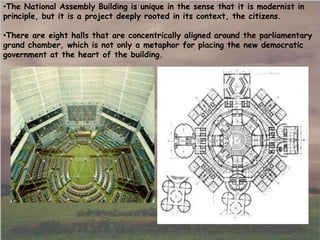
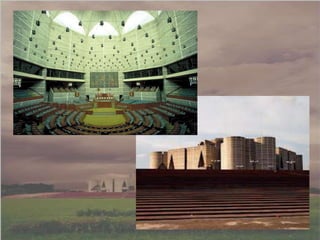
•There are eight halls that are concentrically aligned around the parliamentary
grand chamber, which is not only a metaphor for placing the new democratic
government at the heart of the building.
•The National Assembly Building is unique in the sense that it is modernist in
principle, but it is a project deeply rooted in its context, the citizens.
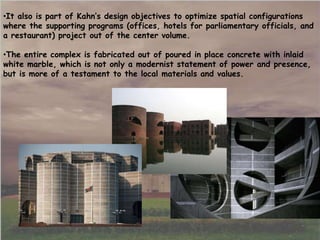
•It also is part of Kahn’s design objectives to optimize spatial configurations
where the supporting programs (offices, hotels for parliamentary officials, and
a restaurant) project out of the center volume.
•The entire complex is fabricated out of poured in place concrete with inlaid
white marble, which is not only a modernist statement of power and presence,
but is more of a testament to the local materials and values.
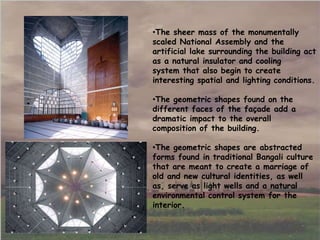
•The sheer mass of the monumentally
scaled National Assembly and the
artificial lake surrounding the building act
as a natural insulator and cooling
system that also begin to create
interesting spatial and lighting conditions.
•The geometric shapes found on the
different faces of the façade add a
dramatic impact to the overall
composition of the building.
•The geometric shapes are abstracted
forms found in traditional Bangali culture
that are meant to create a marriage of
old and new cultural identities, as well
as, serve as light wells and a natural
environmental control system for the
interior.
•Richards Medical Research
Laboratories, University of
Pennsylvania, Philadelphia, Pennsylvania, (1957–
1965),
•First Unitarian Church, Rochester, New
York (1959–1969),.
•Shaheed Suhrawardy Medical College and
Hospital, Dhaka, Bangladesh
•National Institute of Cardiovascular Diseases
(NICVD), Dhaka, Bangladesh (1963)
•Phillips Exeter Academy Library, Exeter, New
Hampshire, (1965–1972), awarded the Twenty-
five Year Award by the American Institute of
Architects in 1997.
•Kimbell Art Museum, Fort Worth, Texas, (1967–
1972),
•Yale Centre for British Art, Yale University, New
Haven, Connecticut, (1969–1974).
Franklin D. Roosevelt Four Freedoms
Park, Roosevelt Island, New York, (1972–1974)
B.VISHWAJA-06
BY:
Louis i khan  ppt

Louis i khan ppt

  • 2.
    • Louis IsadoreKahn was born in 1901 on the Baltic island of Osel, Estonia. • His given name at birth was Itze- Leib Schmuilowsky but was changed upon arrival in the US. • Kahn attended public schools and supplemented his education with art classes at the local industrial Art school Early life
  • 3.
    • Completed hisbachelor’s degree from Pennsylvania University in 1924. •After college, worked as a senior draftsman in the office of Philadelphia City Architect John Molitor. •To find his inspiration, he traveled through Europe visiting castles and medieval strongholds in 1928, only 4 years after graduating. •He finally started his own firm in 1935.
  • 4.
    Elements of Design re-examinationof structure form Space light •His earlier work abstained from the international style modernism. Inspired from greek,roman,egyptian. •“Louis Kahn described his quest for meaningful form as a search for "beginnings,“ a spiritual resource from which modern man could draw inspiration”.
  • 5.
    Design philosophy Louis Kahnis credited in re-defining modern architecture in more than one ways. Forexample: •Kahn was known to appreciate the appearance and feel of different materials that he used in his work. He used brick and concrete extensively . •Kahn realised the importance of sunlight and was highly impressed by its usage in Egyptians and Greek works. •Use extensive geometric shapes and hence we find many of his buildings taking shape of squares, circles or triangles.
  • 6.
    Louis Kahn's visionon how an architect can make difference to his design can be seen from the master's own words : "A building is like a human, an architect has the opportunity of creating life. The way the knuckles and joints come together make each hand interesting and beautiful. In a building these details should not be put in a mitten and hidden. Space is architectural when the evidence of how it is made is seen and comprehended."
  • 8.
    •Yale University ArtGallery, New Haven, Connecticut,(1951– 1953), •The Salk Institute, La Jolla, California, (1959–1965), •Jatiyo Sangshad Bhaban (National Assembly Building) in Dhaka, Bangladesh (1962–1974) •Indian Institute of Management ,in Ahmedabad, India (1962).
  • 10.
    YALE ART GALLERY(1951-1953) •The Yale University Art Gallery is in New Haven, connecticut. •The renowned modernist building that is adjacent to the two neo-Gothic structures. •The Yale University Art Gallery and Design Center was Kahn’s first significant commission and is widely considered his first masterpiece.
  • 11.
    •Constructed of masonry, concrete,glass, and steel, and presenting a windowless wall along its most public facade, the Kahn building was the first modernist structure at Yale. •Kahn’s design has been celebrated not only for its beauty, geometry, and light, but also for its structural and engineering innovations, particularly the tetrahedral ceiling and cylindrical main staircase. •The Yale Art Centre served to catalyze many of his basic ideas and beliefs about architecture
  • 12.
    •While Louis Kahnwas designing the National Assembly Building in Bangladesh in 1962,he was approached by an admiring Indian architect, Balkrishna Doshi, to design the 60acre campus for the Indian Institute of Management in Ahmedabad, India. •In 1961, a visionary group of industrialists collaborated with the Harvard BusinessSchool to create a new school focused on the advancement of specific professions to advance India’s industry. INDIAN INSTITUTE OF MANAGEMENT AHEMDABAD -1963
  • 13.
    •It was Kahn’smethod of blending modern architecture and Indian tradition into an architecture that could only be applied for the Indian Institute of Management. •He incorporated local materials (brick and concrete) and large geometrical façade extractions as homage to Indian vernacular architecture. •The large façade omissions are abstracted patterns found within the Indian culture that were positioned to act as light wells and a natural cooling system protecting the interior from India’s harsh desert climate.
  • 14.
    •Even though theporous, geometric façade acts as filters for sunlight and ventilation, the porosity allowed for the creation of new spaces of gathering for the students and faculty to come together
  • 15.
  • 16.
    SALK INSTITUTE (1959-1965) •This particularbuilding emphasizes the principle, "Keep it simple and strong". •Through this building, Kahn has achieved astonishing use of space, may it be the space available for Laboratories where research is conducted, or may it be the office space where ideas arise. •This institute shows a wonderful collaboration of mind and action. •The building's beautiful concrete surfaces ensure precise detailing and magnificent experience.
  • 17.
    •Louis Kahn wasknown for his ability to create epic architectural structures that showcased human scale. •He predominantly used brick and bare concrete as his building materials and he used highly refined surfaces like travertine marble for reinforcing the textures •"The central court”, as a typical Kahn-like space of shimmering blue water, a band pointing toward the ocean epitomizing what human Endeavour can accomplish at one scale with geometric clarity and authoritative but modest deliberation, to give to the scale less sweep of the ocean, here the Pacific, a poignant gesture
  • 18.
    •According to Kahn,the role of natural light was one of the most significant factors in creating architectural spaces that could be termed as masterpiece. Kahn had described structure as a ‘giver of light’. •Classic examples this are some of his projects located in hot climates. •For projects such as U.S. Consulate in Luanda, Angola (1959-1962), meeting houses of the Salk institute, the Indian Institute of Management (Ahmadabad, India,1962-1974), and the National Capital at Dhaka, Kahn had created visually dynamic sunscreens. •All these projects have great walls taking different kinds of shaped openings, which help in protecting inner spaces from the extreme direct sunlight.
  • 20.
    •Louis Kahn’s NationalAssembly Building of Bangladesh in Dhaka is an extraordinary example of modern architecture being transcribed as a part of Bengali vernacular architecture. NATIONAL ASSEMBLY,DHAKA (1962-1974) •Kahn had intended to make a building of monumental presence, but after Bangladesh had officially broke from Pakistani rule in December of 1971 the project became much more of a symbol of democracy and pride for the Bengali people. •The National Assembly building, completed in 1982, stands as one of Kahn’s most prominent works, but also as a symbolic monument to the government of Bangladesh
  • 21.
    •There are eighthalls that are concentrically aligned around the parliamentary grand chamber, which is not only a metaphor for placing the new democratic government at the heart of the building. •The National Assembly Building is unique in the sense that it is modernist in principle, but it is a project deeply rooted in its context, the citizens.
  • 22.
    •It also ispart of Kahn’s design objectives to optimize spatial configurations where the supporting programs (offices, hotels for parliamentary officials, and a restaurant) project out of the center volume. •The entire complex is fabricated out of poured in place concrete with inlaid white marble, which is not only a modernist statement of power and presence, but is more of a testament to the local materials and values.
  • 23.
    •The sheer massof the monumentally scaled National Assembly and the artificial lake surrounding the building act as a natural insulator and cooling system that also begin to create interesting spatial and lighting conditions. •The geometric shapes found on the different faces of the façade add a dramatic impact to the overall composition of the building. •The geometric shapes are abstracted forms found in traditional Bangali culture that are meant to create a marriage of old and new cultural identities, as well as, serve as light wells and a natural environmental control system for the interior.
  • 26.
    •Richards Medical Research Laboratories,University of Pennsylvania, Philadelphia, Pennsylvania, (1957– 1965), •First Unitarian Church, Rochester, New York (1959–1969),. •Shaheed Suhrawardy Medical College and Hospital, Dhaka, Bangladesh •National Institute of Cardiovascular Diseases (NICVD), Dhaka, Bangladesh (1963)
  • 27.
    •Phillips Exeter AcademyLibrary, Exeter, New Hampshire, (1965–1972), awarded the Twenty- five Year Award by the American Institute of Architects in 1997. •Kimbell Art Museum, Fort Worth, Texas, (1967– 1972), •Yale Centre for British Art, Yale University, New Haven, Connecticut, (1969–1974). Franklin D. Roosevelt Four Freedoms Park, Roosevelt Island, New York, (1972–1974)
  • 29.