Presented by :-
Shivani Goyal
Post Modernism (neo – electic)
Postmodern architecture began
as an international style the first
examples of which are generally
cited as being from the 1950s, but
did not become a movement until
the late 1970s and continues to
influence present day.
Postmodernism, is the term used
to designate a multitude of
trends: in the arts, philosophy,
religion, technology, and many
other areas.
Royal Ontario museum,
Toronto, Canada
POMO is the outcome of:
•Globalisation
•Consumerism
•Commodification of knowledge
Everything served as a package to choose better.
POMO culture rejects the conventional stereotypes in favour of local and sub cultural influences.
POMO characterized by :
Eclecticism ,Historicism, Humour, Irony, Ornament, Pastiche, Wit, Regionalism, COllage
POMO urban space culture is characterized by fragmentation
• Self contained alternative
• Rediscovery of the local
Post - Modernism
Villa savoye AT & T Building
The return of “wit, ornament and reference”
The function and formalized shapes and spaces of the modernist style are replaced by diverse aesthetics.
Perhaps most obviously, architects rediscovered the expressive and symbolic value of architectural
elements and forms that had evolved through centuries of building which had been abandoned by the
modern style.
In Architecture POMO emerged out of
Disenchantment with Modernism
Urban Level : Failure to generate convincing urban development at the level of the city.
Building Level : Denial of effective communication as it failed to provide surprise and delight in architecture.
Who qualify as Post Modernist ?
Architect who
_Has evolved from modernism after having seen its inadequacies
_Opine that modernism failed to transform society
_Declared that modernism’s visual expression in the form of the international style was unappealing.
Two separate sets of responses can be identified
AMERICAN: Post Modernism
EUROPEAN: Rationalism
POMO Limitations
_Limited repertory of forms
_ Spatial issues remain unaddressed
_Prettification of building façade
_Reliance on Modern construction materials and techniques
“POSTMODERNISM”
Need Of An All New Movement -
The post modernist movement began in America around in 1960s – 1970s and then it spread to
europe and to the rest of the world.
Origins in the perceived failure of modern architecture.
Its preoccupation with functionalism and economical building meant that ornaments were gone
away with and the buildings were cloaked in a stark rational appearance.
Many felt the buildings failed to meet the human need for comfort both for body and for the eye,
that modernism did not account for the desire for beauty . The problem worsened when some already
monotonous apartment block degenerated into slums.
In response, architects sought to reintroduce ornament, color, decoration and human scale to
buildings.
Form was no longer to be defined solely by its functional requirements or minimal appearance.
DEBATE AMONGST MODERNIST AND POST
MODERNISTS……
Modernist architects may regard postmodern buildings as vulgar, associated with a populist
ethic. Post modern architects may regard many modern buildings as soulless and bland, overly
simplistic and abstract.
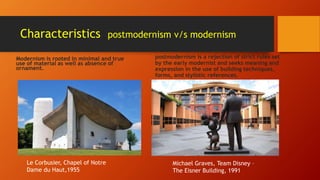
Characteristics postmodernism v/s modernism
Modernism is rooted in minimal and true
use of material as well as absence of
ornament.
postmodernism is a rejection of strict rules set
by the early modernist and seeks meaning and
expression in the use of building techniques,
forms, and stylistic references.
Le Corbusier, Chapel of Notre
Dame du Haut,1955
Michael Graves, Team Disney –
The Eisner Building, 1991
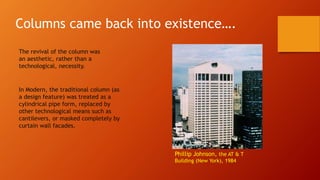
Columns came back into existence….
In Modern, the traditional column (as
a design feature) was treated as a
cylindrical pipe form, replaced by
other technological means such as
cantilevers, or masked completely by
curtain wall facades.
The revival of the column was
an aesthetic, rather than a
technological, necessity.
Phillip Johnson, the AT & T
Building (New York), 1984
Colors came back to the facade
Villa savoye
Piazza d’ Italia
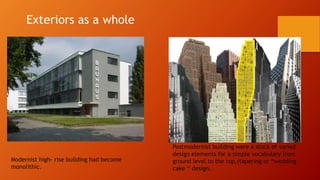
Exteriors as a whole
Modernist high- rise building had become
monolithic.
Postmodernist building were a stock of varied
design elements for a simple vocabulary from
ground level to the top,(tapering or “wedding
cake “ design.
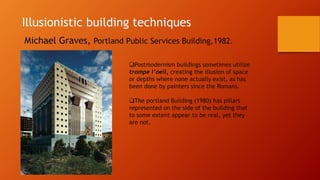
Illusionistic building techniques
Michael Graves, Portland Public Services Building,1982.
Postmodernism buildings sometimes utilize
trompe l’oeil, creating the illusion of space
or depths where none actually exist, as has
been done by painters since the Romans.
The portland Building (1980) has pillars
represented on the side of the building that
to some extent appear to be real, yet they
are not.
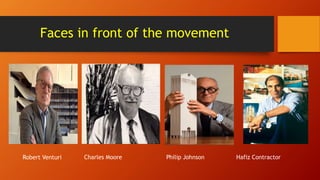
Faces in front of the movement
Robert Venturi Philip Johnson Hafiz ContractorCharles Moore
Robert Charles Venturi
june 25, 1925, Philadeplhia (U.S.)
Father of Post Modernism
The greatest architect of his time, picking up
elements from the past and stretching them,
and combining them in entirely new ways.
“Less is Bore”
Theorized the style
Celebration of the banal elements of the American
urban landscape:
billboards
highways
parking strips
supermarkets
Building Techniques
Venturi’s architecture has had world-wide influence,
beginning in the 1967s with the dissemination of the
broken-gable roof of the Vanna Venturi House and the
segmentally arched window and interrupted string
courses of Guild House.
The façade patterning demonstrated a treatment of
the vertical surfaces of building that is both decorative
and abstract, drawing from vernacular and historic
architecture while still being modern.
Other buildings
Brant house, Connecticut
Trubek & Wislock Houses, Massachussets
Piazza d’ Italia, New Orleans
Gordon Wu hall priceton
Vanna Venturi House
Constructed between (1959-1964)
CHARLES MOORE
Moore preferred conspicuous design features:
 loud color combinations
 Super graphics
 stylistic collisions
 the re-use of esoteric historical-design solutions
 the use of non-traditional materials such as plastic,
(aluminized) PET film, platinum tiles, and neon signs
 Ornament
 Charles Willard Moore (October 31, 1925 – December
16, 1993) was an American architect
Piazza d’ italia, New Orleans
Creation of drama through bright
neon colouring contextualism
Moore’s circular piazza is based on the map of Italy,
built up diagonally from the circle’s center to its
circumference, a cascade of step like forms, making
a rough contour model of Italy’s “Boot”.
A spectacular combination of classical façade,
allegorical earth sculpture, and water.
Other works
Kresge College
Haas school of business
Sea ranch
Beverly hills civic centre
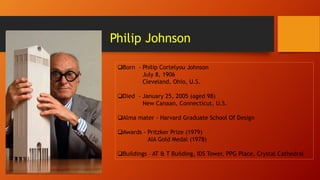
Philip Johnson
Born - Philip Cortelyou Johnson
July 8, 1906
Cleveland, Ohio, U.S.
Died - January 25, 2005 (aged 98)
New Canaan, Connecticut, U.S.
Alma mater - Harvard Graduate School Of Design
Awards - Pritzker Prize (1979)
AIA Gold Medal (1978)
Buildings – AT & T Building, IDS Tower, PPG Place, Crystal Cathedral
AT & T Building (New York), 1984
 The building is a tall skyscraper which brings with it
connotations of very modern technology.
 While the top section conveys elements of classical
antiquity.
Striking repetitive feature
Other works:
Lipstick building
The Crescent
Tycon centre
Gate of Europe
Chapel of St. Basil
Hafiz Contractor
Only architect to become a BRAND
First one to use colors in indian buildings
Creation of an architecture of fantasy
Architecture that belongs to another place
Context emerging from architect’s or client’s imagination &
not from the locale
Skin deep approach
Fascade articulation
Detail modernist interior
IL AND FS CORPORATE OFFICE Hiranandini gardens, Mumbai, India
Some of his other works are:
DLF Pinnacle, Gurgaon.
Beach House, Mandwa.
 Vastu, Mumbai.
Konark Estate, Pune.
 Hiranandani Gardens, Mumbai.
Spagetti, Navi Mumbai.
Gharkul, Navi Mumbai.

Postmodernism

  • 1.
  • 2.
    Post Modernism (neo– electic) Postmodern architecture began as an international style the first examples of which are generally cited as being from the 1950s, but did not become a movement until the late 1970s and continues to influence present day. Postmodernism, is the term used to designate a multitude of trends: in the arts, philosophy, religion, technology, and many other areas. Royal Ontario museum, Toronto, Canada
  • 3.
    POMO is theoutcome of: •Globalisation •Consumerism •Commodification of knowledge Everything served as a package to choose better. POMO culture rejects the conventional stereotypes in favour of local and sub cultural influences. POMO characterized by : Eclecticism ,Historicism, Humour, Irony, Ornament, Pastiche, Wit, Regionalism, COllage POMO urban space culture is characterized by fragmentation • Self contained alternative • Rediscovery of the local
  • 4.
    Post - Modernism Villasavoye AT & T Building The return of “wit, ornament and reference” The function and formalized shapes and spaces of the modernist style are replaced by diverse aesthetics. Perhaps most obviously, architects rediscovered the expressive and symbolic value of architectural elements and forms that had evolved through centuries of building which had been abandoned by the modern style.
  • 5.
    In Architecture POMOemerged out of Disenchantment with Modernism Urban Level : Failure to generate convincing urban development at the level of the city. Building Level : Denial of effective communication as it failed to provide surprise and delight in architecture. Who qualify as Post Modernist ? Architect who _Has evolved from modernism after having seen its inadequacies _Opine that modernism failed to transform society _Declared that modernism’s visual expression in the form of the international style was unappealing.
  • 6.
    Two separate setsof responses can be identified AMERICAN: Post Modernism EUROPEAN: Rationalism POMO Limitations _Limited repertory of forms _ Spatial issues remain unaddressed _Prettification of building façade _Reliance on Modern construction materials and techniques
  • 7.
    “POSTMODERNISM” Need Of AnAll New Movement - The post modernist movement began in America around in 1960s – 1970s and then it spread to europe and to the rest of the world. Origins in the perceived failure of modern architecture. Its preoccupation with functionalism and economical building meant that ornaments were gone away with and the buildings were cloaked in a stark rational appearance. Many felt the buildings failed to meet the human need for comfort both for body and for the eye, that modernism did not account for the desire for beauty . The problem worsened when some already monotonous apartment block degenerated into slums. In response, architects sought to reintroduce ornament, color, decoration and human scale to buildings. Form was no longer to be defined solely by its functional requirements or minimal appearance.
  • 8.
    DEBATE AMONGST MODERNISTAND POST MODERNISTS…… Modernist architects may regard postmodern buildings as vulgar, associated with a populist ethic. Post modern architects may regard many modern buildings as soulless and bland, overly simplistic and abstract.
  • 9.
    Characteristics postmodernism v/smodernism Modernism is rooted in minimal and true use of material as well as absence of ornament. postmodernism is a rejection of strict rules set by the early modernist and seeks meaning and expression in the use of building techniques, forms, and stylistic references. Le Corbusier, Chapel of Notre Dame du Haut,1955 Michael Graves, Team Disney – The Eisner Building, 1991
  • 10.
    Columns came backinto existence…. In Modern, the traditional column (as a design feature) was treated as a cylindrical pipe form, replaced by other technological means such as cantilevers, or masked completely by curtain wall facades. The revival of the column was an aesthetic, rather than a technological, necessity. Phillip Johnson, the AT & T Building (New York), 1984
  • 11.
    Colors came backto the facade Villa savoye Piazza d’ Italia
  • 12.
    Exteriors as awhole Modernist high- rise building had become monolithic. Postmodernist building were a stock of varied design elements for a simple vocabulary from ground level to the top,(tapering or “wedding cake “ design.
  • 13.
    Illusionistic building techniques MichaelGraves, Portland Public Services Building,1982. Postmodernism buildings sometimes utilize trompe l’oeil, creating the illusion of space or depths where none actually exist, as has been done by painters since the Romans. The portland Building (1980) has pillars represented on the side of the building that to some extent appear to be real, yet they are not.
  • 14.
    Faces in frontof the movement Robert Venturi Philip Johnson Hafiz ContractorCharles Moore
  • 15.
    Robert Charles Venturi june25, 1925, Philadeplhia (U.S.) Father of Post Modernism The greatest architect of his time, picking up elements from the past and stretching them, and combining them in entirely new ways. “Less is Bore” Theorized the style Celebration of the banal elements of the American urban landscape: billboards highways parking strips supermarkets
  • 16.
    Building Techniques Venturi’s architecturehas had world-wide influence, beginning in the 1967s with the dissemination of the broken-gable roof of the Vanna Venturi House and the segmentally arched window and interrupted string courses of Guild House. The façade patterning demonstrated a treatment of the vertical surfaces of building that is both decorative and abstract, drawing from vernacular and historic architecture while still being modern. Other buildings Brant house, Connecticut Trubek & Wislock Houses, Massachussets Piazza d’ Italia, New Orleans Gordon Wu hall priceton Vanna Venturi House Constructed between (1959-1964)
  • 17.
    CHARLES MOORE Moore preferredconspicuous design features:  loud color combinations  Super graphics  stylistic collisions  the re-use of esoteric historical-design solutions  the use of non-traditional materials such as plastic, (aluminized) PET film, platinum tiles, and neon signs  Ornament  Charles Willard Moore (October 31, 1925 – December 16, 1993) was an American architect
  • 18.
    Piazza d’ italia,New Orleans Creation of drama through bright neon colouring contextualism Moore’s circular piazza is based on the map of Italy, built up diagonally from the circle’s center to its circumference, a cascade of step like forms, making a rough contour model of Italy’s “Boot”. A spectacular combination of classical façade, allegorical earth sculpture, and water. Other works Kresge College Haas school of business Sea ranch Beverly hills civic centre
  • 19.
    Philip Johnson Born -Philip Cortelyou Johnson July 8, 1906 Cleveland, Ohio, U.S. Died - January 25, 2005 (aged 98) New Canaan, Connecticut, U.S. Alma mater - Harvard Graduate School Of Design Awards - Pritzker Prize (1979) AIA Gold Medal (1978) Buildings – AT & T Building, IDS Tower, PPG Place, Crystal Cathedral
  • 20.
    AT & TBuilding (New York), 1984  The building is a tall skyscraper which brings with it connotations of very modern technology.  While the top section conveys elements of classical antiquity. Striking repetitive feature Other works: Lipstick building The Crescent Tycon centre Gate of Europe Chapel of St. Basil
  • 21.
    Hafiz Contractor Only architectto become a BRAND First one to use colors in indian buildings Creation of an architecture of fantasy Architecture that belongs to another place Context emerging from architect’s or client’s imagination & not from the locale Skin deep approach Fascade articulation Detail modernist interior
  • 22.
    IL AND FSCORPORATE OFFICE Hiranandini gardens, Mumbai, India Some of his other works are: DLF Pinnacle, Gurgaon. Beach House, Mandwa.  Vastu, Mumbai. Konark Estate, Pune.  Hiranandani Gardens, Mumbai. Spagetti, Navi Mumbai. Gharkul, Navi Mumbai.