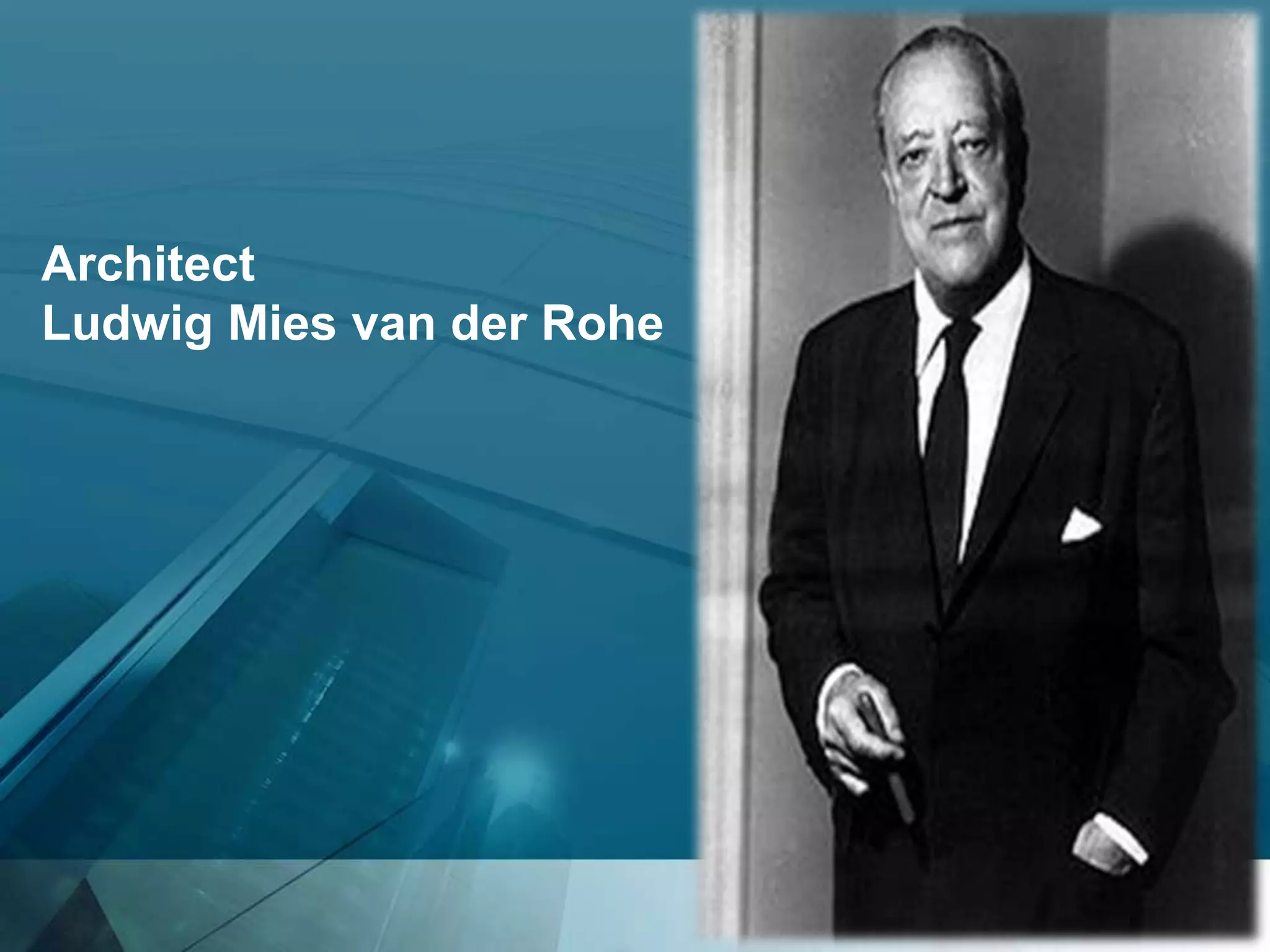
Architect
Ludwig Mies van der Rohe
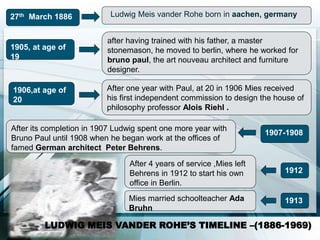
27th March 1886 Ludwig Meis vander Rohe born in aachen, germany
1905, at age of
19
LUDWIG MEIS VANDER ROHE’S TIMELINE –(1886-1969)
after having trained with his father, a master
stonemason, he moved to berlin, where he worked for
bruno paul, the art nouveau architect and furniture
designer.
1906,at age of
20
After one year with Paul, at 20 in 1906 Mies received
his first independent commission to design the house of
philosophy professor Alois Riehl .
1907-1908
After its completion in 1907 Ludwig spent one more year with
Bruno Paul until 1908 when he began work at the offices of
famed German architect Peter Behrens.
1912
After 4 years of service ,Mies left
Behrens in 1912 to start his own
office in Berlin.
1913Mies married schoolteacher Ada
Bruhn
LUDWIG MEIS VANDER ROHE’S TIMELINE –(1886-1969)
1919 -
1921
after world war I (1914-1918), he began studying the skyscraper and
designed two innovative steel-framed towers encased in glass. one
of them was the friedrichstrasse skyscraper, designed in 1921 for
a competition, though it was never built.
1921
Being a man of solitude and intense artistic passion, the marriage
was characterized by distance. By 1921 he completely separated
himself from his family. It was at this time that he adopted the last
name of Mies van der Rohe ,an amalgamation of his father’s last
name combined with the Dutch “van der” in addition to his
mother’s maiden name “Rohe”.
1920s-
1930s
In late 1920s and 1930s he made as artistic director of weissenhof
project, a model housing colony in stuttgart. the modern apartments
and houses were designed by leading european architects, including
a block by mies.
1927-
1929
in 1927 he designed one of his most famous buildings, the german
pavilion at the international exposition in barcelona in 1929.
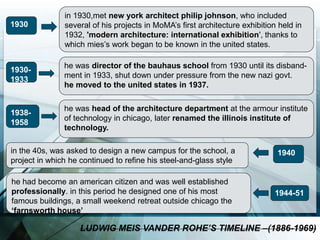
1930
in 1930,met new york architect philip johnson, who included
several of his projects in MoMA’s first architecture exhibition held in
1932, 'modern architecture: international exhibition', thanks to
which mies’s work began to be known in the united states.
1930-
1933
he was director of the bauhaus school from 1930 until its disband-
ment in 1933, shut down under pressure from the new nazi govt.
he moved to the united states in 1937.
1938-
1958
he was head of the architecture department at the armour institute
of technology in chicago, later renamed the illinois institute of
technology.
1940in the 40s, was asked to design a new campus for the school, a
project in which he continued to refine his steel-and-glass style
1944-51
he had become an american citizen and was well established
professionally. in this period he designed one of his most
famous buildings, a small weekend retreat outside chicago the
‘farnsworth house’
LUDWIG MEIS VANDER ROHE’S TIMELINE –(1886-1969)
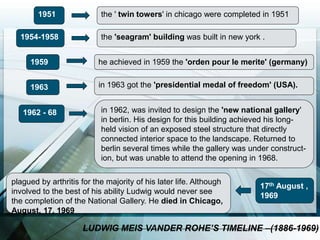
1951 the ' twin towers' in chicago were completed in 1951
1954-1958 the 'seagram' building was built in new york .
he achieved in 1959 the 'orden pour le merite' (germany)1959
1963 in 1963 got the 'presidential medal of freedom' (USA).
1962 - 68 in 1962, was invited to design the 'new national gallery'
in berlin. His design for this building achieved his long-
held vision of an exposed steel structure that directly
connected interior space to the landscape. Returned to
berlin several times while the gallery was under construct-
ion, but was unable to attend the opening in 1968.
17th August ,
1969
plagued by arthritis for the majority of his later life. Although
involved to the best of his ability Ludwig would never see
the completion of the National Gallery. He died in Chicago,
August, 17, 1969
LUDWIG MEIS VANDER ROHE’S TIMELINE –(1886-1969)
DESIGN PHILOSOPHY M
I
E
S
V
A
N
D
E
R
R
O
H
E
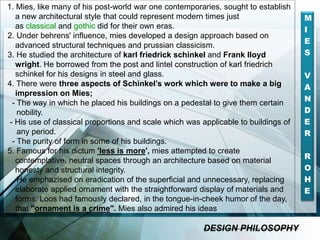
1. Mies, like many of his post-world war one contemporaries, sought to establish
a new architectural style that could represent modern times just
as classical and gothic did for their own eras.
2. Under behrens' influence, mies developed a design approach based on
advanced structural techniques and prussian classicism.
3. He studied the architecture of karl friedrick schinkel and Frank lloyd
wright. He borrowed from the post and lintel construction of karl friedrich
schinkel for his designs in steel and glass.
4. There were three aspects of Schinkel’s work which were to make a big
impression on Mies;
- The way in which he placed his buildings on a pedestal to give them certain
nobility.
- His use of classical proportions and scale which was applicable to buildings of
any period.
- The purity of form in some of his buildings.
5. Famous for his dictum 'less is more', mies attempted to create
contemplative, neutral spaces through an architecture based on material
honesty and structural integrity.
He emphazised on eradication of the superficial and unnecessary, replacing
elaborate applied ornament with the straightforward display of materials and
forms. Loos had famously declared, in the tongue-in-cheek humor of the day,
that "ornament is a crime". Mies also admired his ideas
DESIGN PHILOSOPHY
M
I
E
S
V
A
N
D
E
R
R
O
H
E
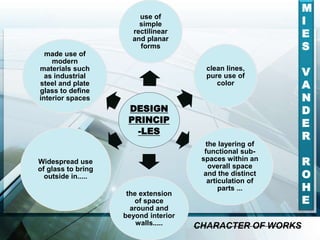
DESIGN
PRINCIP
-LES
use of
simple
rectilinear
and planar
forms
clean lines,
pure use of
color
the layering of
functional sub-
spaces within an
overall space
and the distinct
articulation of
parts ...
the extension
of space
around and
beyond interior
walls.....
Widespread use
of glass to bring
outside in.....
made use of
modern
materials such
as industrial
steel and plate
glass to define
interior spaces
CHARACTER OF WORKS
M
I
E
S
V
A
N
D
E
R
R
O
H
E
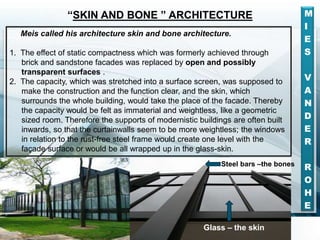
Meis called his architecture skin and bone architecture.
1. The effect of static compactness which was formerly achieved through
brick and sandstone facades was replaced by open and possibly
transparent surfaces .
2. The capacity, which was stretched into a surface screen, was supposed to
make the construction and the function clear, and the skin, which
surrounds the whole building, would take the place of the facade. Thereby
the capacity would be felt as immaterial and weightless, like a geometric
sized room. Therefore the supports of modernistic buildings are often built
inwards, so that the curtainwalls seem to be more weightless; the windows
in relation to the rust-free steel frame would create one level with the
façade surface or would be all wrapped up in the glass-skin.
“SKIN AND BONE ” ARCHITECTURE
Steel bars –the bones
Glass – the skin
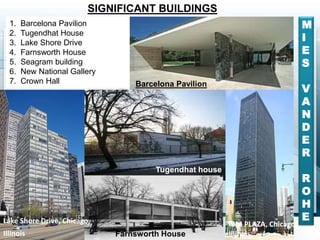
1. Barcelona Pavilion
2. Tugendhat House
3. Lake Shore Drive
4. Farnsworth House
5. Seagram building
6. New National Gallery
7. Crown Hall
SIGNIFICANT BUILDINGS
Lake Shore Drive, Chicago,
Illinois Farnsworth House
IBM PLAZA, Chicago,
Illinois
Tugendhat house
Barcelona Pavilion
M
I
E
S
V
A
N
D
E
R
R
O
H
E
CANADA
1. Toronto-Dominion Centre - Office Tower Complex, Toronto
2. Westmount Square - Office & Residential Tower Complex,Westmount
3. Nuns' Island - 3 Residential Towers & Esso Service Station (Closed), Nuns'
Island, Montreal
CZECH REPUBLIC
1. Tugendhat House - Residential Home, Brno
GERMANY
1. Riehl House- Residential Home, Potsdam (1907)
2. Peris House- Residential Home, Zehlendorf(1911)
3. Werner House - Residential Home, Zehlendorf (1913)
4. Urbig House - Residential Home, Potsdam (1917)
5. Kempner House - Residential Home, Charlottenburg(1922)
MEXICO
1 Bacardi office building- office building, mexico city , spain
2. Barcelona pavilion- world's fair pavilion, barcelona
M
I
E
S
V
A
N
D
E
R
R
O
H
E
NOTABLE WORKS
UNITED STATES
1. the promontory apartments - residential apartment complex, chicago
2. martin luther king, jr. memorial library - district of columbia public library,
washington,dc
3. richard king mellon hall of science - duquesne university, pittsburgh
4. ibm plaza - office tower, chicago
5. lake shore drive apartments - residential apartment towers, chicago.
6. school of social services administration, university of chicago (1965)
7. farnsworth house - residential home, plano, illinois
8. chicago federal center
9. dirksen federal building - office tower, chicago
10. kluczynski federal building - office tower, chicago
11. united states post office loop station - general post office, chicago
12. one illinois center - office tower, chicago
13. one charles center - office tower, baltimore, maryland
M
I
E
S
V
A
N
D
E
R
R
O
H
E
NOTABLE WORKS
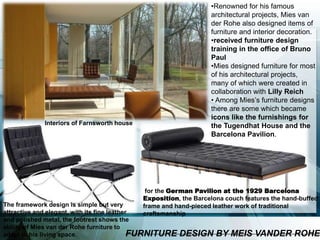
for the German Pavilion at the 1929 Barcelona
Exposition, the Barcelona couch features the hand-buffed
frame and hand-pieced leather work of traditional
craftsmanship
The framework design is simple but very
attractive and elegant, with its fine leather
and polished metal, the footrest shows the
ability of Mies van der Rohe furniture to
adapt to his living space. FURNITURE DESIGN BY MEIS VANDER ROHE
•Renowned for his famous
architectural projects, Mies van
der Rohe also designed items of
furniture and interior decoration.
•received furniture design
training in the office of Bruno
Paul
•Mies designed furniture for most
of his architectural projects,
many of which were created in
collaboration with Lilly Reich
• Among Mies’s furniture designs
there are some which became
icons like the furnishings for
the Tugendhat House and the
Barcelona Pavilion.
Interiors of Farnsworth house
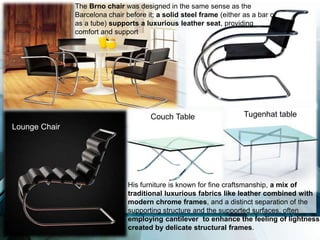
The Brno chair was designed in the same sense as the
Barcelona chair before it; a solid steel frame (either as a bar or
as a tube) supports a luxurious leather seat, providing
comfort and support
Lounge Chair
Couch Table Tugenhat table
His furniture is known for fine craftsmanship, a mix of
traditional luxurious fabrics like leather combined with
modern chrome frames, and a distinct separation of the
supporting structure and the supported surfaces, often
employing cantilever to enhance the feeling of lightness
created by delicate structural frames.
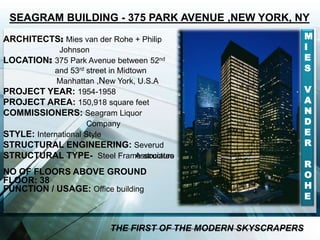
ARCHITECTS: Mies van der Rohe + Philip
Johnson
LOCATION: 375 Park Avenue between 52nd
and 53rd street in Midtown
Manhattan ,New York, U.S.A
PROJECT YEAR: 1954-1958
PROJECT AREA: 150,918 square feet
COMMISSIONERS: Seagram Liquor
Company
STYLE: International Style
STRUCTURAL ENGINEERING: Severud
AssociatesSTRUCTURAL TYPE- Steel Frame structure
NO OF FLOORS ABOVE GROUND
FLOOR: 38
FUNCTION / USAGE: Office building
SEAGRAM BUILDING - 375 PARK AVENUE ,NEW YORK, NY
M
I
E
S
V
A
N
D
E
R
R
O
H
E
THE FIRST OF THE MODERN SKYSCRAPERS
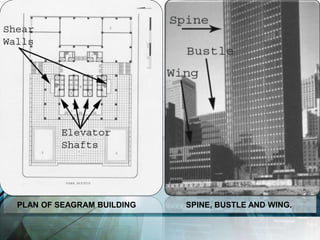
PLAN OF SEAGRAM BUILDING SPINE, BUSTLE AND WING.
ARCHITECTURE
1. The plan of the building is based on a 8.50 m grid, pursued to unprecedented
Miesian accuracy.
2. The elevator core is placed to the back of the building, forming the protruding,
windowless back wall of the tower.
3. Set on bronze-clad pillars, the 38-storey facade consists of alternating bands of
bronze plating and "whisky brown"-tinted glass .
THE FAÇADE - Another interesting feature of the Seagram Building is
the window blinds. Mies wanted the building to have a uniform appearance.
Mies disliked disordered irregularity in facade when window blinds are drawn.
Inevitably, people using different windows will draw blinds to different heights,
making the building appear disorganized. To reduce this disproportionate
appearance, Mie specified window blinds
which only operated in three positions – fully
open, halfway open / closed or fully closed .
THE STRUCTURE - The 38-story structure
combines a steel moment frame and a steel
and reinforced concrete core for lateral
stiffness. The concrete core shear walls extend
up to the 17th floor, and diagonal core bracing
(shear trusses) extends to the 29th floor.
M
I
E
S
V
A
N
D
E
R
R
O
H
E
first tall building to use high strength bolted connections
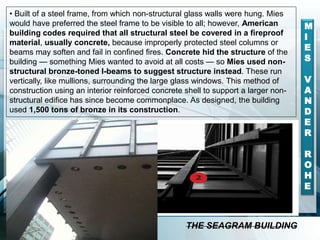
• Built of a steel frame, from which non-structural glass walls were hung. Mies
would have preferred the steel frame to be visible to all; however, American
building codes required that all structural steel be covered in a fireproof
material, usually concrete, because improperly protected steel columns or
beams may soften and fail in confined fires. Concrete hid the structure of the
building — something Mies wanted to avoid at all costs — so Mies used non-
structural bronze-toned I-beams to suggest structure instead. These run
vertically, like mullions, surrounding the large glass windows. This method of
construction using an interior reinforced concrete shell to support a larger non-
structural edifice has since become commonplace. As designed, the building
used 1,500 tons of bronze in its construction.
M
I
E
S
V
A
N
D
E
R
R
O
H
E
THE SEAGRAM BUILDING
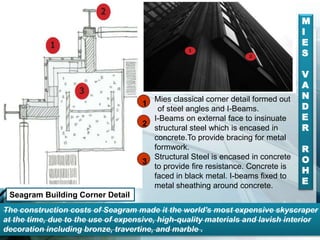
Mies classical corner detail formed out
of steel angles and I-Beams.
I-Beams on external face to insinuate
structural steel which is encased in
concrete.To provide bracing for metal
formwork.
Structural Steel is encased in concrete
to provide fire resistance. Concrete is
faced in black metal. I-beams fixed to
metal sheathing around concrete.
1
2
3
Seagram Building Corner Detail
The construction costs of Seagram made it the world's most expensive skyscraper
at the time, due to the use of expensive, high-quality materials and lavish interior
decoration including bronze, travertine, and marble .
M
I
E
S
V
A
N
D
E
R
R
O
H
E
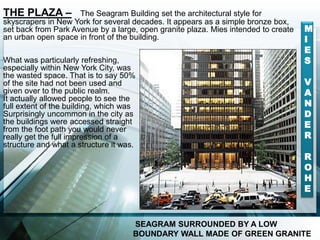
THE PLAZA – The Seagram Building set the architectural style for
skyscrapers in New York for several decades. It appears as a simple bronze box,
set back from Park Avenue by a large, open granite plaza. Mies intended to create
an urban open space in front of the building.
What was particularly refreshing,
especially within New York City, was
the wasted space. That is to say 50%
of the site had not been used and
given over to the public realm.
It actually allowed people to see the
full extent of the building, which was
Surprisingly uncommon in the city as
the buildings were accessed straight
from the foot path you would never
really get the full impression of a
structure and what a structure it was.
SEAGRAM SURROUNDED BY A LOW
BOUNDARY WALL MADE OF GREEN GRANITE
M
I
E
S
V
A
N
D
E
R
R
O
H
E
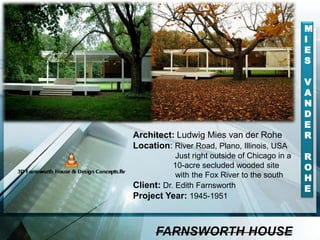
Architect: Ludwig Mies van der Rohe
Location: River Road, Plano, Illinois, USA
Just right outside of Chicago in a
10-acre secluded wooded site
with the Fox River to the south
Client: Dr. Edith Farnsworth
Project Year: 1945-1951
FARNSWORTH HOUSE
M
I
E
S
V
A
N
D
E
R
R
O
H
E
As an architect of ever increasing popularity, Mies ‘had’ to attend certain social
functions. At one of these event Mies had met a woman call Dr. Edith
Farnsworth, and soon became good friends. Dr. Farnsworth had bought a large
plot of land on the Fox River in Plano, Illinois and asked Mies if he would
design for her, a weekend house. The design and construction of this house took
6 years in total, with it being finally completed in 1951.
THE CONCEPT - “Nature, too, shall live its own life. We must beware not to
disrupt it with the color of our houses and interior fittings. Yet we should attempt to
bring nature, houses, and human beings together into a higher unity.”
Mies’s best example to date of his design philosophy, where the beauty lay in
the honesty of a monolithic structure
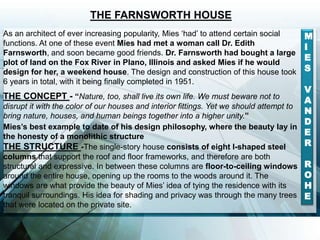
THE STRUCTURE -The single-story house consists of eight I-shaped steel
columns that support the roof and floor frameworks, and therefore are both
structural and expressive. In between these columns are floor-to-ceiling windows
around the entire house, opening up the rooms to the woods around it. The
windows are what provide the beauty of Mies’ idea of tying the residence with its
tranquil surroundings. His idea for shading and privacy was through the many trees
that were located on the private site.
THE FARNSWORTH HOUSE
M
I
E
S
V
A
N
D
E
R
R
O
H
E
WHY DID MEIS RAISED THE HOUSE ??
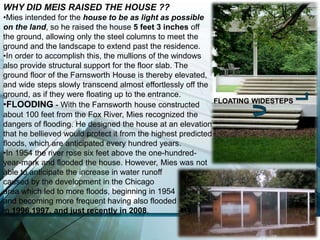
•Mies intended for the house to be as light as possible
on the land, so he raised the house 5 feet 3 inches off
the ground, allowing only the steel columns to meet the
ground and the landscape to extend past the residence.
•In order to accomplish this, the mullions of the windows
also provide structural support for the floor slab. The
ground floor of the Farnsworth House is thereby elevated,
and wide steps slowly transcend almost effortlessly off the
ground, as if they were floating up to the entrance.
•FLOODING - With the Farnsworth house constructed
about 100 feet from the Fox River, Mies recognized the
dangers of flooding. He designed the house at an elevation
that he bellieved would protect it from the highest predicted
floods, which are anticipated every hundred years.
•In 1954 the river rose six feet above the one-hundred-
year-mark and flooded the house. However, Mies was not
able to anticipate the increase in water runoff
caused by the development in the Chicago
area which led to more floods, beginning in 1954
and becoming more frequent having also flooded
in 1996,1997, and just recently in 2008.
.
FLOATING WIDESTEPS
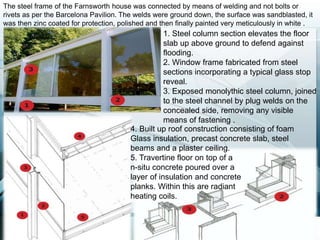
1. Steel column section elevates the floor
slab up above ground to defend against
flooding.
2. Window frame fabricated from steel
sections incorporating a typical glass stop
reveal.
3. Exposed monolythic steel column, joined
to the steel channel by plug welds on the
concealed side, removing any visible
means of fastening .
4. Built up roof construction consisting of foam
Glass insulation, precast concrete slab, steel
beams and a plaster ceiling.
5. Travertine floor on top of a
n-situ concrete poured over a
layer of insulation and concrete
planks. Within this are radiant
heating coils.
The steel frame of the Farnsworth house was connected by means of welding and not bolts or
rivets as per the Barcelona Pavilion. The welds were ground down, the surface was sandblasted, it
was then zinc coated for protection, polished and then finally painted very meticulously in white .
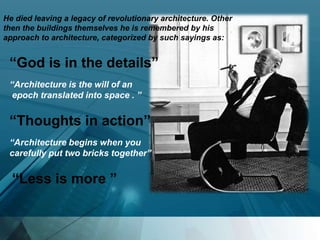
“God is in the details”
“Architecture is the will of an
epoch translated into space . ”
“Thoughts in action”
“Architecture begins when you
carefully put two bricks together”
“Less is more ”
He died leaving a legacy of revolutionary architecture. Other
then the buildings themselves he is remembered by his
approach to architecture, categorized by such sayings as:

Architect Meis vander rohe

  • 1.
  • 2.
    27th March 1886Ludwig Meis vander Rohe born in aachen, germany 1905, at age of 19 LUDWIG MEIS VANDER ROHE’S TIMELINE –(1886-1969) after having trained with his father, a master stonemason, he moved to berlin, where he worked for bruno paul, the art nouveau architect and furniture designer. 1906,at age of 20 After one year with Paul, at 20 in 1906 Mies received his first independent commission to design the house of philosophy professor Alois Riehl . 1907-1908 After its completion in 1907 Ludwig spent one more year with Bruno Paul until 1908 when he began work at the offices of famed German architect Peter Behrens. 1912 After 4 years of service ,Mies left Behrens in 1912 to start his own office in Berlin. 1913Mies married schoolteacher Ada Bruhn
  • 3.
    LUDWIG MEIS VANDERROHE’S TIMELINE –(1886-1969) 1919 - 1921 after world war I (1914-1918), he began studying the skyscraper and designed two innovative steel-framed towers encased in glass. one of them was the friedrichstrasse skyscraper, designed in 1921 for a competition, though it was never built. 1921 Being a man of solitude and intense artistic passion, the marriage was characterized by distance. By 1921 he completely separated himself from his family. It was at this time that he adopted the last name of Mies van der Rohe ,an amalgamation of his father’s last name combined with the Dutch “van der” in addition to his mother’s maiden name “Rohe”. 1920s- 1930s In late 1920s and 1930s he made as artistic director of weissenhof project, a model housing colony in stuttgart. the modern apartments and houses were designed by leading european architects, including a block by mies. 1927- 1929 in 1927 he designed one of his most famous buildings, the german pavilion at the international exposition in barcelona in 1929.
  • 4.
    1930 in 1930,met newyork architect philip johnson, who included several of his projects in MoMA’s first architecture exhibition held in 1932, 'modern architecture: international exhibition', thanks to which mies’s work began to be known in the united states. 1930- 1933 he was director of the bauhaus school from 1930 until its disband- ment in 1933, shut down under pressure from the new nazi govt. he moved to the united states in 1937. 1938- 1958 he was head of the architecture department at the armour institute of technology in chicago, later renamed the illinois institute of technology. 1940in the 40s, was asked to design a new campus for the school, a project in which he continued to refine his steel-and-glass style 1944-51 he had become an american citizen and was well established professionally. in this period he designed one of his most famous buildings, a small weekend retreat outside chicago the ‘farnsworth house’ LUDWIG MEIS VANDER ROHE’S TIMELINE –(1886-1969)
  • 5.
    1951 the 'twin towers' in chicago were completed in 1951 1954-1958 the 'seagram' building was built in new york . he achieved in 1959 the 'orden pour le merite' (germany)1959 1963 in 1963 got the 'presidential medal of freedom' (USA). 1962 - 68 in 1962, was invited to design the 'new national gallery' in berlin. His design for this building achieved his long- held vision of an exposed steel structure that directly connected interior space to the landscape. Returned to berlin several times while the gallery was under construct- ion, but was unable to attend the opening in 1968. 17th August , 1969 plagued by arthritis for the majority of his later life. Although involved to the best of his ability Ludwig would never see the completion of the National Gallery. He died in Chicago, August, 17, 1969 LUDWIG MEIS VANDER ROHE’S TIMELINE –(1886-1969)
  • 6.
    DESIGN PHILOSOPHY M I E S V A N D E R R O H E 1.Mies, like many of his post-world war one contemporaries, sought to establish a new architectural style that could represent modern times just as classical and gothic did for their own eras. 2. Under behrens' influence, mies developed a design approach based on advanced structural techniques and prussian classicism. 3. He studied the architecture of karl friedrick schinkel and Frank lloyd wright. He borrowed from the post and lintel construction of karl friedrich schinkel for his designs in steel and glass. 4. There were three aspects of Schinkel’s work which were to make a big impression on Mies; - The way in which he placed his buildings on a pedestal to give them certain nobility. - His use of classical proportions and scale which was applicable to buildings of any period. - The purity of form in some of his buildings. 5. Famous for his dictum 'less is more', mies attempted to create contemplative, neutral spaces through an architecture based on material honesty and structural integrity. He emphazised on eradication of the superficial and unnecessary, replacing elaborate applied ornament with the straightforward display of materials and forms. Loos had famously declared, in the tongue-in-cheek humor of the day, that "ornament is a crime". Mies also admired his ideas DESIGN PHILOSOPHY
  • 7.
    M I E S V A N D E R R O H E DESIGN PRINCIP -LES use of simple rectilinear and planar forms cleanlines, pure use of color the layering of functional sub- spaces within an overall space and the distinct articulation of parts ... the extension of space around and beyond interior walls..... Widespread use of glass to bring outside in..... made use of modern materials such as industrial steel and plate glass to define interior spaces CHARACTER OF WORKS
  • 8.
    M I E S V A N D E R R O H E Meis called hisarchitecture skin and bone architecture. 1. The effect of static compactness which was formerly achieved through brick and sandstone facades was replaced by open and possibly transparent surfaces . 2. The capacity, which was stretched into a surface screen, was supposed to make the construction and the function clear, and the skin, which surrounds the whole building, would take the place of the facade. Thereby the capacity would be felt as immaterial and weightless, like a geometric sized room. Therefore the supports of modernistic buildings are often built inwards, so that the curtainwalls seem to be more weightless; the windows in relation to the rust-free steel frame would create one level with the façade surface or would be all wrapped up in the glass-skin. “SKIN AND BONE ” ARCHITECTURE Steel bars –the bones Glass – the skin
  • 9.
    1. Barcelona Pavilion 2.Tugendhat House 3. Lake Shore Drive 4. Farnsworth House 5. Seagram building 6. New National Gallery 7. Crown Hall SIGNIFICANT BUILDINGS Lake Shore Drive, Chicago, Illinois Farnsworth House IBM PLAZA, Chicago, Illinois Tugendhat house Barcelona Pavilion M I E S V A N D E R R O H E
  • 10.
    CANADA 1. Toronto-Dominion Centre- Office Tower Complex, Toronto 2. Westmount Square - Office & Residential Tower Complex,Westmount 3. Nuns' Island - 3 Residential Towers & Esso Service Station (Closed), Nuns' Island, Montreal CZECH REPUBLIC 1. Tugendhat House - Residential Home, Brno GERMANY 1. Riehl House- Residential Home, Potsdam (1907) 2. Peris House- Residential Home, Zehlendorf(1911) 3. Werner House - Residential Home, Zehlendorf (1913) 4. Urbig House - Residential Home, Potsdam (1917) 5. Kempner House - Residential Home, Charlottenburg(1922) MEXICO 1 Bacardi office building- office building, mexico city , spain 2. Barcelona pavilion- world's fair pavilion, barcelona M I E S V A N D E R R O H E NOTABLE WORKS
  • 11.
    UNITED STATES 1. thepromontory apartments - residential apartment complex, chicago 2. martin luther king, jr. memorial library - district of columbia public library, washington,dc 3. richard king mellon hall of science - duquesne university, pittsburgh 4. ibm plaza - office tower, chicago 5. lake shore drive apartments - residential apartment towers, chicago. 6. school of social services administration, university of chicago (1965) 7. farnsworth house - residential home, plano, illinois 8. chicago federal center 9. dirksen federal building - office tower, chicago 10. kluczynski federal building - office tower, chicago 11. united states post office loop station - general post office, chicago 12. one illinois center - office tower, chicago 13. one charles center - office tower, baltimore, maryland M I E S V A N D E R R O H E NOTABLE WORKS
  • 12.
    for the GermanPavilion at the 1929 Barcelona Exposition, the Barcelona couch features the hand-buffed frame and hand-pieced leather work of traditional craftsmanship The framework design is simple but very attractive and elegant, with its fine leather and polished metal, the footrest shows the ability of Mies van der Rohe furniture to adapt to his living space. FURNITURE DESIGN BY MEIS VANDER ROHE •Renowned for his famous architectural projects, Mies van der Rohe also designed items of furniture and interior decoration. •received furniture design training in the office of Bruno Paul •Mies designed furniture for most of his architectural projects, many of which were created in collaboration with Lilly Reich • Among Mies’s furniture designs there are some which became icons like the furnishings for the Tugendhat House and the Barcelona Pavilion. Interiors of Farnsworth house
  • 13.
    The Brno chairwas designed in the same sense as the Barcelona chair before it; a solid steel frame (either as a bar or as a tube) supports a luxurious leather seat, providing comfort and support Lounge Chair Couch Table Tugenhat table His furniture is known for fine craftsmanship, a mix of traditional luxurious fabrics like leather combined with modern chrome frames, and a distinct separation of the supporting structure and the supported surfaces, often employing cantilever to enhance the feeling of lightness created by delicate structural frames.
  • 14.
    ARCHITECTS: Mies vander Rohe + Philip Johnson LOCATION: 375 Park Avenue between 52nd and 53rd street in Midtown Manhattan ,New York, U.S.A PROJECT YEAR: 1954-1958 PROJECT AREA: 150,918 square feet COMMISSIONERS: Seagram Liquor Company STYLE: International Style STRUCTURAL ENGINEERING: Severud AssociatesSTRUCTURAL TYPE- Steel Frame structure NO OF FLOORS ABOVE GROUND FLOOR: 38 FUNCTION / USAGE: Office building SEAGRAM BUILDING - 375 PARK AVENUE ,NEW YORK, NY M I E S V A N D E R R O H E THE FIRST OF THE MODERN SKYSCRAPERS
  • 15.
    PLAN OF SEAGRAMBUILDING SPINE, BUSTLE AND WING.
  • 16.
    ARCHITECTURE 1. The planof the building is based on a 8.50 m grid, pursued to unprecedented Miesian accuracy. 2. The elevator core is placed to the back of the building, forming the protruding, windowless back wall of the tower. 3. Set on bronze-clad pillars, the 38-storey facade consists of alternating bands of bronze plating and "whisky brown"-tinted glass . THE FAÇADE - Another interesting feature of the Seagram Building is the window blinds. Mies wanted the building to have a uniform appearance. Mies disliked disordered irregularity in facade when window blinds are drawn. Inevitably, people using different windows will draw blinds to different heights, making the building appear disorganized. To reduce this disproportionate appearance, Mie specified window blinds which only operated in three positions – fully open, halfway open / closed or fully closed . THE STRUCTURE - The 38-story structure combines a steel moment frame and a steel and reinforced concrete core for lateral stiffness. The concrete core shear walls extend up to the 17th floor, and diagonal core bracing (shear trusses) extends to the 29th floor. M I E S V A N D E R R O H E first tall building to use high strength bolted connections
  • 17.
    • Built ofa steel frame, from which non-structural glass walls were hung. Mies would have preferred the steel frame to be visible to all; however, American building codes required that all structural steel be covered in a fireproof material, usually concrete, because improperly protected steel columns or beams may soften and fail in confined fires. Concrete hid the structure of the building — something Mies wanted to avoid at all costs — so Mies used non- structural bronze-toned I-beams to suggest structure instead. These run vertically, like mullions, surrounding the large glass windows. This method of construction using an interior reinforced concrete shell to support a larger non- structural edifice has since become commonplace. As designed, the building used 1,500 tons of bronze in its construction. M I E S V A N D E R R O H E THE SEAGRAM BUILDING
  • 18.
    Mies classical cornerdetail formed out of steel angles and I-Beams. I-Beams on external face to insinuate structural steel which is encased in concrete.To provide bracing for metal formwork. Structural Steel is encased in concrete to provide fire resistance. Concrete is faced in black metal. I-beams fixed to metal sheathing around concrete. 1 2 3 Seagram Building Corner Detail The construction costs of Seagram made it the world's most expensive skyscraper at the time, due to the use of expensive, high-quality materials and lavish interior decoration including bronze, travertine, and marble . M I E S V A N D E R R O H E
  • 19.
    THE PLAZA –The Seagram Building set the architectural style for skyscrapers in New York for several decades. It appears as a simple bronze box, set back from Park Avenue by a large, open granite plaza. Mies intended to create an urban open space in front of the building. What was particularly refreshing, especially within New York City, was the wasted space. That is to say 50% of the site had not been used and given over to the public realm. It actually allowed people to see the full extent of the building, which was Surprisingly uncommon in the city as the buildings were accessed straight from the foot path you would never really get the full impression of a structure and what a structure it was. SEAGRAM SURROUNDED BY A LOW BOUNDARY WALL MADE OF GREEN GRANITE M I E S V A N D E R R O H E
  • 20.
    Architect: Ludwig Miesvan der Rohe Location: River Road, Plano, Illinois, USA Just right outside of Chicago in a 10-acre secluded wooded site with the Fox River to the south Client: Dr. Edith Farnsworth Project Year: 1945-1951 FARNSWORTH HOUSE M I E S V A N D E R R O H E
  • 21.
    As an architectof ever increasing popularity, Mies ‘had’ to attend certain social functions. At one of these event Mies had met a woman call Dr. Edith Farnsworth, and soon became good friends. Dr. Farnsworth had bought a large plot of land on the Fox River in Plano, Illinois and asked Mies if he would design for her, a weekend house. The design and construction of this house took 6 years in total, with it being finally completed in 1951. THE CONCEPT - “Nature, too, shall live its own life. We must beware not to disrupt it with the color of our houses and interior fittings. Yet we should attempt to bring nature, houses, and human beings together into a higher unity.” Mies’s best example to date of his design philosophy, where the beauty lay in the honesty of a monolithic structure THE STRUCTURE -The single-story house consists of eight I-shaped steel columns that support the roof and floor frameworks, and therefore are both structural and expressive. In between these columns are floor-to-ceiling windows around the entire house, opening up the rooms to the woods around it. The windows are what provide the beauty of Mies’ idea of tying the residence with its tranquil surroundings. His idea for shading and privacy was through the many trees that were located on the private site. THE FARNSWORTH HOUSE M I E S V A N D E R R O H E
  • 22.
    WHY DID MEISRAISED THE HOUSE ?? •Mies intended for the house to be as light as possible on the land, so he raised the house 5 feet 3 inches off the ground, allowing only the steel columns to meet the ground and the landscape to extend past the residence. •In order to accomplish this, the mullions of the windows also provide structural support for the floor slab. The ground floor of the Farnsworth House is thereby elevated, and wide steps slowly transcend almost effortlessly off the ground, as if they were floating up to the entrance. •FLOODING - With the Farnsworth house constructed about 100 feet from the Fox River, Mies recognized the dangers of flooding. He designed the house at an elevation that he bellieved would protect it from the highest predicted floods, which are anticipated every hundred years. •In 1954 the river rose six feet above the one-hundred- year-mark and flooded the house. However, Mies was not able to anticipate the increase in water runoff caused by the development in the Chicago area which led to more floods, beginning in 1954 and becoming more frequent having also flooded in 1996,1997, and just recently in 2008. . FLOATING WIDESTEPS
  • 23.
    1. Steel columnsection elevates the floor slab up above ground to defend against flooding. 2. Window frame fabricated from steel sections incorporating a typical glass stop reveal. 3. Exposed monolythic steel column, joined to the steel channel by plug welds on the concealed side, removing any visible means of fastening . 4. Built up roof construction consisting of foam Glass insulation, precast concrete slab, steel beams and a plaster ceiling. 5. Travertine floor on top of a n-situ concrete poured over a layer of insulation and concrete planks. Within this are radiant heating coils. The steel frame of the Farnsworth house was connected by means of welding and not bolts or rivets as per the Barcelona Pavilion. The welds were ground down, the surface was sandblasted, it was then zinc coated for protection, polished and then finally painted very meticulously in white .
  • 24.
    “God is inthe details” “Architecture is the will of an epoch translated into space . ” “Thoughts in action” “Architecture begins when you carefully put two bricks together” “Less is more ” He died leaving a legacy of revolutionary architecture. Other then the buildings themselves he is remembered by his approach to architecture, categorized by such sayings as: